

Gaapio Blog
Expert perspectives on technical accounting, compliance, and technology from the Gaapio team.
Guides by topic
Revenue recognition (ASC 606)
Leases (ASC 842)
Business combinations, consolidation and goodwill
Income taxes (ASC 740)
Financial instruments and fair value
Other FASB topics
SEC reporting and registration
Audit, SOX and controls
Memos, documentation and close
Featured Article
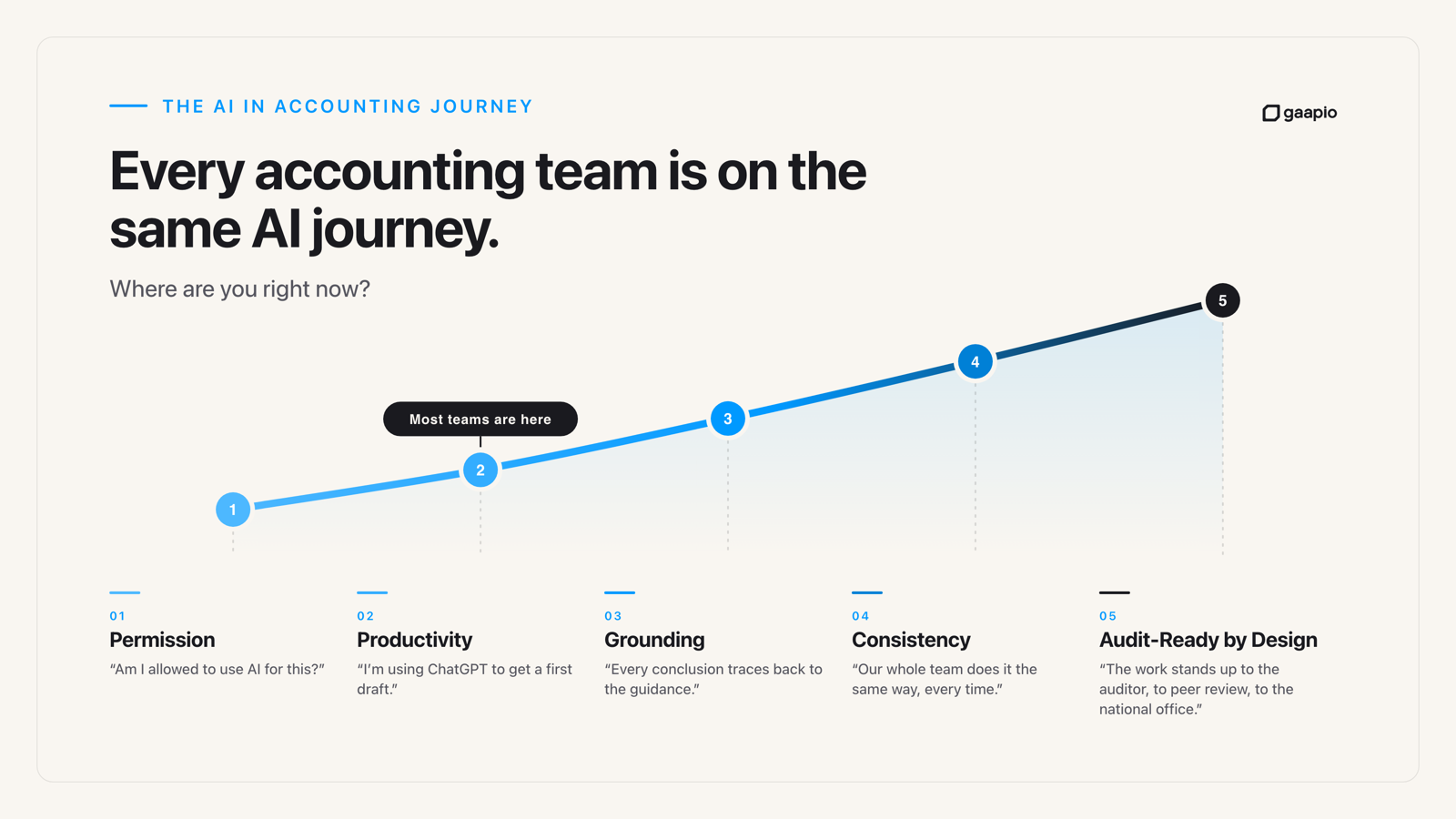
Every accounting team is on the same AI journey. Where are you?
We've been on close to 300 calls with accounting teams and CPA firms about AI. Every one of them is somewhere on the same five steps: Permission, Productivity, Grounding, Consistency, Audit-Ready by Design. What each step sounds like, and what gets a team to the next one.
Latest Articles
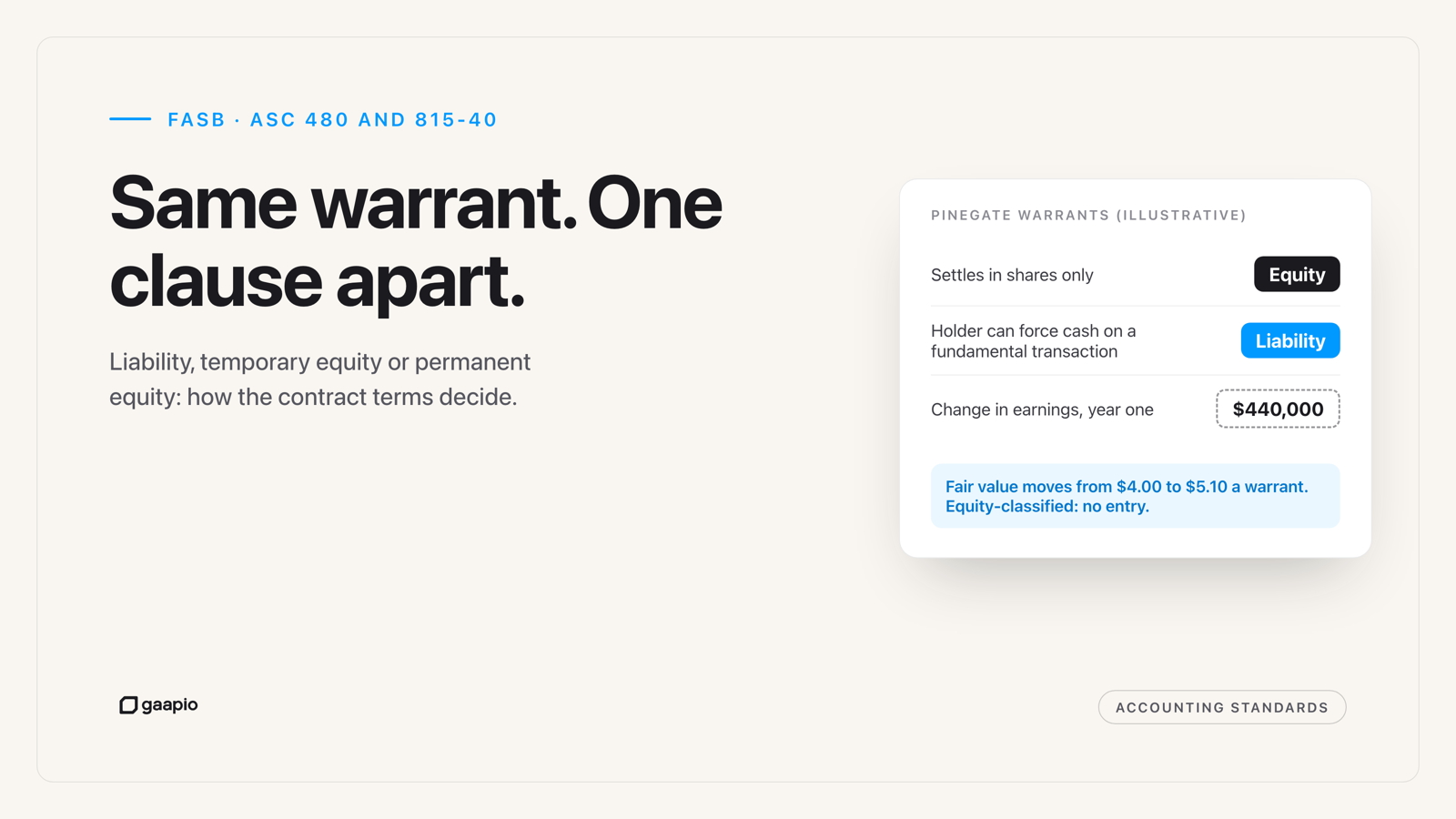
ASC 480 and Liability vs. Equity Classification in 2026: Warrants, Convertible Debt and Temporary Equity for Pre-IPO and Newly Public Companies
How to classify an instrument as a liability, temporary equity or permanent equity: ASC 480, ASC 815-40 for warrants, what ASU 2020-06 changed for convertible debt, and SEC temporary equity for redeemable preferred, with a decision-flow table and an illustrative warrant example.
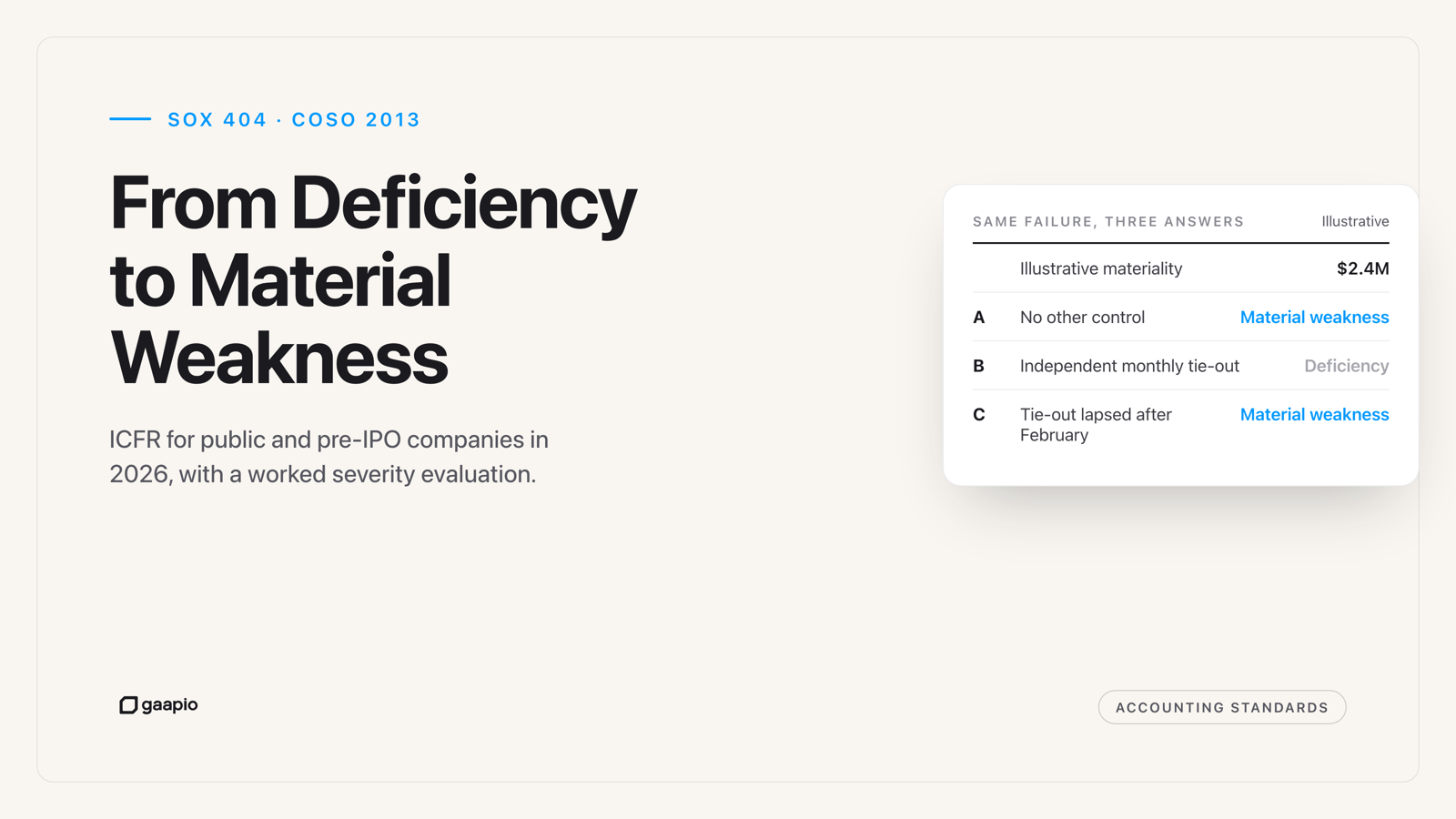
ICFR: Internal Control Over Financial Reporting for Public and Pre-IPO Companies, 2026 Guide
ICFR explained for public and pre-IPO finance teams: COSO 2013's 17 principles, entity-level vs process-level controls and ITGCs, SOX 302 and 404(a) vs the 404(b) attestation and who is exempt, deficiency vs significant deficiency vs material weakness, and a worked severity evaluation.
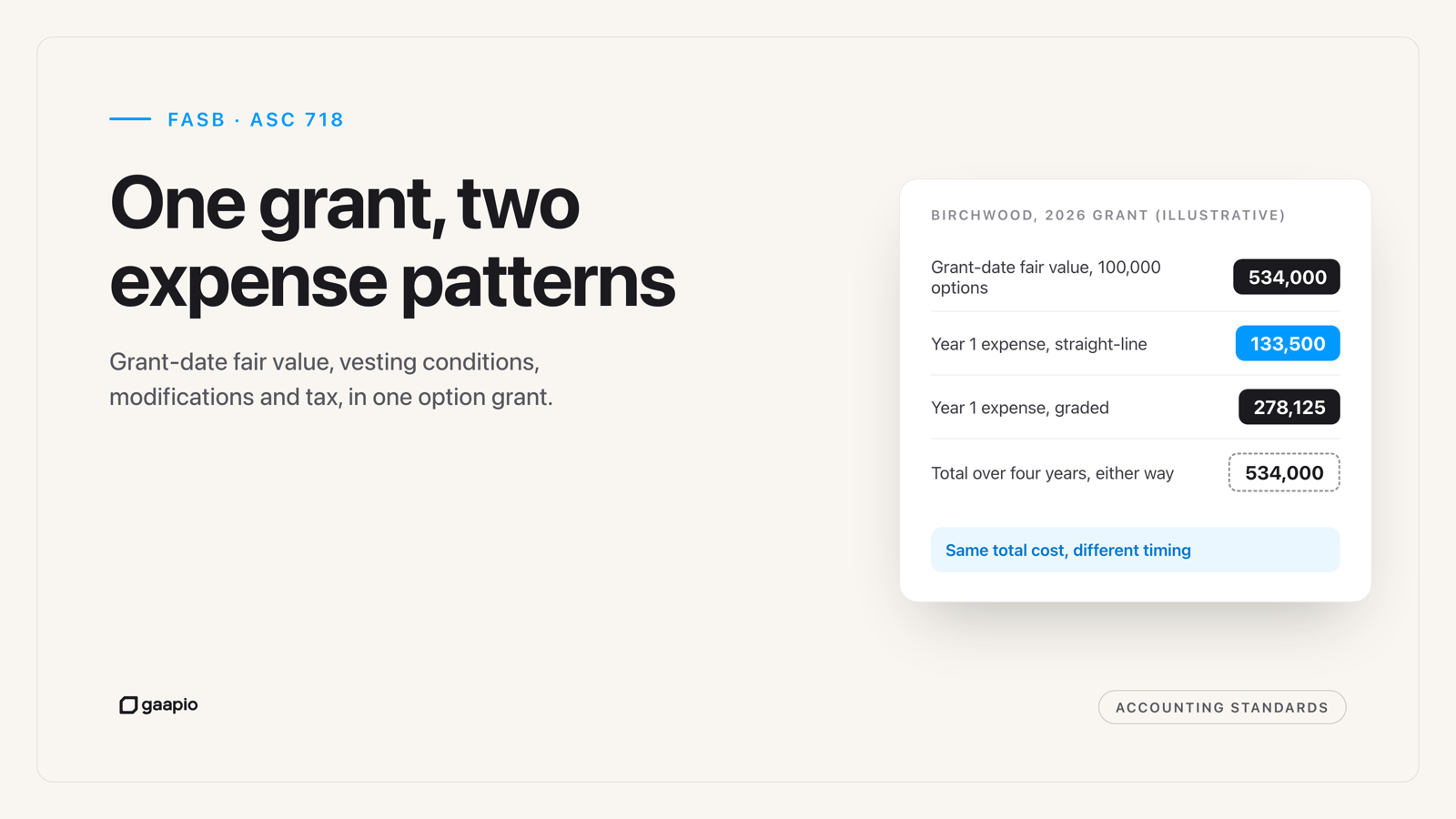
ASC 718 Stock-Based Compensation in 2026: A Practitioner's Guide to Grant-Date Fair Value, Vesting, Modifications and Tax
ASC 718 for the controller who owns equity compensation: grant-date fair value and Black-Scholes inputs, private company practical expedients, service vs performance vs market conditions, graded vs straight-line attribution, the forfeitures election, modifications (Type I to IV), liability vs equity classification and the ASC 740 tax effects, with a worked option and RSU schedule.
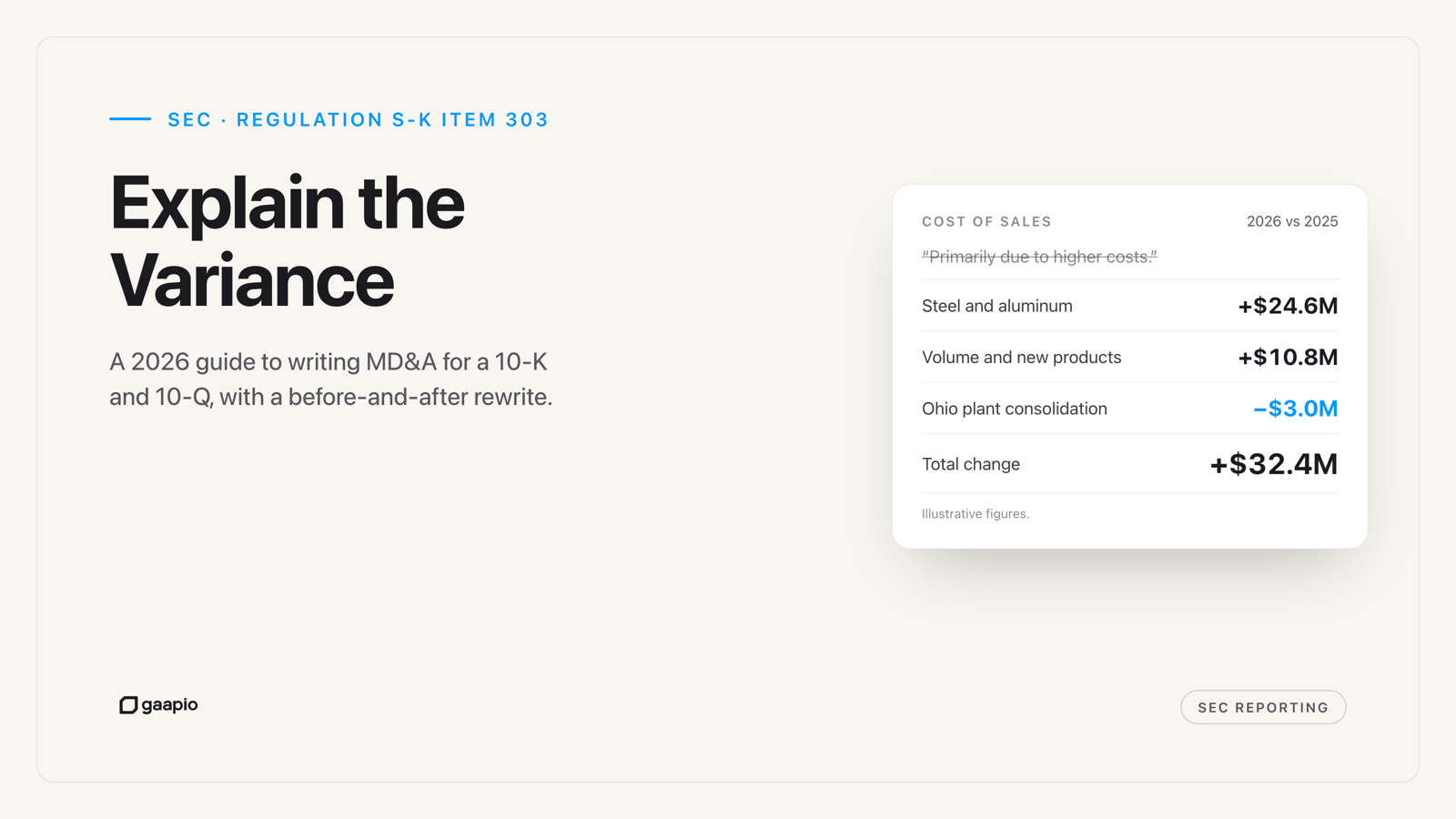
How to Write MD&A (Regulation S-K Item 303): The 2026 Guide for 10-K and 10-Q Filers
How to write MD&A under Regulation S-K Item 303 for a 10-K and 10-Q: required sections, known trends, results of operations, liquidity, critical accounting estimates, non-GAAP measures and a before-and-after rewrite.
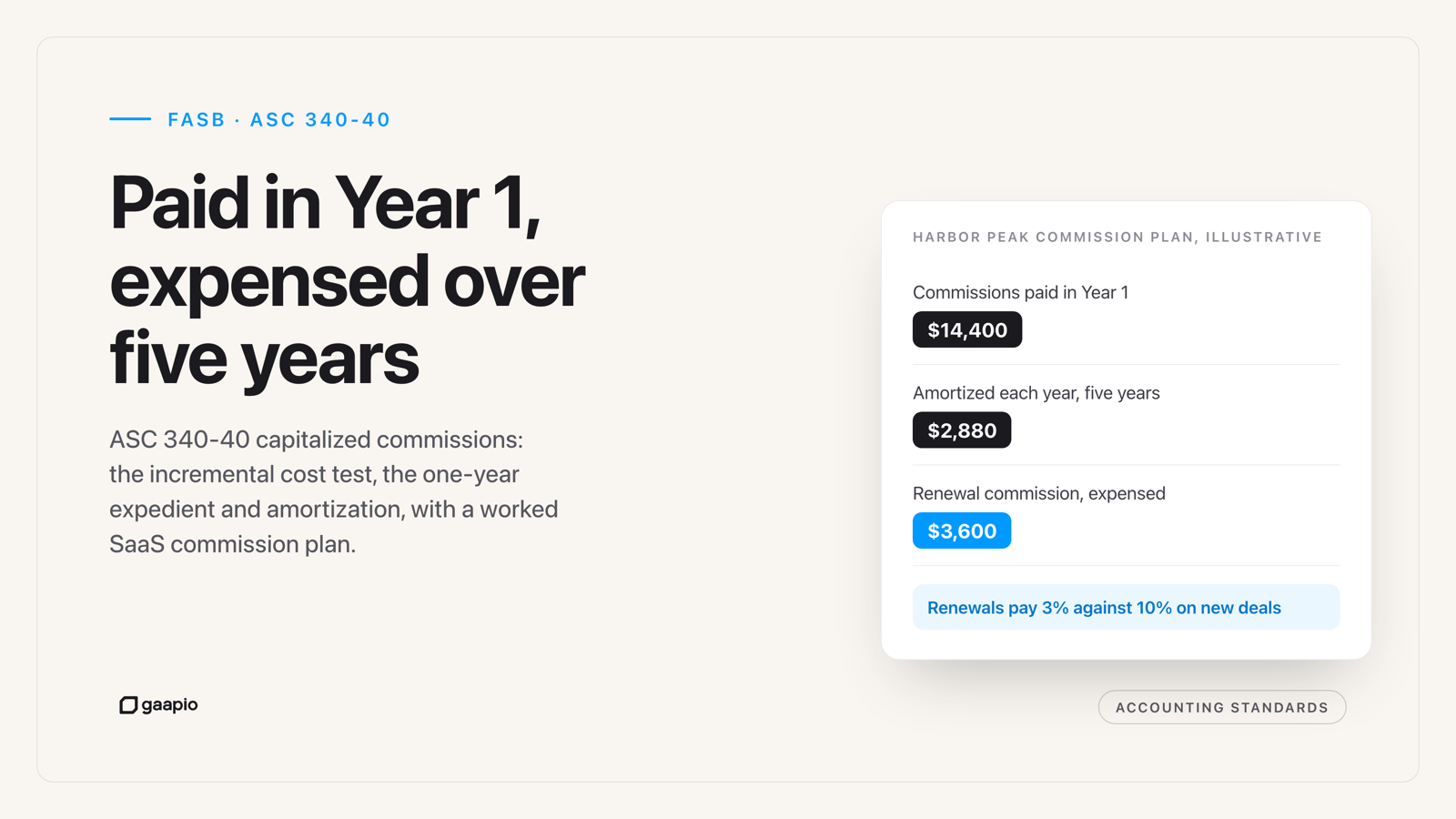
ASC 340-40 Capitalized Commissions and Contract Costs: The 2026 Guide for SaaS and Finance Teams
ASC 340-40 for finance teams: which sales commissions to capitalize, the one-year practical expedient, costs to fulfill, amortization with expected renewals, the portfolio approach, impairment, and disclosures, with a worked SaaS commission plan and amortization table.
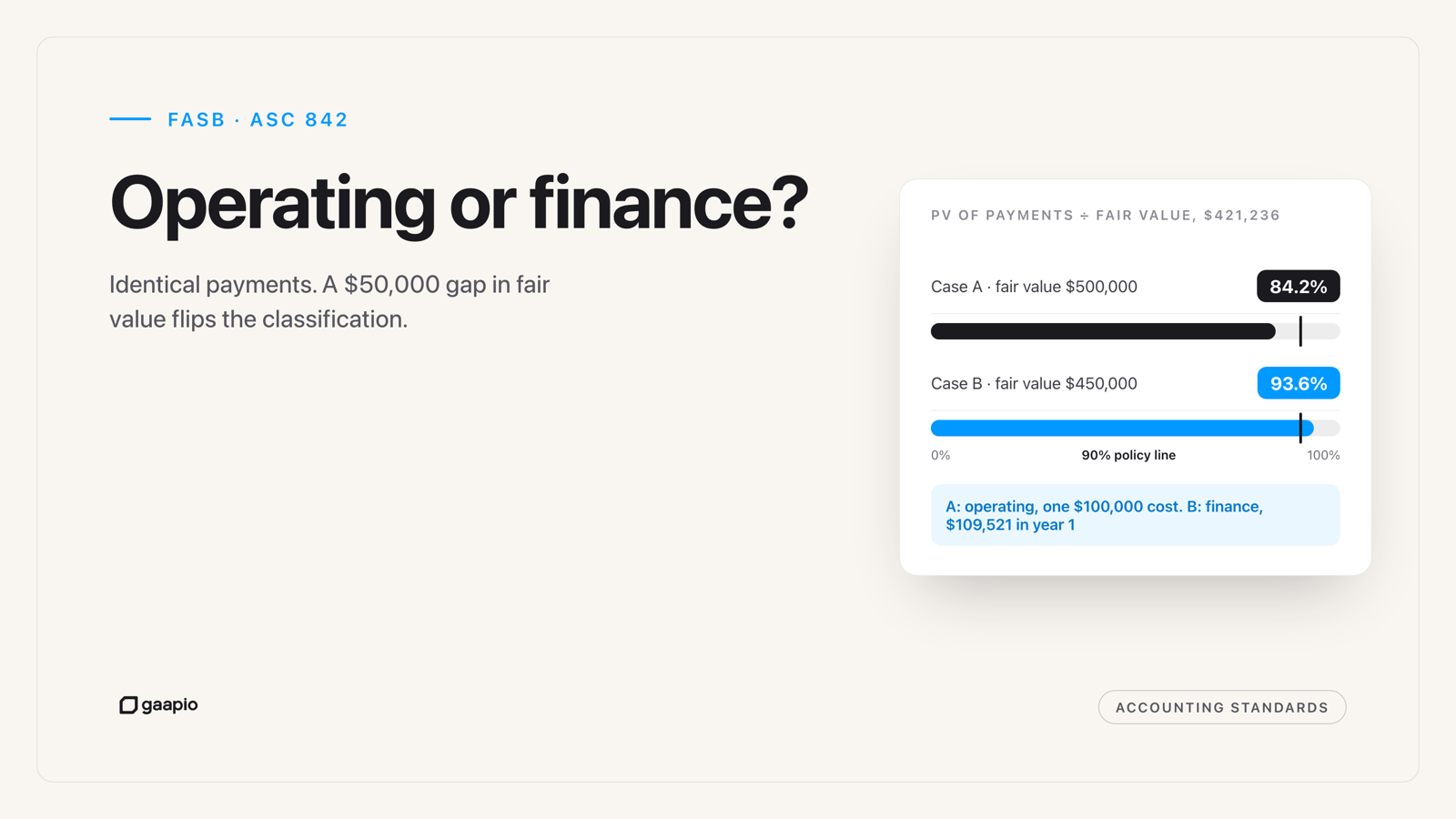
Operating vs Finance Lease Under ASC 842: 2026 Guide to Lessee Classification
How a lessee classifies a lease as operating or finance under ASC 842: the five criteria in 842-10-25-2, the 75% and 90% policy thresholds, expense, balance sheet and cash flow differences, short-term leases, the missing low-value exemption, IFRS 16, and a worked five-year example classified both ways.
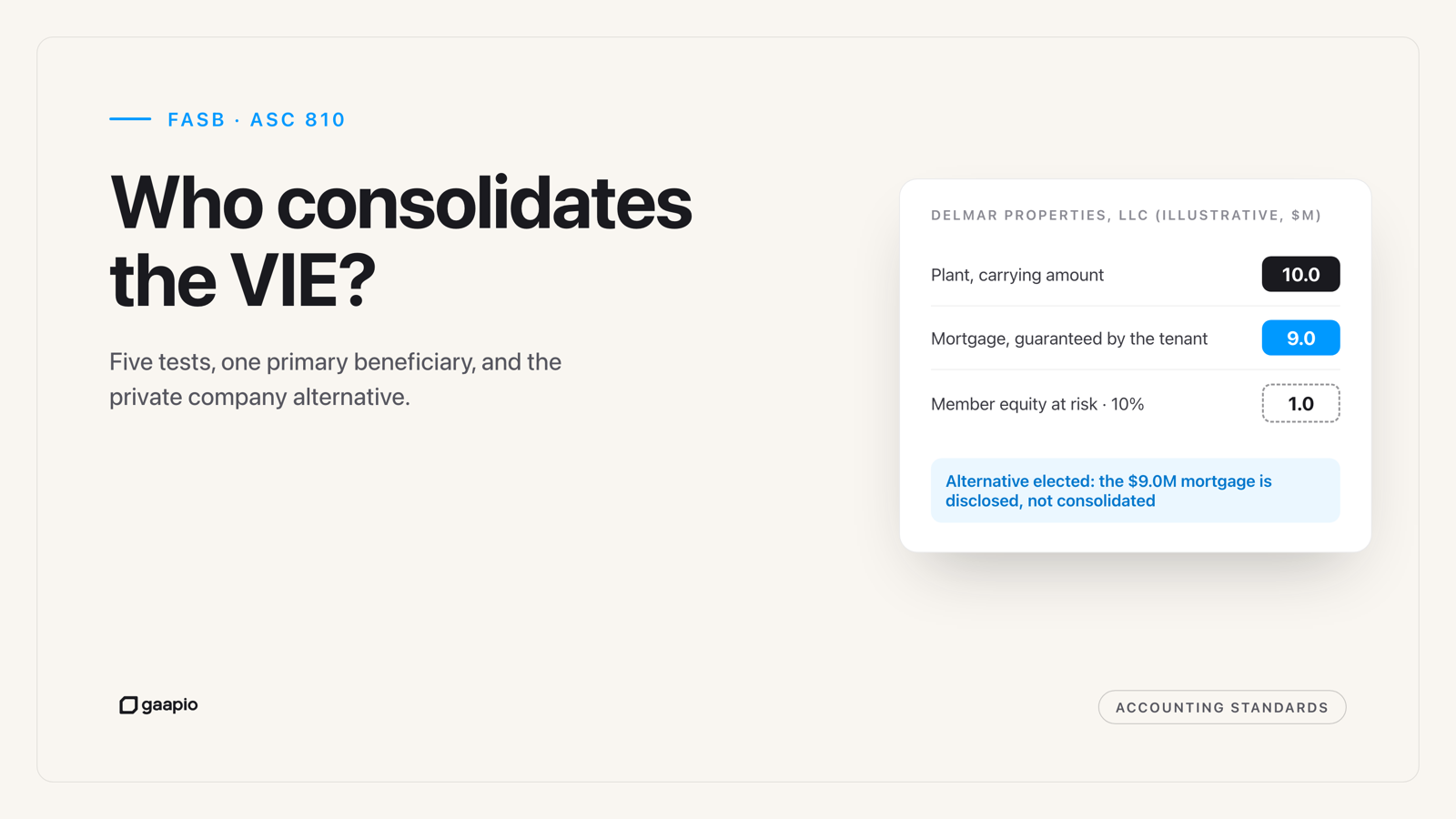
Variable Interest Entity (VIE) Under ASC 810: The 2026 Guide to Consolidation, Primary Beneficiary and the Private Company Alternative
How to decide whether a legal entity is a variable interest entity under ASC 810, who consolidates it, how the voting interest model differs, what ASU 2018-17 gives private companies, and what to disclose, with a worked related-party leasing example.
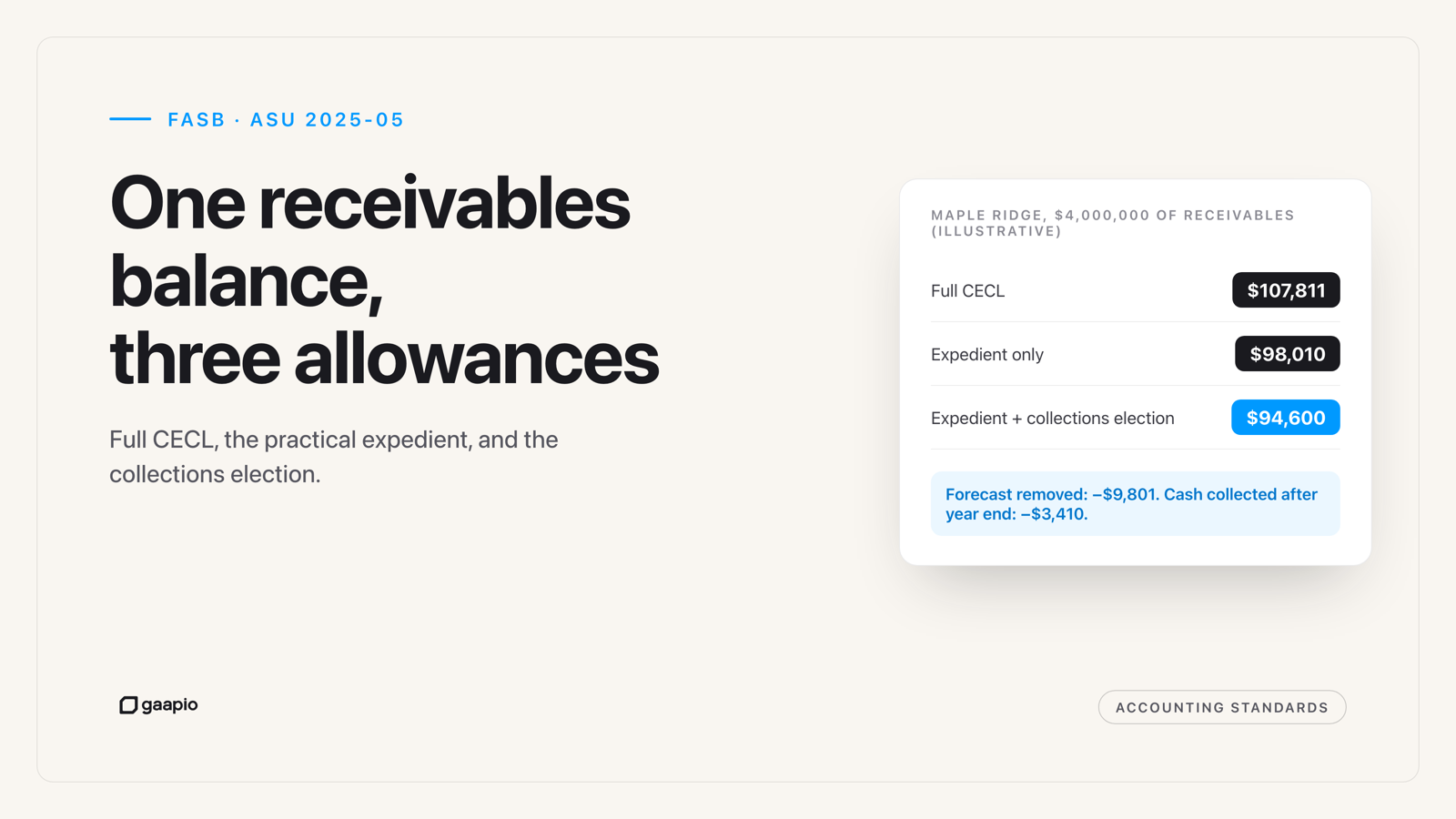
ASU 2025-05 and CECL for Receivables in 2026: The Practical Expedient, the Collections Election and a Worked Aging Model
What CECL requires for trade receivables, what ASU 2025-05 changes, who can elect the practical expedient and the collections policy, the effective date and transition, and a worked aging-based allowance calculated three ways.
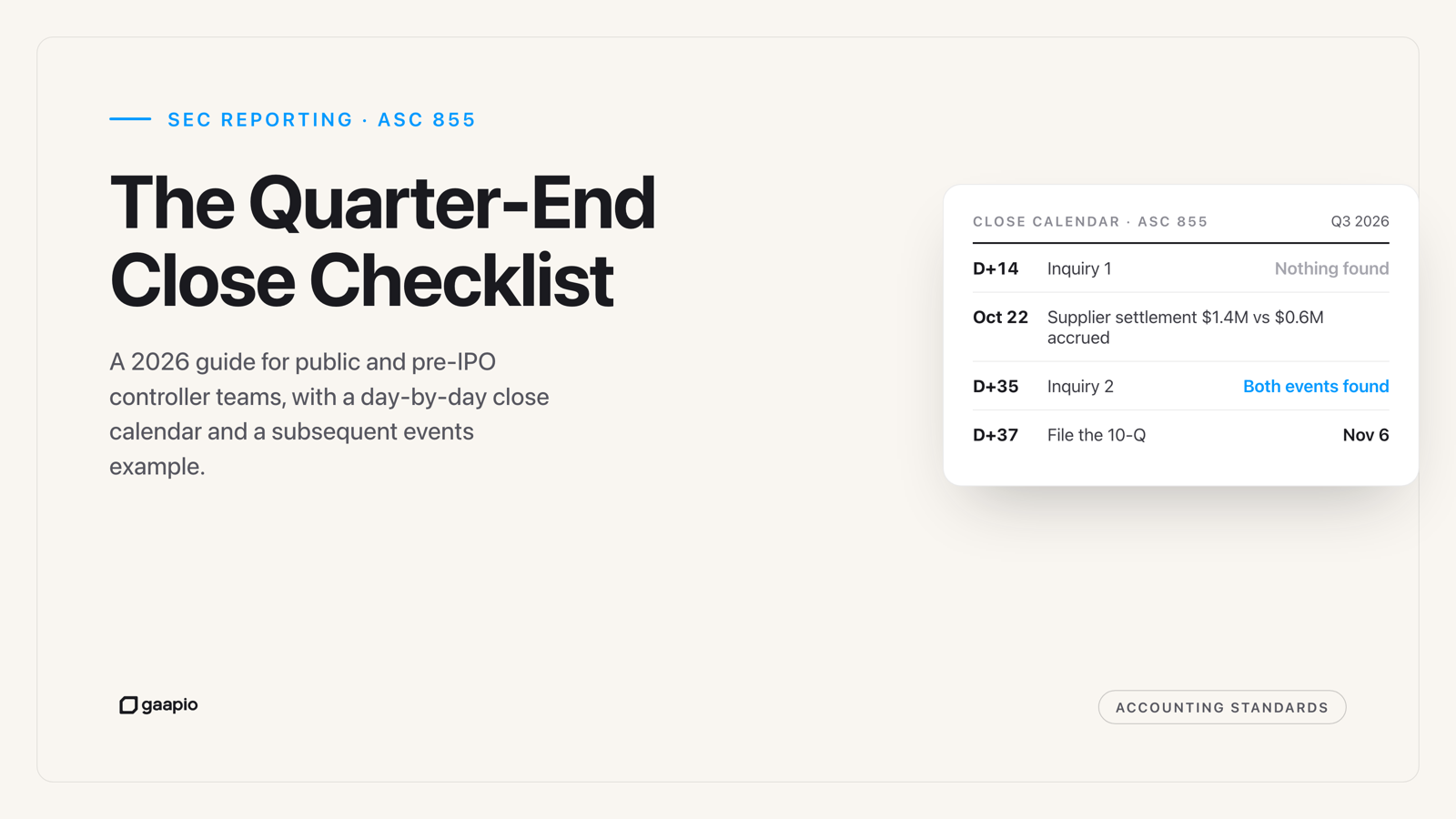
Month-End and Quarter-End Close Checklist for Public and Pre-IPO Companies: 2026 Guide
A close checklist for public and pre-IPO controller teams, with the steps generic checklists skip: cutoff, reconciliations, flux analysis, reserve memos, ASC 855 subsequent events, the disclosure checklist, SOX evidence and 10-Q tie-out, plus a day-by-day calendar and worked example.
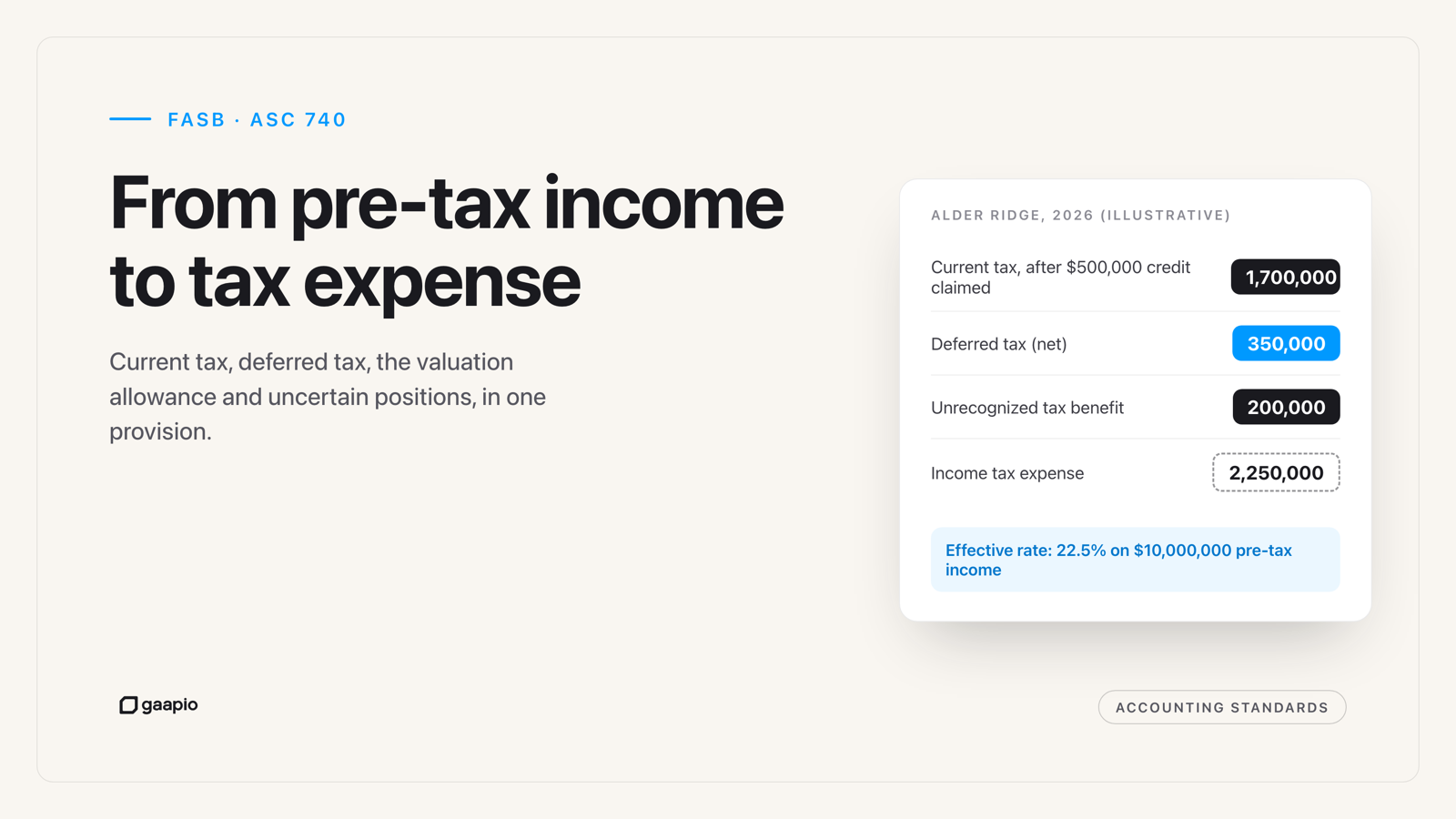
ASC 740 Income Tax Provision in 2026: A Controller's Guide to Current and Deferred Tax, Valuation Allowances and Uncertain Positions
ASC 740 for the controller who owns the provision: current vs deferred tax, temporary differences, valuation allowances, uncertain tax positions, the interim effective tax rate, the 2025 U.S. tax law changes and ASU 2023-09, with a worked provision and deferred tax rollforward.
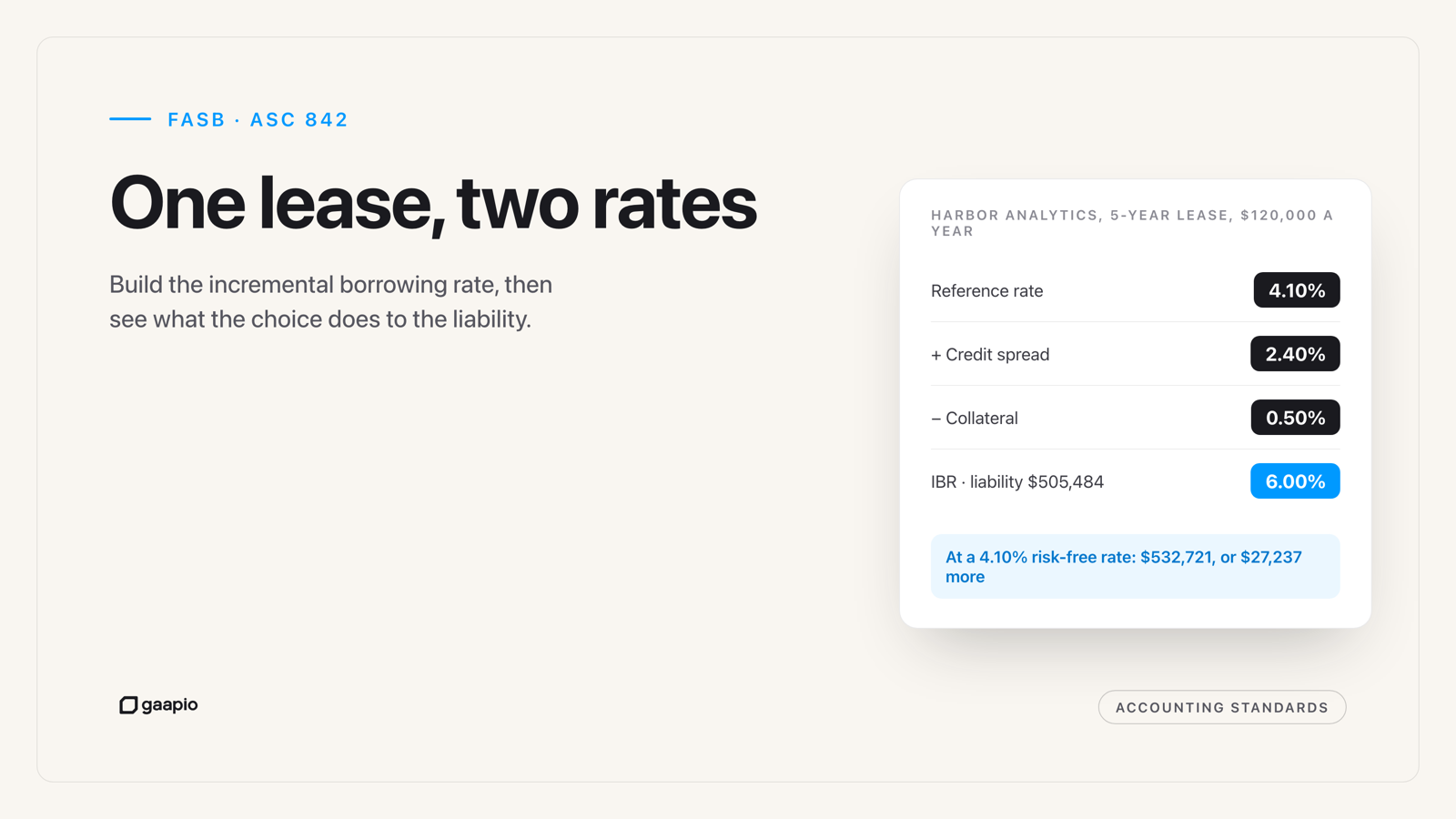
ASC 842 Discount Rate in 2026: Incremental Borrowing Rate, Risk-Free Election and the Rate Implicit in the Lease
How a lessee picks the ASC 842 discount rate: the rate implicit in the lease vs the incremental borrowing rate, how to build an IBR, the risk-free election for non-public entities and ASU 2021-09, the portfolio approach, when to update, what auditors test, and a worked five-year example at two rates.
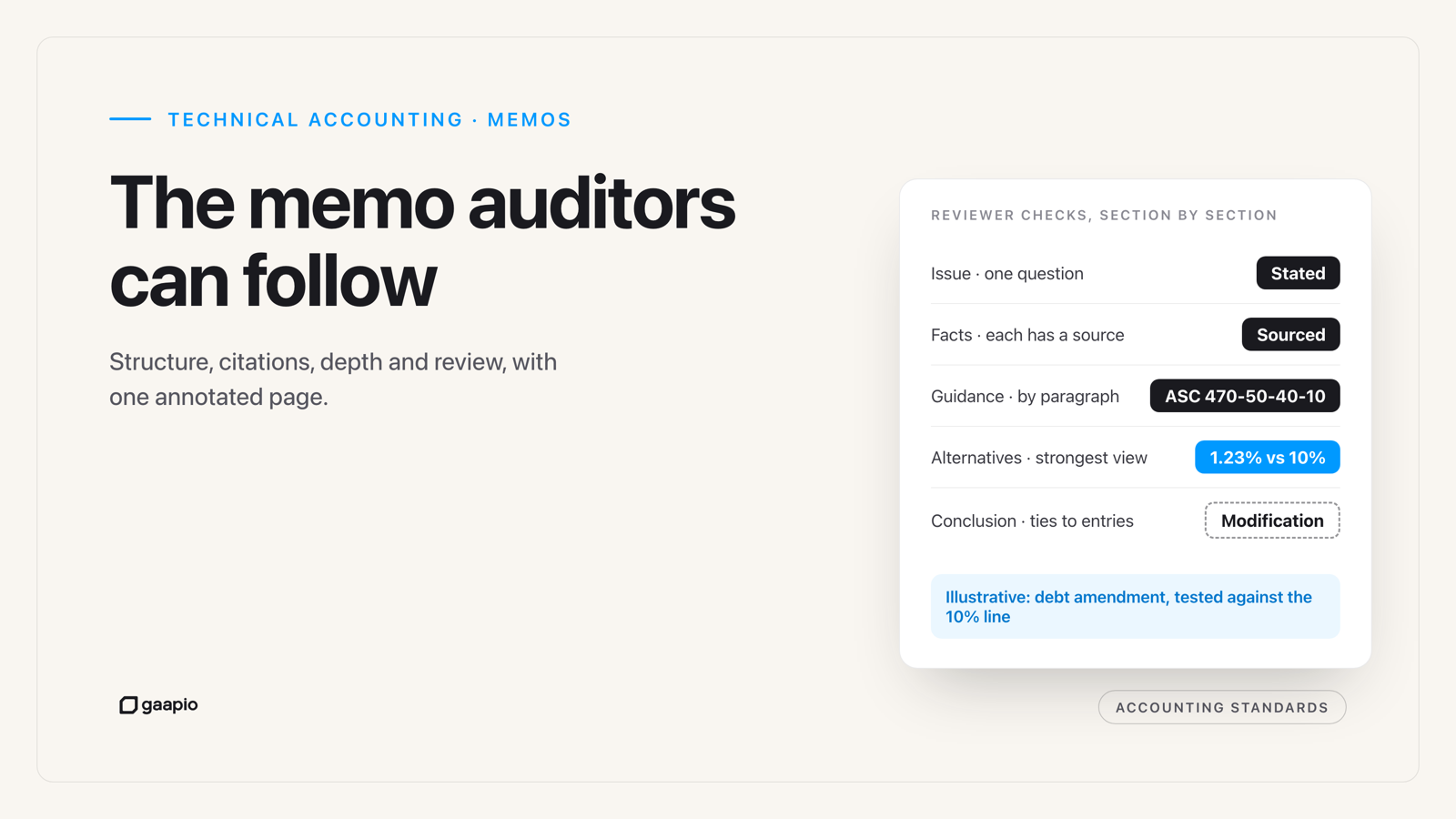
How to Write a Technical Accounting Memo: The 2026 Guide to Structure, Citations and Review
What auditors expect in a technical accounting memo: structure, how to cite the Codification and Big 4 guides, how much depth materiality calls for, common review findings, and how AI changes drafting. Includes an annotated one-page example.
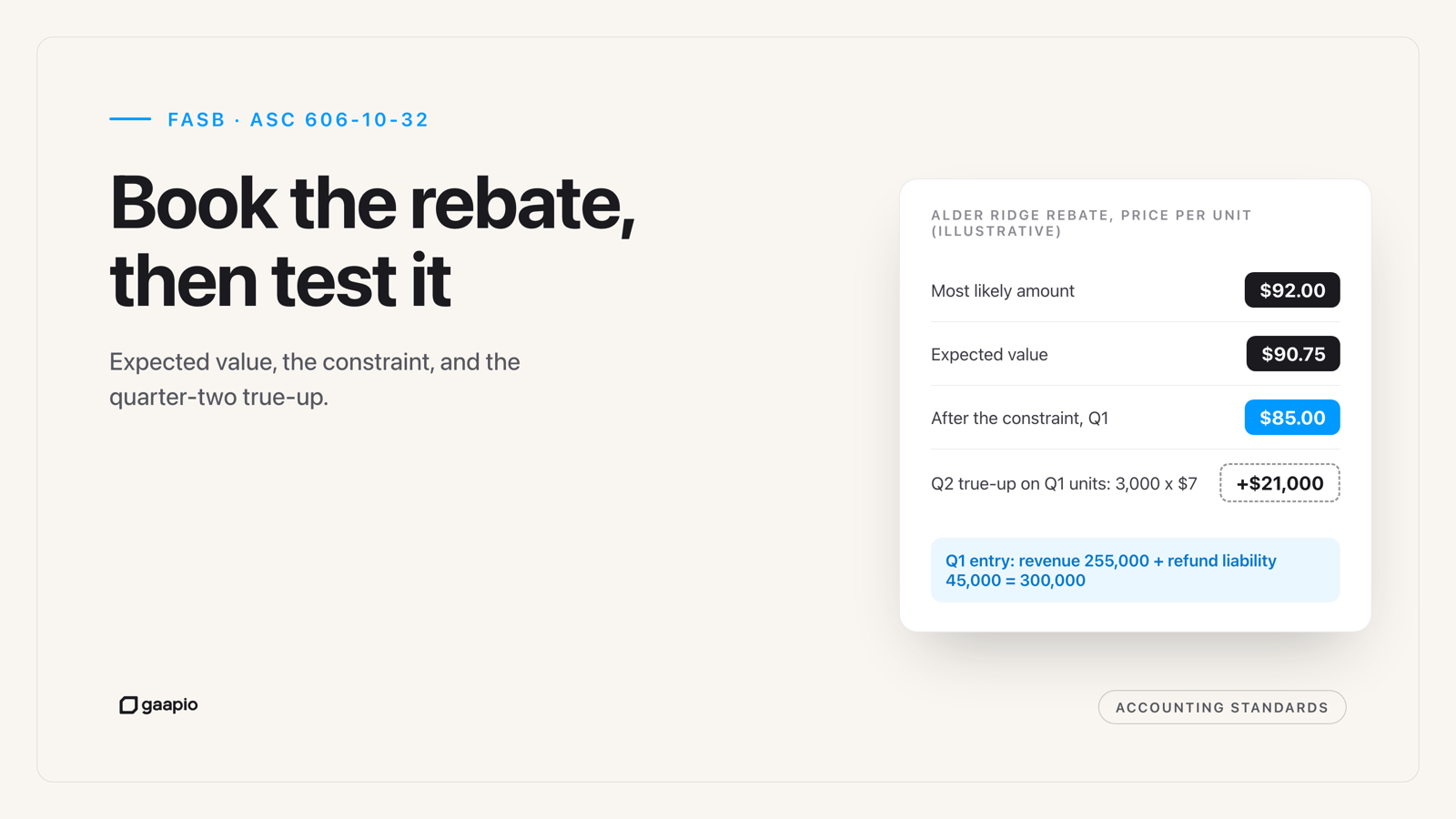
ASC 606 Variable Consideration: The 2026 Guide to Estimating, the Constraint and Reassessment
Variable consideration is the part of the ASC 606 price that can change. A 2026 guide to the forms, expected value vs most likely amount, the constraint in 606-10-32-11 and 32-12, reassessment, the royalty exception, disclosures, and a worked volume-rebate example.
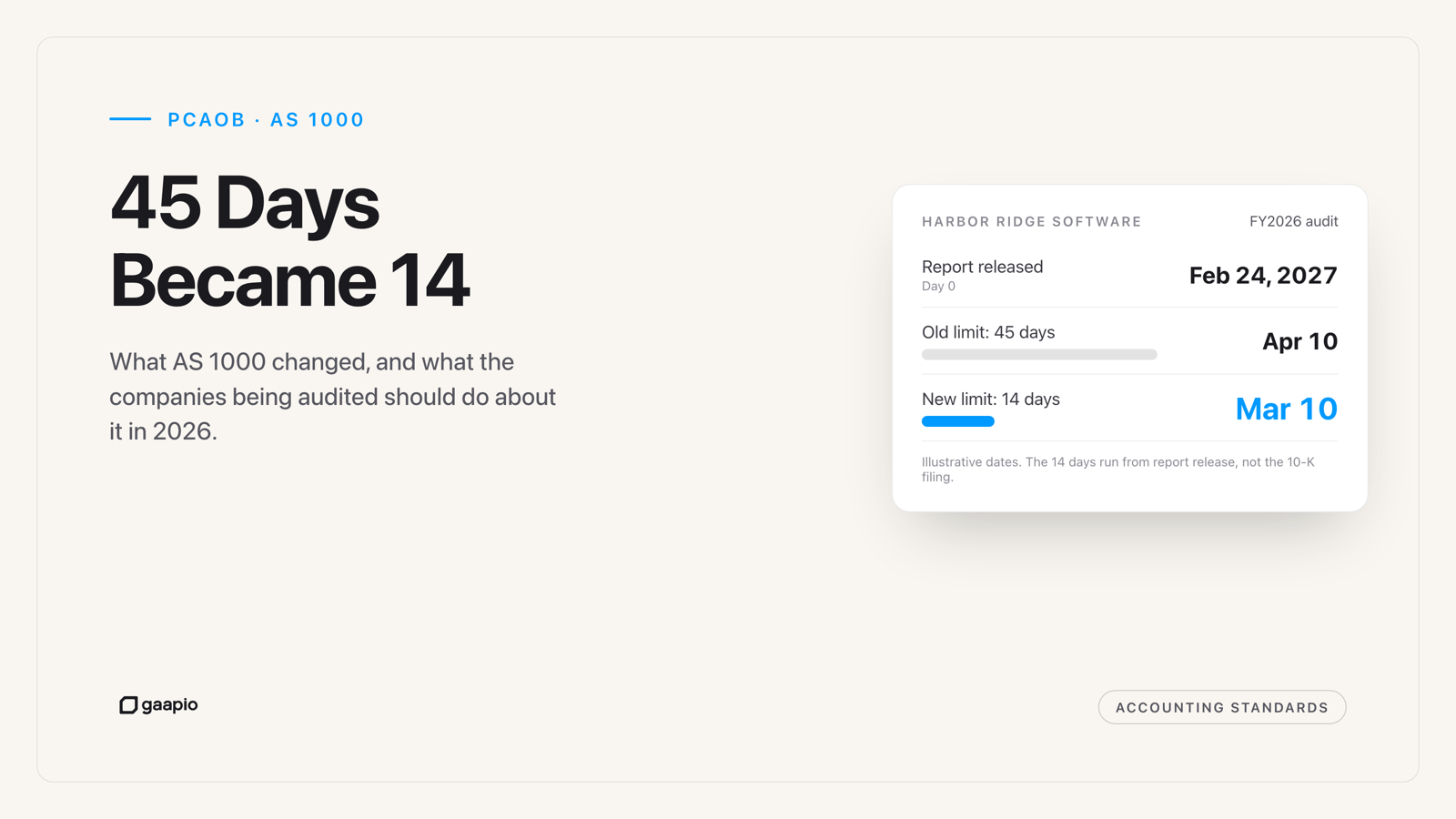
PCAOB AS 1000 in 2026: Auditor Responsibilities, the 14-Day Documentation Rule and What Changes for Your Close
AS 1000 consolidated four PCAOB interim standards into one and cut the audit documentation completion window from 45 days to 14. A 2026 guide to the effective dates, the key changes, and what the companies being audited should do about PBC timing, documentation requests and technical accounting memos, with a worked year-end timeline.
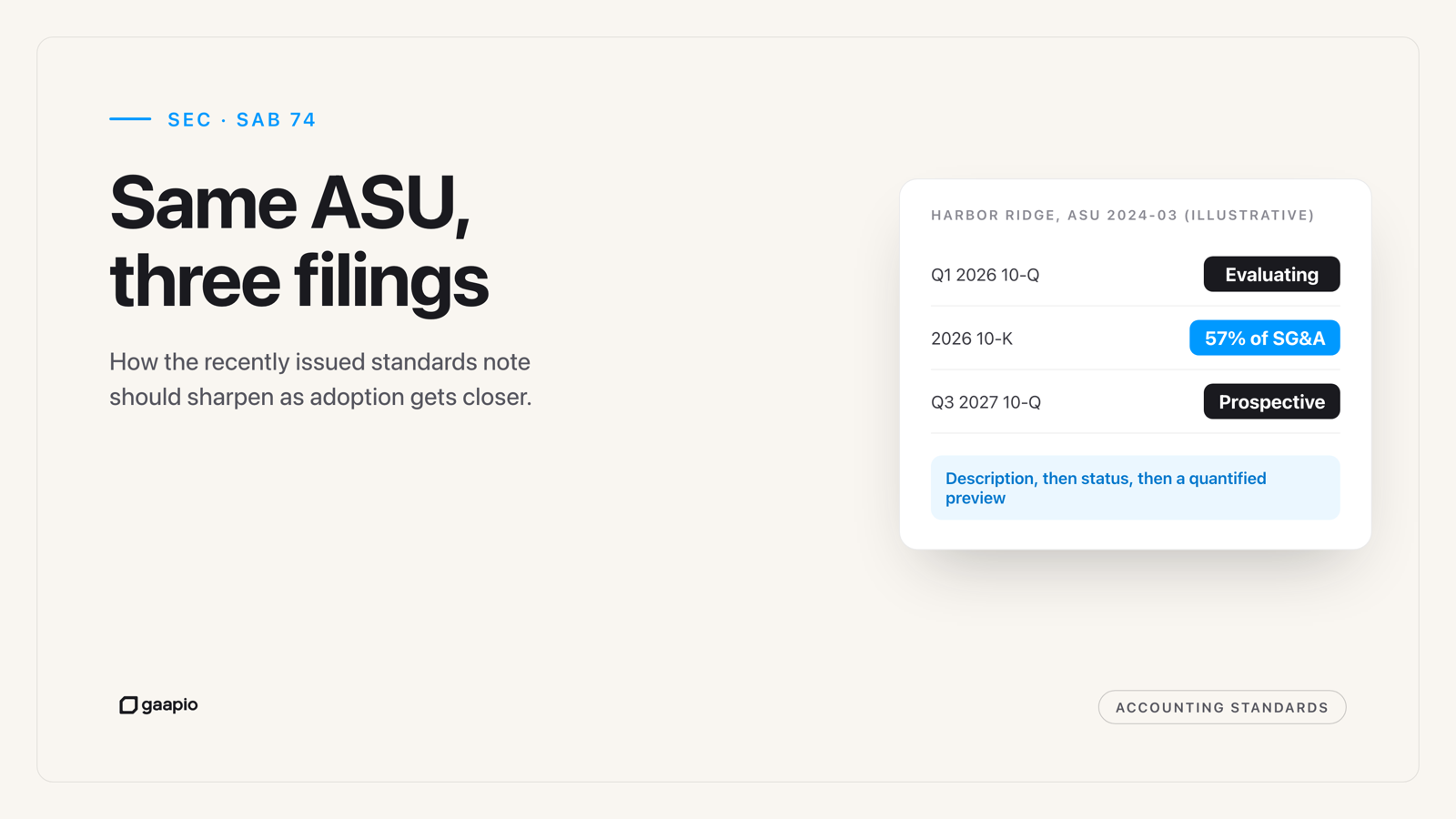
SAB 74 Disclosures: The 2026 Guide to Reporting Accounting Standards You Haven't Adopted Yet
SAB 74 (SAB Topic 11.M) says SEC registrants should disclose the expected impact of accounting standards issued but not yet adopted. A 2026 table of the ASUs to disclose now, what each filing should say as adoption nears, and sample language.
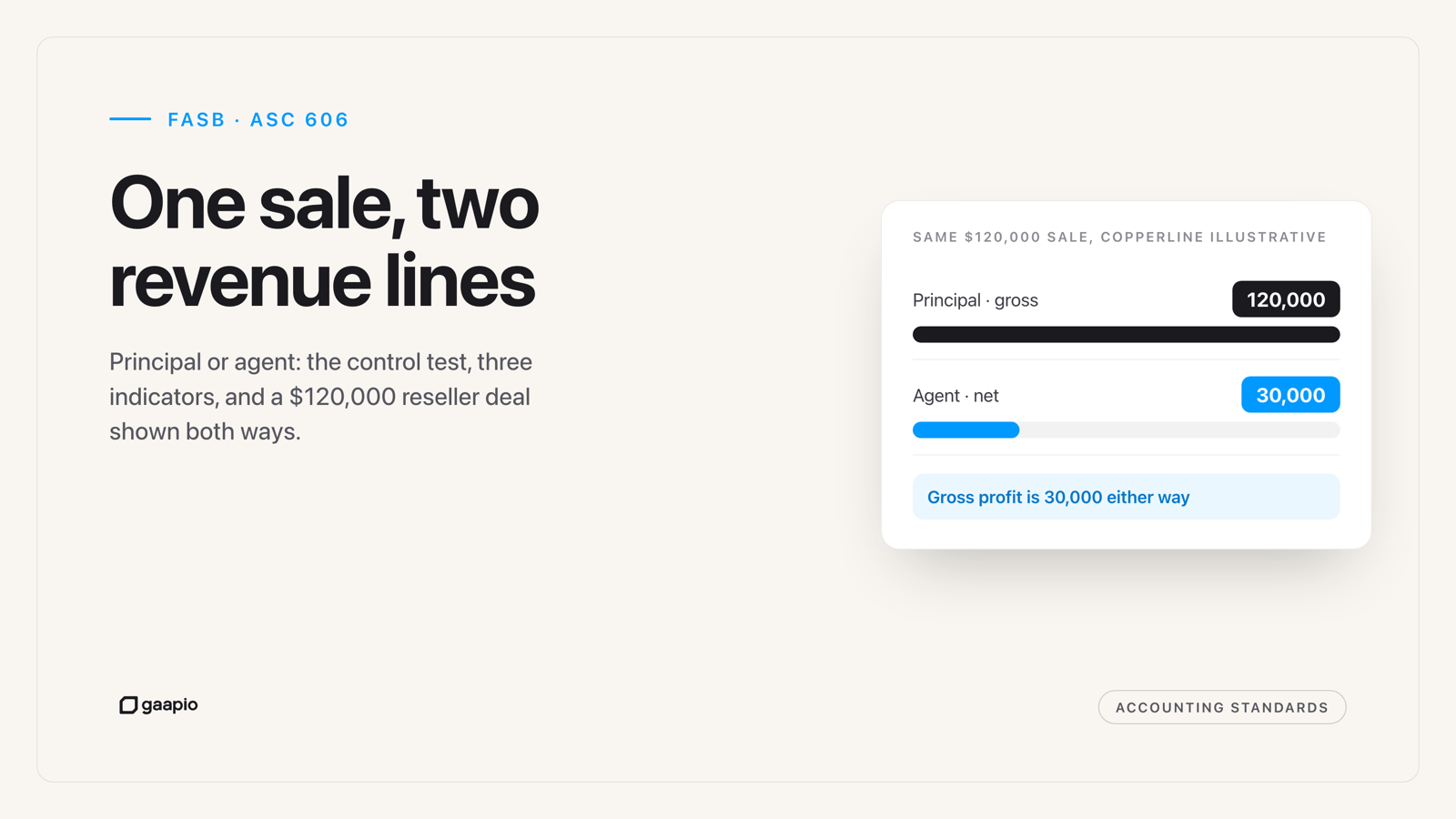
Principal vs. Agent Under ASC 606: The 2026 Guide to Gross vs. Net Revenue
Principal or agent decides whether revenue is gross or net. A 2026 guide to the specified good or service, the ASC 606 control test, the three indicators in 55-39, marketplaces, SaaS resellers, travel, ad tech and shipping, SEC comment letters, and a worked reseller example.
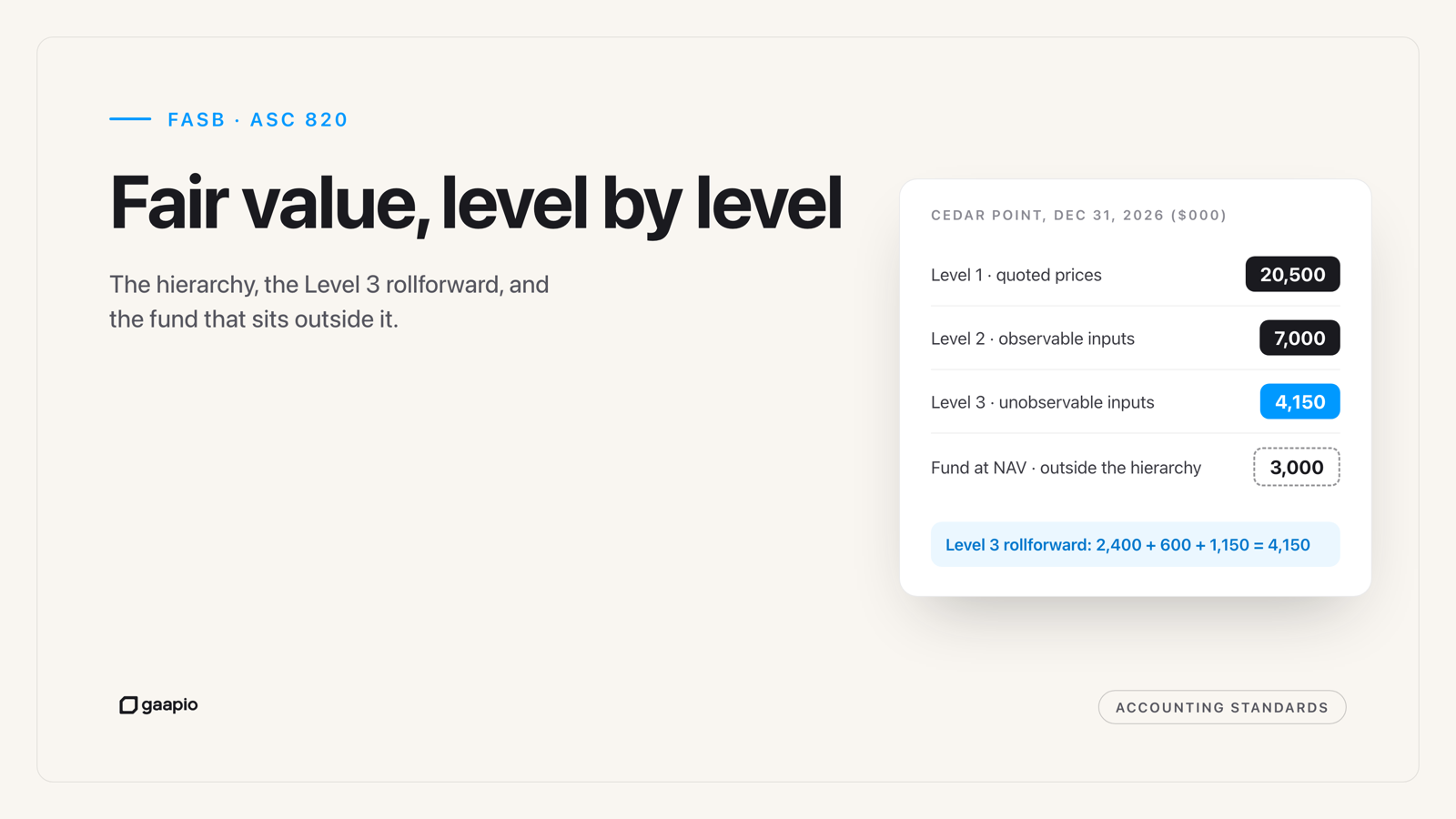
ASC 820 Fair Value Measurement and Disclosures: The 2026 Guide to Levels, Level 3 Rollforwards and NAV
ASC 820 defines fair value as an exit price and ranks inputs in three levels. A 2026 guide to disclosures by level, the Level 3 rollforward and inputs, the NAV practical expedient (820-10-50-6A), recurring vs nonrecurring, private company relief, and a worked example.
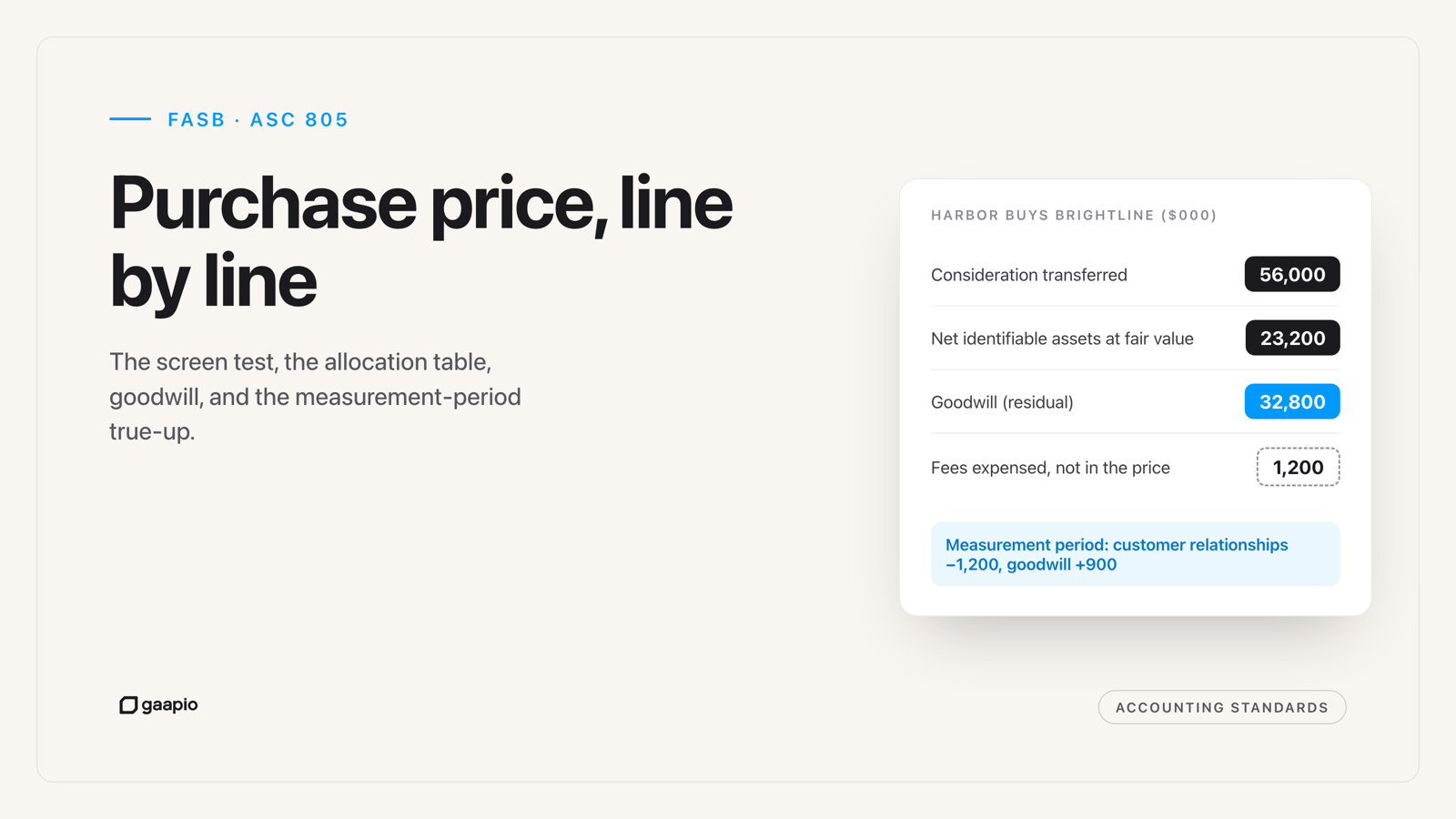
ASC 805 Purchase Price Allocation: The 2026 Guide to Business Combinations, Intangibles and Goodwill
ASC 805 purchase price allocation, step by step: the screen test, business combination vs asset acquisition, identifying and valuing intangibles, goodwill and bargain purchases, the measurement period, ASU 2021-08 contract balances, disclosures, and a worked example.
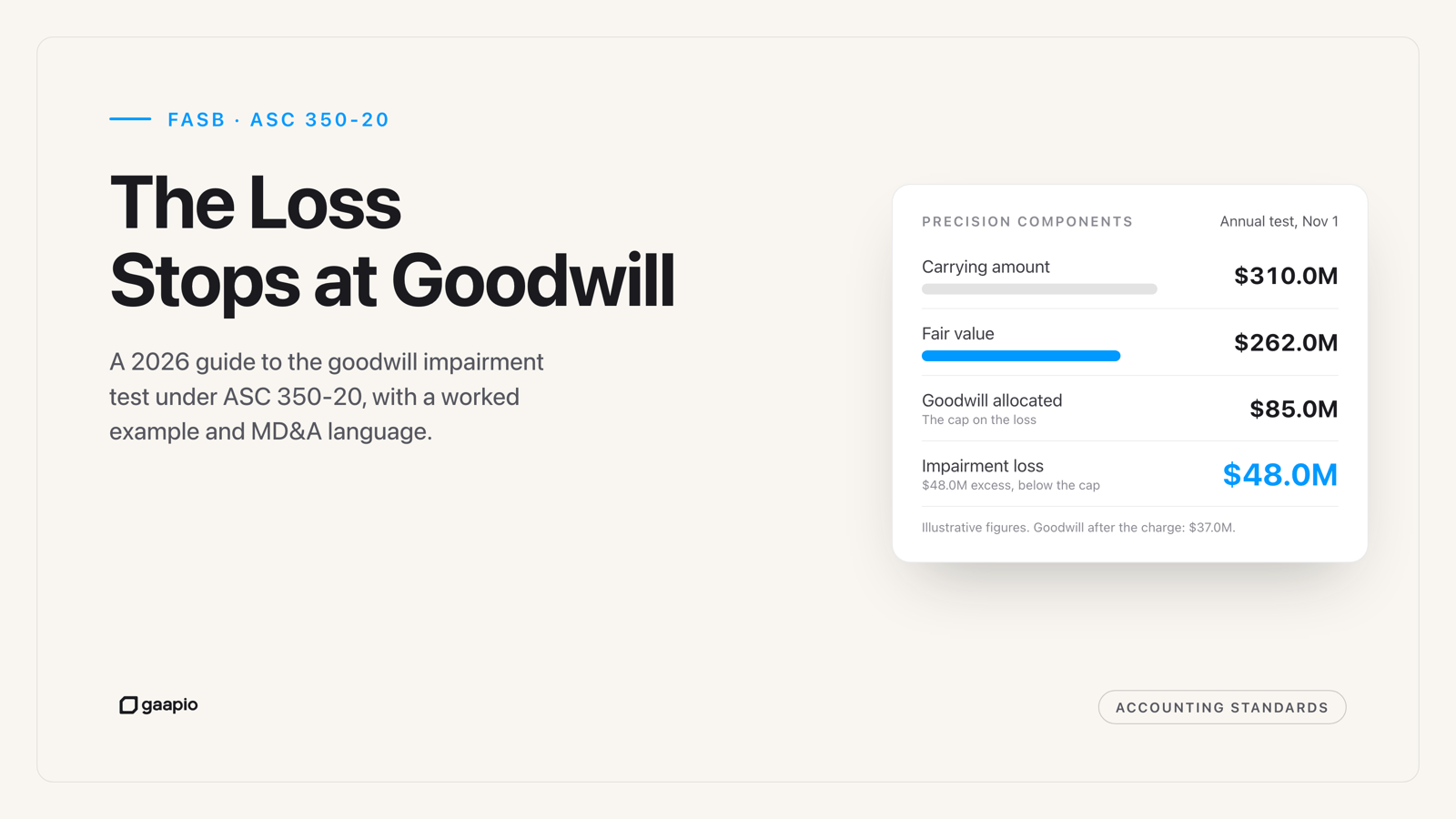
Goodwill Impairment Test Under ASC 350-20: The 2026 Guide, With a Worked Example and MD&A Language
How the goodwill impairment test works under ASC 350-20 after ASU 2017-04: the qualitative assessment, reporting units, triggering events, the private company alternative, and what the SEC expects in MD&A. Includes a worked example with the journal entry and a sample critical accounting estimate paragraph that discloses headroom.
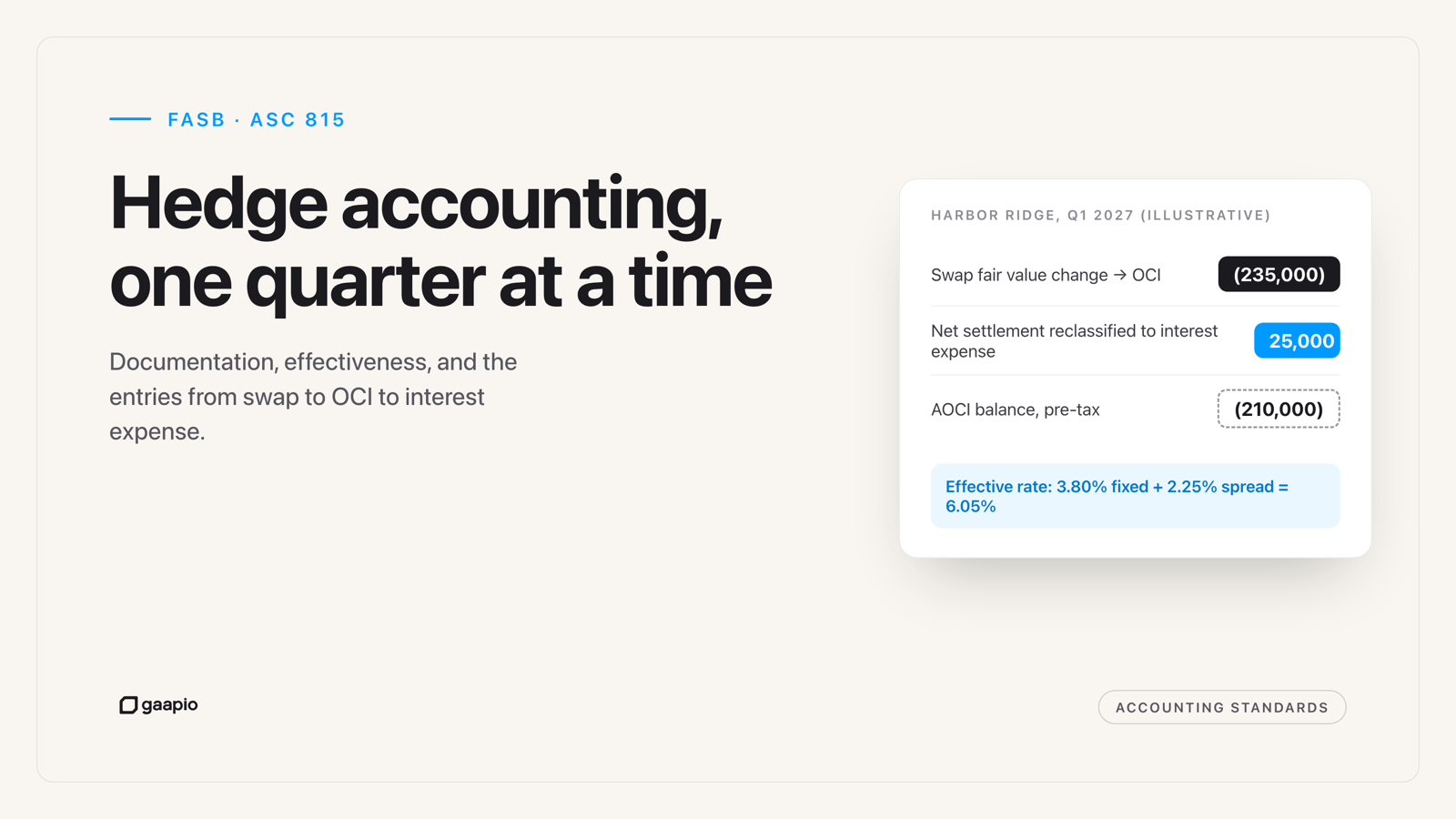
ASC 815 Hedge Accounting in 2026: A Controller's Guide to Qualifying, Documenting and Testing a Swap
ASC 815 hedge accounting for a controller who just entered an interest rate swap: what qualifies, fair value vs cash flow vs net investment hedges, designation documentation, effectiveness methods, ASU 2017-12, ASU 2022-01, ASU 2025-09, and a worked cash flow hedge with one quarter of entries.
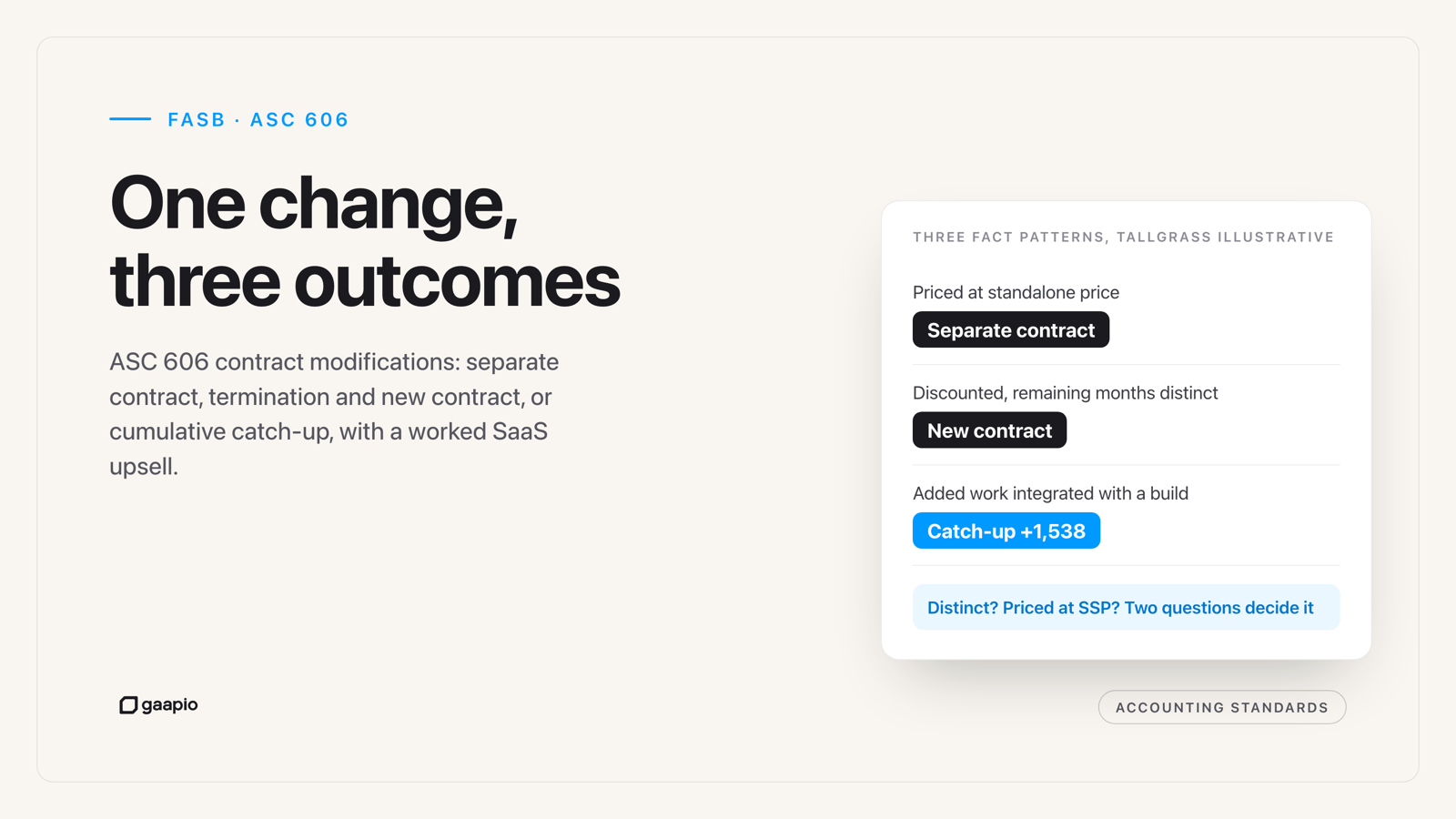
Contract Modifications Under ASC 606: The 2026 Guide to Separate Contracts, Catch-Ups and Change Orders
When is a change a contract modification under ASC 606-10-25-10, and how do you account for it? A 2026 guide to the three outcomes in 25-12 and 25-13 (separate contract, termination and new contract, cumulative catch-up), unpriced change orders, claims, the transition expedient, and a worked SaaS upsell with journal entries.
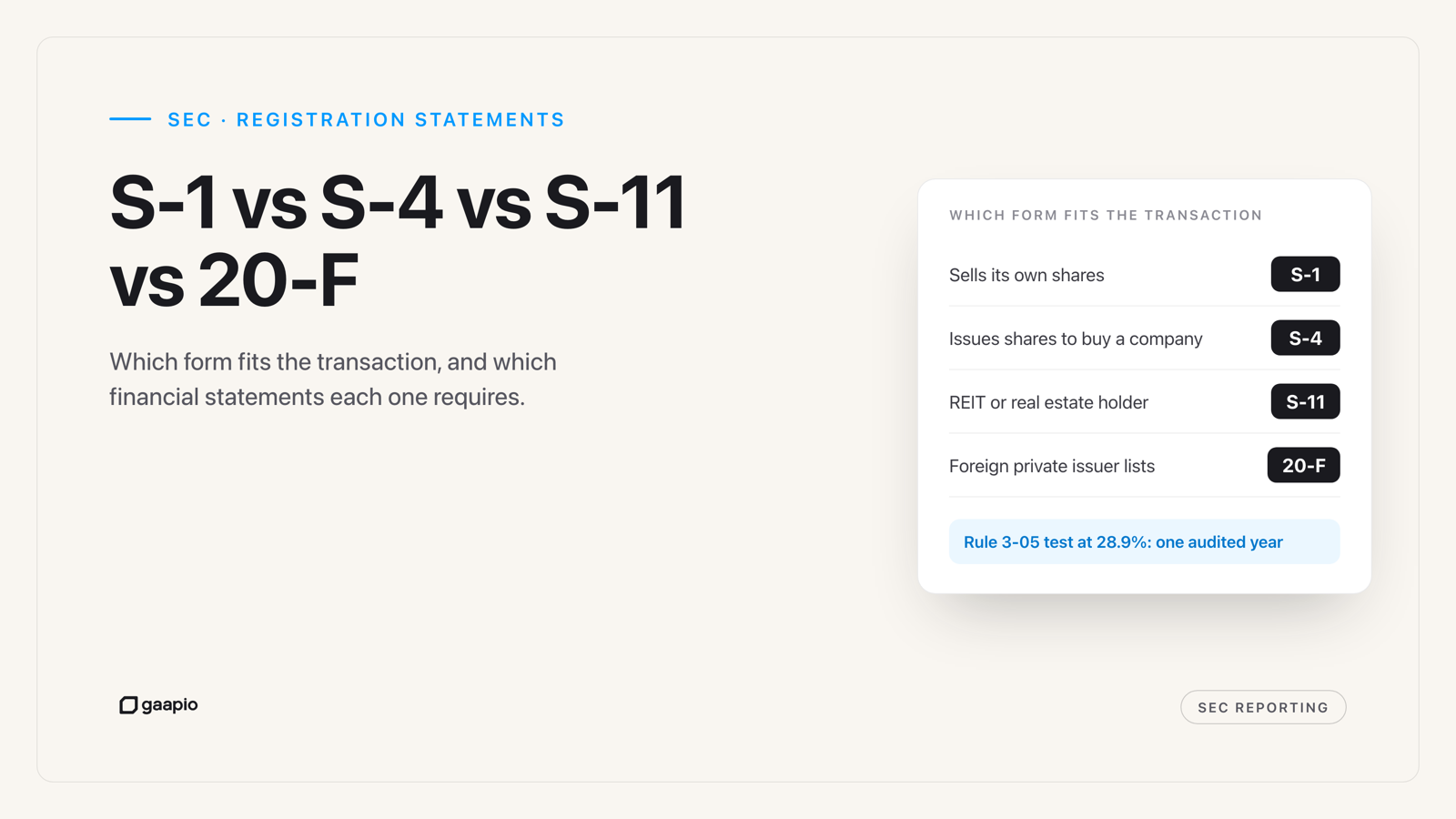
Form S-1 vs S-4 vs S-11 vs 20-F: The 2026 Guide to SEC Registration Statements
Which SEC registration statement fits your transaction: Form S-1, S-4, S-11, S-3 or 20-F, with confidential draft submissions, Regulation S-X financial statement requirements, and a worked S-1 example.
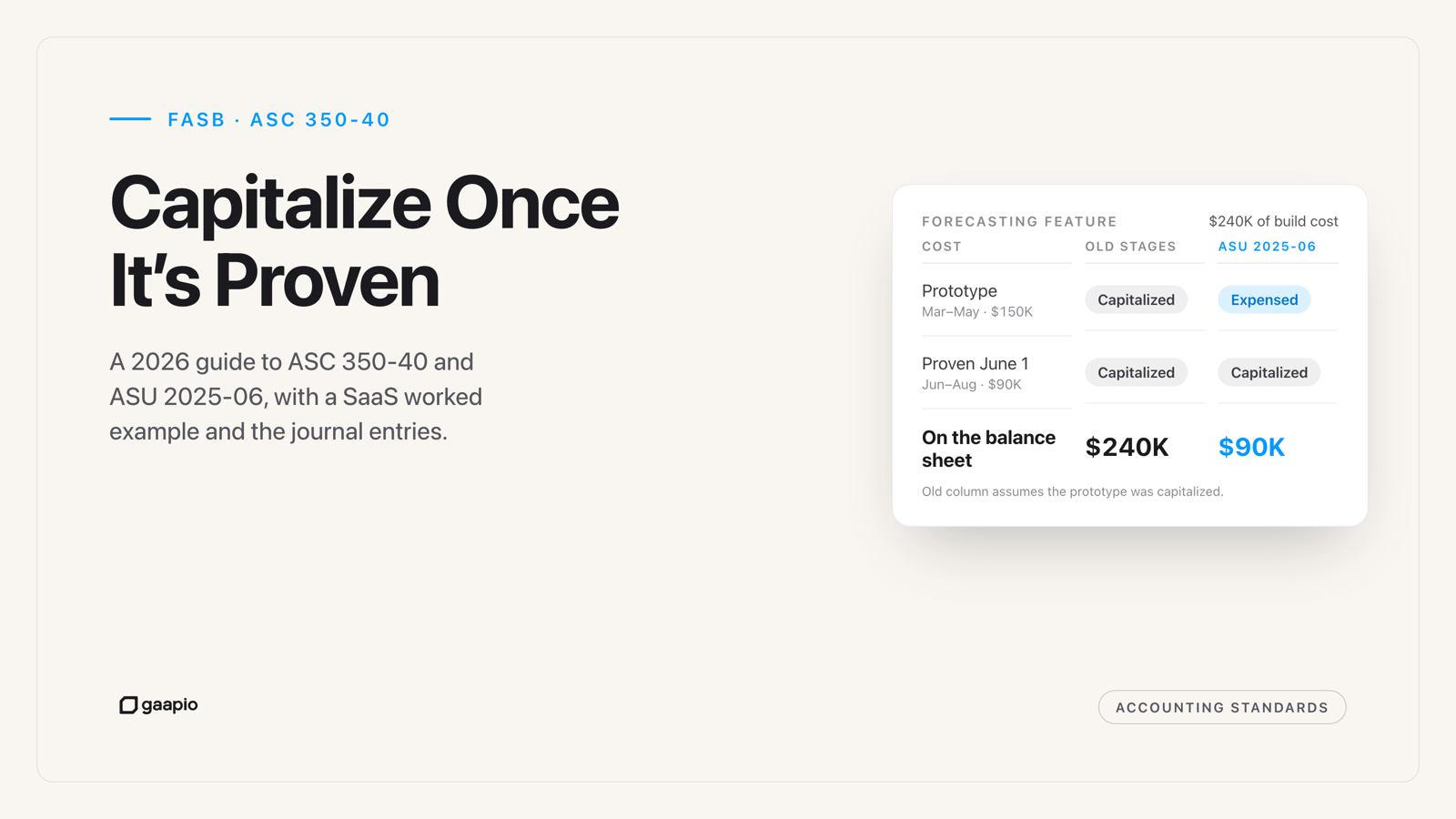
ASC 350-40 Internal-Use Software Capitalization: The 2026 Guide, Including ASU 2025-06
ASC 350-40 says which software costs to capitalize. ASU 2025-06 removes the project stages. A 2026 guide with a before and after table, effective dates, and a SaaS worked example with journal entries and the amortization start.
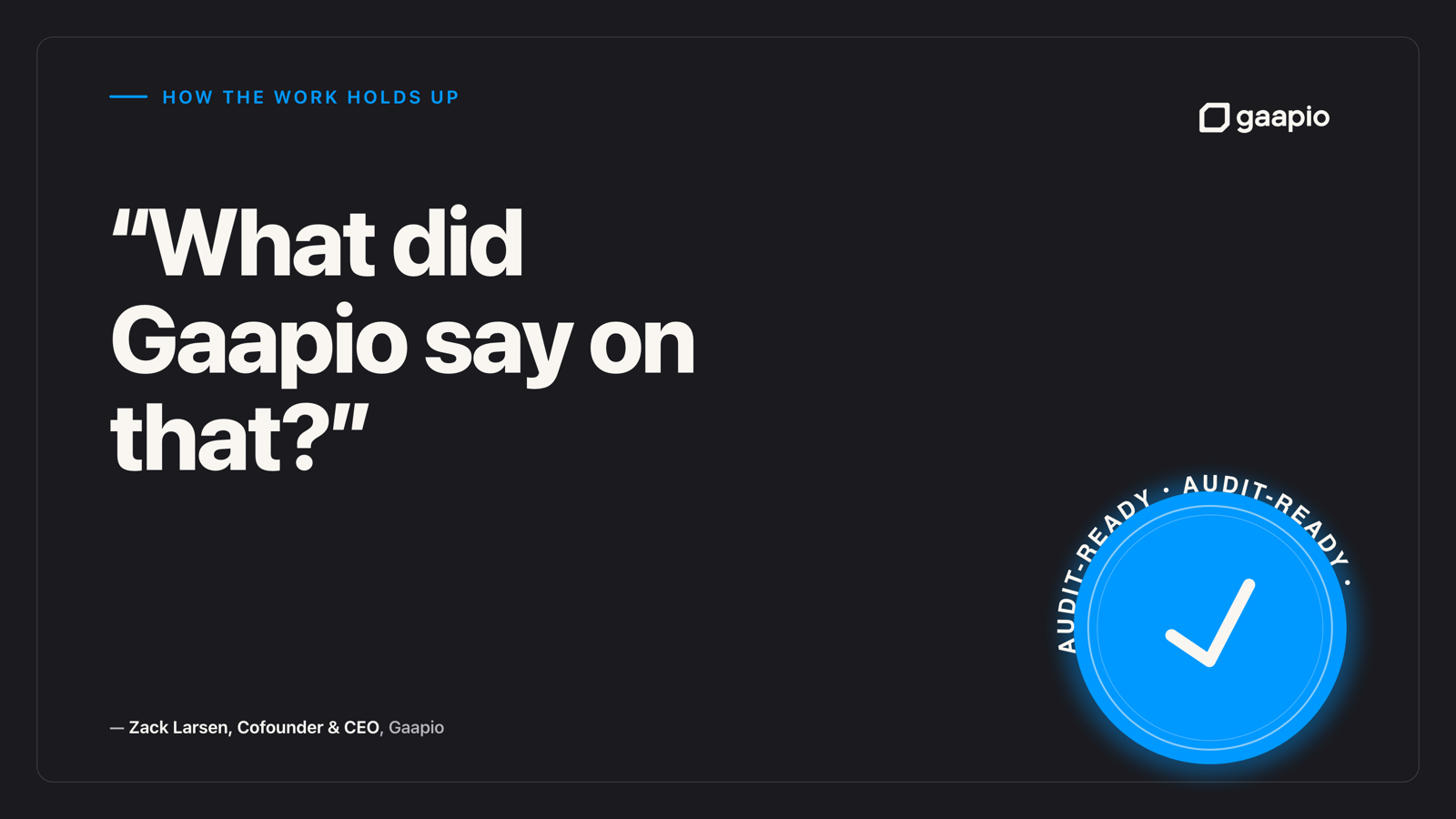
"What did Gaapio say on that?"
A customer of ours drafts in Claude and has Gaapio check it. His auditor asked him what Gaapio said. That is what "audit-ready by design" actually means: not a faster first draft, but a trail that holds up when someone else checks the work.
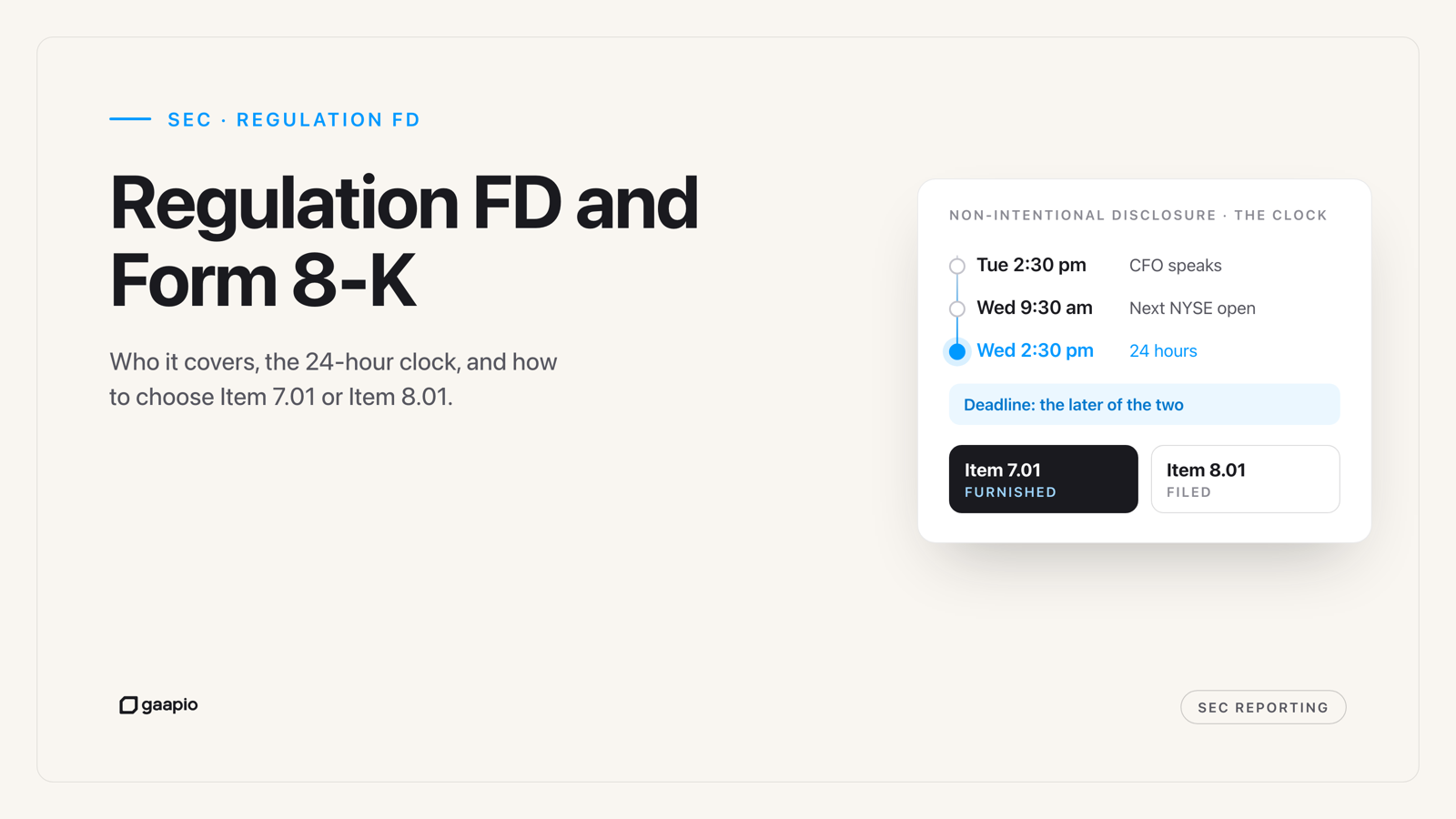
Regulation FD and Form 8-K: The 2026 Guide to SEC Fair Disclosure
Reg FD in plain terms for SEC reporting teams: what counts as selective disclosure, when the 24-hour clock starts, and how to choose Form 8-K Item 7.01 or Item 8.01, with a worked example.
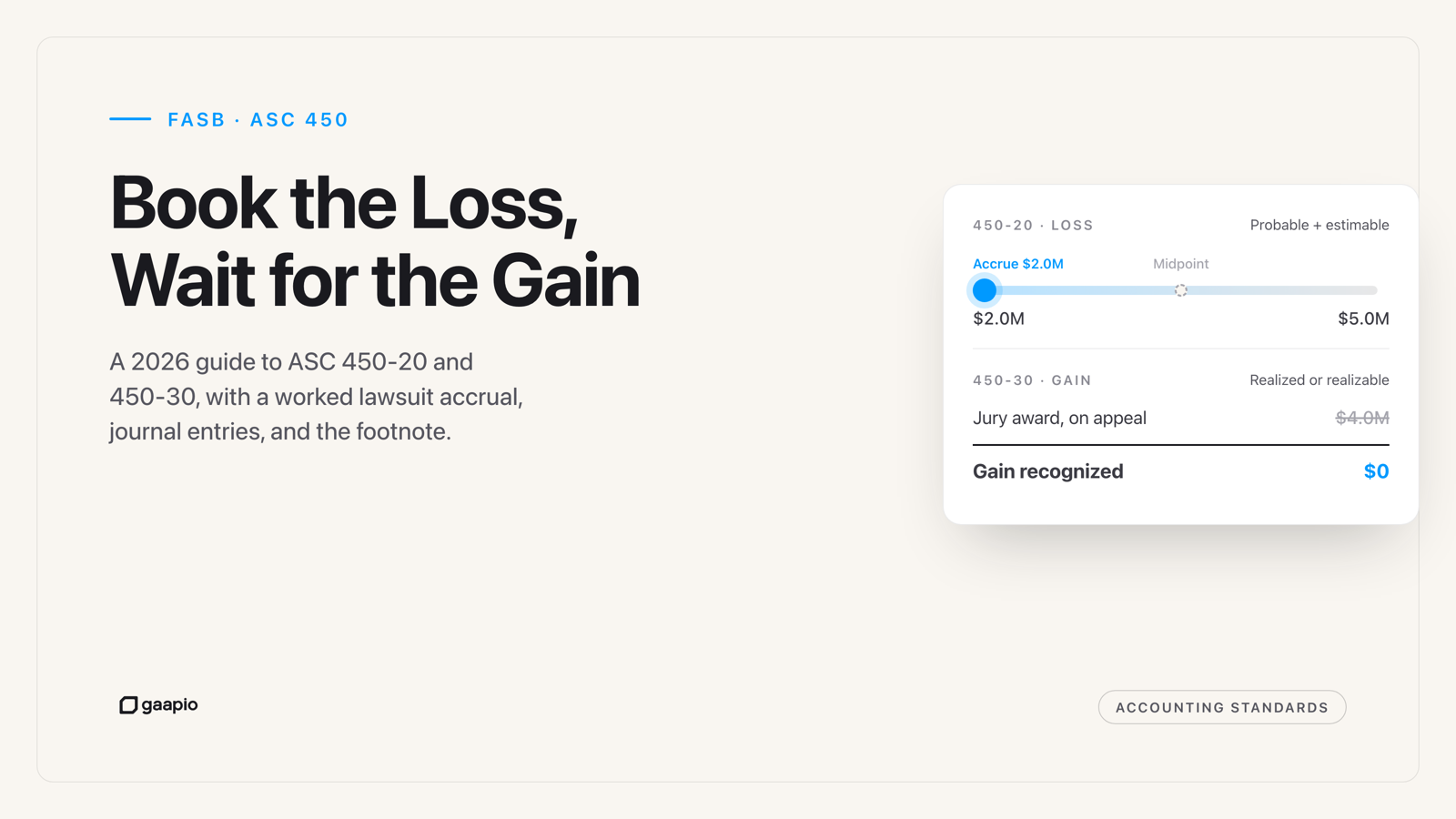
ASC 450 Contingencies: 2026 Guide to Loss (450-20) and Gain (450-30) Accounting
ASC 450-20 accrues a loss when it is probable and estimable. ASC 450-30 holds a gain until it is realized. A 2026 guide with a side-by-side comparison, a worked litigation accrual with journal entries, and footnote language you can adapt.
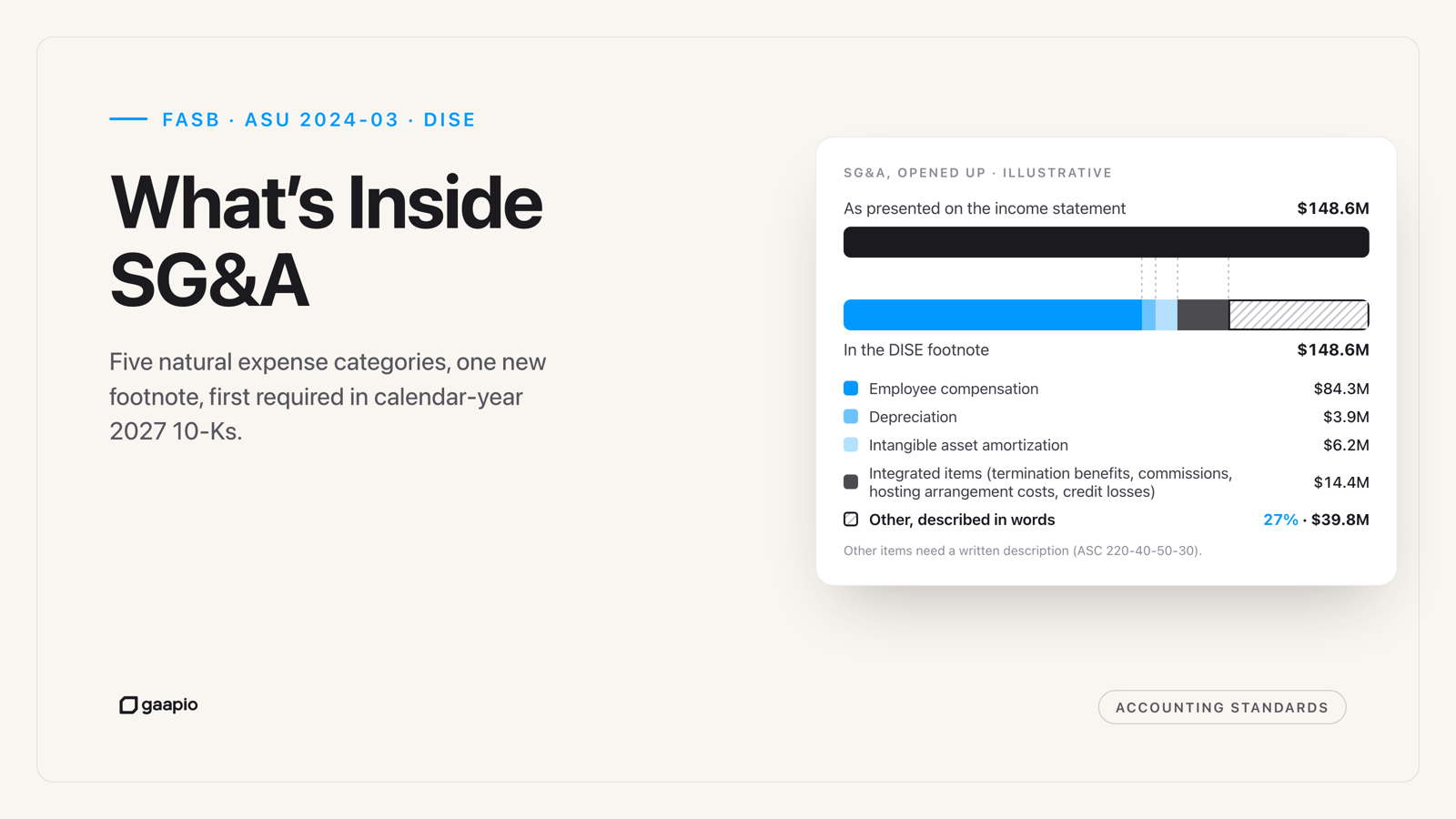
ASU 2024-03 (DISE): The 2026 Guide to Income Statement Expense Disaggregation
DISE (ASU 2024-03) adds a tabular footnote that breaks cost of sales, SG&A, and R&D into five natural expense categories. Effective dates after ASU 2025-01, what goes in the table, a worked SG&A example, and what changes in your first 10-K.
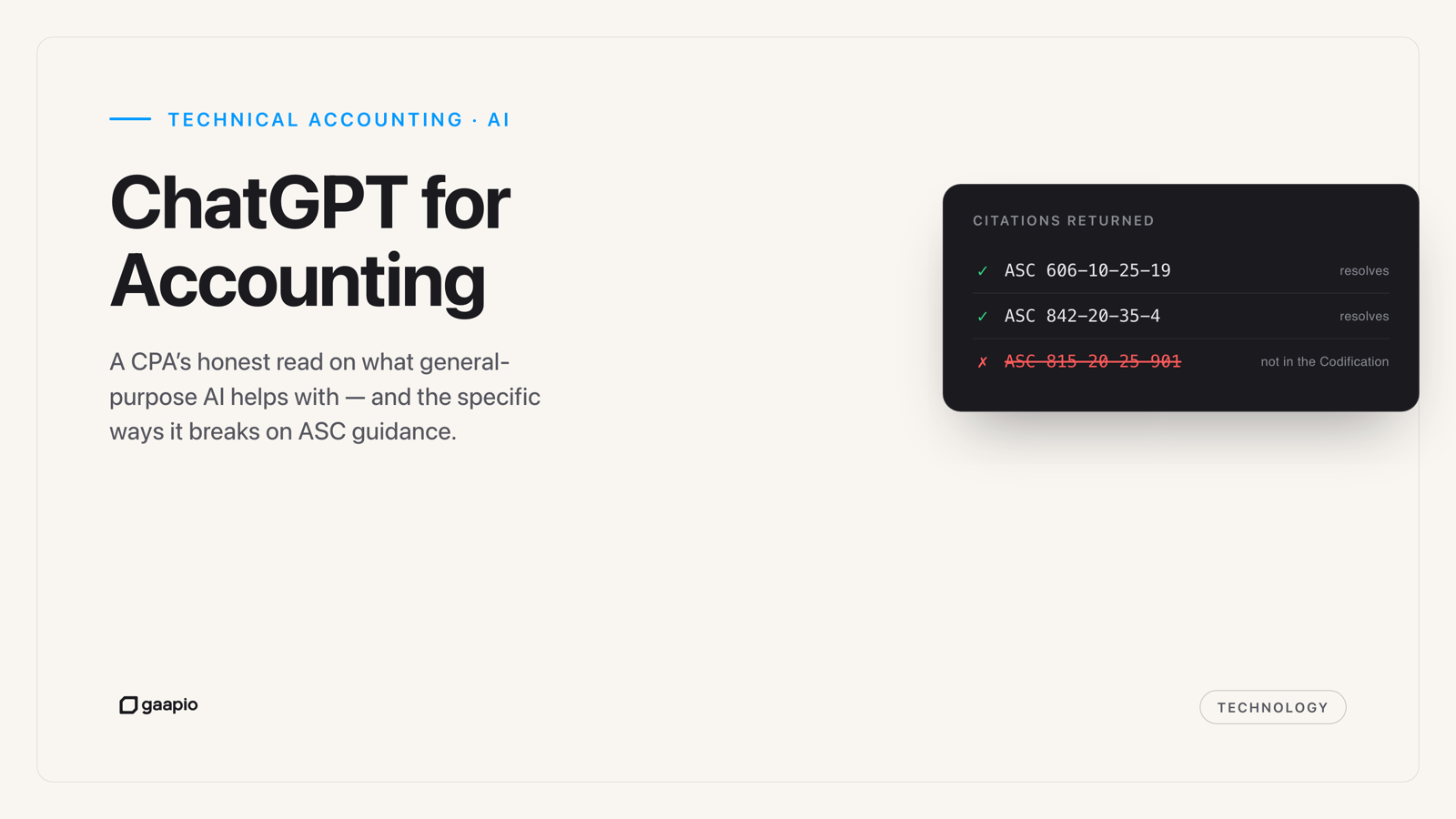
ChatGPT for Accounting: What It's Good For, and Where It Breaks
A CPA's honest assessment of using ChatGPT and Claude for technical accounting work — what they actually help with, the specific ways they fail on ASC guidance, and how to tell the difference.
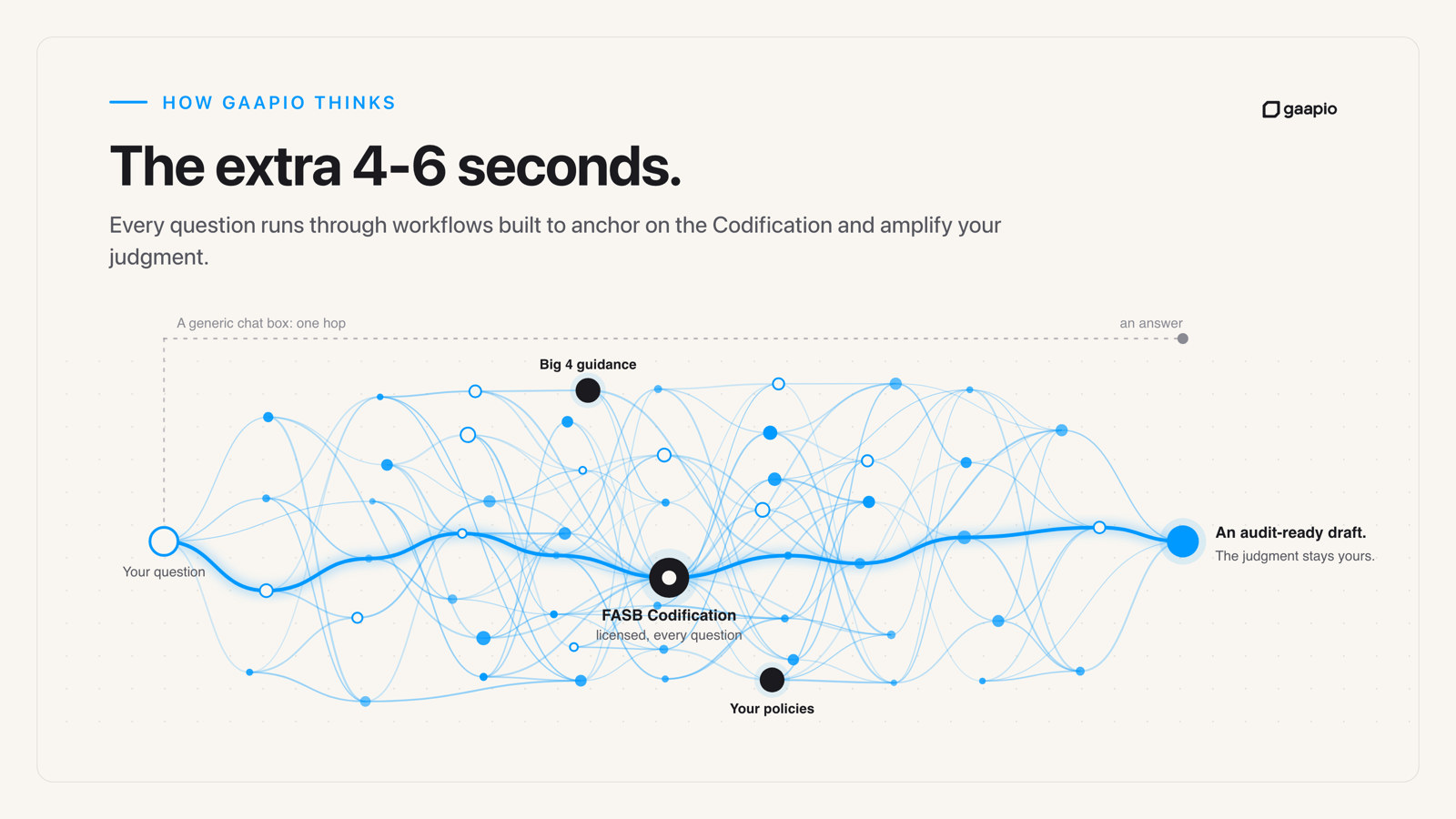
The extra 4-6 seconds: what technical accounting software does before it answers
ChatGPT answers a technical accounting question in about two seconds. Gaapio takes 4-6 seconds longer. Here is what those seconds are for, why purpose-built technical accounting software anchors every answer on the FASB Codification, and what that means for shadow AI, AI guardrails, and "does it actually cite the paragraph."
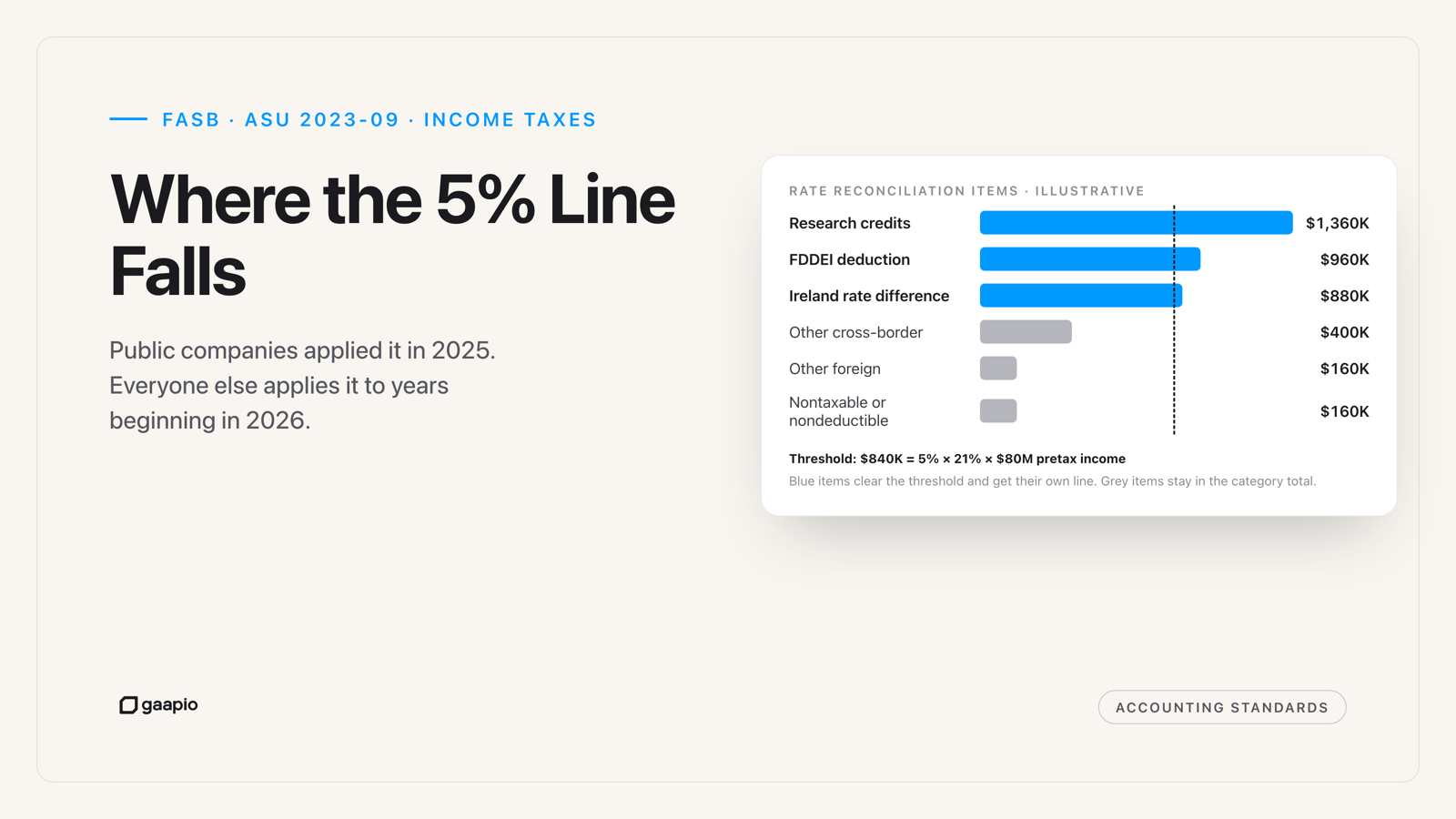
ASU 2023-09 Income Tax Disclosures: The 2026 Guide to Effective Dates, Rate Reconciliation and Examples
ASU 2023-09 effective dates for public and private companies, the eight-category rate reconciliation with a worked example, income taxes paid by jurisdiction, what changed for private companies, and how it compares with IAS 12.
How AI Is Changing Technical Accounting Research
Technical accounting research has always been slow — not because accountants are slow, but because the tools are. AI is changing that by compressing the research phase so professionals can spend more time on the judgment that actually matters.
How to Use AI for Revenue Recognition (ASC 606) Research
ASC 606's five-step model sounds clean, but applying it to real contracts is where the hard questions live. Here's where AI earns its keep in revenue recognition work — and where it still falls short.
Common Technical Accounting Mistakes (and How Better Tools Prevent Them)
The most common technical accounting errors aren't caused by not knowing the standards — they're caused by process gaps. Here are six mistakes that show up again and again, and how to prevent them.
AI for Lease Accounting: What ASC 842 Compliance Actually Requires
ASC 842 isn't a one-time adoption — it's ongoing compliance work. Here's where AI fits into the lease accounting workflow, what it handles well, and what still requires human judgment.
COSO's New AI Governance Framework: What It Means for Accountants Who Use AI Today
COSO's first formal guidance on AI internal controls changes the question the profession is asking — from "can AI do this work?" to "how do we know we can trust it?" A practical breakdown of the framework, its gaps, and a checklist for evaluating AI outputs.
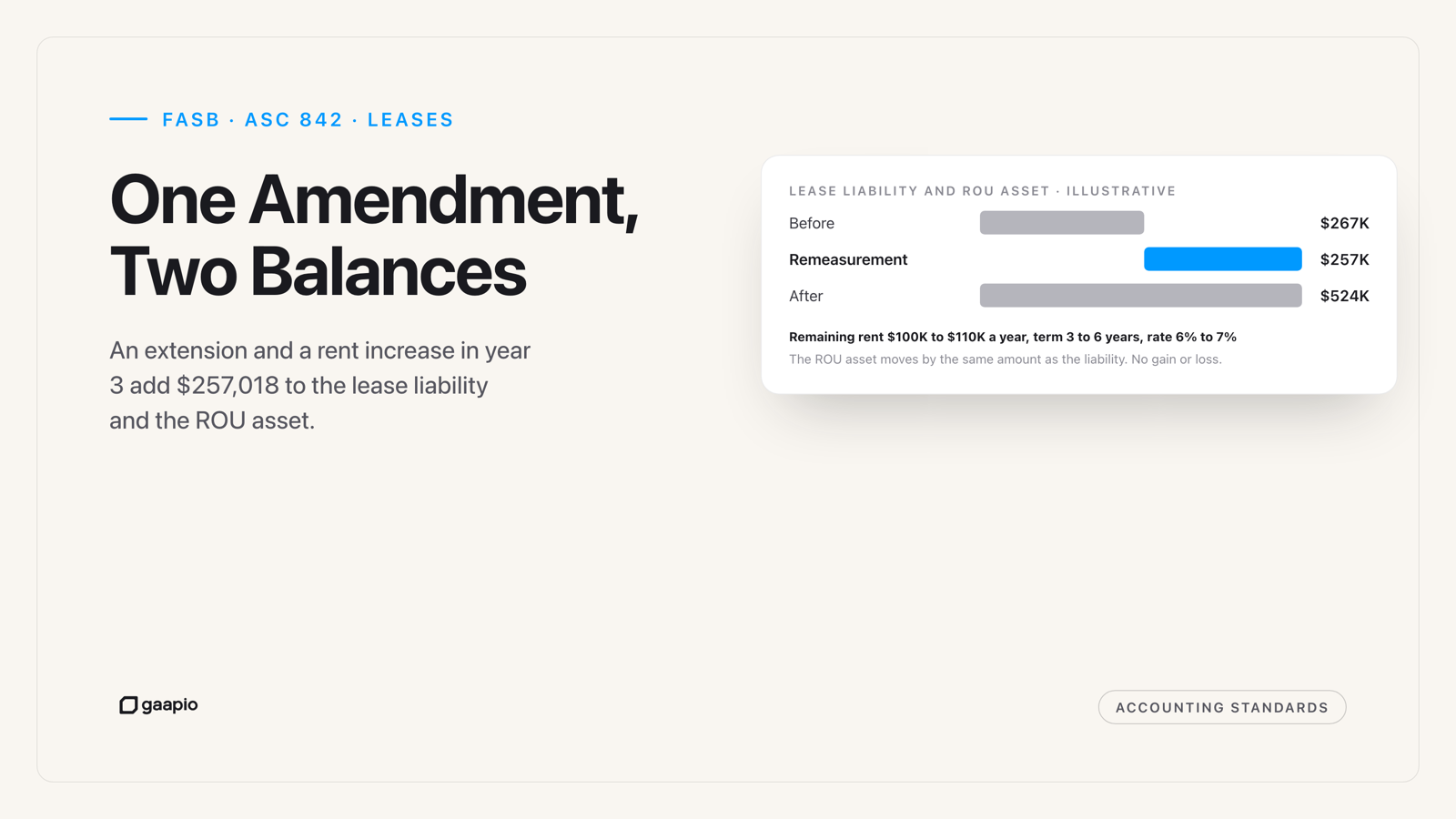
ASC 842 Lease Modification: The 2026 Guide to Separate Contracts, Remeasurement and Journal Entries
When an ASC 842 lease modification is a separate contract, how a lessee remeasures the lease liability and ROU asset when it is not, lessor treatment, a worked journal entry for an extension with a rent change, and ASU 2023-01.
The Future of Technical Accounting Teams
How leading companies are restructuring their accounting teams to leverage AI and automation while maintaining technical excellence and audit quality.
Building an Audit-Ready Documentation Process
Step-by-step guide to creating documentation that auditors love. Reduce review notes and build confidence in your technical accounting positions.
How AI Is Changing the Accounting Landscape
Explore the impact of artificial intelligence on accounting workflows and documentation processes. See how modern tools are helping CPAs focus on high-value advisory work.
5 Common ASC 606 Pitfalls
Navigate the complexities of revenue recognition and avoid these frequent mistakes in your accounting memos. From contract identification to variable consideration, we cover what matters most.
Why Technical Accounting Memos Matter
Discover why thorough documentation is essential for audit readiness and regulatory compliance. Learn how structured technical memos can save your team countless hours during the audit process.

The Accountant's Guide to Evaluating AI-Generated Memos
AI can draft a technical memo in minutes — but knowing how to evaluate that draft is the skill that separates using AI effectively from signing off on something you shouldn't. A five-step review framework for close season.

What to Look for in an AI Tool for Technical Accounting
Not all AI tools are built for judgment work. This post breaks down what makes technical accounting different from other knowledge work — and the specific questions you should ask before trusting any AI tool with it.
COSO's New AI Governance Framework: What It Means for Accountants Who Use AI Today
In early 2026, COSO published "Achieving Effective Internal Control Over Generative AI" — the first formal guidance applying the COSO Internal Control–Integrated Framework to GenAI. This post explains what the framework covers, what it gets right, where the practical gaps are for individual accountants, and how to use it as a lens for evaluating AI tools and your own AI workflow.