

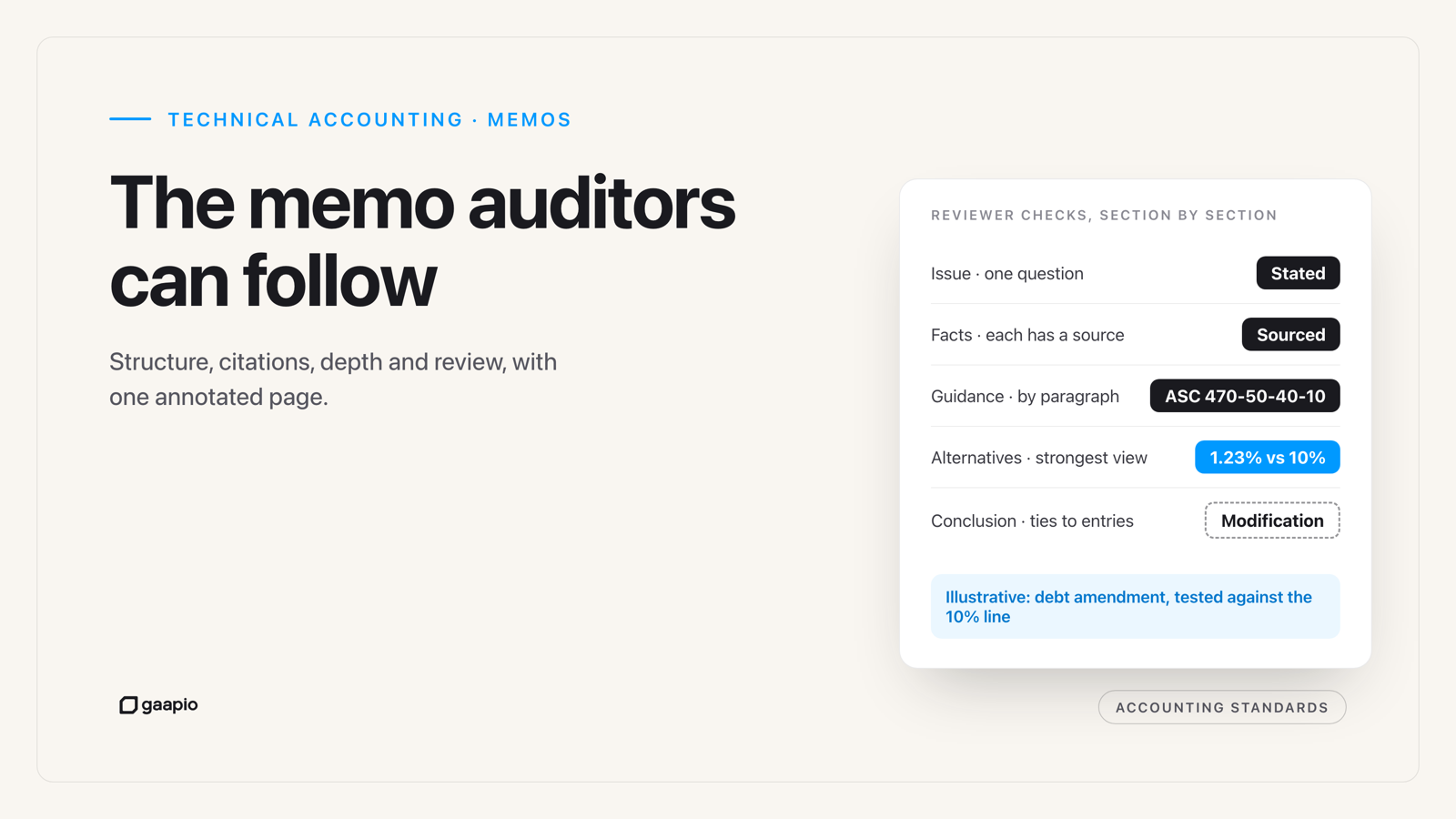
Your auditor asks how you got to the answer, and the honest reply is a conclusion in someone's head and a Big 4 guide open in another tab. A technical accounting memo is the document that closes that gap. It records the question, the facts, the guidance, the alternatives and the answer, so a reviewer can follow the reasoning without calling you.
This guide covers the structure auditors expect, how to cite the Codification and Big 4 guides, how much depth materiality calls for, the review findings that come back most often, and how AI changes the drafting while the judgment stays with you. It ends with a one-page illustrative memo on a debt amendment, annotated with what a reviewer checks at each step. If you want the case for writing memos at all, start with why technical accounting memos matter.
Key takeaway: A good memo states one question, sources every fact, cites Codification paragraphs (not just topics), puts the rejected alternatives on the page, and ties the conclusion to amounts and disclosures. Match the depth to the risk: complexity, judgment and size against materiality. AI can speed up the first draft, but the preparer owns every citation and every conclusion.
What is a technical accounting memo?
A technical accounting memo is a written analysis that applies the relevant accounting guidance to a specific set of facts and reaches a documented conclusion. It is also called an issue memo or position paper. Neither FASB nor the PCAOB prescribes a format, so the structure below is practice. It is the shape auditors and review committees have come to expect.
You write one when a conclusion depends on judgment and someone will later ask how you reached it: an unusual transaction, a debt amendment, a lease classification, a policy election, or a standard you are adopting. For a revenue-specific walkthrough, see what an ASC 606 memo includes.
What structure do auditors expect in a technical accounting memo?
Most auditors expect six core parts, usually in this order: background, issue, authoritative guidance, analysis of alternatives, conclusion, and financial statement and disclosure impact. Add a header and an approval block, and the whole memo is easy to review because each part answers one reviewer question.
| Section | What it holds | The reviewer question it answers |
|---|---|---|
| Header | To, from, date, period, subject | Who owns this, and which period does it cover? |
| Background | Facts, each tied to a source document (contract section, board minutes, price list) | Are these the right facts, and can I open the source? |
| Issue | One question the memo decides, in a sentence or two | What exactly is being decided? |
| Authoritative guidance | Codification paragraphs by number, then interpretive guidance if used | Is this the governing guidance, and is it current? |
| Analysis of alternatives | The guidance applied to the facts, one judgment at a time, with the views considered and rejected | What else did you consider, and why not that? |
| Conclusion | The answer to the issue, stated plainly | Does the conclusion answer the question asked? |
| Financial statement and disclosure impact | Amounts, journal entries, periods affected, footnote requirements | Does this tie to the numbers and the footnote? |
| Review and approval | Preparer, reviewer, dates, open items | Who signed off, and is anything still open? |
Two habits matter more than the headings. Write the issue before anything else; if you cannot state it in a sentence, the memo will wander. And write the conclusion so it can be read alone, with the amounts, because the controller and the audit partner often read only that section first.
How do you cite the Codification and Big 4 guides in a memo?
Cite the Codification at paragraph level, in the Topic-Subtopic-Section-Paragraph format, such as ASC 606-10-25-19. A topic number alone ("ASC 606") tells the reviewer where you looked, not what you relied on. Then cite interpretive guidance separately, and label it as interpretation.
The hierarchy matters. The Codification is the source of authoritative US GAAP for nongovernmental entities (ASC 105-10-05-1), and for SEC registrants, SEC rules and interpretive releases are also authoritative, while SEC staff guidance such as SABs carries weight in practice. The Big 4 guides explain how the firms read the standards. They are useful and widely relied on in practice, but they are not authoritative GAAP, and they can differ from each other. When the Codification does not address a transaction directly, ASC 105-10-05-2 points first to authoritative guidance for similar transactions, and only then to nonauthoritative sources such as the firm guides.
| Source | How to cite it | What it can support |
|---|---|---|
| FASB Codification | ASC Topic-Subtopic-Section-Paragraph, for example ASC 470-50-40-10 | The rule itself. The conclusion must trace here. |
| SEC rules, interpretive releases and staff guidance (registrants) | Regulation S-X, SAB number, or staff comment | Registrant-specific requirements and views |
| Deloitte (DART Roadmaps), PwC Viewpoint guides, KPMG Handbooks, EY Financial Reporting Developments | Firm, guide title, edition or date, section number | Interpretation, examples and common practice. Name the section, not just the firm. |
| Standard-setter material (Basis for Conclusions, ASU text) | ASU number and paragraph | Intent behind the guidance and transition. Nonauthoritative: the Basis for Conclusions explains, the Codification governs. |
Three practices keep citations from becoming a finding. Quote or paraphrase the paragraph and read it, rather than copying a reference from a guide. Check the effective date and whether an ASU has since amended the paragraph. And when a Big 4 guide and another source differ, say so in the memo and explain which view you followed and why. The Codification is licensed, but FASB offers free registered access to a basic view at asc.fasb.org, which is enough to confirm a paragraph.
How much depth does materiality call for?
Match the memo to the risk, not to a fixed page count. The Codification itself says its provisions need not be applied to immaterial items (ASC 105-10-05-6), and SEC Staff Accounting Bulletin 99 (SAB Topic 1.M), written for registrants assessing misstatements but widely used as a reference, reminds preparers that materiality has qualitative factors as well as the dollar amount. A small item can still be material if it flips a covenant or a trend.
Most teams set a written policy with tiers. The table below is an illustrative policy. Each company sets its own thresholds, and the auditor will form its own view.
| Tier | When it applies | What to write |
|---|---|---|
| Full memo | Complex or novel, significant judgment, amount near or above materiality, or the auditor has flagged it | All sections, alternatives analyzed, numbers tied, disclosure drafted, formal review |
| Short memo | Recurring transaction type with clear guidance, amount below materiality but not trivial | Issue, facts, guidance by paragraph, conclusion, entries. One page is often enough. |
| Memo to file | Routine, clearly immaterial, or a conclusion already covered by an approved policy | A short record of the fact, the policy relied on and the conclusion |
Ask four questions to place an item: How complex is the guidance? How much judgment does the conclusion take? How large is the amount against materiality? Is this new for the company? A yes on significant judgment or an amount near materiality, or any two yeses, usually means a full memo. A conclusion that will repeat every quarter belongs in a policy memo that individual transactions can reference.
What do reviewers and auditors flag most often?
The most common findings are not exotic. They are missing sources, topic-level citations, alternatives that were never really considered, and conclusions that do not tie to the numbers. Run this list on your own memo before anyone else does.
| Finding | What it looks like | The fix |
|---|---|---|
| Unsourced facts | "The contract is three years" with no reference | Cite the contract section, document and date for every fact |
| No clear question | The memo opens with background and never states what it decides | Open with a one-sentence issue; check that the conclusion answers it |
| Topic-level citations | "Per ASC 470" | Cite the paragraph and confirm it says what you claim |
| Strawman alternatives | The rejected view is stated weakly so it is easy to dismiss | State the strongest version of the alternative, then the reason it fails on these facts |
| Conclusion does not tie | The memo says modification, the entries show an extinguishment loss | Walk the conclusion into amounts, entries and the footnote |
| Stale guidance | A superseded paragraph, or an ASU not yet adopted | Check the effective date and the entity type (public business entity or not) |
| Missing disclosures | Silence on the footnote | Add a disclosure section, even if the answer is "none required" |
| Facts changed | A contract was amended after the memo was signed | Update or supplement the memo, and date the change |
| Copied interpretation | Paragraphs lifted from a Big 4 guide | Quote briefly with attribution, or paraphrase, and tie it to your facts |
| No approval trail | No reviewer, no date, open items unmentioned | Add preparer, reviewer, dates and open items |
For the process side of keeping this documentation current, see building an audit-ready documentation process.
How does AI change writing a technical accounting memo?
AI changes the speed of the first draft and the cost of research, but not who is accountable. The preparer still owns the facts, the citations and the judgment, and the reviewer still signs. The sensible use is to let AI do the assembly and make the human do the verification.
Where AI helps: pulling the facts from a contract into a draft background section, suggesting candidate Codification paragraphs, laying out the alternatives to consider, and formatting the memo to your template. Where it needs a check: any citation (confirm the paragraph exists and says what the draft claims), any statement about effective dates, and any conclusion, which should be yours before it is the tool's.
General-purpose chat tools add specific risks for this work, which Jace covers in ChatGPT for technical accounting, and the questions to ask of any AI-written memo are in the accountant's guide to evaluating AI-generated memos. Three habits keep it safe: verify every citation against the Codification, keep your data out of tools that train on it, and, if your policy or auditor expects it, note in the memo that AI helped with the draft and a named person reviewed it.
Worked example: a one-page memo on a debt amendment
The memo below is illustrative, with invented facts and numbers. It answers a question that comes up whenever a lender amends a term loan: is it a modification, or an extinguishment of the old debt? The italic lines after each section show what a reviewer checks. (For a memo on a revenue question, the example on the accounting memos page walks through a SaaS implementation fee.)
To: Controller. From: Technical accounting. Date: October 15, 2026. Re: Amendment of the Term Loan with First Meridian Bank, Q4 2026. The company, Alder Creek Components, is hypothetical, with a December 31 year-end.
1. Issue. Does the October 1, 2026 amendment to the Company's term loan result in a modification or an extinguishment of the debt under ASC 470-50, and how are the fee paid to the lender and the third-party legal costs accounted for?
Reviewer checks: one question, stated so the conclusion can answer it directly. The issue includes the fee treatment, which is where the entries come from.
2. Background. The Company borrowed $10,000,000 under a term loan with First Meridian Bank. The loan pays 6.00% interest annually and repays principal in a single payment at maturity. Three years remained before the amendment, and the loan was issued at par and is carried at $10,000,000, with no unamortized discount or issuance costs (Credit Agreement, Section 2.1; debt rollforward, September 30, 2026). The amendment extends maturity by one year, so four years remain, and reduces the rate to 5.50%. The Company paid First Meridian a $50,000 consent fee and incurred $30,000 of fees from its own law firm (Amendment No. 1, Sections 1 and 4; law firm invoice dated October 3, 2026). The lender is the same. The loan has no conversion or other embedded features. The loan has not been modified or exchanged in the past 12 months, and First Meridian holds the whole loan (no syndicate or participants). The Company is not in default, has no going concern doubt, and could obtain similar debt from other lenders at about 5.50%, a market rate for a borrower not in financial difficulty (term sheet from a second bank, September 2026). Cash flow projections show the Company can meet all debt service through maturity (forecast, September 2026; covenant compliance certificate, September 30, 2026).
Reviewer checks: every fact has a document. Same lender confirmed. The financial-condition facts are stated because the TDR screen depends on them, and the absence of a conversion feature is stated because the conversion-option tests in ASC 470-50-40-10 depend on it.
3. Authoritative guidance. ASC 470-60-15-5 and 470-60-55-8 (troubled debt restructurings by the debtor; indicators of financial difficulty); ASC 470-50-40-10 through 40-12 (the 10% cash flow test, including the discount rate and which cash flows count); ASC 470-50-40-14 (new effective rate when the terms are not substantially different); ASC 470-50-40-17 and 40-18 (fees paid to the creditor and costs paid to third parties); ASC 470-10-50-1 (maturities).
Reviewer checks: paragraph-level citations, each tied to a step in the analysis below. The reviewer opens at least the 10% test paragraph and confirms the discount rate and cash flow rules.
4. Analysis.
Step 1, troubled debt restructuring. A restructuring is a TDR when the creditor grants a concession because of the debtor's financial difficulties. The Company is not in default, has no going concern doubt and could borrow at a similar rate elsewhere, so it is not experiencing financial difficulty. The effective rate falls from 6.00% to 5.64%, which would be a concession under ASC 470-60 if the Company were in difficulty, so this finding carries the screen. ASC 470-60 does not apply and the analysis moves to ASC 470-50. (ASU 2022-02 removed the creditor TDR guidance in Subtopic 310-40 for entities that have adopted ASC 326; the debtor guidance in ASC 470-60 still applies.)
Step 2, the 10% test. The present value of the cash flows under the new terms, including the fee paid to the lender, is compared with the present value of the remaining cash flows under the old terms. Both are discounted at the effective rate of the original debt, 6.00%. If the difference is at least 10%, the amendment is an extinguishment.
| ($) | Old terms | New terms |
|---|---|---|
| Fee paid to lender, at amendment | 0 | 50,000 |
| Annual interest | 600,000 for 3 years | 550,000 for 4 years |
| Principal at maturity | 10,000,000 in year 3 | 10,000,000 in year 4 |
| Present value at 6.00% | 10,000,000 | 9,876,745 |
| Difference | 123,255 (1.23%) |
The difference of 1.23% is below 10%. The third-party legal fees are not part of the test. There was no modification in the prior 12 months, so the old terms are the current terms (ASC 470-50-40-12). The $30,000 is the Company's own counsel; none of it reimburses the lender's legal costs, which would be treated as a fee paid to the lender.
Alternative considered. Extinguishment accounting. Rejected: the cash flow difference is 1.23%, well below 10%, and the conversion-option tests in ASC 470-50-40-10 do not apply because the loan has no conversion feature. The memo also records how far the conclusion is from the line: a cut in the rate to 3.0% would produce a 9.90% difference, and any rate below about 2.97%, with the same maturity and fee, would cross 10%.
Reviewer checks: the TDR screen comes first and is supported by facts. The discount rate is the original effective rate. The fee is in the new cash flows and the legal costs are out, after checking whose counsel was paid. No modification in the prior 12 months. The alternative is the strongest competing view, and the margin to the 10% threshold is shown.
5. Conclusion. The amendment is a modification, not an extinguishment. No gain or loss is recognized. The $50,000 fee paid to the lender is a debt discount amortized over the four remaining years as an adjustment of interest expense using the effective interest method. The $30,000 of third-party legal costs is expensed as incurred.
6. Financial statement impact.
| Entry at October 1, 2026 | Debit | Credit |
|---|---|---|
| Debt discount (contra-liability) | 50,000 | |
| Cash | 50,000 | |
| Legal expense | 30,000 | |
| Accounts payable | 30,000 |
The new effective rate on the carrying amount of $9,950,000 is 5.6431%. Interest expense is $561,490 in year 1, $562,139 in year 2, $562,824 in year 3 and $563,547 in year 4, which brings the carrying amount to $10,000,000 at maturity.
Reviewer checks: the entries match the conclusion (a modification, so no loss on extinguishment). The amortization schedule ties to the discount and ends at par. The schedule runs by loan year (October 1 to September 30), so the calendar-year interest expense is a blend of two loan years.
7. Disclosure considerations. The debt footnote reflects the new maturity and rate. The five-year maturity table (ASC 470-10-50-1) moves the principal from 2029 to 2030. Covenant and terms disclosures are updated. The legal costs are presented in general and administrative expense, consistent with the Company's policy for third-party financing costs on modifications.
8. Review and approval. Prepared by: [Preparer], [date]. Reviewed by: [Controller], [date]. Open items: confirm the 2026 interim schedule uses the new effective rate from October 1.
Reviewer checks: names and dates present, and open items listed rather than left blank.
This is a simplified memo. A complete one would also address the partial-period interest, the classification of any current portion, and cross-default terms in other agreements.
How does Gaapio help with technical accounting memos?
Gaapio is an AI-powered technical accounting platform built by CPAs. For memos, it drafts a first version from your own contract, with citations back to the Codification paragraph and a trail a reviewer can follow, and your team reviews, edits and approves it. The judgment stays with the preparer. Our accounting memos page shows the format, an example and a template you can copy.
If you want to see the first draft on one of your own transactions, request a demo.
Frequently asked questions
What should a technical accounting memo include?
At minimum: the issue, the background facts with sources, the authoritative guidance cited by paragraph, the analysis of alternatives, a conclusion, and the impact on the financial statements and disclosures. Add a header with the period and an approval block with the preparer, reviewer and dates.
How long should a technical accounting memo be?
As long as the risk requires. A routine item with clear guidance can fit on one page. A complex or novel transaction, or a judgment near materiality, takes a full memo with every alternative analyzed. Length does not measure quality; a reviewer should be able to find the issue, the guidance and the conclusion on the first page.
How do you cite the FASB Codification in a memo?
Use the paragraph-level format Topic-Subtopic-Section-Paragraph, for example ASC 606-10-25-19. Cite the paragraph you relied on for each step of the analysis, not only the topic, and confirm the wording and effective date in the Codification.
Can you cite a Big 4 guide as support for a conclusion?
You can cite it as interpretive support, with the firm, guide title, edition and section. It is not authoritative GAAP, so the conclusion must trace to the Codification, and the memo should say so when guides differ.
When do you need a technical accounting memo?
Whenever a conclusion depends on judgment and someone will later ask how you reached it: significant or unusual transactions, lease classification, principal versus agent, debt amendments, new standards and policy elections, or an auditor request.
What is the difference between an accounting policy memo and a technical accounting memo?
A policy memo documents a policy the company will apply consistently, such as a capitalization threshold or an election. A technical accounting memo applies the guidance to one transaction or judgment. Individual memos can reference the policy memo instead of repeating it.
Can AI write a technical accounting memo?
AI can produce a first draft and speed up research, but it cannot own the conclusion. The preparer verifies every citation, confirms the facts and makes the judgment, and a reviewer approves the memo.
What do auditors look for when they review a memo?
Sourced facts, paragraph-level citations, alternatives considered and rejected for stated reasons, a conclusion that answers the question and ties to the amounts, disclosures addressed, and a visible preparer and reviewer.
Related reading
- Why technical accounting memos matter
- What an ASC 606 memo includes
- Building an audit-ready documentation process
This post is general information, not accounting advice for a specific entity. Sources: FASB ASC 105-10, 470-10, 470-50 and 470-60; SEC Staff Accounting Bulletin 99, Materiality; FASB Accounting Standards Codification; Big 4 debt and financing guides (Deloitte Roadmap on the issuer's accounting for debt, and the equivalent PwC, KPMG and EY guides).