

General-purpose AI is actually useful for accounting work that doesn't require authoritative sourcing — drafting, summarizing, explaining a concept, restructuring a document. It fails on technical accounting conclusions because it has no licensed access to the Codification and no mechanism for knowing when it is wrong.
I did hedge accounting at Chatham Financial, lease accounting at Netgain, SEC comment letters at Connor Group. I use ChatGPT and Claude every week. This isn't an argument that general-purpose AI is useless for accountants — that position is wrong, and easy to disprove. It's an argument about a specific boundary, and why that boundary is exactly where it is.
Start with what it does well
Any honest assessment has to begin here, because the failure modes only make sense once you understand what is actually working.
- Getting past a blank page. The hardest part of a memo is frequently the first paragraph. A general model produces a structure you can then argue with, which is faster than producing one from nothing.
- Explaining a concept you half-remember. Ask what a lease incentive is and you will get a serviceable answer. Conceptual explanation is where these models are strongest.
- Restructuring writing you already trust. Tightening a paragraph, reorganizing an argument, adjusting tone for an audience. The content is yours; the model is editing.
- Summarizing a long document. Not for conclusions, but for orientation. What is in this 90-page agreement, roughly, and where should I read carefully.
- Interrogating your own reasoning. Ask a model to argue the opposite position. It's a real way to find the weakness in your analysis.
None of that is trivial. If you are not using these tools for the above, you are leaving real time on the table.
Now the boundary
Every item in that list has something in common: you are the source of authority. The model is producing structure, language or a counter-argument, and you are supplying the technical judgment.
The boundary is crossed the moment you ask the model to be the source of authority — to tell you what the guidance says, which paragraph applies, or how a specific fact pattern should be concluded. That is where three specific things go wrong.
1. It does not have the Codification
The FASB Codification's full Professional View is licensed content. General-purpose models have no licensed access to it and no reliable mechanism for retrieving authoritative text at inference time unless a specific integration provides one.
What they can draw on is the enormous volume of material about the Codification that appears on the open web — summaries, firm publications, blog posts, exam prep material, forum discussions. That body of writing is largely correct in outline and unreliable in the specifics that matter. It is also of uneven vintage, which is how you get confident answers reflecting superseded guidance.
2. Citations are generated, not retrieved
This is the failure mode that causes real damage, because it is invisible until checked.
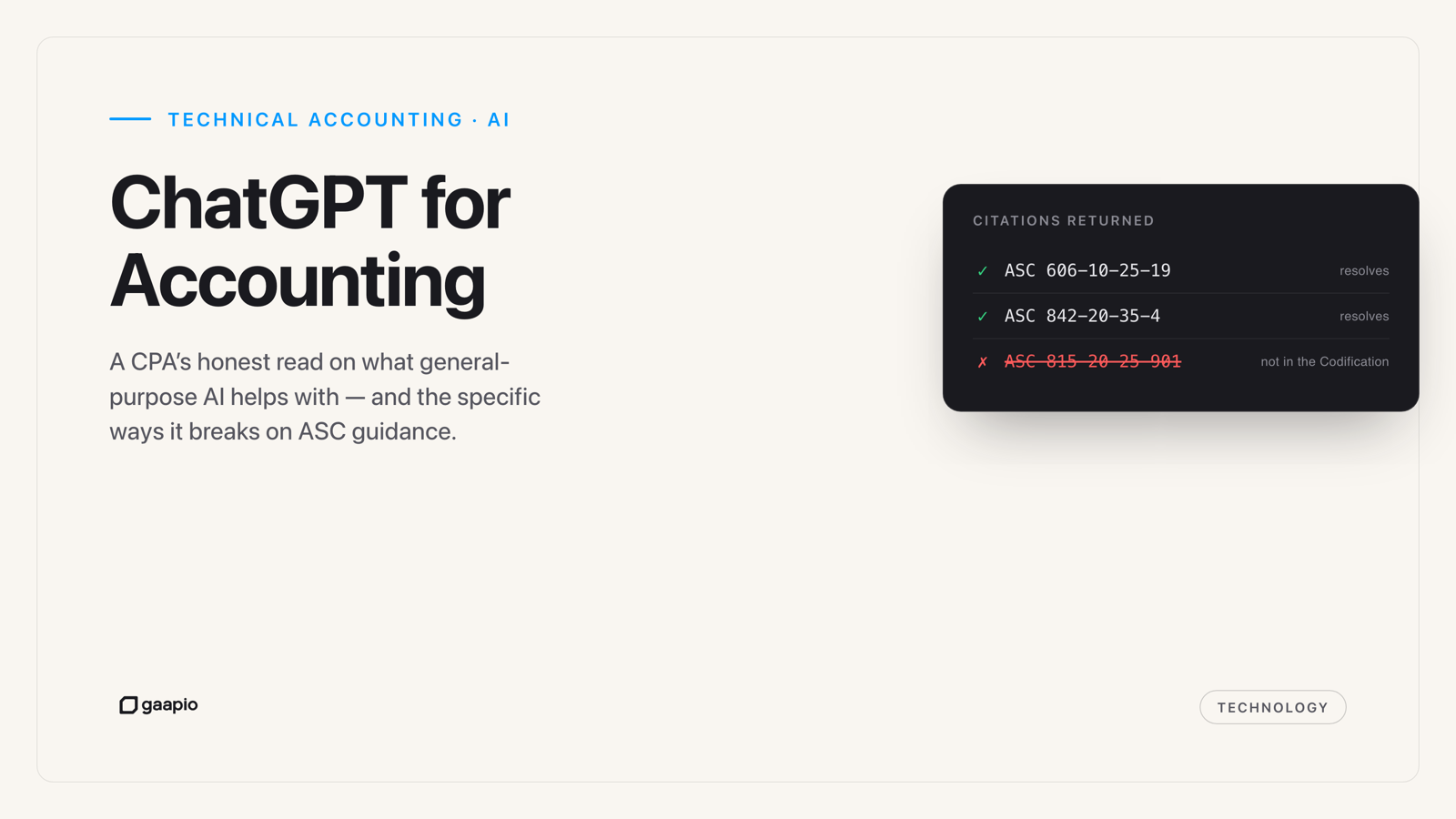
When a general model produces “ASC 606-10-25-19,” it is generating a plausible-looking reference, not looking one up. Sometimes it is right. Sometimes the paragraph exists and says something adjacent. Sometimes it does not exist at all. The output is formatted identically in all three cases.
I've had ChatGPT cite ASC 815 guidance that doesn't exist while I was checking a hedge effectiveness question — confidently, with a paragraph number and everything. Next time a model hands you a pin cite that resolves to something adjacent to what you asked, or to nothing at all, that's the tell.
A reviewer scanning a memo for citation format will not catch this. Someone who clicks through every reference will. That is why the practical response inside accounting teams has been to have a person verify every reference by hand — which removes most of the time saving that motivated using the tool.
3. It optimizes for a satisfying answer
These models are trained to be helpful, and a confident answer reads as more helpful than an uncertain one. In most contexts that trade-off is fine. In technical accounting it is inverted: “the guidance is unclear here and reasonable practitioners disagree” is often the correct and most valuable answer.
Related, and worse: push back on a conclusion and the model will frequently revise it to match your view. Push back again and it may revise back. A tool that agrees with whatever you last said is not a check on your reasoning — it is an amplifier for it.
What “grounded” actually means
The word appears in a great deal of AI marketing and is worth being precise about. A grounded system does not answer from what a model absorbed during training. It retrieves the actual authoritative text, reasons over that specific text, and returns a citation pointing at the passage it used.
The difference is testable. Click the citation. Either it resolves to language that supports the conclusion, or it does not.
| General-purpose AI | Grounded technical accounting tool | |
|---|---|---|
| Source of the answer | Training data — the open web, of mixed vintage and quality | Licensed authoritative guidance, retrieved at the time of the query |
| Citations | Generated to look plausible | Retrieved, and resolvable to real text |
| Currency | Whatever was in the training corpus | Current guidance, including recent ASUs |
| Uncertainty | Tends to resolve toward a confident answer | Should surface ambiguity and competing readings explicitly |
| Consistency | Varies by session and by phrasing | Same framework applied to similar fact patterns |
| Where your data goes | Depends entirely on the plan and settings | Should be contractually specified — see our security page |
Four questions worth asking any vendor
- Do you have a licence to the Codification, and is it retrieved at query time? A yes to the first and no to the second is not grounding.
- Show me a citation resolving to actual text. Not a reference in a memo — the underlying passage, in the interface, on a query I choose.
- Show me the tool saying it does not know. Ask something actually ambiguous. If it always produces a confident answer, that is the finding.
- What happens to what I upload? Retention, training use, subprocessors, and whether it is contractual or a settings toggle.
The honest summary
Use general-purpose AI for drafting, explaining, restructuring and orientation. It is good at those and getting better.
Do not use it as the authority on what the guidance says. Not because AI cannot do technical accounting, but because a system with no licensed access to the source material and no mechanism for expressing uncertainty is the wrong architecture for work where being confidently wrong is the expensive outcome.
The question to ask a tool is not whether it uses AI. It is where its answers come from, and whether you can check.
I still open ChatGPT most days. I just don't let it be the last word on what the guidance says.
Frequently asked questions
Can ChatGPT write a technical accounting memo?
It can produce a memo-shaped document quickly, which is useful for getting past a blank page. It cannot reliably produce the authoritative support — citations are generated rather than retrieved, so each one needs verifying by hand, which removes most of the time saved.
Why does ChatGPT get ASC references wrong?
Because it generates plausible-looking references rather than retrieving real ones. General-purpose models have no reliable mechanism for retrieving authoritative Codification text at the time of the query, so they work from open-web material about the guidance rather than the guidance itself.
Is it safe to paste financial information into ChatGPT?
It depends entirely on your plan and settings, and those can change. For pre-release financial information, the requirement should be a contractual data-handling commitment rather than a configuration option.
What is the difference between ChatGPT and a purpose-built accounting AI tool?
Where the answer comes from. A general model answers from training data. A grounded tool retrieves licensed authoritative guidance at query time and returns a citation you can resolve to real text.
Should accountants use AI at all?
Yes, for the work it is actually good at — drafting, explaining, summarizing, stress-testing your own reasoning. The boundary is authority: the moment you need the tool to be the source of truth on what the guidance says, general-purpose models are the wrong instrument.
Does Gaapio use the same underlying models as ChatGPT?
Gaapio routes across multiple providers — Anthropic, OpenAI, and Gemini — including the same model families, under zero-data-retention agreements. The difference is not the model. It is licensed Codification access directly from the Financial Accounting Foundation, retrieval-based citation, and workflows built by CPAs around how the work is actually reviewed.

Jace Chambers, CPA — Co-Founder & Chief Product Officer, Gaapio
CPA and co-founder of Gaapio, where he leads product. Before Gaapio, he worked technical accounting at Chatham Financial, Netgain, and Connor Group. He writes about where AI actually helps in accounting work, and where it doesn't.
See what a retrieved citation looks like
Bring a fact pattern you would normally take to a general AI tool. We'll run it and show you the citation resolving to actual Codification text. Request a Demo or Talk to a CPA.
Related
- Technical accounting solutions
- ASU 2023-09 income tax disclosures
- Security and trust
- ASC 606 revenue recognition
Notes: Written from experience using general-purpose AI tools for technical accounting work. FASB Accounting Standards Codification is licensed content. This article is general information, not accounting advice for a specific entity.