

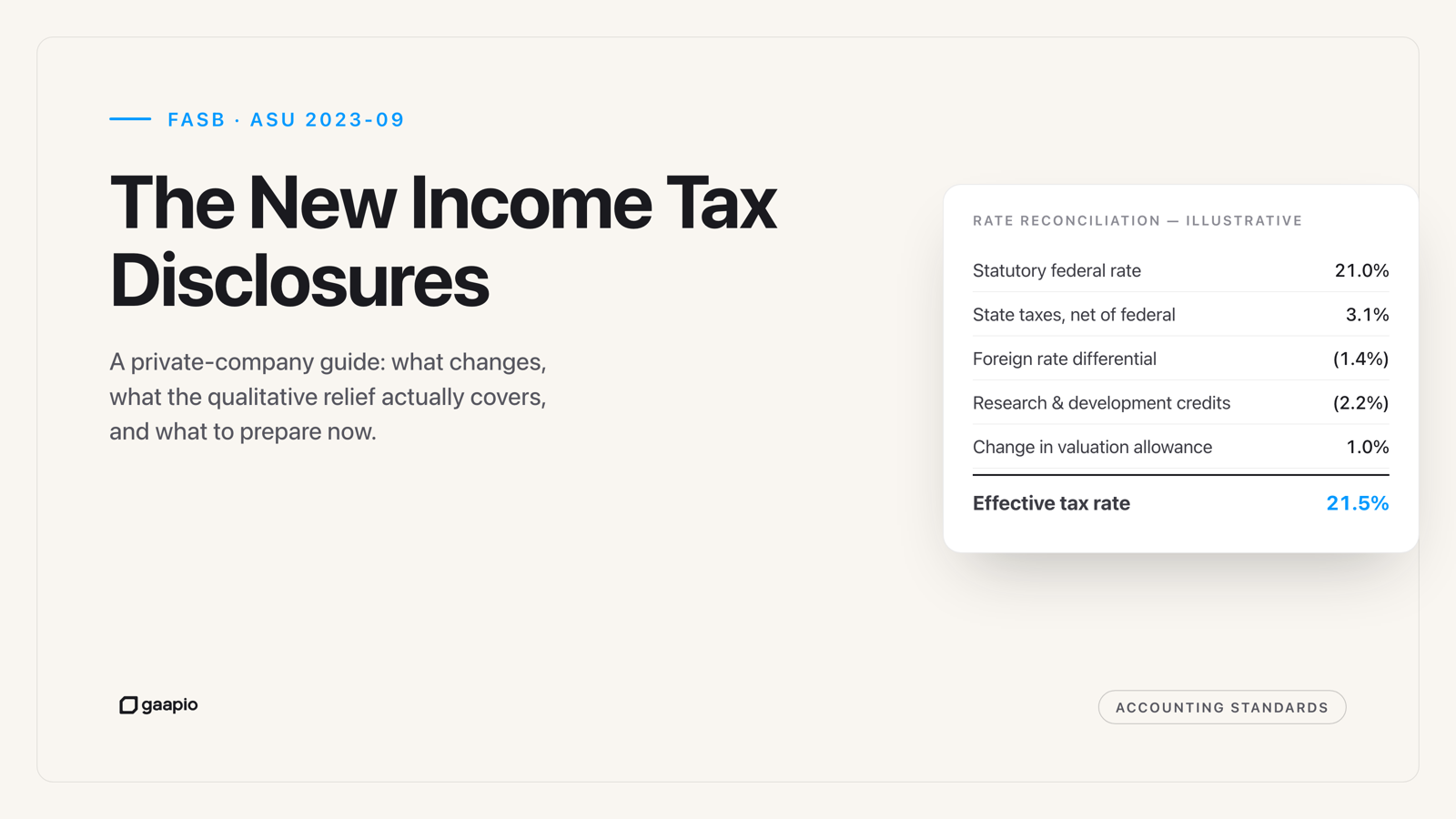
ASU 2023-09 is effective for private companies in annual periods beginning after December 15, 2025 — fiscal 2026 for a calendar-year filer. Private companies are exempt from the tabular rate reconciliation but must still disclose income taxes paid, disaggregated by federal, state and foreign jurisdiction, with any jurisdiction at 5% or more shown separately.
Most coverage of ASU 2023-09 targets public filers, who adopted a year earlier. That's not wrong — it's just answering a different question than the one a private-company controller is actually asking. This guide covers what changes for entities other than public business entities: where the relief actually applies, and where it does not.
Who has to adopt, and when
| Effective for annual periods beginning after | Calendar-year filer adopts in | |
|---|---|---|
| Public business entities | December 15, 2024 | Fiscal 2025 |
| All other entities | December 15, 2025 | Fiscal 2026 |
Early adoption is permitted. The amendments are applied prospectively, and retrospective application is also permitted.
The practical consequence: you're inside the first adoption year right now. The disclosure is due with your fiscal 2026 financials. The data collection problem starts well before that. That's the part worth acting on today.
What actually changed
ASU 2023-09 makes two headline changes to ASC 740 disclosure. Plus a third that gets less attention — and applies to everyone.
1. The effective tax rate reconciliation
Public business entities must now present an annual tabular rate reconciliation in both reporting-currency amounts and percentages, disaggregated into eight specified categories:
- State and local income tax, net of federal (national) income tax effect
- Foreign tax effects
- Effect of changes in tax laws or rates enacted in the current period
- Effect of cross-border tax laws
- Tax credits
- Changes in valuation allowances
- Nontaxable or nondeductible items
- Changes in unrecognized tax benefits
Within those categories, individual reconciling items must be broken out further when their effect meets or exceeds a quantitative threshold: 5% of pretax income or loss from continuing operations multiplied by the applicable statutory income tax rate of the jurisdiction of domicile.
2. Income taxes paid
All entities — public and private alike — must annually disclose income taxes paid, net of refunds received, disaggregated by federal (national), state, and foreign jurisdiction. Individual jurisdictions representing 5% or more of total income taxes paid must be presented separately.
3. Disaggregation of pretax income and tax expense
Less discussed, and it also applies to all entities: income or loss from continuing operations before income taxes must be disaggregated between domestic and foreign, and income tax expense or benefit from continuing operations must be disaggregated by federal, state and foreign.
The ASU also removes two previously required disclosures. Entities no longer have to disclose the nature and estimate of the range of reasonably possible change in unrecognized tax benefits within the next twelve months, or the cumulative amount of temporary differences for which a deferred tax liability has not been recognized under the subsidiary/corporate-joint-venture exception. Worth confirming which of your existing footnote language is no longer required before carrying it forward out of habit — and note that Topic 275, Risks and Uncertainties, can still require a similar disclosure on its own terms even where the ASC 740-specific requirement has been removed.
What private companies do differently — and what they do not
Most summaries compress this into something misleading. The relief is real. It's narrower than “private companies are exempt.”
The relief: entities other than public business entities are not required to produce the numerical tabular rate reconciliation. Instead they qualitatively disclose the nature and effect of the specific categories of reconciling items, and the individual jurisdictions, that result in a significant difference between the statutory rate and the effective rate.
What is not relieved: the income taxes paid disaggregation, and the disaggregation of pretax income and tax expense. Those apply to all entities, in full, including the 5% jurisdiction threshold.
In practice this reverses which requirement is harder for a private company. The rate reconciliation — the part that generated most of the commentary — becomes a narrative disclosure you can draft. The income taxes paid disaggregation becomes a data problem, and it is frequently the one that surfaces late.
The reason is mundane. Cash tax payments are often tracked at a level of aggregation that does not cleanly separate federal from state, or one state from another, particularly where payments are made through a combined return or netted against refunds. Producing the disclosure is straightforward once the data exists in the right shape. Reconstructing a year of payment detail in the middle of an audit is not.
What public companies learned in year one
Public companies already went through this — a year ahead of you, filing their first ASU 2023-09 disclosures in early 2026. That's not just history. It's a preview of the judgment calls you're about to make, before you have to make them cold.
The headline lesson, per BDO's review of first-year filings: materiality still governs. In March 2026, SEC Chief Accountant Kurt Hohl reinforced that the rate-reconciliation categories carry what he called an “overriding premise of materiality” — a reconciling item can technically cross the 5% threshold and still not need its own line if it isn't material to a reasonable investor. Hitting the mechanical threshold is not, by itself, the test.
Two other patterns showed up across filers. Companies that adopted retrospectively (restating prior years) got cleaner comparability out of the gate; companies that went prospective had a simpler first year and a harder second one. And the standard's use of “may” for how current-year unrecognized tax benefits get categorized — versus more prescriptive treatment for prior-year UTBs — produced real inconsistency across filers, with most eventually settling on single-line reporting.
None of this changes what a private company has to disclose. It does mean the qualitative judgment calls in the section above — what counts as a “significant difference,” how much foreign-jurisdiction detail is warranted — are not a blank page. A year of public-company precedent already exists to calibrate against.
What to do before year end
- Pull a full year of cash tax payments and test whether you can split them. Federal, state-by-state, and foreign, net of refunds received. If the answer is “not without manual work,” that is the finding, and there is still time to fix the coding rather than the disclosure.
- Run the 5% jurisdiction test against last year's numbers. It tells you which jurisdictions will need separate presentation before you are under deadline. Most private companies find the list is shorter than expected — which is itself useful to know early.
- Check whether you can disaggregate pretax income between domestic and foreign. Same data question, different report. If you have foreign operations, do this now.
- Draft the qualitative rate reconciliation narrative now, using prior-year figures. It will not be final, but the structure will hold, and it is far easier to update a draft than to write one during close.
- Decide who signs off. Qualitative disclosure means judgment about what constitutes a significant difference. That judgment should be documented, not improvised in a footnote review.
- Talk to your auditor about expectations before fieldwork. First-year adoption of a disclosure standard is exactly where expectations diverge quietly.
Gaapio's citations actually check out against the Codification — which matters enormously when you have to stand behind a position in front of your auditors.
— Controller, CPA
One of our preparers did three or four footnote disclosures she felt pretty comfortable in — she really loved that it didn't just cite the FASB, it gave a direct link back to the FASB.
— CFO · July 2026
Neither of those quotes is about speed. They're about the citation holding up. For a disclosure standard built on judgment calls, that's the part that actually matters.
Frequently asked questions
When does ASU 2023-09 take effect for private companies?
Annual periods beginning after December 15, 2025. A calendar-year private company adopts for its fiscal 2026 annual financial statements. Early adoption is permitted.
Do private companies have to produce the tabular rate reconciliation?
No. Entities other than public business entities may provide a qualitative disclosure in lieu of the numerical tabular reconciliation — describing the nature and effect of the categories of reconciling items and the individual jurisdictions that drive a significant difference between the statutory and effective rates.
Does the income taxes paid disclosure apply to private companies?
Yes, in full. This is the requirement most private companies underestimate, because it is a data-availability problem rather than a drafting problem.
What is the 5% threshold?
Two separate tests use 5%. For the rate reconciliation, items are disaggregated further when their effect meets or exceeds 5% of pretax income or loss from continuing operations multiplied by the applicable statutory rate of the jurisdiction of domicile. For income taxes paid, individual jurisdictions at 5% or more of the total are presented separately.
Is the standard applied prospectively or retrospectively?
Prospectively, with retrospective application permitted.
Did ASU 2023-09 remove any disclosure requirements?
Yes. It eliminates the requirement to disclose the nature and estimate of the range of reasonably possible change in unrecognized tax benefits within twelve months, and the requirement to disclose the cumulative amount of temporary differences for which a deferred tax liability has not been recognized under the subsidiary/corporate-joint-venture exception. Worth checking before carrying existing footnote language forward.
Does ASU 2023-09 require disaggregating pretax income by domestic and foreign?
Yes, for all entities. Income or loss from continuing operations before income taxes must be disaggregated between domestic and foreign, and income tax expense or benefit must be disaggregated by federal, state and foreign — a requirement that applies alongside the income-taxes-paid disclosure and is not part of the private-company relief.
Does adopting ASU 2023-09 change how much tax we owe?
No. ASU 2023-09 is a disclosure standard. It changes what you tell readers of the financial statements about income taxes; it does not change recognition or measurement under ASC 740.
ASU 2023-09 doesn't ask you to know more tax law. It asks you to document the judgment calls you're already making. Do that now, and year end is a formality. Don't, and it's a fire drill.

Zack Larsen, CPA — CEO & Co-Founder, Gaapio
Zack co-founded Gaapio after a career spanning Big 4 audit and accounting software development, with a focus on technical standards including ASC 606 and ASC 842. He writes about how AI fits into technical accounting without compromising the judgment the profession is built on.
Working through first-year adoption?
Gaapio drafts the disclosure, traces every conclusion back to the Codification, and shows the citation trail your reviewer will ask for. Built by CPAs, for CPAs. Request a Demo or Talk to a CPA.
Related
- Footnote disclosures & benchmarking
- Technical accounting memos
- Solutions for private companies
- SEC comment letters
Sources: FASB Accounting Standards Update No. 2023-09, Income Taxes (Topic 740): Improvements to Income Tax Disclosures, issued December 14, 2023. Effective dates and transition per the ASU. This article is general information, not accounting advice for a specific entity.