

The deal closed in March. In October, the auditor asks to see the purchase price allocation, and the finance team realizes the valuation report, the purchase agreement and the memo each say something slightly different about what was acquired.
Purchase price allocation (PPA) under ASC 805 is the work of splitting what you paid across what you got: every identifiable asset and liability at fair value, then goodwill for the rest. This guide covers the first call (business combination or asset acquisition), the acquisition method, identifying and valuing intangibles, goodwill and bargain purchases, the measurement period, contract assets and liabilities under ASU 2021-08, and the disclosures. It ends with a worked example: one illustrative acquisition with the PPA table, the journal entry and a measurement-period adjustment.
Key takeaway: ASC 805 requires a business combination to be accounted for under the acquisition method. The acquirer recognizes the identifiable assets acquired and liabilities assumed at their acquisition-date fair values (with a short list of exceptions), then recognizes goodwill as the excess of consideration over those net assets, or a gain if the deal is a bargain purchase. Before any of that, the screen test decides whether the deal is a business at all. If it is not, it is an asset acquisition: no goodwill, transaction costs capitalized, and a relative fair value allocation. Provisional amounts can be adjusted during a measurement period of up to one year. Since ASU 2021-08, acquired contract assets and contract liabilities follow ASC 606 rather than fair value.
What is purchase price allocation under ASC 805?
Purchase price allocation is the process of assigning the cost of an acquisition to the assets acquired and liabilities assumed. Under ASC 805 (Business Combinations), the acquirer measures the identifiable assets and liabilities at fair value on the acquisition date and records goodwill as the residual. The allocation drives the opening balance sheet, the amortization that follows, and the goodwill that is later tested under ASC 350-20.
You will also see "PPA accounting," "acquisition accounting," "purchase accounting" and "business combination accounting." They describe the same exercise. The fair value work itself follows ASC 820, which is why a PPA is only as good as the inputs behind the valuation.
For a short definition, see Gaapio's glossary entries on purchase price allocation and what ASC 805 is. For how Gaapio supports the work, see purchase accounting.
Is it a business combination or an asset acquisition? How does the screen test work?
A transaction is a business combination only if the assets acquired and liabilities assumed constitute a business. ASC 805-10-55-5A starts with a screen: if substantially all of the fair value of the gross assets acquired is concentrated in a single identifiable asset or a group of similar identifiable assets, the set is not a business and the deal is an asset acquisition. ASU 2017-01 introduced the screen to narrow the definition of a business. Practice generally reads "substantially all" as about 90 percent, though the Codification gives no bright line.
Gross assets for the screen exclude cash and cash equivalents, deferred tax assets, and goodwill that results from the effects of deferred tax liabilities. "Similar" matters. A building and the in-place lease intangibles on it are treated as a single identifiable asset. A customer relationship and developed technology are not similar, because they are different major intangible classes.
If the screen is not met, you move to the second test: does the set include an input and a substantive process that together significantly contribute to the ability to create outputs?
- No outputs yet (for example, an early-stage company): the set needs an organized workforce with the skills and experience to perform a process that is critical to creating outputs, plus an input that workforce can apply that process to.
- Outputs exist: the set needs either an organized workforce that performs a process critical to continuing to produce outputs, or an acquired process that significantly contributes to continuing to produce outputs and is unique or scarce, or cannot be replaced without significant cost, effort or delay. An acquired contract is an input, not a process, unless it gives access to an organized workforce.
The analysis looks at what was acquired. It does not depend on how the seller operated the set or how the buyer intends to use it, and after ASU 2017-01 you do not ask whether a market participant could replace missing inputs or processes.
Why does the answer matter so much?
Because the two models produce different balance sheets. The conclusion changes goodwill, transaction costs, contingent consideration and deferred taxes.
| Business combination (ASC 805-10, 805-20, 805-30) | Asset acquisition (ASC 805-50) | |
|---|---|---|
| Goodwill | Recognized as the residual | Not recognized |
| Measurement of assets | Identifiable assets and liabilities at fair value (with exceptions) | Cost allocated by relative fair value |
| Transaction costs | Expensed as incurred | Capitalized as part of the cost |
| Contingent consideration | Fair value at the acquisition date, part of consideration | Generally recognized under other GAAP, often when probable and estimable or when resolved, unless it is a derivative under ASC 815 |
| In-process R&D | Capitalized as an indefinite-lived intangible until completed or abandoned | Expensed at acquisition unless it has an alternative future use |
| Deferred taxes | Recognized for temporary differences, with goodwill absorbing the effect | Recognized using the simultaneous equation, with no goodwill to absorb it |
| Measurement period | Up to one year | None |
Document the screen conclusion when the deal closes, with the numbers behind it. It is a judgment an auditor will test, and rebuilding it a year later from a data room you no longer have clean access to is how backlogs form.
What are the steps of the acquisition method?
ASC 805-10-05-4 and 805-10-25 lay out four steps. They are: identify the acquirer, determine the acquisition date, recognize and measure the identifiable assets acquired, liabilities assumed and any noncontrolling interest, and recognize and measure goodwill or a gain from a bargain purchase.
- The acquirer is the entity that obtains control. In most deals it is obvious. In reverse acquisitions, in combinations of similar-sized companies and in acquisitions of a variable interest entity (VIE), it takes real analysis. ASU 2025-03 changes how to identify the accounting acquirer when a transaction is primarily effected by exchanging equity interests and the legal acquiree is a VIE that meets the definition of a business: the primary beneficiary is no longer automatically the acquirer, and the ASC 805-10-55-12 through 55-15 factors apply. It is effective for annual periods beginning after December 15, 2026, including interim periods, applied prospectively. Early adoption is permitted.
- The acquisition date is the date the acquirer obtains control, usually the closing date. Everything is measured as of that date.
- Consideration transferred is measured at fair value and can include cash, other assets, equity issued, and contingent consideration. Payments that are really compensation for future services, such as some retention arrangements, are expensed over the service period instead.
- Noncontrolling interest, if any, is measured at acquisition-date fair value. (IFRS 3 allows a proportionate-share option. US GAAP does not.)
- Previously held equity interest, in a step acquisition, is remeasured to fair value with any gain or loss in earnings, and is added to consideration in the goodwill calculation.
How do you recognize and measure identifiable assets and liabilities?
The recognition principle is that the acquirer recognizes identifiable assets acquired and liabilities assumed if they meet the definition of an asset or a liability at the acquisition date (ASC 805-20-25-2). The measurement principle is fair value under ASC 820, measured from a market participant's perspective.
Two points surprise people:
- You recognize things the target never did. Internally generated customer relationships, a self-developed trade name and developed technology often sit nowhere on the target's balance sheet. They are on yours.
- Fair value is not the target's book value. Property and equipment, inventory and debt get stepped to fair value. Debt that has a below-market coupon becomes a discount.
Which items are exceptions to fair value?
ASC 805-20 carves out items that follow other guidance, including:
| Item | Measured under |
|---|---|
| Deferred income taxes | ASC 740 |
| Employee benefit arrangements | ASC 710, ASC 712 and ASC 715 |
| Share-based payment awards replaced by the acquirer | ASC 718 |
| Contract assets and contract liabilities from contracts with customers | ASC 606 (since ASU 2021-08) |
| Assets held for sale | ASC 360, at fair value less cost to sell |
| Indemnification assets | Same basis as the indemnified item, with a valuation allowance if needed |
| Leases where the target is lessee | ASC 842: lease liability at the present value of the remaining payments as if a new lease, with a right-of-use asset at the same amount adjusted for favorable or unfavorable terms |
| Reacquired rights | Value based on the remaining contractual term |
| Contingencies | At fair value if the acquisition-date fair value can be determined during the measurement period; otherwise recognized only if probable and reasonably estimable (ASC 450-20 criteria) |
If your PPA treats all of these at fair value, expect a comment.
What about the target's leases?
A lessee-target's leases are not carried over at the target's balance. The acquiree's lease classification is retained unless the lease is modified (ASC 805-20-25-8A). The acquirer remeasures the lease liability at the present value of the remaining lease payments, as if the acquired lease were a new lease at the acquisition date, using the acquirer's incremental borrowing rate unless the rate implicit in the lease is readily determinable. The right-of-use asset equals that liability, adjusted for any favorable or unfavorable terms against market. The acquirer may elect not to recognize leases with a remaining term of 12 months or less at the acquisition date.
How do you identify and value intangible assets?
An intangible asset is identifiable if it arises from contractual or other legal rights, or if it is separable (capable of being sold, licensed, rented or exchanged). If it meets either test, it is recognized separately from goodwill. ASC 805 has no separate reliability threshold.
The categories in ASC 805-20-55 are marketing-related, customer-related, artistic-related, contract-based and technology-based. In practice, most technology and software deals produce a familiar list:
- Customer relationships (and customer contracts, backlog)
- Developed technology
- Trade names and trademarks
- Non-compete agreements, if legally enforceable. Check whether payments to sellers who become employees are really compensation for post-combination services (a separate transaction)
- In-process research and development (IPR&D)
- Favorable or unfavorable contract terms and other contract-based rights
What is not recognized separately?
Assembled workforce. It is part of goodwill, not an identifiable intangible. Do not put a value on it in the PPA, even though the buyer paid for it. A workforce also matters for the business-or-asset test, but it never appears as a line in the table.
Synergies and expected future customers. They are part of goodwill. Customer relationships cover the target's existing customers at the acquisition date, not the customers the combined company hopes to win.
How are intangibles valued?
ASC 805 requires fair value. It does not prescribe the technique. Valuation specialists commonly use these approaches, and they should be described in the memo along with the inputs:
| Intangible | Commonly used technique | Inputs to scrutinize |
|---|---|---|
| Customer relationships | Multi-period excess earnings method | Attrition rate, contributory asset charges, margins |
| Developed technology | Relief-from-royalty or multi-period excess earnings | Royalty rate, remaining useful life, obsolescence |
| Trade name | Relief-from-royalty | Royalty rate, expected duration of use |
| Non-compete | With-and-without | Probability of competition, ability to compete |
| IPR&D | Multi-period excess earnings or cost approach | Probability and timing of completion |
The accountant's job is to make sure the model reflects the facts in the purchase agreement and the forecast, that the discount rates reconcile (the weighted average return on assets should reconcile to the WACC and the deal's internal rate of return), and that the useful lives used for amortization match the cash flows used in the valuation. These are the points auditors and valuation specialists test.
How are they amortized?
Finite-lived intangibles are amortized over their useful lives under ASC 350-30, in the pattern in which the economic benefits are consumed (straight-line if the pattern cannot be reliably determined). IPR&D is indefinite-lived until the project is completed or abandoned. At completion, you assign a useful life and start amortization. If it is abandoned, you write it off.
What can private companies skip?
Private companies can elect an alternative under ASU 2014-18 (ASC 805-20-25-29 through 25-33) not to recognize separately certain customer-related intangibles (those that cannot be sold or licensed independently of the business) and non-compete agreements. Those amounts fold into goodwill. The election requires also adopting the private company alternative to amortize goodwill, generally over 10 years or less, under ASC 350-20. The election applies to all future business combinations and cannot be made case by case.
How do you account for goodwill and bargain purchases?
Goodwill is the excess of the sum of consideration transferred, the fair value of any noncontrolling interest, and the fair value of any previously held equity interest over the net identifiable assets acquired. It is a residual. It is not amortized (unless a private company or not-for-profit elects the amortization alternative) and is tested for impairment at least annually and when a triggering event occurs (see ASC 350-20 goodwill impairment). A goodwill balance includes the workforce, expected synergies and anything else that did not qualify for separate recognition.
The acquirer assigns goodwill to reporting units that are expected to benefit from the combination. That assignment is a decision made at acquisition. It drives later impairment testing, so write it down.
What is a bargain purchase?
If the net identifiable assets exceed the consideration (plus noncontrolling interest and previously held interest), the result is a bargain purchase. It is uncommon. Before recording a gain, ASC 805-30-25-4 requires the acquirer to reassess whether it correctly identified all of the assets acquired and liabilities assumed and to review the procedures used to measure each amount. If a gain still remains, it is recognized in earnings on the acquisition date, and the acquirer discloses the gain and why the transaction resulted in one.
A bargain purchase gain is a flag. Auditors and the SEC staff will ask what you missed, so the memo should say what was reassessed and what was found.
What is the measurement period, and how do measurement-period adjustments work?
The measurement period is the window in which the acquirer can adjust provisional amounts for information about facts and circumstances that existed at the acquisition date. It ends when the acquirer gets the information it was seeking or concludes it cannot get more, and it cannot exceed one year from the acquisition date (ASC 805-10-25-13 through 25-19).
If the accounting is incomplete by the end of the reporting period in which the deal closes, the acquirer reports provisional amounts for the incomplete items, and discloses which items are provisional and why.
What counts as a measurement-period adjustment?
Only changes based on facts that existed at the acquisition date. A late valuation report, a final working capital true-up, a more complete tax basis analysis and a newly discovered contract all qualify when they tell you something about acquisition-date conditions. Events after the acquisition date do not. A customer lost four months later, a forecast that was missed, or an earnout target met after closing are all post-combination events and do not adjust goodwill. They are accounted for under other GAAP, for example impairment testing for the intangibles or remeasurement of a liability-classified earnout through earnings.
How are the adjustments recorded?
ASU 2015-16 removed retrospective restatement. The acquirer records the adjustment in the period it is determined, along with the effect on earnings (extra or reduced depreciation and amortization, for example) calculated as if the adjustment had been made at the acquisition date. Earnings effects that relate to earlier periods are recognized in the current period, and the acquirer discloses the amount and the line items affected. Prior periods are not revised.
When the measurement period closes, the accounting is final. After that, only error corrections change acquisition-date amounts.
How does contingent consideration fit?
Contingent consideration is measured at fair value on the acquisition date and is part of consideration. Its classification as a liability or equity follows ASC 480 and ASC 815-40. A liability is remeasured to fair value each period through earnings, except when a change reflects new information about acquisition-date facts during the measurement period, which adjusts goodwill. A change because the target was hit or missed after closing is not a measurement-period adjustment. Equity-classified contingent consideration is not remeasured.
What did ASU 2021-08 change for contract assets and contract liabilities?
ASU 2021-08 requires the acquirer to recognize and measure acquired contract assets and contract liabilities (such as deferred revenue) in accordance with ASC 606, as if it had originated the contracts, instead of at fair value. It amended ASC 805-20.
Before the ASU, acquired deferred revenue was written down to fair value, usually the cost to fulfill plus a margin. That meant the acquirer recognized less revenue after the deal than the target would have. Under the ASU, the acquirer generally carries the contract liability at the amount the target recorded under ASC 606, unless the target's accounting had errors, used different policies, or was not on US GAAP (two practical expedients, for contract modifications and standalone selling price, are available), which keeps post-combination revenue closer to what the contract promised.
Details that matter:
- Effective dates. For public business entities, fiscal years beginning after December 15, 2022, including interim periods. For all other entities, fiscal years beginning after December 15, 2023. Early adoption was permitted. In 2026, every entity should be on the new model.
- Prospective application. It applies to business combinations occurring on or after the adoption date. Older deals were not restated.
- The acquirer needs the target's ASC 606 analysis. If the target did not follow ASC 606 at the acquisition date (a private target, for example), the acquirer measures what the contract balances would have been under ASC 606. That is not always a simple carryover.
- It reaches beyond SaaS. Contract assets and contract liabilities from any contract within ASC 606 (and contracts that apply it by reference, such as ASC 610-20) fall inside the ASU. Acquired trade receivables are still measured at fair value. Contract assets can be material for businesses that recognize revenue over time.
- Deferred tax effects. Any difference between the book and tax basis of the contract balances is recognized as a deferred tax asset or liability under ASC 740, separately from the contract balance.
What does a purchase price allocation look like? A worked example
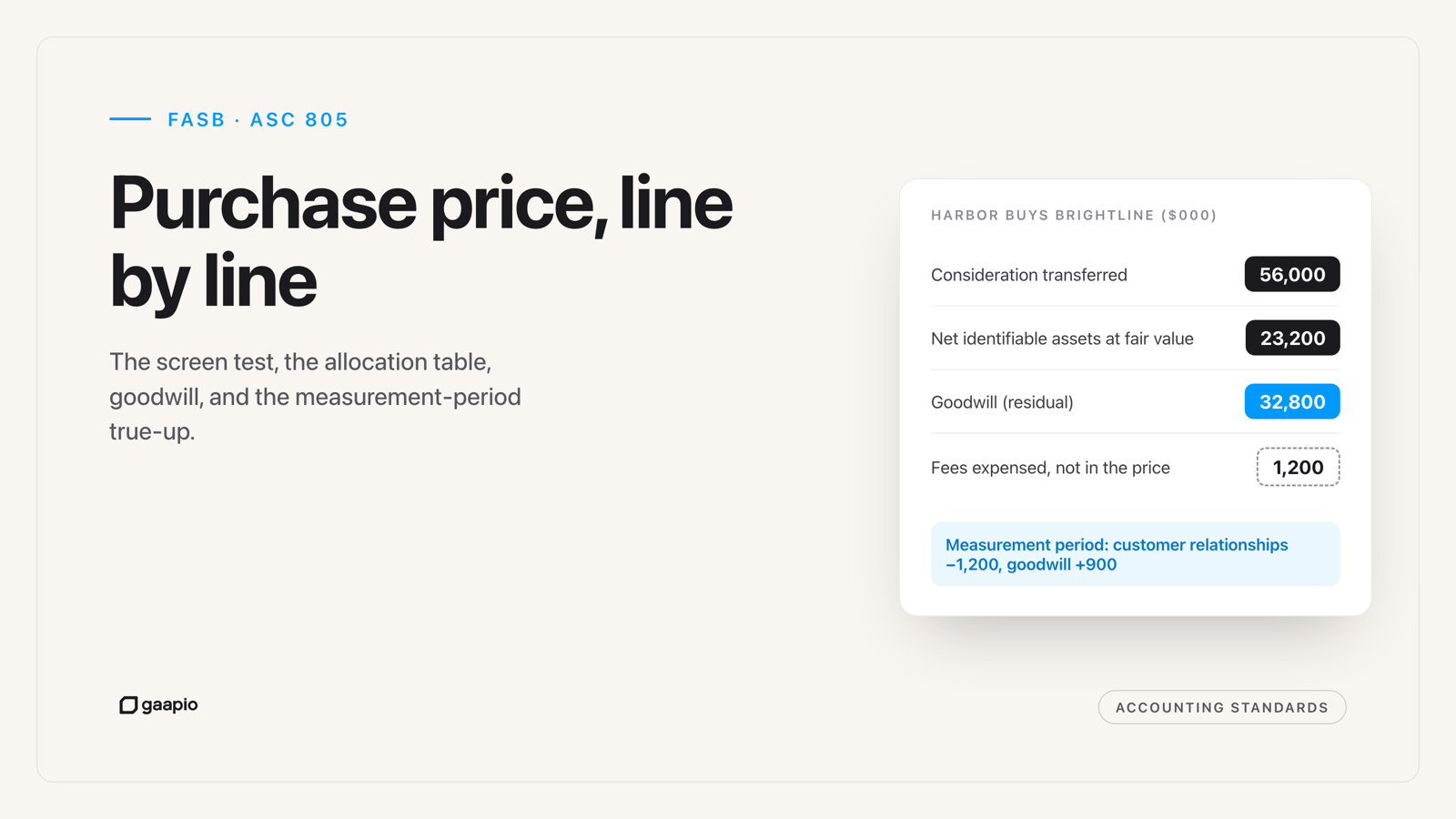
The company and all numbers below are illustrative. Harbor Industrial Corp. is a public company with a December 31 year end. On January 2, 2026, it buys 100 percent of Brightline Analytics, Inc., a privately held software company, from its shareholders. Amounts are in thousands.
Step 1: the screen. Gross assets for the screen are about $59,200: $56,000 of consideration plus $5,700 of liabilities assumed other than the deferred tax liability (leaving out the DTL is what removes the $7,000 of goodwill it creates), less $2,500 of cash. Developed technology, the largest asset, is about 24 percent of that. No single identifiable asset or group of similar assets holds substantially all of the fair value, so the screen is not met. Brightline has revenue, an assembled workforce and processes that are hard to replace, so it is a business and ASC 805 applies.
Step 2: consideration. Harbor pays $52,000 in cash at closing. It also agrees to an earnout of up to $8,000 payable if 2027 revenue exceeds a target. A probability-weighted valuation puts the fair value of the earnout at $4,000. Harbor classifies the earnout as a liability. Its legal and advisory fees are $1,200.
| Consideration transferred | Amount |
|---|---|
| Cash paid at closing | $52,000 |
| Fair value of contingent consideration (liability) | 4,000 |
| Total consideration | $56,000 |
The $1,200 of fees is expensed as incurred, outside consideration.
Step 3: the allocation. Harbor's valuation specialist delivers the following fair values as of January 2, 2026. Brightline's deferred revenue is measured under ASC 606 (ASU 2021-08). The deferred tax liability assumes a 25 percent rate on the book basis of the acquired intangibles, which have no tax basis in a stock purchase, and ignores other temporary differences.
| Purchase price allocation | Fair value |
|---|---|
| Cash | $2,500 |
| Accounts receivable | 3,100 |
| Property and equipment | 1,400 |
| Operating lease right-of-use asset | 900 |
| Developed technology (10-year life) | 14,000 |
| Customer relationships (10-year life) | 11,500 |
| Trade name (5-year life) | 1,800 |
| Non-compete agreements (3-year life) | 700 |
| Total identifiable assets acquired | 35,900 |
| Accounts payable and accrued liabilities | (2,600) |
| Operating lease liability | (900) |
| Contract liability (deferred revenue), under ASC 606 | (2,200) |
| Deferred tax liability ($28,000 of intangibles × 25%) | (7,000) |
| Total liabilities assumed | (12,700) |
| Net identifiable assets acquired | 23,200 |
| Total consideration | 56,000 |
| Goodwill | $32,800 |
Goodwill is $56,000 less $23,200 of net identifiable assets, or $32,800. Notice that the deferred tax liability is part of the reason goodwill is that large. Harbor recorded $28,000 of intangibles that have no tax basis, so the book basis creates a taxable temporary difference, and the DTL raises goodwill dollar for dollar.
Step 4: the journal entry at the acquisition date.
| Account | Debit | Credit |
|---|---|---|
| Cash | $2,500 | |
| Accounts receivable | 3,100 | |
| Property and equipment | 1,400 | |
| Right-of-use asset | 900 | |
| Developed technology | 14,000 | |
| Customer relationships | 11,500 | |
| Trade name | 1,800 | |
| Non-compete agreements | 700 | |
| Goodwill | 32,800 | |
| Accounts payable and accrued liabilities | $2,600 | |
| Lease liability | 900 | |
| Contract liability | 2,200 | |
| Deferred tax liability | 7,000 | |
| Contingent consideration liability | 4,000 | |
| Cash paid | 52,000 | |
| Total | $68,700 | $68,700 |
Separately, Harbor records $1,200 of acquisition-related costs as expense: debit acquisition costs $1,200, credit cash $1,200.
The first-year straight-line amortization on the finite-lived intangibles is $1,400 for developed technology, $1,150 for customer relationships, $360 for the trade name and $233 for the non-competes (rounded). Goodwill is not amortized. The $2,200 contract liability is recognized as revenue as Harbor performs.
Step 5: a measurement-period adjustment. Harbor reported provisional amounts in its first-quarter 10-Q. In the third quarter, the final valuation report arrives. Using information about the customer base that existed on January 2, the specialist lowers the fair value of customer relationships from $11,500 to $10,300, a reduction of $1,200. Nothing else changes. Because the fact pattern existed at the acquisition date, this is a measurement-period adjustment.
Harbor records it in the third quarter:
| Account | Debit | Credit |
|---|---|---|
| Deferred tax liability ($1,200 × 25%) | $300 | |
| Goodwill | 900 | |
| Customer relationships | $1,200 |
Goodwill rises from $32,800 to $33,700, and the DTL falls to $6,700. The net identifiable assets drop by $900, so goodwill takes the whole amount.
The lower base also changes amortization. Customer relationships now amortize at $1,030 a year instead of $1,150. Through September 30, nine months would have been $772.5 rather than $862.5, so Harbor records a $90 credit to amortization expense in the third quarter (debit accumulated amortization, credit amortization expense). Third-quarter amortization was initially recorded at the old rate, so the $90 is $60 for the first two quarters and $30 for the third. Harbor discloses the $60 that would have been recorded in the earlier quarters and the line item where it appears. This example ignores the tax effect of the catch-up.
What the reviewer checks.
- The table foots. Assets plus goodwill equal liabilities plus consideration ($68,700 on each side).
- The earnout. The $4,000 is in consideration. A later change in its fair value goes to earnings, except for acquisition-date information during the measurement period.
- The tax effect. Every intangible step-up has a matching DTL, and goodwill is computed after it.
- The lives. The useful lives match the valuation's cash flow periods.
- The fees. The $1,200 is in expense, not goodwill.
What does ASC 805 require you to disclose?
The disclosure objective is for users to evaluate the nature and financial effect of the business combination. The main requirements are in ASC 805-10-50, 805-20-50 and 805-30-50.
| Requirement | What to disclose |
|---|---|
| The deal | Name and description of the acquiree, acquisition date, percentage of voting equity interests acquired, and the primary reasons for the combination and how control was obtained |
| Goodwill | A qualitative description of the factors that make up goodwill, such as expected synergies and assembled workforce, the amount expected to be deductible for tax, and goodwill by reportable segment (ASC 805-30-50-1) |
| Consideration | Acquisition-date fair value of the total consideration and of each major class (cash, other assets, equity interests, contingent consideration) |
| Contingent consideration | The arrangement, the basis for determining the amount, and an estimate of the range of outcomes (or why one cannot be made) |
| Assets and liabilities | The amounts recognized for each major class of assets acquired and liabilities assumed |
| Receivables | Fair value of acquired receivables, gross contractual amounts, and the best estimate of the contractual cash flows not expected to be collected |
| Noncontrolling interest | The fair value of any noncontrolling interest and the valuation technique |
| Acquisition costs | The amount of acquisition-related costs and the income statement line item where they are recognized |
| Bargain purchase | The amount of the gain, the line item, and the reasons for the gain |
| Measurement period | For provisional items: which amounts are provisional and why. In later periods: the nature and amount of measurement-period adjustments |
| Public business entities | Revenue and earnings of the acquiree since the acquisition date, and supplemental pro forma revenue and earnings as if the deal had closed at the beginning of the comparable prior annual period, including material nonrecurring adjustments |
SEC registrants may also need audited financial statements of a significant acquiree (Regulation S-X Rule 3-05) and Article 11 pro forma information.
Individually immaterial business combinations that are material in the aggregate must be disclosed in the aggregate (ASC 805-10-50-3). The footnote has to reconcile to the balance sheet and to the cash flow statement, and acquisition-date cash is shown net in investing activities.
What does the footnote look like?
Using the example above, an illustrative disclosure reads:
On January 2, 2026, the Company acquired 100% of the outstanding equity interests of Brightline Analytics, Inc., a provider of analytics software, for total consideration of $56.0 million, consisting of $52.0 million in cash and contingent consideration with an acquisition-date fair value of $4.0 million. The contingent consideration is payable if 2027 revenue exceeds a specified target, with undiscounted payments ranging from zero to $8.0 million. The acquisition expands the Company's software offerings. Goodwill of $33.7 million, none of which is expected to be deductible for tax purposes, is attributable primarily to the acquired workforce and expected synergies. Acquisition-related costs of $1.2 million are included in general and administrative expense. The allocation of the purchase price was finalized in the third quarter of 2026; during the measurement period the Company reduced the fair value of customer relationships by $1.2 million, which increased goodwill by $0.9 million and reduced the deferred tax liability by $0.3 million.
Wording for your own filing depends on your facts. The table above becomes the "amounts recognized" disclosure.
Does the purchase price allocation for tax work the same way?
No. The book allocation under ASC 805 and the tax allocation are separate exercises. In a stock purchase without a Section 338 election, the target's tax basis carries over, which is why the example needs a deferred tax liability. In an actual asset purchase, the buyer and seller allocate the price among seven asset classes under Section 1060 using the residual method and each file Form 8594. A deemed asset purchase under a Section 338 or 336(e) election uses the same class system under the Section 338 regulations and is reported on Form 8883. Tax-deductible goodwill is amortized over 15 years under Section 197. Goodwill that is tax-deductible creates different deferred tax outcomes from goodwill that is not. Align book and tax at the start, because the deductibility of goodwill is a required disclosure and affects the deferred tax computation.
What do auditors and the SEC staff push on in purchase accounting?
- The screen conclusion. Was it documented with the fair values behind it, or only asserted?
- Valuation inputs. The auditor's specialist will test discount rates, attrition, royalty rates and projections. They need to tie to the deal model.
- Useful lives. Do they match the cash flows in the valuation, and are they consistent with the company's other intangibles?
- The earnout. Is it consideration or compensation? Is the classification supported by ASC 480 and ASC 815-40?
- Goodwill assignment. Are reporting units assigned and documented?
- Bargain purchases. What was reassessed?
- Measurement-period adjustments. Was the information about acquisition-date conditions? Are the amounts and line items disclosed?
- Cash flow classification. Acquisition cash is in investing, net of cash acquired. Earnout payments made soon after the acquisition date (generally within about three months) are investing. Later payments are financing up to the acquisition-date fair value (as adjusted in the measurement period), and any excess is operating.
How does Gaapio help with purchase accounting?
Gaapio is an AI-powered technical accounting platform built by CPAs. For an acquisition, it handles the ASC 805 analysis and documentation behind a purchase price allocation: the business combination screen, identifiable intangibles, contingent consideration and measurement-period adjustments. It produces a memo and disclosure with every conclusion cited to the Codification.
Gaapio does not produce a valuation. If you need a fair value opinion on customer relationships, you still need a valuation specialist. Gaapio works on everything around that engagement: the screen, the intangibles analysis that scopes the valuation, the consideration and contingent consideration accounting, the memo and the disclosure. You make the accounting calls.
See Gaapio's purchase accounting software, or use AI footnote disclosures for the disclosure side.
Want to see it on your own acquisition? Request a demo.
This article is general information, not accounting, tax or legal advice. Confirm the requirements for your facts against the Codification and with your auditor.
Frequently asked questions
What is purchase price allocation under ASC 805?
It is the assignment of the cost of an acquisition to the identifiable assets acquired and liabilities assumed at acquisition-date fair value, with any excess recorded as goodwill. It applies when the acquired set meets the definition of a business. If it does not, the deal is an asset acquisition and cost is allocated by relative fair value with no goodwill.
What is the screen test in ASC 805?
It is the first test of whether an acquired set is a business. If substantially all of the fair value of the gross assets acquired is concentrated in a single identifiable asset or a group of similar identifiable assets, the set is not a business. Gross assets exclude cash, deferred tax assets and goodwill from the effects of deferred tax liabilities. If the screen is not met, you assess whether there is an input and a substantive process.
What is the difference between a business combination and an asset acquisition?
A business combination uses the acquisition method: fair value allocation, goodwill, expensed transaction costs and a measurement period. An asset acquisition allocates cost by relative fair value, recognizes no goodwill, and capitalizes transaction costs. The treatment of contingent consideration, in-process R&D and deferred taxes also differs.
How do you calculate goodwill in a business combination?
Goodwill is the consideration transferred, plus the fair value of any noncontrolling interest and previously held equity interest, minus the net identifiable assets acquired at fair value. The deferred tax liability on intangible step-ups reduces the net identifiable assets and so increases goodwill.
What is a bargain purchase gain?
It is the excess of the net identifiable assets acquired over the consideration and other interests. Before recognizing it, the acquirer reassesses whether it identified all assets and liabilities and measured them correctly. A remaining gain is recognized in earnings on the acquisition date, with disclosure of the reasons.
How long is the measurement period?
It ends when the acquirer has the information it needs or learns it cannot get more, and it cannot exceed one year from the acquisition date. Adjustments are recognized in the period they are determined, and prior periods are not revised.
What did ASU 2021-08 change?
It requires acquired contract assets and contract liabilities to be measured under ASC 606 as if the acquirer had originated the contracts, instead of at fair value. It is effective for all entities in 2026, and it applies prospectively to business combinations on or after the adoption date.
Which intangible assets are recognized in a business combination?
Those that arise from contractual or legal rights or are separable: commonly customer relationships, developed technology, trade names, non-compete agreements and IPR&D. An assembled workforce is part of goodwill. Private companies can elect not to recognize certain customer-related intangibles and non-competes separately.
Are transaction costs capitalized in a business combination?
No. Acquisition-related costs are expensed as incurred in a business combination, except for the costs of issuing debt or equity securities, which follow other guidance. They are capitalized in an asset acquisition.
Related reading
- ASC 820 fair value measurement and disclosures
- Goodwill impairment test under ASC 350-20
- Purchase price allocation (glossary)
- What is ASC 805? (glossary)
- Purchase accounting software
Sources: FASB ASC 805-10, 805-20, 805-30 and 805-50, ASU 2017-01, ASU 2015-16, ASU 2014-18, ASU 2021-08 and ASU 2025-03; FASB, ASU 2021-08; FASB, ASU 2017-01; Deloitte, Roadmap: Business Combinations; PwC, Business combinations guide; KPMG, Handbook: Business combinations; BDO, Business combinations under ASC 805.