

Goodwill impairment testing is a fair value problem with a simple formula on top. The challenging part is the sentence in MD&A about how much room is left.
The test itself got easier in 2017. Since ASU 2017-04, one comparison does the work: fair value of the reporting unit against its carrying amount. What did not get easier is deciding what a reporting unit is, defending the fair value assumptions, and telling investors how close you are to a charge.
This guide covers the goodwill impairment test under ASC 350-20, from the qualitative assessment to the journal entry, and what the SEC expects in your critical accounting estimates. You get a worked example where a reporting unit fails the test, with the impairment capped at goodwill and a sample MD&A paragraph that discloses headroom. It's written by Jace Chambers, CPA, Gaapio's cofounder and CPO, with the Gaapio team of CPAs, who build technical accounting software for judgment calls like this one.
Key takeaway: Under ASC 350-20, a public company tests goodwill for impairment at least annually, and between annual tests when a triggering event makes impairment more likely than not. You may start with a qualitative assessment. If you run the quantitative test, you compare each reporting unit's fair value with its carrying amount, and any excess of carrying amount over fair value is the impairment loss, capped at the goodwill allocated to that unit. In MD&A, the SEC expects critical accounting estimate disclosure under Item 303(b)(3) of Regulation S-K, and the staff has asked for the percentage by which fair value exceeds carrying amount when a unit's fair value is not substantially in excess of its carrying amount.
This guide is general information about US GAAP and SEC rules, not accounting or legal advice. The FASB Accounting Standards Codification and Regulation S-K are the authoritative text, so check them and your auditor against your own facts.
What is the goodwill impairment test under ASC 350-20?
The goodwill impairment test is the evaluation ASC 350-20 requires to decide whether the goodwill on your balance sheet is still worth what you carry it for. Goodwill is not amortized for public business entities. Instead, you test it at the reporting unit level at least once a year, and again whenever events make it more likely than not that the unit's fair value is below its carrying amount.
Goodwill comes from a business combination, so the starting point is how you recorded the acquisition. Our ASC 805 glossary page covers how goodwill is measured at the acquisition date. This guide picks up after that, with the testing.
How does the one-step test work after ASU 2017-04?
You compare the fair value of a reporting unit with its carrying amount, including goodwill. If the carrying amount is higher, you record an impairment loss for the excess, limited to the total goodwill allocated to that reporting unit. That is the whole test.
ASU 2017-04 removed the old Step 2, which required you to measure the implied fair value of goodwill by running a hypothetical purchase price allocation. It took effect for SEC filers other than smaller reporting companies for tests in fiscal years beginning after December 15, 2019, and for all other entities in fiscal years beginning after December 15, 2022 (as deferred by ASU 2019-10). It is now effective for all entities.
Three details come with the single comparison:
- The cap. The loss can never exceed the goodwill allocated to the reporting unit. Any remaining shortfall is not recorded. The other assets in the unit are tested before goodwill, and they can pass their own tests even when the unit fails, because ASC 360-10 starts with an undiscounted recoverability test.
- Tax effects. If goodwill is tax deductible, consider the income tax effect on the carrying amount of the reporting unit when you measure the loss. That can create a circular calculation, so build it into the model from the start.
- Zero or negative carrying amounts. Before ASU 2017-04, a unit with a zero or negative carrying amount had to perform Step 2 if a qualitative assessment indicated an impairment was more likely than not. Now every reporting unit gets the same test, and a unit with a zero or negative carrying amount generally will not record an impairment. You disclose those units and the goodwill allocated to them.
| Before ASU 2017-04 | After ASU 2017-04 | |
|---|---|---|
| Steps in the quantitative test | Two | One |
| How the loss is measured | Carrying amount of goodwill minus implied fair value of goodwill | Carrying amount of the reporting unit minus its fair value |
| Cap | Carrying amount of the unit's goodwill | Unchanged: goodwill allocated to the reporting unit |
| Zero or negative carrying amount units | Separate qualitative path | Same test, with a disclosure |
Can you skip the quantitative test with a qualitative assessment?
Yes. ASC 350-20-35-3A through 35-3G let you start with a qualitative assessment, often called Step 0. If, after weighing the relevant events and circumstances, you conclude it is not more likely than not (a likelihood of 50% or less) that a reporting unit's fair value is below its carrying amount, you stop. There is no quantitative test that year for that unit.
If you conclude it is more likely than not, you run the quantitative test. You can also skip the qualitative assessment in any period and go straight to the quantitative test, then return to the qualitative assessment in a later period.
The qualitative route works best for units with plenty of headroom from a recent quantitative test and no adverse changes. It works poorly for units that barely passed last time. Your documentation should say which facts you weighed and why they led where they did, because your auditor will read it.
What is a reporting unit, and how do you identify one?
A reporting unit is an operating segment or one level below an operating segment, called a component. A component is a reporting unit when it is a business, discrete financial information is available, and segment management regularly reviews its operating results. ASC 350-20-35-33 through 35-38 set out the rules, including when components with similar economic characteristics must be aggregated into one reporting unit.
The reporting unit structure drives everything that follows, because goodwill is assigned to the units expected to benefit from the combination and tested one unit at a time. A coarse structure can hide a weak business inside a strong one. The SEC staff has questioned how registrants identified their reporting units, so the reasoning for your units should be written down and revisited when you reorganize.
Assets and liabilities used in the operations of a reporting unit get assigned to it. So does goodwill. If you reorganize in a way that changes your reporting units, goodwill is reassigned using a relative fair value approach.
When do you test goodwill: annually or after a triggering event?
You test annually, at the same time each year, and you also test between annual tests when an event makes it more likely than not that a reporting unit's fair value is below its carrying amount. Different reporting units can be tested on different dates, as long as each keeps the same date every year. That is ASC 350-20-35-28 and 35-30.
ASC 350-20-35-3C lists the kinds of events and circumstances to weigh, including:
- Macroeconomic conditions, such as a deterioration in the economy or credit markets
- Industry and market changes, including increased competition
- Cost increases that hurt earnings
- Overall financial performance, such as declining cash flows or missed forecasts
- Entity-specific events, such as a loss of key personnel or customers
- Events affecting a reporting unit, such as a change in the composition of its net assets or a more-likely-than-not expectation of selling or disposing of it
- A sustained decrease in your share price
A market capitalization below book value is a trigger auditors and the SEC staff raise often. It does not force an impairment, but auditors and the staff commonly expect you to reconcile the sum of your reporting unit fair values to your market capitalization and explain the difference, including any control premium.
Order of testing. When goodwill and other assets in the reporting unit are tested for impairment at the same time, test the other assets first (ASC 350-20-35-31). Other assets, such as indefinite-lived intangibles and long-lived assets under ASC 360-10, come before goodwill, because goodwill is tested against a carrying amount that should already reflect any impairment of those assets.
What does a goodwill impairment test look like with real numbers?
A reporting unit fails the quantitative test, the loss is the excess of carrying amount over fair value, and the entry reduces goodwill. Here is that sequence for a fictional company, Northfield Industries, a US public company with a December 31 year end and three reporting units. All figures are illustrative.
What are the facts?
Northfield tests goodwill annually as of November 1. In late October 2026, a large customer of its Precision Components unit moved volume to a competitor, and the unit's forecast was cut. Because the annual test date was days away, Northfield performed its annual test as of November 1, 2026, skipped the qualitative assessment, and ran the quantitative test on all three units, with the reduced forecast reflected in the Precision Components model. It tested the other assets in each unit first and found no impairment.
Fair value was estimated with a discounted cash flow model and cross-checked with market multiples. Both are Level 3 fair value measurements under ASC 820, because the key inputs (projected cash flows, the discount rate, the terminal growth rate) are unobservable. The sum of the unit fair values was reconciled to Northfield's market capitalization, and the difference was explained by a control premium.
Goodwill is not tax deductible for any of the three units, so there is no tax effect to build into the carrying amounts.
What are the test results?
| Amounts in millions | Precision Components | Fluid Systems | Distribution |
|---|---|---|---|
| Carrying amount (including goodwill) | $310.0 | $400.0 | $180.0 |
| Goodwill allocated | $85.0 | $120.0 | $30.0 |
| Fair value | $262.0 | $456.0 | $252.0 |
| Fair value minus carrying amount | ($48.0) | $56.0 | $72.0 |
| Headroom (fair value above carrying amount, as a % of carrying amount) | (15.5%) shortfall | 14% | 40% |
| Impairment loss | $48.0 | $0 | $0 |
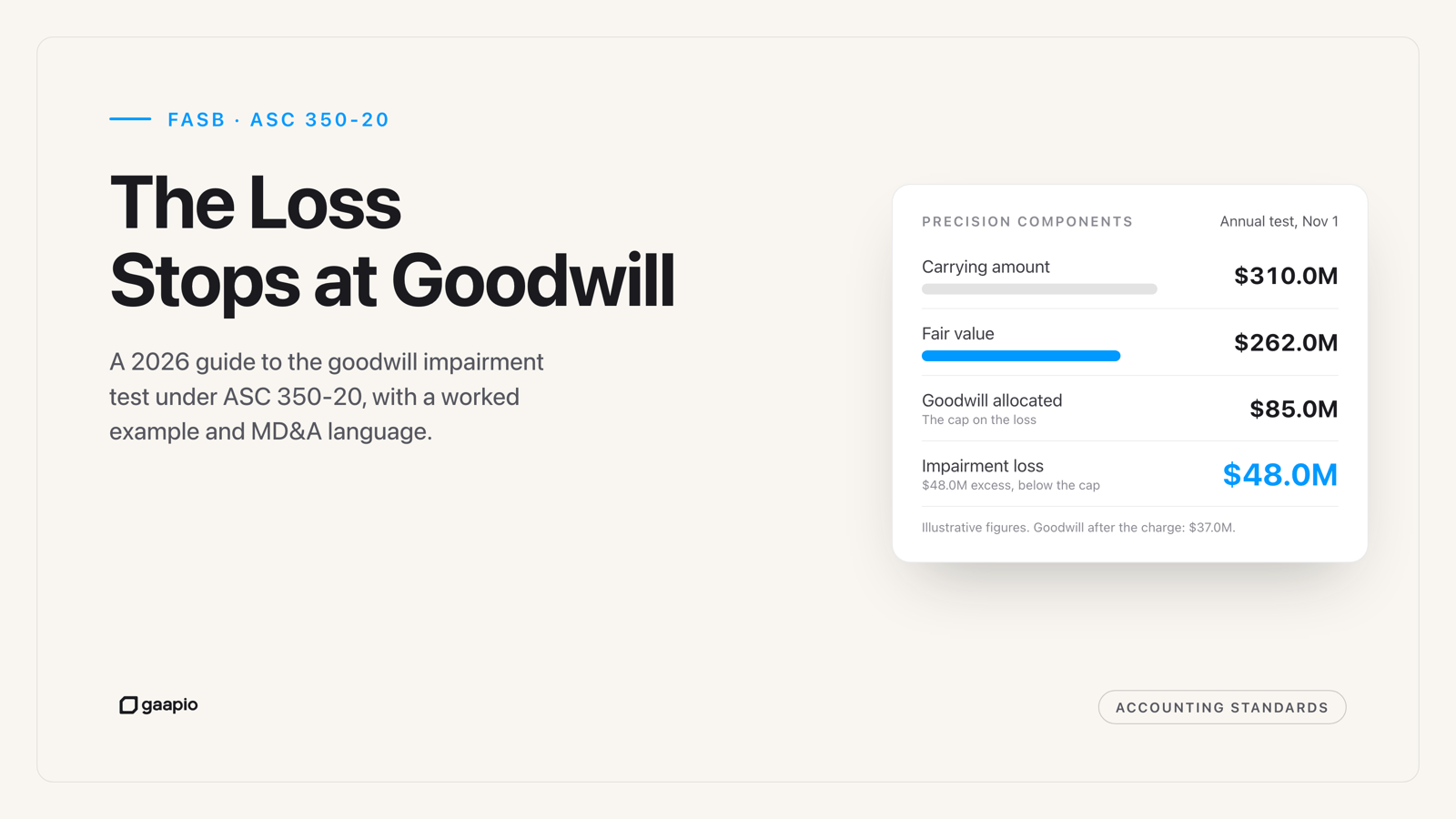
Precision Components fails. The carrying amount of $310.0 exceeds fair value of $262.0 by $48.0. That is less than the $85.0 of goodwill allocated to the unit, so the loss is $48.0 and goodwill in the unit falls to $37.0.
Fluid Systems and Distribution pass. Fluid Systems passes by $56.0, or 14% of its carrying amount. That is positive, and it is also close enough that investors would want to know about it, which matters in the MD&A section below.
What if the shortfall were larger than the goodwill?
Suppose Precision Components' fair value had come in at $200.0. The carrying amount would exceed fair value by $110.0, but the loss is capped at the $85.0 of goodwill. Northfield would write goodwill in the unit to zero and record $85.0.
The remaining $25.0 shortfall is not recorded as a goodwill loss. The other assets were tested first and can pass even when the unit fails, because ASC 360-10 starts with an undiscounted recoverability test. It is also a reason to revisit the fair value assumptions, because a gap that large between the unit's value and its book value usually means something else has changed.
What is the journal entry?
Northfield records the Precision Components loss in the fourth quarter of 2026:
Dr  Goodwill impairment loss       48,000,000
    Cr  Goodwill                                  48,000,000
Goodwill drops from $235.0 to $187.0 across the three units ($37.0 in Precision Components, $120.0 in Fluid Systems and $30.0 in Distribution). The loss is presented as a separate line item in the income statement, before the subtotal for income from continuing operations, and it is a noncash charge. It is not reversed if fair value recovers.
If goodwill had been tax deductible, the deferred tax effect would change the loss. The impairment lowers the book basis of goodwill below its tax basis. That increases the deferred tax asset (or reduces the deferred tax liability), which raises the unit's carrying amount and requires a larger loss. Solving for both at once is the circular calculation noted earlier.
What is the headroom after the charge?
After the charge, the Precision Components carrying amount equals its fair value at $262.0. Headroom is zero by construction, so any further decline in the forecast can cause another charge. That is exactly the kind of fact that investors need in MD&A.
What does the private company alternative change?
Private companies and not-for-profits can elect accounting alternatives that make goodwill much simpler. Public business entities cannot use them.
- Amortization (ASU 2014-02). Amortize goodwill on a straight-line basis over 10 years or less. A shorter life is allowed if you can demonstrate a better fit. You then test goodwill for impairment only when a triggering event occurs, and you can test at the entity level instead of the reporting unit level.
- Triggering event timing (ASU 2021-03). Evaluate whether a triggering event exists only as of the end of each reporting period, interim or annual, instead of monitoring throughout the period. The ASU was issued in March 2021 and is effective for fiscal years beginning after December 15, 2019, with the option available prospectively. It does not require additional disclosure beyond the existing requirements, but the election should appear in your accounting policy note.
The two elections are separate. If you elect the ASU 2021-03 alternative without electing amortization, you still run the annual test, and if your annual test date is not your period end, you still evaluate triggering events at each reporting date between annual tests.
Plan for the exit. If a private company later becomes a public business entity, the alternatives are not available to public business entities, so it generally must remove their effects from the historical financial statements, retrospectively and without hindsight. That is worth knowing before an IPO or a sale to a public acquirer. The same applies if a private company's financial statements are included in another company's SEC filing, for example as a significant acquiree under Rule 3-05 of Regulation S-X, because it is then a public business entity for that purpose.
What do you disclose about goodwill in the financial statements?
ASC 350-20 sets the disclosures, and the balance sheet and the rollforward carry most of them.
- Presentation. Present goodwill as a separate line item (ASC 350-20-45-1), and show the aggregate impairment loss as a separate line item in the income statement (ASC 350-20-45-2).
- Rollforward. ASC 350-20-50-1 requires a reconciliation of the carrying amount of goodwill from the beginning to the end of the period. Entities that report segment information under ASC 280 also present it for each reportable segment, with the gross amount, accumulated impairment losses, additions, impairment losses and other changes such as foreign currency translation.
- Impairment loss. For each period with an impairment, ASC 350-20-50-2 asks for a description of the facts and circumstances that led to it, the amount, and the method used to determine fair value. If the loss is an estimate that is not yet finalized, disclose that fact and the reasons, and in later periods the nature and amount of significant adjustments.
- Zero or negative carrying amount units. Disclose each such unit, the goodwill allocated to it, and the reportable segment it belongs to (ASC 350-20-50-1A).
Fair value measurement and its Level 3 disclosures are a separate topic under ASC 820. For practical help with the notes themselves, see our footnote disclosures page.
What does the SEC expect in MD&A for goodwill impairment?
The SEC expects MD&A to explain goodwill when it involves a critical accounting estimate, which it often does for companies with significant goodwill. Item 303(b)(3) of Regulation S-K defines critical accounting estimates as those that involve a significant level of estimation uncertainty and have had or are reasonably likely to have a material impact on financial condition or results of operations. It asks for the qualitative and quantitative information necessary to understand the estimation uncertainty and its impact.
That means explaining why the estimate is subject to uncertainty and, where material and reasonably available, how much it has changed over a relevant period and how sensitive the reported amount is to the methods, assumptions and estimates behind it. The SEC amended Item 303 in November 2020 (Release 33-10890). The Commission's 2003 interpretive guidance on MD&A, Release 33-8350 (FR-72), particularly Section V on critical accounting estimates, remains relevant to the extent it is consistent with the amended rules.
For goodwill, the staff's comment letters follow a pattern. When a reporting unit's fair value is not substantially in excess of its carrying amount, the staff has asked registrants to:
- Identify the reporting unit and the goodwill allocated to it
- Give the percentage by which fair value exceeded carrying amount at the most recent test
- Describe the key assumptions behind the fair value
- Discuss the uncertainty in those assumptions and the events that could hurt them
If no reporting unit is at risk, the staff has asked registrants to say so, for example by stating that the fair value of each reporting unit substantially exceeds its carrying amount. There is no codified percentage for "substantially." Some preparers treat 10% to 20% as a prompt to give more disclosure, but that is practice, not a rule.
Weak goodwill MD&A tends to fall into three groups: boilerplate that would fit any company, no headroom number for a unit that barely passed, and no link between the assumptions and what happened to the stock price or the forecast.
What does a critical accounting estimate paragraph look like?
Here is a sample for Northfield, using the numbers above. It is illustrative, and a real filing must reflect the company's own facts and its auditor's review.
Goodwill. We test goodwill for impairment annually as of November 1, and between annual tests when events or changes in circumstances indicate that it is more likely than not that the fair value of a reporting unit is below its carrying amount. We estimate fair value using a discounted cash flow model, corroborated by market multiples of comparable companies. The key assumptions are revenue growth, operating margin, the discount rate and the long-term growth rate. These assumptions require significant judgment and are sensitive to changes in market conditions and customer demand.
In the fourth quarter of 2026, we recorded a goodwill impairment charge of $48.0 million in our Precision Components reporting unit, following the loss of volume from a large customer and a reduction in the unit's forecast. After the charge, the carrying amount of the unit equals its fair value of $262.0 million, and $37.0 million of goodwill remains. Because there is no remaining headroom, further adverse changes to the forecast could result in additional impairment charges. A 1.0 percentage point increase in the discount rate (11.5% used) would reduce the unit's fair value by approximately $18 million, and a 0.5 percentage point decrease in the long-term growth rate (2.5% used) would reduce it by approximately $10 million, each of which could result in an additional impairment charge of a similar amount, limited to the $37.0 million of remaining goodwill.
The fair value of our Fluid Systems reporting unit, which has $120.0 million of goodwill, exceeded its carrying amount by approximately 14% at our most recent test. At our prior-year test, Fluid Systems' fair value exceeded its carrying amount by approximately 22%. The decrease reflects a higher discount rate and a lower near-term forecast. A 1.0 percentage point increase in its discount rate would reduce that headroom to approximately 6%. The fair value of our Distribution reporting unit, which has $30.0 million of goodwill, exceeded its carrying amount by approximately 40% at our most recent test.
Three things make this paragraph work. It names the unit and the goodwill, and it ties the assumptions to the numbers. It also tells the reader how much room is left in each case. A reader can see how close each unit is to a charge.
How does Gaapio handle goodwill impairment questions?
Gaapio is an AI-powered technical accounting platform built by CPAs. When a team brings a goodwill question to Gaapio, it asks follow-up questions about the facts before drafting. For goodwill, the facts that usually matter are how reporting units are defined, how recently the unit was tested, and what has changed since.
The draft is grounded in the licensed FASB Codification, with citations you can click. Your reviewer approves it in Gaapio's review workflow, and it ends up as an accounting memo with citations your auditor can trace. Your team still owns the judgment.
That documentation matters for goodwill, because the reporting unit structure, the decision to skip the qualitative assessment and the fair value assumptions are all judgment calls that get questioned a year later. For the habits behind a memo that holds up, see why technical accounting memos matter.
What should you do before your next goodwill test?
- List your reporting units, the goodwill assigned to each, and the date each is tested.
- For each unit, pull the headroom from the last quantitative test. Anything under about 20% needs a closer look.
- Document the triggering events you considered this period, including your share price against book value.
- Rerun the sensitivity on discount rate and growth for the units with the least headroom.
- Draft the critical accounting estimate paragraph before the quarter closes, not after the auditor asks.
Want to see how Gaapio drafts a goodwill memo? Request a demo and bring a real reporting unit.
Frequently asked questions
What is a goodwill impairment test?
A goodwill impairment test compares the fair value of a reporting unit with its carrying amount, including goodwill. If the carrying amount is higher, you record an impairment loss for the excess, up to the goodwill allocated to that unit. ASC 350-20 requires the test at least annually and when a triggering event occurs.
How often do you test goodwill for impairment?
At least once a year, on the same date each year for each reporting unit, and between annual tests when events make it more likely than not that a unit's fair value is below its carrying amount. Private companies that elect the ASU 2021-03 alternative evaluate triggering events only at the end of each reporting period.
What did ASU 2017-04 change about the goodwill impairment test?
It removed Step 2, the hypothetical purchase price allocation, so the impairment loss is now the excess of the reporting unit's carrying amount over its fair value, limited to the goodwill allocated to it. It also applies the same test to reporting units with zero or negative carrying amounts, with a disclosure.
What is the qualitative assessment for goodwill?
The qualitative assessment, or Step 0, lets you evaluate events and circumstances to decide whether it is more likely than not that a reporting unit's fair value is below its carrying amount. If it is not, you skip the quantitative test for that unit. You can bypass it in any period.
What is the journal entry for a goodwill impairment?
Debit goodwill impairment loss and credit goodwill, for the amount of the loss. The loss is the excess of the reporting unit's carrying amount over its fair value, capped at the unit's goodwill. If goodwill is tax deductible, the deferred tax effect is considered in the calculation.
What are triggering events for goodwill impairment?
ASC 350-20-35-3C lists macroeconomic conditions, industry and market changes, cost increases, declining financial performance, entity-specific events such as losing a key customer, and a sustained decrease in share price. A market capitalization below book value is one to take seriously, though it does not by itself require an impairment.
What does the SEC want in MD&A about goodwill?
Critical accounting estimate disclosure under Item 303(b)(3) of Regulation S-K: why the estimate is uncertain, how it has changed and how sensitive it is. For reporting units whose fair value is not substantially in excess of their carrying amounts, SEC staff comments have asked for the unit, its goodwill, the percentage by which fair value exceeds carrying amount, the key assumptions, and the uncertainty in them.
Can private companies avoid annual goodwill impairment testing?
Private companies that elect the ASU 2014-02 alternative amortize goodwill over 10 years or less and test it only when a triggering event occurs. With ASU 2021-03, they evaluate triggering events only at the end of each reporting period. Public business entities cannot elect either alternative.
Can you reverse a goodwill impairment loss?
No. Once you record a goodwill impairment loss, you can't reverse it if fair value recovers later. IFRS has the same rule for goodwill under IAS 36.
Where can I read the guidance?
The authoritative sources are ASC 350-20 in the FASB Accounting Standards Codification, ASU 2017-04, ASU 2014-02 and ASU 2021-03 on fasb.org, and Item 303 of Regulation S-K. Our citations to Deloitte are in the sources below.
Related reading
Sources
- Deloitte, FASB Eliminates Step 2 From the Goodwill Impairment Test (Heads Up, 2017)
- Deloitte, Goodwill Impairment: Accounting Alternative for Evaluating Triggering Events (ASU 2021-03) (Heads Up, 2021)
- Deloitte, Goodwill and Intangible Assets Roadmap, Overview
- SEC, Regulation S-K Item 303(b)(3), Critical accounting estimates (17 CFR 229.303)
- SEC, Release 33-8350, Commission Guidance Regarding Management's Discussion and Analysis (FR-72, December 2003)
- FASB, ASU 2017-04, Simplifying the Test for Goodwill Impairment; ASU 2014-02; ASU 2021-03 (fasb.org)