

Every year, someone on a finance team opens the fair value footnote and finds that the Level 3 table no longer ties to the balance sheet. Often the cause is one investment, one input, or one fund that sat in the wrong place.
ASC 820 is where fair value gets defined, ranked and disclosed, and it applies whenever another Topic requires or permits fair value. This guide covers the hierarchy, the disclosures required at each level, the Level 3 rollforward and unobservable inputs, the NAV practical expedient (ASC 820-10-35-59) and its disclosures in ASC 820-10-50-6A, recurring versus nonrecurring measurements, and the relief for private companies. It ends with a worked example you can adapt: one Level 3 investment with its rollforward, its input table and its footnote.
Key takeaway: ASC 820 defines fair value as an exit price: what you would receive to sell an asset or pay to transfer a liability in an orderly transaction between market participants. The inputs fall into a three-level hierarchy, and the level of the whole measurement is set by the lowest-level input that is significant to it. Recurring Level 3 measurements carry the heaviest disclosure, including a rollforward and the significant unobservable inputs. Investments measured at NAV per share under the practical expedient sit outside the hierarchy and have their own disclosures in ASC 820-10-50-6A. Nonpublic entities get meaningful relief.
What is ASC 820?
ASC 820 (Fair Value Measurement) is the FASB Codification Topic that defines fair value, sets out how to measure it, and prescribes the disclosures about fair value measurements. It does not tell you when to use fair value. Other Topics do that, such as ASC 321 for equity securities, ASC 815 for derivatives, ASC 805 for business combinations and ASC 360 for impairments.
Once another Topic requires or permits fair value, ASC 820 governs how you get the number. A few measurements are outside its scope, including share-based payment awards under ASC 718 and lease classification and measurement under ASC 842.
You will also see it written as "ASC820" or "FASB ASC 820." Same Topic. The disclosure rules sit in ASC 820-10-50, and the NAV practical expedient sits in 820-10-35-59 through 35-62.
How does ASC 820 define and measure fair value?
Fair value is the price that would be received to sell an asset or paid to transfer a liability in an orderly transaction between market participants at the measurement date. It is an exit price, and it is measured from the view of a market participant, not from what the reporting entity intends to do with the item.
Five ideas carry most of the weight:
- Unit of account. The Topic that requires fair value decides what is being measured: a single share, a portfolio, a reporting unit.
- Principal market. Use the market with the greatest volume and activity for the item. If there is no principal market, use the most advantageous market.
- Market participant assumptions. Price the item the way knowledgeable, independent buyers and sellers who are able and willing to transact would, including assumptions about risk.
- Highest and best use. For nonfinancial assets, measure the asset at its highest and best use by market participants, which may differ from how you use it.
- No transaction costs in the price. Transaction costs are not part of fair value. Costs to transport an asset to its market are.
ASC 820 describes three valuation approaches: the market approach (prices from comparable transactions), the income approach (discounted future amounts, or option pricing models) and the cost approach (current replacement cost). Use the techniques that fit the facts and maximize observable inputs. Using more than one technique is common for harder items, and for Level 2 and Level 3 measurements, a change in technique needs to be disclosed, with the reason.
What are the Level 1, Level 2 and Level 3 fair value inputs?
The fair value hierarchy ranks inputs, not instruments. Level 1 inputs are quoted prices in active markets for identical items. Level 2 inputs are observable inputs other than Level 1 prices. Level 3 inputs are unobservable, so you develop them from the best information available, including your own data adjusted for what market participants would assume.
A measurement can use inputs from several levels. The level of the entire measurement is the lowest level of any input that is significant to it. That rule is why a bond priced mostly off observable yields can land in Level 3 when one significant spread is unobservable.
| Level | Inputs | Typical items | Recurring measurements: what you disclose | Nonrecurring measurements: what you disclose |
|---|---|---|---|---|
| Level 1 | Quoted prices in active markets for identical items, with no adjustment. A blockage discount is not allowed at any level | Listed equity securities, money market funds, U.S. Treasury securities traded in active markets | Fair value at the reporting date by class, and the level. No technique or input detail | Fair value, the level, and the reason for the measurement |
| Level 2 | Quoted prices for similar items, quoted prices in inactive markets, or other inputs observable for substantially the full term | Most corporate bonds, interest rate swaps, foreign currency forwards | Fair value, the level, and the valuation technique and inputs used. Disclose any change in technique and why | Same, plus the reason for the measurement |
| Level 3 | Unobservable inputs that are significant to the measurement | Private company investments, warrants on private companies, contingent consideration, complex derivatives | All of the above, plus the rollforward, the quantitative significant unobservable inputs, and for public entities the measurement uncertainty narrative | Fair value, the level, the technique and inputs, and the quantitative significant unobservable inputs. No rollforward |
The right column answers a question that comes up in review: nonrecurring Level 3 measurements, such as an impaired asset written down to fair value, need the valuation inputs but not a rollforward, because there is nothing to roll.
One edge case matters in practice. If a market is active but you hold a very large position, you still use the quoted price times quantity for a Level 1 item. The size of your position is not an adjustment you are allowed to make.
What are the recurring, nonrecurring and disclosed-only tracks?
ASC 820 disclosures depend on why the item is being measured at fair value. There are three tracks.
- Recurring. Measured at fair value every reporting date, such as trading securities, derivatives or contingent consideration. These get the full set of disclosures.
- Nonrecurring. Measured at fair value only in certain periods, usually after an event, such as goodwill or a long-lived asset written down in an impairment test, or an asset held for sale. You disclose fair value, level, technique and inputs, and why the measurement happened.
- Disclosed only. Measured at amortized cost on the balance sheet, but the fair value is disclosed in the notes, such as the fair value of long-term debt by a public company. ASC 820 supplies the level and, for Level 2 and 3, a description of the technique and inputs. The Topic that requires the disclosure, usually ASC 825, supplies the requirement itself.
Getting the track wrong is how companies end up with a Level 3 rollforward they did not need, or without one they did.
What did ASU 2018-13 change in the ASC 820 disclosures?
ASU 2018-13 trimmed and reshaped the Topic 820 disclosures, effective for fiscal years beginning after December 15, 2019, including interim periods within those years. If you are working from an older checklist, check it against this table.
| Change | What it means |
|---|---|
| Removed | The amounts and reasons for transfers between Level 1 and Level 2. Disclosure of the policy for the timing of transfers between levels (the policy itself still applies). The valuation processes for Level 3 measurements. For nonpublic entities, the changes in unrealized gains and losses on Level 3 items held at period end |
| Modified | Nonpublic entities may replace the Level 3 rollforward with transfers into and out of Level 3 and purchases and issues. For NAV investments, the timing of liquidation and the date a redemption restriction lapses are disclosed only if the investee has communicated them. The existing measurement uncertainty narrative for public entities was clarified to cover uncertainty at the reporting date, not sensitivity to future changes in fair value. The "at a minimum" wording was removed from the requirements |
| Added (public entities) | The changes in unrealized gains and losses in OCI for recurring Level 3 measurements held at period end. The range and weighted average of significant unobservable inputs for Level 3 measurements |
Transfers into and out of Level 3 are still disclosed, with the reasons. The ones that went away are the Level 1 to Level 2 transfers.
What does ASC 820 require for Level 3 measurements?
A recurring Level 3 measurement carries three layers of disclosure. Together they let a reader see how the number moved, what it rests on and how fragile it is.
1. The rollforward. A reconciliation from the opening balance to the closing balance, with these items shown separately:
- Total gains or losses for the period in earnings, and the line item where they are reported
- Total gains or losses recognized in OCI, and the line item (public entities add the unrealized portion held at period end)
- Purchases, sales, issues and settlements, each shown separately
- Transfers into and out of Level 3, with the reasons
Public entities also disclose how much of the earnings gain or loss relates to items still held at the reporting date, and the line item it sits in.
2. The significant unobservable inputs. For each class, describe the valuation technique and give quantitative information about the significant unobservable inputs. Public entities give the range and the weighted average, and explain how the weighted average was calculated (for example, weighted by relative fair value). If another quantitative measure is more reasonable and rational, use it and say so.
3. The uncertainty narrative (public entities). Describe how a change in each significant unobservable input would move the measurement, and the interrelationships between inputs. For example, if the volatility used in an option model goes up, the fair value of a warrant goes up, and a larger discount for lack of marketability pushes it the other way.
Which Level 3 measurements are exempt from the quantitative inputs?
The quantitative input table is not required when the entity did not develop the unobservable inputs itself. The usual examples are a price from a prior transaction and an unadjusted quote from a third-party pricing service. That carve-out is narrower than it sounds. You still need to consider other information reasonably available, and if you adjust the third-party price, the adjustment is an input you developed and it needs quantitative disclosure. Reviewers often ask for the inputs behind a "we used a broker quote" explanation.
How does the NAV practical expedient work, and what does ASC 820-10-50-6A require?
The NAV practical expedient lets you use the net asset value per share (or its equivalent) of an investment as its fair value, without further adjustment. It is available only for an investment that does not have a readily determinable fair value, in an investee that is an investment company under ASC 946 or has the attributes of one (private equity, venture and hedge funds are the common cases), and only if the NAV is calculated consistent with ASC 946 measurement principles as of your measurement date (or adjusted to be). Consider it an election, made investment by investment and applied consistently to your entire position in that investment, unless part of it is probable of sale.
Two consequences follow:
- The investment is not categorized in the hierarchy. You show the fair value for reconciliation purposes so the fair value table agrees to the related balance sheet line items.
- You cannot use the expedient if it is probable you will sell the investment at an amount different from NAV. In that case you measure fair value under the normal rules, and the item gets a level.
For each class of these investments, in each period, ASC 820-10-50-6A requires you to disclose:
- The nature and risks of the investments, including whether it is probable that you will sell them at amounts different from NAV per share.
- The fair value of the investments in the class and a description of the significant investment strategies of the investees.
- For investments that can never be redeemed, where distributions come only from liquidation of the underlying assets, the expected liquidation period, if the investee has communicated it or announced it publicly. If the timing is unknown, say so.
- The amount of unfunded commitments related to the investments.
- A general description of the redemption terms, such as quarterly redemption with 60 days' notice.
- Circumstances in which an otherwise redeemable investment might not be redeemable, such as a lockup or a gate. If a restriction exists, when it might lapse, if the investee has communicated the timing or announced it publicly. If the timing is unknown, say so and how long the restriction has been in effect.
- Any other significant restriction on the ability to sell the investments at the measurement date.
- If a group of investments is likely to be sold at an amount different from NAV and individual investments are not yet identified, the plan to sell and what remains to complete the sale.
ASU 2015-07 narrowed these disclosures to investments actually measured using the expedient. A fund interest you value another way has a level and uses the regular disclosures instead.
What are the disclosure rules for equity securities with sale restrictions (ASU 2022-03 and ASU 2026-03)?
ASU 2022-03 added a clarification: a contractual restriction on the sale of an equity security is a characteristic of the holder, so it is not included in the fair value of the security. It also added disclosures for equity securities measured at fair value that are subject to contractual sale restrictions, found in ASC 820-10-50-6B: the fair value of those securities, the nature and remaining duration of the restrictions, and the circumstances that could cause a lapse.
ASU 2026-03 is a narrow exception. The FASB issued it on September 9, 2026, and it requires investment companies within ASC 946 to consider a contractual sale restriction when measuring the fair value of an equity security, and to disclose the amount of the discount attributable to the restriction. It is effective for annual periods beginning after December 15, 2027, including interim periods in those years, with early adoption permitted. Application is prospective, and any adoption adjustment goes to current-period earnings and is disclosed in the period of first application.
Restrictions that arise from a separate arrangement, such as shares pledged as collateral, are outside its scope. Entities outside ASC 946 are not affected. They continue to measure fair value with the restriction ignored, using an otherwise identical unrestricted security of the same issuer, and to make the ASU 2022-03 disclosures.
What relief does ASC 820 give private companies?
ASC 820 has no separate private company alternative from the Private Company Council. The relief is built into the disclosure requirements, and it applies to nonpublic entities as defined in the Master Glossary. That definition is not the same as "not a public business entity," so check which term each requirement uses:
- No disclosed-only requirements. Nonpublic entities are generally not required to make the ASC 820 disclosures for items not measured at fair value on the balance sheet but disclosed at fair value. Separately, ASU 2016-01 made the ASC 825 disclosure of the fair value of financial instruments measured at amortized cost not required for entities that are not public business entities.
- A shorter Level 3 reconciliation. In place of the full rollforward, a nonpublic entity discloses transfers into and out of Level 3 and purchases and issues, each separately.
- No range and weighted average, no uncertainty narrative, no OCI unrealized-gain disclosure. The range and weighted average and the OCI disclosure were added by ASU 2018-13 for public entities only. Nonpublic entities have never been required to give the uncertainty narrative. They still disclose quantitative information about significant unobservable inputs for Level 3 measurements. They are exempt only from the specific range and weighted average requirement.
- No unrealized gains and losses for Level 3 items held at period end. ASU 2018-13 removed this for nonpublic entities.
A nonpublic entity still has to classify recurring measurements by level, describe techniques and inputs, and make the NAV disclosures in ASC 820-10-50-6A. Private company relief shrinks the Level 3 note. It does not remove it.
How do you present a Level 3 rollforward and unobservable inputs? A worked example
The company and all numbers below are illustrative. Cedar Point Industrial is a public company with a December 31 year end. It holds six types of recurring fair value items, reported in thousands.
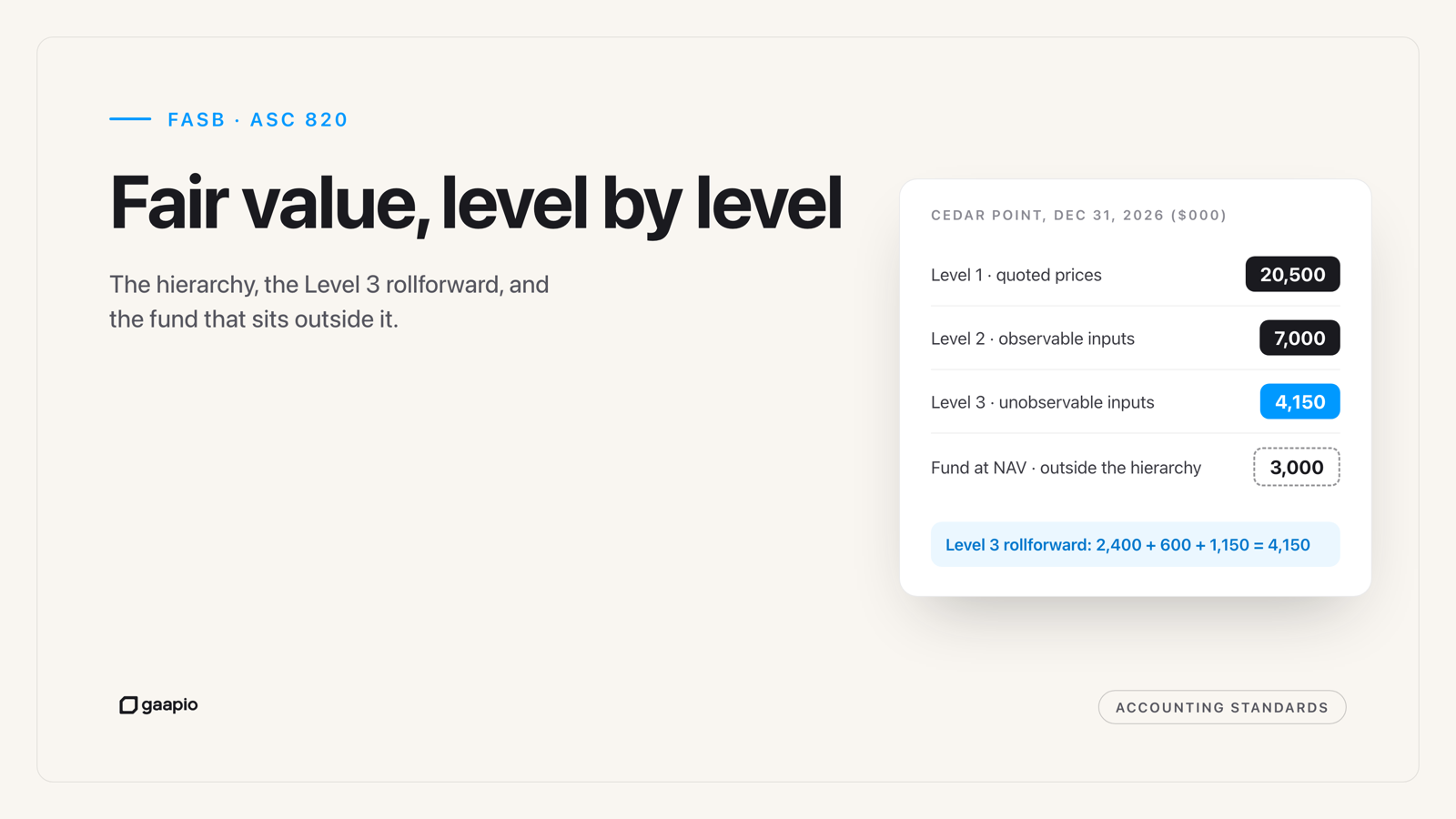
Step 1: the hierarchy table. At December 31, 2026, the recurring fair value measurements are:
| Item | Level 1 | Level 2 | Level 3 | Total |
|---|---|---|---|---|
| Money market funds | $12,000 | $12,000 | ||
| U.S. Treasury securities | 8,500 | 8,500 | ||
| Corporate bonds | $6,200 | 6,200 | ||
| Interest rate swap (asset) | 800 | 800 | ||
| Warrants in Northwind Robotics | $4,150 | 4,150 | ||
| Total in the hierarchy | $20,500 | $7,000 | $4,150 | $31,650 |
| Private equity fund measured at NAV | 3,000 | |||
| Total assets measured at fair value | $34,650 |
The private equity fund is not in a level. It appears as a reconciling line so the table agrees to the related balance sheet line items (cash equivalents, investments and derivative assets).
Step 2: the Level 3 rollforward. The warrants give Cedar Point the right to buy shares of Northwind Robotics, a private company, and are measured at fair value through earnings (as equity securities under ASC 321 or as derivatives under ASC 815, depending on their terms; if under ASC 321, Cedar Point has not elected the measurement alternative for equity securities without a readily determinable fair value). During 2026, Cedar Point paid $600 for additional warrants. It holds no Northwind preferred shares. Nothing was sold, settled or transferred.
| Warrants in Northwind Robotics (Level 3) | 2026 |
|---|---|
| Balance, January 1, 2026 | $2,400 |
| Purchases | 600 |
| Sales and settlements | 0 |
| Total gains included in earnings (other income, net) | 1,150 |
| Transfers into or out of Level 3 | 0 |
| Balance, December 31, 2026 | $4,150 |
| Change in unrealized gains for warrants held at December 31, 2026, included in earnings | $1,150 |
The check: $2,400 plus $600 plus $1,150 equals $4,150, which is the Level 3 amount in the hierarchy table. All $1,150 relates to warrants still held, so the unrealized line equals the total.
Step 3: the significant unobservable inputs. Cedar Point values the warrants with an option pricing model that uses Northwind's most recent financing round to calibrate the equity value.
| Class | Fair value | Valuation technique | Unobservable input | Range (weighted average) |
|---|---|---|---|---|
| Warrants in private companies | $4,150 | Option pricing model | Expected volatility | 65% (65%) |
| Discount for lack of marketability | 20% (20%) | |||
| Time to a liquidity event | 3.0 years (3.0 years) |
The class has one issuer and the same inputs apply to all of its warrants, so each range collapses to a single point. A company with several warrants in the class would show the low and high inputs and the weighted average across them.
Step 4: the uncertainty narrative. A public company also writes how the inputs interact. For example: "An increase in expected volatility or in the time to a liquidity event would increase the fair value of the warrants. An increase in the discount for lack of marketability would decrease it. A longer expected time to a liquidity event is generally accompanied by a higher discount for lack of marketability, which partly offsets the increase in value from the longer term."
Step 5: the NAV disclosure for the fund. Cedar Point is a limited partner in a growth equity fund. For the $3,000 interest it would write:
The Company's investment in a private equity fund is measured at net asset value per share as a practical expedient and is not categorized in the fair value hierarchy. The fund invests primarily in growth-stage technology companies. The investment has a fair value of $3,000 at December 31, 2026, and unfunded commitments of $2,000. The investment cannot be redeemed, and transfers of the interest require the general partner's consent. Distributions are received as the fund's underlying investments are liquidated, which the fund's general partner has communicated is expected over the next five to seven years. The Company does not currently plan to sell its interest.
What reviewers would check. The Level 3 total ties to the hierarchy table. The hierarchy table plus the NAV line ties to the related balance sheet line items. The earnings line item matches the income statement. The input ranges are ones the valuation specialist can support from the Northwind round. The fund note includes the liquidation timing only because the general partner communicated it.
A related point: ASC 450 contingencies are generally not measured at fair value. Contingent consideration in a business combination is, and it is often a Level 3 liability. If you accrue a loss contingency for a lawsuit, the ASC 450 guide covers the recognition and disclosure rules, which have no hierarchy at all.
What does the footnote language look like?
A typical recurring-measurement footnote opens with a policy paragraph and the hierarchy definitions, then the table by level, then the Level 3 detail. This is the policy paragraph, adapted from the example above:
The Company measures certain assets and liabilities at fair value on a recurring basis. Fair value is the price that would be received to sell an asset or paid to transfer a liability in an orderly transaction between market participants at the measurement date. The fair value hierarchy has three levels. Level 1 inputs are quoted prices in active markets for identical assets or liabilities. Level 2 inputs are observable inputs other than Level 1 prices, such as quoted prices for similar instruments or inputs corroborated by market data. Level 3 inputs are unobservable and require the Company to develop assumptions that market participants would use. The level of a measurement is determined by the lowest-level input that is significant to the measurement in its entirety.
Add your own technique descriptions, the Level 3 rollforward and input table, the NAV paragraph, and a statement about how you determined the level for items with mixed inputs. Disclosure checklists vary by company, so run the final note against your own facts and your auditor's expectations.
What do auditors and the SEC staff push on in fair value disclosures?
These are the points that tend to draw questions in review. This list is our practical read of the requirements, not a quote from any standard setter.
- Class definition. Classes are based on nature, characteristics and risks, and on the level. Combining a Level 2 swap and a Level 3 warrant to keep the table short rarely survives review.
- Support for the Level 3 inputs. Expect questions on how the volatility, discount rate or multiple was selected and why the range is what it is.
- Reasons for transfers into or out of Level 3. "Increased market activity" is a reason. "Management judgment" is not.
- Ties to the financial statements. The fair value table, the Level 3 rollforward and the balance sheet should agree, and the income statement line items should match the rollforward.
- The NAV election. Whether the NAV is calculated consistent with ASC 946, and whether any adjustment was needed for a stale NAV.
How does Gaapio help with fair value disclosures?
Gaapio is an AI-powered technical accounting platform built by CPAs. For the fair value footnote, you upload your statements, and Gaapio reviews your disclosures against the Codification, compares them with peer filers in your industry, and surfaces what's missing. Every recommendation traces back to an authoritative source.
You make the disclosure calls. Every recommendation cites the Codification paragraph behind it, so a reviewer can see why a disclosure was flagged. See AI footnote disclosures and Gaapio's FASB research.
Want to see it on your own fair value note? Request a demo.
This article is general information, not accounting or legal advice. Confirm the requirements for your facts against the Codification and with your auditor.
Frequently asked questions
What does ASC 820 require?
ASC 820 requires an entity that measures an item at fair value under another Topic to measure it as an exit price, to rank the inputs in a three-level hierarchy, and to make disclosures about the measurements. The disclosures grow with the level: Level 3 recurring measurements need a rollforward and the significant unobservable inputs.
What is the difference between Level 1, Level 2 and Level 3?
Level 1 uses quoted prices in active markets for identical items. Level 2 uses other observable inputs, such as quotes for similar items. Level 3 uses unobservable inputs. The level of the whole measurement is that of the lowest-level input that is significant to it.
What is the NAV practical expedient under ASC 820?
It lets an entity use the net asset value per share of certain investments in funds as their fair value, when the NAV is calculated consistent with ASC 946 measurement principles as of the measurement date. The investment is not categorized in the hierarchy, and ASC 820-10-50-6A prescribes its disclosures.
What does ASC 820-10-50-6A require?
For each class of investments measured at NAV as a practical expedient, it requires the fair value and investment strategies, unfunded commitments, redemption terms, circumstances that could prevent redemption, other significant sale restrictions, and, if the investee has communicated them, the timing of liquidation and the date a restriction might lapse. It also covers plans to sell a group of investments at an amount different from NAV.
When is a Level 3 rollforward required?
For recurring Level 3 fair value measurements. It is not required for nonrecurring measurements, for items disclosed at fair value only, or for investments measured at NAV under the practical expedient. Nonpublic entities disclose transfers into and out of Level 3 and purchases and issues instead.
What is the difference between recurring and nonrecurring fair value measurements?
A recurring measurement is made at every reporting date, such as a derivative. A nonrecurring measurement happens only when an event triggers it, such as an impairment of a long-lived asset. Both need the level, and Level 2 and 3 measurements need technique and input disclosures, but only recurring Level 3 measurements need a rollforward.
Do private companies have to follow ASC 820 disclosures?
Yes, with relief. Nonpublic entities still measure fair value under ASC 820 and classify recurring measurements by level. They are exempt from several public-entity disclosures: the range and weighted average of unobservable inputs, the uncertainty narrative, and the OCI unrealized-gain disclosure. They give a shorter Level 3 reconciliation in place of the rollforward.
Are transfers between Level 1 and Level 2 still disclosed?
No. ASU 2018-13 removed the requirement to disclose the amounts and reasons for transfers between Level 1 and Level 2, along with disclosure of the policy for the timing of transfers. Transfers into and out of Level 3 are still disclosed.
Related reading
- ASC 450 contingencies: loss and gain accounting
- ASU 2024-03: income statement expense disaggregation
- AI footnote disclosures
Sources: FASB ASC 820-10 and ASU 2018-13, ASU 2022-03, ASU 2015-07 and ASU 2026-03; Deloitte, Roadmap: Fair Value Measurements and Disclosures, section 10.9; Deloitte, Heads Up on ASU 2026-03; Deloitte, Heads Up on ASU 2018-13; PwC, Financial statement presentation guide, net asset value; KPMG, ASU 2026-03.