

If you're a calendar-year public company, the first year your DISE footnote covers starts January 1, 2027.
That's the start of the 2027 fiscal year. The 10-K that carries it gets filed in early 2028, but the data behind it has to be captured all through 2027.
ASU 2024-03, the FASB's Disaggregation of Income Statement Expenses standard (DISE), leaves the face of your income statement alone and adds a footnote that opens up cost of sales, SG&A, and R&D to show investors what's inside them. This guide covers what the standard requires, the effective dates after ASU 2025-01, a worked disclosure for one expense caption, and what changes in your first 10-K.
Key takeaway: ASU 2024-03 (DISE) requires public business entities to break every income statement expense caption that contains purchases of inventory, employee compensation, depreciation, intangible asset amortization, or DD&A into those categories in a tabular footnote: in the 10-K first, then every quarter starting the next fiscal year. It also requires total selling expenses and, annually, how you define them. Calendar-year companies first apply it in the 2027 10-K and the Q1 2028 10-Q. Estimates are allowed, so the hard part is the methodology and the controls around it.
What is DISE (ASU 2024-03)?
DISE stands for Disaggregation of Income Statement Expenses, the FASB project that produced ASU 2024-03 in November 2024. The standard adds Subtopic 220-40 to the Codification and requires public business entities to disclose, in a table in the notes, how much of each relevant expense caption is purchases of inventory, employee compensation, depreciation, intangible asset amortization, and DD&A.
Investors asked for it. In the FASB's 2021 agenda consultation, investors said more disaggregated financial reporting information should be a top priority, and they singled out cost of sales and SG&A. Those captions mix costs that behave very differently when the economy moves. Payroll, freight, and amortization don't respond to a downturn the same way.
KPMG's Defining Issues on the final standard puts the purpose plainly: DISE "addresses investor requests for more transparent information." (KPMG Defining Issues, November 2024)
The standard is called DISE, the DISE ASU, or ASU 2024-03. ASU 2025-01, issued in January 2025, changed only the effective date wording.
Who has to comply with ASU 2024-03?
All public business entities apply ASU 2024-03, including smaller reporting companies. Private companies, not-for-profit entities, and employee benefit plans are scoped out (ASC 220-40-15-3).
Three scope points catch people:
- The PBE definition is broad. A company whose financial statements are included in another registrant's SEC filing (for example, an acquired business under Rule 3-05 or an equity method investee under Rule 3-09) is a public business entity for those financial statements. A company that files its own registration statement, such as an S-1, becomes a public business entity.
- Emerging growth companies get no deferral. DISE has no private company effective date, so EGCs adopt on the public business entity dates.
- The face of the income statement doesn't change. The ASU doesn't change or remove any presentation requirement, including SEC Regulation S-X. Your captions stay as they are. The footnote explains them.
When is ASU 2024-03 effective?
ASU 2024-03 is effective for annual reporting periods beginning after December 15, 2026, and interim reporting periods within annual reporting periods beginning after December 15, 2027. Early adoption is permitted.
That second clause is what ASU 2025-01 fixed. The original wording said interim periods "beginning after December 15, 2027," which led some non-calendar year-end companies to read that their first DISE disclosure would land in a 10-Q partway through their first DISE fiscal year, before their first DISE 10-K. The FASB clarified that every public business entity adopts in a full annual period first, then in quarters the following fiscal year.
| Fiscal year-end | First annual period with DISE | First 10-K with DISE | First 10-Q with DISE |
|---|---|---|---|
| December 31 | Year ending Dec 31, 2027 | Filed early 2028 | Quarter ending Mar 31, 2028 |
| March 31 | Year ending Mar 31, 2028 | Filed mid-2028 | Quarter ending Jun 30, 2028 |
| June 30 | Year ending Jun 30, 2028 | Filed late summer 2028 | Quarter ending Sep 30, 2028 |
| September 30 | Year ending Sep 30, 2028 | Filed late 2028 | Quarter ending Dec 31, 2028 |
10-K timing depends on filer status (60, 75, or 90 days after year-end).
Transition. You can apply DISE prospectively, so periods before the effective date that appear as comparatives don't need the disclosure. Or you can apply it retrospectively to any or all prior periods presented (ASC 220-40-65-1). Prospective is cheaper. Retrospective gives investors a trend line in year one.
What are the five natural expense categories in DISE?
The five DISE expense categories are purchases of inventory, employee compensation, depreciation, intangible asset amortization, and depreciation, depletion, and amortization (DD&A) recognized in oil- and gas-producing activities. Each one has a definition, and a few details trip people up.
| Category | What goes in it | Watch for |
|---|---|---|
| Purchases of inventory | Only amounts within the scope of ASC 330 | Inventory acquired in a business combination, a joint venture formation, or the initial consolidation of a VIE that isn't a business is excluded and goes to "other" (220-40-50-7) |
| Employee compensation | All consideration to employees for services or for termination of employment: salaries, wages, bonuses, share-based compensation, benefits, and payroll taxes that fund social benefits. For defined benefit plans, only service cost counts. Full-time, part-time, temporary, and seasonal employees count. Contractors don't | One-time employee termination benefits are disclosed separately. Banks presenting a salaries and benefits caption under S-X 9-04 can use that amount instead (220-40-50-20) |
| Depreciation | Must tie to how you classify total depreciation under ASC 360-10-50-1(a) | Finance lease right-of-use asset amortization and leasehold improvement amortization follow how you present similar assets (220-40-50-10) |
| Intangible asset amortization | Must tie to your total amortization disclosure under ASC 350-30-50-2(a)(2) | Shown on its own line, separate from depreciation. Internal-use software amortization goes in depreciation or intangible amortization based on your existing policy |
| DD&A | Oil and gas DD&A under Subtopic 932-360, plus other depletion (for example, mining) | Industry-specific; most companies won't have it |
Two rules sit on top of the table:
- Capitalized costs aren't broken down again. If you capitalize payroll into internal-use software, the later amortization isn't split back into employee compensation (220-40-50-14). Inventory under the cost-incurred basis is the one exception, covered below.
- Some liability-driven expenses can stay whole. An expense tied to an estimated future obligation with uncertain settlement timing (for example, insurance claims or asset retirement obligations) doesn't need to be split into the five categories, unless it is entirely one category (220-40-50-16 and 50-17). Ordinary accruals such as bonuses, vacation pay, and pension obligations don't qualify (220-40-50-18).
What is a relevant expense caption?
A relevant expense caption is any expense caption on the face of the income statement, in continuing operations, that contains at least one of the five categories. Cost of sales, SG&A, and R&D are the usual ones, and each one gets its own disaggregation in the table.
Three points to watch:
- A caption made up entirely of one category needs no further breakdown. A "Depreciation" line that is all depreciation is already disclosed (220-40-50-12).
- Equity method earnings or losses are never a relevant expense caption (220-40-50-13).
- Interest expense and income tax expense usually contain none of the five categories, so they drop out.
What else goes in the DISE table besides the five categories?
Besides the five categories, the DISE table has to absorb certain expenses you already disclose elsewhere, any cost reimbursements, and an "other items" amount with a written description. The integrated items come in two lists.
Always integrated (220-40-50-21), in every relevant caption where they appear. Examples include each major type of exit or disposal cost (one-time termination benefits, contract termination costs), impairment of long-lived assets held and used, intangible asset impairment, gains and losses on derivatives and hedged items, and the non-service components of net benefit cost. Later ASUs add to this list, per the FASB's 2026 roundtable materials: government grants presented as a deduction from the related expense (ASU 2025-10, effective for annual periods beginning after December 15, 2028) and certain environmental credit expenses (ASU 2026-02, effective for annual periods beginning after December 15, 2027).
Integrated only when the whole amount sits in one relevant caption (220-40-50-22). Examples include the credit loss provision, amortization of costs to obtain or fulfill a contract with a customer, amortization of capitalized implementation costs for cloud computing arrangements, ARO accretion, loss contingencies, warranty expense, foreign currency transaction gains and losses, and operating, short-term, and variable lease cost. If operating lease cost is split between cost of sales and SG&A, it stays in "other." If one of these items moves from one caption to several (or back) between years, you don't recast prior periods (220-40-50-4(b)), but you provide the comparability disclosure in 205-10-50-1 (220-40-50-23).
These items don't make a caption relevant on their own (220-40-50-24). And they follow the frequency of their home Topic: if a disclosure is annual-only there, it's annual-only in the DISE table.
Other items. Whatever is left in each caption becomes an "other" line, and you describe what's in it qualitatively, in detail that matches its size (220-40-50-30). The staff's roundtable materials asked whether that means a full breakdown or a judgment-based description. The text says the detail is "commensurate with the significance of the amounts being described," which points to judgment.
Reimbursements. If a caption is recorded net of a cost-sharing reimbursement, you either show the reimbursement as its own line or show the categories net of it, and you say which (220-40-50-26 and 50-27). If you pay a reimbursement to another entity and it sits in a relevant caption, show it as its own line (220-40-50-28). When the reimbursement is shown as its own line, describe the expense categories it relates to (220-40-50-29).
How does DISE treat inventory: cost-incurred or expense-incurred?
If a relevant caption includes ASC 330 inventory costs, you choose one of two bases: cost-incurred or expense-incurred. The choice applies to every category with inventory amounts in it, not only purchases of inventory (220-40-50-31).
- Cost-incurred basis. You disclose what you incurred this period, whether it went to inventory or straight to expense. Because that often won't equal what hit cost of sales, you add a "changes in inventories" line and an "other adjustments and reconciling items" line (with a description, for example FX translation differences) so the table ties to the caption.
- Expense-incurred basis. You disclose what was expensed, including inventory relieved this period, traced back to the natural category the cost started in. If last year's payroll sat in inventory and sold this year, it shows up as this year's employee compensation.
Most companies will pick based on what their cost system can produce. The FASB allowed cost-incurred because tracing prior-period capitalized costs through to cost of sales can be impracticable.
There's also a practical expedient: if substantially all of a caption is purchases of inventory, you can skip disaggregating it and describe its composition instead (220-40-50-19).
What does the selling expense disclosure require?
Every quarter and every year, you disclose total selling expenses. In annual periods (and in any interim period where the definition changes) you also disclose how you define selling expenses (220-40-50-35 and 50-36).
The FASB doesn't define selling expenses. You do. The definition can include only items presented as expenses in the income statement, and you don't have to break selling expenses into the five categories unless selling is its own caption on the face.
Pick the definition carefully. Changing it later means disclosing why and recasting prior periods unless that's impracticable (220-40-50-4). Deloitte's DISE FAQ walks through the edge cases.
Can companies use estimates for DISE?
Yes. ASC 220-40-50-1 says you may use estimates or other methods that produce a reasonable approximation of the amounts, and materiality applies (ASC 105-10-05-6).
The basis for conclusions is direct about it. The Board "did not intend for an entity to prepare the disclosure requirements using transaction level details" (ASU 2024-03, BC53). Instead, an entity may take a reasonable approach and prepare the amounts in a systematic and rational way.
The FASB's May 2026 roundtable materials show what that looks like. A service company takes total payroll from the ledger, applies its existing cost-center allocation percentages, and maps each cost center to cost of sales or SG&A. The materials say the Board didn't intend for an entity to prove its estimates against transaction-level detail. The staff materials are for discussion only and don't represent FASB or staff views, but they show one approach the Board's estimation language allows.
That doesn't make it easy. The estimate becomes a disclosure methodology, which means a documented policy, a control over it, and audit scrutiny of both.
What happened at the FASB DISE roundtable?
The FASB held a public roundtable on DISE implementation on May 27, 2026, in Norwalk, Connecticut. Its purpose was to hear from investors, preparers, and practitioners on how adoption is going and where the guidance may need clarification.
The staff's discussion materials posed eleven questions. The ones preparers should care about:
- Are amounts coming from transaction-level records or from estimation and allocation, and is total compensation a workable starting point?
- Are there unique challenges applying materiality when identifying relevant captions and disaggregating them?
- Is identifying relevant expense captions operable?
- Are the five categories clearly defined?
- Will you use the cost-incurred or expense-incurred basis, and what system constraints drove that choice?
- Do the integrated disclosures shrink "other items" in a meaningful way?
- Does describing "other items" require a full breakdown, or judgment?
The roundtable didn't change the standard. Any change to the requirements or the dates would need a new ASU, so plan to the dates in ASU 2025-01 unless the FASB issues one.
What does a DISE disclosure look like? A worked SG&A example
Here is one relevant expense caption, worked through. The company is illustrative: a calendar-year public software company in its first year of DISE (fiscal 2027), applying the standard prospectively. The numbers are invented to show the mechanics.
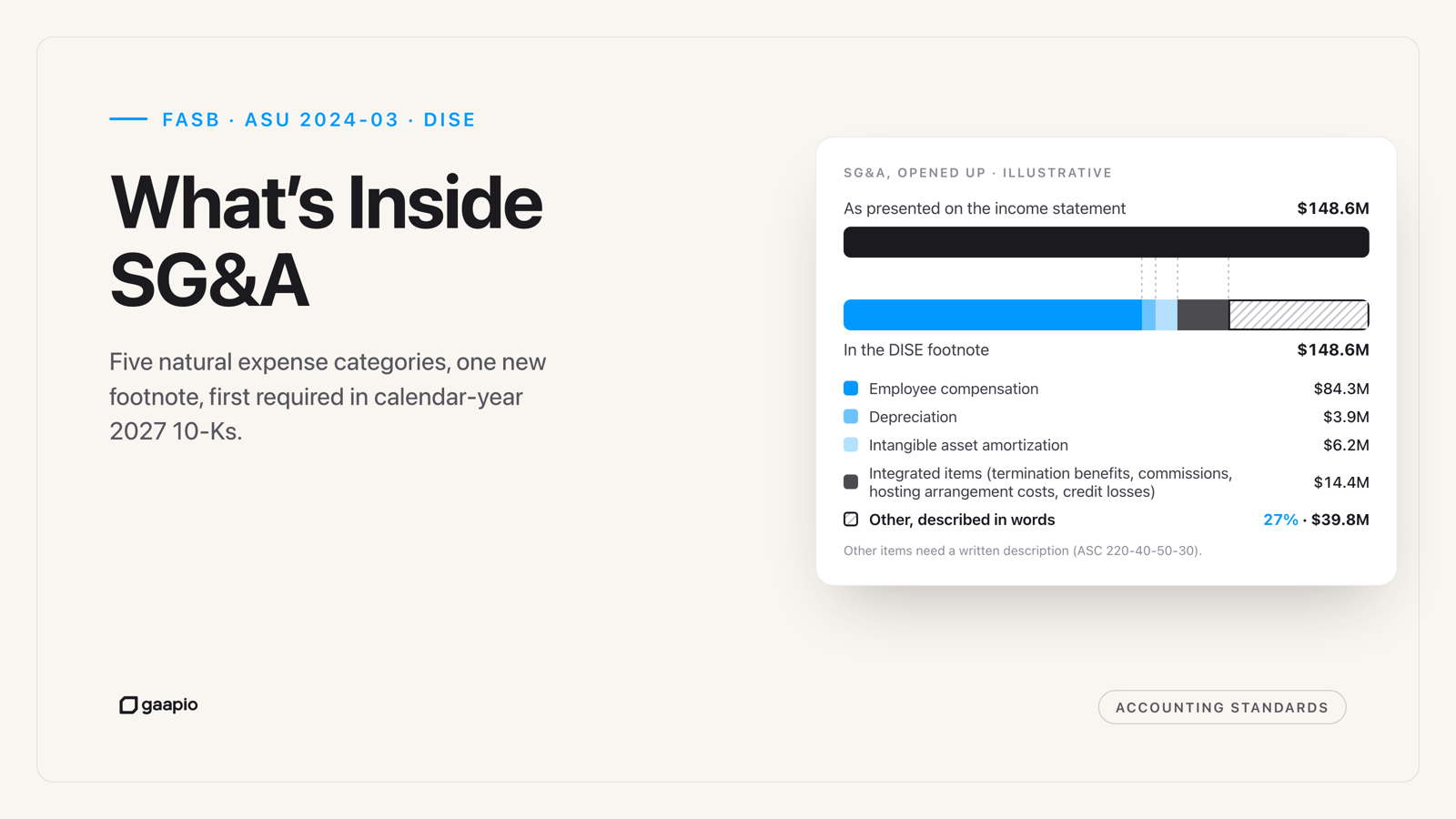
Its income statement shows SG&A of $148.6 million. Here's the table for that caption.
Disaggregation of relevant expense captions (in thousands)
| Selling, general, and administrative | Year ended Dec 31, 2027 |
|---|---|
| Employee compensation (exclusive of one-time employee termination benefits) (a) | $84,300 |
| One-time employee termination benefits | 2,100 |
| Depreciation | 3,900 |
| Intangible asset amortization | 6,200 |
| Amortization of costs to obtain contracts with customers (b) | 9,800 |
| Amortization of capitalized implementation costs of hosting arrangements that are service contracts | 1,400 |
| Provision for expected credit losses | 1,100 |
| Other SG&A (c) | 39,800 |
| Total SG&A | $148,600 |
(a) Employee compensation includes salaries, wages, bonuses, sales commissions expensed as incurred, share-based compensation, payroll taxes, and benefits. It excludes sales commissions capitalized as costs to obtain a contract, whose amortization is shown separately.
(b) Amortization of sales commissions capitalized under ASC 340-40.
(c) Other SG&A consists primarily of third-party software subscriptions and hosting used by corporate functions, advertising and marketing programs, professional fees, operating lease cost, travel, and insurance.
Selling expenses. For the year ended December 31, 2027, selling expenses were $71.5 million. The company defines selling expenses as compensation of its sales and marketing personnel (including commissions, share-based compensation, and benefits), amortization of capitalized sales commissions, advertising, and marketing programs. It excludes allocated facilities and IT costs.
Why each line is there:
- One-time termination benefits are split out of employee compensation. 220-40-50-6(b) and 50-21(e) require them on their own line, and the compensation line says it excludes them. Severance paid under an ongoing plan (ASC 712) stays in employee compensation.
- Capitalized commissions stay out of employee compensation. They were capitalized, so their amortization isn't broken back down (220-40-50-14). Because all of it lands in SG&A, it's an integrated line under 220-40-50-22(f).
- Credit losses and hosting arrangement implementation amortization get lines because each sits entirely in SG&A (220-40-50-22(a) and (h)).
- Operating lease cost stays in "other." This company records it in both cost of revenue and SG&A, so it isn't integrated, and footnote (c) names it instead.
- The "other" description names its biggest pieces. Other SG&A is 27% of the caption. A one-word description like "miscellaneous" won't meet the "commensurate with the significance" bar.
- One column. Under prospective transition, 2026 and 2025 don't need the disclosure. A retrospective adopter could add any or all of the prior years presented (three years for most filers, two for a smaller reporting company).
- Depreciation and amortization tie out. The SG&A amounts, plus those in cost of revenue and R&D, agree with how the company classifies its total depreciation and intangible amortization disclosures (220-40-50-9).
The company's cost of revenue and R&D captions get their own tables in the same footnote. For comparison, the FASB's own illustrations are in ASC 220-40-55, including a manufacturer on the cost-incurred basis.
What changes in your first 10-K under ASU 2024-03?
Your first DISE 10-K adds a new tabular footnote for every relevant caption, a selling expense total and definition, and the policy disclosures behind them. The face of the income statement stays the same, but the work behind the footnote touches payroll, fixed assets, FP&A, and your SEC reporting software.
What to have ready:
- The footnote itself. One table per relevant caption, the integrated items, the "other" descriptions, and the selling expense paragraph. Add it to your disclosure checklist now so it isn't found in the last week of close.
- The basis and methodology decisions, documented. Cost-incurred or expense-incurred, the estimation approach for employee compensation, your selling expense definition. Write each one up in a memo before year-end. Changing the inventory basis or the selling expense definition later means disclosing why and recasting prior periods unless impracticable.
- Controls. The allocation model is a new input to the financial statements. Under SOX 404 it needs documented controls that management assesses. Your auditor audits the footnote either way, and also tests the controls if you're subject to SOX 404(b).
- XBRL. The FASB's GAAP Taxonomy updates add DISE elements, and the table is tagged with dimensions by caption and category, which is heavier than a typical footnote. Confirm your XBRL vendor is on the current taxonomy and has the elements mapped.
- MD&A consistency. Once investors can see employee compensation by caption, your MD&A explanation of cost changes should line up with the table.
- Your 2026 10-K still matters. The 10-K you file in early 2027 should describe the expected effect of ASU 2024-03 under SEC Staff Accounting Bulletin Topic 11.M. At the September 22, 2016 EITF meeting, the SEC staff said it expected SAB 74 disclosures for the revenue, leasing, and credit losses standards to become more informative as adoption neared (Deloitte), so expect the same here.
The Q1 2028 10-Q is the next step: the same table, every quarter. Under prospective transition, the comparative 2027 quarters don't need the disclosure, though you can include them. Integrated items that are annual-only under their home Topic stay annual-only.
PwC's In depth on DISE and Deloitte's Heads Up cover more adoption detail. If you're also in the second year of ASU 2023-09, our income tax disclosure guide covers that standard.
How Gaapio helps with DISE
Gaapio is an AI-powered technical accounting platform built by CPAs. For DISE, that means working the ASC 220-40 items on your checklist with the Codification reference attached, drafting the footnote disclosures and the selling expense definition with every conclusion cited, and writing the memo behind your basis and estimation choices.
It also searches public filings, so you can see how any early adopters, and later your peers, present the DISE table and describe their "other" lines.
The judgment stays with you. Gaapio drafts the disclosure from the amounts your team provides and shows its sources. Your team picks the basis, signs the memo, and owns the footnote.
If you're scoping your first DISE footnote, request a demo and bring your income statement.
Frequently asked questions
What does DISE stand for?
DISE stands for Disaggregation of Income Statement Expenses. It's the name of the FASB project that produced ASU 2024-03, now codified in ASC 220-40.
Is ASU 2024-03 the same as the DISE standard?
Yes. ASU 2024-03 is the DISE standard. ASU 2025-01 amended only its effective date wording, to make clear every public business entity adopts in an annual period first.
Does DISE change the face of the income statement?
No. DISE adds a tabular footnote and a selling expense disclosure; your income statement captions stay the same. It doesn't change any SEC Regulation S-X presentation requirement.
Does ASU 2024-03 apply to private companies?
No. ASU 2024-03 applies only to public business entities, including smaller reporting companies. Private companies, not-for-profits, and employee benefit plans are excluded. A company filing an S-1 becomes a public business entity, and a private company whose statements are included in another registrant's SEC filing must apply DISE to those statements.
When is the first DISE disclosure due for a calendar-year company?
A calendar-year public company first includes DISE in its 2027 10-K, filed in early 2028, and then in every 10-Q starting with the quarter ending March 31, 2028. Early adoption is permitted.
Is DISE required in 10-Q filings?
Yes, starting the fiscal year after your first annual adoption. The tabular disaggregation and total selling expenses are required every quarter; the selling expense definition is annual unless it changes.
Can companies use estimates for DISE?
Yes. ASC 220-40-50-1 permits estimates or other methods that produce a reasonable approximation, and, as with all of the Codification, the requirements need not be applied to immaterial items. The FASB said it didn't intend to require transaction-level detail. In practice, the method still needs to be systematic, documented, and controlled.
What happened at the FASB DISE roundtable?
The FASB held a public DISE roundtable on May 27, 2026, to hear how implementation is going. Topics included estimation versus transaction-level data, the cost-incurred versus expense-incurred choice for inventory, and how detailed the "other items" description must be. It didn't change the standard or its effective dates.