

"Net sales increased primarily due to increased demand."
That sentence has been in a 10-K near you. It is also the sentence the SEC staff asks registrants to rewrite, year after year.
MD&A (Management's Discussion and Analysis, sometimes written MDA or MD and A) is the one section of your annual and quarterly reports where management explains the numbers in its own words. Regulation S-K Item 303 sets what that explanation must cover. This guide walks through each requirement, shows a weak variance explanation next to a rewrite of it, and covers critical accounting estimates, non-GAAP measures, comment letter themes and the differences in a 10-Q.
Key takeaway: Item 303 asks management to explain financial condition and results through its own eyes: the reasons behind material changes, the known trends and uncertainties that are reasonably likely to matter, how the company will fund its cash needs in the next 12 months and beyond, and the estimates that carry real uncertainty. It is a narrative, not a restatement of the financial statements. A 10-K covers the full requirements. A 10-Q covers material changes since the last year-end and between comparable periods.
What is MD&A, and where does it go in a 10-K and 10-Q?
MD&A is management's narrative discussion of a company's financial condition, changes in financial condition and results of operations. In a Form 10-K it is Item 7. In a Form 10-Q it is Part I, Item 2. The content requirements for both come from Item 303 of Regulation S-K (17 CFR 229.303).
The stated objective is to give investors "material information relevant to an assessment of the financial condition and results of operations," including the amount and certainty of cash flows. Item 303(a) says a discussion that meets the requirements is expected to let investors view the registrant from management's perspective.
Registration statements on Form S-1 and Form S-4 carry the same Item 303 content. Foreign private issuers that file Form 20-F answer Item 5 of that form (Operating and Financial Review and Prospects) instead, which has its own wording. For how the two periodic reports differ in general, see our 10-K vs 10-Q glossary entry.
What does Item 303 require?
Item 303 has four working parts: an objective in paragraph (a), the full-year requirements in paragraph (b), the interim requirements in paragraph (c), and a set of instructions that shape how you apply them. The table below maps the paragraphs to what each one asks for.
| Item 303 paragraph | What it requires | What the SEC staff tends to test |
|---|---|---|
| (a) Objective | Material information for an assessment of financial condition and results, including the amount and certainty of cash flows. Focus on known material events and uncertainties reasonably likely to make reported results not indicative of the future. | Whether the discussion reads as management's view or as a restatement of the statements |
| (b) General | Explain the underlying reasons for material period-to-period changes in line items, in quantitative and qualitative terms, including where material changes within a line item offset one another. Discuss segments or other subdivisions where needed to understand the business. | Reasons that stop at "higher costs" or "increased demand" |
| (b)(1) Liquidity and capital resources | Analyze the ability to generate and obtain cash for the short term (next 12 months) and separately the long term (beyond 12 months). Cover material cash requirements from known contractual and other obligations, by type and time period. Identify known trends, demands, commitments, events or uncertainties reasonably likely to change liquidity materially. Describe internal and external sources of liquidity and material unused sources. Describe material capital commitments and anticipated funding, plus known trends in capital resources. | Cash flow discussions that recite working capital lines without explaining drivers |
| (b)(2) Results of operations | Unusual or infrequent events and significant economic changes that materially affected reported income from continuing operations. Known trends or uncertainties that have had, or are reasonably likely to have, a material impact on net sales, revenue or income from continuing operations. Known or reasonably likely changes in the relationship between costs and revenues. The extent to which revenue changes come from price, volume or new products and services. | Missing forward-looking trends; price and volume not separated |
| (b)(3) Critical accounting estimates | Estimates involving a significant level of estimation uncertainty with a material impact. Explain why each is uncertain and, to the extent material and reasonably available, how much it or its assumptions changed and how sensitive the reported amount is. Supplement the notes, do not duplicate them. | Disclosure that copies the significant accounting policies note |
| (c) Interim periods | Material changes in financial condition since the last fiscal year-end, and material changes in results for the year-to-date period and the quarter compared with the prior-year periods (or, for the quarter, the immediately preceding quarter). | Quarterly drafts that skip drivers because "nothing changed" |
| Instructions | Amounts readily computable from the statements need not be recited, and the discussion must not merely repeat them. No line-by-line recitation. Cover subsidiary dividend and transfer restrictions where Rule 4-08(e)(3) of Regulation S-X applies. Cover off-balance sheet arrangements and unconsolidated entity commitments. Forward-looking statements fall under the projections safe harbor (Rule 175 and Rule 3b-6). | Duplication and recitation |
Smaller reporting companies discuss the two years in their financial statements. An emerging growth company can give two years if it provided two years of audited statements in its IPO registration statement. For other filers with three years of statements, the discussion of the earliest year can be left out if it already appears in a prior EDGAR filing that required Item 303 disclosure, as long as the filing states where it can be found.
What changed in the 2020 amendments?
The SEC adopted the current form of Item 303 on November 19, 2020 (Release No. 33-10890). The rules took effect February 10, 2021, and applied from the first fiscal year ending on or after August 9, 2021. For calendar-year companies, that meant the 2021 Form 10-K.
Six changes matter in practice:
- Selected financial data is gone. The SEC eliminated Item 301.
- The contractual obligations table is gone. Item 303 now asks for an analysis of material cash requirements from known contractual and other obligations, by type and time period, instead of a standard table.
- Liquidity and capital resources was rewritten. The 12-month and beyond-12-month split and the focus on material cash requirements are now in the rule text.
- Critical accounting estimates became a requirement. Item 303(b)(3) now defines them and says what to disclose. Before 2020 the expectation came from SEC guidance.
- The sequential-quarter option arrived. A 10-Q can compare the quarter with the immediately preceding quarter instead of the prior-year quarter. (The option to omit the earliest year's discussion came earlier, in the 2019 FAST Act amendments, and now sits in Instruction 1 to Item 303(b).)
- Off-balance sheet arrangements moved into the instructions. The separate section was replaced by Instruction 8, which folds these arrangements into the broader discussion.
The text also adopts "reasonably likely" as the threshold across the known-trends language, in place of the older phrasing. Deloitte's DART Heads Up on the final rule is a good plain-English companion to the release.
How do you disclose known trends and uncertainties in MD&A?
Start with the question the SEC staff keeps asking: what do you know today that will make next year look different from last year? Item 303(a) calls these "material events and uncertainties known to management that are reasonably likely to cause reported financial information not to be necessarily indicative of future operating results or of future financial condition."
Use the two-step judgment the SEC set out in its 1989 MD&A interpretive release (Release No. 33-6835) which EY restates in its 2025 update. First, decide whether the trend or uncertainty is reasonably likely to come to fruition. If it is not, no disclosure is required. If management cannot make that determination, assume it will come to fruition and disclose unless a material effect is not reasonably likely.
Item 303(b)(2)(ii) adds a cost-versus-revenue test. If you know of events reasonably likely to change the relationship between costs and revenues, such as expected increases in labor or materials costs, price increases or inventory adjustments, that change must be disclosed.
Three habits make this section hold up:
- Name the trend and size it. "Steel costs may rise" gives a reader nothing. "Steel and aluminum represent about 60% of our cost of sales, and contracts covering about 40% of 2027 sales reprice one quarter after input costs move" gives them a model.
- Say what management is doing. The liquidity paragraph of Item 303(b)(1)(i) asks for the course of action if a material deficiency is identified. The same instinct applies to results trends.
- Keep it consistent with the rest of the filing. The risk factors, the earnings release and MD&A should not tell three different stories about the same trend.
Key performance indicators belong in this discussion too. The SEC's January 2020 guidance on key performance indicators and metrics in MD&A (Release No. 33-10751) expects a clear definition of each metric and how it is calculated, and why it is useful and how management uses it. If you change how a metric is calculated, say so. Where a metric is really a non-GAAP measure, Item 10(e) applies (covered below).
How do you write results of operations, and what does a good variance explanation look like?
Item 303(b) says to "describe the underlying reasons" for material changes, in "quantitative and qualitative terms." The rule also says the discussion "must not merely repeat numerical data contained in the financial statements." A reader can compute a percentage change from the face of the income statement. What they cannot compute is why.
A useful explanation has four parts:
- The amount of each driver. Break a change into its pieces and make the pieces add up.
- The cause, in business terms. A price action, a lost customer, a plant consolidation, a commodity cost increase.
- Price, volume and new products, separated. Item 303(b)(2)(iii) requires this when net sales or revenue changed materially.
- Whether it will continue. This is where the known-trends test connects to the numbers.
Two other points. When one cause affects several line items, Instruction 2 says you do not have to repeat it everywhere. And where a segment discussion is needed to understand the business, the discussion must focus on each relevant segment and on the registrant as a whole. EY's 2025 update notes that the segment expense disclosures under ASU 2023-07 can affect MD&A, so check that the segment story in the notes and the segment story in MD&A match.
Worked example: rewriting a weak variance explanation
The following example is illustrative. The company and every number in it are made up for teaching purposes.
Alder Ridge Industrial, Inc. is a calendar-year manufacturer. Here is its first draft of the fiscal 2026 MD&A for net sales and cost of sales:
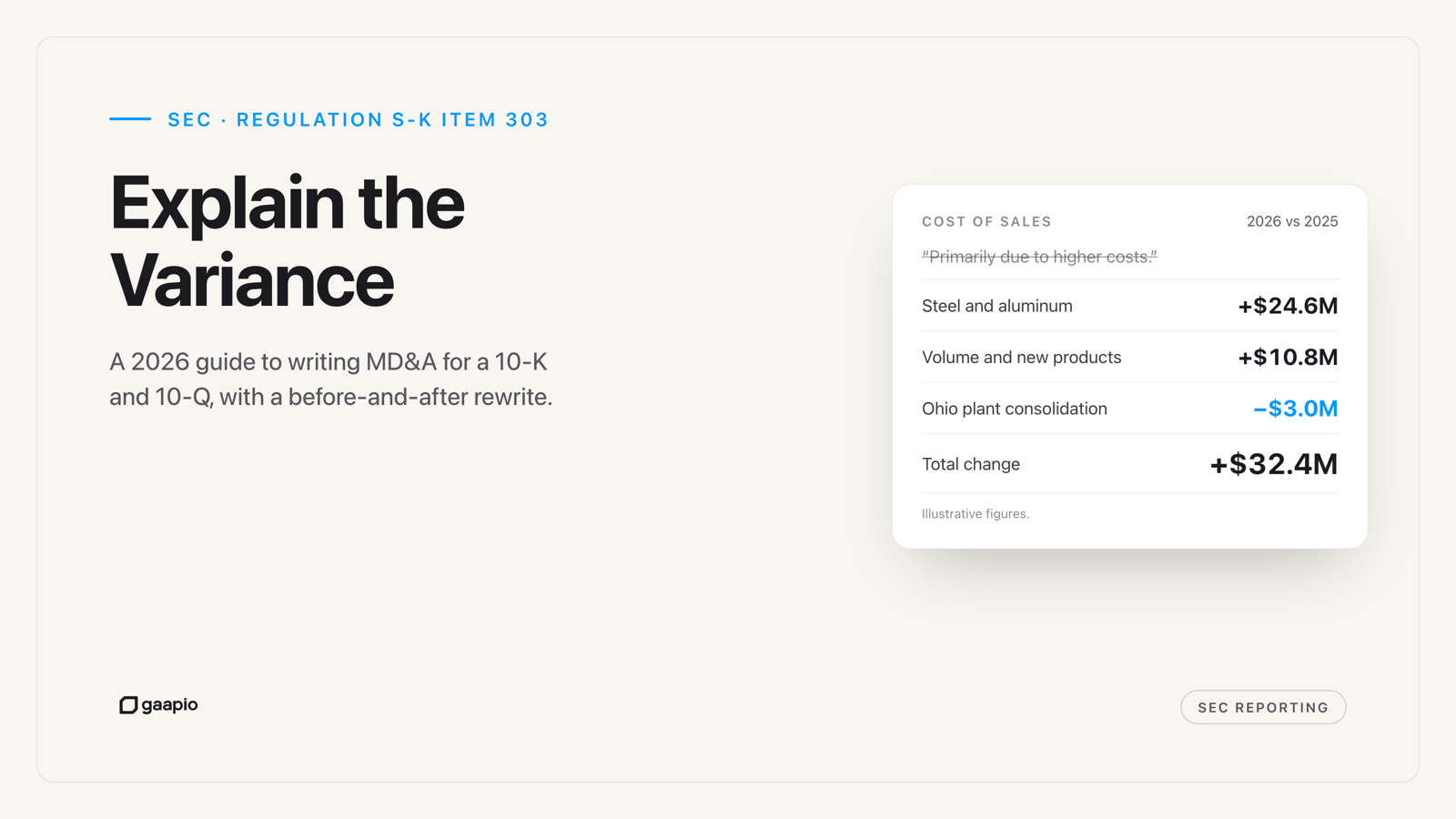
Draft (weak). Net sales increased $33.2 million, or 8.8%, to $412.6 million in 2026 from $379.4 million in 2025, primarily due to increased demand and favorable market conditions. Cost of sales increased $32.4 million, or 12.4%, to $293.4 million in 2026 from $261.0 million in 2025, primarily due to higher costs. Gross margin decreased to 28.9% from 31.2%.
Every number is right and the explanation is empty. "Demand" and "market conditions" do not say how much came from price versus volume. "Higher costs" does not say which costs. And nothing explains why gross profit barely moved while sales grew 8.8%.
Here is the bridge the finance team built before rewriting:
| Driver | Net sales | Cost of sales | Gross profit |
|---|---|---|---|
| Price actions (Q1 and Q3 2026) | +$19.0M | none | +$19.0M |
| Volume and new products | +$14.2M | +$10.8M | +$3.4M |
| Steel and aluminum input costs | none | +$24.6M | -$24.6M |
| Ohio plant consolidation savings | none | -$3.0M | +$3.0M |
| Total change | +$33.2M | +$32.4M | +$0.8M |
Volume and new products includes a net $2.0 million increase in volume of existing products (growth of $9.3 million offset by $7.3 million from the loss of one distribution customer in the second quarter) and $12.2 million from the new product line launched in 2026.
Rewrite (stronger). Net sales increased $33.2 million, or 8.8%, to $412.6 million in 2026. Price increases effective in the first and third quarters contributed $19.0 million. The compressor housing line launched in the second quarter contributed $12.2 million. Volume of existing products increased $2.0 million on a net basis: growth with existing customers of $9.3 million was partly offset by $7.3 million of lost sales after one distribution customer moved to a competing supplier in the second quarter.
Cost of sales increased $32.4 million, or 12.4%, and gross margin fell to 28.9% from 31.2%. Higher steel and aluminum prices added $24.6 million, as our average purchase cost per unit of these materials was about 16% higher than in 2025. Higher volume and the new product line added $10.8 million. These increases were partly offset by $3.0 million of savings from consolidating our Ohio plant, completed in the second quarter. Price increases and plant savings covered most of the increase in input costs, so gross profit in dollars was nearly flat at $119.2 million, but gross margin fell 2.3 percentage points because input costs grew faster than price. Price increases recovered $19.0 million of the $24.6 million increase in input costs, and even full dollar-for-dollar recovery would have lowered the percentage. Lower initial margins on the new product line reduced it slightly further.
We expect input cost pressure to continue into 2027. About 40% of expected 2027 sales are under contracts that reprice one quarter after input costs change. The rest depends on price actions we have not yet taken. A sustained increase in steel prices from fourth-quarter 2026 levels would therefore reduce gross margin until contract repricing and any further price actions take effect.
The rewrite does five things the draft does not. The drivers add up to the totals. The causes are specific enough for an investor to model. Price, volume and new products are separate. The margin decline gets a reason that ties to the bridge. And the last paragraph meets the known-trends test by saying what is reasonably likely to happen next and how the cost-revenue relationship could shift.
What goes in liquidity and capital resources?
Item 303(b)(1) wants an analysis of the company's "ability to generate and obtain adequate amounts of cash to meet its requirements and its plans for cash." It splits that into two time frames: the next 12 months from the balance sheet date, and separately the period beyond.
Cover these in order of how much a reader needs them:
- Material cash requirements from known contractual and other obligations. Instruction 4 gives lease obligations, purchase obligations and balance sheet liabilities as examples. State the type of obligation and when the cash is due.
- Sources of liquidity. Internal (operating cash flow, cash on hand) and external (credit facilities, debt and equity markets), plus any material unused sources.
- Known trends and demands. Anything reasonably likely to increase or decrease liquidity in a material way, such as covenant headroom narrowing or a large debt maturity.
- Capital resources. Material commitments for capital expenditures, how you plan to fund them, and any known trends in the mix and cost of capital among equity, debt and off-balance sheet financing.
- Restrictions on moving cash. Where Rule 4-08(e)(3) of Regulation S-X requires disclosure of limits on subsidiary dividends, loans or advances, Instruction 5 requires the liquidity discussion to cover the nature and extent of those limits and their effect on the parent's ability to meet its obligations.
- Off-balance sheet arrangements. Instruction 8 requires discussion of obligations arising from arrangements with unconsolidated entities that are reasonably likely to have a material effect, even when nothing appears on the balance sheet.
The most common comment pattern sits in the cash flow discussion. EY's 2025 update describes the staff challenging discussions that recite items "readily apparent from the statement of cash flows," such as changes in working capital, without analyzing the underlying drivers of material changes. "Operating cash flow decreased due to changes in working capital" will draw that comment. "Operating cash flow decreased $14 million because inventory built ahead of the second-quarter product launch and customer collections slowed after the distributor transition" is far less likely to.
What are critical accounting estimates, and what does the SEC expect?
Item 303(b)(3) defines critical accounting estimates as estimates made under GAAP that involve "a significant level of estimation uncertainty" and have had, or are reasonably likely to have, a material impact on financial condition or results of operations.
For each one, the disclosure should explain why the estimate is uncertain and, to the extent material and reasonably available, how much the estimate or its assumptions changed over a relevant period and how sensitive the reported amount is to the methods, assumptions and estimates behind it.
The key instruction is Instruction 3: this disclosure must "supplement, but not duplicate" the accounting policy descriptions and notes. The significant accounting policies note describes the method. The MD&A section describes the uncertainty in applying it.
A weak critical accounting estimate section describes the goodwill impairment test the way the note does. A stronger one reads like this (illustrative numbers):
Goodwill, Industrial segment. We test goodwill for impairment annually in the fourth quarter. The estimated fair value of the Industrial reporting unit exceeded its carrying amount by 14% at October 1, 2026, on $62.0 million of goodwill. The fair value estimate depends most on the discount rate (10.5%) and the projected growth in cash flows after 2030 (2.5%). A one percentage point increase in the discount rate, holding other assumptions constant, would reduce the estimated fair value by about 9% and eliminate most of the excess. Our projections assume Industrial segment gross margin recovers to 30% by 2028. If steel costs stay at current levels and pricing does not recover costs, that assumption would not hold.
That version states the cushion, names the assumptions that drive the answer, quantifies a sensitivity, and links the estimate to a known trend. EY's 2025 update adds that the staff believes registrants should analyze sensitivity to other outcomes that are reasonably likely to occur and would have a material effect. EY also reports the staff asking registrants to expand MD&A to describe events and changes in circumstances that could affect key goodwill estimates, and to give information on reporting units whose fair value does not substantially exceed carrying value. For the mechanics behind this example, see our guide to the goodwill impairment test.
The estimates that most often qualify are revenue recognition judgments such as variable consideration, credit losses, income taxes and valuation allowances, fair value of acquired assets and goodwill, inventory valuation, and loss contingencies. Your list should come from your own judgments, not from a peer's 10-K.
How should MD&A handle non-GAAP measures?
Whenever a filing includes a non-GAAP financial measure, Item 10(e) of Regulation S-K applies. In EY's tracking, non-GAAP measures sit alongside MD&A at the top of the staff's comment list. Item 10(e)(1)(i) requires four things:
- The most directly comparable GAAP measure, with equal or greater prominence.
- A quantitative reconciliation to that GAAP measure.
- A statement of why management believes the measure is useful to investors.
- Where material, the other purposes for which management uses it.
Item 10(e)(1)(ii) then lists what you must not do. In summary form:
- Exclude charges or liabilities that required, or will require, cash settlement (or would have, absent an ability to settle another way) from a non-GAAP liquidity measure, other than EBIT and EBITDA.
- Adjust a non-GAAP performance measure to eliminate or smooth items identified as non-recurring, infrequent or unusual when a similar charge or gain is reasonably likely within two years or occurred in the prior two years.
- Present non-GAAP measures on the face of the financial statements or in the notes.
- Present non-GAAP measures on the face of pro forma financial information required by Article 11 of Regulation S-X.
- Use titles that are the same as, or confusingly similar to, GAAP titles.
The staff's interpretations, in its Non-GAAP Compliance and Disclosure Interpretations, add the judgment calls the rule text does not. Question 102.03 says the "non-recurring" prohibition turns on how the item is described, so the label itself is the trigger. Question 100.01 says excluding normal, recurring, cash operating expenses necessary to operate the business can make a measure misleading under Regulation G even where no specific prohibition applies. Question 102.10(a) lists presentations that give a non-GAAP measure undue prominence, including a full non-GAAP income statement and leading a discussion with the non-GAAP measure.
The prominence point is the one drafting teams trip over. In its 2025 update, EY summarizes the staff view as requiring the discussion and analysis of the comparable GAAP measure to come before the non-GAAP one. Put the GAAP story first in MD&A, and put the reconciliation after it.
In a Form 10-Q, Item 10(e)(1)(iii) lets you skip the usefulness and other-purposes statements if they were in your latest 10-K or a later filing and are updated as needed. The prominence and reconciliation requirements still apply. Regulation G covers public disclosures generally, and earnings releases furnished under Item 2.02 of Form 8-K must also meet the Item 10(e)(1)(i) requirements, including prominence.
What do SEC comment letters say about MD&A?
In EY's tracking, MD&A was the most commented-on area in SEC staff review, with non-GAAP measures second. EY's September 2025 SEC Reporting Update (No. 2025-01) says MD&A and non-GAAP financial measures:
"continued to lead our list of topics the SEC staff addressed most frequently"
— EY, SEC Reporting Update No. 2025-01, for the year ended June 30, 2025
The recurring themes line up with the table above:
| Theme | What the staff asks | How to get ahead of it |
|---|---|---|
| Reasons for line item changes | Explain the specific drivers of each material change, including cost of goods sold, gross profit, R&D and SG&A, not only revenue | Build the driver bridge before you write; make the pieces add up |
| Known trends and uncertainties | Disclose forward-looking trends reasonably likely to have a material effect, including macroeconomic pressure | Ask each business owner "what do you know now that changes next year" and write down the answer |
| Liquidity and capital resources | Analyze sources and uses of cash, availability of cash to fund needs, and drivers of operating, investing and financing cash flows | Explain drivers, not working capital line items |
| Critical accounting estimates | Go beyond the accounting policy note, with sensitivity and the reasons for uncertainty | Quantify; cross-reference the note instead of repeating it |
| KPIs and metrics | Define the metric, explain how it is calculated and used, and classify it correctly as a KPI or a non-GAAP measure | Apply the 2020 KPI guidance to every metric in MD&A |
| Non-GAAP measures | Equal or greater prominence for GAAP, reconciliations, labels and adjustments | GAAP first; no full non-GAAP income statement |
The same EY update says the staff often questions KPIs that appear in earnings releases or investor presentations but not in MD&A. If management talks about a metric on the earnings call, assume the staff will ask why it is missing from the filing. The earnings release, the call and MD&A should describe the same trends. For the rules on what you can say selectively and when, see our Regulation FD and Form 8-K guide.
Gaapio's SEC comment letter section is a place to see how the staff has phrased a request on the topic you are drafting before one lands in your inbox.
How does MD&A differ in a Form 10-Q?
A 10-Q MD&A follows Item 303(c). Quarterly reporting is the current requirement. In May 2026 the SEC proposed letting domestic companies elect semiannual reporting on a new Form 10-S instead of filing 10-Qs. Check the status of that proposal before relying on this section. It is an update, not a restatement of the annual report, but it still has to explain why. Item 303(c) says the discussion "must include a discussion of material changes in those items specifically listed in paragraph (b)." The main differences:
| Topic | Form 10-K (Item 7) | Form 10-Q (Part I, Item 2) |
|---|---|---|
| Periods compared | Each year in the financial statements (earliest year can be omitted with a pointer if previously filed; two years for SRCs) | Year-to-date versus prior-year year-to-date, and the quarter versus the prior-year quarter or the immediately preceding quarter |
| Financial condition | Full liquidity and capital resources analysis | Material changes from the last fiscal year-end to the latest balance sheet (and from the prior-year interim date if an interim comparative balance sheet is presented) |
| Sequential quarter option | Not applicable | Allowed for the quarter. If used, give summary financial information for that preceding quarter or point to the prior filing that has it |
| Changing the comparison basis | Not applicable | Explain why and present both comparisons in the first filing where the basis changes |
| Critical accounting estimates | Full section | Address material changes to the items listed in (b), which in practice means updating a critical estimate when something material has moved since the 10-K |
| Items not representative of ongoing business | Covered through unusual or infrequent events | Instruction 2 to (c) requires identifying significant elements of income or loss that do not arise from or are not representative of the ongoing business |
| Non-GAAP | Full Item 10(e) disclosures | Item 10(e) applies. The usefulness and other-purposes statements can be omitted if they appear in the latest 10-K or a later filing and are updated as needed |
Two practical points. First, a 10-Q does not need to repeat the annual discussion, but a known trend that has become reasonably likely since year-end needs to be in there. Second, the sequential comparison is available only for the quarter, not for the year-to-date period.
What should you check before you file MD&A?
Run this list on every draft, 10-K or 10-Q:
- Does every material change have an amount and a cause? If a paragraph says "primarily due to" and names nothing, rewrite it.
- Do the drivers add up? Tie the pieces to the total on the face of the statements.
- Are price, volume and new products separated for revenue?
- Did you ask each business owner about known trends? Capture the answer and the reasonably likely test.
- Does the cash flow discussion explain drivers? Name the causes, not just the working capital lines.
- Do critical accounting estimates add something the notes do not? Sensitivity, change over the period, and why the estimate is uncertain.
- Does GAAP come first around every non-GAAP measure? Check the reconciliation, the labels and the adjustments.
- Do the earnings release, risk factors and MD&A agree? And does every metric in the release appear in the filing?
- Does the segment story match the notes?
How does Gaapio help with MD&A?
Gaapio is an AI-powered technical accounting platform built by CPAs. It searches the Codification and firm accounting guides together and cites the sources behind its answers. For MD&A, that gives your team a faster way to check the accounting behind a critical estimate before the draft goes to review. See Gaapio's SEC reporting software.
Your team still writes the explanation, because only management knows why the numbers moved. Judgment about what is material, what is reasonably likely and what to disclose stays with management, the audit committee and counsel.
If you want to see how it handles the accounting questions behind your MD&A, request a demo.
This guide is general information, not legal advice. Disclosure decisions depend on your facts. Consult your securities counsel on questions of law.
Frequently asked questions
What does MD&A stand for?
MD&A stands for Management's Discussion and Analysis of Financial Condition and Results of Operations. It is Item 7 of Form 10-K and Part I, Item 2 of Form 10-Q, and its content requirements are in Item 303 of Regulation S-K.
What is Item 303 of Regulation S-K?
Item 303 is the SEC rule that sets what MD&A must cover. It requires management to discuss liquidity and capital resources, results of operations and critical accounting estimates, and to focus on known trends and uncertainties that are reasonably likely to affect the company.
Is MD&A audited?
No. MD&A sits outside the audited financial statements, so the auditor does not opine on it. Under PCAOB AS 2710, the auditor reads it as other information in a document containing audited financial statements and considers whether it, or the manner of its presentation, is materially inconsistent with the statements, and responds if it becomes aware of a material misstatement of fact. Management and the audit committee own its accuracy.
Do smaller reporting companies have to file MD&A?
Yes. Smaller reporting companies provide MD&A under Item 303, but the discussion covers the two years in their financial statements rather than three. An emerging growth company can also provide two years if it gave two years of audited statements in its IPO registration statement.
How many years does the MD&A in a 10-K have to cover?
It generally covers each period in the financial statements, so up to three years. For a filer with three years of statements, the discussion of the earliest year can be omitted if it was already filed on EDGAR under Item 303, as long as the filing says where to find it.
What are critical accounting estimates in MD&A?
Critical accounting estimates are GAAP estimates that involve a significant level of estimation uncertainty and have had, or are reasonably likely to have, a material impact on financial condition or results. The disclosure covers why each estimate is uncertain and, where material and reasonably available, how much it changed and how sensitive the reported amount is.
Can I use non-GAAP measures in MD&A?
Yes, if you meet Item 10(e) of Regulation S-K. That means presenting the most directly comparable GAAP measure with equal or greater prominence, reconciling to it, and explaining why the measure is useful. Item 10(e) also prohibits certain adjustments and presentations, such as describing a charge as non-recurring when a similar charge is reasonably likely within two years or occurred in the prior two years.
What is the difference between Item 303 and Item 305?
Item 303 is the MD&A requirement. Item 305 covers quantitative and qualitative disclosures about market risk, which appears as Item 7A of Form 10-K. The two are separate items with separate requirements, although the topics can overlap in practice for interest rate and currency exposures. In a Form 10-Q it is Part I, Item 3. Smaller reporting companies are not required to provide Item 305 disclosure.
Does MD&A get the forward-looking statements safe harbor?
Instruction 6 to Item 303(b) says forward-looking information supplied in MD&A is covered by the safe harbor rule for projections (Rule 175 under the Securities Act and Rule 3b-6 under the Exchange Act). Most filers also include cautionary language to support the statutory safe harbor under the Private Securities Litigation Reform Act. Ask counsel how both apply to your filing.
Related reading
- 10-K vs 10-Q
- Regulation FD and Form 8-K: The 2026 Guide
- SEC disclosure checklist
- Goodwill impairment test (ASC 350-20)
- SEC comment letter library
Sources
- 17 CFR 229.303 (Item 303), eCFR
- 17 CFR 229.10 (Item 10(e), non-GAAP), eCFR
- SEC Release No. 33-10890, MD&A, Selected Financial Data and Supplementary Financial Information (Nov. 19, 2020)
- SEC Release No. 33-10751, Commission Guidance on MD&A: Key Performance Indicators and Metrics (Jan. 30, 2020)
- SEC staff, Non-GAAP Financial Measures C&DIs
- Deloitte DART, Heads Up: SEC Modernizes MD&A and Related Financial Disclosure Requirements (2020)
- EY, SEC Reporting Update No. 2025-01: Highlights of trends in 2025 SEC staff comment letters (Sept. 11, 2025)