

Every accounting team we talk to is on the same journey with AI.
Public companies. PE-backed private companies. Regional firms. National firms.
Different budgets, different auditors, different tools. Same five steps.
Our team has been on close to 300 calls with accounting teams and CPA firms about AI. Somewhere around call 100, I stopped hearing new stories. I started hearing the same story at different points.
So we drew it out.
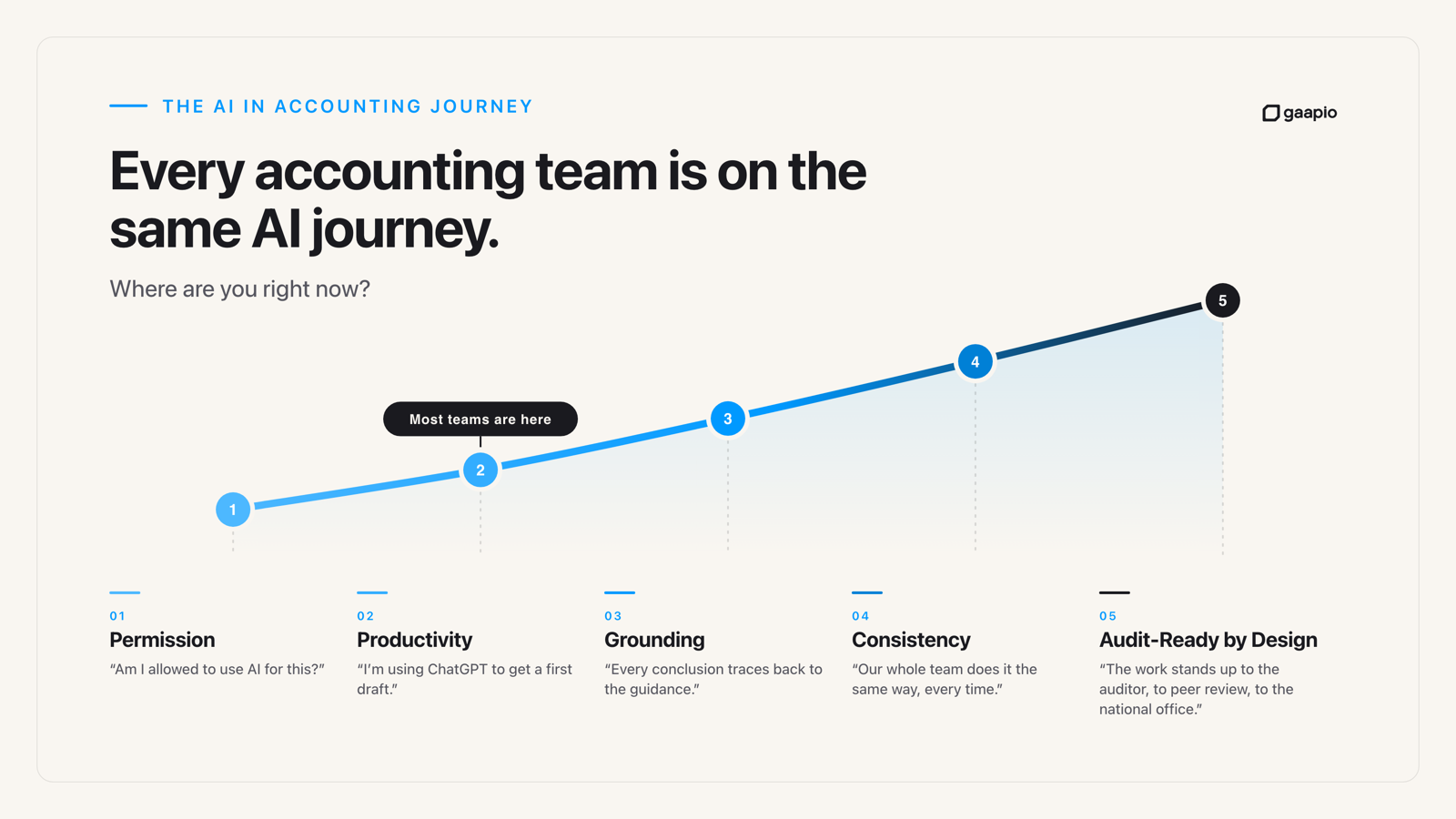
For each step: what it sounds like on a call, what's actually going on, and what gets a team to the next one.
One thing first.
Nobody skips a step. But most teams think they're one step higher than they are. That gap is where AI goes wrong in accounting.
Step 1: Permission
"Am I allowed to use AI for this?"
Everyone starts here. Most teams stay here longer than they'd like.
It doesn't sound like an AI question. It sounds like a security review.
Where does our data go? Does it train the model? Do you have a SOC 2 report? Does this fit our AI policy? Will IT even let us?
In 32% of our sales calls, security is the first objection raised. Before price. Before "does it work."
One corporate finance team described the recurring fight as "trying to get IT on board and IT aligned with finance." Then added: "It's always been a challenge for us."
Underneath the security questions there's a quieter one, and it rarely makes it onto the agenda.
Am I less of an accountant if I use AI for this? Is it cheating?
We hear that from senior people more than from staff. It usually comes out as a joke, and it usually isn't one. Twenty years of being the person who knew the answer is a hard thing to hand a tool.
What's actually going on. The team knows the upside is real. Leadership is nervous. Nobody has said yes. So the default answer is no, and the sharpest people on the team are quietly using a personal ChatGPT account anyway.
What gets you to Step 2. A written answer. Which tools, which data, which use cases. A vendor whose data-retention terms line up with your AI policy, in writing. A zero-data-retention agreement with the model providers instead of a promise on a slide. A SOC 2 Type 2 report you can hand to legal.
Permission is a governance problem wearing an AI label. Treat it like one and it gets solved.
The cheating question has a shorter answer. Using the Codification doesn't make you less of an accountant. Neither does using a tool that reads it faster than you do. The judgment is still yours, and you're still the one signing the memo.
Step 2: Productivity
"I'm using ChatGPT to get a first draft."
Permission granted, or quietly assumed. Now the tool is open and the memo is due.
This is the step most accounting teams are on today. 61% of the teams we talk to already use a general-purpose model for technical work. ChatGPT, Claude, Copilot, Gemini.
And it helps. Getting words on paper is the hardest part of a memo. One corporate accountant named that exact pain, unprompted: "It's even just, you know, getting words on paper to start."
But the stories from this step all end the same way.
"They'll give me specific references and, like, a Big Four guide that doesn't exist."
— Advisory firm, January 2026
"I have to put a human body on every memo to check every bloody reference it does."
— Advisory firm, May 2026
"I end up spending so much time reviewing, telling it what's wrong... I'm like, I should've just written this on my own."
— Accounting firm, December 2025
What's actually going on. The model is built to agree with you. One accountant called it "playing a yes man." Keep prompting a general-purpose model and it will land on whatever conclusion you already believe. An auditor pays you for professional skepticism. This is the opposite of that.
36% of the teams we talk to bring up hallucination on their own. The other 64% haven't been burned yet.
What gets you to Step 3. You stop asking "can AI write this?" and start asking "can I trace this?"
My cofounder Jace wrote a longer, honest read on what general-purpose AI does well and where it breaks on ASC guidance: ChatGPT for technical accounting.
Step 3: Grounding
"Every conclusion traces back to the guidance."
This is the step where AI becomes usable for technical accounting, and not just for typing faster.
The thing that changes is the source. The answer comes from the Codification and the Big 4 guides instead of a model's memory of the internet. Every paragraph cites something you can click. And when the guidance doesn't say, the tool says so.
That last part matters more than anyone expects. A customer's one-line summary of the Gaapio difference: it "answers the question and tells you when it's not finding what you're looking for."
Another customer, on what Gaapio does when the reasoning starts to drift:
"You may be going down the wrong path, and it'll flag some of that, too."
— In-house accounting team, July 2026
What's actually going on. You get your trust back one citation at a time. The accountant learns where AI is strong (research, first drafts, finding the paragraph) and where the human still owns the call (the judgment). "Trust but verify is always gonna be at my core," we heard from one CPA firm. Good. At this step, verifying takes a minute.
This is also where the de-skilling worry shows up, and it's a fair one:
"I give this to a manager who doesn't know to apply any level of judgment on any of these things, they're just gonna be like, 'The tool said this.'"
— Consulting firm, June 2026
The fix is AI that shows its reasoning. A first-year learns what a distinct performance obligation is by watching the analysis get built, paragraph by paragraph, the same way they used to learn it from a senior who had time to explain. One firm described it as giving staff the ability "to get inside of the standard."
What gets you to Step 4. You have more than one person doing this. And you notice they're doing it differently.
Step 4: Consistency
"Our whole team does it the same way, every time."
One person with a grounded tool saves hours. A team with one has a control problem.
Here's what Step 3 creates:
"People will do research. And because of what they prompt, they may come up with different results."
— Accounting educator, July 2026
"Depending on your risk profile or your experience, you can end up with a really different result."
— Accounting firm, July 2026
And the work doesn't travel. "You have a running chat for each client, and before you know it, that chat gets extremely long, and you can't share it."
What's actually going on. Institutional knowledge is still sitting in someone's brain. Now it's also sitting in someone's chat history. The team wants what one corporate team asked for in our first conversation: to "standardize our internal memos."
Step 4 looks like shared templates. A review workflow with a real approver. Version history. The same treatment applied the same way, whoever ran it. Internal benchmarking, so you know you're doing it all the same way.
For firms, this is the step where AI stops being a personal tool and becomes part of the methodology. For corporate teams, it's the step where the memo outlives the person who wrote it.
What gets you to Step 5. Someone outside your team reads the work. And it holds.
Related: building an audit-ready documentation process.
Step 5: Audit-Ready by Design
"The work stands up to the auditor, to peer review, to the national office."
Speed was Step 2. The top step is about the function changing.
The question we get on almost every call, "can it pass an audit?", has an answer now, because the work was built to be reviewed from the first draft. Every conclusion traces to a source you can hand the auditor. Every memo has a preparer, a reviewer, and a version history. The proof is in the document instead of in someone's memory.
At this step, the org chart starts to move.
"As an auditor, I'm saving four hours, six hours in just the preparation stage. Now the preparer can be the reviewer."
— Auditor at a national firm, July 2026
"You don't need to go to the regional office. You don't need to find out the specialty person in our firm to talk about 606 or whatever it is. You can use this tool to get your answers."
— Advisory firm, July 2026
"To give them a tool like this could be such an equalizer for them in competing with larger firms to win work."
— Firm leader, June 2026
For a corporate team, the Controller feels it as budget. The money that used to go to a Big 4 firm to "tell us the answer" now funds a team that can answer it, document it, and defend it themselves.
That's the top step. The accountant still makes the call. The AI makes that call better documented, faster, and easier to defend.
Where are you right now?
We ask that on every call now. Three things I've learned from asking:
1. Most teams are on Step 2 and think they're on Step 3. Here's the test. Ask your tool for the paragraph number. Then go look it up. If the citation doesn't resolve, you're on Step 2.
2. Permission is the slowest step, and it has the least to do with AI. If your team has been "evaluating" for a year, the blocker is a policy. Get the policy written. COSO's framework is a reasonable place to start: what COSO's AI governance guidance means for accountants.
3. You can't skip steps, but you can move through them faster. Teams that pick a grounded tool at Step 2 usually get to Step 4 within a quarter, because templates, review, and version history come with the grounding. Teams that build on a general-purpose model tend to rebuild Steps 3 and 4 by hand, one prompt at a time.
So, which step are you on? Tell me. Especially if you think it's 3.
Where Gaapio fits
We built Gaapio for Steps 3, 4, and 5, after spending years on Step 2 ourselves as Big 4 CPAs. Licensed FASB Codification and Big 4 guidance in the workflow, with citations you can click and a tool that tells you when it can't find the answer. Shared templates, review, and version history so the whole team does it the same way. And for Step 1: a completed SOC 2 Type 2 examination and zero-data-retention agreements with every model provider we use. Read how we handle your data, or see how teams use it.
Frequently asked questions
What are the stages of AI adoption in accounting?
Based on close to 300 conversations with accounting teams and CPA firms, AI adoption in accounting follows five steps. (1) Permission: "Am I allowed to use AI for this?" (2) Productivity: using a general-purpose model like ChatGPT for first drafts. (3) Grounding: AI where every conclusion cites the FASB Codification or authoritative guidance. (4) Consistency: shared templates, review workflows, and version history so a whole team produces the same result. (5) Audit-Ready by Design: work built to stand up to an auditor, peer review, or a national office from the first draft. Most teams are on Step 2.
Is it safe to use ChatGPT for technical accounting?
For brainstorming and first drafts, with caution. For conclusions, no. General-purpose models are built to agree with you and regularly cite ASC paragraphs and Big 4 guides that don't exist. A CPA has to trace every conclusion back to the actual guidance before it goes in a memo. Purpose-built tools ground every answer in the licensed Codification and say so when the guidance is silent. More on this.
What does "audit-ready" AI mean in accounting?
Audit-ready means the output was built to be reviewed: every conclusion traces to a specific, citable source; the memo has a preparer, a reviewer, and a version history; and the reasoning is visible on the page rather than in someone's head. It's the fifth and final step of the AI in accounting journey, and it's a property of the process, not the model.
How do CPA firms use AI differently from corporate accounting teams?
Firms use AI to extend scarce technical expertise across every engagement: staff produce reviewer-ready work, partners spend less time on review, and every conclusion is defensible in peer review. Corporate teams use it to draft and defend memos and disclosures in-house instead of paying an outside firm for the answer. Both follow the same five steps. Firms usually feel Step 4 (Consistency) most sharply because many people are doing the same work across many clients. See audit firms and advisory firms.
How do I know which step my team is on?
Ask the tool you use today for the paragraph number behind its conclusion, then look it up. If it doesn't resolve, you're on Step 2. If it does, but two people on your team would get two different memos, you're on Step 3. If the work is consistent but an outside reviewer hasn't read it yet, you're on Step 4.