

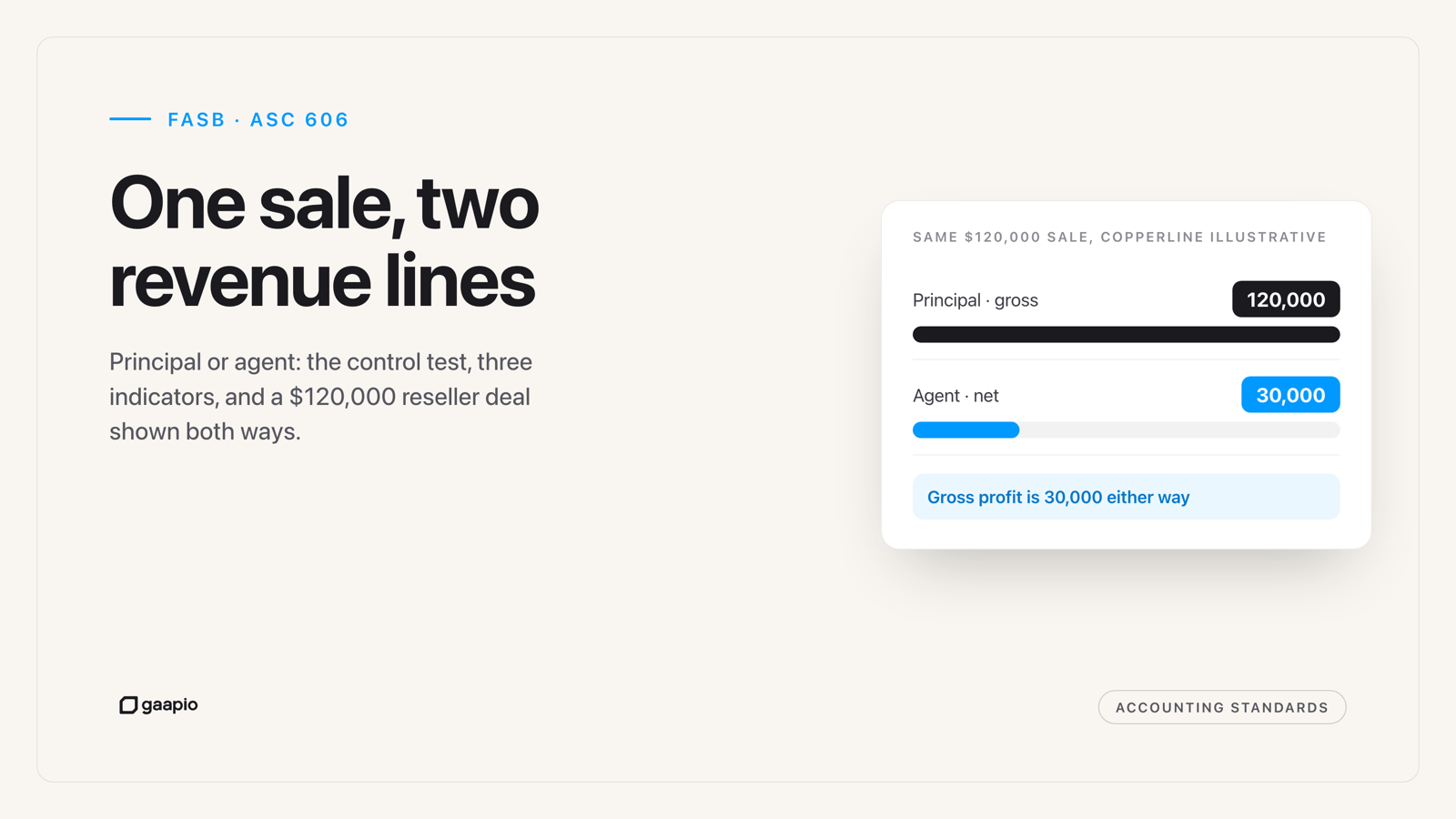
Two companies sell the same software subscription to the same customer for the same $120,000. One reports $120,000 of revenue. The other reports $30,000. Both can be right, because their contracts differ on one question: who controlled the service before the customer got it.
That judgment is principal versus agent, and it decides whether revenue is presented gross or net. This guide covers how to identify the specified good or service, the control test in ASC 606-10-55-37, the three indicators in ASC 606-10-55-39, how the analysis plays out for marketplaces, software resellers, travel, ad tech and shipping, how the conclusion changes the revenue line, and what the SEC staff asks about in comment letters. It ends with a worked example: one software reseller contract, analyzed both ways, with the memo conclusion.
Key takeaway: Under ASC 606, an entity is a principal if it controls a specified good or service before it transfers to the customer, and it reports revenue gross. An entity is an agent if its job is to arrange for another party to provide that good or service, and it reports only its fee or commission, which is net revenue. Identify the specified good or service first, apply the control test second, and use the three indicators in ASC 606-10-55-39 (primary responsibility, inventory risk, pricing discretion) as evidence, not as a checklist. The conclusion moves revenue and gross margin, and it usually leaves gross profit and net income unchanged.
What is the principal versus agent question under ASC 606?
It is the question of whether an entity is the one providing a good or service to a customer, or is arranging for someone else to provide it. ASC 606-10-55-36 through 55-40 (the principal versus agent considerations) apply whenever another party is involved in providing goods or services to a customer.
The answer sets the amount of revenue. A principal recognizes revenue in the gross amount of consideration it expects to be entitled to for the specified good or service. An agent recognizes revenue in the amount of any fee or commission it expects to be entitled to, which is often the net amount it keeps after paying the party that provides the good or service.
ASC 606 (ASU 2014-09) made control the test, replacing the ASC 605-45 approach, which weighed indicators largely tied to risks and rewards. The FASB then clarified how to apply the control test in ASU 2016-08 (March 2016).
The standard is short, the facts are never the same twice, and the judgment lives in how you describe the thing being sold.
What is the difference between gross and net revenue?
The terms have two meanings, and they get mixed up. In everyday business use, gross revenue is total sales before deductions and net revenue is what remains after returns, discounts and allowances. In ASC 606, "gross versus net" means something else: whether you present the whole amount a customer pays (gross) or only your fee after passing the rest to the party that supplied the good or service (net).
This guide uses the second meaning. The first is about measuring the transaction price (returns, discounts and other variable consideration), covered in the rest of the ASC 606 guidance. The second is the principal versus agent conclusion, and it is the one that can change reported revenue by multiples.
Both can show up in the same company. A marketplace might present gross merchandise value in its operating metrics, net commission revenue in its income statement, and a third number for sales net of returns in its disclosures.
How do you identify the specified good or service?
You start by defining what the customer is buying from the entity, at the level where control gets assessed. ASC 606-10-55-36 calls that unit the specified good or service: a distinct good or service (or a distinct bundle of goods or services) to be provided to the customer. ASC 606-10-55-36A then sets the two steps: identify each specified good or service, and assess whether the entity controls it before transfer. The specified good or service can be a right to a good or service to be provided by another party, such as a ticket or a voucher.
This step comes first because the control test needs an object. "Do we control the software subscription?" and "do we control the integrated reporting solution?" can have different answers for the same contract. A reseller that sells a vendor's license and its own implementation work may be an agent for the license and a principal for the implementation. ASC 606-10-55-36 says so directly: an entity could be a principal for some specified goods or services and an agent for others in the same contract.
Practical steps that make this step work:
- Start from the performance obligations. The specified goods or services usually line up with the distinct goods or services you identify under the five-step model. Run your usual distinctness analysis before the principal versus agent analysis.
- Describe each one in plain words. "One year of hosted access to the vendor's analytics platform for 100 users" is a specified service. "The customer's analytics" is not.
- Do the assessment per specified good or service. One conclusion for the whole contract is the exception, not the default, whenever the contract has more than one distinct item.
- Watch the bundle. If the entity integrates vendor inputs into a combined output that is the specified good or service, that points toward control of the inputs. The next section covers why.
What is the control test for a principal?
An entity is a principal if it controls the specified good or service before that good or service is transferred to the customer (ASC 606-10-55-37). Control here has the same meaning as elsewhere in ASC 606: the ability to direct the use of the good or service and obtain substantially all of the remaining benefits from it.
Holding legal title is not enough. ASC 606-10-55-37 says an entity does not necessarily control a good if it obtains legal title only momentarily before transferring it to the customer. A reseller that takes title for a few hours on the way to a customer's warehouse has not necessarily controlled anything.
When another party is involved, ASC 606-10-55-37A describes three ways an entity can control the specified good or service:
- A good or another asset from the other party that it then transfers to the customer. The entity takes control of the thing before passing it on.
- A right to a service to be performed by the other party, which gives the entity the ability to direct that party to provide the service to the customer on the entity's behalf. The entity owns the right and decides where it goes.
- A good or service from the other party that it then combines with other goods or services in providing the specified good or service to the customer. The entity integrates inputs into something different from any single input.
If none of the three applies, the entity is an agent: its job is to arrange for the other party to provide the good or service. The three scenarios are a useful way to ask the question in plain words. Did we get control of something, or did we introduce a customer to a supplier? Fitting one of the three scenarios is not enough on its own. The entity still has to control the good or service before transfer.
What are the three indicators in ASC 606-10-55-39?
ASC 606-10-55-39 lists indicators that an entity controls the specified good or service before it is transferred, and so is a principal. There are three, and the list is not exhaustive:
| Indicator | The question | Points toward principal when |
|---|---|---|
| Primary responsibility (55-39(a)) | Who is primarily responsible for fulfilling the promise to provide the specified good or service? | The entity is, including responsibility for acceptability of the good or service |
| Inventory risk (55-39(b)) | Who has inventory risk before the specified good or service is transferred, or after transfer of control? | The entity does, for example through a purchase commitment made before it has a customer, or a right of return after the sale |
| Pricing discretion (55-39(c)) | Who has discretion in establishing the price? | The entity can set the price the customer pays |
ASU 2016-08 removed two indicators that had been in the original ASC 606 text: exposure to credit risk and the form of consideration. The FASB removed them because they were not helpful in assessing whether an entity controls the specified good or service. Credit risk, for example, is about collecting from the customer, not about control of what is sold. If a draft memo still weighs credit risk, it is working from the wrong list.
Primary responsibility
An entity that is primarily responsible for fulfillment answers to the customer when the good or service is late, wrong or unusable. This includes responsibility for acceptability, meaning the customer expects the entity, not the supplier, to make it right. A service level agreement that runs from the entity to the customer is strong evidence. A contract that routes the customer to the supplier's terms of service for performance claims points the other way.
Responsibility has to be real. A clause saying "the entity is responsible" that the entity then fully backs off to the supplier does not carry the weight of one it actually has to honor.
Inventory risk
Inventory risk is about whether the entity is exposed to loss on the good or service before it has a customer, or after the customer has it. Buying a block of units in advance without a committed buyer is the classic case. So is accepting returns the entity cannot pass back to the supplier. ASC 606-10-55-39(b) also covers risk after transfer of control, which is why a right of return the entity must absorb counts.
For services, the equivalent is capacity: committing to pay for hotel rooms, airline seats or server capacity whether or not you sell them. If the supplier is paid only when a customer buys, the entity holds no inventory risk before the sale.
Pricing discretion
Discretion in establishing the price means the entity decides what the customer pays, and keeps the upside and downside of that decision. Setting the price the customer pays can indicate that the entity directs the use of the good or service. An entity whose price is set or capped by the supplier is more likely an agent.
This indicator needs care. Agents can have pricing discretion in some arrangements: a reseller can choose its margin without ever controlling the service. Pricing discretion alone rarely settles the question.
How do you weigh indicators that disagree?
Treat the indicators as evidence about control. ASC 606-10-55-39A says they may be more or less relevant depending on the nature of the specified good or service and the contract terms, and that different indicators may provide more persuasive evidence in different contracts. The indicators do not override the control assessment, and they are not a checklist to count.
In practice, a memo should state which indicators carry the most weight for this specified good or service and why. Two indicators pointing one way and one pointing the other can still produce either conclusion. Counting votes is the part of the analysis a reviewer will push on first.
How does the analysis play out in common fact patterns?
The facts vary by industry, and the same business model can land on either side depending on contract terms. The table summarizes where each pattern usually starts and the terms that tend to move it. Treat it as a starting point for the analysis, not a conclusion.
| Pattern | Often analyzed as | What moves it the other way |
|---|---|---|
| Marketplace where sellers set prices and ship goods | Agent, with the commission as revenue | The platform takes title, sets prices, handles returns and fulfillment |
| Software or SaaS reseller | Agent when the vendor hosts, supports and carries the SLA | Pre-committed license purchases, the reseller carries the SLA, or it integrates the license into its own solution |
| Travel booking | Agent for bookings of third-party airline, hotel and car inventory | The company buys inventory in advance and sets the price, or packages components into its own tour or trip |
| Ad tech | Agent for platforms that match budgets to publishers for a fee | The company buys inventory in advance, packages it with its own targeting or measurement, and is responsible to the advertiser for delivery |
| Shipping and freight | Agent when the customer holds the carrier relationship | The company contracts with carriers in its own name, owes delivery to the shipper and sets its own rate |
Marketplaces
A marketplace operator that connects buyers and sellers is often an agent when sellers set their prices, ship the goods and handle returns, and the platform earns a commission. The platform controls the marketplace service, not the goods. When the same operator also runs a first-party store, buys inventory, sets prices and takes returns, it is likely a principal on those sales. Many marketplaces have both, so the analysis runs by revenue stream, not by company.
SaaS and software resellers
Resellers sit at the center of the gross versus net debate because the same product can be structured several ways. If the vendor hosts the software, provides support and owes the customer a service level agreement, the reseller's contribution is often the introduction and the billing. If the reseller commits to a block of licenses, carries the SLA and bundles the license into its own managed service, the reseller may control the right to the service and direct it to its customers. The worked example below walks one contract through this.
Travel
An online travel agency that sells a third party's airline ticket at a price set by the airline, with no inventory commitment, is typically an agent. A tour operator that buys hotel rooms and ground transportation in advance, combines them into a trip it prices and delivers, controls those inputs and is typically a principal. The Codification's illustrative examples (Examples 45 through 48A in ASC 606-10-55) work through both ends of that range, including airline tickets an entity commits to buy in advance (principal) and restaurant vouchers it sells for a merchant (agent). They are a good reference for a memo.
Ad tech
Programmatic advertising raises real questions because the contract structures vary widely. A platform that earns a fee on a media buy and passes the publisher's price through is more likely an agent. A company that buys inventory from publishers in advance, packages it with its own targeting, and is responsible to advertisers for delivery and viewability is more likely a principal. Read the master services agreements for who owes what to whom, including when the publisher gets paid if the advertiser does not pay. The last part is relevant to cash and risk, though credit risk is no longer an ASC 606 indicator. A commitment to pay the publisher whether or not the inventory is sold is different: that can be inventory risk evidence.
Shipping and freight
A freight forwarder or logistics company that contracts with carriers in its own name, owes delivery to the shipper, and sets its own rate often controls the shipping service it sells. A broker that introduces a shipper to a carrier under a contract the shipper holds with the carrier is more likely an agent. Separately, ASC 606-10-25-18B lets a seller of goods elect to treat shipping and handling that occurs after the customer obtains control as a fulfillment activity rather than a separate promised service. A seller that makes the election generally does not run a separate principal versus agent analysis for the shipping. The election does not help a freight forwarder or broker, for whom shipping is the service being sold.
How does the conclusion change the revenue line?
It changes how much revenue and cost of revenue show, and it usually does not change gross profit. If the entity is a principal, revenue is the full price paid by the customer and the amount paid to the supplier is cost of revenue. If the entity is an agent, revenue is the commission and there is no matching cost of revenue for the pass-through amount.
The effects reach well beyond the income statement:
- Revenue and growth rates. Gross presentation can multiply reported revenue. Revenue growth, revenue-based multiples and scale thresholds all move with it.
- Gross margin. The same $30,000 of gross profit is a 25% gross margin on $120,000 of revenue and a 100% margin on a $30,000 commission, before any costs of the agent's own. Margin comparisons across companies with different conclusions mislead.
- Metrics and covenants. Revenue-based covenants, bonus plans, sales commission plans and customer concentration disclosures often reference reported revenue.
- Balance sheet. A principal records a contract liability for amounts collected in advance. An agent that collects on behalf of the supplier records a payable to the supplier for the pass-through amount.
- Disclosures. Entities describe the nature of their promises, including any obligations to arrange for another party to provide goods or services (ASC 606-10-50-12(c)), disclose significant judgments (ASC 606-10-50-17), and may separate principal and agent streams when disaggregating revenue.
- Sales tax and pass-throughs. Amounts collected for sales taxes and similar taxes can be excluded from the transaction price by policy election (ASC 606-10-32-2A). That is a separate analysis from principal versus agent.
A change in conclusion from one period to the next is an error correction question under ASC 250 if the earlier conclusion was wrong (restatement depends on materiality), or a change in facts if the contract changed. Document which one it is.
Worked example: a software reseller, analyzed both ways
Everything in this example is invented and illustrative. Copperline Software Partners (the reseller) sells subscriptions to Northfield Analytics (the vendor's platform) to Meridian Dental Group (the customer). No real company is represented.
The contract. Meridian signs with Copperline for 100 seats of the Northfield platform for 12 months starting January 1, 2027, at $120,000, paid at the start. Copperline buys the seats from Northfield at $90,000 after Meridian signs.
The facts that matter.
- Northfield hosts the platform, provides support and security, and owes Meridian an uptime SLA. Meridian accepts Northfield's terms of service on activation. Copperline handles order processing. Northfield handles all support tickets.
- Copperline has no minimum purchase commitment to Northfield and buys seats only after a customer signs. There are no unsold seats.
- Copperline sets its own price to each customer. Northfield sets no floor or ceiling.
- If the platform is down, Meridian's remedy runs against Northfield. Copperline owes no service credits.
- Meridian has no right of return or refund from Copperline.
- Meridian owes Copperline the full $120,000. Copperline owes Northfield $90,000 whether or not Meridian pays. (This is credit risk, which is not an indicator.)
Step 1: the specified service. The specified service is 12 months of access to the Northfield platform for 100 users. Copperline sells no implementation, no integration and no managed service in this contract.
Step 2: the control test. Does Copperline control the access before Meridian receives it? Copperline does not obtain a good, and it does not combine the service with its own inputs. The remaining question is ASC 606-10-55-37A(b): does Copperline obtain a right to a service that it can direct Northfield to provide on its behalf? Here, Northfield's promise runs directly to Meridian: Meridian accepts Northfield's terms of service, holds the SLA and has its remedy against Northfield. Copperline cannot direct how, when or to whom Northfield performs, so it does not control a right to the service. Buying the seats only after Meridian signs does not, by itself, make Copperline an agent. A principal can obtain control of a right to a service at the same moment the customer contract is signed. What matters is whether Copperline can direct the service.
Step 3: the indicators.
| Indicator | Facts | Points toward |
|---|---|---|
| Primary responsibility | Northfield hosts, supports and owes the SLA. Meridian's claims run against Northfield. | Agent |
| Inventory risk | No purchase commitment. Seats bought only after the customer signs. No return or refund exposure. | Agent |
| Pricing discretion | Copperline sets its own price with no vendor floor or ceiling. | Principal |
Two of three point to agent, and the two that do concern who performs the service and who bears the risk of an unsold service. Pricing discretion is often the weakest evidence for control in a reseller relationship, because a reseller can choose its margin without ever controlling what it resells.
Step 4: the conclusion. Copperline is an agent. Its performance obligation is to arrange for Northfield to provide the platform to Meridian.
Gross presentation versus net presentation
The table shows what each answer does to Copperline's 2027 income statement. Only the net column reflects the conclusion above.
| 2027, $ | Gross (principal) | Net (agent) |
|---|---|---|
| Revenue | 120,000 | 30,000 |
| Cost of revenue | 90,000 | 0 |
| Gross profit | 30,000 | 30,000 |
| Gross margin | 25% | 100% |
Cash is the same in both cases. The entries differ. If Copperline were the principal, it would record the following over the year:
| Date | Entry | Debit | Credit |
|---|---|---|---|
| Jan 1, 2027 | Cash / Contract liability (collect from Meridian) | 120,000 | 120,000 |
| Jan 1, 2027 | Prepaid expense / Cash (pay Northfield) | 90,000 | 90,000 |
| Each month | Contract liability / Revenue | 10,000 | 10,000 |
| Each month | Cost of revenue / Prepaid expense | 7,500 | 7,500 |
As an agent, Copperline records:
| Date | Entry | Debit | Credit |
|---|---|---|---|
| Jan 1, 2027 | Cash / Payable to Northfield / Commission revenue (collect from Meridian) | 120,000 | 90,000 and 30,000 |
| Jan 1, 2027 | Payable to Northfield / Cash (pay Northfield) | 90,000 | 90,000 |
The agent entry recognizes the $30,000 commission on January 1 because Copperline's promise, arranging for Northfield to provide access, is complete when Meridian obtains access, and Copperline has no further obligation to Meridian. If Copperline kept an ongoing service such as first-line support, it would assess whether that is a separate performance obligation, and part of the commission might be recognized over the term. If the commission can be clawed back on cancellation, the clawback is variable consideration and some of the commission may need to be constrained.
Memo conclusion (illustrative)
Copperline concluded that it is an agent for the Northfield subscription. The specified service is 12 months of access to the Northfield platform. Copperline does not obtain control of the right to Northfield's service before access transfers to Meridian, because Northfield's obligations run directly to Meridian and Copperline cannot direct Northfield's performance (ASC 606-10-55-37A(b)). The indicators support that conclusion: Northfield is primarily responsible and owes the SLA, and Copperline has no inventory risk. Copperline's pricing discretion does not establish control. Copperline recognizes the commission, equal to the difference between the amount billed to Meridian and the amount owed to Northfield, as revenue when Meridian obtains access. Reassess if the Northfield agreement changes.
What would change the answer
The same reseller could be a principal with different terms. Each of these moves the analysis toward principal, and together they would likely change the answer:
- Copperline commits to buy a block of seats from Northfield, nonrefundable, before it has customers.
- Copperline owes Meridian the uptime SLA and pays service credits from its own pocket.
- Copperline sells the license inside its own managed service, with its own implementation, under its own terms.
- Copperline holds the contractual right to direct Northfield's performance, with Northfield's obligations running to Copperline rather than to Meridian.
If the price and Northfield cost stayed the same and the result were a single obligation satisfied evenly over the year, Copperline would present $120,000 of revenue at $10,000 a month, with $7,500 a month of cost of revenue. Adding Copperline's own implementation or managed service would also change the transaction price, the cost base and possibly the performance obligations.
What does the SEC staff ask in comment letters about principal versus agent?
The staff asks registrants to show their work. In the examples below, the staff asked for the analysis, not just the conclusion, and in one letter pointed the registrant to ASC 606-10-55-36 through 55-40.
Staff comment letters and company responses are posted on EDGAR after the review is complete. The examples below are public, and they are examples, not a survey.
- A request for the full assessment. In a January 12, 2026 letter, the staff asked SemiLEDs Corp. to provide its assessment under ASC 606 of whether to present revenue gross or net for its buy-sell equipment orders, and to address the principal versus agent considerations in ASC 606-10-55-36 through 55-40. The staff also asked for expanded disclosure about those orders. In its January 20, 2026 response, the company walked through control and the three indicators (primary responsibility, inventory risk and pricing discretion) before concluding it was the principal.
- Justify a gross conclusion when someone else performs. The review of recent SEC comment trends from RevenueHub, where I worked in revenue recognition, describes two exchanges. In January 2024, the staff asked GMTech, a subscription AI platform, how it concluded it was the principal for contracts in which it used third-party providers. In 2024 it also asked Peloton to justify reporting extended warranty revenue gross when a third-party service contract obligor fulfilled the warranty obligations.
The pattern across these letters gives a preparer a reasonable list to answer before the staff asks:
- What is the specified good or service? Describe it contract by contract, including which items in a bundle are distinct.
- Who controls it before the customer does? Cite ASC 606-10-55-37 and the 55-37A scenario that applies.
- How does each indicator apply to the actual contracts? Point to clauses: who owes the SLA, who is paid if the customer cancels, who sets the price, who handles returns.
- Where is the third party in the picture? Two of the examples above involve a registrant reporting gross while a third party performed. Show the registrant's contract with the third party and with the customer side by side.
- Do the disclosures say what you concluded and why? The staff asks for expanded disclosure about the arrangement and the judgments behind the conclusion.
This is general information, and each staff review turns on its own facts. A letter to one registrant says nothing about what it would ask of another.
How does Gaapio help with revenue contract analysis?
Gaapio is an AI-powered technical accounting platform built by CPAs. Principal versus agent sits inside the ASC 606 analysis of a revenue arrangement, and Gaapio applies the five-step model to the arrangement and drafts the memo in the same workflow. It extracts the revenue-driving terms and shows where each one came from in the document, and it surfaces the arguments on both sides of a close call.
The conclusion is yours. Every conclusion in the memo is anchored to a Codification reference you can click through and verify. See Gaapio's revenue recognition solution, the glossary entries for revenue recognition and the ASC 606 memo.
Want to see it on one of your own contracts? Request a demo.
This article is general information, not accounting or legal advice. Confirm the requirements for your facts against the Codification and with your auditor.
Frequently asked questions
What is the difference between a principal and an agent under ASC 606?
A principal controls a specified good or service before it transfers to the customer and reports revenue gross. An agent arranges for another party to provide the good or service and reports only its fee or commission. The test is control (ASC 606-10-55-37), supported by the indicators in ASC 606-10-55-39.
What is the difference between gross and net revenue under ASC 606?
Gross revenue is the full amount the customer pays, reported by a principal. Net revenue, in this context, is the entity's fee after passing the rest to the supplier, reported by an agent. This is different from the everyday meaning of net revenue, which is sales less returns and discounts.
What are the three indicators of control in ASC 606-10-55-39?
The entity is primarily responsible for fulfilling the promise to provide the specified good or service, the entity has inventory risk before or after transfer of control, and the entity has discretion in establishing the price. The list is not exhaustive, and the indicators support the control assessment instead of replacing it.
Does pricing discretion make an entity a principal?
No. Pricing discretion is one indicator, and agents can have it too. A reseller that sets its own margin without controlling the underlying service can still be an agent. Weigh it with primary responsibility and inventory risk, and tie the conclusion back to control.
Can a company be a principal for some items and an agent for others?
Yes. ASC 606-10-55-36 says an entity can be a principal for some specified goods or services and an agent for others in the same contract. A reseller that sells a vendor license and its own implementation work may reach different conclusions for each.
Did ASU 2016-08 change the principal versus agent guidance?
Yes. ASU 2016-08, issued in March 2016, clarified the implementation guidance. It reframed the indicators as evidence of control, removed the credit risk and form of consideration indicators, and added the three scenarios in ASC 606-10-55-37A for when another party is involved.
Does the principal versus agent conclusion change net income?
Usually not. A principal reports the full price as revenue and the supplier payment as cost of revenue, while an agent reports the fee as revenue, so gross profit is typically the same. Revenue, cost of revenue and gross margin percentage change, which matters for covenants, metrics and comparisons.
What does the SEC ask about gross versus net revenue?
In the public letters cited above, the staff asked for the registrant's assessment under ASC 606-10-55-36 through 55-40, how each indicator applied to the actual contracts, and why gross presentation was appropriate when a third party performed. In one letter it also asked for expanded disclosure.
How does IFRS 15 treat principal versus agent?
IFRS 15 uses the same control model, with application guidance in paragraphs B34 through B38. Its indicators of control are also primary responsibility, inventory risk and pricing discretion. The ASC-only policy elections for shipping (25-18B) and sales taxes (32-2A) have no IFRS 15 equivalent. Check differences in wording before applying ASC conclusions to IFRS reporters or the other way around.
Related reading
- 5 common ASC 606 pitfalls
- How to use AI for revenue recognition and ASC 606 research
- ASC 606 revenue recognition solution
Sources: FASB ASC 606-10-55-36 through 55-40, ASC 606-10-25-18B and ASU 2016-08; Deloitte, Roadmap: Revenue Recognition, section 10.2, Determining Whether an Entity Is a Principal or an Agent; PwC, Revenue from contracts with customers, chapter 10, principal versus agent; SEC, SemiLEDs Corp. correspondence, January 2026; RevenueHub, Recent SEC comment trends under ASC 606.