

Sales operations sends finance the new commission plan the week before it takes effect. There is a new accelerator, a manager override and a lower rate on renewals. The first question is whether any of it goes on the balance sheet, and the second is how long it stays there.
ASC 340-40 answers both. It is the Codification subtopic on contract costs, and it requires you to capitalize the incremental costs of obtaining a contract, such as sales commissions, unless a one-year practical expedient applies. This guide covers the incremental costs test, the practical expedient, costs to fulfill a contract, the amortization period (including expected renewals and the commensurate commission question), the portfolio approach, impairment, and the presentation and disclosure requirements. It ends with a worked SaaS commission plan with a capitalization and amortization table and journal entries.
Key takeaway: ASC 340-40 covers two kinds of contract costs. Incremental costs of obtaining a contract, with sales commissions as the standard case, are recognized as an asset if you expect to recover them, unless the asset would be amortized over one year or less and you use the practical expedient (340-40-25-1 through 25-4). Costs to fulfill a contract are capitalized only if no other Topic covers them and they relate directly to a contract, generate or enhance resources you will use to satisfy performance obligations, and are expected to be recovered (25-5 through 25-8). Both are amortized on a systematic basis consistent with how the related goods or services transfer to the customer, which can include expected renewals. Both are impaired, with a loss recognized in profit or loss, to the extent the carrying amount exceeds the consideration you expect for the related goods or services, less the costs still to be incurred to provide them (35-3 through 35-6). US GAAP does not allow the loss to be reversed.
What does ASC 340-40 cover?
ASC 340-40, Other Assets and Deferred Costs: Contracts with Customers, tells you when the costs of getting and carrying out a customer contract become an asset instead of an expense. FASB issued it with ASC 606 in ASU 2014-09, and it applies to public and private entities. It has two parts: costs to obtain a contract and costs to fulfill a contract.
The subtopic sits next to the revenue guidance but is separate from it. ASC 606 tells you how much revenue to recognize and when. ASC 340-40 tells you what to do with the cost side. If your revenue policy follows revenue recognition under ASC 606, your contract cost policy has to be consistent with it, because the amortization period for a capitalized cost depends on the same contract terms, renewal rights and expected customer relationship you used in the revenue analysis.
Which costs of obtaining a contract can you capitalize?
You capitalize only the incremental costs of obtaining a contract, and only if you expect to recover them (ASC 340-40-25-1). Incremental means costs you would not have incurred if the contract had not been obtained (25-2). A sales commission is the standard example. Costs you would have incurred whether or not you won the contract are expensed as incurred, unless they are explicitly chargeable to the customer regardless of whether the contract is obtained (25-3).
Capitalization is required when the test is met. Apart from the one-year practical expedient below, you have no policy choice. Expensing a commission because it feels conservative is an error when the amortization period is longer than one year.
| Cost | Incremental? | Treatment |
|---|---|---|
| Commission on a signed contract | Yes | Capitalize, then amortize |
| Accelerator or tier bonus earned on specific contracts | Yes, to the extent triggered by obtaining those contracts | Capitalize the incremental amount. When it is probable a tier will be reached, reflect the expected rate as you accrue. If a tier crossing lifts the rate on earlier deals, allocate the extra amount on a systematic and rational basis, commonly pro rata across the contracts that count toward the tier, and apply the method consistently |
| Manager override calculated on team bookings | Yes, if it is formula-based on contracts obtained | Capitalize with the related contracts |
| Payroll taxes and fringe benefits on the commission | Yes, when they arise only because the commission is paid | Capitalize with the commission |
| Referral fee or channel partner commission | Yes, if paid to a third party that is not your customer | Capitalize. If the partner is your customer (for example, a reseller that buys from you), the payment is consideration payable to a customer under ASC 606-10-32-25 through 32-27 and usually reduces revenue |
| SPIFF or contest prize tied to a contract won | Yes | Capitalize |
| Commission on a renewal or upsell | Yes | Capitalize, unless the one-year expedient applies |
| Base salary and benefits of sales staff | No, incurred whether or not a given contract is won | Expense as incurred |
| Discretionary bonus based on company profit or goals, not tied to contracts | No | Expense as incurred |
| Travel, legal and due diligence costs on a bid | No, incurred whether or not the contract is won (Codification Example 1 treats these as expenses) | Expense as incurred |
Two timing points matter. First, read the conditions on the payout. If a commission is payable only if the rep is still employed on a future date, it may be compensation for future service instead of an incremental cost of the contract. PwC's guidance generally treats it that way, with the cost expensed over the service period under ASC 710. If a commission is payable only when the customer pays, it can still be an incremental cost. Many entities recognize the liability and the asset at signing when payment is probable, but the timing depends on when the liability is incurred under the plan terms, so document the judgment. In every case, no asset exists before a liability does, and the plan document is where the facts are. Second, "expect to recover" is a low bar for most subscription contracts, because the expected margin on the contract, including expected renewals, is usually well above the commission.
What is the practical expedient for the costs of obtaining a contract?
If the amortization period of the asset would have been one year or less, you can expense the incremental costs of obtaining the contract when incurred (ASC 340-40-25-4). It is an accounting policy election, applied consistently to similar contracts, and you disclose that you use it (340-40-50-5).
The expedient looks at the amortization period of the asset, so the length of the contract alone does not decide it. A 12-month contract whose commission you amortize over an expected five-year customer relationship does not qualify, because the asset's amortization period is five years. A commission on a one-year renewal usually qualifies when each later renewal pays a commensurate commission, because that renewal commission relates only to its own renewal year. That is why many software companies expense renewal commissions and capitalize new-customer commissions. The worked example below does exactly that.
What are costs to fulfill a contract, and when do you capitalize them?
Costs to fulfill are costs of carrying out a contract that no other Topic covers. If another Topic applies, you follow it (25-5, 25-6): inventory under ASC 330, property and equipment under ASC 360, internal-use software under ASC 350-40, and software to be sold under ASC 985-20. For what remains, you recognize an asset only if all three criteria are met (ASC 340-40-25-5):
- The costs relate directly to a contract or a specific anticipated contract.
- The costs generate or enhance resources of the entity that will be used in satisfying performance obligations in the future.
- The costs are expected to be recovered.
The standard lists costs that relate directly to a contract, such as direct labor, direct materials, allocations of costs that relate directly to the contract (management and supervision, insurance, depreciation of tools), costs explicitly chargeable to the customer, and costs incurred only because you entered the contract, such as subcontractor payments (25-7). It also lists costs you always expense: general and administrative costs not chargeable to the customer, wasted materials or labor not reflected in the price, costs that relate to performance obligations already satisfied, and costs you cannot attribute to satisfied versus unsatisfied obligations (25-8).
| Fulfillment cost | Capitalize? | Why |
|---|---|---|
| Onboarding labor for a setup activity that does not transfer a service to the customer | Often yes, if the three criteria are met | Relates directly to the contract, creates a resource used to serve the customer later, and is recoverable from the contract margin |
| Customer success or support labor during the subscription term | No | It is the service being delivered, so it is cost of revenue as incurred |
| Hosting costs for a live customer | No | Relates to performance that is transferring now |
| Training of your own implementation staff | No | Not directly related to a specific contract. Expense it |
| Idle capacity and rework | No | Wasted resources not reflected in the price are always expensed |
| Equipment built or bought to serve the contract | Follow ASC 360 | Another Topic applies first |
Setup costs are where SaaS teams most often disagree with their auditors. The test is whether the activity creates a resource, such as a configured environment or data migration, that you will use to deliver the subscription, as opposed to being a service the customer receives right away. The answer depends on the contract. Document why a given setup cost passes all three criteria, and do not use deferral to smooth margins.
One boundary to keep straight: ASC 350-40 also covers a customer's costs to implement a cloud computing arrangement. That is the customer's accounting. ASC 340-40 is the vendor's accounting for what it spends to deliver.
How long do you amortize capitalized commissions?
You amortize on a systematic basis consistent with the pattern of transfer to the customer of the goods or services the asset relates to (ASC 340-40-35-1). The asset can relate to goods or services under a specific anticipated contract, which is how expected renewals enter the period. The question is how long you expect to benefit from the commission, and three inputs usually decide it:
- The initial contract term. The floor.
- Expected renewals. Whether the benefit extends beyond the initial term depends on whether you pay a commission on renewal and how it compares with the initial one.
- The life of the product or technology. The period cannot run past the point where the customer relationship is no longer expected to generate the revenue the commission was incurred to win.
What does "commensurate" mean for renewal commissions?
If you pay a renewal commission that is commensurate with the initial commission, the initial commission relates only to the initial term, and the renewal commission relates to the renewal term. If the renewal commission is not commensurate (for example, 10% of annual contract value on the new deal and 3% on each renewal), part of the initial commission is buying the renewals too, so the amortization period extends over the expected customer relationship. The Codification does not define the test in a bright line. Big 4 guidance and the FASB's Transition Resource Group discussion frame it as proportionality: a renewal commission is commensurate when it is reasonably proportional to the initial commission relative to the respective contract values (for example, 5% of ACV on both). The level of effort needed to win the renewal is not a reason to call a lower rate commensurate.
Practice has two accepted approaches for a commission that is not commensurate. One amortizes the whole initial commission over the expected customer life. The other treats an amount equal to the renewal commission as relating to the initial term and amortizes only the excess over the longer period. Pick one, document why, and apply it consistently.
How do you estimate expected customer life?
Use your own data. Retention curves by customer cohort, contract size and product, supported by what you know about price increases, product roadmaps and competition, give you a supportable estimate. A rounded "five years" with no analysis is the number auditors challenge first. The estimate is updated when there is a significant change in the expected timing of transfer, and a change is a change in accounting estimate under ASC 250-10, recognized prospectively (35-2). If renewals get riskier, the period shortens and the asset amortizes faster from that date.
Straight-line is usually fine when the services transfer evenly. If the asset relates to goods or services that transfer at different times, such as implementation and a subscription, or if service volume changes over the period, use a pattern that follows that transfer. The billing schedule alone does not set the pattern.
Can you use the portfolio approach?
Yes, in practice. ASC 606-10-10-4 lets you apply the revenue guidance to a portfolio of contracts with similar characteristics if you reasonably expect the effects will not differ materially from applying it to each contract. Big 4 guidance extends the same logic to contract cost assets, so many companies amortize commissions by cohort, for example all new-customer commissions paid in a quarter for subscriptions with similar terms and similar expected customer lives, instead of contract by contract.
The portfolio approach makes the schedule far easier to maintain across thousands of deals. It does not remove the need to support the grouping. If the plan pays different rates by product, if retention differs sharply by segment, or if a few large deals dominate, a single pool can distort the pattern. When a specific customer terminates, you also need a policy for the remaining balance related to that contract, since the cohort average no longer describes it.
When is a capitalized contract cost impaired?
You recognize an impairment loss in profit or loss if the carrying amount of the asset exceeds (a) the amount of consideration you expect to receive in the future, plus consideration you have received but not yet recognized as revenue, for the goods or services the asset relates to, less (b) the costs that relate directly to providing those goods or services and have not been recognized as expenses (ASC 340-40-35-3). Three details matter:
- Order of testing. First recognize any impairment of other assets related to the contract under their own Topics (for example, inventory under ASC 330 or software under ASC 985-20). Then apply the contract cost test. Then include the resulting carrying amount in the asset group or reporting unit when you apply ASC 360 or ASC 350 (35-5).
- Measuring consideration. Use the principles for determining the transaction price in ASC 606, but do not apply the constraint on variable consideration, and adjust for the customer's credit risk (35-4). Our guide to the variable consideration constraint explains what is being left out. Include anticipated renewals and extensions if they are part of the amortization period.
- No reversals. Under US GAAP, an impairment loss on a contract cost asset cannot be reversed, even if conditions improve (35-6). IFRS 15 allows a limited reversal, which is the most visible difference between the two standards in this area.
Commission assets rarely fail the test, because the remaining margin on the contract is much larger than the unamortized commission. It becomes a live question when a customer terminates or stops paying, when a contract is loss-making, or when you cancel a product line whose customers you expected to renew.
How are capitalized contract costs presented and disclosed?
ASC 340-40 does not prescribe balance sheet captions. In practice, capitalized commissions appear as deferred commissions or capitalized contract costs, split between current (the next 12 months of amortization) and noncurrent, and are kept separate from contract assets, which are rights to consideration conditional on something other than the passage of time. Amortization of commissions usually goes in sales and marketing expense. Amortization of capitalized fulfillment costs usually goes in cost of revenue. Cash paid for commissions that you capitalize is an operating cash flow, and the change shows up as a reconciling item.
The required disclosures are in ASC 340-40-50-1 through 50-3. You describe the judgments you made in determining the amount of costs incurred to obtain or fulfill contracts and the method you use to determine amortization each period, and you disclose the closing balances by main category (costs to obtain contracts, pre-contract costs, setup costs), together with the amortization and impairment recognized in the period. If you use the practical expedient, you say so (50-5). An entity that is not a public business entity may generally elect not to provide the disclosures in 50-2 and 50-3 (50-4).
For an SEC registrant, the expected amortization period can be a significant estimate, and if so it also appears in critical accounting estimates in MD&A. Ask your auditors early what support they expect, because that is the schedule that gets selected for testing.
Worked example: a SaaS commission plan
All names and figures below are invented and illustrative.
Harbor Peak Software sells an annual SaaS subscription that renews automatically each year. Its commission plan pays:
| Plan element | Rate and basis | Paid when |
|---|---|---|
| New-logo commission (rep) | 10% of first-year annual contract value (ACV) | At signing |
| Manager override | 2% of first-year ACV on deals closed by the manager's team | At signing |
| Renewal commission (rep) | 3% of the renewal year's ACV | At each renewal |
On the first day of Year 1, Harbor Peak signs a new customer with ACV of $120,000 and a 12-month term. The facts that drive the analysis:
- Harbor Peak's cohort retention data for comparable customers supports an expected customer life of five years (the initial year plus four renewals), and it expects no change in the product's useful life over that period.
- The renewal commission (3%) is not commensurate with the initial commissions (10% to the rep plus a 2% manager override, with no override on renewals), so the initial commissions relate to the whole expected customer relationship.
- The manager override and the new-logo commission both depend on obtaining this contract, so both are incremental costs of obtaining it.
- Harbor Peak elected the practical expedient in ASC 340-40-25-4. It applies to the renewal commissions, because each would be amortized over a one-year renewal term. Initial commissions do not qualify and are capitalized.
- Harbor Peak's policy is to amortize the entire initial commission over the expected customer life (the first of the two approaches described above). Under the other approach, $3,600 (equal to the renewal commission) would be amortized over Year 1 and the remaining $10,800 over five years.
- Payroll taxes are ignored to keep the arithmetic clear.
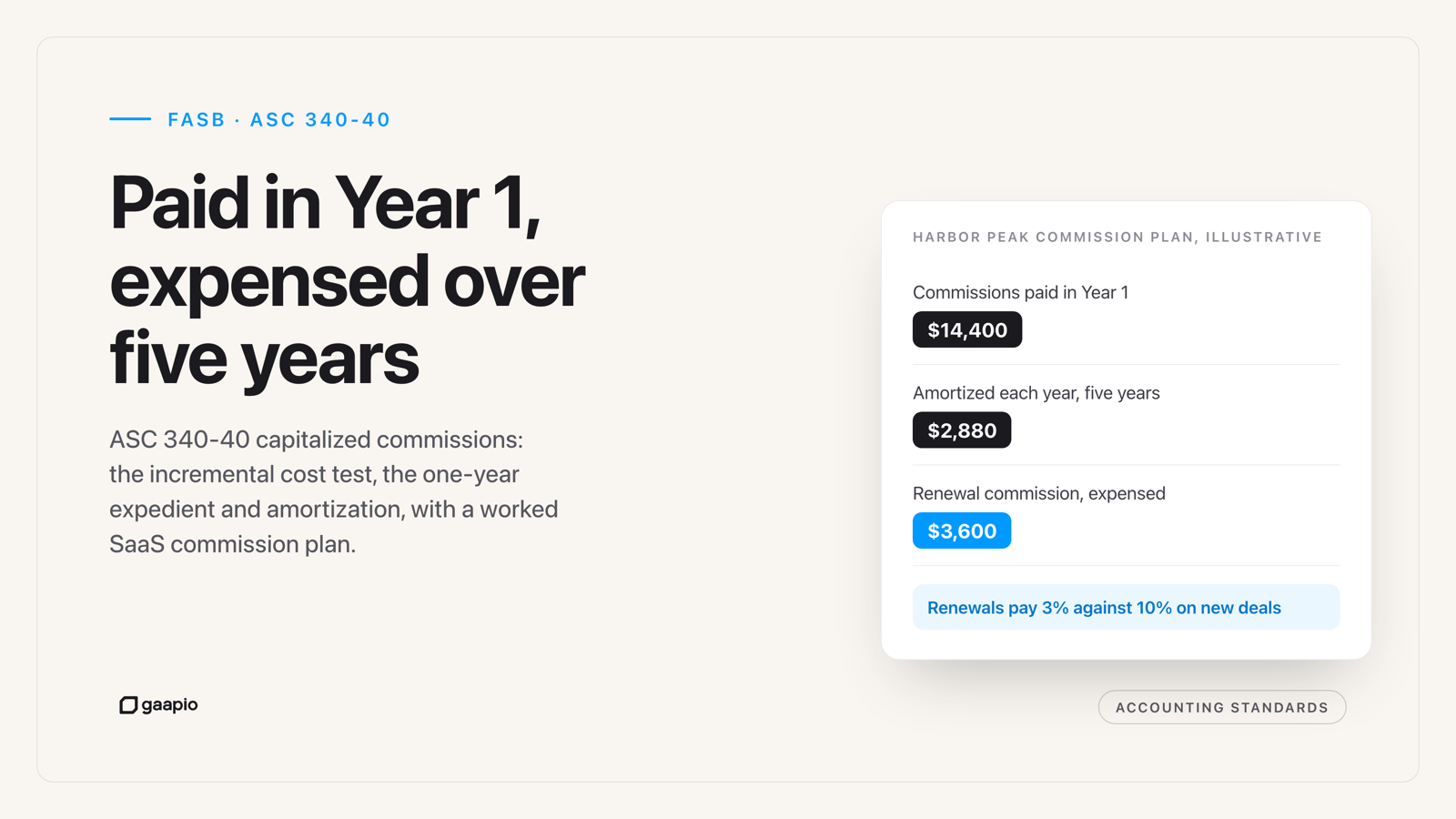
Step 1: the commission to capitalize. New-logo commission: 10% × $120,000 = $12,000. Manager override: 2% × $120,000 = $2,400. Total capitalized: $14,400.
Step 2: the amortization. Straight-line over five years, because the service transfers evenly: $14,400 ÷ 5 = $2,880 a year.
Step 3: the renewal commissions. Each renewal pays 3% × $120,000 = $3,600, expensed when incurred under the expedient.
| Year | Cash commissions paid | Opening deferred commissions | Additions | Amortization | Closing deferred commissions | Renewal commission expensed | Total commission expense |
|---|---|---|---|---|---|---|---|
| 1 | $14,400 | $0 | $14,400 | $2,880 | $11,520 | $0 | $2,880 |
| 2 | $3,600 | $11,520 | $0 | $2,880 | $8,640 | $3,600 | $6,480 |
| 3 | $3,600 | $8,640 | $0 | $2,880 | $5,760 | $3,600 | $6,480 |
| 4 | $3,600 | $5,760 | $0 | $2,880 | $2,880 | $3,600 | $6,480 |
| 5 | $3,600 | $2,880 | $0 | $2,880 | $0 | $3,600 | $6,480 |
| Total | $28,800 | $14,400 | $14,400 | $14,400 | $28,800 |
Over five years, total expense equals total cash paid ($28,800). Capitalization only changes the timing: the $14,400 paid in Year 1 is spread across five years instead of hitting Year 1.
Journal entries, Year 1.
| Entry | Debit | Credit |
|---|---|---|
| Commissions incurred at signing | Deferred commissions $14,400 | Cash or commissions payable $14,400 |
| Annual amortization | Sales and marketing expense (commission amortization) $2,880 | Deferred commissions $2,880 |
Journal entries, Year 2 (and each renewal after).
| Entry | Debit | Credit |
|---|---|---|
| Renewal commission paid (expedient) | Sales and marketing expense $3,600 | Cash $3,600 |
| Annual amortization | Sales and marketing expense $2,880 | Deferred commissions $2,880 |
Presentation at the end of Year 1. Closing balance of $11,520: current $2,880 (the next 12 months of amortization), noncurrent $8,640.
Illustrative disclosure, Year 1. "Sales commissions earned by the sales force and certain managers that are incremental to obtaining customer contracts are capitalized and amortized on a straight-line basis over five years, the expected period of benefit, which we determined based on expected customer life because renewal commissions are not commensurate with initial commissions. We expense commissions on renewals as incurred because the amortization period would be one year or less. Deferred commissions at year-end were $11,520. Amortization recognized in the year was $2,880. There was no impairment."
What changes the answer in Year 3?
At the start of Year 3, just after the renewal, the customer gives notice that it will not renew for Year 4. Two things follow.
First, the amortization period for this contract's asset changes. The remaining benefit now ends with Year 3, so Harbor Peak amortizes the opening balance of $8,640 over the one year left instead of continuing at $2,880. Year 3 amortization expense is $8,640 and total commission expense for the year is $8,640 + $3,600 = $12,240. This is a change in accounting estimate, recognized prospectively (ASC 340-40-35-2). (Under a portfolio approach, you would also derecognize this customer's remaining balance when it ends, and update the cohort estimate if the churn signals a trend.)
Second, Harbor Peak tests for impairment. The remaining consideration is the $120,000 Year 3 fee (received or receivable but not yet recognized as revenue), and assume $30,000 of costs directly related to providing the service in Year 3 have not yet been recognized. $120,000 − $30,000 = $90,000, which is far more than the $8,640 carrying amount, so no impairment is recognized. The cost of the early termination shows up as faster amortization instead of an impairment charge. Over the three years, commission cash is $21,600 ($14,400 + $3,600 + $3,600) and total expense is $2,880 + $6,480 + $12,240 = $21,600.
How do ASC 340-40 and IFRS 15 compare?
The two are substantially aligned. IFRS 15 paragraphs 91 through 94 cover the costs of obtaining a contract, including the one-year practical expedient (paragraph 94). Paragraphs 95 through 98 cover costs to fulfill, and paragraphs 99 through 104 cover amortization and impairment. The main difference is that IFRS 15 permits reversing an impairment loss when conditions improve (paragraph 104), and ASC 340-40-35-6 prohibits it. Check the details against IFRS wording before applying a US conclusion to an IFRS filer.
How does Gaapio help with contract cost accounting?
Gaapio is an AI-powered technical accounting platform built by CPAs. The capitalization question starts in the revenue contract, since the term, renewal rights and renewal pricing drive the amortization period. Gaapio extracts those contract terms and surfaces the arguments on both sides of a close call, such as whether a renewal commission is commensurate, with clickable Codification citations you can verify. The conclusion is yours. See Gaapio's revenue recognition solution.
Want to see it on one of your own contracts? Request a demo.
This article is general information, not accounting or legal advice. Confirm the requirements for your facts against the Codification and with your auditor.
Written by Jace Chambers, CPA, cofounder of Gaapio, who started in audit at EY.
Frequently asked questions
What is ASC 340-40?
ASC 340-40 is the Codification subtopic Other Assets and Deferred Costs: Contracts with Customers. It requires you to capitalize the incremental costs of obtaining a contract with a customer, such as sales commissions, if you expect to recover them, and to capitalize certain costs of fulfilling a contract. Both are amortized consistent with the transfer of the related goods or services and tested for impairment.
Do you have to capitalize sales commissions?
Yes, if they are incremental to obtaining the contract and you expect to recover them, unless the amortization period would be one year or less and you elect the practical expedient in ASC 340-40-25-4. Capitalizing is required when the test is met, and conservatism is not a reason to expense.
What is the one-year practical expedient?
If the asset's amortization period would be one year or less, you can expense the costs of obtaining the contract when incurred. The test looks at the amortization period, so the contract term alone does not decide it. A one-year contract whose commission relates to an expected five-year customer relationship does not qualify.
How long do you amortize capitalized commissions?
Over the period of benefit, on a basis consistent with the transfer of the related goods or services. That is the initial term plus expected renewals when the renewal commission is not commensurate with the initial one. Support the period with your own retention data and revisit it when facts change.
What does commensurate mean for renewal commissions?
A renewal commission is commensurate when it is reasonably proportional to the initial commission relative to the respective contract values, such as 5% of ACV on both. Effort to win the renewal does not factor in. When it is lower, such as 3% on renewals versus 10% on the new deal, part of the initial commission is attributable to the expected renewals, and the amortization period extends beyond the initial term.
Can you use a portfolio approach for contract costs?
Yes, if you reasonably expect the result will not differ materially from contract-by-contract accounting, using the portfolio principle in ASC 606-10-10-4. Many companies amortize by cohort. The grouping needs support, and you need a policy for what happens to the balance when a customer in the pool terminates.
When is a contract cost asset impaired?
When its carrying amount exceeds the remaining consideration you expect for the related goods or services, less the costs still to be incurred to provide them (ASC 340-40-35-3). Test assets under other Topics first, measure consideration without the variable consideration constraint, and adjust for credit risk. US GAAP prohibits reversing an impairment loss on a contract cost asset (ASC 340-40-35-6).
Where do capitalized commissions appear in the financial statements?
On the balance sheet as deferred commissions or capitalized contract costs, split between current and noncurrent, separate from contract assets. Amortization of commissions typically goes in sales and marketing expense, and the cash paid is an operating cash flow. ASC 340-40-50 requires a description of your judgments and method, closing balances by category, and amortization and impairment for the period.
Which costs to fulfill a contract can be capitalized?
Costs that no other Topic covers, relate directly to a contract or specific anticipated contract, generate or enhance resources you will use to satisfy performance obligations, and are expected to be recovered (ASC 340-40-25-5). General and administrative costs, wasted resources, and costs tied to satisfied performance obligations are always expensed.
Do capitalized commissions create deferred taxes?
Often. Tax deductions for commissions typically follow different timing rules than the book amortization, which creates a temporary difference under ASC 740. Confirm the tax treatment with your tax group. Our ASC 740 income tax provision guide covers the mechanics.
Does IFRS 15 treat contract costs the same way?
Largely, yes. IFRS 15 paragraphs 91 through 104 cover costs to obtain and fulfill a contract, amortization and impairment, and include the same one-year practical expedient. One difference: IFRS 15 permits reversing an impairment loss (paragraph 104), and US GAAP prohibits it.
Related reading
- ASC 606 contract modifications: the 2026 guide
- ASC 606 variable consideration and the constraint
- 5 common ASC 606 pitfalls
- ASC 606 revenue recognition solution
Sources: FASB ASC 340-40-25, 340-40-35 (including 35-2 and 35-4 through 35-6), 340-40-50 (including 50-4 and 50-5) and Example 1 in 340-40-55; ASC 606-10-10-4 and 606-10-32-11 through 32-13; IFRS 15 paragraphs 91 through 104; Deloitte, Roadmap: Revenue Recognition, 13.4 Amortization and Impairment of Contract Costs; Deloitte, 15.4 Contract Costs (disclosure); Deloitte, 15.5 Disclosure of Practical Expedients Used; PwC, Revenue from contracts with customers, 11.2 Incremental costs of obtaining a contract; PwC, 11.3 Costs to fulfill a contract; PwC, 11.4 Amortization and impairment.