

Your tax provision has to tie to the return, the balance sheet and the footnote, and it has to do it on the same close calendar as everything else. Next time you lose an evening to a deferred tax rollforward that is off by a rounding difference nobody can find, remember that ASC 740 is mostly a matter of keeping three numbers consistent: what you owe now, what you will owe or recover later, and how sure you are about both.
This guide covers ASC 740 for a controller who owns the provision: current versus deferred tax, temporary differences, the valuation allowance and the evidence behind it, uncertain tax positions under ASC 740-10, the interim estimated annual effective tax rate under ASC 740-270, how ASC 740 treats a change in tax law (with the 2025 U.S. legislation dated and explained), and what ASU 2023-09 changed in the disclosures. It ends with an illustrative walkthrough from pre-tax book income to tax expense, with a deferred tax rollforward you can adapt.
Key takeaway: Income tax expense under ASC 740 is current tax (what the year's return will show) plus deferred tax (the change in deferred tax assets and liabilities, measured at enacted rates). Deferred tax assets are reduced by a valuation allowance when it is more likely than not that some of the benefit will not be realized, and that call rests on weighing positive and negative evidence. A tax position is recognized only if it is more likely than not to be sustained on its technical merits, and then measured as the largest amount with a cumulative probability greater than 50%. Interim periods apply an estimated annual effective tax rate to year-to-date ordinary income, with discrete items recorded in the period they occur. A change in tax law is recorded in the period that includes the enactment date. ASU 2023-09 changed the disclosures, not the calculation.
What does ASC 740 require in an income tax provision?
ASC 740 (Income Taxes) requires you to recognize the amount of taxes payable or refundable for the current year and the deferred tax liabilities and assets for the future tax consequences of events that have been recognized in the financial statements or tax returns. The balance sheet drives the answer: you compare the book basis and tax basis of assets and liabilities, apply enacted tax rates, and the change in the resulting deferred balances flows through income tax expense.
In practice a provision has five parts, and each one is covered below:
- Current tax expense or benefit for the year.
- Deferred tax expense or benefit, from the change in temporary differences, carryforwards and enacted rates.
- The valuation allowance on deferred tax assets that are not realizable.
- The liability for unrecognized tax benefits on uncertain positions, with any interest and penalties.
- The allocation of the total among continuing operations, discontinued operations and other comprehensive income (intraperiod allocation under ASC 740-20).
The standard is an asset and liability approach. That is why deferred tax balances, not the income statement, are where errors tend to hide.
What is the difference between current and deferred income tax?
Current income tax is the tax payable or refundable on this year's taxable income, computed under the tax law. Deferred income tax is the tax effect of temporary differences, which is the amount of tax you will pay or recover in future years because book and tax treat the same item differently in timing.
Think of current tax as the return and deferred tax as the bridge between the return and GAAP pre-tax income. Total tax expense is the sum:
| Current tax | Deferred tax | |
|---|---|---|
| What it measures | Tax on this year's taxable income | Change in deferred tax assets and liabilities during the year |
| Where the amount comes from | The tax return (or the provision estimate of it) | The balance sheet: book basis versus tax basis, carryforwards, enacted rates |
| Balance sheet account | Income taxes payable or receivable | Deferred tax asset or liability (noncurrent) |
| Rate used | Rate applicable to the year | Enacted rate expected to apply when the difference reverses |
| What changes it | Taxable income, credits, estimated payments | New temporary differences, reversals, rate or law changes, valuation allowance |
Deferred taxes are classified as noncurrent on the balance sheet, and assets and liabilities are offset within the same tax-paying component and jurisdiction (ASC 740-10-45-4 and 45-6). Federal, state and each foreign jurisdiction generally stay separate for offsetting.
What are temporary differences, and which ones create deferred tax assets and liabilities?
A temporary difference is a difference between the tax basis of an asset or liability and its carrying amount in the financial statements that will result in taxable or deductible amounts in future years. If the reversal increases future taxable income, it creates a deferred tax liability. If the reversal reduces future taxable income, it creates a deferred tax asset. Carryforwards for net operating losses and credits are not temporary differences but are treated the same way: as deferred tax assets, subject to the valuation allowance assessment.
Not every book-tax difference is temporary. A permanent difference never reverses (for example, certain nondeductible expenses or tax-exempt income), so it affects the effective tax rate but creates no deferred tax.
| Item | Typical book-tax difference | Deferred tax result |
|---|---|---|
| Depreciation | Tax depreciation faster than book (bonus depreciation) | Deferred tax liability |
| Accrued compensation and bonuses | Expensed for book, deductible when paid | Deferred tax asset |
| Warranty and other reserves | Accrued for book, deductible when incurred | Deferred tax asset |
| Allowance for credit losses | Book reserve ahead of tax write-offs | Deferred tax asset |
| Capitalized research costs | Capitalized for tax, expensed for book (the old Section 174 pattern, still the pattern for foreign research costs and in states that decouple from Section 174A) | Deferred tax asset |
| Lease right-of-use assets and liabilities | Book ASC 842 balances differ from tax | Deferred tax liability and asset, often presented net by jurisdiction |
| Acquired intangibles | Book amortizes, tax basis may be zero in a stock deal | Deferred tax liability (acquisition accounting is covered in our ASC 805 guide) |
| Net operating loss carryforward | Tax loss not yet used | Deferred tax asset, subject to valuation allowance |
| Nondeductible portion of meals; fines and penalties | Never deductible | Permanent difference, no deferred tax |
Two measurement rules matter every close. First, deferred taxes are measured using enacted tax rates and laws, not proposed ones (ASC 740-10-30-8). Second, ASC 740 has recognition exceptions: no deferred tax liability for goodwill whose amortization is not deductible for tax (ASC 740-10-25-3(d)), and none for outside basis differences in foreign subsidiaries that are indefinitely reinvested (ASC 740-30-25-17). Those exceptions need their own documentation.
Fair value measurements feed several of these differences. Our ASC 820 guide covers the hierarchy and disclosures for the assets and liabilities whose book basis comes from fair value.
What changed in U.S. tax law in 2025, and how does ASC 740 treat a change in tax law?
ASC 740 records the effect of a change in tax law or rates in the period that includes the enactment date, and the effect on deferred taxes is reported in income from continuing operations even when the related item was originally recorded elsewhere (ASC 740-10-25-47, 35-4 and 45-15). The effective date of the law does not control when you record it. The enactment date does.
The legislation that matters most for 2026 reporting is Public Law 119-21, commonly called the One Big Beautiful Bill Act (H.R. 1), signed on July 4, 2025. For a calendar-year company, July 4 falls in the third quarter of 2025, so the effects went into the Q3 2025 interim period and the 2025 annual provision. The provisions below are the ones most likely to touch a controller's provision. Dates are as of this post, October 29, 2026, and Treasury and IRS guidance is still being issued, so confirm each item against the statute and current guidance for your facts.
| Provision (P.L. 119-21) | What it does | Effective date | Why it matters for ASC 740 |
|---|---|---|---|
| Bonus depreciation | Permanently restores 100% bonus depreciation and adds 100% expensing for qualified production property (new Section 168(n)) | Property acquired and placed in service after January 19, 2025 (binding-contract rules apply) | Changes tax basis of qualifying property, so the depreciation deferred tax liability and current tax both move |
| Domestic research expensing (new Section 174A) | Permits current deduction of domestic research and experimental costs; foreign research costs still amortize over 15 years | Amounts paid or incurred in tax years beginning after December 31, 2024. Unamortized 2022-2024 domestic costs can be deducted in full in 2025 or ratably over 2025 and 2026; eligible small businesses could also elect to apply 174A retroactively to 2022-2024 by amended return, but that election had to be made by the earlier of July 6, 2026 or the refund statute of limitations (Rev. Proc. 2025-28) | Reverses the deferred tax asset that built up under the old capitalization rule. Section 280C(c) again requires reducing the research deduction by the research credit unless you elect the reduced credit, so model the credit and the deduction together |
| Section 163(j) interest limitation | Returns to an EBITDA-based adjusted taxable income measure. For tax years beginning after December 31, 2025, CFC inclusions (Subpart F, NCTI, the Section 78 gross-up) are excluded from adjusted taxable income and the limit applies before interest capitalization, which can cut deductible interest for multinationals | Tax years beginning after December 31, 2024 | Changes how much interest is deductible, so carryforward deferred tax assets and valuation allowances may change |
| Net CFC tested income (NCTI, formerly GILTI) and foreign-derived deduction eligible income (FDDEI, formerly FDII) | Section 250 deduction cut to 40% (NCTI) and 33.34% (FDDEI); the QBAI return is eliminated; the NCTI foreign tax credit haircut is reduced to 10%; expense allocation is narrowed | Tax years beginning after December 31, 2025 | Part of the 2026 annual effective tax rate. If your policy records deferred taxes for NCTI rather than treating it as a period cost, revisit the measurement and document the policy |
Also check the BEAT rate increase to 10.5%, expanded Section 162(m) aggregation (deferred tax assets on covered-employee compensation), the new 1% floor on corporate charitable deductions, and energy credit phase-outs and foreign-entity restrictions if you claim or buy credits.
How the effect reaches the financial statements depends on timing and type:
- Deferred tax effects on existing temporary differences were recognized discretely in the period that includes the enactment date, including any change in the valuation allowance on deferred tax assets that existed at that date.
- Current-year effects of provisions effective in the enactment year went through the estimated annual effective tax rate for the interim period that includes enactment and later periods. A retroactive change applies to the current year through the annual rate (with a catch-up in the interim periods already reported) and to earlier years discretely. Deferred taxes on temporary differences that arose earlier in the current year, before enactment, involve a policy choice (discrete or through the rate); apply it consistently.
- In 2026, the federal law is ordinary provision work. The enactment-date accounting happened in Q3 2025 for a calendar-year company. Provisions effective for tax years beginning after December 31, 2025 are simply part of the estimated annual effective tax rate from Q1 2026. What still moves in 2026: the 2025 return-to-provision true-up (calendar-year 2025 returns were due October 15, 2026 on extension, so it lands in Q3 or Q4), including Section 174A and bonus depreciation elections made on the return, and changes in estimate from IRS guidance issued after the 2025 provision, such as further Section 174A or bonus depreciation guidance.
- State conformity is a separate enactment. Each state decides whether to follow Section 174A, bonus depreciation, 163(j) and the international changes. A state law enacted in 2026 is recorded in the period that includes that state's enactment date, with the deferred effect discrete, so track state legislation each quarter.
If you elected to deduct unamortized domestic research costs in 2025 or 2026 under the transition rules, check that the deferred tax asset for capitalized costs reverses on the schedule your election actually follows, and that your valuation allowance assessment reflects the changed taxable income. Pillar Two global minimum taxes are a separate ASC 740 topic with their own jurisdiction-by-jurisdiction evaluation, and the status of the OECD arrangements for U.S.-parented groups has been changing, so confirm the current position for each jurisdiction.
Primary sources worth keeping open: Public Law 119-21 (H.R. 1) at Congress.gov, KPMG's hot topic on accounting for the Act, and BDO's implications for accounting for income taxes.
When do you need a valuation allowance on a deferred tax asset?
You need a valuation allowance when it is more likely than not (a likelihood above 50%) that some or all of a deferred tax asset will not be realized (ASC 740-10-30-5(e) and 30-17). The allowance reduces the asset to the amount you expect to realize. The assessment is made for each tax-paying component and jurisdiction, at every reporting date, using all available evidence.
ASC 740-10-30-18 lists four sources of future taxable income you can use to support realization:
- Future reversals of existing taxable temporary differences.
- Future taxable income exclusive of reversing temporary differences and carryforwards.
- Taxable income in prior carryback years, if the tax law permits carryback.
- Tax planning strategies that are prudent and feasible.
Then you weigh the evidence. The more negative evidence you have, the more positive evidence you need, and the weight you give each item depends on how objectively it can be verified (ASC 740-10-30-21 to 30-23).
| Evidence | Examples |
|---|---|
| Negative | Cumulative pre-tax losses in recent years; a history of operating loss or credit carryforwards expiring unused; losses expected in early future years; unsettled circumstances that, if unfavorably resolved, would adversely affect future operations; a carryforward period so brief it limits realization |
| Positive | Existing contracts or a sales backlog that will produce taxable income; an appreciated asset base that would generate gains if sold; strong earnings history with the loss being an aberration (nonrecurring cause); taxable temporary differences reversing in the right periods; prudent tax planning strategies |
A recent cumulative loss is the negative evidence auditors weigh most heavily, because it is objective and hard to overcome with forecasts alone. The Codification does not define the cumulative loss period. Most practice uses three years including the current year, but it is a convention, not a bright line, and you document how you applied it. Where that evidence is present, forecasts of future profit alone rarely carry the conclusion; support from reversing taxable temporary differences, contracts or tax planning strategies carries more weight.
Three practical points. First, scheduling matters. A deferred tax liability reversing in the same period and jurisdiction as a deductible difference supports realization, but indefinite-lived taxable differences, such as those on indefinite-lived intangibles, generally support only indefinite-lived deferred tax assets, such as post-2017 federal NOLs, and then only to the extent of the 80% limitation. Second, carryforward character matters: a state NOL, a federal NOL arising after 2017 (indefinite carryforward, with deductions limited to 80% of taxable income) and a capital loss carryforward each have different realization paths. Third, a valuation allowance release is as much a judgment as the original allowance, and it often comes with the earnings turnaround that would otherwise draw scrutiny from auditors and the SEC.
For the Big 4 views, see PwC's assessing the need for a valuation allowance and sources of taxable income, and Deloitte's basic principles of valuation allowances.
How do uncertain tax positions work under ASC 740-10?
ASC 740-10 uses a two-step approach to uncertain tax positions: recognize a benefit only if the position is more likely than not to be sustained on its technical merits, then measure the recognized benefit as the largest amount that has a cumulative probability greater than 50% of being realized on ultimate settlement (ASC 740-10-25-6 and 740-10-30-7). It is often still called by its pre-codification name, FIN 48.
Step one assumes the taxing authority has full knowledge of all relevant information and will examine the position. Detection risk is not a factor. Step two is a measurement, not a recognition threshold, and you evaluate it against a distribution of possible settlement outcomes.
The difference between the amount you claim on the return and the amount you recognize in the financial statements is the unrecognized tax benefit. It is presented as a reduction of a deferred tax asset for an NOL, similar tax loss or tax credit carryforward when that carryforward is available under the tax law to settle the additional tax and you would use it, and otherwise as a liability (ASC 740-10-45-10A and 45-10B). It is disclosed in a tabular rollforward for public entities (ASC 740-10-50-15A). Interest and penalties follow a policy election for income statement classification, either income tax expense or another line, and you disclose the policy.
| Settlement outcome | Probability of that outcome | Cumulative probability (from largest benefit) |
|---|---|---|
| $500,000 benefit sustained in full | 25% | 25% |
| $400,000 | 20% | 45% |
| $300,000 | 30% | 75% |
| $150,000 | 25% | 100% |
Here the largest amount with a cumulative probability greater than 50% is $300,000, so you recognize $300,000 of the $500,000 claimed and carry a $200,000 unrecognized tax benefit. (This is the same position used in the worked example below, and the percentages are illustrative.)
Position by position, re-evaluate at each reporting date. New information, a settlement, the expiration of a statute of limitations, or a court ruling can change the recognition or measurement, and the change is recorded in the period in which the new information arises. Income tax positions are also different from loss contingencies, where ASC 450 applies. Our ASC 450 guide covers that threshold for non-tax contingencies.
How do you calculate the interim tax provision under ASC 740-270?
ASC 740-270 requires you to estimate the annual effective tax rate for the full fiscal year at each interim date and apply it to year-to-date ordinary income. The tax for a quarter is the year-to-date tax minus the tax already recorded for earlier quarters. Items that are not ordinary income, or that are unusual or infrequent, are recorded discretely in the quarter they occur, with their own tax effect.
The estimated annual effective tax rate includes the expected permanent differences, credits, the mix of income across jurisdictions, and tax planning actions available. It excludes discrete items, and it is updated each quarter for changes in your estimate.
| Item | Interim treatment |
|---|---|
| Ordinary income and recurring permanent differences | In the estimated annual effective tax rate |
| Change in tax law or rate | Current-year effects in the estimated annual effective tax rate starting with the period of enactment; deferred tax remeasurement on existing balances discrete in the period of enactment |
| Change in judgment about the realizability of beginning-of-year deferred tax assets because of expected current-year income | Spread across the year through the estimated annual effective tax rate |
| Change in judgment about realizability of beginning-of-year deferred tax assets in future years | Discrete, in the quarter of the change (ASC 740-270-25-7) |
| Settlement of a prior-year uncertain tax position | Discrete |
| Significant unusual or infrequent items | Discrete, with their own tax effect |
| Ordinary loss in a jurisdiction for which no tax benefit can be recognized for the year, or a jurisdiction where a reliable estimate cannot be made | That jurisdiction's income and tax are excluded from the overall estimated annual effective tax rate and computed separately (ASC 740-270-30-36) |
Using the example below: if the company expects full-year ordinary pre-tax income of $10,000,000 and full-year tax of $2,250,000 (the annual example below, before any discrete items), the estimated annual effective tax rate is 22.5%. With first-quarter pre-tax income of $2,000,000, first-quarter tax is $450,000. If the quarter also includes a discrete $50,000 benefit from a statute of limitations lapse, first-quarter tax expense is $400,000, and the quarterly effective rate is 20.0%, which is why reviewers ask for the discrete items separately.
Interim reporting is where a lot of provision errors surface, because the full-year estimate depends on forecasts the rest of the close is also using. Document what changed in the estimate each quarter. A reviewer will ask for the roll from last quarter's rate.
What did ASU 2023-09 change in income tax disclosures?
ASU 2023-09, Income Taxes (Topic 740): Improvements to Income Tax Disclosures, changed the income tax footnote. It did not change how you calculate current tax, deferred tax or the valuation allowance. Public business entities adopted it for annual periods beginning after December 15, 2024, and all other entities for annual periods beginning after December 15, 2025.
The standard requires a more specific rate reconciliation with defined categories, disaggregated income taxes paid by jurisdiction, a split of pre-tax income between domestic and foreign, and a split of income tax expense among federal, state and foreign. Everything you build for the provision in this guide is the input to those tables. We cover the categories, the 5% thresholds, private company relief, prospective versus retrospective adoption and a worked reconciliation in our ASU 2023-09 guide.
Separately from ASU 2023-09, ASU 2019-12 simplified several parts of Topic 740 and has been effective for years. If your template still reflects the pre-2019 intraperiod allocation exception or the old interim loss limitation language, update it.
Worked example: from pre-tax book income to tax expense (illustrative)
The example below is invented to show the mechanics. It is not a recommendation about any treatment. Alder Ridge Software is a calendar-year, U.S.-only company with a blended federal and state statutory rate of 25% (21% federal, plus about 4% for state tax net of the federal benefit, rounded for simplicity). It does not file in any jurisdiction with a different rate, and all numbers are illustrative.
Facts for 2026:
- Pre-tax book income: $10,000,000.
- Nondeductible expenses (permanent): $200,000.
- Accrued compensation (accrued for book, deductible when paid): the balance grew by $300,000.
- Warranty reserve (accrued for book, deductible when incurred): grew by $100,000.
- Tax depreciation exceeded book depreciation by $1,800,000, mostly from bonus depreciation.
- A research credit of $500,000 is claimed on the return. Alder Ridge elects the reduced credit under Section 280C(c), so no reduction of the research deduction is modeled; the $500,000 is the reduced credit. Based on the settlement analysis in the uncertain tax position section above, $300,000 is recognized and $200,000 is an unrecognized tax benefit.
- Beginning deferred balances are shown in the rollforward below. A state net operating loss deferred tax asset of $160,000 (stated at the state rate, net of federal) has a full valuation allowance, and the facts do not change.
Step 1: Taxable income and current tax
| Line | Amount |
|---|---|
| Pre-tax book income | $10,000,000 |
| Add: nondeductible expenses (permanent) | 200,000 |
| Add: increase in accrued compensation | 300,000 |
| Add: increase in warranty reserve | 100,000 |
| Less: excess of tax depreciation over book depreciation | (1,800,000) |
| Taxable income | $8,800,000 |
| Tax at 25% | $2,200,000 |
| Less: research credit claimed on the return | (500,000) |
| Tax per the return (after credit claimed) | $1,700,000 |
Step 2: Deferred tax expense and the rollforward (tax-effected at 25%)
| Deferred item | Beginning | Current-year change | Ending |
|---|---|---|---|
| Accrued compensation (asset) | $125,000 | $75,000 | $200,000 |
| Warranty reserve (asset) | 50,000 | 25,000 | 75,000 |
| State NOL carryforward (asset) | 160,000 | 0 | 160,000 |
| Gross deferred tax assets | 335,000 | 100,000 | 435,000 |
| Valuation allowance (state NOL) | (160,000) | 0 | (160,000) |
| Net deferred tax assets | 175,000 | 100,000 | 275,000 |
| Depreciation (liability) | (900,000) | (450,000) | (1,350,000) |
| Net deferred tax liability | (725,000) | (350,000) | (1,075,000) |
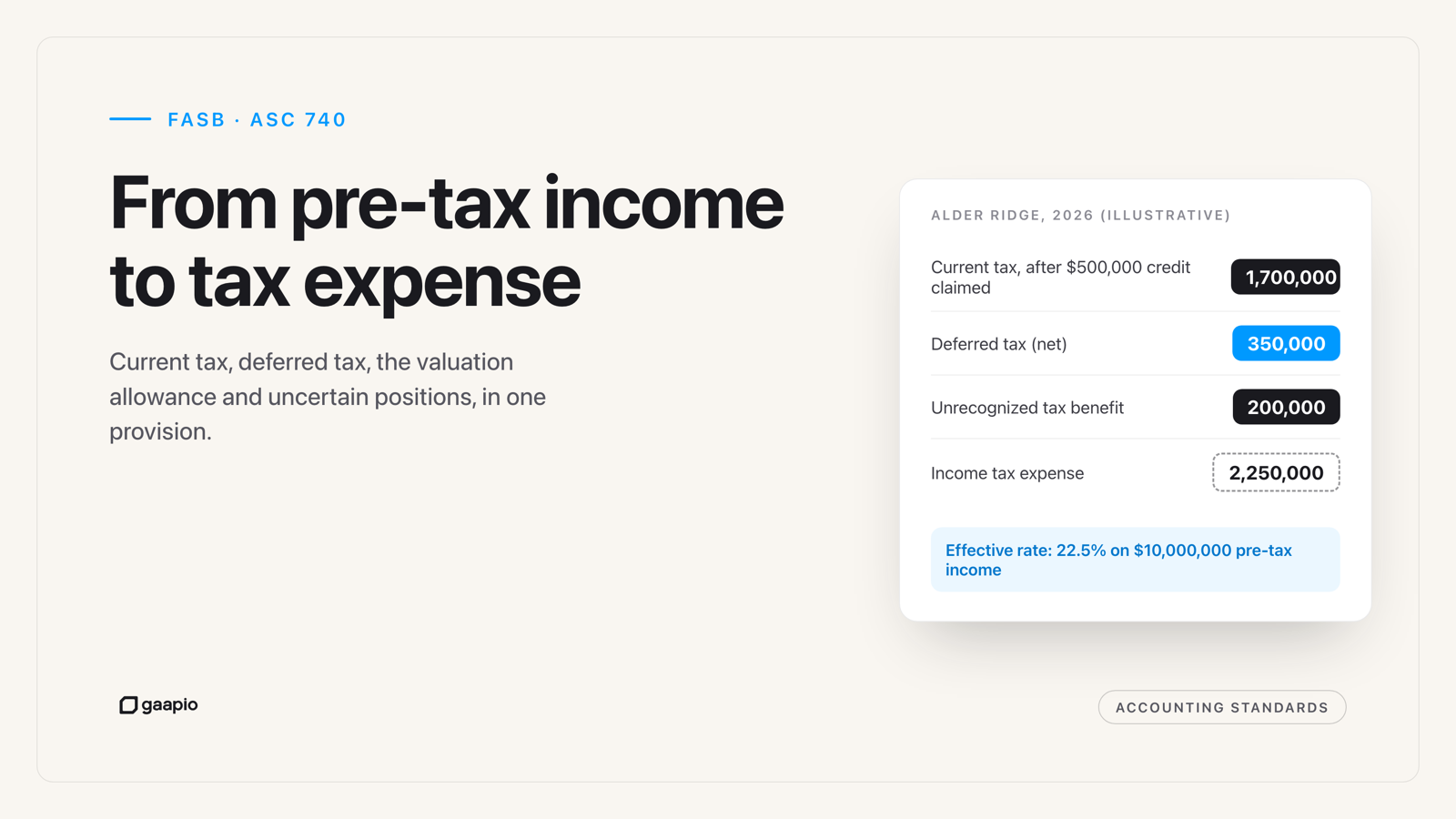
The deferred tax expense is $350,000: a $450,000 increase in the depreciation liability, less $100,000 of new deferred tax assets ($75,000 plus $25,000). Nothing changed in the valuation allowance, because the facts that supported it did not change.
Step 3: Uncertain tax position. Recognizing $300,000 of the $500,000 credit claimed leaves a $200,000 unrecognized tax benefit. It increases income tax expense by $200,000. This example ignores interest and penalties.
Step 4: Total provision and journal entry
| Component | Amount |
|---|---|
| Tax on the return, after the credit claimed | $1,700,000 |
| Increase in unrecognized tax benefits | 200,000 |
| Current tax expense | $1,900,000 |
| Deferred tax expense | 350,000 |
| Total income tax expense | $2,250,000 |
| Effective tax rate (expense / pre-tax book income) | 22.5% |
The $200,000 increase in unrecognized tax benefits relates to a current-year return position, so it is generally part of current tax expense in the footnote's components. It is shown on its own line here so you can see the mechanics.
| Account | Debit | Credit |
|---|---|---|
| Income tax expense | $2,250,000 | |
| Income taxes payable | $1,700,000 | |
| Deferred tax liability, net | 350,000 | |
| Liability for unrecognized tax benefits | 200,000 |
Step 5: Prove it with the rate reconciliation. If the numbers do not tie here, something above is wrong. For a 2026 filer the reconciliation starts at the 21% federal statutory rate and shows state tax, credits and unrecognized tax benefits as their own lines. (This tabular, amount-and-percentage format is the public business entity requirement; other entities give a qualitative description.)
| Rate reconciliation line | Amount | Rate |
|---|---|---|
| Federal statutory rate (21%) on $10,000,000 | $2,100,000 | 21.0% |
| State and local income taxes, net of federal effect | 408,000 | 4.1% |
| Nondeductible items ($200,000 × 21%) | 42,000 | 0.4% |
| Tax credits: research credit claimed | (500,000) | (5.0%) |
| Changes in unrecognized tax benefits | 200,000 | 2.0% |
| Income tax expense | $2,250,000 | 22.5% |
The state line includes the $8,000 state effect of the nondeductible items. Whether a current-year unrecognized benefit gets its own category or is netted against the credit is a presentation judgment to agree with your auditor.
The check is the point. Current tax (including the unrecognized tax benefit) plus deferred tax equals the rate reconciliation total, and the deferred rollforward ties to the balance sheet. When these tie out, the mechanics are ready for review; the judgments still need their own support. Under ASU 2023-09 the reconciliation also needs the specific categories and the 5% threshold analysis, which are covered in our linked guide.
What do auditors push on in the income tax provision?
Auditors usually push on the same five areas, and your documentation should answer them before they ask.
- Tie-out of the deferred rollforward. Every movement should trace to the return-to-provision true-up, the current-year activity or a purchase accounting entry, with no unexplained plug.
- The valuation allowance conclusion. They want the evidence, the weighting and the scheduling in writing, especially with a cumulative loss, an allowance release, or a change in the forecast. Our ASC 350-20 goodwill guide covers another area where forecasts carry a conclusion, and the same support standard applies.
- Uncertain tax positions. Inventory of positions, technical merit analysis, measurement distribution, statute of limitations tracking and the interest and penalty policy.
- Return-to-provision true-ups. The difference between the estimated and filed return goes through current-year expense as a change in estimate when it reflects new information and should be explainable; a true-up caused by a mistake in the prior provision is an error under ASC 250 and is evaluated for materiality.
- Changes in tax law and the interim rate. What was enacted when, which pieces went through the annual rate and which were discrete, and how the estimate was updated.
For a public company, the SEC staff also reads the tax footnote and the effective rate discussion in MD&A. A reconciling item that is unexplained or a valuation allowance release without a clear evidence story can draw a comment.
How does Gaapio help with income tax accounting?
Gaapio is an AI-powered technical accounting platform built by CPAs. For the judgment pieces of the provision, such as a valuation allowance conclusion or an uncertain tax position analysis, you give Gaapio your facts and it asks follow-up questions before drafting. It is grounded in the licensed FASB Codification, Big 4 guidance, and SEC filings and comment letters. Where the analysis forks, it shows the alternatives so a reviewer can see the close calls, and conclusions come with clickable citations. It drafts in your team's memo template, with reviewer comments, approvals and version history. See Gaapio accounting memos.
For the income tax footnote, Gaapio reviews your disclosures against the Codification, compares them with peer filers in your industry, and drafts footnote language for your review. See AI footnote disclosures. Gaapio does not compute your provision or file your returns; those come from your tax team, tax software or provider. You make the tax accounting calls.
Want to see it on your own valuation allowance memo or tax footnote? Request a demo.
This article is general information, not accounting, tax or legal advice. Confirm the requirements for your facts against the Codification, current tax law and with your auditor and tax advisor.
Written by Jace Chambers, CPA, who started his career in audit at EY.
Frequently asked questions
What is ASC 740?
ASC 740 is the FASB Codification topic on accounting for income taxes. It requires you to record current tax for the year and deferred tax for the future tax effects of temporary differences and carryforwards, reduce deferred tax assets by a valuation allowance when realization is not more likely than not, and recognize uncertain tax positions only when they meet the more-likely-than-not threshold.
What is the difference between current and deferred tax?
Current tax is the tax payable or refundable on the year's taxable income. Deferred tax is the change in deferred tax assets and liabilities, which reflect the future tax effect of temporary differences between book and tax basis. Total income tax expense is current plus deferred.
What is a valuation allowance?
A valuation allowance is a reduction of a deferred tax asset when it is more likely than not that some or all of the asset will not be realized. You assess it every reporting date using all available positive and negative evidence, for each tax-paying component and jurisdiction.
What counts as positive and negative evidence for a valuation allowance?
Negative evidence includes recent cumulative losses, expiring carryforwards and expected near-term losses. Positive evidence includes existing contracts or backlog, reversing taxable temporary differences, a strong earnings history with a nonrecurring cause for the loss, and prudent tax planning strategies. The more negative evidence you have, the more positive evidence you need.
What is an uncertain tax position under ASC 740-10?
It is a tax position, such as a deduction or credit claimed on a return, where the technical merits leave doubt about whether it will be sustained. You recognize the benefit only if it is more likely than not to be sustained on its technical merits, then measure it as the largest amount with a cumulative probability greater than 50% of being realized on settlement.
How is the interim tax provision calculated under ASC 740-270?
You estimate the annual effective tax rate for the full year, excluding discrete items, and apply it to year-to-date ordinary income. Discrete items, such as a change in tax law on existing deferred balances or a settlement of a prior-year position, are recorded in the period they occur.
When is a change in tax law recorded under ASC 740?
In the period that includes the enactment date, not the effective date. Deferred tax effects on existing balances are discrete in that period, and current-year effects flow through the estimated annual effective tax rate. For the One Big Beautiful Bill Act (P.L. 119-21), signed July 4, 2025, a calendar-year company recorded the effects in the third quarter of 2025.
What did ASU 2023-09 change for income taxes?
It changed the disclosures: a more detailed rate reconciliation, income taxes paid by jurisdiction, and a domestic versus foreign split of pre-tax income and a federal, state and foreign split of income tax expense. It did not change how current or deferred tax is calculated. See our ASU 2023-09 guide for the details.
Related reading
- ASU 2023-09 income tax disclosures
- ASC 805 purchase price allocation guide
- Accounting memos: format, example and template
- AI footnote disclosures
Sources: FASB ASC 740-10, 740-20, 740-30 and 740-270, ASU 2019-12 and ASU 2023-09; Public Law 119-21 (Congress.gov); KPMG, accounting for the One Big Beautiful Bill Act; BDO, implications for accounting for income taxes; PwC, assessing the need for a valuation allowance; Deloitte, basic principles of valuation allowances; RSM, IRS acceleration election procedures.