

A customer asks to add 20 seats to a 12-month software subscription six months in. The sales rep quotes a price. Operations starts provisioning. Nobody has written down what that does to revenue, and finance finds out when the invoice posts.
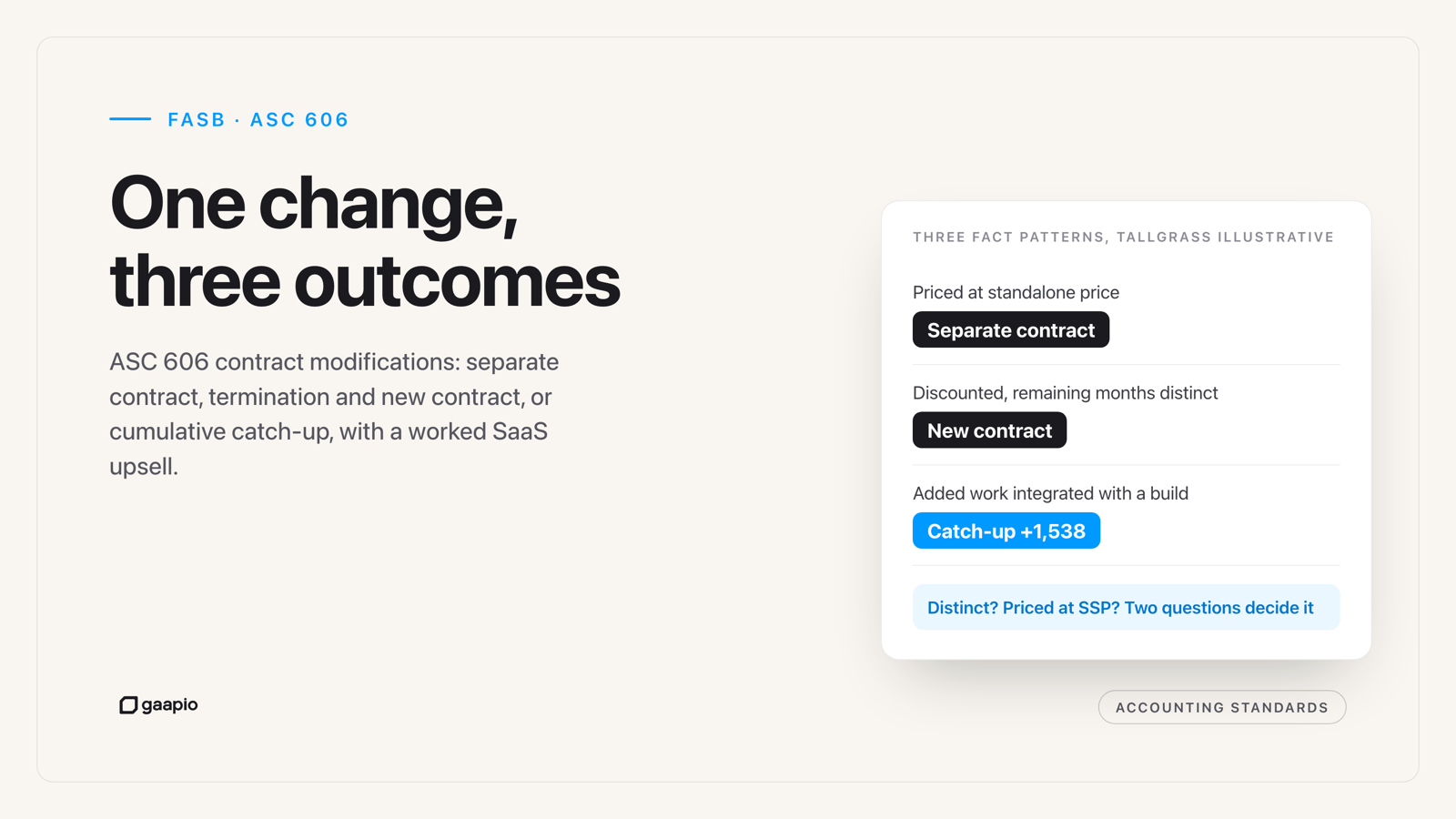
That change is a contract modification under ASC 606, and it has three possible accounting outcomes, plus a combination of the last two. This guide covers when a change counts as a modification under ASC 606-10-25-10, how the answer in ASC 606-10-25-12 and 25-13 depends on two questions (are the added or remaining items distinct, and does the price reflect standalone selling price), how to treat unpriced change orders and claims, and what the practical expedient for modifications made before adoption does in 2026. It ends with a worked example: a SaaS upsell analyzed under all three outcomes, with the journal entries.
Key takeaway: A contract modification is an approved change in the scope or price of a contract, or both (ASC 606-10-25-10). If the modification adds distinct goods or services at a price that reflects their standalone selling prices, it is a separate contract (25-12) and the original contract is untouched. Otherwise, you account for the goods or services not yet transferred in one of three ways (25-13): as a termination and new contract if they are distinct from what was already delivered, as part of the existing contract with a cumulative catch-up adjustment if they are not, or a mix of the two. When the scope is agreed but the price is not, you estimate the price change using the variable consideration guidance and its constraint (25-11).
What is a contract modification under ASC 606?
A contract modification is a change in the scope or price (or both) of a contract that the parties have approved (ASC 606-10-25-10). The standard says the label does not matter: in some industries and jurisdictions a modification is called a change order, a variation, or an amendment.
Approval does not have to be a signed amendment. The parties can approve a modification in writing, by oral agreement, or by customary business practices (25-10). Until a modification is approved, you keep applying ASC 606 to the existing contract.
A modification exists once the parties approve a change that creates new enforceable rights and obligations or changes existing ones. Enforceability is judged from all relevant facts and circumstances, including the contract terms and other evidence (25-11). Work that starts on a handshake can be a modification before any paperwork follows.
When is a change a modification, and when is it something else?
A modification is a change to the contract the parties have already agreed to. Several things that look like modifications are not, and a few look like something else but are modifications. Use the table as a first filter.
| Situation | Modification under 25-10? | Where the accounting goes |
|---|---|---|
| Customer approves a change order that adds scope | Yes | 25-12 and 25-13 |
| Parties agree to a price change for future work | Yes | 25-12 and 25-13 |
| Customer exercises a priced option already in the contract (a renewal at the stated price) | Usually no, because the rights already existed | Original contract terms. Assess whether the option itself was a material right when the contract was signed |
| Price adjusts under a formula already in the contract (an index escalator) | No | Variable consideration in the original contract |
| Scope agreed, price still open | Yes (25-11) | Estimate the price change with variable consideration and the constraint |
| Customer and vendor dispute scope or price | Possibly (25-11), once the change is enforceable | Same estimate; reassess every period |
| Early termination with a fee | Yes, if it changes enforceable rights | Typically the remaining obligations drop out, and the fee goes into the transaction price |
| Price reduction on goods or services already delivered | Depends on why. If it resolves uncertainty that existed at inception (an implicit price concession or a pattern of credits), it is a change in variable consideration. If it is a newly negotiated price change, it is a price-only modification | Variable consideration: 32-42 through 32-44, allocated to delivered items too, so revenue already recognized is reduced at the date of the change. Modification: 25-13. Codification Example 5, Case B shows a credit for poor-quality goods already delivered treated as a reduction of revenue |
The hardest row in practice is the last one. A discount that looks like a modification may really be a concession for past performance, which reduces revenue already earned. Document the reason for the price change before you pick the outcome.
What are the three accounting outcomes for a contract modification?
If the modification is approved, you work through two questions in order, and the answers produce three outcomes.
- Does the modification add distinct goods or services at a price that reflects their standalone selling prices? If yes, account for it as a separate contract (ASC 606-10-25-12). The original contract does not change.
- If not, are the goods or services that have not yet transferred distinct from those already transferred? If yes, account for the modification as if the existing contract ended and a new one began (25-13(a)). If no, and they form a single performance obligation that is partially satisfied, account for it as part of the existing contract with a cumulative catch-up adjustment (25-13(b)). If the remaining goods or services are a mix of both, apply the two approaches in the way that fits (25-13(c)).
| Outcome | What triggers it | What happens to revenue already recognized | What happens to the remaining consideration |
|---|---|---|---|
| Separate contract (25-12) | Added goods or services are distinct, and the price increase reflects standalone selling prices (with appropriate adjustments) | Nothing changes | The new contract has its own transaction price, allocated on its own |
| Termination and new contract (25-13(a)) | Not a separate contract, and the remaining goods or services are distinct from those already transferred | Nothing changes | Unrecognized consideration from the original contract plus the modification's consideration is allocated to the remaining performance obligations |
| Cumulative catch-up (25-13(b)) | Not a separate contract, and the remaining goods or services are not distinct and form a single, partially satisfied performance obligation | Adjusted on a cumulative catch-up basis at the modification date | Revised transaction price and measure of progress apply to the single obligation |
| Combination (25-13(c)) | The remaining goods or services include both kinds | Catch-up for the non-distinct part only | Prospective for the distinct part |
When is a modification a separate contract?
A modification is a separate contract only when both conditions in ASC 606-10-25-12 are true. The scope increases because distinct goods or services are added, and the price increases by an amount that reflects the entity's standalone selling prices for the additional goods or services, adjusted as appropriate for the circumstances of the particular contract.
"Distinct" is the same two-part test used to identify performance obligations: the customer can benefit from the good or service on its own or with readily available resources, and the promise is separately identifiable from other promises in the contract (ASC 606-10-25-19 through 25-22). Both parts matter. A modification that adds a customization that substantially changes the original software fails the second part even if the customer could buy the customization separately.
The "appropriate adjustments" language allows some pricing flexibility. A software vendor can reasonably price an upsell to an existing customer below what it charges new customers if it avoids selling costs it would incur with a new customer. A discount that rewards the customer for a late delivery, or that buys goodwill, does not qualify as an adjustment to standalone selling price.
When both conditions hold, the new contract is accounted for on a prospective basis, separately from the original (ASC 606-10-25-12). Codification Example 5 (606-10-55-111 through 55-116) shows this for an add-on to a goods contract.
What is a termination and new contract under ASC 606-10-25-13(a)?
It is the outcome you reach when the modification is not a separate contract, and the goods or services that remain to be delivered are distinct from those already delivered. The existing contract is treated as if it ended on the modification date and a new one began.
The new contract's transaction price is the consideration promised by the customer (including amounts already received) that was included in the estimate of the transaction price and has not been recognized as revenue, plus the consideration promised in the modification (25-13(a)). You allocate that total to the remaining performance obligations using relative standalone selling prices. Revenue recognized before the modification date does not change.
For recurring services such as SaaS, hosting or maintenance, this is the usual outcome. Each month of a subscription is a distinct service in a series (25-14(b)), so the months already delivered are distinct from the months that remain. A priced-below-SSP upsell therefore rarely produces a catch-up. It produces a blended rate across the old and new seats for the rest of the term.
What is a cumulative catch-up adjustment under ASC 606?
A cumulative catch-up adjustment adjusts revenue on a cumulative basis as of the modification date, because the modification is treated as part of the existing contract (ASC 606-10-25-13(b)). It applies when the goods or services still to be delivered are not distinct from those already delivered, because they form a single performance obligation that is partially satisfied.
You update the transaction price and the measure of progress for that obligation, calculate cumulative revenue as if the revised terms had applied from the start, and record the difference from revenue already recognized as an adjustment in the period of the modification. The adjustment can be positive or negative.
Cumulative catch-up shows up most often in over-time arrangements where the work product is integrated: construction and engineering contracts, custom software builds, and implementation projects. A change order that extends a building's scope generally belongs to the same performance obligation as the original work. The example below walks through one with a cost-to-cost measure of progress.
How do you account for an unpriced change order?
An unpriced change order is a scope change that the parties have approved before they have agreed on the price. ASC 606-10-25-11 says the entity estimates the change in transaction price arising from the modification using the guidance on estimating variable consideration (32-5 through 32-9) and the constraint (32-11 through 32-13).
The estimate matters from day one. You do not wait for the price to be negotiated before accounting for work you are doing under an approved scope change.
A practical sequence:
- Confirm a modification exists. Is the change enforceable under the contract and local law? Evidence includes the contract's change order clause, the customer's written or implied approval, and the history of paying for similar changes.
- Decide which outcome applies to the scope as approved (separate contract, termination and new contract, or catch-up). The question depends on distinctness and on how you expect the price to compare to standalone selling price.
- Estimate the price using the expected value or most likely amount, whichever better predicts the consideration, then apply the constraint so you include it only to the extent it is probable that a significant reversal in the amount of cumulative revenue recognized will not occur when the uncertainty is resolved.
- Reassess each reporting period. As the negotiation moves, update the estimate. A change in the estimate after the modification date is a change in transaction price, allocated under 32-42 through 32-44 in the way 32-45 directs for changes that follow a modification.
The constraint is where unpriced change orders get challenging. An entity with a long history of settling change orders near its cost-plus estimate can often include more of its estimate than an entity with no history, and a dispute that has already gone to the customer's legal team means less of the estimate can be included.
How are claims and disputes treated?
Claims, change orders, variations and other changes the parties negotiate go through the same modification guidance. The accounting question is whether the change is enforceable, and then which outcome applies. The constraint then limits the amount of any claim recognized as revenue.
Two points come up in construction and professional services:
- Enforceability decides whether a modification exists. A contractor that submits a claim for extra costs from a customer-caused delay has a modification only if the claim creates or changes enforceable rights and obligations, whether under the contract terms or under law. A claim with no contractual or legal basis is not a modification, and revenue should not be recognized on it. Cost recovery alone does not create revenue.
- The constraint is judged per claim. The more subjective the entitlement (disputed causation, a customer who has not accepted any part of it), the more of the estimate stays out of revenue.
Auditors look closely at this area. The rule is the same as for any estimate of variable consideration: show the basis for the amount you include.
What is the practical expedient for contract modifications before adoption?
ASC 606-10-65-1, as amended by ASU 2016-12, let an entity adopting ASC 606 skip separately evaluating each modification made before a cutoff date. Instead, the entity reflects the aggregate effect of all modifications made before that date when it identifies the satisfied and unsatisfied performance obligations, determines the transaction price, and allocates the transaction price to the satisfied and unsatisfied performance obligations. Under the full retrospective method the cutoff is the beginning of the earliest period presented. Under the modified retrospective method the entity could use either that date or the date of initial application.
In 2026 this expedient is mostly historical. Public business entities adopted ASC 606 for 2018, and most other entities for 2019 (some private entities used a deferral from ASU 2020-05 and adopted a year later). It matters when you read an older revenue policy note that says the entity elected it, or when you reconstruct how a long-lived contract's opening balances were set. For a modification made after your adoption date, the full 25-10 through 25-13 analysis applies.
IFRS 15 has the same three outcomes (paragraphs 18 through 21) and a similar transition relief (paragraph C5(c), also available under the modified approach through C7A). One wording difference matters for unpriced change orders and claims: the IFRS 15 constraint uses "highly probable" where ASC 606 uses "probable," although the boards intended the same threshold.
Worked example: a SaaS upsell, analyzed three ways
Tallgrass Software sells a hosted logistics platform. Tallgrass is invented and every figure below is illustrative. The facts that stay constant for Scenarios A and B:
- Contract: Ridgeway Logistics buys a 12-month subscription, January 1 to December 31, 2026, 100 seats, $120,000 invoiced and paid on January 1.
- Standalone selling price: $100 per seat per month, so $120,000 for the original contract.
- Pattern of recognition: the subscription is a series of distinct monthly services, recognized ratably at $10,000 per month.
- Modification date: July 1, 2026. Six months have been delivered. Revenue recognized is $60,000. The unamortized balance of the contract liability is $60,000.
Opening entries (all scenarios):
| Date | Entry | Debit | Credit |
|---|---|---|---|
| Jan 1 | Cash | 120,000 | |
| Contract liability (deferred revenue) | 120,000 | ||
| Jan to Jun, each month | Contract liability | 10,000 | |
| Subscription revenue | 10,000 |
Scenario A: 20 more seats at standalone selling price (separate contract)
On July 1, Ridgeway Logistics adds 20 seats through December 31 at $100 per seat per month, or $12,000 total, invoiced and paid on July 1. The seats are distinct and the price equals standalone selling price, so both conditions in 25-12 are met. The modification is a separate contract.
| Date | Entry | Debit | Credit |
|---|---|---|---|
| Jul 1 | Cash | 12,000 | |
| Contract liability (new contract) | 12,000 | ||
| Jul to Dec, each month | Contract liability (original contract) | 10,000 | |
| Subscription revenue | 10,000 | ||
| Jul to Dec, each month | Contract liability (new contract) | 2,000 | |
| Subscription revenue | 2,000 |
Revenue for the second half is $72,000 ($60,000 original plus $12,000 new), and for the year is $132,000.
Scenario B: 20 more seats at a discount (termination and new contract)
Same facts, but Ridgeway negotiates the 20 seats at $80 per seat per month, or $9,600 total, invoiced and paid on July 1, as a one-off concession to close the upsell. Tallgrass's pricing data show that comparable customers pay $100 per seat, and the $20 discount is not explained by avoided selling costs or any other circumstance that adjusts standalone selling price. The seats are distinct, but the price does not reflect standalone selling price, so the modification is not a separate contract (25-12(b) fails).
The six remaining months of service are distinct from the six months already delivered (each month is a distinct service in a series), so 25-13(a) applies: Tallgrass accounts for the change as if the original contract ended on June 30 and a new one began on July 1.
Consideration for the new contract: the $60,000 of consideration received but not yet recognized, plus the $9,600 promised in the modification, totals $69,600. Allocate it by relative standalone selling price across 720 seat-months (600 original, 120 new):
| Group | Seat-months | SSP per seat-month | Relative SSP | Allocated | Per month |
|---|---|---|---|---|---|
| Original seats | 600 | $100 | $60,000 | $58,000 | $9,667 |
| Added seats | 120 | $100 | $12,000 | $11,600 | $1,933 |
| Total | 720 | $72,000 | $69,600 | $11,600 |
The $2,400 discount from SSP ($72,000 less $69,600) is spread across all 720 seat-months, so each seat-month earns $96.67.
| Date | Entry | Debit | Credit |
|---|---|---|---|
| Jul 1 | Cash | 9,600 | |
| Contract liability | 9,600 | ||
| Jul to Dec, each month | Contract liability | 11,600 | |
| Subscription revenue | 11,600 |
Revenue for the second half is $69,600, and for the year is $129,600. The annual total happens to be the same as it would be if Tallgrass had billed and recognized the added seats separately, because all seats follow the same ratable pattern within the same year. The difference shows up in the allocation between the original and added seats ($58,000 versus $60,000 for the original seats), and in any later modification, termination or price change that touches one group of seats.
If part of Ridgeway's discount were a credit for outages in the first half of the year, the analysis would change. Following Codification Example 5, Case B, Tallgrass would split the negotiated price. The portion that compensates for service already delivered is a change in transaction price that reduces revenue at the modification date (32-42 through 32-44). Only the remainder is compared to standalone selling price under 25-12. Document the basis for the split.
Scenario C: a custom integration build (cumulative catch-up)
Cumulative catch-up needs a performance obligation that is not a series of distinct months, so Scenario C uses a different Tallgrass contract: a fixed-fee custom integration project. The facts are separate from Scenarios A and B.
- Original contract: Tallgrass will build a custom integration between its platform and Ridgeway's warehouse system for $120,000. The integration is a single performance obligation, satisfied over time, and measured with cost-to-cost progress.
- Expected total cost: $90,000 (expected margin $30,000, or 25%).
- At the modification date: costs incurred are $45,000, so progress is 50% and revenue recognized to date is $60,000 ($120,000 x 50%).
- Modification: Ridgeway adds two new warehouse connectors that are tightly interwoven with the build, for an additional $40,000. Tallgrass estimates the extra work will cost $27,000, so expected total cost rises to $117,000.
The added work and the remaining work are not distinct from the work already done, because they are integrated into one deliverable. The modification cannot be a separate contract (the added work is not distinct) and the remaining services are not distinct from the delivered services (they form a single partially satisfied performance obligation). 25-13(b) applies.
| Step | Calculation | Result |
|---|---|---|
| Revised transaction price | $120,000 + $40,000 | $160,000 |
| Revised expected total cost | $90,000 + $27,000 | $117,000 |
| Progress at modification date | $45,000 / $117,000 | 38.46% |
| Cumulative revenue as if revised terms applied from the start | $160,000 x 38.46% | $61,538.46 |
| Revenue already recognized | $60,000.00 | |
| Cumulative catch-up adjustment | $61,538.46 - $60,000.00 | $1,538.46 |
| Date | Entry | Debit | Credit |
|---|---|---|---|
| Modification date | Contract asset (or a reduction of contract liability, if billings exceed revenue) | 1,538.46 | |
| Revenue, cumulative catch-up | 1,538.46 |
The remaining $98,461.54 of revenue ($160,000 - $61,538.46) is recognized as the remaining $72,000 of costs are incurred (total costs of $117,000 less $45,000 incurred). Expected margin rises from $30,000 to $43,000, or 26.9% of $160,000.
The adjustment here is positive because the added fee carries a higher margin than the original work. If the added price had been $20,000 against the same $27,000 of added cost, the same arithmetic gives cumulative revenue of $53,846.15 and a catch-up reduction of $6,153.85. Catch-ups cut both ways.
Comparison of the three outcomes
| Scenario A | Scenario B | Scenario C | |
|---|---|---|---|
| Fact pattern | 20 seats at SSP | 20 seats at a discount | Added connectors integrated with a build |
| Distinct added items? | Yes | Yes | No |
| Price at SSP? | Yes | No | Not relevant |
| Remaining items distinct from delivered? | Not relevant | Yes | No |
| Outcome | Separate contract (25-12) | Termination and new contract (25-13(a)) | Cumulative catch-up (25-13(b)) |
| Effect on revenue already recognized | None | None | Adjusted ($1,538.46 increase) |
Memo conclusion (illustrative, Scenario B)
"Tallgrass concluded that the July 1, 2026 amendment is a contract modification under ASC 606-10-25-10 because the parties approved a written change in both scope and price. The 20 added seats are distinct, but the $80 per seat-month price is below the $100 standalone selling price and no circumstance of the contract justifies the discount, so the modification is not a separate contract under 25-12(b). The remaining months of service are distinct from the months already delivered, so under 25-13(a) Tallgrass accounts for the change as a termination of the original contract and creation of a new one. Total remaining consideration of $69,600 is allocated by relative standalone selling price and recognized ratably from July 1 through December 31, 2026."
What would change the answer
- A price of $95 per seat. If Tallgrass can show that selling costs it avoids with an existing customer justify a $5 reduction in standalone selling price, the modification may qualify as a separate contract at $11,400.
- Seats that last past December 31. If the 20 added seats run 18 months (through December 31, 2027), the new contract under 25-13(a) covers 600 original seat-months and 360 added seat-months. Allocate the combined consideration across both groups by relative standalone selling price. Revenue for the original seats still ends December 31, 2026, while the added seats' share runs into 2027.
- A customer-specific change that alters the platform. If the added work were a customization that significantly modifies the software, it would fail the distinct test and 25-12 would be off the table. The choice between 25-13(a) and 25-13(b) still turns on whether the remaining services are distinct from the months already delivered, which for a hosted subscription usually points back to 25-13(a). A catch-up needs a single, partially satisfied performance obligation, as in Scenario C.
- A signature that has not happened. If operations starts provisioning the seats and no amendment is signed, ask whether the parties have approved the change through customary business practices. If they have, a modification exists. If not, the existing contract guidance still applies.
How do lease modifications differ from contract modifications under ASC 606?
Lease modifications follow different rules. ASC 842 treats a lease modification as a separate contract only if it grants an additional right of use not in the original lease and the lease payments increase by an amount commensurate with the standalone price of that right, adjusted for the circumstances (842-10-25-8). If not, the entity reassesses lease classification at the effective date (25-9). The lessee remeasures the lease liability using an updated discount rate and adjusts the right-of-use asset, or recognizes a gain or loss for a modification that reduces scope. The lessor's accounting depends on the classification before and after the change. There is no cumulative catch-up outcome in lease accounting.
The mismatch matters when a contract contains both a lease and a service. If a customer amends a bundled equipment-and-support arrangement, you may need to analyze one modification under both standards. Our guide to lease modifications under ASC 842 covers the lease side.
How does Gaapio help with revenue contract analysis?
Gaapio is an AI-powered technical accounting platform built by CPAs. It applies the ASC 606 five-step model to a specific revenue arrangement and drafts the memo in the same workflow. It extracts the terms that drive revenue and shows where each came from in the document, and it surfaces the arguments on both sides of a close call.
The conclusion is yours. Every conclusion in the memo is anchored to a Codification reference you can click through and verify. See Gaapio's revenue recognition solution, the glossary entries for revenue recognition and the ASC 606 memo.
Want to see it on one of your own contracts? Request a demo.
This article is general information, not accounting or legal advice. Confirm the requirements for your facts against the Codification and with your auditor.
Frequently asked questions
What is a contract modification under ASC 606?
A contract modification is a change in the scope or price (or both) of a contract that the parties have approved (ASC 606-10-25-10). It can be approved in writing, orally, or by customary business practices, and it exists once it creates or changes enforceable rights and obligations. Approved change orders, variations and amendments are all modifications.
What are the three accounting outcomes for a contract modification?
A separate contract (25-12), when the modification adds distinct goods or services at a price reflecting standalone selling prices. A termination and new contract (25-13(a)), when the remaining goods or services are distinct from those already transferred. A cumulative catch-up adjustment (25-13(b)), when they are not distinct and form a partially satisfied single performance obligation. A mix of the last two applies when the remaining items include both kinds (25-13(c)).
When is a contract modification a separate contract?
When two conditions are met: the scope increases because distinct goods or services are added, and the price increases by an amount that reflects the standalone selling prices of those additions, with appropriate adjustments for the circumstances of the contract (ASC 606-10-25-12). If either fails, the modification is not a separate contract.
What is a cumulative catch-up adjustment?
A cumulative catch-up adjustment is the difference between the revenue you would have recognized to date if the revised terms had applied from the start and the revenue you recognized before the modification. It is recorded in the period of the modification and applies when the remaining goods or services are not distinct from those already transferred and form part of a single, partially satisfied performance obligation (25-13(b)).
Is a change order a contract modification?
Usually, once it is approved. Change orders, claims and variations are evaluated under the same modification guidance. The questions are whether the change is approved and enforceable, and then which of the three outcomes applies. A change order with an agreed scope but no price is an unpriced change order and requires an estimate of the price change (25-11).
How do you account for an unpriced change order?
Estimate the change in transaction price using the variable consideration guidance (ASC 606-10-32-5 through 32-9) and apply the constraint (32-11 through 32-13), so you include it only to the extent it is probable that a significant reversal in the amount of cumulative revenue recognized will not occur when the uncertainty is resolved. Reassess the estimate every reporting period as the negotiation develops.
Are claims treated as contract modifications?
When a claim creates or changes enforceable rights and obligations under the contract, it is evaluated as a modification. A claim without a contractual or legal basis is not, and revenue on it should not be recognized. Even when a claim is enforceable, the constraint limits how much you can include.
Does the practical expedient for modifications before adoption still matter in 2026?
Rarely. ASC 606-10-65-1, as amended by ASU 2016-12, allowed entities to reflect the aggregate effect of modifications made before a transition cutoff date instead of separately evaluating each one. It mainly appears in older revenue policy disclosures. For modifications made after adoption, the full analysis in 25-10 through 25-13 applies.
How do lease modifications differ from contract modifications under ASC 606?
ASC 842 uses a separate-contract test too (an additional right of use at a commensurate price). A lease modification that fails it leads to reassessment of classification. A lessee then remeasures the lease liability and adjusts the right-of-use asset (or recognizes a gain or loss if scope shrinks), and a lessor's accounting depends on the classification before and after the change. Neither produces a cumulative catch-up. See the guide to lease modifications under ASC 842 for the full lease analysis.
Does IFRS 15 treat contract modifications the same way?
IFRS 15 paragraphs 18 through 21 give the same three outcomes as ASC 606-10-25-10 through 25-13, and paragraph C5(c) provides transition relief similar to the US expedient. One wording difference matters for unpriced change orders and claims: the IFRS 15 constraint uses "highly probable" where ASC 606 uses "probable," although the boards intended the same threshold. Check wording differences before applying conclusions across frameworks.
Related reading
- 5 common ASC 606 pitfalls
- Understanding ASC 842 lease modifications
- ASC 606 revenue recognition solution
Sources: FASB ASC 606-10-25-10 through 25-15, 25-19 through 25-22, 32-5 through 32-13, 32-42 through 32-45, 55-111 through 55-116 and 65-1, and ASU 2016-12; Deloitte, Roadmap: Revenue Recognition, chapter 9, Contract Modifications; Deloitte, 9.2 Types of Contract Modifications; PwC, Revenue from contracts with customers, contract modifications; Journal of Accountancy, FASB issues revenue recognition changes and practical expedients (May 2016).