

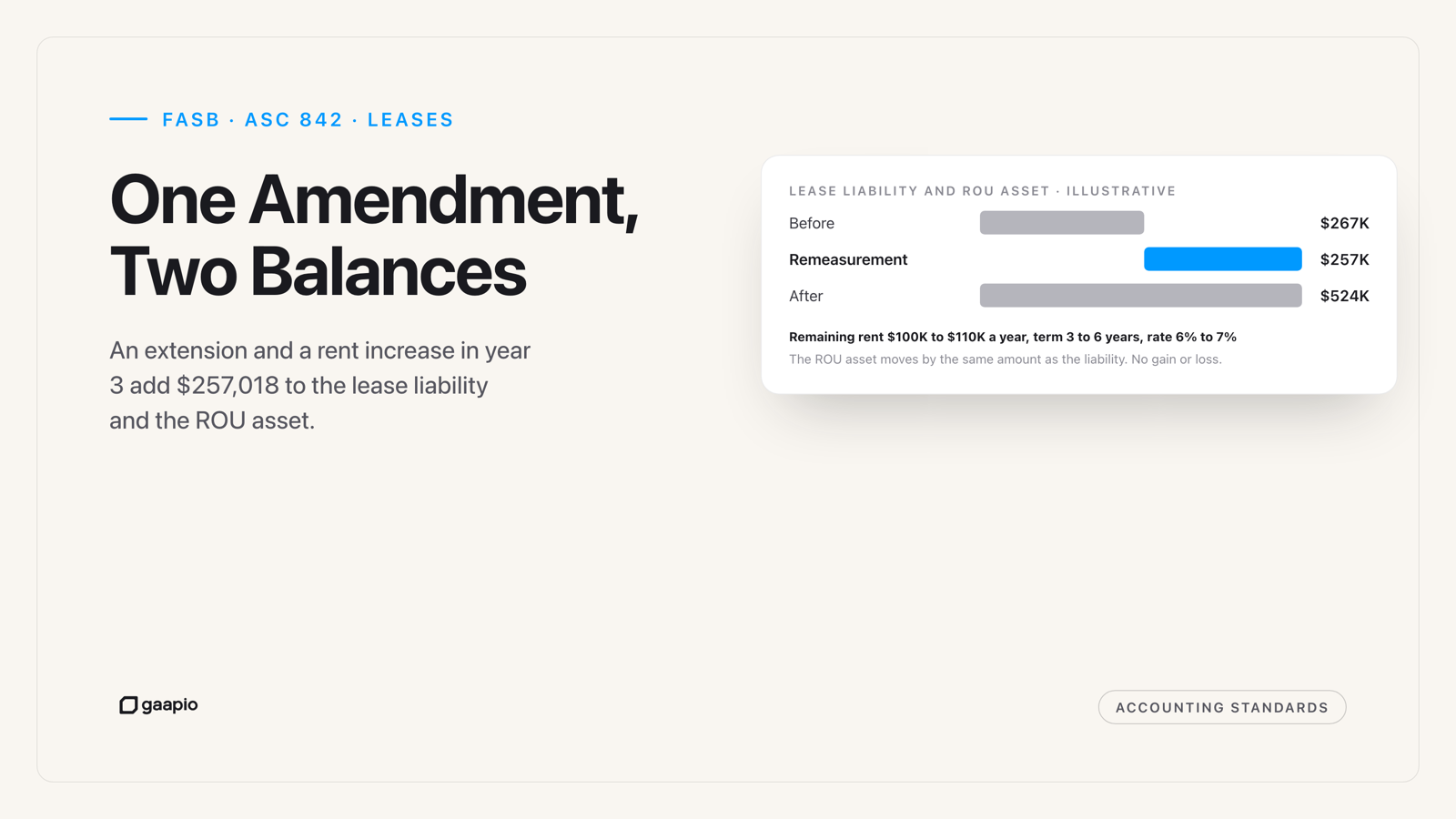
A lease amendment is one signed page with a long accounting tail.
Every ASC 842 lease modification starts with the same question. Does the change create a new lease, or does it change the one you already have? This guide answers that question, then walks through the lessee remeasurement, the lessor view, a worked journal entry for an extension with a rent change, and where ASU 2023-01 matters.
Key takeaway: A lease modification is a change to the contract's terms that changes the scope of the lease or the consideration for it. Under ASC 842-10-25-8, it is a separate contract only when it adds a right of use that was not in the original lease and the payments rise by an amount commensurate with the standalone price of that added right. Every other modification is accounted for on the existing lease. The lessee reassesses classification, remeasures the lease liability with a discount rate as of the modification's effective date, and adjusts the right-of-use (ROU) asset. A partial or full termination reduces the ROU asset proportionately and can create a gain or loss.
What is a lease modification under ASC 842?
A lease modification is a change to the terms and conditions of a contract that changes the scope of a lease or the consideration for it. The ASC 842 glossary gives examples: adding or ending the right to use one or more underlying assets, or lengthening or shortening the lease term.
The accounting date is the modification's effective date, which is the date both parties approve it. Rent changes count even when no space moves. A signed amendment that cuts rent for the remaining term is a modification of the consideration, so it follows the same rules as an extension.
Not every change in a lease is a modification. Exercising an option that was already written into the lease is not. Neither is a change driven only by an index or rate the contract already referenced. That change alone does not trigger a remeasurement. The lessee picks up the current index only when it remeasures the liability for another reason.
One more edge: if you elected the short-term lease exemption, the lease stops qualifying when a change extends the remaining term more than 12 months past the end of the previously determined term, or makes a purchase option reasonably certain (ASC 842-20-25-3). Treat the date of the change as the commencement date and recognize the ROU asset and liability then. Check how your auditor applies this to an amendment.
When is a lease modification a separate contract?
A lease modification is a separate contract when both conditions in ASC 842-10-25-8 are met. The modification grants an additional right of use that was not included in the original contract, and the lease payments increase by an amount commensurate with the standalone price for that additional right, adjusted for the circumstances of the contract. Lessees and lessors apply the same test.
If both conditions are met, the new lease stands on its own. You leave the original lease alone and account for the new one from its commencement date, with its own classification, liability and ROU asset.
Take a tenant that adds a second floor in the same building at the market rate per square foot. Both conditions are met, so the second floor is a new lease and the first floor continues unchanged.
Now take a tenant that extends the term on the space it already occupies. No new right of use is added. The extension is not a separate contract, whatever the price. The same is true of a rent change on existing space.
If the second floor comes at a steep discount, the right of use is new but the price is not commensurate. The modification fails the second condition and is accounted for on the existing lease, even though space was added. Judgment shows up here, because "standalone price" often means looking at market rates for comparable space. A discount can still be commensurate if it reflects costs the lessor avoids, such as marketing or broker fees.
How do you account for a modification that is not a separate contract?
A lessee accounts for a modification that is not a separate contract by reassessing the lease, remeasuring the liability, and adjusting the ROU asset, all as of the modification's effective date. ASC 842-10-25-9 and the paragraphs that follow it set out the sequence for the lessee.
At the effective date, the lessee:
- Reallocates the consideration in the modified contract to its lease and nonlease components, unless it elected the practical expedient to combine them.
- Determines the lease term of the modified lease and reassesses any purchase option.
- Reassesses classification (operating or finance) using the modified terms and the conditions at the effective date.
- Remeasures the lease liability at the present value of the remaining payments, using a discount rate determined at the effective date. The original rate is retired. Use the rate implicit in the lease if it is readily determinable. Otherwise use the incremental borrowing rate. A lessee that is not a public business entity and elected the risk-free rate for a class of assets (ASU 2021-09) uses the risk-free rate at that date for that class.
- Adjusts the ROU asset by the amount of the remeasurement. The exception is a full or partial termination, which reduces the ROU asset proportionately first.
Reading the sequence once tells you the shape of every case below. The difference between a term extension, a partial termination and a payment change lies in step 5 and in whether anything gets recognized in earnings.
How do a term extension, a partial termination and a payment change differ?
They differ in what moves the ROU asset and whether a gain or loss appears. The table shows the lessee view for a modification that is not a separate contract.
| Modification | Separate contract? | Lease liability | ROU asset | Gain or loss |
|---|---|---|---|---|
| Term extension | No | Remeasured with the new term, payments and effective-date rate | Adjusted by the remeasurement amount | None |
| Payment change (rent up or down, no scope change) | No | Remeasured with the new payments and effective-date rate | Adjusted by the remeasurement amount | None |
| Partial termination (less space given back) | No | Reduced for the part given up, then remeasured for what remains | Reduced proportionately to the part given up, then adjusted for the remeasurement | Yes: the difference between the liability reduction and the proportionate ROU reduction |
| Full termination | No | Derecognized | Derecognized | Yes: the difference between the two balances |
| Added space at a market rate | Yes | New lease, separate liability | New lease, separate ROU asset | None |
How does a partial termination work?
A partial termination reduces the ROU asset first, on a basis proportionate to the part of the lease that ends. If a tenant gives back 40% of its space, one common method cuts the ROU asset by 40%. Another bases the cut on the change in the lease liability. Pick one, apply it consistently, and document it. The lessee then recognizes in earnings the difference between the reduction in the lease liability and that proportionate ROU reduction (ASC 842-10-25-11 through 25-13). The liability for the remaining space is remeasured at the effective-date rate, with the offset to the ROU asset.
It is the sort of choice an auditor asks about, and the answer should be in the file before they do.
A modification that only shortens the term is a separate question. ASC 842-10-25-11 treats a shorter term as a change in term, not a termination. The ROU asset moves by the remeasurement amount, and no gain or loss is recorded. Termination accounting applies only when the right of use ends at the effective date. If the tenant keeps the space for a period, even 30 days to move out, it is a shorter term.
A full termination that takes effect right away is the simple case. Derecognize the liability and the ROU asset, and book the difference as a gain or loss. If the termination takes effect at a later date, treat it as a shorter term. Remeasure the liability with any termination fee included, adjust the ROU asset, and amortize over the remaining months.
What about an early termination option the tenant exercises?
An option the tenant exercises under the original lease terms is not a modification. It is a reassessment of the lease term. If the lease term already assumed the termination, nothing changes. If it did not, the lessee reassesses the term and remeasures the liability, as covered in the remeasurement section below. An agreed termination that changes the contract's terms, such as a buyout with a fee, is a modification.
How does a lessor account for a lease modification?
A lessor applies the same separate-contract test in ASC 842-10-25-8. If the modification passes, the lessor accounts for it as a new lease. If it does not, the answer depends on the lease type, and the paragraphs that follow 25-8 in the same subtopic cover each case.
- Operating lease. The lessor accounts for the modification as a new lease from the effective date. Any prepaid or accrued rent from the original lease is treated as part of the payments of the new lease.
- Sales-type or direct financing lease. The lessor reassesses classification at the effective date, using the modified terms and the facts on that date. If the modified lease is an operating lease, the carrying amount of the underlying asset is the net investment in the original lease immediately before the effective date. If a direct financing lease stays direct financing, the lessor adjusts the discount rate so the net investment in the modified lease equals the net investment just before the modification. If the modified lease is sales-type, the lessor accounts for it under Subtopic 842-30 from the effective date. Confirm the steps for your fact pattern against ASC 842-10-25-16 and 25-17.
- Nonlease components. The lessor reallocates the remaining consideration using the ASC 606 allocation guidance, unless it elected the practical expedient to combine lease and nonlease components.
The lessor view matters to lessees too. Landlords document their own conclusions, and a lessee that reaches a different classification on the same amendment should be able to say why.
What is the difference between a lease modification and a lease remeasurement?
A lease modification is a change to the contract. Lease remeasurement is the accounting that follows, and a contract change is one of two triggers for it. The other trigger is a reassessment event with no contract change at all.
Reassessment events include the lessee deciding to exercise an option it previously judged not reasonably certain, or a significant event within its control that changes that judgment. Contingencies that resolve and change payments can also trigger a remeasurement. In those cases the lessee updates the lease term or purchase option conclusion, then remeasures the liability under ASC 842-20-35-4 and 35-5. Which of the two applies controls which paragraphs you cite, and it shapes how the memo reads, so name the trigger in the file.
For a modification that is not a separate contract, the effective date is when the lessee reassesses classification and fixes the discount rate. A change in lease term or purchase option conclusion usually updates the rate as of the reassessment date. A remeasurement driven by a resolved contingency or a residual value guarantee keeps the existing rate (ASC 842-20-35-5). The arithmetic can look the same. The trigger, and the paragraphs you cite, differ.
How do you account for a lease extension with a rent change? A worked example
A lessee extends its office lease by three years and raises the rent for the whole remaining term. The extension is not a separate contract, so the lessee remeasures the liability at a new rate and adds the difference to the ROU asset. The example below is illustrative, with round numbers.
Facts.
- The lessee leases office space under a five-year operating lease. Payments are $100,000 a year, paid at the end of each year.
- The original discount rate is 6%. There are no initial direct costs, incentives or prepaid rent, so the ROU asset equals the lease liability at every date, because the straight-line cost equals the payment.
- At the start of year 3, the parties sign an amendment. It extends the term by three years, so six years remain. It raises the rent to $110,000 a year for all six remaining years. No space is added.
- The lessee's incremental borrowing rate at the effective date is 7%.
- The modified lease is still an operating lease. There is no transfer of ownership or purchase option, the asset is not specialized, the six remaining years are a small part of the building's remaining economic life, and the present value of the payments is well below the fair value of the space.
Step 1. Is it a separate contract? No. The amendment adds no right of use, so the first condition in 842-10-25-8 fails. The lessee accounts for it on the existing lease.
Step 2. Carrying amounts before the modification. Two payments have been made. Three payments of $100,000 remain, discounted at the original 6%.
- Lease liability: $267,301
- ROU asset: $267,301
Step 3. Remeasure the liability. Six payments of $110,000, discounted at 7%, the rate on the effective date.
- Remeasured lease liability: $524,319
- Adjustment: $524,319 − $267,301 = $257,018
Step 4. Adjust the ROU asset by the same $257,018. A modification that does not reduce the scope moves the ROU asset by the amount of the liability remeasurement.
Journal entry at the effective date
| Account | Debit | Credit |
|---|---|---|
| Right-of-use asset | $257,018 | |
| Lease liability | $257,018 |
Reconciliation
| Lease liability | ROU asset | |
|---|---|---|
| Before the modification (start of year 3) | $267,301 | $267,301 |
| Remeasurement | $257,018 | $257,018 |
| Immediately after the modification | $524,319 | $524,319 |
| Accretion of the liability, year 3 (7%) | $36,702 | |
| Payment at the end of year 3 | ($110,000) | |
| ROU asset reduction, year 3 | ($73,298) | |
| End of year 3 | $451,021 | $451,021 |
Year 3 entries. The lessee recognizes a single operating lease cost of $110,000, which is the remaining cost of $660,000 spread evenly over the six years. Here that equals the remaining payments, because there is no accrued rent or initial direct cost.
| Account | Debit | Credit |
|---|---|---|
| Operating lease cost | $110,000 | |
| Cash | $110,000 | |
| Lease liability | $73,298 | |
| Right-of-use asset | $73,298 |
The second entry moves both balances down by the same $73,298. The payment of $110,000 less accretion of $36,702 reduces the liability, and the ROU asset falls by the same amount because the single lease cost stays level.
The example uses level rent. With escalating rent, the ROU asset and the liability differ by accrued rent. The ROU asset still moves by the remeasurement amount, but the two balances will not match.
Two things in the example are worth checking in your own files. The discount rate changed from 6% to 7%, so the liability did not simply gain the extra rent. And if the lease had been classified as a finance lease instead, the ROU asset would still adjust by the remeasurement, but the interest and amortization pattern would differ from year 3 on.
Where does ASU 2023-01 matter for lease modifications?
ASU 2023-01 matters when the lessor and lessee are under common control, such as related entities that lease property to each other. It is effective for fiscal years beginning after December 15, 2023, including interim periods within those years, so it applies now to calendar-year entities.
The ASU does two things:
- Written terms. An entity that is not a public business entity or a conduit bond obligor can use the written terms and conditions of a common control arrangement to decide whether a lease exists and how to classify and account for it, rather than the legally enforceable terms. Check that your modification is a change to those written terms, and whether the practical expedient was elected, before you apply the steps in this guide.
- Leasehold improvements. A lessee amortizes leasehold improvements in a common control lease over their useful life to the common control group, as long as it controls the use of the underlying asset through the lease. This change applies to all entities, public and private. If the lessee no longer controls the use of the underlying asset, the unamortized balance is accounted for as a transfer between entities under common control, through equity. That can matter when a modification shortens a lease.
Outside common control arrangements, ASU 2023-01 changes nothing about the modification steps above.
What is the modified retrospective approach in ASC 842?
The modified retrospective approach is a transition method for adopting ASC 842. It is how companies moved existing leases onto ASC 842 at adoption: public business entities for fiscal years beginning after December 15, 2018, and other entities for fiscal years beginning after December 15, 2021 (the later date came from ASU 2020-05). ASU 2018-11 let an entity apply it at the adoption date without restating comparative periods.
You will see the term in searches next to "modification" because modifications made before the adoption date were accounted for under ASC 840. Once a lease is on the books under ASC 842, a later change to its terms follows the modification guidance in this post.
How do you document a lease modification for the audit file?
A lease modification file records the amendment, the effective date, the separate-contract conclusion, the reassessed classification, the discount rate, and the entries. Auditors ask for each of them. The judgment calls draw the most questions.
A short memo covers it:
- The amendment's terms and the date both parties approved it.
- The two 25-8 conditions, each answered, with the standalone price evidence if the answer turns on it.
- The lease term and purchase option conclusions after the amendment.
- The classification conclusion, with the rate and inputs.
- The remeasurement schedule and the journal entry.
- For a partial termination, the method used to measure the liability reduction.
The arithmetic is usually the easy part. The questions land on the judgment: why a renewal was or was not reasonably certain, why the new space was or was not priced at standalone. Gaapio's lease accounting solution drafts the cited memo your team reviews.
How does Gaapio handle lease modifications?
Gaapio is an AI-powered technical accounting platform built by CPAs. For leases, it abstracts the contract, assesses classification, and drafts the memo and the disclosure, cited to the Codification. An amendment is a contract like any other, so it starts the same way. Gaapio abstracts the amendment, assesses classification, and drafts the cited memo for your team to review.
If you already run a lease subledger, keep it. Those systems are good at schedules, journal entries and roll-forwards. Gaapio covers the layer above the calculation: the contract abstract (see what a lease abstract is), the classification analysis and the memo. The accounting stays yours. Your team reviews every cited draft and makes the call.
A short refresher on the standard itself lives in the glossary at what is ASC 842. For the AI side of lease work, see our post on what ASC 842 compliance actually requires.
Sources and further reading
The Codification is the authority. These Big 4 guides walk through the same paragraphs:
- PwC Viewpoint: Leases, 5.2, lease modification (lessee)
- Deloitte DART roadmap: lessee accounting, lease modifications (8.6), lessee view only
- KPMG Handbook: Leases (ASC 842)
This guide is general information about ASC 842, not accounting advice for your facts.
Want a cited draft of your next lease amendment memo? Request a demo.
Frequently asked questions
What is a lease modification under ASC 842?
A lease modification is a change to the terms and conditions of a contract that changes the scope of a lease or the consideration for it. Examples include adding or ending the right to use an underlying asset, lengthening or shortening the term, and changing the rent. The accounting date is the effective date, when both parties approve the change.
When is a lease modification a separate contract?
It is a separate contract when it grants an additional right of use not in the original lease and the payments increase by an amount commensurate with the standalone price for that right (ASC 842-10-25-8). Adding a floor at a market rate qualifies. A term extension or a rent change on existing space does not.
Do you reassess lease classification after a modification?
Yes, for a modification that is not a separate contract. The lessee reassesses classification as of the effective date using the modified terms. The result can move a lease between operating and finance, so run the test every time, even for a small rent change.
What discount rate do you use after a lease modification?
Use a rate determined at the effective date of the modification, not the original rate. Use the rate implicit in the lease if it is readily determinable. Most lessees cannot determine it, so they use their incremental borrowing rate for the remaining term and collateral. A lessee that is not a public business entity and elected the risk-free rate for a class of assets (ASU 2021-09) uses the risk-free rate at that date for that class. A separate contract has its own rate at its commencement date.
Is exercising a renewal option a lease modification?
No. If the option is already in the lease, exercising it is a reassessment of the lease term, not a change to the contract. If the option was not already in the lease term, the lessee updates the term and remeasures the lease liability. Changing the option's price or terms by amendment is a modification.
How do you account for a rent reduction under ASC 842?
A signed rent reduction for existing space changes the consideration, so it is a modification that is not a separate contract. The lessee remeasures the liability with the lower payments and the effective-date rate, and adjusts the ROU asset by the same amount. A reduction that the original lease already provided for, such as a scheduled step-down, is not a modification.
How does a lessor account for a lease modification?
A lessor applies the same separate-contract test. If it fails, an operating-lease modification is treated as a new lease from the effective date, with any prepaid or accrued rent folded into the new lease's payments. For sales-type and direct financing leases, the lessor reassesses classification at the effective date, and the accounting follows the new classification.
Does ASU 2023-01 change lease modification accounting?
Only for common control arrangements. ASU 2023-01 lets eligible private entities use written terms to decide whether a lease exists and how to classify it, and it sets the amortization period for leasehold improvements in those arrangements. The modification steps in this guide are otherwise unchanged.
Is the modified retrospective approach the same as a lease modification?
No. The modified retrospective approach is a transition method for adopting ASC 842. A lease modification is a change to a lease after it is on the books. They share a search result page, and little else.