

Every quarter-end, someone on a revenue team asks the same question about a rebate, a bonus or a credit: how much of this do we book now? Book too much and you reverse it next quarter. Book too little and you understate the period.
Variable consideration is the part of the ASC 606 transaction price that can change after the contract is signed. This guide covers the forms it takes, the two estimation methods, the constraint in ASC 606-10-32-11 and 32-12, the reassessment you owe every period, the sales- and usage-based royalty exception, and the disclosures. It ends with an illustrative volume rebate estimated both ways, with the constraint applied, the quarter-one entry and the true-up one quarter later.
Key takeaway: Variable consideration is any part of the price that depends on a future event, a customer's behavior, or an outcome the contract leaves open. You estimate it with either the expected value method or the most likely amount method, whichever better predicts what you will be entitled to. Then the constraint caps the estimate: include only the amount for which a significant reversal of cumulative revenue is probable not to occur. You redo both steps every reporting period, and changes flow through revenue in the period of change. Sales- and usage-based royalties on licenses of intellectual property are carved out and recognized when the sale or usage happens.
What is variable consideration under ASC 606?
Variable consideration is the portion of the transaction price that can change, either because the contract says so or because the facts and circumstances do. ASC 606-10-32-6 lists the common forms: discounts, rebates, refunds, credits, price concessions, incentives, performance bonuses and penalties, or other similar items. It also covers any price that depends on whether a future event occurs, such as a milestone or a deadline.
The variability does not need to be written in the contract. Under ASC 606-10-32-7, customary business practices, published policies, specific statements to the customer, or the facts around the deal can create it. If you have a history of giving credits to customers that miss a delivery date, the price is variable even when the contract says nothing.
This is Step 3 of the five-step model, determining the transaction price. It feeds Step 4, because the estimate you land on gets allocated to performance obligations. If you want the full model first, start with our guide to what revenue recognition is.
What are the forms of variable consideration?
Most of the forms below fall under one of three triggers: something the customer does, something you do, or something that happens outside either of you. Teams miss variable consideration when it sits in a side letter, a pricing exhibit or a long-standing habit instead of the main price line.
| Form | Where it shows up | What drives the variability |
|---|---|---|
| Volume discounts and rebates | Distributor and reseller agreements, supply contracts | Customer purchase volume, and whether the rebate applies to all units or only future units |
| Refunds and rights of return | Retail, consumer products, wholesale | Return rates; see the returns guidance in ASC 606-10-55-22 through 55-29 |
| Credits and service level penalties | Hosting, managed services, SaaS with uptime commitments | Your own performance against the SLA |
| Price concessions | Any contract where you expect to accept less than the stated price | Customer circumstances and your history of conceding |
| Performance bonuses and incentive fees | Construction, consulting, services | Hitting a milestone, quality score or completion date |
| Liquidated damages and penalties | Construction, long-term supply | Late delivery or failure to meet specifications |
| Price protection and index-based pricing | Distribution, commodities-linked contracts | Changes in your list price or an external index |
| Milestone payments | Development agreements, licenses | An event such as regulatory approval |
| Sales- or usage-based royalties | Licenses of intellectual property | The licensee's sales or usage; special rules apply, covered below |
| Trailing commissions and similar | Insurance and financial products | Customer behavior over a long period |
Two judgment calls come up constantly. The first is whether a discount to a customer who "might not pay" is a price concession or a credit loss. A concession you expect to grant is variable consideration under ASC 606. A customer's inability to pay a price that was meant to be collected is a credit risk issue under ASC 326. The question is whether you expect to accept less than the contract price, based on your intent or the customer's valid expectation (ASC 606-10-32-7), or whether you expect to collect the full price and the customer later cannot pay. The first reduces revenue. The second is a credit loss.
The second is the volume rebate. A retrospective rebate, where hitting a threshold lowers the price on every unit including the ones already shipped, makes the whole price variable. A prospective rebate, where the lower price applies only to units after the threshold, is often evaluated as a possible material right instead (ASC 606-10-55-42 and 55-43). The worked example below uses a retrospective rebate.
How do you estimate variable consideration: expected value or most likely amount?
You pick the method that you expect to better predict the amount of consideration you will be entitled to. ASC 606-10-32-8 gives you two. Choosing between them is a prediction judgment, and you document why.
| Expected value | Most likely amount | |
|---|---|---|
| What it is | The sum of probability-weighted amounts across a range of possible outcomes | The single most likely amount in the range |
| When it tends to fit | You have a large number of contracts with similar characteristics | The contract has only two possible outcomes, such as a bonus that is either earned or not |
| Typical examples | Portfolio of rebate contracts, return rates, volume tiers with several outcomes | Performance bonus, milestone payment, liquidated damages |
| Data it leans on | Historical outcomes, forecast volumes, probabilities | A clear read on which outcome is most likely |
| Watch for | False precision in the probabilities | Ignoring a meaningful tail outcome |
Three rules from ASC 606-10-32-8 and 32-9 keep this honest:
- Apply one method consistently for a given uncertainty. You cannot switch methods quarter to quarter because one gives a better number. A single contract can hold more than one uncertainty, such as a rebate and a bonus, and Deloitte's roadmap (section 6.3.2.3) notes that each element of variability gets its own estimate, so the methods can differ between elements.
- Use all reasonably available information. That means historical, current and forecast information, and enough outcomes to be reasonable. You do not need a model with every possible outcome. You need one that reflects the real shape of the uncertainty.
- The probabilities come from your own evidence. Past rebate attainment by similar customers, pipeline data, seasonality and the customer's own forecasts are the usual inputs.
For a deeper walkthrough of how Deloitte and PwC describe the two methods, see the variable consideration chapters in Deloitte's Revenue Roadmap, section 6.3 and PwC's Revenue guide, section 4.3.
What is the constraint on variable consideration?
The constraint limits how much of your estimate goes into the transaction price. ASC 606-10-32-11 says you include variable consideration only to the extent it is probable that a significant reversal in the amount of cumulative revenue recognized will not occur when the uncertainty is later resolved.
Four phrases in that sentence matter.
- "Probable" carries its ASC 450 meaning: the future event is likely to occur. The standard sets no percentage. The standard sets no percentage. PwC notes that probable is generally considered a 75% threshold, and also describes the assessment as largely qualitative, weighing both the likelihood and the magnitude of a reversal.
- "Significant" has no bright line either. You judge it against the cumulative revenue recognized under the contract, not against your company's total revenue.
- "Cumulative revenue recognized" means fixed and variable consideration together. A contract with a large fixed fee can absorb a larger swing in the variable piece before the reversal is significant.
- "Reversal" points the constraint in one direction. It protects against recognizing too much. Upside you cannot support yet stays out until it is probable.
The constraint is assessed at the contract level. You can constrain part of an estimate, include the portion you are confident about, and leave the rest out.
IFRS 15 uses "highly probable." The boards intended the two terms to produce the same threshold, but companies reporting under both frameworks should document the assessment against both.
Which factors increase the risk of a reversal?
ASC 606-10-32-12 lists five factors, not an exhaustive list, that raise the likelihood or the magnitude of a reversal. No single factor decides the answer, and you consider all of them.
| Factor | In plain terms | Example that points toward constraining |
|---|---|---|
| (a) Highly susceptible to factors outside your influence | Market volatility, third-party judgment or actions, weather, high risk of obsolescence | A rebate that depends on how much the customer's end buyers purchase |
| (b) Long time to resolution | The uncertainty will not clear for a long period | A twelve-month volume rebate measured at year end |
| (c) Limited experience | Your experience with similar contracts is limited or has limited predictive value | A new distributor, a new product, a new pricing model |
| (d) Practice of concessions or changing terms | You often offer a broad range of price concessions or change the payment terms and conditions of similar contracts | A history of renegotiating rebate tiers after the fact |
| (e) Many possible outcomes across a wide range | A large number of possible amounts, spread broadly | A tiered rebate with many tiers and a wide gap between the top and bottom |
Look at the table from the other side to see when the constraint barely matters. A contract with a short resolution period, a long history with similar customers, and a narrow range of outcomes will often support recognizing close to the estimate.
Does the estimate get updated every period?
Yes. ASC 606-10-32-14 requires you to update the estimated transaction price at the end of each reporting period, including your assessment of whether the estimate is constrained. Both the estimate and the constraint move with new facts.
The accounting for a change follows ASC 606-10-32-42 through 32-45. In general:
- Changes are allocated to performance obligations on the same basis as at contract inception. You do not reallocate because standalone selling prices moved.
- The part allocated to a performance obligation you have already satisfied is recognized as revenue, or a reduction of revenue, in the period of the change. That is a cumulative catch-up in the current period.
- Where variable consideration relates specifically to one performance obligation or one distinct good or service in a series, you allocate it there entirely when the conditions in ASC 606-10-32-40 are met.
Two practical points follow. First, the constraint is one-directional: it holds back amounts that could reverse, and it releases them as the uncertainty narrows, as the Q2 catch-up below shows. Second, the refund liability for amounts you expect to give back (ASC 606-10-32-10) is updated at each reporting date alongside the revenue estimate, so the two stay in step.
What is the sales- and usage-based royalty exception?
When a license of intellectual property is paid for with a sales-based or usage-based royalty, ASC 606 skips the estimate-and-constrain model. You recognize the royalty revenue at the later of two events: the customer's subsequent sale or usage occurs, or the performance obligation to which some or all of the royalty has been allocated is satisfied or partially satisfied. The guidance is in ASC 606-10-32-13 and 55-65 through 55-65B.
Three points trip people up.
- It applies to licenses of intellectual property only. A usage-based fee on a hosted software service, a data feed or a cloud platform is generally not a license, so the exception does not apply. Depending on the nature of the promise, those fees are either variable consideration in a stand-ready or series obligation, where the allocation rules in ASC 606-10-32-39 through 32-41 usually decide the timing, or optional purchases that are evaluated for a material right.
- Predominance matters. When a royalty is promised for a license plus other goods or services, the exception applies if the royalty relates solely or predominantly to the license (ASC 606-10-55-65A).
- It is a recognition timing rule. Under the exception, the royalty is not estimated at inception, so there is no constraint analysis to run. The cost is lumpier revenue: it arrives when the licensee reports sales.
A minimum guaranteed royalty is generally fixed consideration, recognized based on the nature of the license. Amounts above the guarantee generally follow the royalty exception.
Worked example: a volume rebate estimated both ways, constrained, booked and trued up
This example is illustrative. Alder Ridge Components, Northgate Distribution and every figure below are invented. The accounting is simplified to isolate variable consideration: cost of goods sold, tax and discounting are left out.
The contract. Alder Ridge sells components to Northgate, a new distributor, under a twelve-month agreement beginning January 1, 2026. List price is $100 per unit. A retrospective annual volume rebate resets the price on every unit shipped in the year, including units already shipped:
| Annual units purchased | Price per unit on all units | Rebate rate |
|---|---|---|
| Under 10,000 | $100 | 0% |
| 10,000 to 14,999 | $92 | 8% |
| 15,000 or more | $85 | 15% |
Alder Ridge invoices at $100 and settles the rebate by credit memo after year end. Alder Ridge has a portfolio of about forty similar distributor agreements, which gives it history on how often each tier is reached. Northgate is new, so its own history is limited.
Step 1: estimate the price per unit, both ways. Based on its portfolio history and Northgate's forecast, Alder Ridge assigns these probabilities at inception:
| Final price per unit | Probability | Weighted |
|---|---|---|
| $100 | 15% | $15.00 |
| $92 | 50% | $46.00 |
| $85 | 35% | $29.75 |
| Expected value | $90.75 |
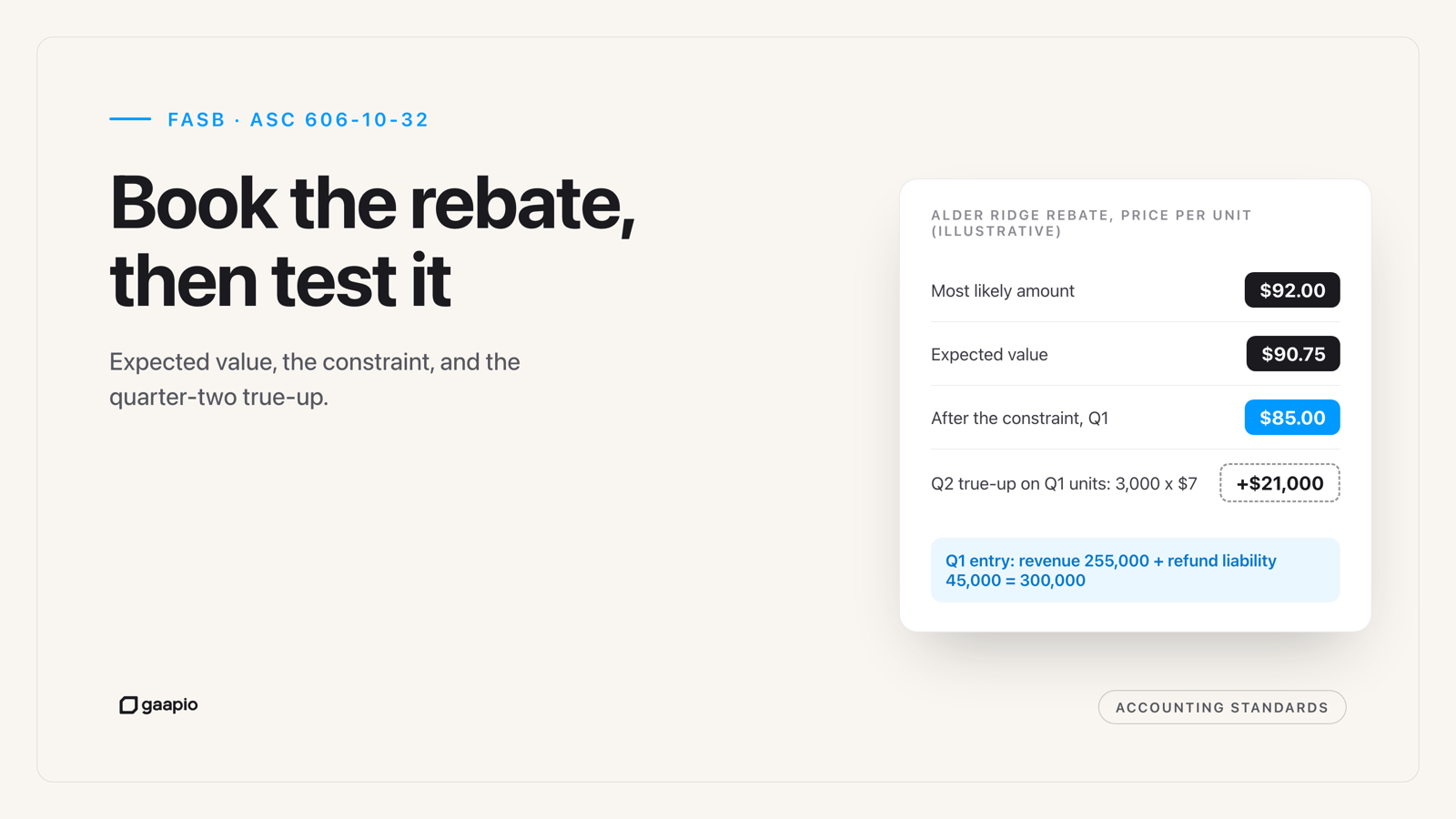
The most likely amount is $92, the single outcome with the highest probability.
Alder Ridge has a portfolio of similar contracts and a spread of outcomes, so expected value is the better predictor and it adopts that method for this rebate. The most likely amount is shown for comparison.
Step 2: apply the constraint. Alder Ridge walks through the five factors:
- (a) The final tier depends on Northgate's own buying and its end customers' demand, which Alder Ridge does not control.
- (b) The uncertainty is not resolved until December 31, 2026.
- (c) Northgate is a new customer, so experience with this specific distributor is limited.
- (d) Alder Ridge has not made a practice of renegotiating tiers.
- (e) There are three outcomes across a $15 range, which is a moderate spread.
Factors (a), (b) and (c) point toward constraining. The constraint weighs both likelihood and magnitude. At $92, the chance that the final price is $92 or higher is 65% (the $100 and $92 outcomes), which falls short of probable. If the $85 tier is reached, recognizing at $92 would reverse $7 a unit, about 7.6% of cumulative revenue on the contract, which Alder Ridge judges significant. An amount between $85 and $92 would carry a smaller exposure, but with a new distributor and a year-long resolution period Alder Ridge cannot support a point above $85 as probable not to reverse significantly. It concludes the constrained price per unit is $85. The $85 floor itself is not constrained, because no outcome produces a lower price, so it is included in the transaction price. A company with stronger evidence could reasonably land higher, so the floor is a judgment here, not a rule. The probabilities are an aid to judgment, not a threshold the standard sets.
| Measurement basis | Price per unit | Q1 revenue on 3,000 units | Refund liability on $300,000 invoiced |
|---|---|---|---|
| Expected value, unconstrained | $90.75 | $272,250 | $27,750 |
| Most likely amount, unconstrained | $92.00 | $276,000 | $24,000 |
| Expected value, constrained (adopted) | $85.00 | $255,000 | $45,000 |
Step 3: the quarter-one entry. Alder Ridge ships 3,000 units in Q1 and invoices $300,000.
| Account | Debit | Credit |
|---|---|---|
| Accounts receivable | $300,000 | |
| Revenue | $255,000 | |
| Refund liability (rebates) | $45,000 |
Step 4: reassess at June 30. Q2 shipments come in at 2,600 units, bringing the cumulative total to 5,600. Northgate tells Alder Ridge that a competitor took share. Reaching 15,000 units would now need 9,400 units in the second half, against a run rate near 2,800 a quarter. Alder Ridge updates its probabilities:
| Final price per unit | Probability |
|---|---|
| $100 | 35% |
| $92 | 60% |
| $85 | 5% |
The updated expected value is $94.45 (35.00 + 55.20 + 4.25). The constrained price is $92. A reversal below $92 requires the 15,000-unit tier, which is now unlikely (5%), so it is probable that recognizing $92 will not reverse significantly. The $100 outcome is upside Alder Ridge cannot yet support, so it stays out. Recognizing at the $94.45 expected value would reverse about $2.45 a unit (roughly 2.6% of cumulative revenue) if the final price is $92 or lower, which has a 65% chance. Alder Ridge judges that exposure, together with factors (a) and (b), too large to call a significant reversal improbable, so it measures revenue at $92. Another company could reasonably conclude a reversal of that size is not significant and land between $92 and $94.45. The judgment gets documented either way.
Step 5: the Q2 true-up. Cumulative revenue at $92 on 5,600 units is $515,200. Revenue recognized in Q1 was $255,000. Q2 revenue is the difference, $260,200, which splits into two parts:
| Component | Calculation | Amount |
|---|---|---|
| Q2 shipments at $92 | 2,600 x $92 | $239,200 |
| Catch-up on Q1 units (price moved from $85 to $92) | 3,000 x $7 | $21,000 |
| Q2 revenue | $260,200 |
Q2 invoices total $260,000. The refund liability ends the quarter at $44,800 (cumulative invoices of $560,000 less cumulative revenue of $515,200), down $200 from $45,000.
| Account | Debit | Credit |
|---|---|---|
| Accounts receivable | $260,000 | |
| Refund liability (rebates) | $200 | |
| Revenue | $260,200 |
What the reviewer will check. Does the Q2 revenue tie to cumulative units times the constrained price less revenue already recognized? Does the refund liability tie to invoices less revenue? Does the footnote disclose the $21,000 as revenue from a performance obligation satisfied in a prior period? Alder Ridge, a public company, answers yes to all three, which is why the example computes cumulative revenue first and backs into the quarter.
If the year ends differently. If Northgate buys 12,600 units for the year, the final price is $92 and no further adjustment is needed. If a late surge reaches 15,000 units, the price falls to $85 on every unit and Alder Ridge books the reduction in revenue in the period the estimate changes. If volume stays under 10,000, the price is $100 and the constrained revenue is released as the uncertainty resolves.
What do you disclose about variable consideration?
ASC 606 does not have a single "variable consideration footnote." The disclosures are spread across the revenue footnote. The ones that touch variable consideration most often:
| Disclosure | Where | What it asks for |
|---|---|---|
| Methods, inputs and assumptions | ASC 606-10-50-20 | How you determine the transaction price, including estimating variable consideration, assessing whether the estimate is constrained, allocating, and measuring obligations for returns and refunds |
| Revenue from prior-period performance obligations | ASC 606-10-50-12A | Revenue recognized in the period from performance obligations satisfied in earlier periods, such as changes in transaction price. The $21,000 catch-up above is an example |
| Remaining performance obligations | ASC 606-10-50-13 | The transaction price allocated to unsatisfied performance obligations, with expedients in 50-14 and 50-14A, including for variable consideration allocated entirely to a wholly unsatisfied performance obligation and for sales- or usage-based royalties |
| Significant judgments | ASC 606-10-50-17 and 50-18 | Judgments that significantly affect the timing and amount of revenue, which frequently include variable consideration estimates |
| Contract balances | ASC 606-10-50-8 through 50-10 | Opening and closing receivables, contract assets and contract liabilities, and revenue recognized from the opening contract liability balance. A rebate refund liability is not a contract liability, so many companies present and describe it separately (see 50-12(d) and 50-20(d)) |
Nonpublic entities may elect to omit or simplify several of these disclosures (the elections are in ASC 606-10-50-7, 50-11, 50-16 and 50-21), so check what applies to you before building the footnote.
An illustrative sentence for the methods disclosure, using the example above: "The Company's distributor agreements include retrospective volume rebates. The Company estimates the rebate using the expected value method based on historical attainment of similar agreements and customer forecasts, and includes in the transaction price only the amount for which it is probable that a significant reversal of cumulative revenue will not occur. Estimates are updated each reporting period."
What mistakes come up most often with variable consideration?
- Treating variable consideration as a one-time estimate. The reassessment each period is required, and the constraint is reassessed with it.
- Applying the constraint to individual transactions. The test is against cumulative revenue under the contract.
- Missing implicit variability. A history of credits or concessions makes the price variable even when the contract is silent.
- Changing methods to get a better number. The method should reflect what predicts the outcome, applied consistently.
- Forgetting the refund liability. Revenue and the liability move together. Booking the revenue reduction without the liability, or the reverse, leaves the balance sheet out of step.
- Applying the royalty exception to a SaaS usage fee. The exception needs a license of intellectual property.
- Treating "probable" as a 75% rule. The standard asks for a judgment about likelihood and magnitude, and 75% is a convention that supports the judgment.
For more of the common misses in ASC 606 work, see our post on 5 common ASC 606 pitfalls.
How does Gaapio help with variable consideration?
Gaapio is an AI-powered technical accounting platform built by CPAs. For a revenue contract, it extracts revenue-driving terms from the contract documents you provide, with links back to the source. It then works through the five-step analysis in writing and labels judgment-dependent conclusions as judgments, so the terms behind each conclusion are easy for a reviewer to trace.
It drafts a reviewer-oriented ASC 606 memo with citations a reviewer can check, and drafts the revenue disclosures benchmarked against comparable filers. You make the calls on the method, the constraint and the reassessment. Gaapio sits in the analysis and documentation layer and does not replace your billing system or subledger.
See how it works on the revenue recognition solution page, or request a demo.
This article is general information about U.S. GAAP, not accounting, legal or audit advice. The example is illustrative. Apply the Codification to your own facts, and consult your auditors on judgments specific to your contracts.
Frequently asked questions
What is variable consideration under ASC 606?
Variable consideration is the part of the transaction price that can change because of discounts, rebates, refunds, credits, price concessions, incentives, performance bonuses, penalties or similar items, or because the price depends on a future event. ASC 606-10-32-6 lists the forms, and 32-7 explains that customary business practices can create variability even when the contract does not state it.
What is the difference between expected value and most likely amount?
Expected value is the sum of probability-weighted amounts across a range of outcomes, and it tends to fit a large number of similar contracts or a wide spread of results. Most likely amount is the single most likely outcome, and it tends to fit contracts with two outcomes, such as a bonus that is either earned or not. ASC 606-10-32-8 says to use the method that better predicts the consideration you will be entitled to.
What is the constraint on variable consideration?
The constraint in ASC 606-10-32-11 allows you to include variable consideration in the transaction price only to the extent it is probable that a significant reversal of cumulative revenue will not occur when the uncertainty is resolved. It is assessed at the contract level against cumulative revenue, and you can include part of an estimate and constrain the rest.
What are the factors that make a reversal more likely?
ASC 606-10-32-12 lists five: the amount is highly susceptible to factors outside your influence, the uncertainty will not be resolved for a long time, your experience with similar contracts is limited, you have a practice of offering broad price concessions or changing terms, and the contract has a large number of possible outcomes across a broad range. No single factor decides the question.
How often do you reassess variable consideration?
At the end of each reporting period. ASC 606-10-32-14 requires you to update the estimated transaction price, including whether the estimate is constrained. Changes are allocated on the same basis as at inception, and the part related to satisfied performance obligations is recognized in the period of the change.
Can you use different estimation methods in the same contract?
Yes, for different uncertainties. A contract with a volume rebate and a performance bonus can use expected value for one and most likely amount for the other if their characteristics differ. Within a single uncertainty, you apply one method consistently.
Does the sales- or usage-based royalty exception apply to SaaS usage fees?
Generally no. The exception in ASC 606-10-55-65 applies to royalties promised in exchange for a license of intellectual property. A usage-based fee for a hosted service is not a license, so it is analyzed as variable consideration, usually with the allocation guidance in ASC 606-10-32-39 through 32-41.
What are the disclosure requirements for variable consideration?
You disclose the methods, inputs and assumptions used to estimate variable consideration and assess the constraint (ASC 606-10-50-20), revenue recognized from performance obligations satisfied in prior periods, including changes in transaction price (50-12A), the significant judgments (50-17 and 50-18), and remaining performance obligation information subject to the expedients in 50-14 and 50-14A. Nonpublic entities may elect to omit or simplify some of these disclosures under 50-7, 50-11, 50-16 and 50-21.