

Equity compensation is the one expense you book for years without ever paying cash, and the one that still has to tie to the grant ledger, the cap table, the tax return and the footnote. Next time you lose an evening to a stock compensation schedule that is off by a tranche nobody remembers repricing, remember that ASC 718 is mostly a question of which date you measure on and which date you recognize on.
This guide covers ASC 718 for a controller who owns equity compensation: how grant-date fair value is measured (including the Black-Scholes inputs and the relief for private companies), service, performance and market conditions, graded versus straight-line attribution, the forfeitures election, modifications (Type I to Type IV), liability versus equity classification, and the ASC 740 tax effects. It ends with an illustrative option and restricted stock unit (RSU) schedule for one invented company, so you can see the expense by year.
Key takeaway: ASC 718 measures an equity award at its grant-date fair value and recognizes that cost over the requisite service period. Service and performance conditions affect whether and when you recognize cost, and market conditions are built into the fair value itself. A modification is measured against the original award, and the original grant-date cost generally keeps running even when a repricing makes the award worth more. Equity classification fixes the measurement at grant. Liability classification means you remeasure every period. Tax follows the cost: you record a deferred tax asset as you expense, and the difference between the deduction and the book cost lands in income tax expense when the deduction arises (at exercise, vest or settlement) or when an award expires unexercised.
What is ASC 718?
ASC 718 (Compensation - Stock Compensation) is the FASB Codification Topic that governs share-based payment transactions in which an entity receives goods or services in exchange for its equity instruments, or for liabilities based on the price of its equity. The core principle is that the cost of those services is recognized in the financial statements, measured at fair value.
The Topic applies to employees and, since ASU 2018-07, to nonemployees on largely the same basis. It covers stock options, restricted stock, RSUs, performance share units, stock appreciation rights (SARs) and employee stock purchase plans (ESPPs). Share-based consideration payable to a customer is measured and classified under ASC 718 (since ASU 2019-08) and recorded as a reduction of the transaction price under ASC 606, unless it pays for a distinct good or service (see the recent changes section below).
You may also see it written "ASC718," "FASB ASC 718," "SFAS 123(R)" (its predecessor) or simply "stock-based compensation accounting." Same Topic. Fair value under ASC 718 is a "fair-value-based" measure with its own rules. Share-based payment awards are outside the scope of ASC 820, so the Level 1, 2 and 3 hierarchy does not apply to them.
How do you measure grant-date fair value under ASC 718?
You measure an equity-classified award once, at the grant date, at the fair value of the award, and you do not remeasure it for later changes in the stock price. For an RSU or restricted stock award that is generally the fair value of the underlying share at grant, adjusted if the holder does not receive dividends during the vesting period. For a stock option, the fair value is an option-pricing estimate, most often from the Black-Scholes-Merton formula or a lattice or Monte Carlo model.
The grant date is the date on which the entity and the employee have a mutual understanding of the key terms and the employee begins to benefit from, or be affected by, changes in the share price. That is a legal and practical test. If board or shareholder approval of the grant is required, the grant date cannot be earlier than that approval, and approving the plan alone does not create a grant date. If key terms are still open, there is no grant date yet, and awards that have a service inception date before the grant date are expensed from service inception and remeasured until grant.
Black-Scholes needs six inputs. ASC 718 does not prefer one model over another. It requires that the model reflect the substantive characteristics of the instrument and take the inputs below into account.
| Input | What it represents | Public company source | Private company notes |
|---|---|---|---|
| Current price of the share | The fair value of one share on the measurement date | Quoted market price | A reasonable valuation, such as an independent 409A-type appraisal. ASU 2021-07 lets a nonpublic entity use the value from a reasonable application of a reasonable valuation method as the current price input for equity-classified awards |
| Exercise price | The strike price | Set by the award terms | Set by the award terms |
| Expected term | How long the award is expected to be outstanding, not the contractual term | Exercise and post-vesting behavior history; SEC staff allow the simplified method for plain-vanilla options when history is insufficient | A nonpublic entity may elect a practical expedient for qualifying options (for example, granted at the money with a short post-termination exercise window). For a service-only award, the expected term is the midpoint between the requisite service period and the contractual term. For a performance-condition award, it is the midpoint if achievement is probable, or the contractual term if not (ASC 718-10-30-20A and 30-20B) |
| Expected volatility | How much the share price is expected to fluctuate over the expected term | Historical, implied or both, based on the entity's own traded shares and options | If volatility cannot be reasonably estimated, use calculated value, which substitutes the historical volatility of an appropriate industry sector index |
| Risk-free interest rate | Zero-coupon U.S. Treasury yield for the expected term | Treasury yield curve | Same |
| Expected dividend yield | The expected dividends on the share | Dividend policy and history | Same |
Four points trip up reviews. First, expected term is not the contractual term. A 10-year option is almost never outstanding for 10 years, and using the contractual term as the input overstates the value. Second, a nonpublic entity that cannot reasonably estimate its expected volatility uses calculated value, which substitutes the historical volatility of an appropriate industry sector index (ASC 718-10-30-20). Separately, a nonpublic entity may make an entity-wide policy election to measure all of its liability-classified awards at intrinsic value instead of fair value or calculated value (ASC 718-30-30-2). The two choices are independent. Third, the practical expedients are elections: the current price expedient is elected measurement date by measurement date for equity-classified awards (ASC 718-10-30-20C), and the expected-term expedient is an entity-wide accounting policy. Both are disclosed. Fourth, the current price expedient does not apply to liability-classified awards, which are remeasured.
Public company registrants should also be aware of SEC Staff Accounting Bulletin Topic 14, which covers the expected term simplified method (SAB 107 and SAB 110), volatility, and spring-loaded grants made ahead of material information (SAB 120).
What is the difference between service, performance and market conditions?
A service condition requires continued employment. A performance condition is tied to the entity's own operations or the achievement of a target, such as revenue, EBITDA or an IPO. A market condition is tied to the entity's share price, such as total shareholder return against an index. The distinction drives both the fair value and the expense pattern.
| Condition | Example | Reflected in grant-date fair value? | Expense recognized if condition is not met | Reassessed each period? |
|---|---|---|---|---|
| Service | Vests after four years of employment | No | None. Cost for the unvested portion is reversed when the employee leaves (or never recognized, under the "as they occur" election) | Forfeitures per policy election |
| Performance | Vests if FY2027 revenue exceeds a target, or on an IPO | No | None. Cost is recognized only if achievement is probable | Yes. Estimate each period and true up with a cumulative catch-up |
| Market | Vests if total shareholder return ranks in the top quartile | Yes. A Monte Carlo or lattice model captures the probability | Cost is still recognized if the service is rendered, even if the market target is never met. It is not reversed | No. The probability is already in the fair value |
Three consequences matter in practice:
- Performance conditions use a probable-outcome test. If it is probable at the reporting date, recognize cost for the portion earned. If probability changes, record a cumulative catch-up. Management's best estimate and the board's own forecasts need to agree.
- Market conditions are measured once. You value the market condition at grant and expense that amount over the derived service period as long as the employee provides service. If the market target is missed, you do not reverse expense for a vested-in-service award. If the employee leaves before the service condition is met, you do.
- A liquidity event is a performance condition. An award that vests only on an IPO or a change of control, sometimes called a double-trigger RSU, generally has no recognizable expense until the event occurs, because the event is not considered probable until it happens. At that point you recognize a cumulative catch-up for the service already rendered. The worked example below shows the entry.
An award can combine conditions. A common version vests on both a service period and a performance target, and the cost is recognized only if both are met. If an award vests when either of two conditions is met (for example, service or a market condition), the market condition is reflected in fair value and cost is recognized over the shortest of the explicit, implicit and derived service periods. If both must be met, use the longest. The answer depends on how the conditions are written, so read the award agreement rather than the plan summary.
Should you use graded vesting or straight-line attribution?
For an award that has only service conditions and a graded vesting schedule, ASC 718-10-35-8 gives you an accounting policy election: recognize cost on a straight-line basis over the requisite service period for the entire award, or recognize cost tranche by tranche (the graded or accelerated method). Whichever you choose, cumulative cost at any date must at least equal the grant-date fair value of the portion of the award that has vested by then.
The two methods recognize the same total cost. They differ in timing. The graded method front-loads expense, because each tranche is expensed over its own shorter service period, so year one carries the full first tranche, half of the second and so on. The straight-line method spreads the total evenly. Companies often choose straight-line because it is simpler to maintain, while the graded method more closely follows the economics of an award in which some employees leave before the later tranches vest.
Two limits are worth stating plainly. The election applies to awards with only service conditions. Awards with performance conditions are assessed tranche by tranche because the probability of each tranche is judged separately, so do not assume you can apply straight-line attribution to them. And the election is a policy: apply it consistently to similar awards, and be ready to explain a change as a change in accounting principle that requires preferability.
The worked example below shows both methods on the same option grant.
How do you account for forfeitures under ASC 718?
You make an accounting policy election: estimate the number of awards that will be forfeited and adjust the estimate as actual forfeitures differ, or recognize forfeitures as they occur. ASU 2016-09 added the second option. Whichever you choose, it applies to service-condition awards to employees and other service providers, and you disclose the election. After ASU 2025-04, share-based consideration payable to a customer with a service condition must use estimated forfeitures (see the recent changes section).
If you estimate, you recognize cost only for the awards you expect to vest, and you true up when actual forfeitures differ (a cumulative catch-up in the period the estimate changes). If you account for forfeitures as they occur, you recognize cost for all awards as if they will vest and reverse the cost of an award when the employee leaves. The as-they-occur election is simpler to administer and is common in private companies with small, stable populations. The estimate election smooths the expense, though a layoff or reorganization well above the estimated rate still produces a true-up.
Auditors look at two things here: that the election is applied consistently, and that, for the estimate method, the rate is supported by actual turnover and updated at least annually. A rate that has not moved in three years while headcount changed is a finding.
How does ASC 718 treat modifications, and what are Type I to Type IV?
A modification is a change to the terms or conditions of an award, such as a repricing, an extension of the exercise period, an acceleration of vesting or a change in the vesting conditions. ASC 718-20-35-3 treats it as an exchange of the original award for a new one, and the accounting starts by comparing the fair value of the modified award with the fair value of the original award immediately before the modification. That difference is the incremental fair value.
The second step is the probability test. You ask whether the original award was expected to vest, and whether the modified award is expected to vest, just before and just after the change. Practice labels the four combinations Type I through Type IV.
| Type | Before the change | After the change | Typical example | Accounting |
|---|---|---|---|---|
| Type I | Probable of vesting | Probable of vesting | Repricing an option for employees still expected to complete service | Keep recognizing the original grant-date cost. Add any incremental fair value, over the remaining service period (immediately for any portion already vested) |
| Type II | Probable | Improbable | Adding a condition or raising a target that now looks unlikely to be met (rare in practice) | The original grant-date fair value is still recognized if the original vesting condition is satisfied. Any incremental fair value is recognized only if the modified condition is met |
| Type III | Improbable | Probable | Lowering a performance target the entity was not going to meet, or accelerating vesting for an employee being terminated | Ignore the original grant-date cost and reverse any cost already recognized for it. Recognize the fair value of the modified award, measured at the modification date, over the remaining service period |
| Type IV | Improbable | Improbable | Changing a target that was out of reach to another that is also out of reach | No cost is recognized under either set of conditions unless an award vests. If the modified award vests, the fair value of the modified award at modification date is the cost |
A modification that changes classification between equity and liability is a separate analysis, with a remeasurement on the modification date. If the award's fair value (or calculated or intrinsic value), vesting conditions and classification are all unchanged, ASU 2017-09 says you do not apply modification accounting (ASC 718-20-35-2A).
Three further points:
- Accelerating vesting for a departing employee is a modification, usually Type III. Without the change, the unvested awards would be forfeited, so the original award is no longer probable of vesting. You reverse the cost already recognized for the unvested portion and recognize the modified award's fair value at the modification date. If vesting is accelerated for an employee who is not expected to leave, it is generally Type I, and you recognize the remaining grant-date cost plus any incremental value. Under the as-they-occur forfeiture election, practice differs on when the earlier cost is reversed, so document your view.
- Cancellation without a replacement is accounted for as a repurchase for no consideration (ASC 718-20-35-9). Any unrecognized cost is recognized on the cancellation date. A cancellation with a concurrent replacement award is a modification of the original.
- Awards replaced in a business combination follow ASC 805-30 for the split between consideration transferred and postcombination expense. See our ASC 805 purchase price allocation guide for the acquisition side.
When is an award a liability instead of equity?
An award is classified as a liability if it can or must be settled in cash or other assets, or if it has certain repurchase features, and as equity otherwise. Classification matters because an equity award is measured once at grant, and a liability award is remeasured at fair value every reporting date until settlement, with the change flowing through compensation cost.
| Feature | Usual classification | Why |
|---|---|---|
| Settles in shares only | Equity | No obligation to deliver cash |
| Settles in cash, or the holder can require cash settlement (a cash-settled SAR) | Liability | Obligation based on the share price |
| Holder can put the shares back to the employer for cash and avoid the risk of ownership for less than about six months after vesting or exercise | Liability | The employee has not borne the risks and rewards of ownership |
| Employer call right that it is expected to exercise within about six months of vesting or exercise, or a call at less than fair value | Liability (or other effects), depending on terms | The employee does not bear the risks and rewards of ownership |
| Cash settlement required on a contingent event outside the employee's control, such as a change in control | Liability only when the event becomes probable | Obligation to transfer assets once the contingency is probable |
| Net share settlement to cover withholding up to the maximum statutory tax rate in the applicable jurisdictions | Equity (does not by itself taint the award) | ASU 2016-09 aligned the withholding threshold with the maximum statutory rate |
| Net share settlement above the maximum statutory rate | Liability for the entire award | Exceeds the allowed threshold |
The practical point is the withholding rate. Many plans withhold shares at the employee's actual marginal rate. Under ASU 2016-09, withholding up to the maximum statutory tax rate keeps equity classification. A plan that lets an employee elect withholding above the highest combined federal, state and local statutory rate in the employee's applicable jurisdictions can make the entire award a liability, so read the plan and the election forms together (ASC 718-10-25-18). Also check repurchase rights, particularly in private company stock plans where the company has a call right on termination. A call right does not by itself make an award a liability, unless the company expects to exercise it within about six months of vesting or exercise, or it is priced below fair value. A put right or a mandatory repurchase can also create a liability.
Liability awards are remeasured at each reporting date until settlement. A nonpublic entity may elect, as an entity-wide policy, to measure them at intrinsic value instead of fair value or calculated value, and that value is also remeasured each period (ASC 718-30-35-4). The current price expedient is not available for liability awards.
What are the tax effects of stock compensation under ASC 740?
You record a deferred tax asset as you recognize book compensation cost for awards that will produce a tax deduction, and you true it up when the award is settled. The difference between the actual deduction and the book cost is an excess tax benefit or a tax shortfall, and since ASU 2016-09 it goes through income tax expense in the period the deduction arises (exercise, vest or settlement) or the award expires unexercised, not through additional paid-in capital. For the wider provision framework, see our ASC 740 income tax provision guide.
What you deduct, and when, depends on the award type under the Internal Revenue Code:
| Award | Tax deduction | Deferred tax asset on book cost? |
|---|---|---|
| Nonqualified stock option (NSO) | Spread at exercise (fair value less exercise price), in the year of exercise | Yes, as book cost is recognized |
| RSU | Fair value of the shares at settlement (delivery), usually at vest | Yes |
| Restricted stock award | Fair value at vest, or at grant if the employee makes a Section 83(b) election | Yes |
| Incentive stock option (ISO) or ESPP (qualified) | None on exercise, unless the employee has a disqualifying disposition | Generally no, because the book cost is a permanent difference. If a disqualifying disposition occurs, the deduction is recorded in the period of the disposition |
| Cash-settled SAR | Cash paid, when paid | Yes, remeasured with the liability |
Five practical points:
- Excess tax benefits and shortfalls are discrete. For interim reporting, they are recognized in the period they occur and are not part of the estimated annual effective tax rate.
- The benefit is recognized even if it does not reduce taxes payable. An excess tax benefit increases a net operating loss deferred tax asset, which is then subject to the valuation allowance assessment as usual.
- Section 162(m) caps the deduction at $1 million for covered employees of public companies, and the covered group expands to the next five highest-paid employees for taxable years beginning after December 31, 2026. Record a deferred tax asset only for the cost you expect to deduct.
- The cash flow statement follows. Excess tax benefits are operating cash flows. Cash paid by the employer to tax authorities for shares withheld is a financing outflow.
- Diluted EPS uses the treasury stock method. Excess tax benefits are not included in assumed proceeds after ASU 2016-09, which simplified the calculation.
What has changed in ASC 718 recently?
Five updates are worth knowing. ASU 2016-09 and ASU 2021-07 carry the private company expedients, ASU 2024-01 is new for most private companies in 2026, and ASU 2025-04 changes customer awards from 2027.
- ASU 2016-09 simplified several areas: excess tax benefits through income tax expense, the forfeiture election, the withholding threshold and the cash flow classification, plus the nonpublic expected-term expedient.
- ASU 2018-07 brought nonemployee awards into ASC 718 and removed the separate guidance for them.
- ASU 2021-07 added the practical expedient for the current price input for nonpublic entities' equity-classified awards, effective for fiscal years beginning after December 15, 2021.
- ASU 2024-01 clarifies how to decide whether a profits interest or similar award is in the scope of ASC 718 and adds an illustrative example. It is effective for public business entities for annual periods beginning after December 15, 2024, and for other entities for annual periods beginning after December 15, 2025, with early adoption permitted. For many private LLCs, 2026 is the first year it applies.
ASU 2025-04 amends ASC 718 and ASC 606 for share-based consideration payable to a customer. It expands the performance condition definition to include conditions tied to customer purchase volume, removes the as-they-occur forfeiture election for customer awards with service conditions, and says the ASC 606 variable consideration constraint does not apply. It is effective for all entities for annual periods, and interim periods within them, beginning after December 15, 2026, with early adoption permitted. If you grant equity to customers, read it before you grant. If you grant only to employees and service providers, it does not change the employee accounting above.
Worked example: option and RSU expense schedule (illustrative)
Birchwood Analytics is a private software company with a calendar year end. All names and numbers are invented. The company elects the nonpublic expedients for the current price and expected term, accounts for forfeitures as they occur (none occur in this example), and uses a 25% blended tax rate (21% federal plus about 4% net state).
Part 1: Grant-date fair value of the options
On January 1, 2026, Birchwood grants 100,000 NSOs with a 10-year contractual term. The options vest in four equal annual tranches of 25,000 on each December 31 from 2026 to 2029, subject to continued service.
| Black-Scholes input | Value | Basis |
|---|---|---|
| Current price | $10.00 | Independent valuation, ASU 2021-07 expedient |
| Exercise price | $10.00 | Set at the current price |
| Expected term | 6.25 years | Illustrative simplification: the average of the four tranche midpoints (5.5, 6.0, 6.5 and 7.0 years). Under the expedient, a tranche-by-tranche approach would value each tranche separately; confirm the approach with your auditor |
| Expected volatility | 50% | Average historical volatility of a peer group of comparable public companies over the expected term |
| Risk-free rate | 4.0% | U.S. Treasury yield at the expected term |
| Dividend yield | 0% | No dividends expected |
| Fair value per option | $5.34 | |
| Total grant-date fair value | $534,000 | 100,000 options x $5.34 |
The entry each year is a debit to compensation expense and a credit to additional paid-in capital. The fair value is fixed at grant, and later changes in the share price do not change it.
Part 2: Straight-line versus graded attribution
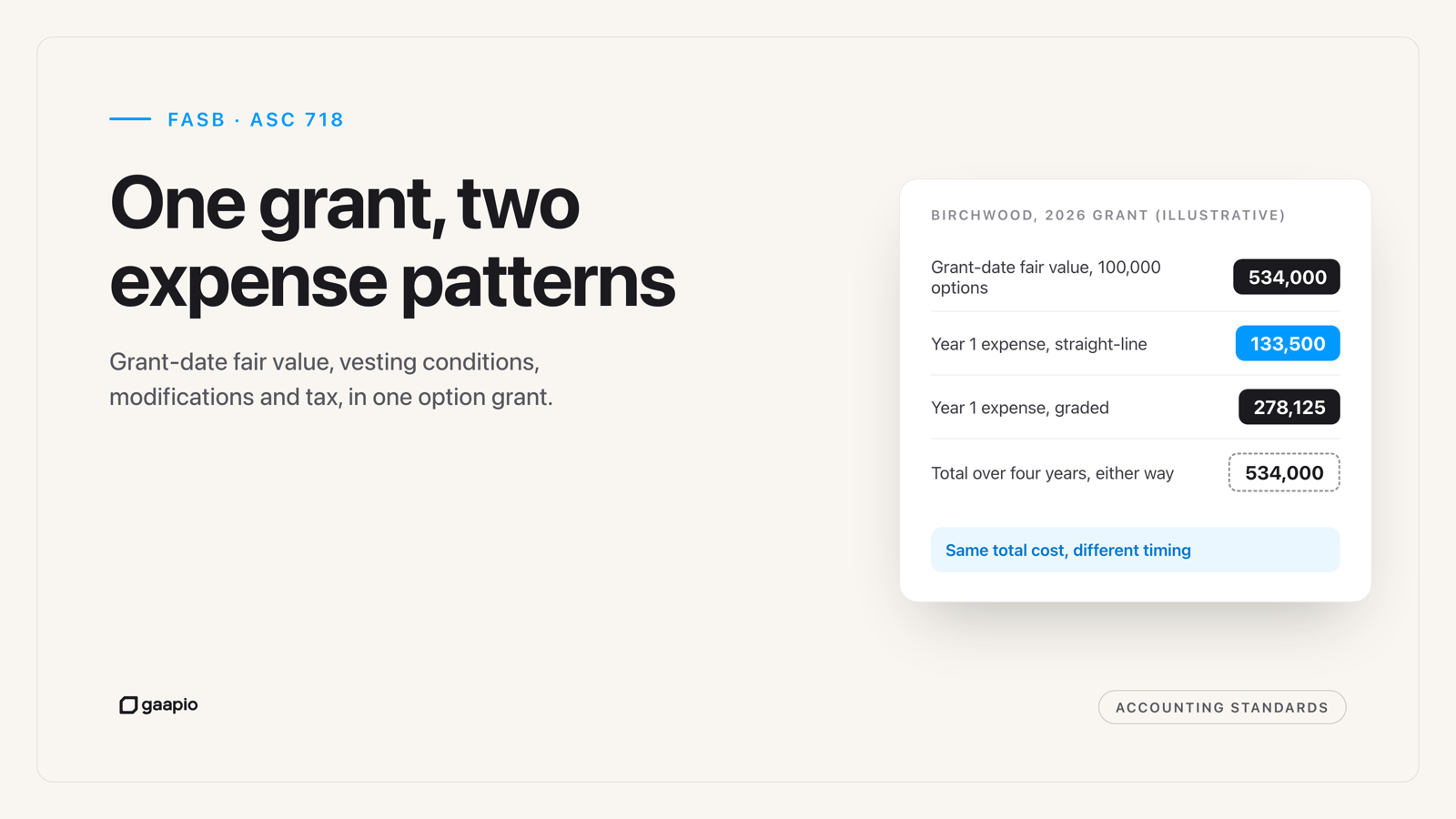
The same $534,000 of cost is recognized under both methods. Straight-line spreads it evenly over four years. The graded method treats each 25,000-option tranche as its own award, with $133,500 of cost recognized over one, two, three and four years respectively. (This example uses one fair value for all tranches. In practice, tranches with different expected terms can have different fair values.)
| Year | Straight-line | Graded (tranche by tranche) | Difference |
|---|---|---|---|
| 2026 | $133,500 | $278,125 | $144,625 |
| 2027 | $133,500 | $144,625 | $11,125 |
| 2028 | $133,500 | $77,875 | ($55,625) |
| 2029 | $133,500 | $33,375 | ($100,125) |
| Total | $534,000 | $534,000 | $0 |
In year one under the graded method, the first tranche contributes $133,500, the second $66,750, the third $44,500 and the fourth $33,375, which adds to $278,125. Either policy is acceptable, and the cumulative cost never falls below the grant-date fair value of the tranches that have vested.
Part 3: A repricing (Type I modification)
On December 31, 2027, the share price has fallen to $6.00 and Birchwood reprices all 100,000 options to a $6.00 exercise price. Tranches 1 and 2 (50,000 options) are vested, and tranches 3 and 4 (50,000 options) are unvested. The employees are expected to complete service, so both before and after the change the award is probable of vesting. That is a Type I modification.
| Step | Per option | 100,000 options |
|---|---|---|
| Fair value of original award immediately before (price $6.00, strike $10.00, 4.25 years remaining expected term, 50% volatility, 4.0% rate) | $1.76 | $176,000 |
| Fair value of modified award immediately after (price $6.00, strike $6.00, same other inputs) | $2.67 | $267,000 |
(Simplified. In practice you re-estimate the expected term for both the pre- and post-modification valuations and use a current valuation for the $6.00 price.)
| Incremental fair value | $0.91 | $91,000 |
The $534,000 original cost keeps running as before. The $91,000 is added on top. The portion for vested options ($45,500) is recognized on the modification date. The portion for unvested options ($45,500) is recognized over the remaining two years of service. The table below is simplified: it spreads the unvested increment straight-line over those two years.
| Year | Original cost (straight-line) | Incremental cost | Total expense |
|---|---|---|---|
| 2026 | $133,500 | $0 | $133,500 |
| 2027 | $133,500 | $45,500 | $179,000 |
| 2028 | $133,500 | $22,750 | $156,250 |
| 2029 | $133,500 | $22,750 | $156,250 |
| Total | $534,000 | $91,000 | $625,000 |
The original $534,000 stays in place even though the options were underwater when repriced. Under ASC 718-20-35-3, total cost for an award that was expected to vest is at least its original grant-date fair value, so a fall in the share price after grant never reduces it. Only the increment is new.
Part 4: Double-trigger RSUs and the liquidity event catch-up
On January 1, 2026, Birchwood also grants 40,000 RSUs, with a $10.00 grant-date fair value per share ($400,000 in total). The RSUs vest on the later of a three-year service period (cliff, December 31, 2028) and a qualifying liquidity event. A liquidity event is a performance condition, and it is not probable until it occurs, so no cost is recognized in 2026 or 2027. The IPO closes on June 30, 2028.
| Date | Event | Cumulative service-based cost | Expense recognized |
|---|---|---|---|
| 12/31/2026 | Liquidity event not probable | $0 | $0 |
| 12/31/2027 | Liquidity event not probable | $0 | $0 |
| 6/30/2028 | IPO closes. 2.5 of 3 service years rendered | $333,333 (2.5/3 of $400,000) | $333,333 (catch-up) |
| 12/31/2028 | Service complete, RSUs vest | $400,000 | $66,667 |
The June 30, 2028 entry is a debit to compensation expense for $333,333 and a credit to additional paid-in capital. The grant-date fair value stays at $10.00 per share even though the stock may trade at a very different price after the IPO. This is a cliff-vesting award. If the RSUs had graded service vesting and a liquidity condition, the tranches would be assessed separately.
One consequence of the IPO: the nonpublic expedients (the ASU 2021-07 current price expedient and the expected-term expedient) have no transition relief, so the historical financial statements in the registration statement may need their effects removed and the January 2026 grants measured on a public-company basis. A company that expects to go public should weigh that before electing them.
Part 5: The tax effect
Birchwood records a deferred tax asset as it recognizes cost on the RSUs: $83,333 at June 30, 2028 (25% of $333,333) and $16,667 by December 31, 2028, or $100,000 in total. The RSUs vest on December 31, 2028, when the stock trades at $18.00. This assumes no RSU holder is a Section 162(m) covered employee. If any holder is, the deductible amount (and the deferred tax asset) is limited.
| Item | Amount |
|---|---|
| Tax deduction: 40,000 shares x $18.00 | $720,000 |
| Current tax benefit at 25% | $180,000 |
| Deferred tax asset recorded on $400,000 of book cost at 25% | $100,000 |
| Excess tax benefit, recognized in income tax expense in 2028 | $80,000 |
If the stock had been $6.00 at vest, the deduction would have been $240,000, the tax benefit $60,000, and Birchwood would record a $40,000 tax shortfall in income tax expense instead. Under ASU 2016-09, neither the benefit nor the shortfall goes through additional paid-in capital, and both are discrete items in the interim period. The company would also check whether shares withheld for taxes stay within the maximum statutory rate.
What do auditors push on in stock compensation?
Auditors test three things in this area, and most findings fall in the first two.
- The inputs. Volatility and expected term are the largest judgments in an option value. Expect to support the peer group, the period used, and why the expected term differs from the contractual term. For private companies, expect questions on the valuation used for the current price, including its date relative to the grant date and whether recent financing, secondary sales or a pending IPO make it stale.
- Grant date and the population. Whether the grant date is the date the terms are communicated, whether the right number of awards is on the ledger, and whether late approvals or backdated grants moved the measurement date. Tie the grant ledger to the board minutes and to the cap table.
- Modifications and settlements. A repricing, an extension at termination, or an acceleration for a departing executive that was never run through the incremental fair value calculation is a common deficiency. Ask HR and legal for every change to award terms, not only those the stock plan administrator flags.
Also expect questions on the classification of awards with net settlement and repurchase features, the support for performance condition probability, and whether the disclosures tie: total expense by income statement line, unrecognized cost and the weighted average period, option activity, and the assumptions used.
How does Gaapio help with stock compensation accounting?
Gaapio is an AI-powered technical accounting platform built by CPAs. For the judgment calls in ASC 718, such as a classification conclusion on an award with repurchase features or the treatment of a modification, you give Gaapio your facts and it asks follow-up questions before drafting. It is grounded in the licensed FASB Codification, Big 4 guidance, and SEC filings and comment letters. Where the analysis forks, it shows the alternatives so a reviewer can see the close calls, and conclusions come with clickable citations. It drafts in your team's memo template, with reviewer comments, approvals and version history. See Gaapio accounting memos.
For the stock compensation footnote, Gaapio checks your disclosures against the Codification and your GAAP checklist, flags gaps, and shows how your note compares with real 10-K filings from public peers in your industry. You make the disclosure calls. See AI footnote disclosures. Gaapio does not value your awards or compute your expense; those come from your valuation specialist and your equity administration system. You make the accounting calls.
Want to see it on your own modification memo or stock compensation footnote? Request a demo.
This article is general information, not accounting, tax or legal advice. Confirm the requirements for your facts against the Codification, current tax law and with your auditor and tax advisor.
Written by Jace Chambers, CPA, who started his career in audit at EY.
Frequently asked questions
What is ASC 718?
ASC 718 is the FASB Codification Topic on stock compensation. It requires an entity to recognize the cost of goods or services received in share-based payment transactions, measured at fair value (at the grant date for equity-classified awards; liability awards are remeasured each period), over the period in which the services are provided.
How do you calculate stock-based compensation expense?
Multiply the number of awards expected to vest by the grant-date fair value per award, and recognize that total over the requisite service period. For an option, the fair value per award comes from an option-pricing model. For an RSU, it is generally the share price at grant. Then apply your attribution method (straight-line or graded) and your forfeiture policy.
What are the Black-Scholes inputs for stock options?
The current share price, the exercise price, expected term, expected volatility, the risk-free interest rate and the expected dividend yield. Expected term is the period the option is expected to be outstanding, not the contractual term.
How do private companies value stock options under ASC 718?
They use the same measurement objective as public companies, with practical expedients. A nonpublic entity can use a value from a reasonable valuation method as the current price input for equity-classified awards (ASU 2021-07), can elect an expected-term expedient, and must use calculated value, which relies on an industry sector index, when it cannot reasonably estimate expected volatility.
What is the difference between graded vesting and straight-line attribution?
For service-only awards with graded vesting, you may recognize cost straight-line over the whole award or tranche by tranche. Total cost is the same. The graded method recognizes more expense in the early years.
Should I estimate forfeitures or account for them as they occur?
Either is allowed as an accounting policy election. Estimating smooths expense but requires a supportable rate and true-ups. Accounting for forfeitures as they occur is simpler but can produce reversals in the periods when employees leave.
What are Type I, II, III and IV modifications?
They describe whether the original and the modified awards were probable or improbable of vesting just before and after the change. Type I is probable to probable, Type II is probable to improbable, Type III is improbable to probable and Type IV is improbable to improbable. The type determines whether you keep the original grant-date cost, replace it with the modified award's fair value, or recognize cost only if the award vests.
When is a stock award a liability under ASC 718?
When it can or must be settled in cash or other assets, such as a cash-settled SAR, or when it has features such as a put right that lets the holder avoid the risks of ownership for less than about six months, or net settlement above the maximum statutory tax rate. Liability awards are remeasured each period.
How is stock-based compensation taxed under ASC 740?
You record a deferred tax asset as you recognize book cost on awards that will produce a deduction. At exercise, vest or settlement, or when an award expires unexercised, the difference between the actual deduction and the book cost (if any) is an excess tax benefit or shortfall, recognized in income tax expense in that period.
What is a double-trigger RSU, and when do you expense it?
It vests on both a service condition and a liquidity event, such as an IPO. The liquidity event is a performance condition and is generally not probable until it happens, so you recognize no cost before it. When it occurs, you recognize a cumulative catch-up for the service already rendered.
Related reading
- ASC 740 income tax provision guide
- ASC 820 fair value measurement and disclosures
- ASC 805 purchase price allocation guide
- AI footnote disclosures
Sources: FASB ASC 718 and ASU 2016-09, ASU 2018-07, ASU 2021-07, ASU 2024-01 and ASU 2025-04; Deloitte, Roadmap: Share-Based Payment Awards; Deloitte, Heads Up on ASU 2021-07; Wolters Kluwer, FASB clarifies accounting for profits interest awards; BDO, Share-based consideration payable to a customer; SEC Staff Accounting Bulletin Topic 14.