

Every lease you sign gets sorted into one of two buckets, and the bucket decides how the lease shows up in your income statement, your balance sheet and your cash flow statement.
Under ASC 842, a lessee classifies each lease as an operating lease or a finance lease at the commencement date. Both go on the balance sheet.
The difference is the pattern of expense, where it lands in the financial statements, and which metrics move: EBITDA, operating income, debt ratios and covenants.
This guide to operating vs finance lease classification under ASC 842 covers the five classification criteria in ASC 842-10-25-2, the 75 percent and 90 percent thresholds practitioners use for "major part" and "substantially all," what changes after classification, short-term leases, the missing low-value exemption, and how IFRS 16 differs.
Key takeaway: A lessee classifies a lease as a finance lease if any one of five criteria is met at commencement: ownership transfers, a purchase option is reasonably certain to be exercised, the lease term covers a major part of the asset's remaining economic life, the present value of lease payments (plus any lessee-guaranteed residual value) equals or exceeds substantially all of the asset's fair value, or the asset is so specialized that it has no alternative use to the lessor. Otherwise the lease is an operating lease. The 75 percent and 90 percent figures are a reasonable approach described in the implementation guidance, not rules, so your policy needs to name the threshold and apply it consistently. Operating leases produce one straight-line lease cost. Finance leases produce amortization plus interest, which front-loads expense.
What is the difference between an operating lease and a finance lease under ASC 842?
A finance lease is one that meets at least one of the five criteria in ASC 842-10-25-2. An operating lease is every other lease. Both put a right-of-use (ROU) asset and a lease liability on the lessee's balance sheet at commencement, measured the same way. What differs is everything after that.
| Operating lease | Finance lease | |
|---|---|---|
| Test | Meets none of the five criteria | Meets any one of the five criteria |
| Balance sheet | ROU asset and lease liability, kept apart from finance lease balances (presented separately or disclosed by line item, never in the same line) | ROU asset and lease liability, kept apart from operating lease balances (presented separately or disclosed by line item, never in the same line) |
| Income statement | One lease cost, generally straight-line over the lease term, inside operating expenses | Amortization of the ROU asset plus interest on the liability, shown separately |
| Expense pattern over the term | Level: straight-line over the lease term, even when payments escalate (variable payments aside) | Front-loaded: higher in early years, lower later |
| Where expense sits | Inside operating expenses, so it reduces both operating income and EBITDA | Amortization and interest typically sit with other amortization and interest, below EBITDA |
| Cash flow statement | Payments in operating activities (except payments capitalized into another asset, which go in investing) | Principal in financing activities; interest in operating activities |
| Disclosure | Operating lease cost, with operating-lease weighted-average term and discount rate | Amortization and interest cost separately, with finance-lease weighted-average term and discount rate |
The names carry over loosely from ASC 840, where a "capital lease" was the counterpart to an operating lease. ASC 842 renamed it a finance lease for lessees, and lessees now put operating leases on the balance sheet too. That was the biggest change in the standard.
What are the five lease classification criteria in ASC 842-10-25-2?
A lessee classifies a lease as a finance lease when, at commencement, it meets any one of these five criteria. They are tested separately, and meeting one is enough.
- Transfer of ownership. The lease transfers ownership of the underlying asset to the lessee by the end of the lease term.
- Purchase option. The lease grants the lessee an option to purchase the underlying asset that the lessee is reasonably certain to exercise.
- Lease term. The lease term is for the major part of the remaining economic life of the underlying asset. This criterion is not used if the commencement date falls at or near the end of the asset's economic life. ASC 842-10-55-2 describes a commencement date in the last 25 percent of total economic life as one reasonable reading of "at or near the end."
- Present value of payments. The present value of the sum of the lease payments, plus any residual value guaranteed by the lessee that is not already reflected in the lease payments, equals or exceeds substantially all of the fair value of the underlying asset.
- Specialized asset. The underlying asset is of such a specialized nature that it is expected to have no alternative use to the lessor at the end of the lease term.
If none of the five is met, the lease is an operating lease. Lessors apply the same five criteria in ASC 842-10-25-2 to identify a sales-type lease. A lessor that meets none of them then runs a separate direct financing lease test in ASC 842-10-25-3, which also counts residual value guarantees from unrelated third parties. That test has no lessee equivalent.
A few points trip up reviewers:
- "Reasonably certain" is a high bar. It is the same threshold used for lease term options. It is a high threshold, generally viewed as higher than "probable" as used in ASC 450, and it should be supported with economic factors (ASC 842-10-55-26): an exercise price well below expected fair value, significant leasehold improvements, the cost of relocating or replacing the asset, or the asset's importance to operations.
- "Economic life" is not the depreciable life. The Master Glossary defines it as the period over which an asset is expected to be economically usable by one or more users. That is often longer than the lessee's own useful life, and for real estate it can be decades.
- The term includes more than the base period. Under the Master Glossary definition, the lease term is the noncancellable period plus periods covered by an option to extend that the lessee is reasonably certain to exercise, periods covered by an option to terminate that the lessee is reasonably certain not to exercise, and periods covered by an option to extend (or not to terminate) that the lessor controls.
- The present value test starts with lease payments as ASC 842 defines them. Lease payments under ASC 842-10-30-5 are fixed and in-substance fixed payments less lease incentives, variable payments tied to an index or rate (measured at the commencement index or rate), the purchase option price if exercise is reasonably certain, and termination penalties if the term reflects exercise. For classification, the lessee then adds the full residual value it guarantees, to the extent it is not already in lease payments. Measuring the liability uses only the amount probable of being owed under that guarantee, so the two figures can differ. Usage-based and performance-based variable payments are excluded from both.
- The discount rate is the same one you use to measure the liability. That is the rate implicit in the lease if readily determinable, otherwise the incremental borrowing rate. A lessee that is not a public business entity may instead elect a risk-free rate by class of underlying asset, but it still uses the implicit rate when that rate is readily determinable. A lower rate produces a higher present value and can push a lease over the line. See our guide to the ASC 842 discount rate and incremental borrowing rate.
Are 75 percent and 90 percent required for major part and substantially all?
No. ASC 842 uses the words "major part" and "substantially all" and sets no numbers. The implementation guidance in ASC 842-10-55-2 says that one reasonable approach is to treat 75 percent or more of the remaining economic life as a major part, and 90 percent or more of fair value as substantially all. Those are the bright lines ASC 840 used, and most lessees carried them forward as policy.
Reviewers care about one point: these thresholds are a policy choice. Three things follow:
- Write the threshold in your policy. If you use 75 percent and 90 percent, say so and apply them consistently across leases. If you use something else, support it.
- A result close to the line deserves a second look at the inputs. At 89 percent or 91 percent, the fair value, the discount rate, the economic life and the payments in the test decide the answer. Support each one, and apply the policy threshold as written.
- The thresholds cover two of the five criteria. A lease below both can still be a finance lease under the ownership, purchase option or specialized asset criteria. Under a 75/90 policy, a lease at or above the 90 percent present value threshold is a finance lease, and so is a lease at or above the 75 percent lease term threshold unless commencement falls at or near the end of the asset's economic life.
Check which thresholds your auditor expects to see in the policy.
When do you assess lease classification, and can it change?
Classification is determined at the commencement date, the date the lessor makes the underlying asset available for the lessee's use. After that, a lessee reassesses classification only on specific events:
- A modification that is not accounted for as a separate contract. The lessee reassesses classification using the modified terms as of the modification date. Our guide to ASC 842 lease modifications walks through when a modification is a separate contract.
- A change in the lease term or in the assessment of a purchase option. If the lessee's reasonably-certain assessment changes, the lease liability is remeasured and classification is reassessed. A lessee revisits those assessments only on a significant event or change in circumstances within its control, or when it exercises or forgoes an option.
Changes in market conditions, the asset's fair value or interest rates do not trigger reassessment on their own. Other liability remeasurements, such as a change in the amount probable of being owed under a residual value guarantee, also do not reopen classification. When a reassessment event does occur, the lessee reruns the criteria using the fair value, remaining economic life and an updated discount rate as of that date, which is why the rate matters twice.
How do operating and finance lease expenses differ over the life of a lease?
An operating lease produces one straight-line lease cost. A finance lease produces two expense lines that, added together, start high and fall over the term. Total expense across the whole lease is the same in both cases (the total payments, adjusted for any initial direct costs or incentives, when the finance lease ROU asset is amortized over the lease term and there is no impairment), but the timing differs.
For an operating lease, ASC 842-20-25-6 requires a single lease cost allocated over the lease term on a generally straight-line basis. The liability still accretes interest at the discount rate, and the ROU asset amortization is the plug that makes the total equal the single straight-line cost. None of that shows up as separate expense lines.
For a finance lease, the lessee amortizes the ROU asset and recognizes interest on the liability using the effective interest method. Amortization is generally straight-line over the shorter of the lease term and the asset's useful life, unless ownership transfers or a purchase option is reasonably certain to be exercised, in which case the lessee amortizes over the asset's useful life. Because interest is highest when the liability is highest, the combined expense is highest in year 1.
The practical effect shows up in ratios:
- EBITDA is higher under a finance lease. The amortization and interest sit below EBITDA. An operating lease cost sits inside operating expenses and reduces it.
- Operating income is also higher under a finance lease if interest is presented outside operating income, which is the common presentation.
- Debt and leverage metrics. Finance lease liabilities are often included in debt definitions in credit agreements. Operating lease liabilities often are not, but check the specific definitions, because some agreements use frozen GAAP provisions that measure debt under ASC 840 or under GAAP as of the signing date.
How are operating and finance leases presented on the balance sheet and cash flow statement?
Both types go on the balance sheet. ASC 842-20-45-1 requires the lessee to present, or disclose in the notes, finance lease and operating lease ROU assets separately from each other and from other assets, and the two kinds of lease liabilities separately from each other and from other liabilities. If they are not presented separately, the lessee discloses which line items include them (ASC 842-20-45-2). Under ASC 842-20-45-3, finance and operating lease balances cannot be combined in the same line item. Many companies show operating lease ROU assets on their own line and include finance lease ROU assets in property and equipment (disclosing which line holds them), with matching lease liability lines split into current and noncurrent.
On the cash flow statement:
- Operating lease payments go in operating activities, except payments that represent costs to bring another asset to the condition and location necessary for its intended use, which go in investing activities.
- Finance lease principal payments go in financing activities.
- Finance lease interest payments go in operating activities, as ASC 842-20-45-5 and ASC 230 require for interest paid.
- Noncash activity. ROU assets obtained in exchange for new lease liabilities are a supplemental noncash disclosure, shown separately for operating and finance leases.
One more difference shows up in the notes. A lessee discloses the components of lease cost (finance lease amortization and interest, operating lease cost, short-term lease cost, variable lease cost and sublease income), and weighted-average remaining lease term and discount rate separately for operating and finance leases.
How does the same lease look classified both ways? A worked example
The example below is illustrative. The company, the amounts and the rate are invented to show the mechanics.
Facts. Northgate Packaging leases production equipment for five years and pays $100,000 at the end of each year, so total payments are $500,000. The equipment has a remaining economic life of eight years at commencement. There is no ownership transfer, no purchase option, no residual value guarantee, no initial direct costs and no incentives. The equipment is standard and has alternative uses to the lessor. Northgate's incremental borrowing rate is 6.00 percent, and the rate implicit in the lease is not readily determinable.
Step 1: measure the liability. The present value of five payments of $100,000 at 6.00 percent is $421,236. That is the opening lease liability and, with no other items, the opening ROU asset. This is identical whichever classification applies.
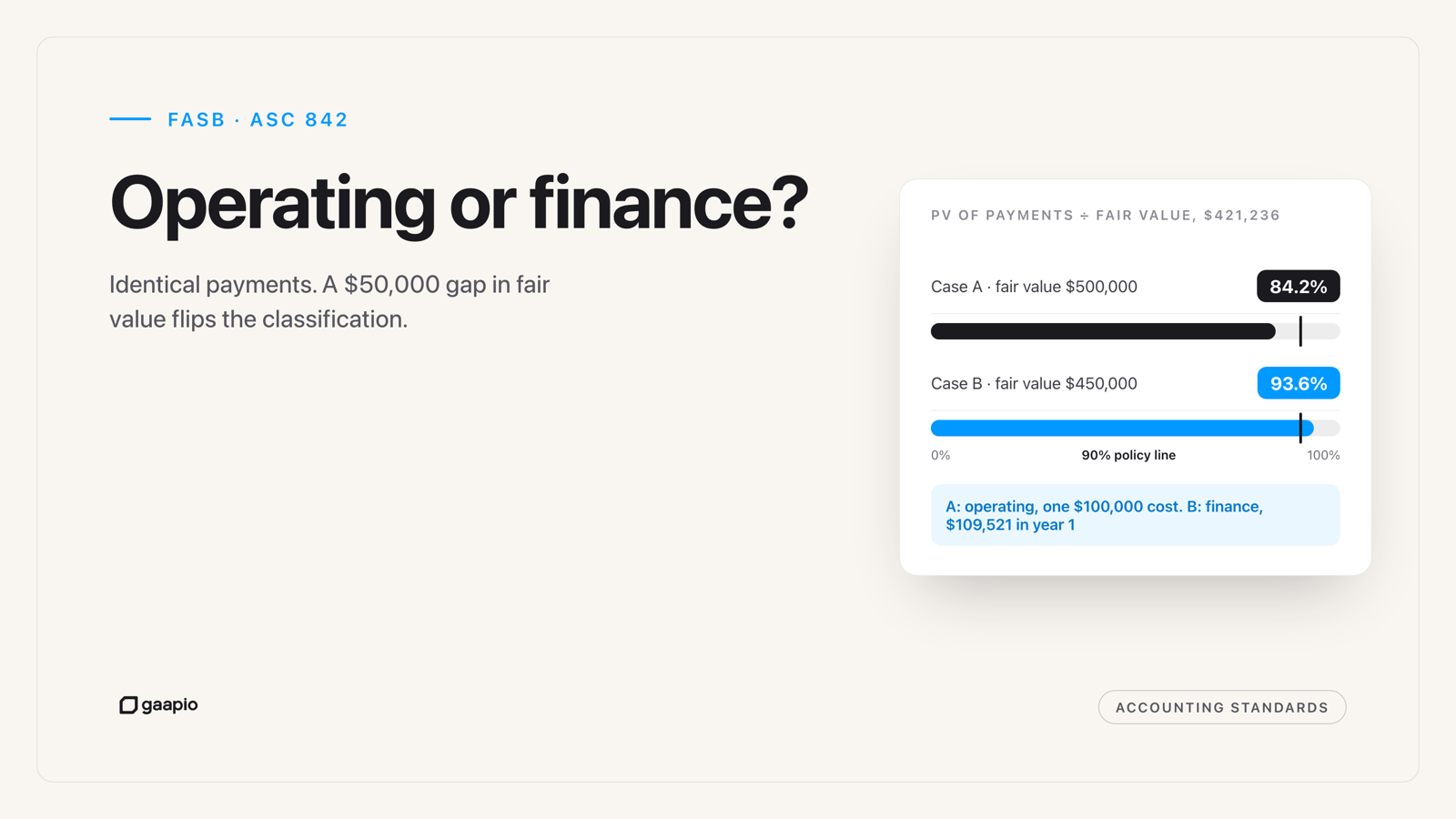
Step 2: run the criteria. The test depends on the fair value of the equipment, so we run it twice. The only fact that changes between the two cases is the equipment's fair value.
| Criterion | Case A: fair value $500,000 | Case B: fair value $450,000 |
|---|---|---|
| 1. Ownership transfers | No | No |
| 2. Purchase option reasonably certain | No option | No option |
| 3. Term is a major part of remaining economic life (5 of 8 years) | 62.5%, below a 75% policy threshold | 62.5%, below a 75% policy threshold |
| 4. PV of payments vs. fair value | $421,236 / $500,000 = 84.2%, below a 90% policy threshold | $421,236 / $450,000 = 93.6%, at or above a 90% policy threshold |
| 5. No alternative use to lessor | No | No |
| Classification | Operating | Finance (criterion 4) |
Case A is an operating lease. Case B is a finance lease because of the present value test. Under a 90 percent policy, the lease is a finance lease at any fair value of $468,040 or less (the $421,236 present value divided by 0.90). Case B would have been an operating lease if the commencement-date fair value estimate had been about 4 percent higher, above $468,040, or if the incremental borrowing rate had been about 7.5 percent or higher instead of 6.00 percent. That is why the fair value support and the rate support both need to be documented.
Step 3: build the schedule. Interest is the opening liability times 6.00 percent, rounded to the dollar, with a $1 rounding adjustment in year 5 so the liability closes at zero. The liability schedule is the same in both cases.
| Year | Opening liability | Payment | Interest at 6.00% | Principal | Closing liability |
|---|---|---|---|---|---|
| 1 | $421,236 | $100,000 | $25,274 | $74,726 | $346,510 |
| 2 | $346,510 | $100,000 | $20,791 | $79,209 | $267,301 |
| 3 | $267,301 | $100,000 | $16,038 | $83,962 | $183,339 |
| 4 | $183,339 | $100,000 | $11,000 | $89,000 | $94,339 |
| 5 | $94,339 | $100,000 | $5,661 | $94,339 | $0 |
Step 4: the expense and the ROU asset under each classification. For the operating treatment, lease cost is $100,000 a year ($500,000 divided by five). ROU amortization is the plug: $100,000 less interest. For the finance treatment, amortization is $84,247 a year ($421,236 divided by five, with the odd dollar in year 5) plus the interest above.
| Year | Operating: lease cost | Operating: ROU asset, end of year | Finance: interest | Finance: amortization | Finance: total expense | Finance: ROU asset, end of year |
|---|---|---|---|---|---|---|
| 1 | $100,000 | $346,510 | $25,274 | $84,247 | $109,521 | $336,989 |
| 2 | $100,000 | $267,301 | $20,791 | $84,247 | $105,038 | $252,742 |
| 3 | $100,000 | $183,339 | $16,038 | $84,247 | $100,285 | $168,495 |
| 4 | $100,000 | $94,339 | $11,000 | $84,247 | $95,247 | $84,248 |
| 5 | $100,000 | $0 | $5,661 | $84,248 | $89,909 | $0 |
| Total | $500,000 | $78,764 | $421,236 | $500,000 |
Two things stand out. The totals tie: both treatments recognize $500,000 over five years. And the operating lease ROU asset equals the lease liability each year, because payments are level, there are no prepaid or accrued rents and straight-line cost equals the payment. The finance ROU asset is lower than the liability from year 1 on, because it amortizes straight-line while the liability falls more slowly early on.
Entries.
At commencement (both classifications): Dr ROU asset $421,236; Cr Lease liability $421,236.
Year one, operating: Dr Operating lease cost $100,000; Dr Lease liability $74,726; Cr Cash $100,000; Cr ROU asset $74,726.
Year one, finance: Dr Interest expense $25,274; Dr Lease liability $74,726; Cr Cash $100,000. Then Dr Amortization expense $84,247; Cr ROU asset $84,247.
Year-one financial statement effect.
| Operating (Case A) | Finance (Case B) | |
|---|---|---|
| Income statement | $100,000 lease cost in operating expenses | $84,247 amortization and $25,274 interest, $109,521 in total |
| EBITDA effect | Reduced by $100,000 | Not reduced (amortization and interest are excluded) |
| Cash flow: operating activities | ($100,000) | ($25,274) interest |
| Cash flow: financing activities | none | ($74,726) principal |
| Closing ROU asset | $346,510 | $336,989 |
| Closing lease liability | $346,510 | $346,510 |
Total cash out is $100,000 in both cases. Where it lands in the cash flow statement is what moves. Cash from operations looks $74,726 better under the finance treatment in year 1, with the principal repayment in financing activities.
How do short-term leases work under ASC 842?
A short-term lease is a lease with a term of 12 months or less at commencement that does not include a purchase option the lessee is reasonably certain to exercise. A lessee can elect, by class of underlying asset, not to recognize an ROU asset or lease liability for short-term leases (ASC 842-20-25-2). It then recognizes the lease payments in profit or loss on a straight-line basis over the lease term, recognizes variable lease payments in the period the obligation for them is incurred, and discloses short-term lease cost.
Two cautions apply:
- The test uses the lease term, which can be longer than the contract period. If the lessee is reasonably certain to exercise a renewal option, the lease term includes it. A one-year lease with a reasonably certain one-year renewal has a two-year term and is not short-term. If the lease term changes so that the remaining term extends more than 12 months beyond the end of the previously determined term, or the lessee becomes reasonably certain to exercise a purchase option, the lease no longer qualifies. The lessee then applies ASC 842 as if the date of the change were the commencement date (ASC 842-20-25-3).
- The election is by asset class. A lessee that elects the exemption for vehicles applies it to every short-term vehicle lease. It cannot pick lease by lease.
A lease of 12 months or less that includes a purchase option the lessee is reasonably certain to exercise does not meet the definition of a short-term lease. It also meets the purchase option criterion, so the lessee recognizes it on the balance sheet as a finance lease.
Is there a low-value lease exemption under ASC 842?
No. ASC 842 has no low-value exemption. IFRS 16 does (see below), and the difference surprises teams that run both. Under US GAAP a lessee recognizes an ROU asset and liability for a lease of a laptop, a copier or a phone as it does for a lease of a building, unless the amounts are immaterial.
In practice, many lessees apply a policy based on materiality or a capitalization threshold, which is a different concept from an exemption. It rests on the general principle that a standard need not be applied to immaterial items. The policy has to be written down, and it has to hold up when leases are aggregated. A large number of small leases can be material in total. Talk to your auditor before relying on a threshold, and test it against the whole population of leases, not lease by lease.
How does IFRS 16 treat lease classification for lessees?
IFRS 16 has no operating vs finance classification for lessees. A lessee recognizes an ROU asset and a lease liability for almost every lease and presents expense as depreciation plus interest, the same pattern as a US GAAP finance lease. Lessors still classify leases as operating or finance under IFRS 16.
| ASC 842 (lessee) | IFRS 16 (lessee) | |
|---|---|---|
| Classification | Operating or finance, tested at commencement | No classification; one model |
| Balance sheet | ROU asset and liability for both types (except elected short-term leases) | ROU asset and liability for all leases, except elected short-term and low-value leases |
| Income statement | Operating: one straight-line lease cost. Finance: amortization plus interest | Depreciation plus interest for all leases |
| Expense pattern | Level for operating, front-loaded for finance | Front-loaded for all |
| Cash flow statement | Operating: operating activities. Finance: principal in financing, interest in operating | Principal in financing. Interest per IAS 7: today a policy choice of operating or financing; under the IAS 7 amendments issued with IFRS 18 (effective for annual periods beginning on or after January 1, 2027, subject to local endorsement), most nonfinancial entities classify interest paid in financing |
| Short-term exemption | Yes, 12 months or less, no reasonably certain purchase option, by asset class | Yes, 12 months or less, no purchase option, by asset class |
| Low-value exemption | No | Yes, lease by lease, based on the value of the asset when new (the IASB had about $5,000 in mind) |
For a company that reports under both, the same lease can produce a single straight-line cost in US GAAP and a front-loaded depreciation-plus-interest pattern in IFRS. Reconciling the two is a common source of work in cross-border groups. The lessor side is unchanged: IFRS 16 lessors, like ASC 842 lessors, classify.
What do auditors and reviewers test in lease classification?
Reviewers tend to start with the same short list:
- The policy. Which thresholds the entity uses for major part and substantially all, and whether leases follow it.
- The inputs to the term. Renewal options, termination options and the economic factors behind any reasonably-certain conclusion.
- Economic life support. A source for the remaining economic life that is not just the depreciable life in the fixed asset register.
- Fair value support. For new equipment, a purchase price or quote. For used equipment, an estimate, and for real estate, an appraisal or comparable.
- The discount rate. The same rate used to measure the liability, with the support for how it was built.
- The calculation. The present value test, with the payments reconciled to the liability, including any lessee residual value guarantee and index-based adjustments.
- Near-the-line leases. An explanation of the judgment, plus the other four criteria.
- Reassessment events. Modifications and changes in term or option assessments, and what happened to the classification.
- Disclosures. Lease cost components and weighted-average term and rate, split by operating and finance.
Where does Gaapio fit in lease classification?
Gaapio is an AI-powered technical accounting platform built by CPAs. For leases, it is lease accounting software for the judgment layer of ASC 842: Gaapio helps your team work through classification and write the analysis into a reviewer-ready memo, with version history and sign-off. The criterion-by-criterion conclusion, the thresholds in your policy and the support for the term and the rate can sit in that memo alongside the rest of the analysis.
Gaapio does not replace your lease subledger. Systems built for schedules, journal entries and roll-forwards produce the amortization table once classification and the rate are set. See Gaapio for lease accounting for how the two fit together, and the ASC 842 glossary entry for the definitions.
Want to see how this works on one of your leases? Request a demo.
This article is general information for accounting professionals, not accounting or legal advice. Your facts, your auditor and the Codification govern.
Frequently asked questions
What is the difference between an operating lease and a finance lease?
A finance lease meets at least one of the five criteria in ASC 842-10-25-2, and an operating lease meets none. Both appear on the balance sheet. An operating lease produces a single straight-line lease cost, while a finance lease produces amortization plus interest, with higher expense in the early years. Operating lease payments are all operating cash flows, while finance lease principal is a financing cash flow.
What are the five criteria for a finance lease under ASC 842?
The lease transfers ownership by the end of the term, grants a purchase option the lessee is reasonably certain to exercise, runs for a major part of the asset's remaining economic life, has lease payments (plus lessee-guaranteed residual value) with a present value of substantially all of the asset's fair value, or covers an asset so specialized that it has no alternative use to the lessor at the end of the term. Meeting any one makes the lease a finance lease.
Are 75 percent and 90 percent required to classify a lease?
No. The Codification says "major part" and "substantially all" and gives no numbers. The implementation guidance in ASC 842-10-55-2 describes 75 percent of remaining economic life and 90 percent of fair value as a reasonable approach, and most lessees adopt them as policy. Whatever you choose should be written down and applied consistently.
Does a purchase option always make a lease a finance lease?
No. A purchase option makes the lease a finance lease only if the lessee is reasonably certain to exercise it, which depends on economic factors such as a bargain exercise price. An option priced at expected fair value generally does not meet that bar. If the lessee is not reasonably certain to exercise a purchase option, the exercise price is excluded from the lease payments.
Is a finance lease the same as a capital lease?
Largely, yes. ASC 842 uses "finance lease" for the lessee model that corresponds to what ASC 840 called a capital lease. The criteria are similar, but ASC 842 added the specialized asset criterion for lessees, replaced the bargain purchase option test with a purchase option the lessee is reasonably certain to exercise, and removed the explicit numeric thresholds from the text. The bigger change is that operating leases are now on the balance sheet too.
Are operating leases on the balance sheet?
Yes. Under ASC 842 a lessee recognizes an ROU asset and a lease liability for operating leases, other than short-term leases for which it has made the election. The income statement still shows a single straight-line lease cost.
Is there a low-value exemption under ASC 842?
No. ASC 842 has a short-term lease exemption but no low-value exemption. IFRS 16 has both. Some US GAAP lessees use a materiality-based policy for low-value assets, which should be documented and tested in aggregate.
How does IFRS 16 differ from ASC 842 for lessee classification?
IFRS 16 has a single lessee model. Almost all leases go on the balance sheet, and expense is depreciation plus interest, similar to a US GAAP finance lease. There is no operating vs finance split for lessees. IFRS 16 also has a low-value exemption that ASC 842 lacks.
Does the discount rate affect lease classification?
Yes. The present value test uses the same discount rate used to measure the lease liability, so a lower rate produces a higher present value and can push a lease over the substantially-all threshold. Rate support is part of classification support.
Can lease classification change after commencement?
Yes, but only on specific events. A lessee reassesses classification when a modification is not accounted for as a separate contract, and when the lease term or the assessment of a purchase option changes. Changes in market rates or the asset's fair value alone do not trigger reassessment.
Related reading
- ASC 842 discount rate: incremental borrowing rate and risk-free election
- ASC 842 lease modifications: separate contracts and remeasurement
- What is ASC 842?
- Gaapio for lease accounting
Sources: FASB ASC 842-10-25-1 to 25-3, 842-10-30-5, 842-10-55-2 and 55-26, 842-20-25-2, 25-3 and 25-6, 842-20-35-8, 842-20-45-1 to 45-3 and 45-5, 842-20-50-4, ASC 230, FASB ASU 2021-09, and the Master Glossary definitions of economic life, lease term and reasonably certain; IFRS 16 paragraphs 5, 6, 22, 50, B3 to B8 and BC100; IFRS 18; Deloitte, Roadmap: Leases; KPMG, Handbook: Leases; PwC Viewpoint, Leases guide.