

Every lease you sign gets a number nobody negotiated: the discount rate. It sets the lease liability and the right-of-use asset on day one, it feeds every interest calculation after that, and it is the input an auditor will ask you to support first.
ASC 842 gives lessees a short hierarchy for picking it: the rate implicit in the lease if you can readily determine it, otherwise your incremental borrowing rate (IBR), and for entities that are not public business entities, an election to use a risk-free rate by class of underlying asset. This guide covers each choice, how to build an IBR you can defend, the portfolio approach, when the rate gets updated, and what auditors test. It ends with an illustrative five-year office lease valued at two different rates.
Key takeaway: A lessee discounts lease payments at the rate implicit in the lease if that rate is readily determinable, which is rare for a lessee. Otherwise it uses its incremental borrowing rate: the rate to borrow, on a collateralized basis, an amount equal to the lease payments over a similar term in a similar economic environment. A lessee that is not a public business entity can instead elect a risk-free rate, and since ASU 2021-09 it can make that election by class of underlying asset. The rate is set at commencement and updated only on certain remeasurements, such as a modification that is not a separate contract or a change in lease term or purchase option assessment, and not for market rate changes.
What discount rate does ASC 842 require a lessee to use?
A lessee uses the rate implicit in the lease when that rate is readily determinable. When it is not, the lessee uses its incremental borrowing rate. Both rules sit in ASC 842-20-30-3. ASC 842-20-30-2 adds that the rate is determined using information available at the commencement date.
In practice, almost every lessee ends up at the second step. The implicit rate depends on the lessor's fair value of the asset, its expected residual value at the end of the term and its initial direct costs. A lessee rarely sees those inputs, so the implicit rate is rarely "readily determinable."
Entities that are not public business entities have a third path. They may elect to use a risk-free rate in place of the IBR, covered below.
| Step | Rate | When it applies |
|---|---|---|
| 1 | Rate implicit in the lease | The lessee can readily determine it. All material inputs must be known. |
| 2 | Incremental borrowing rate | The implicit rate is not readily determinable. Required for public business entities, and for other entities that have not elected the risk-free rate for that asset class. |
| Election | Risk-free rate | The lessee is not a public business entity, the implicit rate is not readily determinable, and the lessee elected the policy for that class of underlying asset. |
What is the rate implicit in the lease?
The rate implicit in the lease is the rate that makes the present value of the lease payments and the amount the lessor expects to derive from the underlying asset at the end of the term equal to the fair value of the underlying asset (less any investment tax credit the lessor retains and expects to realize) plus any deferred initial direct costs of the lessor. It is a lessor's rate. Lessors use it to classify a lease and measure a net investment.
A lessee that cannot see the lessor's residual value assumption or initial direct costs cannot compute it. The exception is a lease where the lessor shares its implicit rate and the inputs behind it, or where the payments, fair value and residual are plainly known to both sides, such as some vehicle and equipment leases. A rate quoted in the contract is not the implicit rate unless it reconciles to those inputs. If a material input is missing, move to the IBR.
What is the incremental borrowing rate under ASC 842?
The incremental borrowing rate is the rate of interest a lessee would have to pay to borrow, on a collateralized basis over a similar term, an amount equal to the lease payments in a similar economic environment. That definition comes from the ASC Master Glossary. Each phrase in it is a decision you have to document:
- Collateralized. The rate reflects secured borrowing. It does not have to be secured by the leased asset itself, though the leased asset can generally be assumed as the collateral.
- Over a similar term. A five-year lease calls for a five-year borrowing rate. A revolver or line of credit with a different maturity does not match.
- An amount equal to the lease payments. The borrowing is sized to the payments, not to the value of the asset.
- In a similar economic environment. The jurisdiction, currency and market conditions at commencement.
Some practitioners also consider whether a comparable borrowing would carry fees that affect its effective rate. If you adjust for them, document why.
How do you build an incremental borrowing rate?
Build it in layers: a risk-free or benchmark reference rate for the lease term, a credit spread for your own credit standing, and an adjustment to move from an unsecured to a secured rate. Then check the result against any real borrowing evidence you have.
- Pick a reference rate that matches the lease term. Many teams use the U.S. Treasury yield for the same maturity, or the SOFR swap rate. Pick one source and use it consistently.
- Add a credit spread. The spread reflects what lenders would charge a borrower with your credit profile for debt of that term. Evidence includes your own credit facility, recent term loans, a public bond curve for your rating or a quote from a lender.
- Adjust for collateral. A secured rate is generally lower than an unsecured one, because the lender has recourse to the collateral, so a collateralized rate would not normally exceed the lessee's unsecured rate. A common build starts from the unsecured rate and adjusts down.
- Adjust for amount and payment pattern if it matters. The IBR is for a borrowing sized to the lease payments, with a similar payment profile.
- Reconcile to observable evidence. Compare the output with actual quotes or recent debt. A build that sits far from anything a lender would offer needs an explanation.
Two situations come up often:
- Weak credit or no borrowing history. If financing would not be available on normal terms because of creditworthiness, Deloitte points to the rate on the lowest-grade debt in the market, adjusted for collateral.
- Subsidiaries. The Basis for Conclusions (ASU 2016-02, paragraph BC201) notes that a parent's IBR may be the most appropriate rate when the subsidiary's borrowing would depend on the parent, for example through a guarantee or centralized treasury. Firm guidance generally points to the subsidiary's own IBR when a comparable borrowing would be priced on the subsidiary's own credit. Decentralized treasury points toward the subsidiary's own rate but does not decide it. The risk-free election follows the reporting entity. A private subsidiary of a public parent may elect it in its own standalone financial statements, but the parent's consolidated statements are prepared as a public business entity and must use the implicit rate or an IBR for those same leases, so the group needs two measurements.
A single IBR for all leases is generally not appropriate, because term, payment pattern and credit effects differ from lease to lease.
Can a private company use a risk-free rate for ASC 842?
Yes. A lessee that is not a public business entity may make an accounting policy election to use a risk-free rate instead of the IBR. The rate should be for a period comparable with the lease term (ASC 842-20-30-3). In practice, use a risk-free rate in the currency of the lease payments. The election applies only where the rate implicit in the lease is not readily determinable. Public business entities cannot make it.
ASU 2021-09, issued in November 2021, made two changes. First, it changed the unit of the election: before, the election applied to all leases; now a lessee can elect the risk-free rate by class of underlying asset, so it can use a risk-free rate for equipment and an IBR for real estate, for example. Second, it clarified that a lessee must use the rate implicit in the lease whenever that rate is readily determinable, even if it has made the risk-free election. ASC 842 does not define "class of underlying asset," so write down how you define yours. A lessee that makes the election must disclose it, including the asset classes it applies to.
The trade-off is plain. A risk-free rate is easy to support, but it is generally lower than a collateralized borrowing rate, so lease liabilities and right-of-use assets come out larger. That can change lease classification, covenant ratios and the debt-like numbers lenders look at. A company planning an IPO should know that the elections available to entities that are not public business entities, including the risk-free rate, are not available to a public business entity. Financial statements in a registration statement generally have to apply PBE requirements, so a risk-free election would typically have to be unwound and replaced with an IBR for the periods presented. Talk to your auditor early.
What is the portfolio approach for discount rates?
ASC 842-20-55-17 through 55-20 allows a lessee to apply one discount rate to a portfolio of leases with similar characteristics, if doing so would not produce results materially different from applying the rate lease by lease. The paragraphs include an example in which a public entity applies a single 4 percent IBR to 400 leases with 4- to 5-year terms across two subsidiaries, because the leases are similar and group credit drives pricing.
Most lessees group by the attributes that move the rate:
- remaining or original lease term, often in bands such as 1 to 3, 3 to 5, 5 to 10 and over 10 years
- the type of collateral, for example real estate versus equipment
- the currency and jurisdiction
- the entity that signs the lease, if subsidiary credit differs
Document why the grouping is not materially different from a lease-by-lease rate. The size of the effect is your test. A portfolio rate that is a quarter point off on small leases may not matter. The same gap on a 15-year headquarters lease might.
When do you update the discount rate?
The discount rate is determined at the commencement date, and you do not change it just because market rates move. You update it when the lease liability is remeasured for specific reasons.
| Event | New discount rate? |
|---|---|
| Modification accounted for as a separate contract | New lease, so it gets its own rate at its commencement; the original lease's rate does not change |
| Change in lease term | Yes, rate at the remeasurement date for the remaining term, unless the original rate already reflected the option to extend or terminate |
| Change in the assessment of a purchase option | Yes, rate at the remeasurement date, unless the original rate already reflected the purchase option |
| Modification that is not a separate contract | Yes, rate at the effective date of the modification |
| Change in amounts probable of being owed under a residual value guarantee | No, keep the original rate |
| Resolution of a contingency that makes variable payments fixed | No, keep the original rate |
| Market rates change | No |
The first three are the ones teams miss. If you negotiate an extension, that is a modification, and a modification that is not a separate contract always takes a new rate as of its effective date. If you reassess an existing renewal or purchase option, for example after a significant event within your control makes renewal reasonably certain, you also need a current rate based on the remaining term and remaining payments. The exception is when the rate you set at commencement already reflected that option (ASC 842-20-35-5), so document whether your original rate priced in options. Our guide to ASC 842 lease modifications walks through the modification cases that trigger a new rate.
Changing the risk-free election is a voluntary change in accounting principle under ASC 250. It needs a preferability justification and is generally applied retrospectively.
How does the choice of rate change the lease liability? A worked example
The example below is illustrative. The company, the market rates and the amounts are invented to show the mechanics and are not current market data.
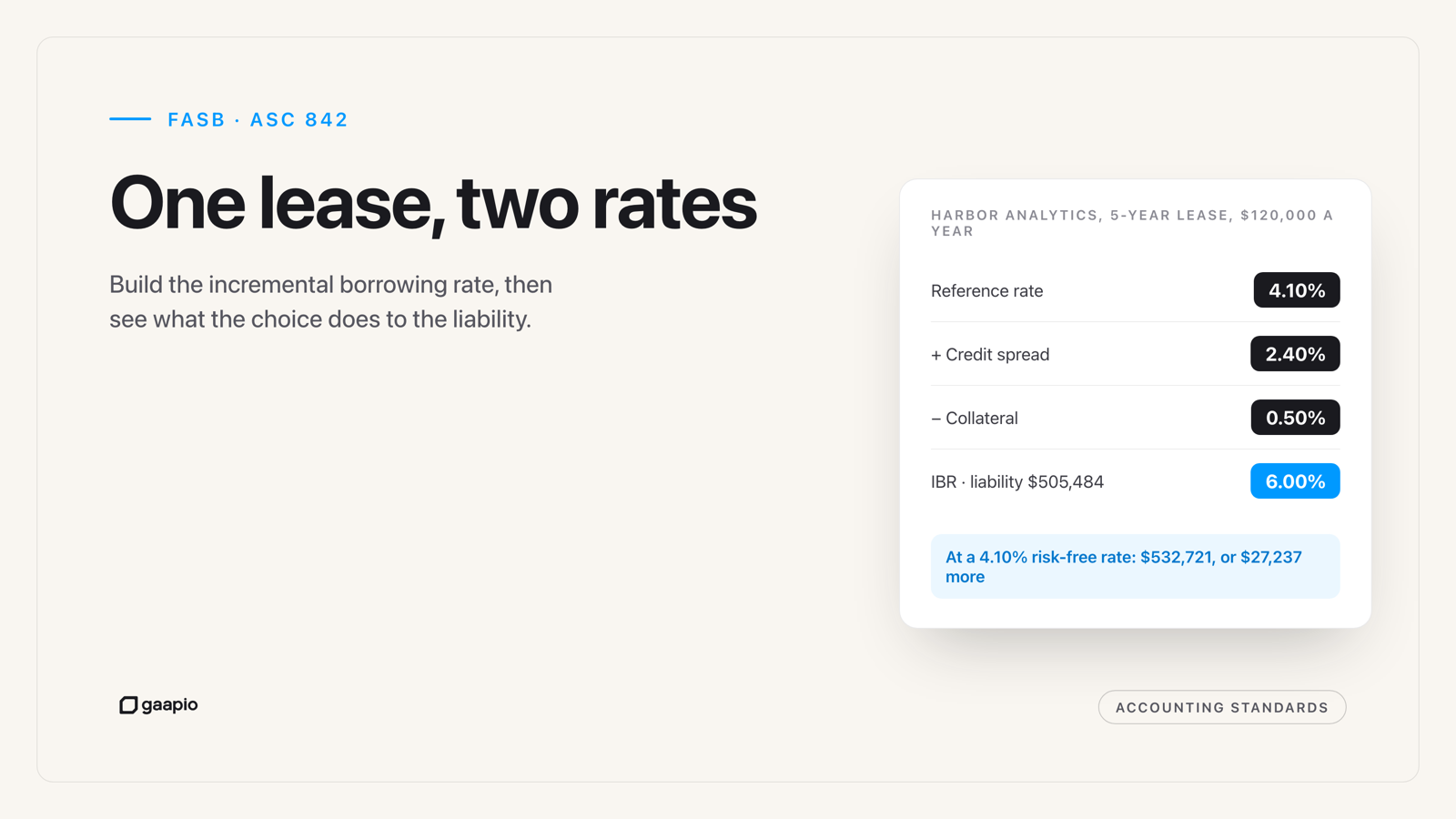
Facts. Harbor Analytics, a private company, signs a five-year office lease. It pays $120,000 at the end of each year, so total payments are $600,000. There are no variable payments, no options, no initial direct costs and no incentives. The rate implicit in the lease is not readily determinable.
Building the IBR (illustrative).
| Layer | Rate | Basis |
|---|---|---|
| Five-year reference rate | 4.10% | Treasury yield for a matching five-year term at commencement (a weighted-average-life rate could also be supported for amortizing payments) |
| Credit spread | +2.40% | Spread on five-year unsecured debt for a borrower with Harbor's credit profile, supported by a term-loan quote |
| Unsecured rate | 6.50% | Reference rate plus credit spread |
| Collateral adjustment | −0.50% | Adjusts to a fully collateralized borrowing equal to the lease payments, using the leased office space as the assumed collateral |
| Incremental borrowing rate | 6.00% | Documented in the lease memo under the entity's discount rate policy |
If Harbor had elected the risk-free rate for real estate under ASU 2021-09, it would use the matching five-year risk-free rate, here 4.10%.
Lease liability at commencement under each rate.
| IBR (6.00%) | Risk-free election (4.10%) | Difference | |
|---|---|---|---|
| Present value of $120,000 for five years | $505,484 | $532,721 | $27,237 (5.4% higher) |
| Right-of-use asset at commencement | $505,484 | $532,721 | $27,237 |
Year-one effect on a finance lease, for comparison.
| IBR (6.00%) | Risk-free election (4.10%) | |
|---|---|---|
| Interest on the liability, year 1 | $30,329 | $21,842 |
| Amortization of the right-of-use asset, year 1 | $101,097 | $106,544 |
| Total year-1 expense | $131,426 | $128,386 |
| Liability at end of year 1 | $415,813 | $434,563 |
Harbor's office lease would normally be an operating lease. Under an operating lease the lessee recognizes a single straight-line lease cost, which is $120,000 a year ($600,000 divided by five) under either rate. The rate changes the balance sheet, not the income statement, though it changes how the liability and the asset roll forward behind the single cost line. Under operating lease accounting with these facts, the liability at the end of year 1 is the same as above ($415,813 at 6.00%, $434,563 at 4.10%), and the right-of-use asset equals the liability because there are no prepaid or accrued rents, incentives or initial direct costs.
So the 1.9 point gap in rate moves the opening balance sheet by about $27,000 on one small lease. At portfolio scale, across many leases, that is where the covenant and ratio conversations come from. It is also why an auditor will ask for the support behind a rate before looking at the schedule.
What do auditors test about the discount rate?
Auditors treat the discount rate as a judgment input that can move the liability materially, so expect them to test the build as well as the arithmetic. Typical requests:
- The policy. Which rate you use, whether the risk-free election was made, for which classes, and when it was approved.
- The reference rate. A source for each reference rate and a tie-out to the date of commencement.
- The credit spread. Evidence for the spread, such as a credit facility, a recent loan, a rating-based curve or a lender quote, and why it is relevant to your credit profile at that date.
- Term matching. That the rate corresponds to the lease term, including renewal periods you judged reasonably certain.
- Collateral adjustment. That the adjustment is supported and that the secured rate does not exceed the unsecured rate.
- Portfolio groupings. That the groupings are documented and that the result is not materially different from lease-by-lease.
- Remeasurement. That a new rate was used when the term, an option assessment or a modification required one.
- Disclosure. The weighted-average discount rate and weighted-average remaining lease term, shown separately for operating and finance leases (ASC 842-20-50-4), and, for a lessee that elected a risk-free rate, the election and the asset classes it covers.
A short memo that records the policy, the build, the evidence and the review date answers most of these in one document.
Where does Gaapio fit in ASC 842 discount rate work?
Gaapio is an AI-powered technical accounting platform built by CPAs. For leases, it is lease accounting software for the judgment layer of ASC 842: you upload the agreement, and Gaapio helps your team work through embedded leases and classification and write the analysis into a reviewer-ready memo, with version history and sign-off. The discount rate is one of the judgments that memo has to carry, and the memo is where your rate policy, build and evidence can sit alongside the rest of the analysis. Gaapio does not source market rates or compute your IBR.
Gaapio does not replace your lease subledger. Systems built for schedules, journal entries and roll-forwards calculate the liability once you have the rate. See Gaapio for lease accounting for how the two fit together, and the ASC 842 glossary entry for the definitions.
Want to see how this works on one of your leases? Request a demo.
This article is general information for accounting professionals, not accounting or legal advice. Your facts, your auditor and the Codification govern.
Frequently asked questions
What is the discount rate under ASC 842?
The discount rate under ASC 842 is the rate used to calculate the present value of a lessee's lease payments. A lessee uses the rate implicit in the lease if it is readily determinable, and otherwise its incremental borrowing rate. A lessee that is not a public business entity may elect to use a risk-free rate instead.
What is the difference between the rate implicit in the lease and the incremental borrowing rate?
The rate implicit in the lease is based on the lessor's fair value, residual value and initial direct costs, which a lessee usually cannot see. The incremental borrowing rate is the rate the lessee would pay to borrow on a collateralized basis over a similar term. Most lessees use the incremental borrowing rate because the implicit rate is not readily determinable.
How do you calculate the incremental borrowing rate for ASC 842?
Start with a reference rate for the lease term, add a credit spread that reflects your credit standing, and then adjust from an unsecured to a secured rate. Compare the result with real borrowing evidence such as a loan or lender quote. Document the sources and the date.
Can a private company use the risk-free rate for ASC 842?
Yes. A lessee that is not a public business entity may elect a risk-free rate in place of the incremental borrowing rate when the implicit rate is not readily determinable. Since ASU 2021-09, the election can be made by class of underlying asset, and the classes must be disclosed.
Does ASU 2021-09 apply to public companies?
No. The election is limited to lessees that are not public business entities, and the PBE definition is broader than listed companies (for example, an entity whose financial statements are included in another company's SEC filing can be a PBE). A public business entity uses the rate implicit in the lease if it is readily determinable and otherwise its incremental borrowing rate.
Can you use one incremental borrowing rate for all leases?
Only if all of your leases share the characteristics that drive the rate. ASC 842 permits one rate for a portfolio of leases with similar characteristics if the result would not be materially different from a lease-by-lease approach. Most lessees end up with several portfolios, grouped by term, collateral, currency and signing entity.
When does the discount rate have to be updated?
The rate is set at the commencement date and is updated when the liability is remeasured for a modification that is not a separate contract, or for a change in lease term or purchase option assessment, unless the original rate already reflected that option. It is not updated for changes in market rates, residual value guarantee amounts or the resolution of variable payment contingencies.
Does the discount rate affect lease classification?
Yes. Classification tests such as the present value of lease payments compared with the fair value of the asset depend on the rate. A lower risk-free rate produces a higher present value, which can push a lease toward finance lease classification.
What do auditors look for when they test an IBR?
They look for a documented policy, a sourced reference rate, evidence for the credit spread, a term that matches the lease, a supported collateral adjustment, documented portfolio groupings, and a new rate on remeasurement. They also test the weighted-average discount rate disclosure.
Related reading
- ASC 842 lease modifications: separate contracts and remeasurement
- AI for lease accounting: what ASC 842 compliance actually requires
- What is ASC 842?
Sources: FASB ASC 842-20-30-2 through 30-3, 842-20-35-5, 842-20-55-17 through 55-20, 842-20-50-4 and the Master Glossary definitions of incremental borrowing rate and rate implicit in the lease; FASB ASU 2021-09; Deloitte, Roadmap: Leases, section 7.2, determination of the discount rate for a lessee; KPMG, Lessee discount rates under ASC 842.