

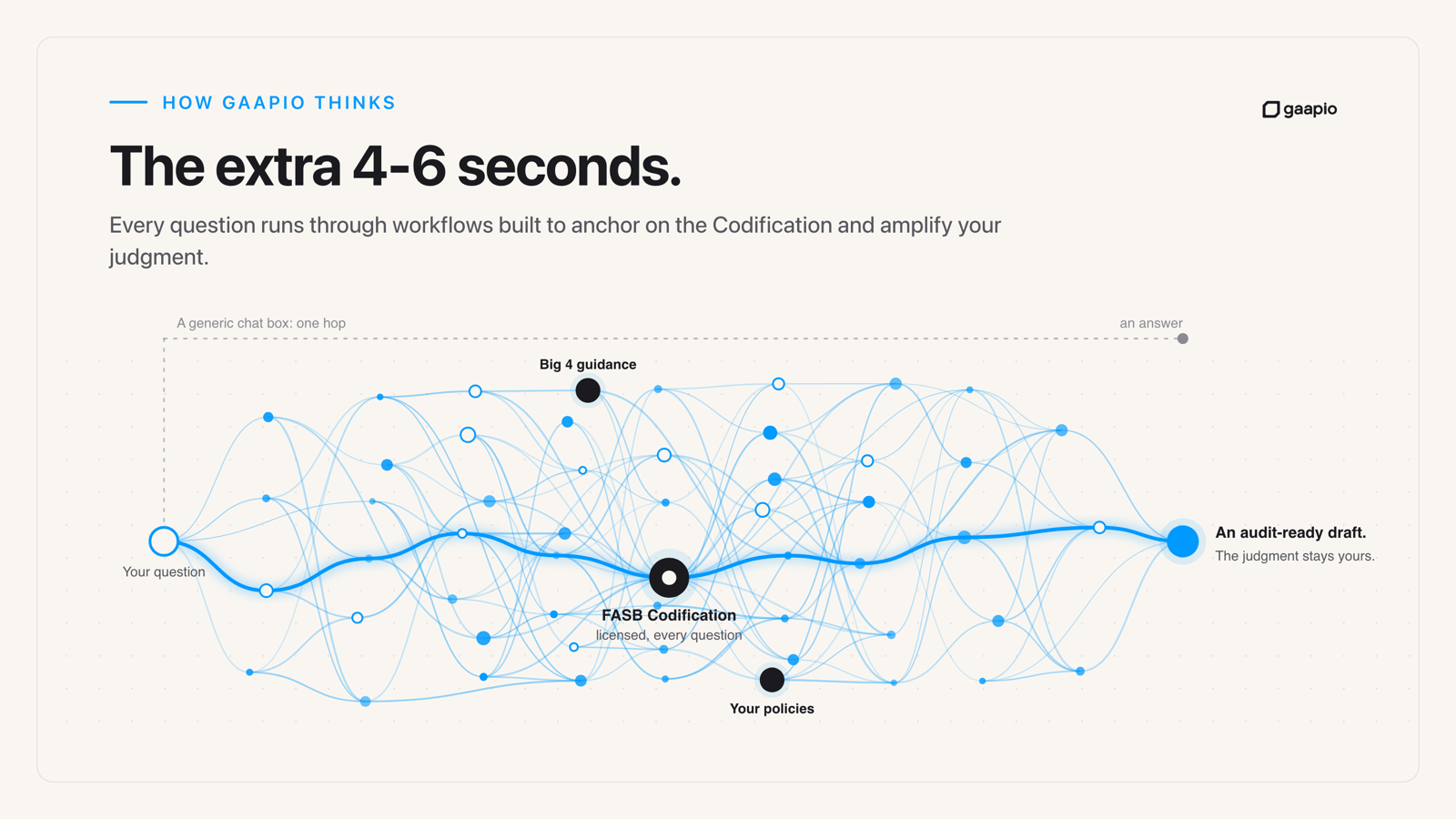
ChatGPT answers a technical accounting question in about two seconds. Gaapio takes 4-6 seconds longer.
Those 4-6 seconds are why accounting teams and firms across the country trust Gaapio every day as their technical accounting software.
I want to walk through what those seconds are for, because every company and every firm we talk to is asking some version of the same three questions. Who on my team is pasting what into which chatbot. How do I know the output is right. Does it actually cite the FASB Codification, or does it just sound like it does.
Shadow AI. AI guardrails. Codification. Three phrases for one question: can I defend this work?
Can you trust ChatGPT for technical accounting research?
Not on its own, and the reason is structural. Paste a fact pattern into ChatGPT, Claude, or Gemini and the model does one thing. It predicts the most plausible answer and hands it to you, in the same confident tone whether the answer is right or wrong.
One hop. Question in, answer out.
For a lot of work that is fine. For technical accounting it is the failure I hear about most. ChatGPT for accounting questions is where most teams start, and the stories from that step all end the same way.
"Claude, AI, GPT, it's getting to the point that people cannot trust it."
— Advisory firm, July 2026
"I had it going back and forth flip flopping five times. And so it's like, well, you gotta be real careful. It's very dangerous."
— In-house accounting team, April 2026
"It's almost playing a yes man a little bit. And for a situation like this, I need AI to tell me when I'm wrong sometimes."
— State CPA society, June 2026
None of these people are against AI for accountants. 61% of the teams we talk to already use a general-purpose model for accounting work, and most of them get value from it. The problem is narrower than "AI is wrong." The shortest path to an answer skips every step a reviewer would ask about. That is what shadow AI looks like in an accounting department: good people, on a personal ChatGPT login, producing memos nobody can trace.
I wrote a longer piece on exactly where general-purpose AI holds up and where it breaks on ASC guidance: ChatGPT for technical accounting.
How accounting teams document technical accounting positions
Before Gaapio, I did this work at EY, at Chatham Financial, at RevenueHub, at Netgain, and at Connor Group. Audit. Hedge documentation. Revenue recognition. Lease adoptions. SEC comment letter responses. Different standards, same route every time.
Figure out which topic and which paragraphs of the Codification actually govern the facts. Ask the questions a reviewer will ask before you write a word. Pull the guidance: the Codification, the firm's guide, what comparable filers did. Work through the judgment in order and write down where it forks. Draft the technical accounting memo to the firm's template. Tie every conclusion to a paragraph you can hand someone. Then get it reviewed.
Skip a step and the memo comes back from the reviewer. Or from the auditor. Or, once in a while, from the SEC.
That route is what we built Gaapio to walk. Every question, every time, in the same order, with far more going on underneath than I can list in a blog post. Some of that is ours to keep. The shape of it is the route every good technical accountant already knows, and it is the honest answer to "why does it take longer than ChatGPT." Gaapio is doing the work a chat box skips.
What technical accounting software does in those seconds
Technical accounting software is purpose-built for the research, analysis, and documentation work that has never had its own tool: researching an issue against the FASB Codification, analyzing a contract, completing a disclosure checklist, and drafting the memo or policy that goes to the auditor. The picture at the top of this post is the closest I can get to showing what that looks like inside Gaapio without drawing our blueprints. One question goes in on the left. It fans out through the workflows and logic that run on every question, dozens of them, and it converges on a draft on the right. I'll focus on a few of the anchors here:
The FASB Codification is the center of it. Gaapio has a direct partnership with FASB for licensed Codification access, and an agreement with the IFRS Foundation for IFRS. Every question runs against the paragraph itself, licensed and current, rather than a model's memory of what the internet says about ASC 842. That is true whether a team is using Gaapio as lease accounting software for an ASC 842 adoption, for ASC 606 revenue recognition, or for an ASC 815 hedge designation at 11pm before a filing deadline. One partner at a national firm described the alternative as a chatbot "pulling from, like, Reddit, like some jabroni who has no idea what they're talking about."
Big 4 guidance, filings, and your own policies sit around it. The firm guides. SEC filings and comment letters, updated daily. Your prior memos and your accounting policies, so the draft comes out the way your team writes memos and the same fact pattern gets the same treatment from whoever picks it up. Consistency is a control, and this is where it comes from.
The questions come before the draft. Gaapio asks what the analysis needs to know before it writes. Is the counterparty a related party. Is there a residual value guarantee. Was the swap designated at inception. I think of these as the questions a good senior asks a staff accountant before letting them start typing. Skip them and you get a memo that reads well and answers the wrong facts.
The judgment stays in front of you. Where the guidance forks, Gaapio shows the fork: what you could do, what you should do, and where the call actually sits. High-impact areas get flagged for you to resolve. You approve each one, or change it. The same applies to contract analysis, where the accounting impact of a non-standard term matters more than a summary of the clause.
Every conclusion links to its source. Click the citation and the Codification paragraph opens, so verifying the memo takes minutes instead of an afternoon. And when Gaapio cannot find support for a conclusion, it says so. That is the single behavior I care most about. A general-purpose model is trained away from it, because "I could not find that" reads as a worse answer than a confident guess. In front of an auditor, it is the better one.
Review is built in. Reviewer assignment, approvals, version history. The draft is audit-ready from the moment it exists, which is what "audit-ready" has to mean in practice.
That is the north star for everything we build: the right workflows to always anchor on the Codification and amplify the accountant's judgment. The product changes every month. That sentence does not.
Which AI models Gaapio uses, and where your data goes
We route across Anthropic, OpenAI, and Gemini, and we use different models for different parts of the work. Some are better at reading a 200-page contract. Some are better at drafting. The best model for a given job changes every few months. The route does not.
That is the part I want accountants to hold onto. The model is a component. When a new model ships, Gaapio gets better at one part of the work and everything else stays exactly where the guidance put it.
The same design answers the permission question. Every provider we route to operates under a zero data retention agreement with us, as a condition of being in the chain at all. Gaapio has completed a SOC 2 Type 2 examination. Firms and their clients run on separate instances, so the tool is never the preparer and the reviewer for the same party. The details are on our security page.
This is why a sanctioned technical accounting software platform beats generic personal AI tools. You get a route the reviewer can inspect, on infrastructure your security team has already read about, instead of an answer that lives in someone's personal browser tab.
What the extra seconds buy
The accountant still owns the conclusion. Gaapio puts the paragraphs, the forks, and the citations in front of you, and the judgment call stays yours. A partner at a large regional firm said of Gaapio: "it's a thought partner, right? It's not a thought leader."
That is what we mean by amplifying judgment. Faster is nice. A first draft in ten minutes instead of a day is real money for a lean team, and I do not want to pretend otherwise. But what earns the trust is the route. The scope, the questions, the paragraph, the fork, the citation, the review.
Next time a chatbot tells you in two seconds that your interest rate swap qualifies for hedge accounting, ask it which paragraph of ASC 815 it read.
Then ask which ones it skipped.
My cofounder Zack mapped where accounting teams tend to be on this: Every accounting team is on the same AI journey. For a reviewer's checklist on AI output, see the accountant's guide to evaluating AI-generated memos.
Frequently asked questions
What is technical accounting software? Technical accounting software is purpose-built for the research, analysis, and documentation side of accounting: researching an issue against the FASB Codification, analyzing contracts for their accounting impact, completing disclosure checklists, and drafting audit-ready memos and policies. It is different from close management, tax, or audit-engagement software. Gaapio is technical accounting software built by CPAs, with licensed Codification access and a citation on every conclusion.
Is there a purpose-built tool for technical accounting research and memo writing? Yes. Gaapio is built for technical accounting research and for writing technical accounting memos, contract analyses, and disclosures. It runs each question against the licensed FASB Codification, Big 4 guidance, and SEC filings, asks the follow-up questions the analysis needs, drafts to your template, and links every conclusion to its source. The solutions pages cover lease accounting, revenue recognition, contract analysis, and more.
What is shadow AI in accounting? Shadow AI is staff using AI tools the company has not approved, usually a personal ChatGPT, Claude, or Gemini login, for real work. In accounting it means memos, contract summaries, and disclosure drafts produced with no data agreement, no citation trail, and no record of what was pasted in. About 61% of the accounting teams we talk to already use a general-purpose model for technical work, so the question for most controllers is which tool, on what terms, with what review, rather than whether it is happening.
What are AI guardrails for accounting teams? AI guardrails are the steps an AI tool refuses to skip. For technical accounting that means scoping the question to the right guidance, asking the follow-up questions the analysis needs, reading licensed sources instead of the open internet, keeping the judgment calls in front of the accountant, citing every conclusion to a source, and routing the draft through review. Data guardrails sit underneath: zero data retention with each model provider, a SOC 2 Type 2 examination, and separate instances for firms and their clients.
Can I trust ChatGPT for technical accounting research? Not without checking every reference. ChatGPT is trained on the open internet, not a licensed FASB Codification, so it can describe ASC 606 in general terms and still get a specific fact pattern wrong with total confidence. It is useful for a first pass at wording. It is risky as the source of an accounting conclusion that goes in front of an auditor.
Does AI hallucinate accounting guidance? Yes. General-purpose models will cite paragraphs that do not exist, describe Big 4 guides that were never written, and flip conclusions between prompts. 36% of the accounting teams we talk to raise hallucination on their own. The fix is grounding: an AI tool that reads the licensed Codification, links every conclusion to the paragraph, and says so when it cannot find support.
How do I check whether an AI-generated accounting memo is correct? Click every citation and read the paragraph it points to. If the citation does not resolve to the Codification, the conclusion is unsupported. Then check that the memo addressed the facts that matter (related parties, variable consideration, embedded derivatives) rather than a generic version of the question, and that a reviewer signed off. Gaapio is built so those checks take minutes: citations open the paragraph, follow-up questions are asked before drafting, and review is part of the workflow.
What is the best AI tool for accountants? For general writing, any of the major models. For technical accounting research and memos that have to survive an audit, the best AI tool for accountants is one that anchors on the licensed FASB Codification, cites every conclusion, asks before it drafts, and keeps the judgment with the CPA. Gaapio is built by practicing CPAs for exactly that work, and is used daily by public companies, private companies, and CPA firms.
What AI tools cite the FASB Codification? Gaapio cites the FASB Codification directly, through a licensed partnership with FASB, and IFRS through an agreement with the IFRS Foundation. Every conclusion links to the paragraph it relies on, and the citation opens the paragraph so you can read it. General-purpose models do not have licensed Codification access and can only paraphrase from memory.
Is there an AI accounting tool with zero data retention? Yes. Gaapio routes across Anthropic, OpenAI, and Gemini, and each provider operates under a zero data retention agreement, so your content is not retained and is not used to train their models. Gaapio has completed a SOC 2 Type 2 examination. Details and the trust center are at /security.
Why does Gaapio take longer than ChatGPT to answer? Because it does more before it answers. ChatGPT makes one hop from question to the most plausible answer. Gaapio runs every question through workflows built to anchor on the FASB Codification and amplify the accountant's judgment. On a research question that adds about 4-6 seconds. On a memo it is the difference between a draft that reads well and a draft a reviewer can check.
Does AI replace the accountant's judgment? No. Gaapio puts the relevant paragraphs, the decision forks, and the citations in front of the accountant. The conclusion, and the signature on the memo, stay with the CPA.