

Most consolidation questions get answered by counting votes. A variable interest entity is the case where counting votes gives you the wrong answer. A company can own none of the equity in a legal entity and still be required to consolidate it, and a company that owns most of the equity can be required to leave it off.
This guide walks through the ASC 810 variable interest entity (VIE) model in the order you apply it: the scope exceptions, the tests for whether a legal entity is a VIE, what counts as a variable interest, who the primary beneficiary is, how the voting interest model differs, the private company alternative from ASU 2018-17, what triggers a reassessment, and what you disclose. It ends with a worked example for a private manufacturer and the company that owns its plant.
Key takeaway: Start with the scope exceptions, then ask whether the legal entity is a VIE. It is a VIE if its equity at risk is insufficient, or if its equity holders as a group lack the power to direct the entity, the obligation to absorb losses, or the right to receive residual returns, or if an investor's voting rights are out of proportion to its economics and substantially all of the entity's activities involve or are conducted on behalf of that investor. If it is a VIE, the primary beneficiary consolidates it. That is the party with both the power to direct the activities that most significantly affect the entity's economic performance and an obligation to absorb losses or a right to receive benefits that could be significant. If the entity is not a VIE, the voting interest model applies. Private companies can elect not to apply the VIE model to certain legal entities under common control (ASU 2018-17), and the election comes with its own disclosures.
What is a variable interest entity?
A variable interest entity is a legal entity that is subject to consolidation under the VIE Subsections of ASC 810-10 because control is not decided by voting rights. In a VIE, the equity investors either cannot finance the entity without help or do not carry the characteristics of a controlling financial interest, so the party that actually directs the entity and absorbs its variability consolidates it.
ASC 810 (Consolidation) has two models for deciding who consolidates a legal entity. The VIE model applies first. If the entity is not a VIE, the voting interest model applies. You will also see the VIE guidance cited as ASC 810-10, the subtopic where it sits.
The model came out of the special purpose entities of the early 2000s, where a sponsor held little or no equity but kept the risks and rewards. FASB Interpretation 46(R) introduced it in 2003. FASB Statement 167 (ASU 2009-17) replaced the expected-losses test for the primary beneficiary with today's power-and-economics test, and ASU 2015-02 changed how limited partnerships, fees paid to decision makers and related parties are treated.
Which entities are outside the VIE model?
You check scope before anything else. ASC 810-10-15-12 sets out exceptions to all of the consolidation guidance in ASC 810, including employee benefit plans subject to ASC 712 or ASC 715, certain investments held by investment companies under ASC 946, governmental organizations, and money market funds that operate under Rule 2a-7 or similar requirements. ASC 810-10-15-17 adds exceptions that apply only to the VIE Subsections: not-for-profit entities (unless one is used to get around the VIE guidance), separate accounts of life insurance entities, certain legal entities created before December 31, 2003 when the information cannot be obtained after exhaustive efforts, and the business scope exception. An entity excluded only from the VIE Subsections is still evaluated under the voting interest model.
The business scope exception in ASC 810-10-15-17(d) matters more often. A legal entity that meets the ASC 805 definition of a business does not need a VIE evaluation unless one of four conditions applies:
- The reporting entity, its related parties (excluding certain de facto agents), or both participated significantly in the design or redesign of the legal entity. This condition does not apply to an operating joint venture under joint control of the reporting entity and one or more independent parties, or to a franchisee.
- The entity is designed so that substantially all of its activities either involve or are conducted on behalf of the reporting entity and its related parties.
- The reporting entity and its related parties provided more than half of the equity, subordinated debt and other subordinated financial support, based on fair values.
- The entity's activities relate primarily to securitizations or other asset-backed financing, or to single-lessee leasing arrangements.
Operating companies that are businesses often qualify. Single-asset real estate entities usually do not: most meet the ASC 805 screen, because substantially all of the fair value of their gross assets sits in one property, so they are not businesses. Even when one is a business, a related-party single-lessee lease usually triggers the second and fourth conditions. The worked example later in this guide uses one.
How do you decide whether a legal entity is a VIE?
A legal entity is a VIE if any one of the tests in ASC 810-10-15-14 is met. Together they make up the five characteristics most practitioners work through:
| # | Characteristic | Source | What to test |
|---|---|---|---|
| 1 | The total equity investment at risk is not sufficient to finance the entity's activities without additional subordinated financial support | 810-10-15-14(a) | Equity below 10% of total assets is presumed insufficient unless shown otherwise (ASC 810-10-25-45), and more than 10% is not automatically enough (25-46). Equity financed for the investor by the entity or by other parties involved with it, such as through a loan or a loan guarantee, does not count as equity at risk |
| 2 | The equity holders as a group lack the power, through voting or similar rights, to direct the activities that most significantly affect the entity's economic performance | 810-10-15-14(b)(1) | Who decides? For a limited partnership, the limited partners lack power unless a simple majority or lower threshold of them (excluding the general partner, entities under common control with it and parties acting on its behalf) can remove the general partner or dissolve the partnership without cause, or the limited partners have substantive participating rights |
| 3 | The equity holders as a group lack the obligation to absorb the entity's expected losses | 810-10-15-14(b)(2) | A guarantee of the equity holders' return, a put on their interests, or a total return swap can move the obligation to absorb losses away from equity |
| 4 | The equity holders as a group lack the right to receive the entity's expected residual returns | 810-10-15-14(b)(3) | A cap on equity returns, or a call option or fixed-price purchase option held by someone else, can shift the upside |
| 5 | Voting rights are not proportional to economics, and substantially all of the activities involve or are conducted on behalf of an investor with disproportionately few voting rights | 810-10-15-14(c) | Common in arrangements where a sponsor holds small voting rights but the entity exists for its benefit |
Characteristics 2 through 4 sit in a single test in the Codification: the holders of equity at risk, as a group, lack any one of the three. Counting them separately keeps each one visible in a memo.
Expected losses and residual returns can be assessed qualitatively or quantitatively. For judgment calls, document which inputs you considered and why they point where they do.
What is a variable interest?
A variable interest is a contractual, ownership or other pecuniary interest in a legal entity that changes with changes in the fair value of the entity's net assets, exclusive of variable interests. In practice you apply the by-design approach (ASC 810-10-25-21 through 25-36): identify the risks the entity was designed to create and pass along, and ask whether your interest absorbs that variability. Equity is the obvious one. Subordinated debt, guarantees of the entity's debt, residual value guarantees, certain derivatives, and some fees to decision makers are others (ASC 810-10-55-16 through 55-41).
You only consolidate under the VIE model if you hold a variable interest, so an inventory of every interest you have in the entity comes at the start of the analysis (step 1 in the decision tree below). Things that often get missed:
- Guarantees of the entity's debt. These absorb losses and are variable interests.
- Fixed-price purchase options. A lessee's option to buy the leased asset at a fixed price gives it a share of the upside.
- Decision maker and service provider fees. A fee is not a variable interest if it meets all three remaining criteria in ASC 810-10-55-37: it is commensurate with the services provided, the arrangement has only terms customary for similar services negotiated at arm's length, and the decision maker and its related parties hold no other interests that would absorb more than an insignificant amount of the entity's variability. Fees tied to arrangements that expose the decision maker to risk of loss, such as a guarantee of the value of the entity's assets, cannot use this evaluation. Fees that fail are variable interests.
- Interests held through related parties. A single decision maker includes indirect interests held through related parties under common control on a proportionate basis (ASC 810-10-25-42). Related parties and de facto agents (25-43) matter again in the related-party tests in 25-44 through 25-44B.
Most lease payments at market rates with no residual value guarantee or purchase option are not variable interests in the lessor entity by themselves. Add a guarantee or an option and the answer changes.
Who is the primary beneficiary of a VIE?
The primary beneficiary is the party that has both (a) the power to direct the activities of the VIE that most significantly affect its economic performance, and (b) the obligation to absorb losses of the VIE, or the right to receive benefits from it, that could potentially be significant to the VIE (ASC 810-10-25-38A). It consolidates the VIE. A reporting entity needs both elements. Power alone or economics alone is not enough.
A few rules decide close cases:
- Identify the most significant activities first. Then find who directs them. If different parties direct different activities, the one directing the activities that most significantly affect economic performance has the power.
- Shared power. If two or more unrelated parties must agree on the most significant decisions, no one has power, and no one is the primary beneficiary (ASC 810-10-25-38D).
- Kick-out and participating rights. In the primary beneficiary analysis, rights to remove a decision maker or block decisions affect who has power only if a single party, including its related parties and de facto agents, can exercise them unilaterally (ASC 810-10-25-38C).
- Related parties. If a single decision maker lacks the characteristics on its own, but it and its related parties under common control have them as a group, the party in the group most closely associated with the VIE is the primary beneficiary (ASC 810-10-25-44 and 25-44A). If the group is not under common control, a variable interest holder in the group other than the decision maker consolidates if substantially all of the VIE's activities are conducted on its behalf (25-44B). Otherwise, no party in the group is the primary beneficiary. Factors for the most-closely-associated test include any principal-agency relationship between the parties, the relationship and significance of the VIE's activities to each party, exposure to variability, and the design of the VIE.
- The assessment is ongoing. Primary beneficiary status is assessed on an ongoing basis, so you confirm it at least at each reporting date, not just at inception.
Once you conclude you are the primary beneficiary, consolidate the VIE's assets, liabilities and noncontrolling interest, and present assets that can be used only to settle the VIE's obligations, and liabilities without recourse to your general credit, separately on the face of the balance sheet (ASC 810-10-45-25). Initial measurement follows ASC 810-10-30. If the primary beneficiary and the VIE are under common control, use carrying amounts. Otherwise, a VIE that is a business is measured under ASC 805, and a VIE that is not a business is measured at fair value with no goodwill and any gain or loss recognized.
ASU 2025-03 changes how you identify the accounting acquirer when a business combination is effected primarily by exchanging equity interests and the legal acquiree is a VIE that is a business. Under the prior guidance, the primary beneficiary of the acquired VIE was always the accounting acquirer. The ASU requires you to weigh the factors in ASC 805-10-55-12 through 55-15 instead, so the legal acquirer may not be the accounting acquirer. It is effective for annual reporting periods beginning after December 15, 2026, including interim periods within them, applies prospectively to business combinations after adoption, and may be adopted early. See our purchase price allocation guide for what follows the acquirer determination.
How does the VIE model differ from the voting interest model?
The voting interest model asks who holds the votes. The VIE model asks who has the power over the activities that matter and the economics that follow. In practice, you test the VIE model first, and an entity that is not a VIE falls to the voting interest model.
| VIE model | Voting interest model | |
|---|---|---|
| Question | Who has power over the most significant activities and significant economics? | Who holds a majority of the voting interests? |
| Typical trigger | Thin equity, guarantees, fees, options, contractual control | Ownership above 50% of voting shares, or of kick-out rights in a limited partnership |
| Source | ASC 810-10-15-14 and 25-38A | ASC 810-10-15-8 and 25-1 through 25-14 |
| Can a party with no equity consolidate? | Yes | Generally no |
| Can a majority owner be prevented from consolidating? | Yes, if the entity is a VIE and the owner is not its primary beneficiary | Rarely, for example when minority holders have substantive participating rights (810-10-25-2 through 25-14) |
| Reassessment | Primary beneficiary on an ongoing basis; VIE status at specified events | When facts change, such as a change in ownership or rights |
| Disclosures | The detailed VIE disclosures in 810-10-50 | Ownership and noncontrolling interest disclosures |
The 2015 amendments pushed more limited partnerships into the VIE model. Under ASC 810-10-15-14(b)(1), the limited partners lack power, and the partnership is a VIE, unless a simple majority or lower threshold of limited partners (excluding the general partner, parties under common control with it and parties acting on its behalf) holds substantive kick-out rights, including liquidation rights, or the limited partners hold substantive participating rights. A partnership that passes this test can still be a VIE under another characteristic. If it is not a VIE, the voting interest model for limited partnerships applies.
What is the decision tree for ASC 810 consolidation?
Work through these six questions in order and write down the answer to each one. It is a decision tree you can paste into a memo.
| Step | Question | If yes | If no | Where |
|---|---|---|---|---|
| 1 | Is the investee a legal entity, and do you hold a variable interest in it? | Go to step 2 | Stop. The VIE model applies only to legal entities in which you hold a variable interest | 810-10-15, 55-16 |
| 2 | Does a scope exception apply (for example, an employee benefit plan, an investment company's investee, a money market fund, or a not-for-profit entity)? | Under 15-12, no consolidation guidance in ASC 810 applies. Under 15-17(a) through (c), skip the VIE model and use the voting interest model | Go to step 3 | 810-10-15-12, 15-17(a) to (c) |
| 3 | Is the legal entity a business, and does none of the four 15-17 conditions apply? | The VIE model does not apply. Use the voting interest model | Go to step 4 | 810-10-15-17 |
| 4 | Are you a private company eligible for, and have you elected, the common control alternative? | Do not apply the VIE model to that legal entity. Make the disclosures | Go to step 5 | 810-10-15-17AD |
| 5 | Is the legal entity a VIE (any of the five characteristics)? | Go to step 6 | The voting interest model applies | 810-10-15-14 |
| 6 | Are you the primary beneficiary (power plus significant economics)? | Consolidate. Present and disclose as a primary beneficiary | Do not consolidate. Make the non-primary-beneficiary disclosures in ASC 810-10-50-4 and 50-5A | 810-10-25-38A |
The worked example below runs the full analysis first so you can see what the alternative saves, then applies the alternative. In practice, a company that elects the alternative stops at step 4.
Two practical notes. Step 6 is where most of the time goes, because it takes judgment about which activities are most significant. And steps 4 and 5 both look at the same entity, so a private company that elects the alternative has to be careful that every condition for the election is met before skipping the VIE test.
What is the private company alternative in ASU 2018-17?
ASU 2018-17 lets a private company elect not to apply the VIE Subsections to legal entities under common control, if all of the criteria in ASC 810-10-15-17AD are met. It replaced the narrower alternative for common control leasing arrangements from ASU 2014-07.
The reporting entity must meet all four criteria:
- The reporting entity and the legal entity are under common control.
- The reporting entity and the legal entity are not under common control of a public business entity.
- The legal entity under common control is not a public business entity.
- The reporting entity does not directly or indirectly have a controlling financial interest in the legal entity under the General Subsections (the voting interest model).
Four points matter for application:
- It is an accounting policy. If you elect it, apply it to all legal entities that meet the criteria, not selectively.
- Common control is assessed under the voting interest model only for this purpose (ASC 810-10-15-17AE).
- A parent that holds a controlling financial interest in a subsidiary cannot use it for that subsidiary. The fourth criterion rules that out.
- You can lose it. If a relevant entity becomes a public business entity, you must apply the VIE model again.
ASU 2018-17 had a second part that applies to every entity. A decision maker evaluating whether a fee is a variable interest now counts indirect interests held through related parties under common control only in proportion to its own share, instead of in their entirety. Fewer fee arrangements end up as variable interests.
Effective dates: fiscal years beginning after December 15, 2019 for entities other than private companies, and fiscal years beginning after December 15, 2020 for private companies, with interim periods within fiscal years beginning after December 15, 2021. Early adoption was permitted. An eligible private company can still elect the alternative today, but unlike some earlier private company alternatives, ASU 2018-17 did not provide an exemption from the preferability assessment. A later election that is a change in accounting principle has to be justified as preferable under ASC 250. First-time application is retrospective, with a cumulative-effect adjustment to retained earnings at the beginning of the earliest period presented. Deloitte's Heads Up on ASU 2018-17 walks through the transition detail.
What events require you to reassess?
Reassess whether a legal entity is a VIE when a reconsideration event occurs (ASC 810-10-35-4). Do not wait for the next year-end if one of these happens:
| Reconsideration event | Example |
|---|---|
| The governing documents or contractual arrangements change in a way that changes the characteristics or adequacy of the equity at risk | An operating agreement amendment that moves decision rights or caps equity returns |
| Some or all of the equity investment is returned to the equity investors, and other interests become exposed to the entity's expected losses | A distribution that leaves the entity thinly capitalized and the lender exposed |
| The entity undertakes additional activities or acquires additional assets, beyond those anticipated at inception or the last reconsideration, that increase its expected losses | A single-property entity starts developing a second site |
| The entity receives an additional equity investment at risk, or curtails or modifies its activities in a way that decreases its expected losses | A new equity round that makes the equity sufficient |
| Changes in facts and circumstances cause the equity holders as a group to lose the power to direct the entity's activities | A new lender is given approval rights over the budget and sale decisions |
Losses in excess of the entity's expected losses that reduce the equity investment do not, by themselves, make the entity a VIE (ASC 810-10-35-4).
Separately, the primary beneficiary assessment is continuous. You revisit it at each reporting date, and a change in who holds power, or in the size of your exposure, can move consolidation in either direction. When a change causes you to consolidate or deconsolidate, follow the initial measurement guidance in ASC 810-10-30 or the deconsolidation guidance in ASC 810-10-40, and disclose the primary factors and effect under ASC 810-10-50-5A.
What do you disclose for a VIE?
The disclosures sit principally in ASC 810-10-50-2AA through 50-5B and differ for the primary beneficiary and for other holders of a significant variable interest. The objective is to help users understand the significant judgments in the consolidation conclusion, the nature of the risks, and how the VIE affects financial position, performance and cash flows.
| Primary beneficiary of a VIE | Holder of a significant variable interest that is not the primary beneficiary | |
|---|---|---|
| Judgments | The significant judgments and assumptions used to decide the entity is a VIE and that you are its primary beneficiary | The same, for why you are not the primary beneficiary |
| Balance sheet | The carrying amounts and classification of the VIE's assets and liabilities that are on your balance sheet, with assets pledged as collateral and whether creditors have recourse to your general credit | The carrying amounts and classification of assets and liabilities related to your variable interest |
| Exposure | The terms of arrangements that could require you to provide financial support, including liquidity arrangements | Maximum exposure to loss and how it was determined, or a statement that it cannot be quantified, with a tabular comparison of carrying amounts to maximum exposure and an explanation of the difference |
| Support | Financial support provided without a contractual obligation, and why | The same |
| Changes | If your consolidation conclusion changed, the primary factors and the effect (ASC 810-10-50-5A) | The same, plus the judgments behind any conclusion that power is shared |
| Aggregation | Permitted for similar VIEs, if it does not obscure significant differences | Permitted on the same basis |
A reporting entity that elects the private company alternative has its own set of disclosures (ASC 810-10-50-2AG through 50-2AI). It discloses the nature and risks of its involvement with the legal entity, how that involvement affects its financial position, performance and cash flows, the carrying amounts and classification of the related assets and liabilities, and its maximum exposure to loss or a statement that it cannot be quantified. When the maximum exposure is larger than the carrying amounts, it explains the difference. In assessing exposure, consider implicit guarantees, such as an economic incentive or a history of funding the entity's losses (ASC 810-10-50-2AH). These disclosures add to those required by other Topics, such as ASC 460, ASC 842 and ASC 850, and can be combined in one note or cross-referenced (50-2AI).
If you are building out the notes, the Gaapio guide to ASC 820 fair value disclosures covers the fair value side of consolidation accounting, and the section below explains how Gaapio can help with the VIE note.
Worked example: a private manufacturer and the company that owns its plant
This example is illustrative. The companies and figures are invented. It shows the order of the analysis, not a conclusion for any particular set of facts.
Delmar Manufacturing, Inc. is a private company. Ms. Delmar owns 100% of its voting shares. She also owns 100% of Delmar Properties, LLC, which owns the land and building where Delmar Manufacturing operates. The facts:
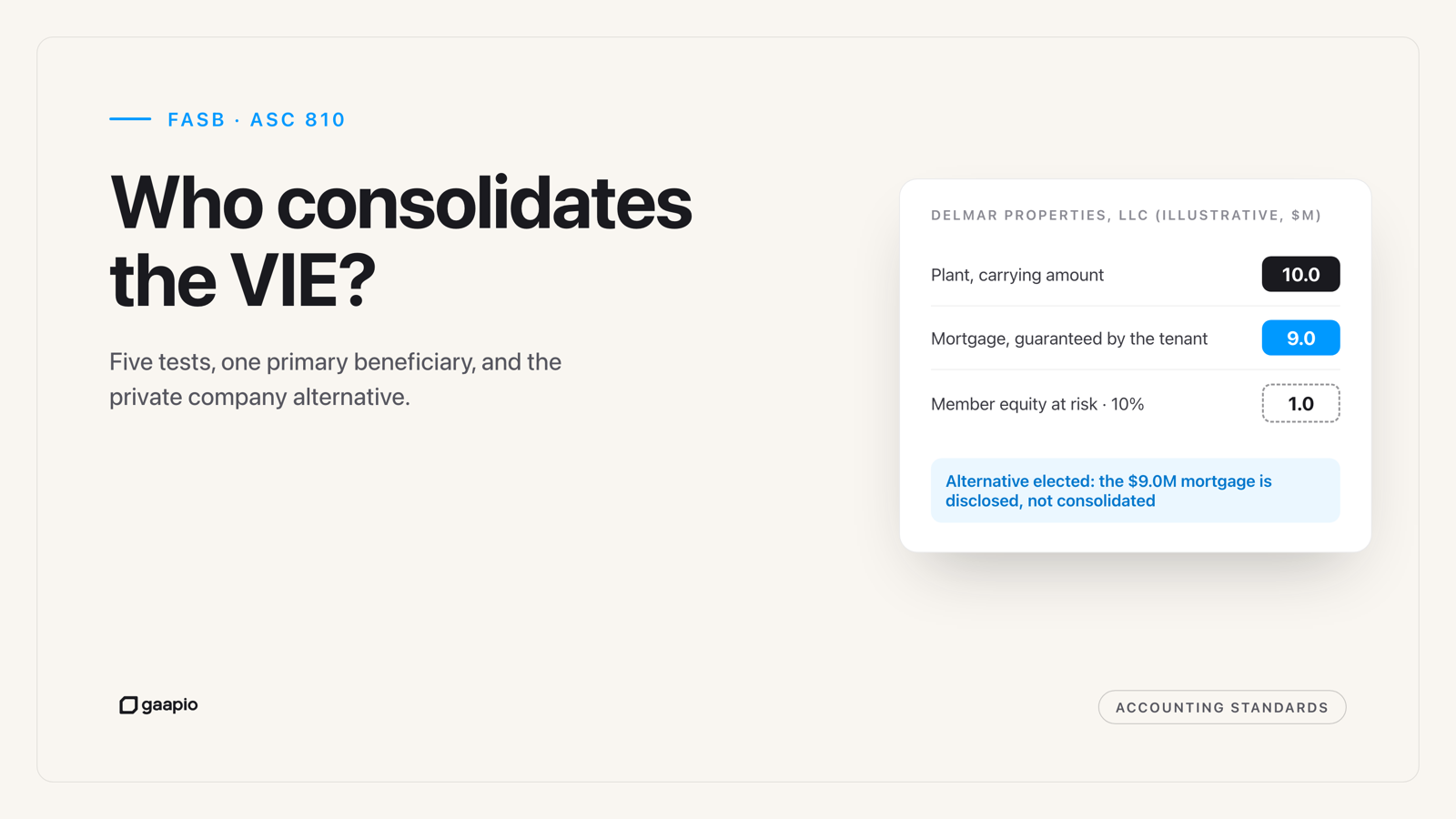
- Delmar Properties holds the plant at a carrying amount of $10.0 million. It is financed with a $9.0 million bank mortgage and $1.0 million of member equity.
- Delmar Manufacturing is the only tenant. It leases the plant for 15 years at $720,000 a year and accounts for it as an operating lease under ASC 842.
- The bank required Delmar Manufacturing to guarantee the mortgage.
- Ms. Delmar, as managing member, makes the LLC's decisions about refinancing, repairs and re-letting.
Scope (steps 2 and 3). None of the exceptions in ASC 810-10-15-12 or 15-17(a) through (c) apply, and the business scope exception in 15-17(d) does not help either. Substantially all of the LLC's fair value sits in one building, which counts as a single identifiable asset under the ASC 805 screen, so the LLC is not a business. Even if it were, Ms. Delmar, a related party of Delmar Manufacturing, designed it, and its activities are a single-lessee leasing arrangement conducted substantially on behalf of Delmar Manufacturing and its related party. That would trigger the first, second and fourth conditions.
Variable interests (step 1). Delmar Manufacturing's guarantee of the mortgage absorbs losses of the LLC, so it is a variable interest. The fixed-rent lease, with no purchase option or residual value guarantee, is not one by itself.
Is the LLC a VIE? (step 5) Member equity of $1.0 million is 10% of $10.0 million of total assets, and the lender would not make the loan without the guarantee. A guarantee required to finance the entity is evidence that the equity at risk cannot finance the activities alone. The LLC is a VIE under characteristic 1.
Who is the primary beneficiary? (step 6) Start with power. Ms. Delmar, as managing member, makes the refinancing, repair and re-letting decisions, and she holds all of the equity at risk. On those facts she alone appears to have both characteristics, which points away from Delmar Manufacturing consolidating. The answer can change if the lease gives the tenant control over maintenance, capital decisions or remarketing, or if the design shows the LLC acts on the tenant's behalf. The related-party provisions in ASC 810-10-25-42 through 25-44B come in only if no single party has both characteristics. That is a judgment-heavy analysis with a lot of documentation, and it is the work the common control alternative lets a private company skip.
The alternative (step 4). Delmar Manufacturing is a private company. It and the LLC are under common control of Ms. Delmar, which is assessed under the voting interest model. Neither is under common control of a public business entity, the LLC is not a public business entity, and Delmar Manufacturing owns none of the LLC, so it has no controlling financial interest. All four criteria are met. Delmar Manufacturing elects the alternative as an accounting policy and applies it to every legal entity that qualifies.
On these facts the election mostly saves analysis and documentation, because the primary beneficiary step already points away from consolidation. It changes the balance sheet when the VIE analysis would otherwise have required Delmar Manufacturing to consolidate, for example if the lease gave it control over maintenance, capital decisions and remarketing. Here is what consolidation would look like, with the lease liability at about $6.2 million (15 annual payments of $720,000 in arrears, discounted at an illustrative 8%):
| Delmar Manufacturing balance sheet | Alternative elected (LLC not consolidated) | If the LLC were consolidated | Difference |
|---|---|---|---|
| Right-of-use asset (operating lease) | $6.2M | Eliminated | -$6.2M |
| Plant (land and building, at the LLC's carrying amount) | None | $10.0M | +$10.0M |
| Operating lease liability | $6.2M | Eliminated | -$6.2M |
| Mortgage payable | None (guarantee disclosed) | $9.0M | +$9.0M |
| Noncontrolling interest (Ms. Delmar's $1.0M of LLC equity) | None | $1.0M | +$1.0M |
| Total assets | +$3.8M | ||
| Total liabilities | +$2.8M |
Assets rise by $3.8 million ($10.0 million less $6.2 million). Liabilities rise by $2.8 million ($9.0 million less $6.2 million), and the noncontrolling interest adds $1.0 million. Liabilities on the face of the balance sheet shift from a $6.2 million operating lease liability to a $9.0 million mortgage, which can matter for leverage covenants depending on how the loan agreement defines debt. The simplified comparison ignores initial direct costs, incentives, and any difference between the ROU asset and the lease liability. Two ASC 842 points also matter for a private company in this fact pattern. ASU 2023-01 lets a private company use the written terms and conditions of a common control lease to decide whether a lease exists and how to classify and account for it, and it changes how leasehold improvements under common control leases are amortized. A private company can also elect a risk-free discount rate by class of underlying asset, which would raise the lease liability above the illustrative $6.2 million.
What Delmar Manufacturing discloses. Under the alternative, the footnote covers:
- The nature of its involvement: the 15-year lease and the guarantee of the mortgage.
- Carrying amounts of related items: the ROU asset and lease liability.
- Maximum exposure to loss: the $9.0 million guaranteed mortgage balance, compared with the carrying amounts above, with an explanation of why it exceeds them. Remaining lease payments appear in the ASC 842 maturity analysis.
- Any implicit support, such as a history of funding the LLC's shortfalls.
The guarantee also raises ASC 460 questions. ASC 460-10-25-1 excepts certain guarantees between parents and subsidiaries, and between corporations under common control, from initial recognition and measurement, but not from the ASC 460 disclosures. Whether that exception covers a corporation guaranteeing the debt of an LLC owned by the same individual is a judgment to document. Either way, evaluate the contingent exposure under ASC 450 and confirm the treatment against the Codification for your facts.
Had Delmar Manufacturing owned 60% of the LLC's voting interests, the fourth criterion would fail. It would evaluate the LLC under the VIE model first and, if the LLC were not a VIE, under the voting interest model as a majority-owned entity. On these facts, either path likely leads to consolidation.
How does Gaapio help with VIE disclosures?
Gaapio is an AI-powered technical accounting platform built by CPAs. For the VIE note, Gaapio reviews your disclosures against the Codification and surfaces what is missing. Every recommendation traces to an authoritative source you can check.
You make the judgment calls. Which activities are most significant, and whether power is shared, are yours to decide and to document. See AI footnote disclosures, Gaapio's FASB research and solutions for private companies.
Want to see it on your own VIE disclosures? Request a demo.
This article is general information, not accounting or legal advice. Confirm the requirements for your facts against the Codification and with your auditor.
Frequently asked questions
What is a variable interest entity?
A variable interest entity is a legal entity where control is not decided by voting rights, so the party with the power to direct its significant activities and a significant share of its economics consolidates it. A legal entity is a VIE if its equity at risk is insufficient, or its equity holders as a group lack the power to direct it, the obligation to absorb losses or the right to receive residual returns, or an investor's voting rights are out of proportion to its economics and substantially all of the entity's activities involve or are conducted on behalf of that investor (ASC 810-10-15-14).
What are the five characteristics of a VIE?
The five characteristics are insufficient equity at risk, equity holders lacking decision-making power, lacking the obligation to absorb expected losses, lacking the right to receive expected residual returns, and non-proportional voting rights with activities conducted for a party with disproportionately few votes. Any one is enough to make the entity a VIE. The Codification groups the middle three into one test (810-10-15-14(b)).
Who is the primary beneficiary of a VIE?
The primary beneficiary is the party that has both the power to direct the activities that most significantly affect the VIE's economic performance and the obligation to absorb losses or the right to receive benefits that could be significant to the VIE (ASC 810-10-25-38A). If power is shared among unrelated parties, none of them is the primary beneficiary. The assessment is ongoing, and you confirm it at least at each reporting date.
How is the voting interest model different from the VIE model?
The voting interest model generally gives consolidation to the party holding more than 50% of the voting rights, while the VIE model gives it to the party with power over the most significant activities and significant economics. A party can consolidate a VIE with no equity, and a majority owner can be required to leave a VIE off its balance sheet. You test the VIE model first.
Is 10% equity enough for an entity not to be a VIE?
Equity above 10% does not settle it on its own. Equity at risk below 10% of total assets is generally considered insufficient unless shown otherwise, but more than 10% is not a safe harbor. The test is whether the equity can finance the entity's activities without additional subordinated financial support, and a guarantee required by the lender is evidence that it cannot.
What is the private company alternative for VIEs?
ASU 2018-17 lets a private company elect not to apply the VIE guidance to legal entities under common control when neither is a public business entity or under the common control of one, and the reporting entity has no controlling financial interest in the legal entity. It is an accounting policy that must be applied to all eligible entities, and it requires its own disclosures in ASC 810-10-50-2AG through 50-2AI.
When do you have to reconsider whether an entity is a VIE?
You reassess when a reconsideration event occurs, such as changes in the governing documents or contracts that affect the equity at risk, a return of equity to investors, new activities or assets not contemplated at the start, an additional equity investment, or a loss of the equity holders' power (ASC 810-10-35-4). Primary beneficiary status is assessed on an ongoing basis.
What must be disclosed about a VIE?
A primary beneficiary discloses its significant judgments, the carrying amounts and classification of the VIE's assets and liabilities, collateral and recourse, and any support it provided without a contractual obligation. A holder of a significant variable interest that is not the primary beneficiary discloses its carrying amounts and its maximum exposure to loss (ASC 810-10-50-2AA through 50-5B).
Related reading
- ASC 805 purchase price allocation guide
- ASC 842 discount rate and the incremental borrowing rate
- ASC 820 fair value measurement and disclosures
Sources: FASB ASC 810-10, ASU 2015-02, ASU 2018-17 and ASU 2025-03; Deloitte, Heads Up: FASB finalizes targeted amendments to the related-party guidance for variable interest entities; Deloitte DART, FASB ASU on identifying the acquirer in a business combination; KPMG, Handbook: Consolidation.