

Your cap table has a Series C preferred with a redemption right, a venture lender holding warrants, a convertible note, and an S-1 on the calendar. Each of those instruments can land in liabilities, in temporary equity (for equity-classified securities), or in permanent equity, and the answer drives your balance sheet, your earnings and your EPS.
This guide walks the classification questions in the order a reviewer asks them. It covers ASC 480 (mandatorily redeemable instruments, obligations to repurchase shares, and obligations settled in a variable number of shares), then ASC 815-40 for warrants and other equity-linked instruments, what ASU 2020-06 changed for convertible debt, and SEC temporary equity under ASR 268 and ASC 480-10-S99-3A for redeemable preferred. It includes a decision-flow table and an illustrative warrant example with journal entries. Next time you lose an evening to the Basis for Conclusions on ASU 2020-06 trying to decide whether a warrant can stay in equity, start with the order below.
Key takeaway: Classify in order. First ask whether ASC 480 makes the freestanding instrument a liability (mandatorily redeemable, obligation to repurchase shares with assets, or an obligation settled in a variable number of shares tied to a fixed amount, something other than the issuer's own share price, or the inverse of it). If not, ask whether ASC 815-40 lets it be equity: the instrument must be indexed to the entity's own stock and meet the equity classification conditions, otherwise it is an asset or liability, generally at fair value through earnings. Equity-classified securities that holders can force the company to redeem, or that become redeemable on an event outside the company's control, go in temporary equity under ASC 480-10-S99-3A for SEC registrants (and for private companies that elect it or are preparing an S-1). After ASU 2020-06, convertible debt is generally a single liability unless the conversion feature must be bifurcated as a derivative.
How do you decide between liability, temporary equity and permanent equity?
Work through a fixed sequence, because the order determines which guidance wins. Each step either ends the analysis or hands the instrument to the next one.
| Step | Question | If yes | If no |
|---|---|---|---|
| 1 | Identify the unit of account. Is each instrument freestanding (entered into separately, or legally detachable and separately exercisable)? | Freestanding: go to step 2 | Embedded feature: test for bifurcation under ASC 815-15, which applies the ASC 815-40 indexation and equity conditions through the ASC 815-10-15-74(a) scope exception. Then account for the host (ASC 470-20 for debt; for preferred, decide whether the host is debt-like or equity-like) |
| 2 | Under ASC 480-10-25, is it mandatorily redeemable, an obligation to repurchase shares by transferring assets (or a warrant on such shares), or an obligation to issue a variable number of shares tied to a fixed amount, an outside index, or the inverse of share price? | Liability, with the measurement shown in the next table. Stop | Go to step 3 |
| 3 | Under ASC 815-40-15, is it indexed to the entity's own stock (fixed-for-fixed)? | Go to step 4 | Not eligible for equity. Classify as an asset or liability. If it meets the derivative definition (ASC 815-10-15-83), measure at fair value through earnings. If not, apply other applicable GAAP, which often also results in fair value |
| 4 | Under ASC 815-40-25, does it meet every equity classification condition? | Equity-classified: go to step 5 | Asset or liability at fair value, changes through earnings |
| 5 | For any equity-classified instrument (shares, convertible preferred, equity-classified warrants or awards), can the holder require cash redemption, is redemption on a fixed date but avoidable only through conversion, or can an event not solely within the issuer's control trigger redemption (ASC 480-10-S99-3A)? | Temporary equity (SEC registrants, including S-1 financial statements for all periods presented) | Permanent equity |
| 6 | Convertible debt (the embedded track from step 1): does the conversion feature need bifurcation under ASC 815-15, or does a substantial premium apply? | Bifurcate the feature (or record the premium in paid-in capital) | Single liability at amortized cost (ASU 2020-06), unless the company elects the fair value option under ASC 825-10 |
Treat this as a screen, not a substitute for reading the contract. The terms that decide the outcome are in the redemption, settlement and anti-dilution provisions, and a reviewer will ask to see them.
What does ASC 480 say about liability vs. equity classification?
ASC 480-10 requires a freestanding financial instrument to be a liability, even if its legal form is equity, when it embodies an obligation of one of three kinds. Each one is measured differently, and they apply to freestanding instruments only. A feature embedded in another instrument, such as a conversion option in a note, goes through ASC 815-15 instead. Hedging instruments are a separate ASC 815 analysis; see our ASC 815 hedge accounting guide.
| ASC 480-10-25 class | What it covers | Typical pre-IPO example | Measurement |
|---|---|---|---|
| Mandatorily redeemable financial instrument (25-4 to 25-7) | Shares that unconditionally obligate the issuer to redeem them by transferring assets at a specified or determinable date, or on an event certain to occur | Preferred stock that must be redeemed on a fixed date | Fair value at issuance. Fixed-date, fixed-amount instruments: present value of the amount to be paid, with accretion in interest cost. Otherwise: amount that would be settled at the reporting date |
| Obligation to repurchase the issuer's shares by transferring assets (25-8) | Freestanding forward purchase contracts, written put options on the issuer's shares, and warrants on shares that are themselves puttable or redeemable | Warrant to buy redeemable convertible preferred stock | Physically settled forward purchase of a fixed number of shares for cash: present value of the settlement amount, with interest cost (480-10-35-3). Written puts, net-settled forwards and warrants on redeemable shares: fair value, with changes in earnings (480-10-35-5) |
| Obligation to issue a variable number of shares (25-14) | An obligation whose monetary value at inception is based solely or predominantly on (a) a fixed monetary amount, (b) something other than the issuer's own share price, or (c) changes inversely related to the issuer's share price | A note that repays a fixed $5.0 million in a variable number of common shares | Fair value, with changes in earnings, unless other guidance specifies otherwise. Share-settled debt for a fixed amount is commonly carried at amortized cost, accreting to that amount. Confirm with your auditor |
Four points trip up reviewers.
First, mandatorily redeemable excludes instruments that are redeemable only on the liquidation or termination of the entity (ASC 480-10-25-4). A share whose redemption depends on a conditional event is not mandatorily redeemable (25-7), so most venture preferred with a holder put or a deemed liquidation trigger lands in the temporary equity analysis below rather than here. If the event occurs, or becomes certain to occur, the shares become mandatorily redeemable and are reclassified to a liability.
Second, a freestanding warrant to buy shares that are themselves redeemable is generally a liability, even when the warrant is plain-vanilla and settles in shares (ASC 480-10-25-8 through 25-13 and 55-33). That is a common reason a pre-IPO company carries a "preferred stock warrant liability."
Third, ASC 480 applies before ASC 815-40. An instrument can look perfectly indexed to your own stock and still be a liability because it settles in a variable number of shares for a fixed dollar amount.
Fourth, many private companies are partly outside the mandatorily redeemable class. A nonpublic entity that is not an SEC registrant does not apply that guidance unless the instrument is redeemable on a fixed date for a fixed amount, or an amount tied to an external index (ASC 480-10-15-7A). The exception generally ends once the company becomes an SEC registrant, so revisit it when you prepare the S-1.
When do warrants and other equity-linked instruments qualify for equity under ASC 815-40?
Warrant accounting under ASC 815-40 starts with one rule: a warrant qualifies for equity classification only if it is indexed to the entity's own stock and meets the settlement conditions for equity classification. Failing either test makes it an asset or liability, generally measured at fair value each period, with changes in earnings. This analysis covers warrants issued in financings. Warrants granted to employees or vendors for goods or services fall under ASC 718, and warrants issued to customers are evaluated under ASC 606 and ASC 718.
What does "indexed to the entity's own stock" mean?
The test in ASC 815-40-15-5 through 15-8, with the two steps in 15-7 through 15-7I, works like this. First, an exercise contingency cannot be based on an observable market other than the market for the entity's own stock, or on an observable index other than one calculated or measured solely by reference to the entity's own operations (such as revenue or EBITDA). Second, the settlement amount must equal the difference between the fair value of a fixed number of the entity's shares and a fixed strike price. Adjustments to the strike or the number of shares are allowed only if they act as inputs to the fair value of a fixed-for-fixed option on equity shares, such as customary anti-dilution for stock splits and dividends.
What breaks indexation is a settlement amount that depends on something other than those inputs. Examples reviewers flag: a strike that resets based on the issuer's own financial performance or a market index, a cash-out value based on the characteristics of the holder, and some tender-offer or change-of-control provisions that pay the warrant holder differently from common shareholders. The SEC staff's April 12, 2021 statement on warrants issued by special purpose acquisition companies (SPACs) put these provisions in the spotlight.
The staff said that because "the holder of the instrument is not an input into the pricing of a fixed-for-fixed option on equity shares," a settlement amount that depends on who holds the warrant precludes indexation.
The same statement concluded that a tender offer provision that can pay warrant holders cash when not all shareholders receive cash is outside the entity's control, so those warrants are liabilities at fair value. Many SPACs restated their warrants, often both public and private placement, as a result.
ASU 2017-11 removed down round features from the indexation analysis. A warrant with a down round feature can still be equity-classified, and when the feature is triggered the company recognizes the value transferred as a dividend that reduces income available to common shareholders in EPS.
What are the equity classification conditions?
Passing indexation is not enough. ASC 815-40-25 adds conditions designed to confirm the company controls settlement. The core ones that remain after ASU 2020-06:
- The company has enough authorized and unissued shares to settle the contract in shares.
- The contract has an explicit limit on the number of shares to be delivered.
- The company is not required to pay cash if it fails to make timely SEC filings (a penalty payment does not by itself preclude equity).
- The contract has no cash-settled top-off or make-whole provision.
- Nothing can force net cash settlement through an event outside the company's control (ASC 815-40-25-7 through 25-9). Probability and intent do not matter if the company cannot prevent the settlement. The narrow exception is a change-of-control event in which holders of the underlying shares would also receive cash.
The contract's settlement method also matters. If the counterparty can choose net cash or shares, net cash is presumed. If the company chooses, shares are presumed (ASC 815-40-25-2 and 25-4). A contract that can be forced into net cash settlement generally cannot be equity.
What did ASU 2020-06 change for convertible debt and equity-linked contracts?
ASU 2020-06, Debt with Conversion and Other Options and Derivatives and Hedging, Contracts in Entity's Own Equity, simplified convertible debt and three of the equity-classification tests. It is fully effective for every entity in 2026 (public business entities that are SEC filers and not eligible to be smaller reporting companies, for fiscal years beginning after December 15, 2021, with smaller reporting company status determined as of the ASU's August 2020 issuance date; all other entities, including smaller reporting companies, for fiscal years beginning after December 15, 2023).
| Area | Before ASU 2020-06 | After ASU 2020-06 |
|---|---|---|
| Cash conversion model (ASC 470-20) | Convertible debt that could be settled in cash split into a liability and an equity component | Removed. Single liability at amortized cost |
| Beneficial conversion feature | Intrinsic value of an in-the-money conversion option recorded in equity with a debt discount | Removed. No BCF for convertible debt or preferred stock |
| Embedded conversion feature | Bifurcated as a derivative if it met the derivative definition and failed the equity scope exception | Same test. With fewer equity conditions to fail, more conversion options avoid bifurcation |
| Substantial premium model | Premium over par recorded in paid-in capital | Retained |
| Equity classification conditions in ASC 815-40-25-10 | Included settlement in unregistered shares, no collateral, and counterparty rights not ranking above shareholders | Those three conditions removed |
| Diluted EPS (ASC 260) | Treasury stock or if-converted method depending on the instrument; settlement method could be rebutted | If-converted method for all convertibles (when principal must be paid in cash, only the shares for the conversion spread are included). Share settlement presumed, with no rebuttal, for instruments that may settle in cash or shares, except liability-classified share-based awards |
KPMG summarized the intent in its Defining Issues on the ASU: "ASU 2020-06 reduces the number of accounting models for convertible instruments and allows more contracts to qualify for equity classification." (KPMG Defining Issues 20-08)
In practice, a plain convertible note usually shows up as one liability at amortized cost, with no day-one discount from a beneficial conversion feature. The bifurcation question narrows to features that fail indexation, such as a conversion price that floats with a market index or resets on the company's financial results, or that fail a remaining settlement condition.
A substantial premium over par can still lead to a paid-in capital credit. The Codification does not define "substantial," so document the basis for your conclusion and agree it with your auditor.
Venture-style notes are the exception to watch. A note that converts at a discount into the next preferred round, or pays a premium on a sale, often contains a redemption feature that is a derivative requiring bifurcation under ASC 815-15, and many companies elect fair value for the whole note instead. SAFEs are often classified as liabilities under ASC 480 because they can require cash or a variable number of shares worth a fixed amount.
Is anything changing for ASC 815-40 in 2026?
Not yet in GAAP, but a change is in the pipeline. The FASB added an "Indexation - Debt and Equity" project on ASC 815-40 to its agenda on March 18, 2026. At its June 3, 2026 meeting the Board reached tentative decisions that include clarifying the "acceptable variables" concept, removing the separate down round feature scope exception, using modified prospective transition, and adding disclosures about variables or contingent events that could affect settlement of equity-classified contracts. The Board directed its staff to draft a proposed ASU for vote by written ballot.
Staff materials also explore letting settlement adjustments tied to the entity's own operations pass indexation, which would change the result for some performance-based resets. Tentative decisions and proposals are not GAAP and can change. Apply the current guidance in this post, and track the project before you finalize a conclusion on a contract with a down round or performance-based reset.
What is temporary equity, and when do pre-IPO companies need it?
Temporary equity (also called mezzanine equity) is a presentation category between liabilities and equity for securities that are not liabilities but that holders can require the company to redeem, or that may become redeemable on an event outside the issuer's control. The guidance is ASC 480-10-S99-3A, the SEC staff's announcement (originally EITF Topic D-98) interpreting Accounting Series Release 268 (Redeemable Preferred Stocks, 1979) and Regulation S-X Rule 5-02.27.
A security belongs outside permanent equity if it is redeemable (a) at a fixed or determinable price on a fixed or determinable date, (b) at the option of the holder, or (c) on an event that is not solely within the issuer's control.
The one that catches venture-backed companies is the third. Most venture preferred has a liquidation preference that is paid in a deemed liquidation event, such as a merger or sale of substantially all assets. The test looks at possibility, not probability: if the event could trigger a payout that is not solely in the company's control, the preferred goes outside permanent equity.
If the preferred holders control the board vote, directly or through other rights, a board decision to redeem is not solely within the company's control. An ordinary liquidation does not trigger the rule, but a deemed liquidation event generally does for preferred, because holders of the common stock do not always receive the same form of consideration as the preferred.
How do you measure temporary equity?
Initial carrying amount is fair value, usually the issue price net of issuance costs. After that, the answer depends on whether redemption is currently possible or probable:
- If the security is currently redeemable, adjust to the maximum redemption amount at the balance sheet date.
- If it is not currently redeemable but redemption is probable, either accrete changes in redemption value over the period to the earliest redemption date, usually by the interest method, or recognize changes immediately as they occur. This is a policy choice, applied consistently.
- If redemption is not probable (typically a deemed liquidation event that management cannot conclude is probable), no remeasurement until it is. Disclose why redemption is not probable.
The carrying amount does not go below its initial amount, and the fair value option is not available. The adjustment is charged to retained earnings or, absent retained earnings, to additional paid-in capital, not to net income. It is treated like a dividend on nonredeemable preferred and reduces income available to common shareholders in EPS.
This guidance applies to SEC registrants. A nonpublic entity is not required to apply it but may elect to, and a company moving toward an S-1 has to reassess, so most pre-IPO companies with venture preferred follow it. Confirm the expectation with your auditor.
What happens at the IPO?
Convertible preferred usually converts to common automatically at the IPO. The old instrument is derecognized, and the common stock and paid-in capital are recorded at the temporary equity carrying amount. A conversion that happens after the balance sheet date is generally shown pro forma, not retrospectively. If IPO pricing triggers a conversion ratchet or modified terms, evaluate whether there is an induced conversion or deemed dividend.
If you are still mapping the filing itself, see S-1 vs. S-4 vs. S-11 vs. 20-F registration statements.
Preferred stock warrant liabilities follow a common pattern in IPO filings. When the underlying preferred converts to common, the warrants no longer fall under ASC 480 and are reassessed under ASC 815-40. If they now qualify as equity, they are remeasured to fair value at that date through earnings, and the liability is reclassified to additional paid-in capital. Prior gains and losses are not reversed. Many preferred warrants instead net-exercise or expire at the IPO, so read the terms and confirm the treatment with your auditor.
SPAC structures raise a related point. SEC staff objected to keeping part of the public shares in permanent equity to preserve a net tangible asset floor, and the resulting practice is to classify all redeemable public shares in temporary equity at redemption value. The redemption features generally lapse after the business combination, so the shares move to permanent equity.
Worked example: classifying a lender warrant (illustrative)
Pinegate Robotics, a pre-IPO company, borrows $10,000,000 under a term loan on January 2, 2026. As part of the deal the lender receives warrants to buy 400,000 shares of Pinegate common stock at a fixed $12.50 per share for seven years. Pinegate values the warrants at $4.00 each, or $1,600,000, at issuance. Assume the term loan's standalone fair value, without the warrants, is $9,000,000 (its stated rate is below market because the lender also receives the warrants), and ignore issuance costs. All numbers are illustrative.
The question is how the contract is written. Here are two versions.
| Version A | Version B | |
|---|---|---|
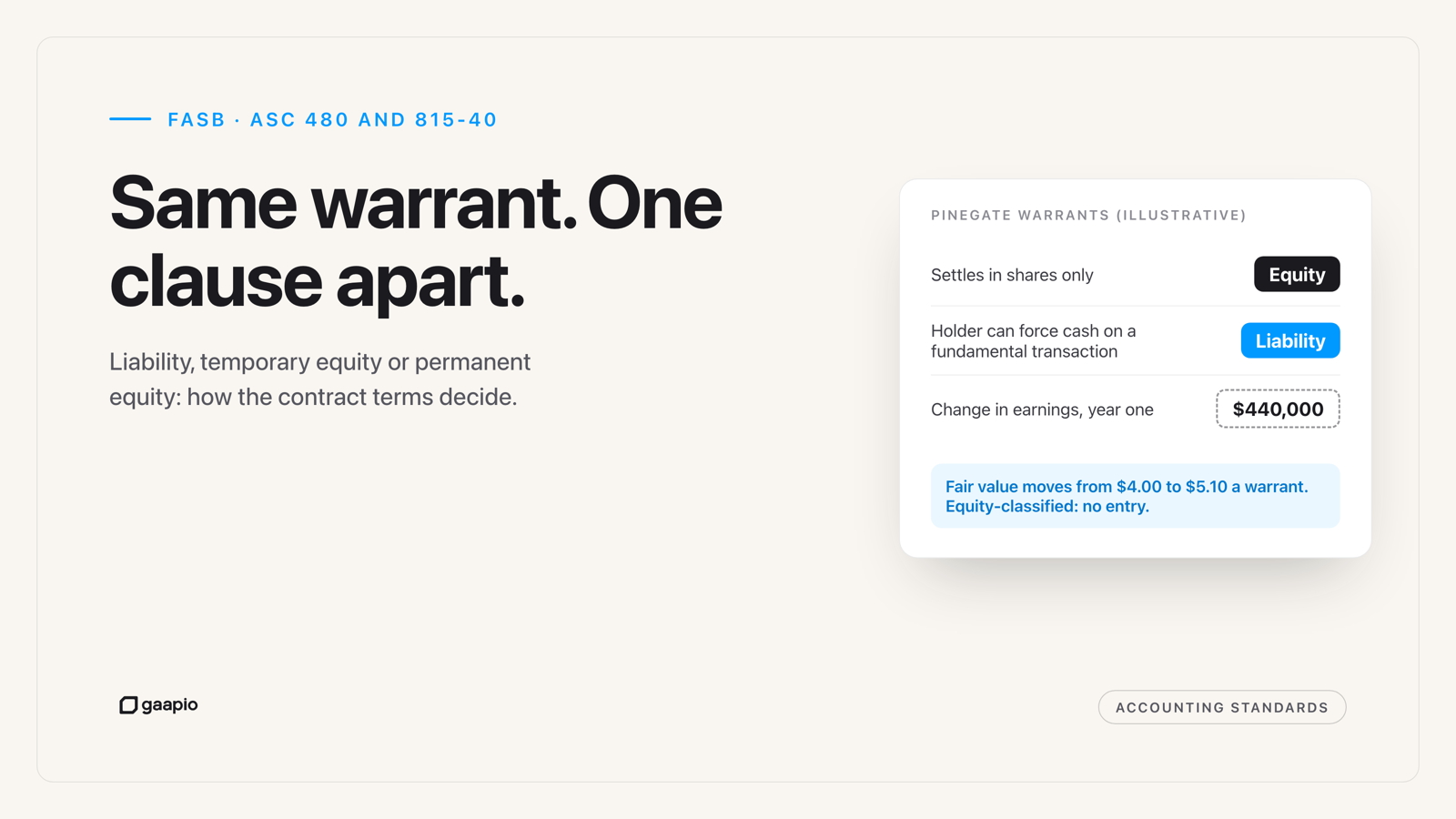
| Settlement | Physical or net share settlement, at the company's choice | Same, plus the holder may require cash settlement at a Black-Scholes value on a fundamental transaction, whether or not common shareholders receive cash |
| ASC 480 | Not a liability: the warrant is on common shares, which are not redeemable | Same answer under the most common reading. Even if a reviewer treats the cash-out as a 480-10-25-8 repurchase obligation, the result is still a liability at fair value |
| Indexation (ASC 815-40-15) | Passes: fixed number of shares, fixed strike | Not the deciding test here. The Black-Scholes cash-out is a settlement feature to examine, but the next row already fails |
| Equity conditions (ASC 815-40-25) | Passes, assuming enough authorized shares, a share cap, and no make-whole | Fails: the holder can force net cash settlement on an event outside the company's control (25-7 to 25-9) |
| Classification | Equity (paid-in capital) | Liability at fair value, changes in earnings |
Journal entries at issuance (January 2, 2026)
Version A, equity-classified. Proceeds are allocated between the loan and the warrants by relative fair value (ASC 470-20-25-2): warrants get $1,600,000 / ($9,000,000 + $1,600,000) = 15.09% of $10,000,000, or $1,509,434.
Dr Cash                              10,000,000
Dr Debt discount                      1,509,434
    Cr Notes payable                              10,000,000
    Cr Additional paid-in capital - warrants       1,509,434
Version B, liability-classified. The warrants are recorded at fair value first, and the remainder of the proceeds goes to the debt.
Dr Cash                              10,000,000
Dr Debt discount                      1,600,000
    Cr Notes payable                              10,000,000
    Cr Warrant liability                           1,600,000
December 31, 2026 remeasurement. Assume the warrants are now worth $5.10 each, or $2,040,000.
Version A: no entry. Equity-classified warrants are not remeasured.
Version B: the liability increases by $440,000.
Dr Change in fair value of warrant liability   440,000
    Cr Warrant liability                                 440,000
The debt discount amortizes to interest expense under the effective interest method in both versions, and Version B amortizes a larger discount. Any issuance costs allocated to the warrant liability are expensed immediately. The facts that change the answer are all in the contract language. A single sentence in the fundamental transaction clause put a $440,000 fair value loss through 2026 earnings, increased the discount amortized to interest expense, and added a recurring fair value measurement to every close. Pinegate should settle the wording with its lender before signing, not after the auditor reads the agreement.
What do auditors and the SEC staff push on?
They push on the contract language and on the judgments behind each classification. Expect questions in these six areas.
- The contract, not the term sheet. Reviewers read the settlement, change-of-control and anti-dilution language in the executed agreement.
- Redemption triggers on preferred. They ask who controls the board, what a deemed liquidation event pays common holders, and whether the company concluded a redemption is probable.
- Fair value inputs. For liability-classified warrants, volatility, term and the marketability of pre-IPO shares will be tested every period.
- Reclassification at the IPO. Support for the date, the final fair value and the equity conditions on the new common warrants.
- Consistency across instruments. Warrants, convertible notes and preferred issued to the same investor are often analyzed together, and a position taken on one gets applied to the others.
- Disclosure. The terms of each instrument, the classification conclusion, the fair value hierarchy level for liability-classified items, and redemption values for temporary equity.
How does Gaapio help with equity classification memos?
Gaapio is an AI-powered technical accounting platform built by CPAs. For a classification conclusion, such as a warrant analysis or a preferred stock temporary equity memo, you give Gaapio your facts and it asks follow-up questions before drafting. It is grounded in the licensed FASB Codification, Big 4 guidance, and SEC filings and comment letters. Where the analysis forks, it shows the alternatives so a reviewer can see the close calls, and conclusions come with clickable citations. Reviewers can comment and approve inside the memo, and version history tracks every change. See Gaapio accounting memos.
For companies getting ready to file, see how Gaapio supports IPO readiness. Gaapio does not value your warrants or settle your contract terms; your valuation specialist and counsel do that, and you make the accounting call.
Want to see it on your own warrant or preferred stock memo? Request a demo.
This article is general information, not accounting, tax or legal advice. Confirm the requirements for your facts against the Codification and with your auditor and counsel.
Written by Jace Chambers, CPA, cofounder of Gaapio, who started his career in audit at EY.
Frequently asked questions
What is ASC 480?
ASC 480, Distinguishing Liabilities from Equity, requires certain freestanding financial instruments to be classified as liabilities even if their legal form is equity: mandatorily redeemable instruments, obligations to repurchase the issuer's shares by transferring assets, and certain obligations settled in a variable number of shares.
How do you account for warrants under ASC 815-40?
Test them in order: first ASC 480, then ASC 815-40. A warrant is equity-classified only if it is indexed to the entity's own stock and meets the settlement conditions. Otherwise it is an asset or liability measured at fair value with changes in earnings.
What did ASU 2020-06 change?
It eliminated the cash conversion and beneficial conversion feature models for convertible debt, so most convertible notes are a single liability at amortized cost. It also removed three equity classification conditions in ASC 815-40 and required the if-converted method for diluted EPS.
What is temporary equity?
Temporary equity is the category between liabilities and equity for securities, mostly redeemable preferred stock, that holders can force the company to redeem or that may become redeemable on an event outside the issuer's control (ASC 480-10-S99-3A, from ASR 268).
Is preferred stock a liability or equity?
It depends. Mandatorily redeemable preferred is a liability under ASC 480. Preferred that is conditionally redeemable, including through a deemed liquidation event outside the company's control, is typically temporary equity. Otherwise it is permanent equity. Private companies that are not SEC registrants may be outside the ASC 480 mandatorily redeemable guidance (ASC 480-10-15-7A) and are not required to apply temporary equity presentation.
What happens to preferred stock and warrants at an IPO?
Convertible preferred converts to common and moves from temporary to permanent equity at its carrying amount. Preferred stock warrant liabilities are remeasured through the conversion date and then reclassified to paid-in capital if the resulting common warrants meet the equity conditions.
Does ASC 480 apply to embedded conversion options?
No. ASC 480 applies to freestanding instruments. Embedded features are evaluated under ASC 815-15 for bifurcation. Warrants issued for goods or services are share-based payments under ASC 718.
Related reading
- ASC 815 hedge accounting guide
- S-1 vs. S-4 vs. S-11 vs. 20-F registration statements
- IPO readiness
- Accounting memos: format, example and template
Sources: FASB ASC 480-10, ASC 815-40, ASC 470-20 and ASC 480-10-S99-3A; ASU 2020-06, ASU 2017-11; SEC staff statement on accounting and reporting considerations for warrants issued by SPACs, April 12, 2021; KPMG Defining Issues 20-08, FASB simplifies accounting for convertible instruments; Deloitte Roadmap: Distinguishing Liabilities from Equity; Deloitte Roadmap: Contracts on an Entity's Own Equity; Deloitte Roadmap: Initial Public Offerings, liabilities and temporary equity; Deloitte, FASB June 3, 2026 meeting.