

You entered an interest rate swap, and now someone wants to know whether it qualifies for hedge accounting. The answer depends on paperwork you either completed on the day you designated the hedge or did not. Next time you lose an evening to the Basis for Conclusions trying to work out whether a swap qualifies, start with the documentation, because that is where hedge accounting is most often lost.
This guide covers ASC 815 hedge accounting for a controller who has just entered a swap: what qualifies, fair value versus cash flow versus net investment hedges, the documentation you need at designation, how to show effectiveness (quantitative, qualitative, the shortcut method and critical terms match), what ASU 2017-12 changed, and the portfolio layer method from ASU 2022-01. It ends with a worked example you can adapt: a pay-fixed swap on floating-rate debt, designated as a cash flow hedge, with the documentation, one quarter of journal entries and the reclassification out of OCI.
Key takeaway: Hedge accounting under ASC 815 is elective. If you do not designate, the derivative is carried at fair value with every change in earnings. If you designate, you must document the hedge at inception and show that it is highly effective. A cash flow hedge parks the swap's fair value changes in OCI and releases them into earnings when the hedged cash flows hit earnings. A fair value hedge runs both the derivative and the hedged item through earnings. A net investment hedge puts the gains and losses in the cumulative translation adjustment. Since ASU 2017-12, there is no separate measurement of ineffectiveness, and ongoing assessments can be qualitative when the initial quantitative test supports it and you document that election at inception.
What is hedge accounting under ASC 815?
Hedge accounting is an optional accounting treatment under ASC 815 (Derivatives and Hedging) that lets an entity match the earnings effect of a derivative to the earnings effect of the item it hedges. Without it, ASC 815 requires every derivative within its scope to be recorded at fair value on the balance sheet with changes in earnings, which creates volatility when the hedged item is not measured the same way.
The treatment is a designation, not an automatic result. You choose to apply it hedge by hedge, and you must meet the conditions in ASC 815-20 at the time you designate. If you miss them, the derivative still exists and is still measured at fair value, but hedge accounting does not apply, usually from the start of the relationship.
The swap's fair value is also a fair value measurement under ASC 820. Interest rate swaps are commonly Level 2, and our ASC 820 guide covers the hierarchy and the disclosures behind that number.
Which hedges qualify for hedge accounting?
A hedge qualifies when the hedging instrument, the hedged item and the hedged risk are all eligible, and when the relationship is documented and expected to be highly effective. ASC 815-20-25 sets the criteria. The table summarizes the eligibility questions a controller asks first.
| Question | Typical answer under ASC 815 |
|---|---|
| What can be the hedging instrument? | A derivative, such as an interest rate swap, forward, or purchased option. A nonderivative financial instrument, such as foreign-currency debt, qualifies only as a net investment hedge or a fair value hedge of the foreign currency risk of an unrecognized firm commitment. A written option, or a combination that is a net written option, qualifies only if it passes the written option test in ASC 815-20-25-94 (or, once ASU 2025-09 applies, is a swap combined with a written option of matching notional in an interest rate hedge) |
| What can be hedged in a fair value hedge? | A recognized asset or liability, an unrecognized firm commitment, or an available-for-sale debt security |
| What can be hedged in a cash flow hedge? | Variable cash flows of a recognized asset or liability, or a forecasted transaction that is probable, and whose cash flows could affect earnings |
| What risks can be hedged? | For financial items: the total change in fair value or cash flows, the benchmark interest rate (fair value hedges), the contractually specified interest rate (cash flow hedges of variable-rate items), foreign exchange rates, or credit risk. For nonfinancial items: foreign currency risk or the entire price, plus price components in cash flow hedges (broadened by ASU 2025-09, effective 2027 for public business entities) |
| What does not qualify? | Items already remeasured through earnings, such as trading securities, because there is no mismatch to fix. A forecasted transaction that is not probable. Documentation prepared after the fact |
| Eligible benchmark rates for interest rate risk | U.S. Treasury rates, the SOFR OIS rate, the Fed Funds Effective Swap Rate (OIS) and the SIFMA Municipal Swap Rate (the Codification list still includes the LIBOR swap rate, which is no longer usable). For a cash flow hedge of a variable-rate instrument, you can hedge the contractually specified rate |
Two points trip people up. First, a forecasted transaction has to be specifically identified and probable. Wanting to borrow in the future is not enough; you need the expected timing, the amount and the evidence that it will happen. Second, hedging a pool of forecasted transactions requires that they share the same risk exposure, which ASU 2025-09 loosens to "similar" starting in 2027 for calendar-year public business entities, or earlier if adopted early (more below).
What is the difference between fair value, cash flow and net investment hedges?
A fair value hedge protects against changes in the fair value of a recorded item, a cash flow hedge protects against variability in future cash flows, and a net investment hedge protects the value of an investment in a foreign operation. The three differ in which exposure you hedge and where the gains and losses land.
| Fair value hedge (ASC 815-25) | Cash flow hedge (ASC 815-30) | Net investment hedge (ASC 815-35) | |
|---|---|---|---|
| Exposure | Changes in fair value of a fixed-rate debt instrument, a firm commitment, an AFS debt security | Variable interest payments, forecasted sales or purchases, forecasted debt issuance | Foreign currency risk in the net assets of a foreign operation |
| Typical instrument | Receive-fixed, pay-floating swap on fixed-rate debt | Pay-fixed, receive-floating swap on variable-rate debt; FX forward on forecasted sales | FX forward, cross-currency swap, or foreign-currency-denominated debt |
| Derivative gain or loss | Earnings, in the same income statement line as the hedged item's earnings effect | OCI, then reclassified to earnings when the hedged item affects earnings | Cumulative translation adjustment in OCI |
| Hedged item | Carrying amount adjusted for the change in fair value from the hedged risk, through earnings | No adjustment; the item is accounted for as usual | No adjustment; the investment is translated as usual |
| When it leaves OCI | Not applicable, except excluded components under the amortization approach | When the hedged forecasted transaction affects earnings | On sale or complete or substantially complete liquidation of the foreign operation |
| On discontinuation | Basis adjustment stays in the hedged item's carrying amount. For an interest-bearing item, it is amortized to earnings as a yield adjustment, starting no later than when hedge accounting ends | AOCI stays and is reclassified when the hedged transaction affects earnings, unless it becomes probable the transaction will not occur, in which case it is reclassified immediately | CTA stays until the foreign operation is sold or completely or substantially completely liquidated |
The controller with a new pay-fixed swap on a floating-rate loan is almost always looking at a cash flow hedge. The controller who swapped a fixed-rate bond into floating is in a fair value hedge. Treasury teams with foreign subsidiaries often use a net investment hedge.
What documentation does hedge accounting require?
Hedge accounting requires documentation at inception of the hedge, and the documentation must be specific. ASC 815-20-25-3 requires formal documentation of the hedging relationship, the risk management objective and strategy for undertaking the hedge, the hedging instrument, the hedged item or forecasted transaction, the nature of the risk being hedged, and how effectiveness will be assessed. Documentation prepared after the fact does not meet the requirement, because the rule exists to prevent choosing hedges with hindsight. The one timing relief is for private companies that are not financial institutions, covered under the simplified approach below.
| Element | What to document |
|---|---|
| Hedging relationship and type | Cash flow, fair value or net investment hedge, and the date of designation |
| Risk management objective and strategy | Why you are hedging, for example to fix the cash flows on variable-rate borrowing in line with the treasury policy |
| Hedging instrument | The derivative, its notional, trade date, maturity, counterparty, and terms (fixed rate, index, payment and reset dates) |
| Hedged item or forecasted transaction | The loan or the forecasted transaction, with enough detail that an outsider could identify it: amount, timing, index, spread. For forecasted transactions, the expected date and why it is probable |
| Nature of the risk being hedged | For example, variability in cash flows from changes in the contractually specified benchmark rate. Not "interest rate risk" in general |
| Effectiveness assessment | Whether you will use a quantitative or qualitative method, which one, and the fallback quantitative method if facts change |
| Excluded components | If you exclude any component from the assessment (forward points, cross-currency basis, option time value), which one and how it will be recognized |
| Credit risk monitoring | Good practice, not a listed 815-20-25-3 element: how counterparty and own credit risk will be considered in the ongoing assessment |
Practical points that matter at audit time. The documentation should be signed or otherwise dated at designation. If the documentation says you will assess effectiveness qualitatively, it must also name the quantitative method you would use if circumstances changed. Documentation must exist at designation, which can be later than the trade date. A swap designated after its trade date usually has a nonzero fair value, which rules out the shortcut method.
How do you test hedge effectiveness?
ASC 815 requires that a hedging relationship be highly effective at achieving offsetting changes in the hedged risk, assessed at inception and on an ongoing basis (at least quarterly). The Codification does not set a numerical threshold. In practice, auditors and SEC staff accept offset of 80% to 125%. For regression, that means an R-squared of at least 0.80 and a slope between -0.80 and -1.25. Treat these as the working standard, not a safe harbor written into the Codification.
You choose the method, document it at inception and apply it consistently to similar hedges. The common methods differ in how much work they ask for.
| Method | When it applies | What it asks of you |
|---|---|---|
| Shortcut method (ASC 815-20-25-102 through 25-117) | An interest rate swap hedging a recognized interest-bearing asset or liability, when every criterion is met. Examples: the swap's fair value is zero at inception, the notional matches the principal, the net settlement formula stays constant, and the hedged item is not prepayable | Assume perfect effectiveness. No quantitative assessment. You keep confirming that the criteria are still met. Forecasted debt issuance and most prepayable loans do not qualify |
| Critical terms match (ASC 815-20-25-84 and 25-85) | A forward contract whose critical terms match the hedged forecasted transaction, such as an FX or commodity forward with the same notional, underlying and settlement date. It is not used for interest rate swaps | Assume perfect effectiveness for the hedged risk. Since ASU 2017-12, a group of forecasted transactions qualifies if they and the derivative's maturity fall within the same 31-day period or fiscal month |
| Qualitative assessment | After an initial quantitative assessment (not needed when a method such as the hypothetical derivative method shows the terms match exactly), when you documented a qualitative approach and facts have not changed, and the relationship is expected to remain highly effective | A written conclusion each quarter that the facts that supported the initial assessment still hold. Triggers a quantitative test if they do not |
| Quantitative methods | Everything else, or when you choose them | Regression, dollar offset, the hypothetical derivative method or the change in variable cash flows method, run at inception and at least quarterly |
Two cautions. The shortcut method has strict conditions, and an entity that applies it without meeting them loses hedge accounting for the affected periods, which has been a common source of restatements. Since ASU 2017-12, you can document a quantitative fallback method at inception so that if the shortcut method turns out to be inapplicable, you can continue to apply hedge accounting under the fallback method without dedesignating, if the hedge was highly effective under that method. And critical terms match still carries ongoing work: you reassess that the critical terms continue to match and consider counterparty credit risk at least quarterly.
For a typical corporate swap on a prepayable term loan, the shortcut method is off the table because of the prepayment option. The usual answer is a qualitative assessment supported by the hypothetical derivative method: compare the swap's fair value changes to those of a hypothetical swap that would perfectly offset the hedged cash flows.
What did ASU 2017-12 change in hedge accounting?
ASU 2017-12 (Targeted Improvements to Accounting for Hedging Activities) simplified ASC 815 so that hedge accounting results are easier to apply and better reflect the economics. It is now effective for all entities. The changes that matter in day-to-day work:
- No separate ineffectiveness measurement. Before, you reported ineffectiveness in earnings each period. Now, if the hedge is highly effective, the entire change in the hedging instrument's fair value that is included in the effectiveness assessment is recorded in OCI (cash flow hedge) and moves to earnings with the hedged item. In a fair value hedge, the derivative's gain or loss is shown in the same income statement line as the hedged item's earnings effect.
- Presentation in one line. The amounts that move out of OCI go to the same line item in which the hedged item's earnings effect is reported, such as interest expense.
- Excluded components. For items like forward points, cross-currency basis and option time value, you can recognize the excluded amount in earnings under an amortization approach or a fair value approach. You choose and apply consistently.
- More hedgeable risk components. You can hedge the contractually specified rate in a cash flow hedge of variable-rate instruments, hedge a partial term of a fixed-rate instrument, and for nonfinancial items, hedge contractually specified price components.
- Easier effectiveness assessments. You can elect to assess effectiveness qualitatively after the initial quantitative test. That initial test can be completed after designation, using data as of hedge inception, as long as it is done by the first quarterly effectiveness assessment date. Private companies that are not financial institutions get more time.
- Documentation fix for the shortcut method. A quantitative fallback documented at inception lets you continue hedge accounting if the shortcut method was wrongly applied.
- A new layer method. The last-of-layer method for closed portfolios of prepayable financial assets (see the next section).
What did ASU 2022-01 add: the portfolio layer method?
ASU 2022-01 (Fair Value Hedging: Portfolio Layer Method) expanded the last-of-layer method from ASU 2017-12 and renamed it the portfolio layer method. It lets an entity hedge the fair value interest rate risk of a stated amount of a closed portfolio of financial assets, without assuming that particular assets will be prepaid first.
The ASU made four changes. It allows multiple hedged layers of a single closed portfolio. It expands the scope to include nonprepayable financial assets. It requires fair value hedge basis adjustments to be maintained at the closed-portfolio level rather than allocated to individual assets. And it prohibits considering those basis adjustments when determining credit losses. It was effective for public business entities for fiscal years beginning after December 15, 2022, and for other entities a year later.
This method is mainly a tool for banks and lenders managing large portfolios of loans. A controller with a single swap on a term loan will not use it, but it is the answer to "can I hedge a slice of a loan book" when someone asks.
What is new for hedge accounting in 2026?
Three developments matter this year.
ASU 2025-09 (Hedge Accounting Improvements), issued November 25, 2025. It is effective for public business entities for fiscal years beginning after December 15, 2026, and for all other entities a year later. Early adoption is permitted, and it applies prospectively. It changes five areas:
- For a group of forecasted transactions in a cash flow hedge, it replaces "share the same risk exposure" with "similar risk exposure," which can be assessed qualitatively.
- It adds an optional model for forecasted interest payments on choose-your-rate debt, such as a revolver that lets you pick among rate indexes.
- It replaces the contractually specified component model for nonfinancial items with a principles-based model: a variable price component can be hedged if it is referenced in the pricing formula, or, for items not priced by formula, if it is clearly and closely related to the asset.
- It removes the requirement to apply the net written option test to a derivative that combines a swap and a written option, such as a swap with a written floor, when it is designated as a cash flow or fair value hedge of interest rate risk and the notional amounts match.
- It addresses a dual hedge of foreign-currency debt that is both a net investment hedge and a fair value hedge of interest rate risk.
Reference rate reform relief has ended. The temporary relief in ASC 848 for contract modifications and hedging relationships moving off LIBOR expired on December 31, 2024. A SOFR-based hedge you designate now follows the ordinary ASC 815 rules.
The private company simplified approach is still available. Private companies that are not financial institutions (not-for-profit entities and employee benefit plans are not eligible) can use the simplified hedge accounting approach for a receive-variable, pay-fixed swap that hedges a variable-rate borrowing. It lets them measure the swap at settlement value and assume the hedge is perfectly effective, and allows the documentation to be completed by the date the first annual financial statements are available to be issued. If you can use it, it is much less work than the full model.
Worked example: a pay-fixed swap designated as a cash flow hedge
This example is illustrative. Harbor Ridge Manufacturing is an invented calendar-year company, and the rates and amounts are made up to show the mechanics. It applies the full ASC 815 model and does not elect the private company simplified approach.
The facts.
- On January 1, 2027, Harbor Ridge borrows $50,000,000 on a term loan maturing December 31, 2029. Interest is 3-month Term SOFR plus 2.25%, reset and paid quarterly. The loan is prepayable at par.
- The same morning, before the first Term SOFR rate for the loan is set, it enters a swap with a bank and designates the hedge. Notional is $50,000,000, maturity is December 31, 2029, Harbor Ridge pays fixed 3.80% and receives 3-month Term SOFR, settled quarterly on the same reset and payment dates as the loan. The swap's fair value at inception is zero.
- Term SOFR set on January 1 is 3.60%. To keep the arithmetic simple, each quarter is one quarter of the annual rate. Dates are simplified; in practice, funding, fixings and settlements fall on business days.
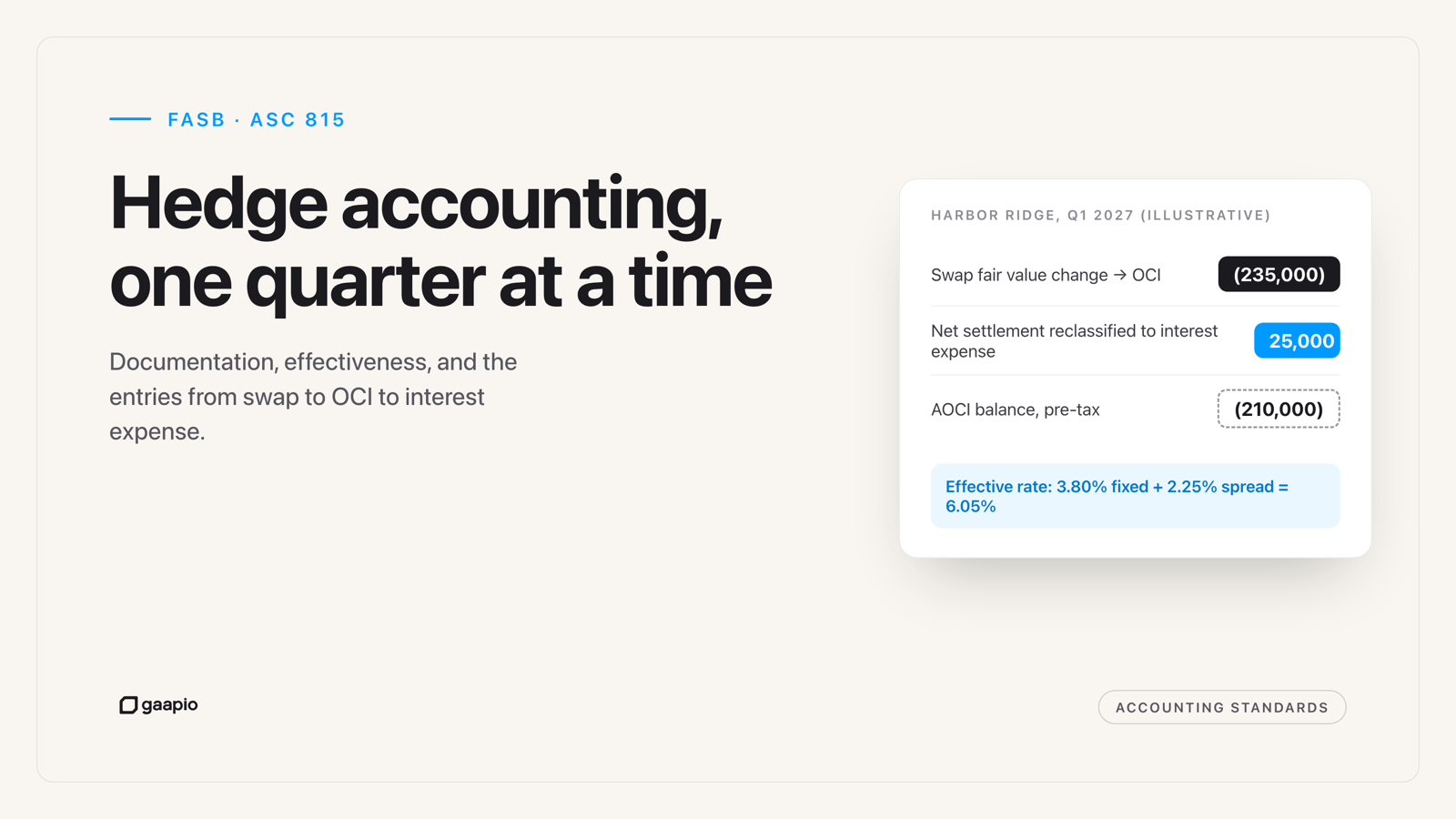
- At March 31, 2027, immediately before settlement, the swap is a liability of $235,000, which includes the $25,000 net settlement due that day. Rates fell, so the pay-fixed swap lost value.
Why a cash flow hedge, and why not the shortcut method. The swap converts variable interest payments to fixed, so the exposure is variability in cash flows. The loan is prepayable, so the shortcut method does not apply. Harbor Ridge documents a qualitative assessment supported by the hypothetical derivative method, with a quantitative fallback.
The documentation, completed January 1, 2027.
| Element | Harbor Ridge entry |
|---|---|
| Type and date | Cash flow hedge, designated January 1, 2027 |
| Objective and strategy | Fix the cash flows on the $50,000,000 term loan in line with the treasury policy to hedge at least 75% of floating-rate debt (invented policy) |
| Hedging instrument | Pay-fixed 3.80% / receive 3-month Term SOFR swap, $50,000,000 notional, maturing December 31, 2029, with the named bank |
| Hedged item | The variable interest payments on the term loan, each quarterly payment through December 31, 2029, starting with the first payment, whose rate had not been set when the hedge was designated |
| Hedged risk | Variability in the interest cash flows attributable to changes in the contractually specified rate, 3-month Term SOFR. The 2.25% spread is not hedged |
| Effectiveness | Initial quantitative assessment using the hypothetical derivative method, with data as of January 1, 2027, completed by the first quarterly assessment date, March 31, 2027. Subsequent assessments qualitative each quarter. If facts change, the hypothetical derivative method becomes the quantitative test |
| Credit risk | Counterparty credit risk and Harbor Ridge's own nonperformance risk are considered each quarter in the assessment and reflected in the swap's fair value |
The entries. Nothing is recorded for the swap on January 1, because its fair value is zero. Here is the first quarter.
| Date | Entry | Debit | Credit |
|---|---|---|---|
| Jan 1 | Cash | 50,000,000 | |
| Term loan | 50,000,000 | ||
| Mar 31 | Interest expense | 731,250 | |
| Cash | 731,250 | ||
| Mar 31 | OCI: cash flow hedge (swap fair value change) | 235,000 | |
| Derivative liability | 235,000 | ||
| Mar 31 | Derivative liability | 25,000 | |
| Cash (net swap settlement) | 25,000 | ||
| Mar 31 | Interest expense | 25,000 | |
| OCI: cash flow hedge (reclassification) | 25,000 |
The loan interest of $731,250 is $50,000,000 times (3.60% + 2.25%) divided by four. The swap's net settlement of $25,000 is $50,000,000 times (3.80% minus 3.60%) divided by four, paid by Harbor Ridge because the fixed rate is higher than the floating rate.
What the quarter shows.
| Item | Amount |
|---|---|
| Interest expense | 756,250 (731,250 + 25,000) |
| Effective rate | 6.05%, which is the 3.80% fixed rate plus the 2.25% spread |
| Derivative liability at March 31 | 210,000 (235,000 less 25,000 paid) |
| AOCI, beginning | 0 |
| Change in swap fair value, to OCI | (235,000) |
| Reclassified to interest expense | 25,000 |
| AOCI, ending (pre-tax) | (210,000) |
The interest expense lands at 6.05% annualized on $50,000,000, so the swap did its job: the cost of the debt is fixed at the swap rate plus the spread, whatever Term SOFR does. The $210,000 in AOCI is an unrealized amount that will keep moving as rates change, and amounts are reclassified to interest expense as each hedged interest payment affects earnings. If the hedge stays in place until maturity, the swap's fair value ends at zero and AOCI for this hedge returns to zero. Tax effects are omitted here. In a real set of books you would record the deferred tax effect through OCI.
What the disclosures need. ASC 815-10-50 and 815-30-50 ask for, among other things, the objectives and strategies for using derivatives, the location and fair value of the swap on the balance sheet, the gains and losses recognized in OCI and reclassified to earnings by income statement line, and an estimate of the amount in AOCI expected to be reclassified into earnings in the next 12 months. The swap's fair value also falls under the ASC 820 disclosures.
What can go wrong later. If the forecasted interest payments are no longer probable, Harbor Ridge must discontinue the hedge. The amount in AOCI stays there and is reclassified as the original payments affect earnings, unless it becomes probable that those payments will not occur by the originally documented date or within two months after it. If Harbor Ridge repays the loan early, that is the second case, so the related AOCI is reclassified into earnings immediately. Because the documentation names this term loan, refinancing it has the same result. Entities that expect to refinance often designate the interest payments on the first $50,000,000 of Term SOFR borrowings instead, so the hedge survives a replacement loan. Once the hedge is discontinued, any later fair value changes on a swap Harbor Ridge keeps go straight to earnings. If Harbor Ridge dedesignates the swap while the loan stays outstanding, the AOCI balance is reclassified into interest expense as the hedged interest payments occur, and the swap's later fair value changes are recorded in earnings.
What do auditors push on in hedge accounting?
Auditors look first at the documentation date, because hedge accounting that lacks contemporaneous documentation fails from inception. If it fails, the swap's fair value changes belong in earnings for every period since designation, which can force a restatement.
Other points they raise:
- The designation date and the effectiveness method. They want to see them in the documentation, signed or dated, and consistent with the policy you apply to similar hedges.
- Whether the shortcut conditions are met. A prepayment option, a swap that was not at market at inception, or a notional that does not match are the usual reasons the shortcut method fails.
- Probability of the forecasted transaction. For a forecasted issuance or purchase, they look for evidence such as board approvals, budgets and history.
- Counterparty credit risk. They expect it to be considered in the ongoing assessment and reflected in the swap's fair value.
- The 12-month reclassification estimate. It should be supported by the Term SOFR forward curve and the debt's remaining payments.
- Excluded components. The method for recognizing them has to be documented and applied consistently.
How does Gaapio help with hedge accounting?
Gaapio is an AI-powered technical accounting platform built by CPAs. For a hedge designation memo, you give Gaapio your facts and it asks follow-up questions before drafting. Draft it before you designate: the documentation has to exist at inception, and a memo written after the fact does not rescue a missed designation. It is grounded in the licensed FASB Codification, Big 4 guidance, and SEC filings and comment letters. Where the analysis forks, it shows the alternatives so a reviewer can see the close calls, and conclusions come with clickable citations. It drafts in your team's memo template, with reviewer comments, approvals and version history. See Gaapio accounting memos.
For the derivative footnote, Gaapio reviews your disclosures against the Codification, compares them with peer filers in your industry, and drafts footnote language for your review. See AI footnote disclosures. Gaapio does not value your swap or run your effectiveness test; those come from your valuation provider or treasury system. You make the hedge accounting calls.
Want to see it on your own hedge memo? Request a demo.
This article is general information, not accounting or legal advice. Confirm the requirements for your facts against the Codification and with your auditor.
Written by Jace Chambers, CPA, who worked in audit at EY and in hedge accounting at Chatham Financial.
Frequently asked questions
What is hedge accounting under ASC 815?
It is an optional treatment that lets you match the earnings effect of a derivative to the earnings effect of the item it hedges. You must designate the relationship and document it at inception. Without it, a derivative within ASC 815's scope is carried at fair value with every change in earnings.
What are the three types of hedges in ASC 815?
Fair value hedges, cash flow hedges and net investment hedges. A fair value hedge covers changes in the fair value of a recorded item or firm commitment, a cash flow hedge covers variability in future cash flows, and a net investment hedge covers foreign currency risk in a foreign operation.
What documentation is required for a cash flow hedge?
At inception you document the hedging relationship, the risk management objective and strategy, the hedging instrument, the hedged forecasted transaction or variable cash flows, the nature of the risk, and how you will assess effectiveness, including the quantitative fallback if you use a qualitative method. ASC 815-20-25-3 sets the requirement.
What is the shortcut method for hedge accounting?
It is a method that lets you assume a hedge is perfectly effective when an interest rate swap hedges a recognized interest-bearing asset or liability and every criterion in ASC 815-20-25-102 through 25-117 is met. A prepayable hedged item or a swap that was not at market at inception usually rules it out.
What is critical terms match?
It is a method under ASC 815-20-25-84 and 25-85 that lets you assume perfect effectiveness when the critical terms of the hedging instrument and the hedged forecasted transaction match. You still reassess quarterly that the terms continue to match and that counterparty credit risk does not change the conclusion.
What did ASU 2017-12 change?
It eliminated the separate measurement of ineffectiveness, required the hedge results to be presented in the same line as the hedged item, allowed more risk components to be hedged, gave choices for excluded components, and allowed qualitative effectiveness assessments after the initial test.
What is the portfolio layer method?
It is a fair value hedge method from ASU 2022-01 that lets an entity hedge interest rate risk on a stated amount of a closed portfolio of financial assets. It allows multiple layers and nonprepayable assets, and basis adjustments are kept at the portfolio level. It is mostly used by banks.
Do I have to use hedge accounting for an interest rate swap?
No. It is elective. If you do not designate the swap, you carry it at fair value on the balance sheet with changes in earnings. If you want hedge accounting, you must document the relationship at inception and meet the effectiveness requirements.
Related reading
- ASC 820 fair value measurement and disclosures
- Accounting memos: format, example and template
- AI footnote disclosures
Sources: FASB ASC 815-10, 815-20, 815-25, 815-30 and 815-35, ASU 2017-12, ASU 2022-01, ASU 2022-06 and ASU 2025-09; PwC, Derivatives and hedging guide, methods of assessing effectiveness; PwC, Derivatives and hedging guide, shortcut method; Deloitte, Heads Up on ASU 2025-09; FASB in Focus, ASU 2017-12; RSM, ASU 2025-09.