

If you have a trade receivables balance and a December 31, 2026 close coming, this is likely the first year end where ASU 2025-05 applies to you. The ASU lets every entity stop building a separate forecast for current receivables and current contract assets, and lets entities that are not public business entities also count cash collected after the balance sheet date.
This guide covers what CECL requires for trade receivables, who can elect which relief, the effective date and transition, the disclosures, and how to build a loss-rate model you can defend. It ends with an illustrative aging-based calculation run three ways: full CECL, the practical expedient, and the expedient plus the collections election.
Key takeaway: ASU 2025-05 amends ASC 326-20 for current accounts receivable and current contract assets arising from ASC 606 transactions. Any entity may elect a practical expedient that assumes conditions at the balance sheet date stay unchanged for the life of the asset, so no forecast is required. An entity that is not a public business entity and elects the expedient may also elect a policy of considering collections received after the balance sheet date. The ASU is effective for annual periods beginning after December 15, 2025, and interim periods within them, is applied prospectively, and permits early adoption.
What did ASU 2025-05 change about CECL for receivables?
The FASB issued ASU 2025-05, Financial Instruments-Credit Losses (Topic 326): Measurement of Credit Losses for Accounts Receivable and Contract Assets, on July 30, 2025. It adds two optional simplifications to the measurement of expected credit losses on short-term trade receivables. Nothing else about CECL changes: you still record an allowance for expected credit losses over the life of the asset, and you still pool receivables with similar risk characteristics.
The two options are different in kind:
- A practical expedient that removes the forecast period. An entity may assume that current conditions as of the balance sheet date do not change for the remaining life of the asset.
- An accounting policy election to consider collection activity after the balance sheet date. It is available only to entities other than public business entities, and only if they also elect the expedient.
The proposal that preceded the final ASU would have limited the relief to private companies and certain not-for-profit entities. The final ASU made the expedient available to all entities, including public business entities, and made the collections election available to all entities other than public business entities (Deloitte, Heads Up, July 31, 2025).
What does CECL require for trade receivables?
CECL requires an entity to record, at inception, an allowance equal to the expected credit losses over the contractual life of a receivable, based on past events, current conditions and reasonable and supportable forecasts. ASC 326-20 replaced the incurred-loss model that waited for a loss to be probable. For a trade receivable with a 30-day term, "life" is short, but the model still applies to every receivable on the books, including ones that are not yet past due.
Four requirements matter most for a trade receivables portfolio:
- Measure on a collective basis when risk characteristics are similar. ASC 326-20-30-2 requires pooling. Common pool drivers are customer type, geography, product line, and days past due. Receivables that do not share risk characteristics with a pool are evaluated individually.
- Start with history, then adjust. Historical loss information is the usual starting point. It is adjusted for differences between the conditions in the historical period and today, and for reasonable and supportable forecasts of the period over which you can make them (ASC 326-20-30-8 and 30-9).
- Do not assume zero loss without support. ASC 326-20-30-10 requires the estimate to reflect the risk of loss even when that risk is remote. Zero is acceptable only when historical loss information, adjusted for current conditions and forecasts, results in an expectation that nonpayment is zero. The implementation guidance points to assets such as U.S. Treasury securities. A trade receivable from a customer you consider creditworthy will rarely meet that bar.
- Present the allowance as a valuation account. Credit loss expense goes through earnings, write-offs reduce the gross receivable and the allowance, and recoveries are added back.
ASC 326-20-55 includes an example that estimates expected credit losses for trade receivables using an aging schedule, and ASU 2025-05 adds examples of the expedient and the collections election. The aging example is the starting point for the worked example below.
Who can elect the practical expedient and the policy election?
Any entity can elect the practical expedient. Only an entity that is not a public business entity (PBE) can elect the collections policy, and it must elect the expedient to do so. Public business entities are limited to the expedient.
| Entity | Practical expedient | Collections policy election |
|---|---|---|
| Public business entity (SEC registrant, entity with exchange-traded or OTC-traded securities, and others meeting the PBE definition) | Yes | No |
| Private company that is not a PBE | Yes | Yes, if it also elects the expedient |
| Not-for-profit entity | Yes | Yes, if it also elects the expedient |
| Employee benefit plan | Yes | Yes, if it also elects the expedient |
The PBE definition is broader than "listed company." An entity can be a PBE because its financial statements are included in another entity's SEC filing, or because it has securities traded over the counter. Not-for-profit entities and employee benefit plans are not business entities, so they are not PBEs (Withum, Aug. 14, 2025). Check the definition in the Master Glossary before assuming your subsidiary or private-equity-owned company is outside it.
Per BDO's summary, the elections apply consistently to all in-scope current receivables and contract assets, and the date through which collections are considered can change in a later period without being treated as a change in accounting principle. A non-PBE that elects the expedient, and the collections policy if applicable, after the effective date is not required to justify that the change is preferable under ASC 250 (KPMG, July 2025; RSM). A PBE has no such relief.
Which receivables and contract assets are in scope?
The relief applies to current accounts receivable and current contract assets that arise from transactions accounted for under ASC 606. Grant Thornton's summary adds that this includes those acquired in an ASC 805 business combination or recognized through consolidating a variable interest entity that is not a business.
"Current" has its usual meaning under ASC 210: expected to be collected within one year, or within the operating cycle if that is longer than 12 months. Longer-term receivables with a significant financing component are outside the relief.
The relief does not cover other short-term assets with different risk profiles. Withum lists short-term loan receivables, insurance premiums receivable and employer contributions receivable for employee benefit plans among the receivables that stay under the full model. Lease receivables are outside the relief. A lessor's net investment in a sales-type or direct financing lease stays under the full CECL model, and operating lease receivables are outside ASC 326 entirely and follow ASC 842.
What does the practical expedient actually let you skip?
It lets you skip the forecast. The expedient is a simplification of the "reasonable and supportable forecast" step: you assume the conditions at the balance sheet date persist for the remaining life of the asset, instead of building a forward view of unemployment, GDP, industry stress or other drivers.
It does not let you skip the history, and it does not let you ignore today. Historical loss information still has to be adjusted when conditions in the historical period differ from conditions now, and when assets have characteristics that differ from the pool. Grant Thornton illustrates it with historical losses measured when unemployment was 5% and a current rate of 8%: you adjust the historical experience for the move to 8%, then assume 8% holds for the life of the receivables.
BDO's summary makes the same point with customer-specific distress or a change in credit policy as the "current condition" examples. If you know a large customer has filed for bankruptcy, the expedient does not let you reserve at the pool rate.
In plain terms: the expedient deletes the "forecast" layer and leaves the "current conditions" layer in place.
What does the collections policy election do?
It lets a non-PBE look at cash received after the balance sheet date, up to the date the financial statements are available to be issued or an earlier date the entity selects after the balance sheet date, before it estimates the allowance. Without the election, the measurement rests on conditions at the balance sheet date, so an entity could record an allowance on a balance that was paid in full two weeks later.
Under the election, balances collected through the cutoff date carry no allowance. The uncollected balances are then assessed using the expedient, by delinquency status as of the cutoff date. An entity that uses an aging schedule may, but is not required to, update its loss rates for the post-balance-sheet collections (Grant Thornton; BDO).
This matters for anyone who builds the rates themselves. Loss rates measured on the full bucket balance at period end already assume most of that bucket will be collected. If you leave the uncollected balances in their December 31 buckets and apply those rates to them, you can understate the allowance, because the collections are counted once in the rate and again in the smaller base. The approach the ASU illustrates avoids this: remove the collected balances, then assess what is left by its delinquency status at the cutoff date. An entity that uses an aging schedule may also update its loss rates for the post-balance-sheet collections, as Maple Ridge does below. Either way, document why the rates fit the balances they are applied to, and agree the method with your auditor before year end.
What is the effective date and transition?
ASU 2025-05 is effective for annual reporting periods beginning after December 15, 2025, and interim periods within those annual periods. The date is the same for public business entities and all other entities. Early adoption is permitted in any interim or annual period for which the financial statements have not yet been issued or made available to be issued. An entity that adopts in an interim period applies the amendments as of the beginning of the annual period that includes it (Grant Thornton; RSM).
Transition is prospective. Prior periods are not restated. The firm summaries we reviewed describe no cumulative-effect adjustment to opening retained earnings, so the change in the allowance runs through credit loss expense in the period of adoption.
Timing matters for a PBE. The ASU took effect for calendar-year companies on January 1, 2026. Only entities other than PBEs are relieved of the requirement to justify preferability when they elect after the effective date, so a PBE that did not elect the expedient when it adopted the ASU should plan to discuss preferability under ASC 250 with its auditor if it elects later.
| Fiscal year end | First annual period affected | Notes |
|---|---|---|
| December 31 | Year beginning January 1, 2026 | Interim periods in 2026 are included. Year-end 2026 statements are the first annual statements. |
| June 30 | Year beginning July 1, 2026 (already under way) | The fiscal 2026 Form 10-K was the SAB 74 filing for a registrant. Elections show up in the first fiscal 2027 Form 10-Q. |
| September 30 | Year beginning October 1, 2026 (already under way) | The fiscal 2026 Form 10-K, filed late 2026, carries the SAB 74 disclosure for a registrant. |
For an SEC registrant that had not yet reached its first affected year when it filed, SAB Topic 11.M expects disclosure of the expected effect of a standard that has been issued and not yet adopted. We walk through that disclosure in our guide to SAB 74 disclosures for new accounting standards. If you want a running view of ASU 2025-05 and the other recently issued standards, the guidance updates page tracks them.
What do you have to disclose?
An entity that elects the expedient discloses that fact. A non-PBE that also elects the collections policy discloses both elections, and in annual financial statements discloses the date through which subsequent cash collections were considered. BDO places the new disclosure requirements at ASC 326-20-50-12A and 50-12B, and the measurement guidance at ASC 326-20-30-10A through 30-10H.
Everything else in the ASC 326-20 disclosure set stays. The rollforward of the allowance, the policy for write-offs and the information about significant judgments still apply, and the credit quality indicator disclosures continue not to apply to receivables from the sale of goods or services due in one year or less.
How do you build a receivables loss-rate model?
Build it in five steps: segment the receivables, measure historical loss by segment, adjust for current conditions, decide how to handle the forecast period, and document and back-test. The expedient changes step four only.
- Segment into pools with similar risk characteristics. Start with the data you can already pull from the subledger: customer class, region, product line, payment terms, and days past due. Do not create more pools than you can support with enough history. Two years of data on a pool of 14 customers will not give a stable rate.
- Measure historical loss rates by pool and aging bucket. For each bucket, take the receivables that sat in that bucket at a period end (the denominator) and the amounts that were ultimately written off, net of recoveries (the numerator). Use enough periods to cover a normal credit cycle. A three-year look-back that includes only good years is the first thing an auditor will question.
- Adjust for current conditions. Compare conditions today with conditions during the look-back: customer concentration, industry stress, credit policy changes, collection staffing, dispute levels, and the credit quality of the pool. Document the adjustment and its basis, whether it is a percentage uplift on the rates or an individually evaluated reserve for a named customer.
- Address the forecast period, or elect the expedient. Under full CECL, assess whether reasonable and supportable forecasts of conditions over the life of the receivables change the rates, and revert to historical experience beyond the forecast period. For a receivable that is outstanding 45 days on average, the forecast period is short, which is why many teams concluded the forecast changed nothing. The expedient lets you assume current conditions persist instead, and removes the need to evidence that conclusion each period.
- Document, back-test and review. Record the data, segmentation, rates, adjustments and conclusion in a memo. Each quarter compare the prior period's allowance with actual write-offs and recoveries, and investigate variances.
Pair the memo with a reconciliation from the aging report to the ledger. If the aging total does not agree to the gross receivable balance, the model starts from the wrong number.
Worked example: an aging-based allowance with and without the expedient
This example is illustrative. Maple Ridge Supply is invented, and so are all of its figures.
Maple Ridge Supply is a private distributor with a December 31 year end. It is not a PBE. At December 31, 2026, its in-scope trade receivables total $4,000,000. Its historical loss rates by aging bucket come from five years of write-off data that include a period of industry stress, measured against the bucket balance at each period end. Management concludes that conditions in the commercial construction market, where most of its customers operate, are weaker than in the look-back period and justify a 10% uplift on every historical rate for current conditions. Under the full model it also concludes that a reasonable and supportable forecast over the remaining life of the receivables, most of which will be collected within 90 days, adds another 10%. The financial statements will be available to be issued on March 15, 2027.
Scenario A: full CECL, no expedient
| Aging bucket | Balance | Historical rate | Historical loss | Current-conditions adjustment (×1.10) | Forecast adjustment (×1.10) |
|---|---|---|---|---|---|
| Current | $2,400,000 | 0.40% | $9,600 | $10,560 | $11,616 |
| 1 to 30 days past due | $900,000 | 1.50% | $13,500 | $14,850 | $16,335 |
| 31 to 60 days | $400,000 | 4.00% | $16,000 | $17,600 | $19,360 |
| 61 to 90 days | $200,000 | 10.00% | $20,000 | $22,000 | $24,200 |
| Over 90 days | $100,000 | 30.00% | $30,000 | $33,000 | $36,300 |
| Total | $4,000,000 | $89,100 | $98,010 | $107,811 |
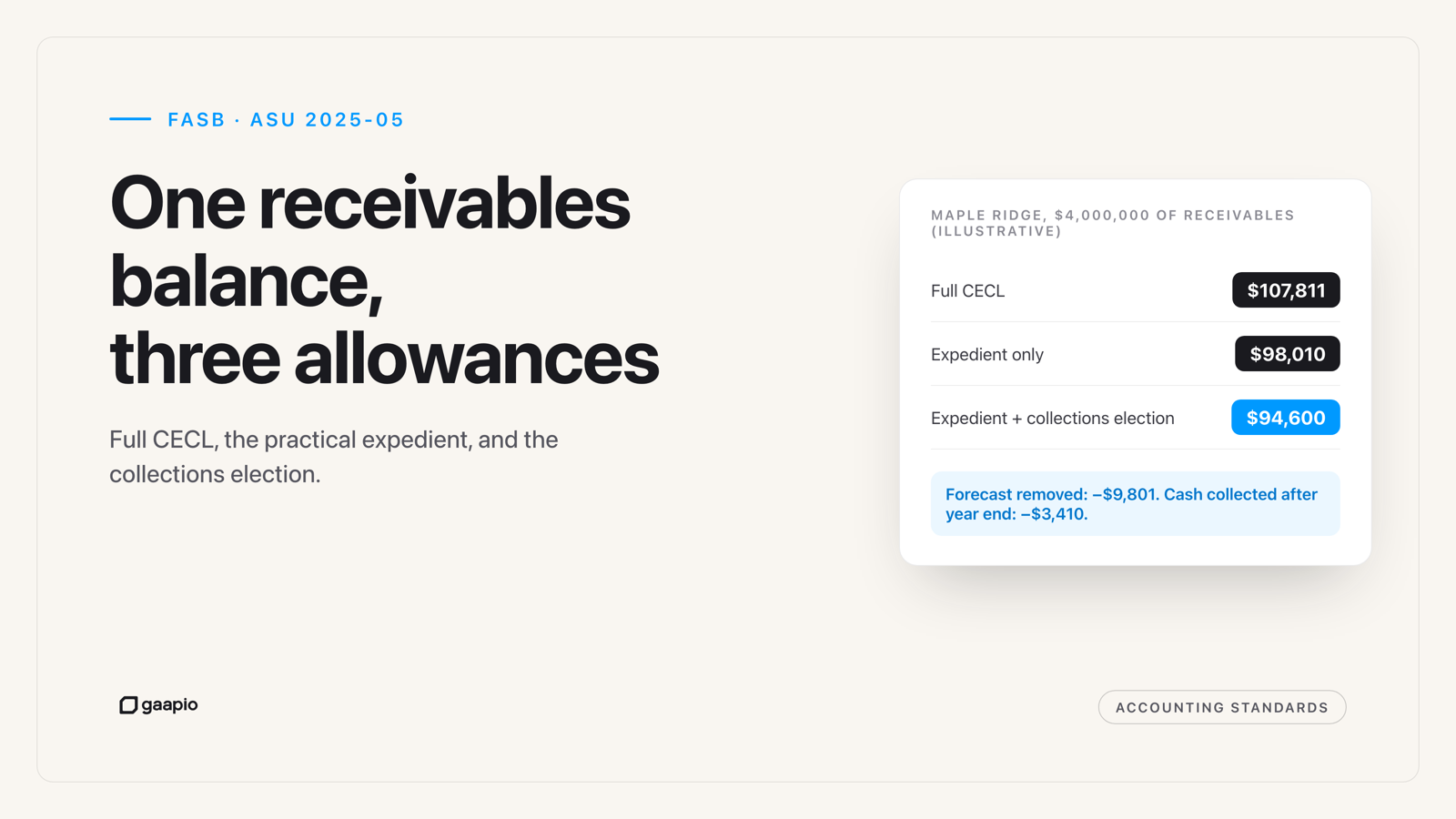
The allowance under full CECL is $107,811, or 2.70% of the gross balance.
Scenario B: practical expedient only
Maple Ridge elects the expedient. The current-conditions adjustment stays, because conditions in its customers' market are weaker today. The forecast adjustment goes, because the entity assumes conditions at December 31 persist. The allowance is the current-conditions column of Scenario A: $98,010, or 2.45% of the balance. The expedient removed $9,801 of forecast-driven reserve and the evidence needed to support it. A PBE can stop here.
If the opening allowance was $82,000 and the entity wrote off $12,000 of receivables during the year, credit loss expense is $28,010 ($98,010 ending allowance, less $82,000 opening, plus $12,000 written off):
| Account | Debit | Credit |
|---|---|---|
| Credit loss expense | $28,010 | |
| Allowance for credit losses | $28,010 |
Scenario C: expedient plus the collections election
Maple Ridge also elects the policy to consider collections through March 15, 2027. At that date, the uncollected balances from the December 31 aging are:
| Aging bucket | Balance at Dec 31, 2026 | Uncollected at March 15, 2027 | Share uncollected, actual |
|---|---|---|---|
| Current | $2,400,000 | $100,000 | 4.2% |
| 1 to 30 days past due | $900,000 | $150,000 | 16.7% |
| 31 to 60 days | $400,000 | $120,000 | 30.0% |
| 61 to 90 days | $200,000 | $80,000 | 40.0% |
| Over 90 days | $100,000 | $70,000 | 70.0% |
| Total | $4,000,000 | $520,000 |
Of the $4,000,000, $3,480,000 was collected and carries no allowance. The $520,000 that is left needs a rate. The approach the ASU illustrates removes the collected balances, then assesses what remains by its delinquency status at the cutoff date. The ASU also permits an entity that uses an aging schedule to update its historical loss rates for post-balance-sheet collections, and does not require it. Maple Ridge keeps its history by December 31 bucket, so it updates its rates for post-balance-sheet collections and does not apply the unadjusted rates, which were measured against the full bucket balance. In its look-back, 5%, 15%, 32%, 40% and 75% of the five buckets (current through over 90 days) were still uncollected at a comparable cutoff. Dividing the historical loss by that uncollected balance gives updated rates of 8.0%, 10.0%, 12.5%, 25.0% and 40.0%. The rates rise with the age of the bucket, as they should.
| Aging bucket | Uncollected | Updated rate | Loss at that rate | With current-conditions adjustment (×1.10) |
|---|---|---|---|---|
| Current | $100,000 | 8.0% | $8,000 | $8,800 |
| 1 to 30 days past due | $150,000 | 10.0% | $15,000 | $16,500 |
| 31 to 60 days | $120,000 | 12.5% | $15,000 | $16,500 |
| 61 to 90 days | $80,000 | 25.0% | $20,000 | $22,000 |
| Over 90 days | $70,000 | 40.0% | $28,000 | $30,800 |
| Total | $520,000 | $86,000 | $94,600 |
The allowance is $94,600, or 2.37% of the gross balance. It is lower than Scenario B because, in total, Maple Ridge collected more after year end than its history predicted: $520,000 was left uncollected, against $538,000 that the historical pattern would have left. Had collections matched the pattern, the updated rates would have returned the same allowance as Scenario B. The method matters. Maple Ridge's updated rates are measured on balances still uncollected at a comparable cutoff, so they reflect where those balances stand at March 15 even though the table keeps the December 31 bucket labels. An entity that re-ages each open balance to its delinquency status at March 15 and applies rates built for those buckets may get a different answer. Agree the approach with your auditor before year end.
What the three results show
| Scenario | Allowance | % of gross balance | What drives the difference |
|---|---|---|---|
| A. Full CECL | $107,811 | 2.70% | History, current conditions and a forecast over the receivables' remaining life |
| B. Expedient only | $98,010 | 2.45% | Forecast removed; current conditions stay |
| C. Expedient plus collections election | $94,600 | 2.37% | Cash collected through March 15, 2027 removes balances from the base |
The expedient moves the number by the size of the forecast adjustment. The election moves it by what actually happened after year end. If a customer pays $400,000 on January 9, the election lets the financial statements reflect it, where without the election the allowance rests on conditions at the balance sheet date.
What do auditors look at on a receivables allowance?
They test the inputs before the output. In order, expect questions on the completeness and accuracy of the aging report, the pools and why they are right, the look-back period and whether it covers a stress period, the basis for each current-conditions adjustment, and whether the entity followed its own policy the same way last period.
For an entity that elects the collections policy, add four more: the cutoff date and why it was chosen, that cash received was applied to the right invoices and not to later billings, that credit memos and disputes were not counted as collections, and that the updated rates are consistent with the cutoff. Subsequent cash that settles a different invoice than the one in the aging is an easy error to make and an easy one for an auditor to find.
Do not let the expedient become a reason to skip the memo. It reduces the evidence you need for the forecast. It does not reduce the evidence for the pools, the history or the current-conditions adjustment.
Should you elect the expedient and the collections policy?
For most entities with short-term trade receivables, the expedient is worth electing if the forecast has never changed your rates. It removes a judgment you would otherwise document each quarter. The cases where you might not elect it are entities with a customer base that is highly sensitive to a measurable external driver, where the forecast is how the allowance responds to a downturn before it shows up in aging.
The collections policy is a bigger decision for a non-PBE. It reduces the allowance when collections are strong, and it adds a year-end process: cutoff, cash application and rate updates have to be done under a close deadline. Entities with a reliable cash application process and a consistent time to close will find it easiest. An entity whose statements are available to be issued two weeks after year end gets little from a policy that looks forward two weeks.
Both the expedient and the collections policy must be applied consistently to all in-scope receivables and contract assets, and disclosed. This is general information for accounting professionals. Your facts, your auditor and the Codification govern.
How does Gaapio help with a CECL receivables memo?
Gaapio is an AI-powered technical accounting platform built by CPAs. The guidance updates page tracks FASB, IASB, PCAOB and SEC updates daily and alerts you when guidance changes, so a standard like ASU 2025-05 reaches you when it is issued. When you write the memo that records your pools, your rates and your election, Gaapio drafts it with Codification citations you can check, and your team keeps the judgment on the rates and the elections. See it on your own receivables memo: request a demo.
Frequently asked questions
What is ASU 2025-05?
ASU 2025-05 is the FASB's July 30, 2025 update to ASC 326-20 for current accounts receivable and current contract assets from ASC 606 transactions. It adds a practical expedient that assumes current conditions persist for the life of the asset, and an accounting policy election to consider collections after the balance sheet date for entities that are not public business entities.
When is ASU 2025-05 effective?
It is effective for annual reporting periods beginning after December 15, 2025, and interim periods within those years. A calendar-year company adopts in fiscal year 2026. Early adoption is permitted for periods whose financial statements have not been issued or made available to be issued, and the ASU is applied prospectively.
Can a public company use the practical expedient?
Yes. The practical expedient is available to all entities, including public business entities. The collections policy election is not: it is limited to entities other than public business entities that also elect the expedient.
Does the practical expedient mean I can ignore current conditions?
No. The expedient removes the forecast. You still adjust historical loss information for differences between the historical period and conditions at the balance sheet date, and for characteristics specific to the assets, such as a customer in financial distress.
What receivables does ASU 2025-05 cover?
It covers current accounts receivable and current contract assets arising from transactions accounted for under ASC 606, including those acquired in a business combination. Current means collectible within one year, or the operating cycle if longer. Short-term loan receivables, insurance premiums receivable, lease receivables and noncurrent receivables are outside it.
Do I have to update my loss rates if I elect the collections policy?
The ASU permits an entity that uses an aging schedule to update its loss rates for post-balance-sheet collections, and does not require it. Uncollected balances are assessed by their delinquency status at the cutoff date. If your history is organized by year-end bucket, rates measured on the full year-end balance can understate the allowance, so update them for the collections and be ready to explain the method to your auditor.
What are the disclosure requirements for ASU 2025-05?
An entity that elects the expedient discloses that fact. A non-PBE that also elects the collections policy discloses both elections, and annual financial statements state the date through which subsequent cash collections were considered. The existing ASC 326-20 disclosures otherwise remain.
Is CECL different for private companies and public companies?
The measurement model is the same, and the effective dates for ASC 326 differed historically. ASU 2025-05 differs in two places: only non-PBEs can elect the collections policy, and only non-PBEs can elect either option after the effective date without justifying preferability.
How is the aging method different from a loss-rate method?
They are the same family. An aging method applies a loss rate to each days-past-due bucket. A simple loss-rate method applies one rate to the whole balance. Aging picks up a shift in delinquency that a single rate can mask, and it is the method used in the ASC 326-20-55 trade receivables example.
Related reading
Sources: FASB ASU 2025-05 (issued July 30, 2025); FASB ASC 326-20-30-2, 30-8, 30-9 and the aging-schedule example in 326-20-55; Deloitte, Heads Up: FASB Amends Guidance on the Measurement of Credit Losses for Accounts Receivable and Contract Assets; BDO, Measurement of Credit Losses for Accounts Receivable and Contract Assets; Grant Thornton, Measuring credit losses; Withum, ASU 2025-05; RSM, Amended guidance for measuring credit losses on short-term receivables.