

Every 10-K has a paragraph that gets copied forward and never rewritten.
It sits in the "recently issued accounting standards" note. Last year's text, with the dates nudged. This guide covers what SAB 74 (SAB Topic 11.M, with the related staff announcement at ASC 250-10-S99-6) requires, which ASUs belong in that note in 2026 filings, and how the wording should change as each effective date gets closer. It ends with sample language for one invented company at three points on the road to adoption.
This is general information about accounting and SEC reporting. It is not accounting or legal advice. Management owns the conclusion for your filings, with input from your auditor and counsel.
Key takeaway: SAB 74 says SEC registrants should disclose the effects of recently issued accounting standards that they have not yet adopted, unless the impact on financial position and results of operations is not expected to be material. The disclosure should cover what the standard is, when it takes effect, how you will adopt it, and what you expect the impact to be. The SEC staff has said it expects these disclosures to become more informative as the effective date approaches. A line that was fine two years before adoption is rarely enough once the adoption year begins.
What is SAB 74 (SAB Topic 11.M)?
SAB 74 is a Staff Accounting Bulletin. It sets out the SEC staff's view that registrants should disclose the expected effects of new accounting standards before they take effect. It is also known as SAB Topic 11.M. The related SEC staff announcement is in the Codification at ASC 250-10-S99-6.
It applies to SEC registrants, including companies filing a registration statement for an IPO. Private companies are not subject to it. Emerging growth companies that elected private-company effective dates should use those dates, not the public business entity dates in the table below. Some standards in the table, including ASU 2024-03, apply only to public business entities, so emerging growth companies should confirm their dates with their auditor. The reason it exists is simple. Investors need to know what is coming before the standard shows up in the numbers.
SAB 74 refers to the effect on the financial statements, which includes the notes. A standard that changes only the footnotes can still trigger it.
What does a SAB 74 disclosure have to include?
A SAB 74 disclosure should cover four things: what the standard is and when it is required, the methods of adoption, the expected impact on the financial statements, and any other significant matters. Those items come from the bulletin itself, as summarized in Deloitte's SEC comment letter roadmap.
| SAB 74 item | What to write |
|---|---|
| 1. Description and date | A brief description of the standard and the date adoption is required. Add the planned adoption date if you will adopt early |
| 2. Methods of adoption | The methods the standard allows, and the method you expect to use, if you have decided |
| 3. Expected impact | The impact on your financial statements. If the impact is not known or not reasonably estimable, say so |
| 4. Other significant matters | Anything else that adoption could cause, such as a technical violation of a debt covenant or a planned change in business practices |
The bulletin carves out standards where the impact is "not expected to be material." That is a judgment, and you should be able to support it.
What if you can't estimate the impact yet?
Say so, and then say more than that. In September 2016, the SEC staff addressed the revenue recognition, leases and credit losses standards. For a registrant that could not yet estimate the impact, the staff suggested qualitative disclosure about:
- The accounting policies you expect to select on adoption
- How those policies may differ from the ones you use today
- The status of implementation, and the significant matters still open
Those remarks were about three specific standards. In practice, they have become the working template for any large standard where the number is not ready.
How do you write the recently issued accounting standards disclosure?
Start with the ASU number and title, state the effective date and the transition method, and then give the expected impact in the most specific terms you can support. SAB 74 addresses both MD&A and the notes to the financial statements. Most registrants put the full disclosure in the notes and discuss the most significant standards in MD&A.
Three habits make the note stronger:
- Group by effect. Standards you expect to matter get their own paragraph. Standards you expect to be immaterial can share one sentence.
- Use the same words everywhere. If an earnings call says the standard will have a "significant" effect, the 10-K should not say "not expected to be material."
- Refresh it every filing. An ASU that went from "evaluating" to "decided on prospective adoption" should read differently in the next 10-Q.
Which ASUs do public companies need to disclose in 2026 filings?
As of October 26, 2026, a calendar-year public business entity has these ASUs issued but not yet effective. Each is a candidate for the note. The "first annual period" column shows the year of the first annual report that includes the new guidance.
| ASU | What it covers | Effective for public business entities | First annual period (calendar year) | Where it tends to matter |
|---|---|---|---|---|
| 2026-01 | Initial measurement of paid-in-kind dividends on equity-classified preferred stock (Topic 505) | Annual periods beginning after Dec 15, 2026, including interim periods | 2027 (first 10-Q: Q1 2027) | Companies with PIK preferred stock; others generally omit it |
| 2025-12 | Codification Improvements | Annual periods beginning after Dec 15, 2026, including interim periods | 2027 (first 10-Q: Q1 2027) | Usually immaterial; check the specific amendments |
| 2025-09 | Hedge accounting improvements (Topic 815) | Annual periods beginning after Dec 15, 2026, including interim periods | 2027 (first 10-Q: Q1 2027) | Companies with hedging programs |
| 2025-08 | Credit losses on purchased loans (Topic 326) | Annual periods beginning after Dec 15, 2026, including interim periods | 2027 (first 10-Q: Q1 2027) | Banks and lenders |
| 2025-07 | Derivatives scope refinements and share-based noncash consideration (Topics 815 and 606) | Annual periods beginning after Dec 15, 2026, including interim periods | 2027 (first 10-Q: Q1 2027) | Contracts with embedded features; noncash consideration from customers |
| 2025-04 | Clarifications to share-based consideration payable to a customer (Topics 718 and 606) | Annual periods beginning after Dec 15, 2026, including interim periods | 2027 (first 10-Q: Q1 2027) | Companies that grant equity awards to customers |
| 2025-03 | Determining the accounting acquirer in the acquisition of a VIE (Topics 805 and 810) | Annual periods beginning after Dec 15, 2026, including interim periods | 2027 (first 10-Q: Q1 2027) | Companies planning VIE acquisitions |
| 2024-03 (clarified by 2025-01) | Disaggregation of income statement expenses (Subtopic 220-40), or DISE | Annual periods beginning after Dec 15, 2026, and interim periods within annual periods beginning after Dec 15, 2027 | 2027 (first 10-Q: Q1 2028) | Nearly every registrant. Read our DISE guide |
| 2025-06 | Internal-use software (Subtopic 350-40) | Annual periods beginning after Dec 15, 2027, including interim periods | 2028 | Software developers and companies that capitalize internal-use software. See our ASC 350-40 guide |
| 2025-11 | Interim reporting, narrow-scope improvements (Topic 270) | Interim periods within annual periods beginning after Dec 15, 2027 | n/a, interim only (first 10-Q: Q1 2028) | Every registrant that files 10-Qs, though usually a small effect |
| 2026-02 | Environmental credits and environmental credit obligations (new Topic 818) | Annual periods beginning after Dec 15, 2027, including interim periods | 2028 | Companies that buy, hold or surrender environmental credits |
| 2025-10 | Government grants received by business entities (new Topic 832) | Annual periods beginning after Dec 15, 2028, including interim periods | 2029 | Companies that receive grants |
| 2023-06 | Disclosure improvements, in response to the SEC's disclosure update and simplification initiative | Tied to the SEC removing the related requirements from Regulation S-X or S-K. If the SEC has not done so by June 30, 2027, the amendment will not take effect | Not fixed | Watch for the SEC's action |
Early adoption is permitted for these ASUs except ASU 2023-06, which prohibits it for SEC registrants. For ASU 2025-06 and ASU 2026-02, early adoption is allowed only as of the beginning of an annual period. For a calendar-year filer, most rows take effect January 1, 2027, so the Q3 2026 10-Q and the 2026 10-K are the last filings where they are SAB 74 items. The last column is our judgment of who is affected, not part of any standard. Your own materiality assessment decides what goes in your note.
ASU 2026-03 (investment companies with equity securities subject to contractual sale restrictions) applies only to investment companies under Topic 946 (annual periods beginning after December 15, 2027, issued September 9, 2026), so it is left out of this table.
What is ASU 2026-02?
ASU 2026-02, Environmental Credits and Environmental Credit Obligations, was issued May 19, 2026. It creates Topic 818, a model for recognizing, measuring, presenting and disclosing environmental credits and the compliance obligations that can be settled with them. It is effective for public business entities for annual periods beginning after December 15, 2027, and for all other entities one year later. Early adoption is permitted.
That puts the first annual report with Topic 818 at 2028 for a calendar-year public company.
Which standards have dropped off the list?
A standard drops off the SAB 74 list when you adopt it. After that it moves to a "recently adopted" paragraph and the ASU's own transition disclosures apply.
ASU 2023-09 (income tax disclosures) is the one most readers look for. Public business entities adopt it for annual periods beginning after December 15, 2024, so calendar-year filers adopted it in their 2025 10-K. A few fiscal-year filers are still in their adoption year. For most registrants, it now belongs in the adopted section. Our ASU 2023-09 guide covers the rate reconciliation and income taxes paid disclosures.
ASU 2024-04 (induced conversions) and ASU 2025-05 (credit losses on current receivables) were effective for annual periods beginning after December 15, 2025, so they moved to the adopted section in 2026 calendar-year filings. ASU 2023-07 (segment reporting) is also past SAB 74. It was effective for fiscal years beginning after December 15, 2023, and interim periods within fiscal years beginning after December 15, 2024, so calendar-year filers adopted it in their 2024 10-K.
At the 2023 AICPA & CIMA Conference, then-SEC Deputy Chief Accountant Melissa Rocha highlighted the SAB 74 requirements for the new segment reporting standard (ASU 2023-07) and the then-forthcoming income tax (ASU 2023-09) and crypto asset (ASU 2023-08) standards, according to Deloitte. The staff has also said it expects SAB 74 disclosures to become more informative as adoption dates approach. That is the standard to hold your own drafts against.
Do you have to disclose a standard you expect to be immaterial?
No, if you can support the conclusion. SAB 74 asks for disclosure unless the impact is not expected to be material. That includes disclosure-only standards. A change that never touches a number on the balance sheet can still affect the footnotes enough to matter.
A practical rule: write a short, dated conclusion for each issued ASU. "Reviewed by the technical accounting team, reporting impact limited to presentation, no change to amounts." Keep it in the file. It answers the question an auditor or the SEC staff may ask later, which is how you decided. For standards that do not apply to your company at all, leave them out rather than listing them.
How should the disclosure change as adoption gets closer?
The disclosure should get more specific with each filing: first what the standard is, then the method and the status of your work, and finally a quantified or partly quantified impact. The SEC staff has said it expects these disclosures to become more informative as the adoption date approaches, and it raised SAB 74 again at the 2023 AICPA & CIMA Conference. In practice that usually means first what the standard is, then the method and the status of your work, and finally a quantified or partly quantified impact. A paragraph can be adequate in one quarter and draw a comment in a later one.
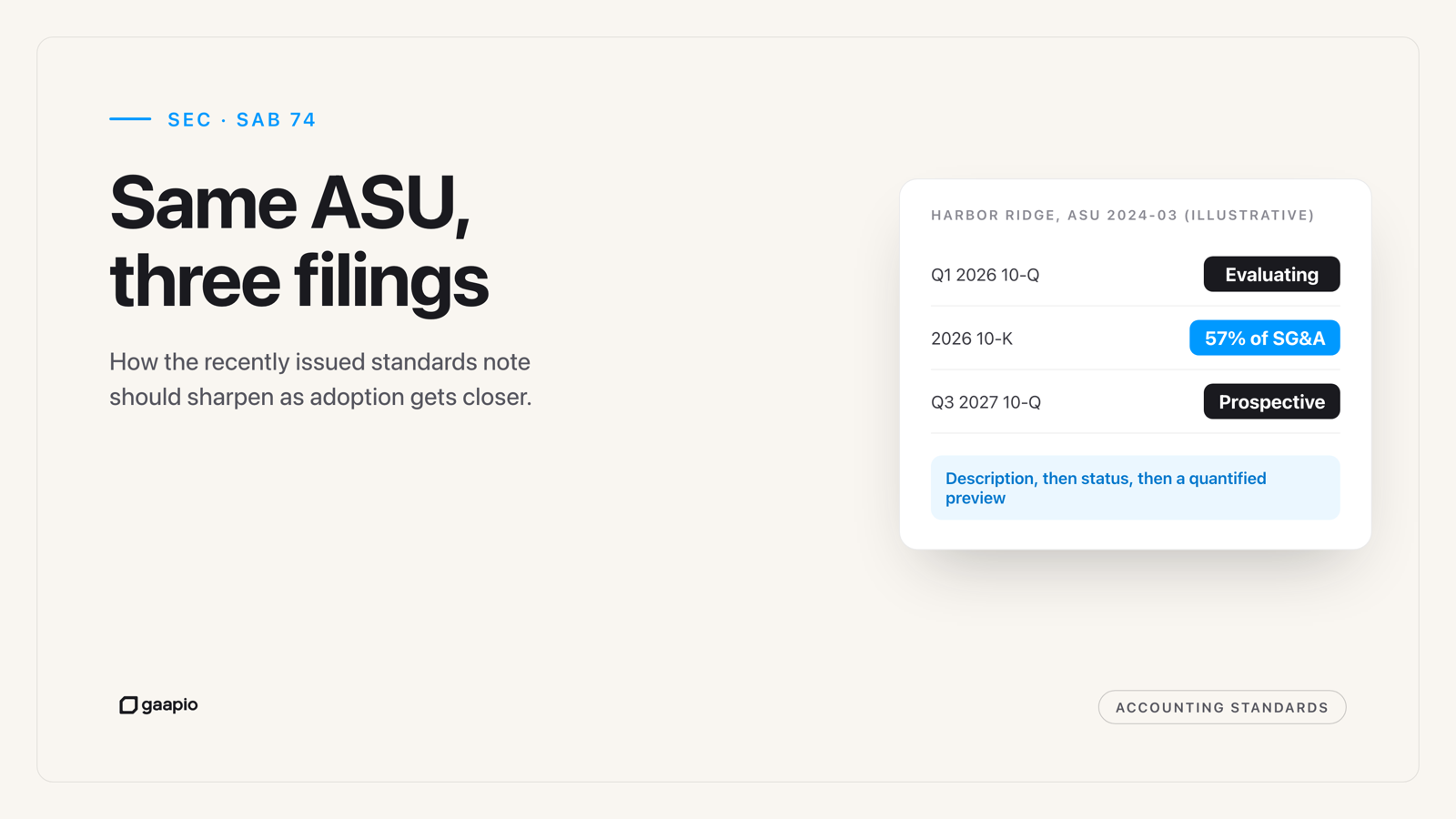
Here is how that looks in practice. Harbor Ridge Components, Inc. is an invented calendar-year manufacturer. Everything below is illustrative. Its standard is ASU 2024-03 (DISE). The adoption year is 2027, so the first required disclosure is in its 2027 10-K.
| Filing | What changes in the note |
|---|---|
| Q1 2026 10-Q (early) | Description, effective date, a statement that work is underway |
| 2026 10-K (adoption year begins) | Method under consideration, what has been done, what is open, a preview of the largest category |
| Q3 2027 10-Q (last 10-Q before the first required disclosure) | Method decided, a dry run on year-to-date numbers, where the first disclosure will appear |
Early in the year: Q1 2026 10-Q
In November 2024, the FASB issued ASU 2024-03, Disaggregation of Income Statement Expenses (Subtopic 220-40), which requires additional footnote disclosure about specific natural expense categories within relevant income statement captions. The ASU is effective for our annual period ending December 31, 2027, and for interim periods beginning with the quarter ending March 31, 2028. Early adoption is permitted. The ASU affects disclosures only. We are evaluating its effect on our consolidated financial statements and related disclosures.
This is acceptable early on, when the first required disclosure is almost two years away. The weak spot is readiness. The adoption year starts in eight months, and DISE needs full-year 2027 natural-expense data, yet the note says nothing about it.
The adoption year begins: 2026 10-K
ASU 2024-03, effective for our annual period ending December 31, 2027 and for interim periods beginning in 2028, requires us to disclose, in a tabular footnote, amounts for specified natural expense categories, such as purchases of inventory, employee compensation, depreciation and intangible asset amortization, included in each relevant expense caption on our income statement, along with a qualitative description of the remaining amounts and our total selling expenses and how we define them. The ASU permits prospective or retrospective application, and we currently expect to apply it prospectively. The ASU does not change the amounts or the presentation of our income statement, balance sheet or cash flows. Our assessment is substantially complete for cost of sales and in progress for selling, general and administrative expenses. Based on our preliminary mapping, employee compensation represented approximately 57% of 2026 SG&A expenses. Remaining work includes finalizing the allocation of shared costs between cost of sales and SG&A. Our reporting systems began capturing the required categories on January 1, 2027. We do not expect the ASU to affect debt covenants or our business practices.
Because the 2026 10-K is filed after the adoption year has started, it should say whether 2027 data is already being captured. This version adds the method, the status, the open items, a preview of one category and the "other significant matters" statement. The 57% is a partial quantitative estimate. It tells the reader what the footnote will look like without pretending the work is finished.
If you give a number like this, it becomes a public statement. The next filing should either repeat it or explain the change.
The last 10-Q before the first disclosure: Q3 2027 10-Q
ASU 2024-03 is effective for our fiscal year ending December 31, 2027. We will apply it prospectively and first present the required disclosures in our 2027 Annual Report on Form 10-K, and in our interim reports beginning with the quarter ending March 31, 2028. The ASU does not change our financial position, results of operations or cash flows. Applying the ASU's categories to the nine months ended September 30, 2027, employee compensation represented approximately 56% of SG&A expenses, consistent with our preliminary estimate. We have completed the allocation of shared costs and updated our reporting systems, and we have implemented controls over the new disclosure.
This version states the decision, the first filing in which the disclosure appears, and the result of a dry run. It also reports that controls are in place. Nothing is left in "evaluating."
A standard you expect to be immaterial
In December 2025, the FASB issued ASU 2025-11, Interim Reporting (Topic 270): Narrow-Scope Improvements, which clarifies interim disclosure requirements and is effective for our interim periods beginning January 1, 2028. Early adoption is permitted. We do not expect the ASU to have a material impact on our condensed consolidated financial statements.
One sentence is enough when it is true, and the file holds the support.
What do SEC comments on SAB 74 look like?
The staff asks registrants to quantify the expected impact when they can, and to give more specific qualitative disclosure when they can't. Deloitte's roadmap shows two patterns.
- Credit losses. The staff asked a registrant to include in future filings the quantitative information about the allowance build that its CFO had discussed at a conference but that was not in its 10-K, citing SAB Topic 11.M.
- Leases. The staff asked a registrant that expected a material balance sheet effect to quantify the impact where it could. Where it could not, the staff asked for more specific qualitative disclosure, the status of implementation, and the significant matters still to be addressed.
The pattern is consistent. The staff compares what you say in the note with what you say elsewhere, and asks you to close the gap.
Which controls and approvals sit behind the disclosure?
The note should have an owner and a review trail like any other disclosure. A workable setup looks like this:
- Technical accounting maintains a log of every issued ASU, with its effective date, transition method and materiality conclusion.
- The reporting team pulls from that log each quarter and updates the note.
- The audit committee sees the list of material standards and the status of each.
- The disclosure committee compares the note with MD&A, earnings call scripts and investor materials before each filing. The SEC staff makes the same comparison, as the credit losses comment above shows. Your auditor reviews the note as part of the audit or interim review.
Most of the pain comes from the first item. If the log lives in last quarter's Word file, nobody notices that an ASU has been added, that a date has moved or that a conclusion has gone stale.
How does Gaapio help with SAB 74 disclosures?
Gaapio is an AI-powered technical accounting platform built by CPAs. Its Guidance Updates page tracks new FASB, IASB, PCAOB and SEC guidance, with summaries written and reviewed by certified professionals. For SAB 74 work, that means new ASUs reach your team as they are issued, without someone checking fasb.org.
Your team still decides materiality, the adoption method and the wording. Those are judgments, and they belong to you and your auditor.
Request a demo to see how a technical accounting team keeps this list current.
Frequently asked questions
What is SAB 74?
SAB 74 is a Staff Accounting Bulletin that sets out the SEC staff's view that SEC registrants should disclose the expected effects of accounting standards that have been issued but not yet adopted. It is also known as SAB Topic 11.M, and the SEC staff's related 2016 announcement is codified at ASC 250-10-S99-6. The disclosure can be omitted only when the impact is not expected to be material.
Is SAB 74 the same as SAB Topic 11.M?
Yes. SAB 74 is the bulletin number and SAB Topic 11.M is its place in the SEC staff's topical index. The SEC staff's 2016 announcement on applying it is codified at ASC 250-10-S99-6, the Codification reference most firms cite alongside it.
Does SAB 74 apply to private companies?
No. SAB 74 applies to SEC registrants. Private companies are not subject to it, although lenders, investors and acquirers sometimes ask for similar information. Private companies adopt many ASUs on later effective dates than public business entities.
What is ASU 2026-02?
ASU 2026-02 is the FASB's Environmental Credits and Environmental Credit Obligations standard, issued May 19, 2026. It creates Topic 818. Public business entities adopt it for annual periods beginning after December 15, 2027, and all other entities for annual periods beginning after December 15, 2028. Early adoption is permitted.
Do disclosure-only standards need a SAB 74 disclosure?
They can. SAB 74 turns on whether the impact is expected to be material, not on whether a number changes. At the 2023 AICPA & CIMA Conference, the SEC staff reminded registrants of SAB 74 for the segment reporting standard (ASU 2023-07) and the upcoming income tax disclosure standard (later issued as ASU 2023-09), both disclosure standards, according to Deloitte. A disclosure-only standard that touches many footnotes can warrant more than a one-line mention.
What should we say if we can't estimate the impact yet?
State that you cannot reasonably estimate it, then give qualitative disclosure: the accounting policies you expect to elect, how they may differ from your current policies, the status of implementation, and the significant matters still open. The SEC staff described this approach in 2016 for the revenue, leases and credit losses standards, and registrants use it for other large standards.
Does early adoption end the SAB 74 disclosure?
Yes, for that standard. Once you adopt, the standard is no longer issued but not yet adopted. Disclose it in your recently adopted paragraph and give the transition disclosures the ASU requires. The earlier filings still stand.
Do 10-Qs need the disclosure too?
The bulletin does not draw a line between annual and interim filings. According to a PLI SEC Institute summary of the September 2016 announcement, the staff said it would be appropriate to include disclosures about the three standards it was discussing in interim filings before year-end. Most registrants carry the note in each 10-Q and update it as plans change.