

Close day eight arrives and the trial balance ties. The controller team is ready to call it done. Weeks later, in the interim review, the auditor asks one question: where is the evidence that anyone reviewed the accrual rollforward before those numbers went into the 10-Q?
A generic close checklist stops at "books are closed." A public or pre-IPO company closes the books and then has to prove the close, tell the SEC about it, and survive an interim review. This guide covers the month-end close checklist, the extra steps that a quarter-end close adds, and the technical accounting and SEC reporting items that generic checklists skip: cutoff, reconciliations, flux analysis, accrual and reserve memos, subsequent events under ASC 855, the disclosure checklist, SOX control evidence, and 10-Q tie-out.
Key takeaway: A month-end close checklist for a public or pre-IPO company has to produce three things: books that are right, support showing who prepared and reviewed each number and when, and technical accounting conclusions written down before the 10-Q draft goes to the auditor. The month-end close covers cutoff, reconciliations, accruals and flux analysis. The quarter-end close adds reserve and judgment memos, a subsequent events evaluation under ASC 855, the disclosure checklist, SOX evidence, and a tie-out of every number in the 10-Q to the ledger. This guide includes a close calendar by day, with a worked example.
What is a month-end close checklist?
A month-end close checklist is the ordered list of tasks, owners and evidence a finance team completes after a period ends so that the general ledger is complete, accurate and ready for reporting. The ordering matters more than the list: cutoff first, then subledgers, then reconciliations, then accruals and adjustments, then flux analysis, then review and lock.
For a public or pre-IPO company, each task also needs a trail. Once a company has filed its first annual report, management has to maintain internal control over financial reporting (ICFR), and every registrant has to evaluate its disclosure controls and procedures each quarter under Exchange Act Rule 13a-15. A pre-IPO company is not yet subject to either, but the books-and-records and internal accounting control provisions of Section 13(b)(2) apply as soon as it registers, and the rest follows soon after. So the checklist is also a control document. Every line answers four questions: who does it, who reviews it, when, and where the evidence lives.
A generic checklist built for private companies tends to stop at "post accruals, reconcile, run the reports." The sections below add what an SEC registrant, or a company preparing to become one, needs on top.
What is the financial close process, and how is it different from the month-end close?
The financial close process is the full cycle of steps that turns transactions into financial statements and disclosures for a period. The month-end close is the recurring part. The quarter-end close is the month-end close plus the work needed to file a Form 10-Q: interim financial statements and footnotes, MD&A, certifications, and an auditor review.
A short way to hold it: the month-end close produces the numbers. The quarter-end close produces the numbers, the judgments behind them, and the filing.
| Month-end close | Quarter-end close | |
|---|---|---|
| Output | Management financials | Management financials plus the Form 10-Q |
| Who reviews | Controller, CFO | Controller, CFO, disclosure committee, audit committee, auditor interim review |
| Technical accounting | Routine accruals, new transactions as they arise | Reserve and judgment memos, impairment indicators, interim tax provision, subsequent events |
| Disclosure | Little or none | Interim footnotes, MD&A, Item 4 controls disclosure |
| Control evidence | Preparer and reviewer sign-off on reconciliations | The same, plus sub-certifications and Section 302 certifications |
| Deadline | Internal | 40 days (large accelerated and accelerated filers) or 45 days (others) after quarter-end |
The 10-Q deadlines come from the General Instructions to Form 10-Q and Exchange Act Rule 13a-13. If the due date falls on a weekend or a federal holiday, Exchange Act Rule 0-3 moves it to the next business day. For the quarter ended September 30, 2026, day 40 is Monday, November 9, 2026. Day 45 is Saturday, November 14, so a 45-day filer has until Monday, November 16, 2026.
In May 2026 the SEC proposed letting registrants elect semiannual reporting on a new Form 10-S in place of the 10-Q. As of this writing it is a proposal, not a final rule, so check its status before you change your calendar.
What should be on a month-end close checklist for a public company?
Eight blocks of work make up a month-end close. The table below shows them in order, with the evidence each one should leave behind. This is the baseline. The quarter-end additions follow in the next section.
| Step | What gets done | Evidence to keep |
|---|---|---|
| 1. Cutoff | Stop the period. Confirm receipts, shipments, invoices and expense reports land in the right month. Review goods received not invoiced, unbilled revenue, and manual journal entries posted in the first days of the next period | Cutoff procedure signed off, listing of items reviewed and period assigned |
| 2. Subledger close | Close accounts payable, accounts receivable, fixed assets, inventory, payroll and revenue subledgers. Run subledger-to-GL tie-outs | Tie-out report by subledger, with reconciling items explained |
| 3. Reconciliations | Reconcile every balance sheet account to support: bank, debt, intercompany, prepaid, accruals, deferred revenue, equity | Reconciliation with preparer, reviewer, dates, and support attached |
| 4. Accruals and reserves | Book recurring accruals. Update estimates (bonus, commissions, warranty, credit losses, inventory reserves). Document the basis for each estimate | Accrual schedule with the calculation and the source of each input |
| 5. Adjustments and journal entries | Post standard and nonstandard entries. Review manual entries for authorization, unusual accounts and round amounts | Journal entry listing with approvals; review of manual entries |
| 6. Flux analysis | Compare the period to the prior period and to budget or forecast. Investigate variances above your threshold | Flux workbook with explanations and corroboration, reviewed by someone above the preparer |
| 7. Reporting package | Prepare trial balance, financial statements, key metrics and non-GAAP reconciliations | Package with a tie-out checklist |
| 8. Review and lock | Controller and CFO review. Lock the period. Log any post-close adjustments | Sign-off, lock record, post-close adjustment log |
Two of these steps cause more trouble than their size suggests, so they get their own sections below: cutoff and flux analysis.
How do you get cutoff right?
Cutoff means each transaction is recorded in the period where the economic event happened, not in the period when the paperwork showed up. The test is date of the event versus date of the entry. Revenue follows transfer of control under ASC 606, and expenses follow when the goods or services were received.
Three cutoff checks catch most of the problems:
- Search for unrecorded liabilities. Review disbursements and invoices received after period-end, and compare what you received to what you accrued.
- Match shipping or delivery dates to revenue dates. For product companies, this ties to transfer of control. For software and services, confirm service periods against the revenue schedule.
- Review the first days of the next period. Manual entries posted on day one or two that reference the closed period deserve a second look.
Cutoff is also where the year-end auditor starts. An auditor searching for unrecorded liabilities will pick through your first weeks of subsequent payments, and in an interim review the auditor may ask how you checked cutoff. If your own team already ran the search, you will not hear about it for the first time from the audit team.
What do reconciliations need to show?
A reconciliation compares a general ledger balance to independent support and explains every difference. For a SOX-scoped account, the preparation and review of the reconciliation is usually the control, and the reconciliation is its evidence, so it has to show who prepared it, who reviewed it, and when.
A reconciliation that satisfies a skeptical reviewer has five features:
- The ledger balance agrees to the trial balance for that date.
- The support is independent: a bank statement, a third-party confirmation, a subledger report, or a schedule from the system of record.
- Reconciling items are listed, aged, and tied to a plan to clear them.
- The preparer and the reviewer are different people, and both sign and date.
- The reviewer's work leaves evidence of what they checked, such as a note on the tie-out or a tick mark on the support.
That last point is the one teams skip. A signature with no evidence of what the reviewer examined gives an auditor very little to rely on. We come back to review precision in the SOX evidence section.
How do you run flux analysis that holds up?
Flux analysis compares balances or results between periods, finds the movements that exceed a threshold, and explains them with something other than the movement itself. The explanation needs corroboration: a driver, a document, a person who confirmed it. "Revenue up due to higher sales" restates the variance and teaches nobody anything.
Four design choices decide whether the flux analysis is useful:
- Set thresholds by dollars and percent, and write them down. A common practice is to investigate a movement that exceeds both a dollar floor and a percentage. The numbers are your call. Scope them to materiality and document the logic.
- Compare to the right baseline. Prior month, same month last year, budget and forecast each answer a different question. Quarter-end analysis for the 10-Q should match the comparisons your MD&A uses. Item 303(c) requires year-to-date against the prior year-to-date, and the current quarter against either the same quarter last year or the immediately preceding quarter. Run flux on whichever basis you report, and keep the other as a reasonableness check.
- Run flux on ratios as well as lines. A gross margin that drops while every cost line stays under its threshold will not show up in a line-by-line review. The worked example below shows this.
- Track what you expected. Write down the expected movement before you open the variance. A movement you did not expect is the one to chase.
Flux analysis also feeds the 10-Q. Regulation S-K Item 303(c) asks for MD&A on interim periods, including material changes in results of operations and financial condition. The flux file is the first draft of that discussion. It is also the evidence that management reviewed the results for reasonableness, which is a common management review control.
What technical accounting work belongs in the quarter-end close?
Quarter-end is when the judgments get written down. A generic checklist says "review accruals." A registrant's checklist asks which estimates changed this quarter and whether the memo supporting each one is current.
Items that belong on the list every quarter:
- Accrual and reserve memos. For each significant estimate (loss contingencies under ASC 450-20, credit losses, inventory, warranty, variable compensation, revenue constraints under ASC 606), update the analysis and the conclusion. A reserve that moved needs a reason documented the quarter it moved. See our guide to ASC 450 contingencies.
- Impairment indicators. On top of the annual goodwill test, goodwill gets tested between annual tests when an event makes it more likely than not that fair value is below carrying amount (ASC 350-20), and long-lived assets get tested when events indicate the carrying amount may not be recoverable (ASC 360-10), so assess indicators at each quarter-end. Write down what you considered, even when the answer is no indicator.
- New or unusual transactions. Debt amendments, leases, acquisitions, equity awards, customer contract changes. Each one should have a memo concluding on the accounting before the quarter's books lock, or a documented plan to finish before the 10-Q is filed. Our guide to writing a technical accounting memo covers the structure.
- Interim income taxes. ASC 740-270 requires an estimated annual effective tax rate applied to year-to-date ordinary income, with discrete items recorded in the period they occur. If a reliable estimate cannot be made, ASC 740-270 allows the actual year-to-date rate. Refresh the estimate every quarter.
- Recently issued accounting standards. SAB Topic 11.M (SAB 74) asks registrants to disclose the expected effect of standards issued but not yet adopted. Update that disclosure each quarter. See our guide to SAB 74 disclosures.
The common failure is timing. The memo gets written after the numbers are final, and the numbers end up shaped by what the team had time to analyze. Put the memo deadlines on the close calendar ahead of the 10-Q draft date.
What are subsequent events under ASC 855, and what does the close have to do about them?
Subsequent events are events or transactions that occur after the balance sheet date but before the financial statements are issued. ASC 855 sorts them into two types. The first type provides additional evidence about conditions that existed at the balance sheet date, and it gets recognized in the financial statements. The second type reflects conditions that arose after the balance sheet date, and it gets disclosed (not recognized) if disclosure is needed to keep the financial statements from being misleading.
For an SEC filer (or a conduit bond obligor), the evaluation window runs through the date the financial statements are issued. An SEC filer is also not required to disclose the date through which it evaluated subsequent events. A company that is not an SEC filer evaluates through the date the financial statements are available to be issued and does disclose that date.
| Recognized (Type I) | Nonrecognized (Type II) | |
|---|---|---|
| Test | Event gives additional evidence about a condition that existed at the balance sheet date | Event reflects a condition that arose after the balance sheet date |
| Treatment | Adjust the financial statements | Disclose if needed to keep the statements from being misleading |
| Disclosure | Normal footnote for the item | Nature of the event and an estimate of its financial effect, or a statement that an estimate cannot be made |
| Typical examples | Settlement of litigation for a claim arising from events before period-end. Customer bankruptcy after period-end that results from a deteriorating financial condition that existed at period-end | Business combination after period-end. Loss from fire or casualty after period-end. Issuance of debt or equity after period-end |
The examples in the last row follow the illustrations in ASC 855-10-55. "Type I" and "Type II" are practice shorthand. ASC 855 itself says recognized and nonrecognized.
Here is what the close has to do about it. Someone owns the subsequent events step, and it runs on a dated cadence. The practical routine is:
- Inquire. Ask legal, treasury, tax, HR, sales and the business units what happened since period-end. Written confirmations beat hallway answers.
- Read. Review board and committee minutes, material contracts signed after period-end, legal letters, bank statements, and cash receipts and disbursements for the first weeks of the next period.
- Classify. For each item, decide recognized or nonrecognized and write down why.
- Roll forward to the issuance date. Repeat the inquiry right before the 10-Q is filed, and confirm nothing changed on the filing date itself. A subsequent events memo dated day 14 does not cover what happens by day 37.
- Disclose. Draft the footnote for anything nonrecognized and material.
Subsequent events is where the quarter-end close and the legal and treasury teams meet. A settlement agreed on day 15 that the finance team hears about on day 36 is a late adjustment waiting to happen.
What does the SEC reporting layer add to the close?
A Form 10-Q requires more than the numbers. The SEC reporting layer has five parts, and each one needs an owner and a date on the close calendar.
- Interim financial statements and footnotes under Regulation S-X Article 10. Interim footnotes can be condensed, but they must not be misleading, and they have to include disclosures about material events since the last annual report.
- MD&A under Regulation S-K Item 303. Explain material changes in results of operations and financial condition against the prior periods.
- Controls and procedures under Item 4 of Part I. The CEO and CFO state their conclusion on the effectiveness of disclosure controls and procedures (Item 307), and the company discloses any change in ICFR identified in the quarterly evaluation that materially affected, or is reasonably likely to materially affect, ICFR (Item 308(c)).
- Certifications. The CEO and CFO give Section 302 certifications and the Section 906 certification.
- Interim review. Regulation S-X Rule 10-01(d) requires that interim financial statements in a 10-Q be reviewed by an independent public accountant before filing. The auditor follows PCAOB AS 4105.
The disclosure checklist is the working document for step one. It lists the required disclosures by topic so that nothing drops out between quarters, and the team checks each line against the draft. If you do not have one, start from our glossary entry on the SEC disclosure checklist. Gaapio also reviews footnote disclosures against the Codification and against peer filers' disclosures: see AI footnote disclosures.
For a pre-IPO company, a few of these have different timing. A newly public company's first 10-Q, for the first fiscal quarter after the latest period in its registration statement, is due the later of 45 days after the effective date of the registration statement and the date the 10-Q would otherwise be due under Rule 13a-13. A newly public company also does not have to include management's ICFR report, or the auditor's attestation, until its second annual report. Instruction 1 to Regulation S-K Item 308 provides that transition, and the first annual report has to state that it does not include either report. Quarterly certifications and the evaluation of disclosure controls and procedures still apply from the first 10-Q. Until the first annual report that includes management's ICFR report, the certifications may omit the ICFR language in paragraph 4. Our guide to registration statements covers the S-1 side.
What does SOX control evidence look like at close?
SOX control evidence is documentation that a control operated, who performed it, who reviewed it, and when. Management has to be able to support its ICFR conclusion, and, for accelerated and large accelerated filers that are not emerging growth companies, the auditor's integrated audit under PCAOB AS 2201 tests the controls directly, often by inspecting and reperforming what management kept. At close, the controls that matter are reconciliations, journal entry review, estimate and judgment review, and the management review of financial statements and flux.
For each close control, keep four things:
- The control description, including frequency, owner and the risk it addresses.
- The evidence it ran: the completed reconciliation, the approved journal entry listing, the signed checklist.
- The reviewer's precision: what they compared, what threshold triggered a follow-up, and what they asked about. A review control whose evidence says only "reviewed" is hard to rely on.
- Information used in the control (IPE). If a control relies on a system report, you need support that the report is complete and accurate: the parameters, the source, and a check of the output.
Management's assessment of ICFR follows a recognized framework, usually the 2013 COSO Internal Control Integrated Framework, and the SEC's interpretive guidance (Release 33-8810) calls for a top-down, risk-based approach. Quarterly, the practical requirement is narrower: keep operating the controls, keep the evidence, and tell the disclosure committee about any deficiency that might affect the Item 4 conclusion.
Gaapio is building SOX Controls to help organize control documentation and testing for auditor review. It is listed as coming soon, so see the SOX controls page for what is planned.
Sub-certifications are a common practice for the CEO and CFO to support their Section 302 certifications. Business unit and function leaders certify that they have followed the close procedures, reported unusual items, and told finance about anything relevant. They are not required by the SEC, but they are a widespread practice. Build them into the calendar for roughly days 23 to 28.
What is the quarter-end close checklist, day by day?
Here is an illustrative close calendar for a calendar-quarter company with a 40-day filing deadline. Business days (BD) cover the month-end and the first part of the quarter-end close. Calendar days after quarter-end (D+) cover the filing run. Every company's calendar differs by size, systems and audit committee schedule, so treat the day numbers as a starting point. BD counts assume the team works Columbus Day (Monday, October 12, 2026); if you skip federal holidays, BD 8 falls on Tuesday, October 13.
Month-end close, by business day
| Day | Task | Owner | Evidence |
|---|---|---|---|
| BD -1 | Pre-close: confirm cutoff procedures, accrual inputs requested, open items from last close | Controller | Pre-close email, open-items log |
| BD 1 | Cutoff. Subledgers closed. Intercompany matched | AP, AR, revenue, treasury | Cutoff sign-off, intercompany tie-out |
| BD 2 | Recurring entries and accruals posted. Revenue and deferred revenue schedules complete | GL accounting, revenue | Accrual schedule, deferred revenue rollforward |
| BD 3 | Balance sheet reconciliations prepared | Account owners | Reconciliations with support |
| BD 4 | Reconciliations reviewed. Manual journal entries reviewed | Assistant controller | Reviewer sign-off, entry listing |
| BD 5 | Preliminary trial balance. Flux analysis prepared | FP&A, GL accounting | Flux workbook |
| BD 6 | Flux explanations reviewed. Post-close adjustments booked | Controller | Reviewed flux, adjustment log |
| BD 7 | Management package, non-GAAP reconciliation, KPI tie-out | FP&A | Package, tie-out checklist |
| BD 8 | Controller and CFO review. Period locked | Controller, CFO | Sign-off, lock record |
Quarter-end additions, by calendar day after quarter-end (40-day filer)
| Day | Task | Owner | Evidence |
|---|---|---|---|
| D+9 (Fri Oct 9) | Technical accounting memos updated (estimates, contingencies, impairment indicators, new transactions) | Technical accounting | Memos with conclusions and dates |
| D+12 (Mon Oct 12) | Interim tax provision booked. Month-end close complete for the third month (BD 8). Equity, EPS, segment and fair value footnote schedules | Controller, tax, controllership | Lock record, provision workpapers, schedules |
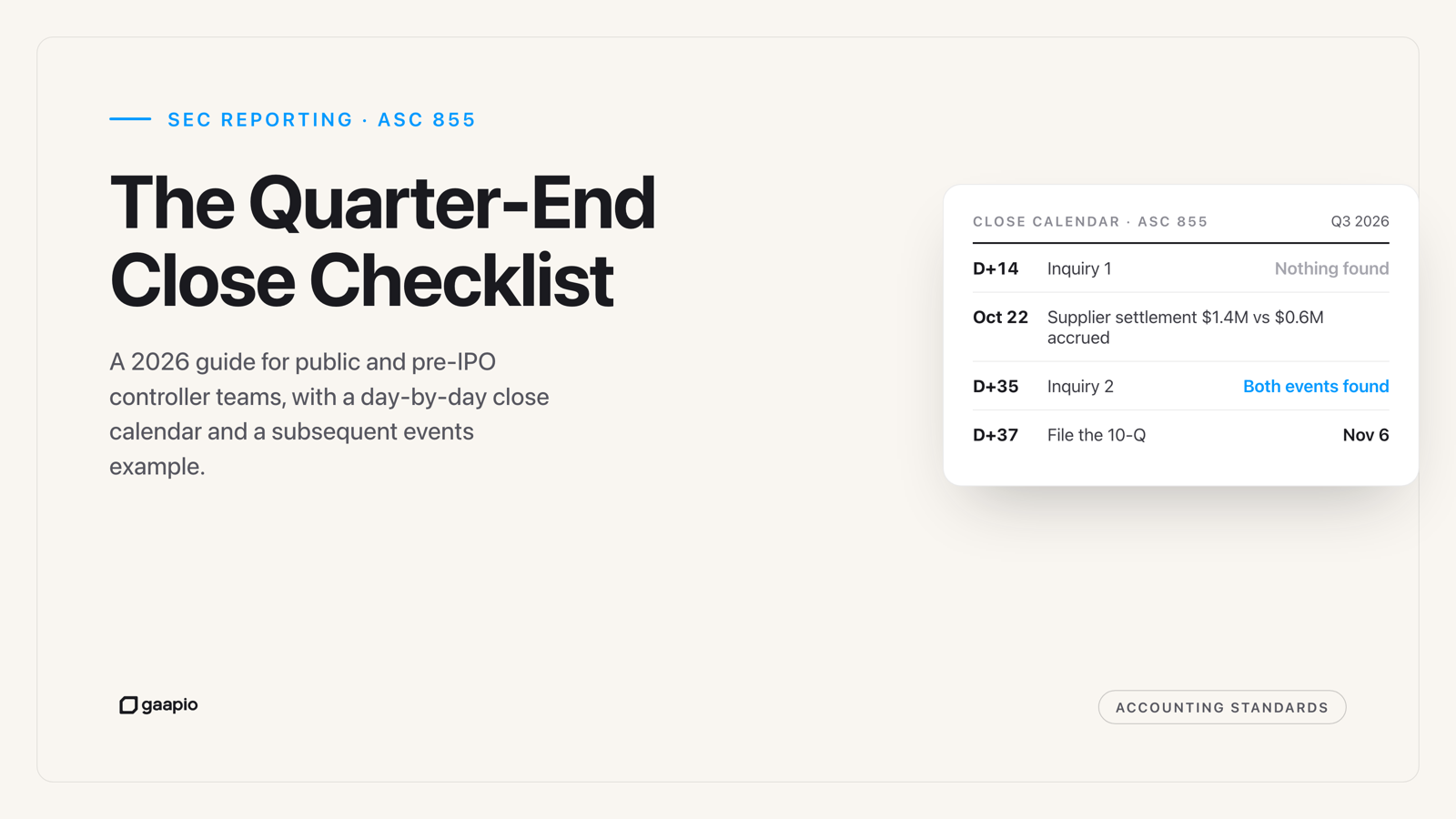
| D+14 (Wed Oct 14) | First subsequent events inquiry sent | Controller, legal, treasury | Inquiry log |
| D+16 (Fri Oct 16) | Draft 10-Q: financial statements and footnotes | SEC reporting | Draft, disclosure checklist started |
| D+20 (Tue Oct 20) | Draft MD&A using the flux file | SEC reporting, FP&A | Draft, source mapping |
| D+22 (Thu Oct 22) | Disclosure checklist complete. Recently issued standards updated | SEC reporting | Completed checklist |
| D+23 (Fri Oct 23) | Sub-certification requests out | Controller | Request list |
| D+26 (Mon Oct 26) | Draft 10-Q to auditors for interim review | Controller | Transmittal, noting the draft is pre-tie-out |
| D+28 (Wed Oct 28) | Sub-certifications returned. Tie-out of every number in the draft to the ledger and support | SEC reporting | Sub-certs, tie-out file |
| D+30 (Fri Oct 30) | Disclosure committee meets. Auditor comments resolved | Disclosure committee | Minutes |
| D+34 (Tue Nov 3) | Audit committee reviews the 10-Q | Audit committee | Minutes |
| D+35 (Wed Nov 4) | Second subsequent events inquiry, covering D+14 to date. Re-tie any changed lines and send changed pages to the auditor and the audit committee chair | Controller, legal, treasury | Subsequent events memo, dated |
| D+36 (Thu Nov 5) | XBRL tagging checked. Filing agent proof reviewed | SEC reporting | Proof, tagging review |
| D+37 (Fri Nov 6) | Bring-down of subsequent events through the filing date. CEO and CFO certifications. Management representation letter. File the 10-Q | CEO, CFO, SEC reporting | Signed certifications, EDGAR acceptance |
For the quarter ended September 30, 2026, D+37 is Friday, November 6. That leaves Monday, November 9 (day 40) as a one-business-day cushion. EDGAR treats a 10-Q whose transmission starts after 5:30 p.m. Eastern as filed the next business day, so do not plan on an evening submission on the due date.
How do you tie out a 10-Q?
Tie-out means tracing every number, date and statement in the filing back to a source, and every source forward to the filing. A good tie-out file lets someone who did not draft the 10-Q verify it in a day.
A usable tie-out has these rules:
- Every number gets a source. A tick mark and a reference to the ledger, subledger, schedule or contract.
- Cross-foot and cross-reference. The balance sheet agrees to the footnotes. The cash flow statement agrees to the balance sheet changes. MD&A agrees to the statements. Subtotals sum.
- Compare to the prior filing. Comparative amounts match the prior 10-Q, 10-K and any recast. A difference needs a reason.
- Read for narrative consistency. The risk factor update, the MD&A, the footnotes, the earnings release and the investor deck should tell one story. Legal proceedings in the footnote should match legal proceedings in Part II.
- Control the version. Any change after tie-out triggers a re-tie of the lines it touches.
Tie-out happens late, when the schedule is tightest. That is the reason to build the support schedules in the shape the footnotes need: when a schedule already matches the disclosure layout, the tie-out is a line-by-line comparison, not a rebuild.
What does a worked example look like?
The numbers below are illustrative. Ridgeway Components, Inc., is a fictional large accelerated filer with a calendar year, closing its books for the quarter ended September 30, 2026. The 10-Q is due Monday, November 9, 2026. The company plans to file on Friday, November 6.
Part 1: flux analysis on the third-quarter results. Ridgeway's policy flags a line when the movement from the prior quarter exceeds both $1.0 million and 10%.
| ($ thousands) | Q3 2026 | Q2 2026 | Change | Change % | Flagged? |
|---|---|---|---|---|---|
| Revenue | 118,400 | 112,100 | 6,300 | 5.6% | No |
| Cost of revenue | 71,000 | 66,000 | 5,000 | 7.6% | No |
| Gross profit | 47,400 | 46,100 | 1,300 | 2.8% | No |
| Gross margin | 40.0% | 41.1% | (1.1 pts) | ||
| SG&A | 21,000 | 18,200 | 2,800 | 15.4% | Yes |
| R&D | 14,200 | 13,900 | 300 | 2.2% | No |
Two takeaways. First, SG&A is the only flagged line, so it gets investigated and corroborated. Second, the line-by-line test passes revenue and cost of revenue, yet gross margin fell by about 1.1 points. A ratio check catches this. MD&A has to discuss a material change in results whether or not a line threshold fired, so Ridgeway adds gross margin as a standing flux line, runs the same test against Q3 2025 and year to date, and investigates the margin decline with the product mix and a freight cost increase in the cost of revenue detail.
These are the numbers at the BD 5 flux review. The October 22 settlement in Part 2 adds an $800,000 charge to third-quarter SG&A, so the flux line, its explanation and the MD&A discussion all get updated when the charge is booked.
Part 2: subsequent events. Ridgeway is a defendant in a supplier dispute that began in 2025. At September 30, it had accrued $600,000, the low end of a range of $600,000 to $2.0 million with no better estimate in the range, as ASC 450-20-30-1 directs. Two events occur after quarter-end:
- October 22: Ridgeway agrees to settle the supplier dispute for $1.4 million. The dispute arose from events before September 30, and the settlement gives additional evidence about a condition that existed at the balance sheet date. That is a recognized subsequent event. Ridgeway records an additional $800,000 pre-tax charge in the third quarter ($1,400,000 less $600,000 accrued), updates its ASC 450 disclosures, and handles the tax effect in its interim provision.
- October 30: Ridgeway closes a $40 million cash acquisition of a business. The acquisition happened after the balance sheet date, so it reflects a condition that arose after September 30. That is a nonrecognized subsequent event. Ridgeway does not record it in the third-quarter statements. It discloses the nature of the event and the estimated financial effect, along with the business combination disclosures ASC 805-10-50-4 requires when the acquisition date falls after the reporting date but before the financial statements are issued. If the initial accounting is incomplete when the 10-Q is filed, Ridgeway says which of those disclosures it cannot yet make and why. If the acquisition is significant, Form 8-K Item 2.01 and Regulation S-X Rule 3-05 financial statements follow on their own timelines.
Part 3: the calendar. The first subsequent events inquiry goes out on D+14, October 14, and catches nothing. The second goes out on D+35, November 4, and legal confirms the October 22 settlement in writing. The acquisition was already on the radar through the board minutes and the Form 8-K process. The $800,000 charge goes into the draft that day, the tie-out is re-run on the affected lines, and the auditor and audit committee chair see the change before the CFO signs. Had the team stopped at D+14, the 10-Q would have gone out with a $600,000 accrual against a $1.4 million settlement. The better fix is a standing rule that legal reports settlements to the controller within a day, so the second inquiry confirms rather than discovers.
What do Big 4 and primary sources say?
The primary sources for this process are the Codification, SEC rules and PCAOB standards. The Big 4 publish the interpretive guidance that most teams use day to day.
- FASB ASC 855, Subsequent Events, covers recognized and nonrecognized events, the evaluation window, and disclosure.
- FASB ASC 270, Interim Reporting, and ASC 740-270 set interim reporting and the interim tax rate.
- SEC Form 10-Q and Exchange Act Rule 13a-13 set the deadlines, and Regulation S-X Article 10 and Rule 10-01(d) set interim financial statements and the review requirement.
- PCAOB AS 4105, Reviews of Interim Financial Information, describes what the auditor does in the interim review.
- SEC Release 33-8810 is the SEC's interpretive guidance for management's ICFR assessment.
- Big 4 guidance. PwC's Financial statement presentation guide on Viewpoint (Chapter 28, Subsequent events), Deloitte's DART guidance on ASC 855 and ASC 270, and EY's annual SEC quarterly reports Form 10-Q publication are common starting points. KPMG publishes topic Handbooks on its Financial Reporting View site.
Frequently asked questions
What is on a month-end close checklist?
A month-end close checklist covers cutoff, subledger close, reconciliations, accruals and reserves, journal entries, flux analysis, the reporting package and a lock of the period. Each line should have an owner, a due day and the evidence that the work happened. Public and pre-IPO companies add reviewer sign-offs and the support an auditor will ask for.
How long should a month-end close take?
There is no regulatory standard for how long a month-end close takes. Many teams aim for roughly five to ten business days, and the target depends on size, systems and complexity. The calendar that matters is the one that gets the 10-Q to the auditor in time to finish an interim review before the deadline.
What is the difference between month-end close and quarter-end close?
The quarter-end close is the month-end close plus the work to file a Form 10-Q. That adds technical accounting memos, the interim tax provision, interim footnotes, MD&A, the disclosure checklist, a subsequent events evaluation, SOX sub-certifications, the auditor's interim review, the CEO and CFO certifications, and tie-out of the filing.
What is flux analysis in accounting?
Flux analysis compares balances or results across periods, such as this quarter against last quarter, to find movements that need an explanation. A team sets thresholds, investigates the movements that exceed them, and documents the cause with corroboration. The same analysis supports MD&A and serves as evidence of management review.
What are subsequent events under ASC 855?
Subsequent events are events that occur after the balance sheet date but before the financial statements are issued. If an event gives additional evidence about a condition that existed at the balance sheet date, the company recognizes it. If it reflects a condition that arose afterward, the company discloses it when needed to keep the statements from being misleading. An SEC filer evaluates through the issuance date.
Do SEC filers have to disclose the date through which they evaluated subsequent events?
No. ASC 855 does not require an SEC filer to disclose the date through which it evaluated subsequent events. A company that is not an SEC filer discloses the date through which it evaluated and whether that is the issued date or the available-to-be-issued date.
When is the 10-Q due?
The 10-Q is due 40 days after quarter-end for large accelerated and accelerated filers, and 45 days after quarter-end for all other filers. If the day falls on a weekend or federal holiday, the deadline moves to the next business day. For the quarter ended September 30, 2026, that is Monday, November 9, 2026 for the 40-day group and Monday, November 16, 2026 for the 45-day group.
What SOX controls matter at quarter-end?
The close controls that most affect the financial statements are account reconciliations, journal entry review, review of significant estimates, management review of the financial statements and flux analysis, and the controls over the disclosure process. Management evaluates disclosure controls every quarter, and Item 4 of the 10-Q discloses any ICFR change during the quarter that materially affected, or is reasonably likely to materially affect, ICFR.
Is a pre-IPO company required to follow a quarter-end close checklist?
A private company has no 10-Q obligation until its registration statement becomes effective. It still has reasons to close like a public company: the S-1 will carry audited annual and unaudited interim financial statements (which underwriters typically require the auditor to review for the comfort letter), and the first 10-Q is due soon after the IPO. Building the close calendar and control evidence before the IPO shortens the first public quarter.
How do you tie out a 10-Q?
Trace every number in the draft to the ledger or a supporting schedule, cross-foot and cross-reference between the statements, footnotes and MD&A, compare comparatives to the prior filings, and read the narrative for consistency. Then control the version. A change after tie-out means a re-tie of the lines it touches.
This guide is general information for accounting and finance professionals. It is not legal advice, and it does not replace the Codification, SEC rules or your auditor's requirements. Check the current text of each cited rule before you rely on it.
How does Gaapio help with the quarter-end close?
Gaapio is an AI-powered technical accounting platform built by CPAs. The technical accounting memos in the checklist are where it fits. You give Gaapio your facts and it asks follow-up questions before drafting. It is grounded in the licensed FASB Codification, Big 4 guidance, and SEC filings and comment letters. Conclusions come with clickable citations so a reviewer can trace each one. See Gaapio accounting memos.
For the interim footnotes, Gaapio reviews your disclosures against the Codification and peer 10-K filings. See AI footnote disclosures. Your team makes the accounting and disclosure calls. Gaapio does not run your close, post entries or file your 10-Q.
Ready to see how it works on your next close? Request a demo.