

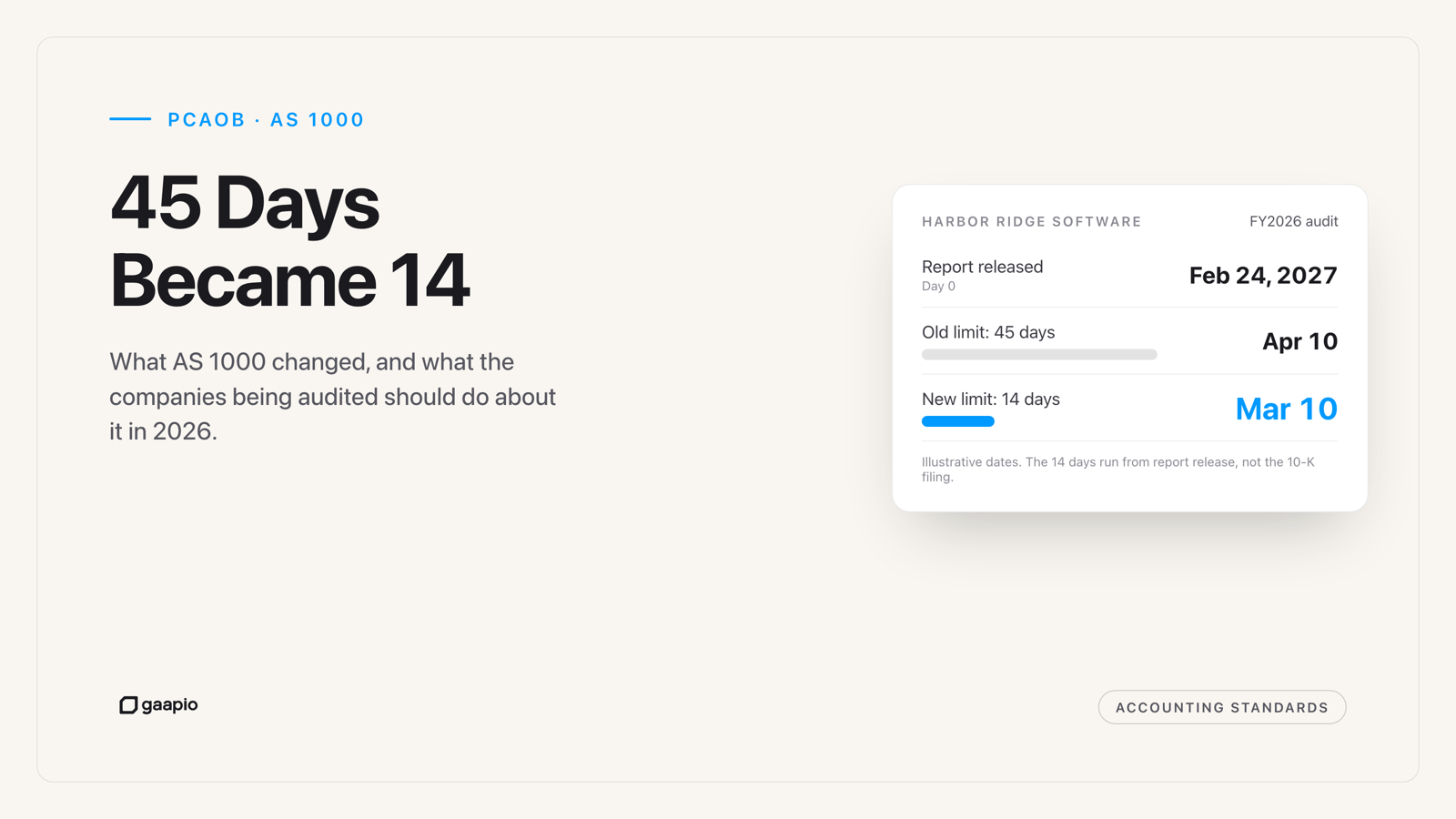
Your auditor used to have 45 days after releasing the report to finalize the audit file. Under the amendments that came with PCAOB AS 1000, it has 14.
I started my career in audit at EY. The part of that change controllers feel first is what the shorter window does to everything that happens before the report date. This guide covers what AS 1000 replaced, when it takes effect for your audit, the key changes in professional skepticism and due professional care, the 14-day documentation completion date, and what the companies being audited should do now about PBC timing, documentation requests and technical accounting memos. It ends with a dated year-end timeline for a calendar-year company.
Key takeaway: PCAOB AS 1000, General Responsibilities of the Auditor in Conducting an Audit, replaced four interim standards (AS 1001, AS 1005, AS 1010 and AS 1015) with one. It applies to audits of fiscal years beginning on or after December 15, 2024, and the PCAOB says it clarifies existing responsibilities rather than creating new principles. The change with practical bite is the audit documentation completion date: the auditor must assemble a complete and final file within 14 days after the report release date, down from 45. Firms that issued audit reports for more than 100 issuers in 2024 have been on that clock for fiscal years beginning on or after December 15, 2024, which is the 2025 audit for a calendar-year company. Every other registered firm joins for fiscal years beginning on or after December 15, 2025, which makes the December 31, 2026 audit the first one for those firms. The standard binds the auditor, and the company feels it in the PBC list, the documentation requests and when its memos are due.
What is PCAOB AS 1000?
AS 1000, General Responsibilities of the Auditor in Conducting an Audit, is the PCAOB standard that sets out the general principles and responsibilities of an auditor performing an audit under PCAOB standards. The PCAOB Board adopted it on May 13, 2024 (PCAOB Release No. 2024-004), and the SEC approved it on August 20, 2024 (SEC Release No. 34-100773).
It applies to audits performed under PCAOB standards: audits of issuers (public companies) and of SEC-registered broker-dealers. A private company audited under AICPA standards is not subject to it. Related amendments also changed other PCAOB standards, most notably AS 1215, Audit Documentation.
You will see it written as "AS 1000," "AS1000" and "PCAOB AS 1000." Same standard.
What did AS 1000 replace and consolidate?
AS 1000 replaced four standards that set out the general principles and responsibilities of the auditor: AS 1001, Responsibilities and Functions of the Independent Auditor; AS 1005, Independence; AS 1010, Training and Proficiency of the Independent Auditor; and AS 1015, Due Professional Care in the Performance of Work. The PCAOB inherited those from the AICPA when it adopted its interim standards in 2003. The same package rescinded a fifth standard, AS 2815, The Meaning of "Present Fairly in Conformity with Generally Accepted Accounting Principles," and moved its requirements into AS 2810, Evaluating Audit Results.
The PCAOB's stated reasons were that the auditing environment has changed since 2003, with new PCAOB standards, new or revised independence requirements and more use of technology. It says the new standard eliminates outdated and inconsistent language and puts fundamental principles in one place.
Here is what moved where:
| Interim standard | What it covered | Where it sits now |
|---|---|---|
| AS 1001, Responsibilities and Functions of the Independent Auditor | The auditor's overall responsibilities and functions | Replaced by AS 1000 |
| AS 1005, Independence | The auditor's independence | Replaced by AS 1000 |
| AS 1010, Training and Proficiency of the Independent Auditor | The training and proficiency an auditor needs | Replaced by AS 1000 |
| AS 1015, Due Professional Care in the Performance of Work | Due professional care, including professional skepticism | Replaced by AS 1000; related amendments to AS 1201, AS 1215 and AS 2101 add specificity to the engagement partner's supervision and review responsibilities |
| AS 2815, The Meaning of "Present Fairly in Conformity with GAAP" | What "presents fairly" means in the opinion | Rescinded; its requirements were updated and moved into AS 2810, Evaluating Audit Results |
| AS 1215.15, Audit Documentation | Auditor must assemble a complete and final audit file within 45 days after the report release date | Amended: 14 days after the report release date |
The first four rows are consolidation, and the fifth is a move. The PCAOB's news release, as the Journal of Accountancy reported it, says AS 1000 creates no new principles or responsibilities and only clarifies existing ones. The last row is an amendment to another standard, and it is a real change.
When does AS 1000 take effect, and was it deferred?
AS 1000 and the related amendments are effective for audits of financial statements for fiscal years beginning on or after December 15, 2024, with one exception: the 14-day documentation completion requirement in AS 1215.15, which is phased in by firm size.
| Auditor | AS 1000 and related amendments | 14-day documentation requirement |
|---|---|---|
| Firm that issued audit reports for more than 100 issuers during calendar 2024 | Fiscal years beginning on or after Dec 15, 2024 | Fiscal years beginning on or after Dec 15, 2024 |
| All other registered firms | Fiscal years beginning on or after Dec 15, 2024 | Fiscal years beginning on or after Dec 15, 2025 |
For a calendar-year company, that works out to:
| Fiscal year | 14-day rule applies if the auditor is... |
|---|---|
| 2025 (year ended Dec 31, 2025; report in early 2026) | A firm with more than 100 issuer audit reports in 2024 |
| 2026 (year ending Dec 31, 2026; report in early 2027) | Any registered firm |
For quarterly reviews, the 14-day requirement starts with the first quarter ending after the first financial statement audits it covers. For example, a calendar-year company reviewed by a firm that issued audit reports for more than 100 issuers in 2024 has its first covered review quarter in the first quarter of 2026. For other registered firms, that is the first quarter of 2027.
Was AS 1000 deferred? No. On August 28, 2025, the PCAOB postponed by one year, to December 15, 2026, the effective date of QC 1000, A Firm's System of Quality Control, and the other standards, rules and forms in the QC 1000 package (PCAOB Release No. 2024-005), which was adopted the same day as AS 1000. The SEC's notice of that postponement (Release No. 34-103803) lists the items that moved, and neither AS 1000 nor the 14-day requirement in AS 1215.15 is on it. That list includes conforming amendments to AS 1215 that came with QC 1000. It does not name AS 1000 or the 14-day requirement in AS 1215.15, and the AS 1000 implementation page still shows the dates above. The December 15, 2026 date you may see quoted is the QC 1000 date. Confirm the dates for your audit with your engagement partner, because the date that matters is the one your firm is on.
What are the key changes in AS 1000?
Four things changed in ways you can point to: how professional skepticism is framed, how the engagement partner's due professional care is spelled out, the "presented fairly" evaluation, and the documentation requirements in AS 1215. The first three are clarifications, according to the PCAOB. The fourth changes the calendar.
Professional skepticism
Professional skepticism, an attitude that includes a questioning mind and a critical assessment of evidence, predates AS 1000. What the PCAOB clarified is that it extends beyond audit evidence to other information the auditor obtains to comply with PCAOB standards and rules.
The standard itself addresses the auditor's mindset, so the effects on the company show up in the later section on what changes for the companies being audited.
Due professional care and the engagement partner
Due professional care is the auditor's duty to exercise appropriate care in performing the audit and preparing the report. AS 1000 consolidated the old AS 1015, and the SEC's approval order says the amendments extend due professional care to other areas of audit practice, such as public reporting and documentation, including completing the audit documentation and the public reporting in Form AP. The PCAOB frames this as applying an existing duty rather than creating a new one. The engagement partner's due professional care responsibilities are clarified by adding specificity to certain audit performance principles, including supervision and review, through related amendments to AS 1201, AS 1215 and AS 2101.
The "presented fairly" evaluation
The related amendments clarify the auditor's responsibility to evaluate whether the financial statements are presented fairly. The PCAOB frames this as a clarification of an existing responsibility. The requirements of AS 2815 now sit in AS 2810, Evaluating Audit Results, with the meaning of "presents fairly" preserved.
The 14-day documentation completion date
This is the change that moves calendars. AS 1215.15 requires the auditor to assemble a complete and final set of audit documentation no later than 14 days after the report release date. Before, the maximum was 45 days. The amendments also clarify the existing requirement in AS 1215.06 that the documentation show who performed the work, who reviewed it, and the date of that review. The next section covers how the 14 days work.
What does the 14-day documentation completion date mean in practice?
The documentation completion date is the last day the auditor can take to assemble a complete and final audit file. Under AS 1215.15 as amended, it is no later than 14 calendar days after the report release date, which is the date the auditor grants permission to use the auditor's report in connection with the issuance of the financial statements.
Three points are worth being precise about:
- The clock starts at report release, which is separate from the 10-K filing. If the auditor releases the report on a Wednesday and the company files the next day, the 14 days still count from Wednesday. The release date can also be later than the date on the auditor's report, and the clock runs from release.
- It is a deadline to assemble the file. The audit procedures and the evidence supporting the opinion belong to the period before the report is released. The 14 days are for putting the file in final form: completing sign-offs, cross-referencing and archiving the file. That window is not meant for gathering support from you.
- Count it as 14 days on the calendar. The standard says 14 days, so a release date just before a weekend or holiday leaves fewer working days.
The PCAOB's stated aims were to shorten the window in which workpapers could be changed after the report and to let inspections reach a finished file sooner. For audit firms the effect is a heavier load on the days around the report release date. For companies, the effect follows from that.
What changes for the companies being audited?
AS 1000 puts its requirements on the auditor, so nothing in the standard tells a company to do anything. The effects below are our inference from how an audit works, and you should confirm the specifics with your engagement team. You may also see more routine questions, such as how a report was produced and who reviewed a schedule, because auditors apply professional skepticism to information they obtain, and a schedule that explains itself draws fewer of them.
PBC timing
Prepared by client (PBC) requests will probably need to close earlier. The evidence that supports the opinion has always had to be in hand before the report is released. What changed is the wrap-up. If the auditor has only 14 days after the report release date to finish the file, it will want as little assembly work as possible left after release, and items that arrive late in the engagement are the ones that make a file hard to assemble in time.
Ask your engagement team three questions early. What is the final PBC cutoff date? Which items does the team need before the audit committee meeting that precedes the report? And which of your schedules does the team want final and tied out before the report date, so little finishing work remains after release?
Documentation requests
The requirement that documentation show who performed the work, who reviewed it, and the date of the review applies to the auditor's workpapers. Our inference is that auditors will also want the same on the client schedules that go into those workpapers, so a schedule with a preparer, a reviewer and dates makes a cleaner file than one without. Where a control relies on a report or an AI-assisted step, expect the auditor to ask how completeness and accuracy were established. The same applies to the evidence behind your internal control over financial reporting if your auditor also opines on it under AS 2201. Our SOX controls page describes the controls product Gaapio has coming soon.
Late requests are also riskier. Anything the team needs to support the opinion has to be in hand before release, and a late item squeezes the time left to finish the file.
Technical accounting memos ready earlier
This is where a controller's calendar changes the most. A technical accounting memo on a significant or unusual transaction has often landed during fieldwork, with the auditor's review running alongside the close. With less time after release to finish the file, many engagement teams will want to finish evaluating significant judgments earlier, which means the memo has to exist earlier. You may also see the engagement partner weigh in more directly on significant judgments.
Practically, that means a list of expected memos agreed with the auditor at planning, interim transactions documented as they happen instead of at year-end, and year-end transactions flagged in December. Our guide to why technical accounting memos matter covers what a reviewer expects in one, and building an audit-ready documentation process covers the process around it.
The audit committee conversation
Audit committees should hear the new calendar from their auditor. Ask what changed in the firm's timeline for fiscal 2026 (or fiscal 2025, if your firm was in the first group), whether the report release date will move earlier to leave room for the file, and what the firm needs from management to hit it.
Worked example: a calendar-year company's close under the 14-day window
Harbor Ridge Software is an invented large accelerated filer with a December 31, 2026 year-end. Its 10-K is due on March 1, 2027, which is 60 days after year-end. Its audit firm is one of the registered firms newly on the 14-day clock for fiscal 2026. The dates are illustrative: they show how the windows relate, and your auditor sets your own.
Say the auditor releases its report on Wednesday, February 24, 2027. The documentation completion date is then Wednesday, March 10, 2027, which is 14 days later. Under the old 45-day maximum, the same release date would have allowed until April 10, 2027.
| Date (illustrative) | What the controller hands over | Why it matters |
|---|---|---|
| Mon, Nov 2, 2026 | Agreed PBC list with due dates, and the list of technical accounting memos the auditor expects (leases, debt, stock compensation, any acquisition) | Sets the final PBC cutoff and the memo list before the year-end rush |
| Fri, Nov 20, 2026 | Signed memos for transactions through Q3, with preparer, reviewer and dates | Interim work is reviewed in November |
| Fri, Dec 11, 2026 | Flag list of year-end transactions and new-standard adoption policies | The memo for a December transaction gets started in December |
| Fri, Jan 15, 2027 | Draft memos for Q4 transactions | The auditor reads them before year-end close ties out |
| Fri, Feb 5, 2027 | Close complete: trial balance, reconciliations, draft financial statements, control evidence | Leaves the auditor about two and a half weeks to finish testing before report release |
| Fri, Feb 12, 2027 | Final signed memos, draft footnotes | Last scheduled PBC delivery |
| Mon, Feb 22, 2027 | Legal letters, draft management representation letter, audit committee materials | Items that must be in hand to release the report |
| Wed, Feb 24, 2027 | Signed management representation letter; auditor releases the report (assumed here to be the same day as the report date) | Day 0 of the 14-day window |
| Thu, Feb 25, 2027 | 10-K filed | Ahead of the March 1 deadline; the filing does not start or stop the clock |
| Wed, Mar 10, 2027 | Nothing, ideally | Documentation completion date (day 14) |
| Sat, Apr 10, 2027 | Not applicable | Where day 45 would have fallen under the old rule |
Look at the last PBC delivery. Under both the old and new rules, the evidence supporting the opinion has to be in hand before the report is released. What changed is the wrap-up. With 45 days, an engagement team had room to finish assembling the file after release: final sign-offs, cross-references and archiving. With 14, more of that finishing work moves before the report date, so the team will want your schedules final and tied out earlier.
Every row from February 12 back is a date the company controls, and moving those earlier is the way to give the auditor room.
How does Gaapio help with audit-ready technical accounting?
Gaapio is an AI-powered technical accounting platform built by CPAs. For the memo work that has to be ready earlier, it drafts technical accounting memos from your contracts and facts, with clickable citations to the Codification, reviewer comments, approvals and version history, and exports the memo as an audit package. You and your reviewer make the accounting calls, and the exported package shows who prepared and reviewed what, and when. Read how it works in accounting memos, and see Gaapio for CPA and audit firms if you are on the audit side of the table.
If your year-end memo list is longer than your calendar, request a demo and bring a contract from this quarter.
Frequently asked questions
What is PCAOB AS 1000?
PCAOB AS 1000, General Responsibilities of the Auditor in Conducting an Audit, is the PCAOB standard that sets out the general principles and responsibilities of an auditor performing an audit under PCAOB standards. It replaced AS 1001, AS 1005, AS 1010 and AS 1015 and took effect for audits of fiscal years beginning on or after December 15, 2024, with a phase-in for the 14-day documentation requirement.
What did AS 1000 replace?
It replaced four interim standards: AS 1001, Responsibilities and Functions of the Independent Auditor; AS 1005, Independence; AS 1010, Training and Proficiency of the Independent Auditor; and AS 1015, Due Professional Care in the Performance of Work. The same package rescinded AS 2815 and moved its "present fairly" requirements into AS 2810, and it came with amendments to related standards, including AS 1215, Audit Documentation.
When is AS 1000 effective?
For audits of financial statements for fiscal years beginning on or after December 15, 2024. The 14-day documentation completion requirement applies from that date for firms that issued audit reports for more than 100 issuers in calendar 2024, and from fiscal years beginning on or after December 15, 2025 for all other registered firms.
Was the AS 1000 effective date postponed?
The PCAOB's August 28, 2025 postponement moved QC 1000 and the other standards, rules and forms in that package to December 15, 2026. The PCAOB's list does not name AS 1000 or the 14-day requirement in AS 1215.15, and its AS 1000 page still shows the original dates. Confirm with your audit firm which dates it applies to your engagement.
What is the 14-day documentation completion date?
It is the deadline for the auditor to assemble a complete and final set of audit documentation: no later than 14 days after the report release date. The maximum used to be 45 days. The report release date is the date the auditor grants permission to use the auditor's report in connection with issuing the financial statements.
Does the 14-day rule start when the 10-K is filed?
No. It starts on the report release date, which can differ from both the filing date and the date on the auditor's report. If the auditor releases the report on a Wednesday and the company files the next day, the 14 days run from the Wednesday.
What does AS 1000 mean for my PBC list?
The standard does not regulate the PBC list, but a shorter file-assembly window gives the auditor less room for items that arrive late. Expect an earlier final cutoff and less tolerance for items that arrive close to the report date. Ask your engagement team for the cutoff dates at planning.
Does AS 1000 apply to private company audits?
No, unless the audit is performed under PCAOB standards. Private company audits follow AICPA standards, where AU-C 230 requires the auditor to assemble the final audit file no later than 60 days after the report release date. Check with your auditor if your company is preparing to go public, because audits of financial statements filed with the SEC in a registration statement are performed under PCAOB standards.
What changed on professional skepticism?
The PCAOB clarified that professional skepticism, an attitude that includes a questioning mind and a critical assessment of evidence, extends beyond audit evidence to other information the auditor obtains to comply with PCAOB standards and rules. The concept itself was not new.
Related reading
- Why technical accounting memos matter
- Building an audit-ready documentation process
- SOX controls (coming soon)
Sources: PCAOB, General Responsibilities of the Auditor in Conducting an Audit (AS 1000) implementation page (adopting release PCAOB Release No. 2024-004); SEC Release No. 34-100773; SEC, Release No. 34-103803 (notice of the QC 1000 postponement); PCAOB, Postpones Effective Date of QC 1000 and Related Standards, Rules, and Forms (Aug. 28, 2025); Journal of Accountancy, PCAOB updates general auditor responsibilities, quality control rules (May 14, 2024).
This post is general information, not accounting, audit or legal advice for a specific situation. Written by Jace Chambers, CPA, with the Gaapio team of CPAs. Last reviewed October 2026.