

Diluted EPS under ASC 260 is income available to common stockholders, adjusted for the effect of dilutive securities (for example, after-tax interest on convertible debt), divided by the weighted-average common shares plus the additional shares that would exist if every dilutive option, RSU, warrant and convertible security were exercised or converted. Basic EPS (ASC 260-10-45-10) counts only the shares outstanding, and diluted EPS from continuing operations can never be higher than basic EPS from continuing operations.
Picture the Thursday before an earnings release. The average stock price for the quarter rose ten percent, so the option dilution number moved with it. A convertible note still runs through the if-converted method that ASU 2020-06 made mandatory, and the newest person on the team has never seen the old treasury stock approach. Someone asks whether the restricted stock in the proxy is a participating security. This guide walks through each calculation in ASC 260 as of November 2026, with a full worked example you can copy.
Key takeaway: Diluted EPS starts from basic EPS and adds potential common shares one instrument at a time, from the most dilutive to the least (lowest earnings per incremental share first), and stops when the next one would raise EPS. Stock options, warrants and RSUs use the treasury stock method. Convertible debt and convertible preferred stock use the if-converted method, and since ASU 2020-06 the treasury stock method is no longer allowed for them. Participating securities use the two-class method. Income from continuing operations is the control number: if it is a loss, the potential shares are generally antidilutive for every per-share figure, with a 2027 change for settleable contracts described below.
This guide is general information for accounting professionals, not accounting or legal advice. Your facts, your auditor and the Codification govern.
What is the difference between basic and diluted EPS?
Basic EPS measures earnings per share of common stock actually outstanding, and diluted EPS measures it again after assuming that securities which could become common stock already have. ASC 260 requires entities in its scope that have potential common shares to present both, with equal prominence, on the face of the income statement (ASC 260-10-45-2). Entities with only common stock outstanding present basic EPS.
| Basic EPS | Diluted EPS | |
|---|---|---|
| Formula | (Net income attributable to the parent − preferred dividends) ÷ weighted-average common shares outstanding | (Net income attributable to the parent − preferred dividends + numerator adjustments) ÷ (weighted-average shares + dilutive potential common shares) |
| What it counts | Shares outstanding, plus shares issuable for little or no consideration and shares whose contingency is resolved | Everything in basic, plus options, warrants, RSUs, convertibles and contingently issuable shares, but only those that are dilutive |
| Governing paragraphs | ASC 260-10-45-10 to 45-14 | ASC 260-10-45-16 to 45-57 |
| Can it be higher than the other? | For continuing operations, basic is the higher or equal figure | Not for income from continuing operations. An instrument is included only if it reduces EPS (or increases loss per share) from continuing operations, so other lines, such as net loss per share, can show an antidilutive result |
The "diluted EPS formula" most searchers want is the second column. The part that takes judgment is the word "dilutive," which has a precise meaning in ASC 260: an instrument is dilutive when including it reduces earnings per share or increases loss per share from continuing operations (ASC 260-10-20 and 45-17).
How do you calculate basic EPS?
Basic EPS equals income available to common stockholders divided by the weighted-average number of common shares outstanding during the period (ASC 260-10-45-10). Income available to common stockholders is net income attributable to the parent (after noncontrolling interests) less dividends declared in the period on noncumulative preferred stock and dividends accumulated for the period on cumulative preferred stock (whether or not declared), and other adjustments such as the excess of the fair value of consideration paid to redeem preferred stock over its carrying amount (ASC 260-10-45-11 and 260-10-S99-2).
Weighted-average shares weight each share by the portion of the period it was outstanding, measured daily or monthly. Shares issued on July 1 count for six months of a calendar year. Four points trip up preparers:
- Retrospective adjustment. A stock split or stock dividend is applied to every period presented, as if it happened at the start of the earliest period (ASC 260-10-55-12). This is why the EPS you reported last year can differ from the comparative column this year.
- Shares issuable for little or no consideration. Penny warrants and fully vested shares that are issuable with no further condition count as outstanding in basic EPS from the date issuance is no longer contingent (ASC 260-10-45-13).
- Unvested restricted stock. Shares subject to forfeiture are treated like contingently returnable shares and left out of basic weighted shares until they vest, unless they are participating securities, which go through the two-class method below.
- Treasury stock and buybacks. Repurchased shares drop out from the date of repurchase.
ASU 2026-01 (issued April 2026) requires paid-in-kind dividends on equity-classified preferred stock to be initially measured at the stated PIK rate, which can change income available to common stockholders. It is effective for fiscal years beginning after December 15, 2026, including interim periods, applied prospectively or on a modified retrospective basis, with early adoption permitted.
How do you calculate diluted EPS, and what counts as dilutive?
Start with basic EPS, adjust the numerator and denominator for each potential common share, test each one for dilution in a set order, and stop when including the next one would raise EPS. A numbered procedure an auditor would recognize:
- Compute basic EPS for income from continuing operations and for net income.
- List every instrument that could become common stock: options, warrants, RSUs and PSUs, ESPP rights, convertible debt, convertible preferred stock, contingently issuable shares, participating securities, forward purchase contracts and written puts on your own stock.
- Pick the method for each one using the table in the next section.
- Compute each instrument's effect on its own: the incremental shares it adds and any numerator adjustment (for example, after-tax interest on a convertible note).
- Rank the instruments by incremental EPS, meaning numerator adjustment divided by incremental shares, lowest first. Options, warrants and RSUs have no numerator adjustment, so they rank at or near zero and go in first (ASC 260-10-45-20).
- Add them one at a time to the control number, which is income from continuing operations. Keep each instrument only if diluted EPS from continuing operations goes down after it is added. Drop any that raise it, because they are antidilutive.
- Use the same share count for every per-share line (continuing operations, discontinued operations, net income), even if an instrument is antidilutive for net income (ASC 260-10-45-18).
- Disclose what you excluded as antidilutive.
Antidilution sequencing matters most when you have a convertible instrument with high interest and a low share yield. It can look dilutive on its own and still be antidilutive once the options and RSUs are already in the denominator. The worked example below includes a case where a note is dropped.
Which EPS method applies to which instrument?
Options, warrants and unvested RSUs use the treasury stock method, convertible debt and convertible preferred stock use the if-converted method, participating securities use the two-class method, and earn-out shares use the contingently issuable share method.
| Instrument | Method | What goes in the numerator | What goes in the denominator |
|---|---|---|---|
| Stock options, warrants, ESPP rights | Treasury stock method | No adjustment (liability-classified warrants adjust for fair value changes) | Shares issued less shares bought back with assumed proceeds |
| Unvested RSUs and nonparticipating restricted stock | Treasury stock method | No adjustment | Units less shares bought back with unrecognized compensation as assumed proceeds |
| Convertible debt | If-converted method | Add back after-tax interest, including amortization of discount and issuance costs | Shares issued on assumed conversion at the start of the period or issuance date |
| Convertible preferred stock | If-converted method | Add back preferred dividends | Shares issued on assumed conversion |
| Participating securities (for example, unvested restricted stock with nonforfeitable dividend rights) | Two-class method | Allocate earnings between common and the participating class | Each class's own weighted shares |
| Earn-outs and performance awards | Contingently issuable shares | Depends on the underlying instrument | Included only if the condition would be met at period end |
| Written put options on own stock | Reverse treasury stock method | No adjustment, unless the contract is an asset or liability that may be settled in stock or cash | Shares assumed issued to raise the put proceeds, less the shares repurchased under the put (only when in the money) |
The Deloitte, PwC and KPMG EPS guides cited below organize diluted EPS around the treasury stock, reverse treasury stock, if-converted and contingently issuable share methods, with the two-class method layered on for participating securities.
How does the treasury stock method work for options, RSUs and warrants?
The treasury stock method assumes the holder exercises the instrument, the company receives the exercise price and uses those proceeds to buy back shares at the average market price for the period, and only the net new shares count (ASC 260-10-45-22 to 45-28A). Incremental shares equal the instrument's share count minus the proceeds divided by average price.
For an option with a $30 exercise price and an average stock price of $40, each option adds 0.25 shares: one share issued, less 0.75 shares bought back with the $30. Three rules go with it:
- In the money only. If the exercise price is above the average market price for the period, the option is antidilutive and excluded.
- Assumed proceeds for share-based awards include unrecognized compensation. For options and RSUs, assumed proceeds equal the exercise price (zero for an RSU) plus the average unrecognized compensation cost under ASC 718 (ASC 260-10-45-28A). Because unrecognized cost shrinks as an award vests, at a constant stock price the dilution from an award rises over its life. After ASU 2016-09, hypothetical excess tax benefits are no longer included in assumed proceeds.
- Performance awards. A performance-based RSU is also a contingently issuable share (see below). Include it only if the performance condition would be met at the end of the reporting period.
For the grant mechanics behind those awards, see the ASC 718 stock-based compensation guide.
If a warrant is classified as a liability under ASC 480 or ASC 815-40, adjust the numerator for the change in fair value as if the warrant were equity-classified, and then test whether the adjustment plus the shares is dilutive. The ASC 480 liability versus equity guide covers when a warrant is a liability, and the ASC 815 hedge accounting guide covers related derivative topics.
How does the if-converted method work after ASU 2020-06?
The if-converted method assumes the convertible instrument was converted at the beginning of the period (or at issuance, if later), adds back the related interest or dividends to the numerator, and adds the shares issued on conversion to the denominator (ASC 260-10-45-40). ASU 2020-06 made this the required method for convertible instruments (subject to the two-class method for participating convertibles). It removed the treasury stock method that applied to convertible debt that could be settled in cash or shares.
For a convertible note, the numerator add-back is interest expense including amortization of discount and issuance costs, net of tax. For convertible preferred stock, it is the preferred dividends for the period, because those dividends would not exist after conversion.
ASU 2020-06 made two further changes that affect the calculation:
- Presumption of share settlement. If the issuer can settle the principal or conversion value in cash or shares, ASC 260-10-45-45 presumes share settlement. Before the ASU, an entity could overcome the presumption with a history or policy of cash settlement. That option is gone for diluted EPS, except for certain share-based payment awards classified as liabilities under ASC 718, which follow separate guidance.
- Principal required in cash. If the terms require the principal to be paid in cash and only the conversion spread can be settled in shares, the shares in the denominator are limited to the spread. The numerator is not adjusted for interest in that case (ASC 260-10-45-40(b)).
Contingently convertible instruments, such as notes that become convertible only if the stock trades above a trigger price for a set period, are included in diluted EPS if dilutive, whether or not the trigger has been met (ASC 260-10-45-44). Everyone has had to adopt ASU 2020-06 as of November 2026: public business entities that meet the SEC filer definition, excluding entities eligible to be smaller reporting companies, for fiscal years beginning after December 15, 2021, and all other entities for fiscal years beginning after December 15, 2023.
For how the same instrument is accounted for on the balance sheet when its terms change, see the ASC 470 debt modification and extinguishment guide.
When do you use the two-class method for participating securities?
Use the two-class method when a security participates in dividends or undistributed earnings with common stock, for example unvested restricted stock that carries nonforfeitable rights to dividends (ASC 260-10-45-59A to 45-70). You allocate income between common stockholders and the participating security based on dividends declared and each holder's participation rights in the undistributed earnings, then divide each class's share by its own weighted shares.
An illustration (labeled illustrative): a company has net income of $10,000,000, 9,000,000 weighted common shares and 1,000,000 unvested restricted shares with nonforfeitable dividend rights. It declared $0.20 per share on all shares.
| Common | Participating | Total | |
|---|---|---|---|
| Dividends declared | $1,800,000 | $200,000 | $2,000,000 |
| Undistributed earnings (pro rata by shares) | $7,200,000 | $800,000 | $8,000,000 |
| Earnings allocated | $9,000,000 | $1,000,000 | $10,000,000 |
| Weighted shares | 9,000,000 | 1,000,000 | |
| EPS | $1.00 | $1.00 |
Two points about losses and diluted EPS. Undistributed losses are allocated to a participating security only if it has a contractual obligation to share in losses (ASC 260-10-45-67 and 45-68). For diluted EPS on participating unvested share-based awards, the more dilutive of the two-class method and the treasury stock (or if-converted) method is the one you report.
How do contingently issuable shares affect EPS?
Shares that are issuable only when a condition is met are included in diluted EPS if the condition would have been met had the reporting date been the end of the contingency period, and in basic EPS only once the condition is satisfied and nothing else stands between the holder and the shares (ASC 260-10-45-13 and 45-48 to 45-57). Earn-outs in business combinations, performance-based RSUs and shares issuable on a milestone all follow this rule.
Take an earn-out that pays 100,000 shares if revenue for the year exceeds $50 million. If revenue was $52 million at December 31, the shares are in diluted EPS for the year, weighted from the start of the period or the date of the arrangement if later. If revenue was $47 million, they are out. For a market-price condition, use the market price at the reporting date as if it were the end of the contingency period. A contingency with several conditions requires all of them to be met at the reporting date.
Include contingent shares in the antidilution ranking like any other potential shares. The shares have no numerator adjustment unless the arrangement is liability-classified.
Why does a loss from continuing operations control diluted EPS?
Income from continuing operations is the control number: if it is a loss, potential common shares are generally antidilutive in every per-share figure, including net income per share, even when net income is positive (ASC 260-10-45-18 and 45-19). Diluted EPS therefore equals basic EPS for that period in most cases.
An illustration (labeled illustrative): a variation of the ExampleCo, Inc. facts below, with a loss from continuing operations of $2,000,000 and income from discontinued operations of $14,000,000, so net income is $12,000,000. Weighted shares are 10,600,000.
| Basic | Diluted | |
|---|---|---|
| Loss from continuing operations per share | $(0.19) | $(0.19) |
| Discontinued operations per share | $1.32 | $1.32 |
| Net income per share | $1.13 | $1.13 |
The options, RSUs and convertible notes from the worked example below would have lowered net income per share, but they are excluded because none of them lowers the loss per share from continuing operations. Applying them to net income would break the rule that one share count serves every line.
The Financial Accounting Standards Board refined this in December 2025. ASU 2025-12 (Codification Improvements, Issue 4) clarifies that when there is a loss from continuing operations and a contract recorded as an asset or liability that may be settled in stock or cash, the entity adjusts the numerator for any gain or loss as if the contract were equity-classified and tests the combined effect. An entity cannot assume all potential shares are antidilutive just because it has a loss. It is effective for annual periods beginning after December 15, 2026, and interim periods within them, applied retrospectively, with early adoption permitted. Before you finalize a loss-period computation with liability-classified warrants or similar contracts, check whether this applies to you.
How do you compute diluted EPS in interim periods?
Compute each quarter on its own, then compute the year-to-date figure by weighting the quarterly incremental shares, not by rerunning the treasury stock method on a year-to-date average price (ASC 260-10-55-3). The year-to-date denominator for a treasury stock instrument equals the average of the incremental shares from each quarter in the year to date.
An illustration (labeled illustrative): 1,000,000 vested options with a $30 exercise price, and average prices of $36, $40 and $44 in the first three quarters.
| Quarter | Average price | Incremental shares |
|---|---|---|
| Q1 | $36 | 166,667 |
| Q2 | $40 | 250,000 |
| Q3 | $44 | 318,182 |
| Nine months | Average of the three | 244,950 |
Rerunning the method on the nine-month average price of $40 would give 250,000 shares, which is not what ASC 260 asks for. The difference is small here and larger with volatile prices. An instrument that was out of the money in one quarter contributes zero incremental shares for that quarter but still enters the year-to-date average for the quarters in which it was dilutive. ASU 2025-12 also clarifies that potentially dilutive shares excluded from quarterly computations because of a loss are included in the year-to-date diluted computation, weighted, when the combined numerator and denominator effect is dilutive.
Worked example: how do you compute basic and diluted EPS step by step? (illustrative)
ExampleCo, Inc. is an invented calendar-year public company. All numbers are illustrative and do not describe any real company.
Facts for 2026
| Item | Amount |
|---|---|
| Net income (also income from continuing operations); no preferred stock | $12,000,000 |
| Common shares outstanding January 1 | 10,000,000 |
| Shares issued July 1 | 1,200,000 |
| Average market price of common stock for 2026 | $40 |
| Options: all vested, outstanding all year, exercise price $30 | 1,000,000 options |
| RSUs: service condition only, unvested all year, average unrecognized compensation cost $9,000,000 | 600,000 units |
| Convertible notes: $20,000,000, 4% coupon, issued at par on January 1, convertible at $25 per share, settled in shares, no issuance costs; tax rate 25% | 800,000 shares on conversion |
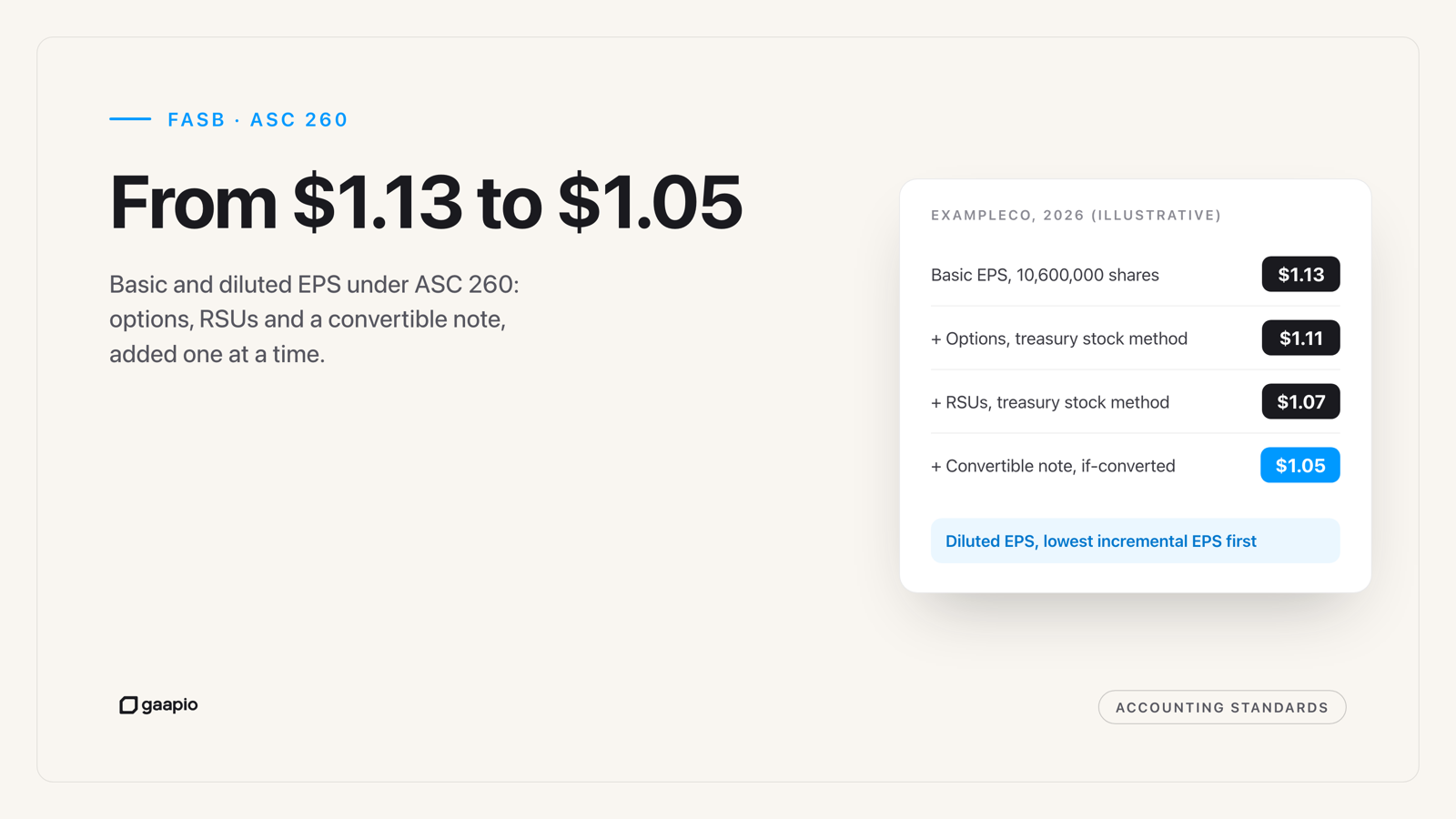
Step 1: basic EPS. Weighted shares are 10,000,000 for twelve months plus 1,200,000 for six months, which is 10,000,000 + 600,000 = 10,600,000. Basic EPS is $12,000,000 ÷ 10,600,000 = $1.13.
Step 2: incremental shares from each instrument.
| Instrument | Calculation | Incremental effect |
|---|---|---|
| Options (treasury stock) | 1,000,000 shares issued; proceeds 1,000,000 × $30 = $30,000,000; repurchased at $40 = 750,000 shares | 250,000 shares |
| RSUs (treasury stock) | 600,000 shares issued; proceeds = unrecognized compensation $9,000,000; repurchased at $40 = 225,000 shares | 375,000 shares |
| Convertible notes (if-converted) | Interest $20,000,000 × 4% = $800,000; after tax at 25% = $600,000; shares $20,000,000 ÷ $25 = 800,000 | Numerator +$600,000; 800,000 shares |
Step 3: rank by incremental EPS. The options and RSUs have no numerator effect, so their incremental EPS is $0.00 and they go first. The note's incremental EPS is $600,000 ÷ 800,000 = $0.75, so it goes last. Any instrument whose incremental EPS is below the running diluted EPS is dilutive.
Step 4: add them in order and test each.
| Step | Numerator | Denominator | EPS | Dilutive? |
|---|---|---|---|---|
| Basic | $12,000,000 | 10,600,000 | $1.13 | |
| Add options | $12,000,000 | 10,850,000 | $1.11 | Yes |
| Add RSUs | $12,000,000 | 11,225,000 | $1.07 | Yes |
| Add convertible notes | $12,600,000 | 12,025,000 | $1.05 | Yes |
Result: basic EPS $1.13 and diluted EPS $1.05. The note's incremental EPS of $0.75 is below the running $1.07, so it reduces EPS and stays in.
What if the note were antidilutive? Suppose the notes carried an 8% coupon and converted at $40 per share. After-tax interest would be $20,000,000 × 8% × 75% = $1,200,000 for 500,000 shares, an incremental EPS of $2.40. That is higher than $1.07, so including it would raise EPS. The notes are excluded, and diluted EPS is $1.07. You would disclose the 500,000 shares as excluded because they are antidilutive. The footnote reconciliation for the base case uses the same figures: basic shares, plus 250,000 from options, 375,000 from RSUs and 800,000 from the notes, with the $600,000 after-tax interest added to the numerator.
Real computations add layers this example leaves out: quarterly average prices, forfeitures, tranches with different unrecognized compensation, shares repurchased during the year and convertible instruments that convert mid-year. Each adds weighted-average mechanics to the same steps.
What changes in diluted EPS for 2026 and 2027?
Three FASB updates touch EPS in the 2026 and 2027 reporting cycles, and one is already in your numbers.
| Update | What it changes for EPS | Effective |
|---|---|---|
| ASU 2020-06 | If-converted method required for convertible instruments; share settlement presumed; treasury stock method removed for them | Adopted by all entities as of November 2026 |
| ASU 2025-12 (Issue 4) | Loss from continuing operations: numerator adjustments for settleable contracts; year-to-date treatment of shares excluded in quarters | Annual periods beginning after December 15, 2026, and interim periods within them (all entities); retrospective; early adoption permitted, issue by issue |
| ASU 2026-01 | Initial measurement of paid-in-kind dividends on equity-classified preferred stock, which can change income available to common | Fiscal years beginning after December 15, 2026, including interim periods; prospective or modified retrospective |
If your fiscal year ends in December, the 2027 annual report is the first one under ASU 2025-12 and ASU 2026-01, and the 2027 quarterly reports are the first interim periods. Because ASU 2025-12 Issue 4 is applied retrospectively, plan to re-run prior loss periods presented. ASU 2026-01 lets you choose prospective or modified retrospective transition, and under the modified retrospective method prior periods presented are recast with a cumulative-effect adjustment to equity, so comparative EPS can change. Review that choice and any early adoption with your auditor.
What must you present and disclose about EPS?
Present basic and diluted EPS on the face of the income statement for every period presented, for income from continuing operations and net income, and for each class of common stock (ASC 260-10-45-2 and 45-5). Per-share amounts for discontinued operations can go on the face or in the notes. When basic and diluted amounts are the same, both can be shown on one line labeled "basic and diluted" (ASC 260-10-45-7). Entities with a simple capital structure present basic EPS only.
The disclosures in ASC 260-10-50-1 and 50-2 include:
- A reconciliation of the numerator and denominator of basic and diluted EPS for income from continuing operations, including the individual effect of each instrument that changes EPS.
- The effect of preferred dividends on income available to common stockholders.
- Securities that could dilute basic EPS in the future but were excluded because they were antidilutive, including contingently issuable shares (in practice, disclosed by type and number of shares).
- Post-period events that would have materially changed the share count if they had occurred during the period (for example, a stock issuance after year end).
Many registrants also describe the method used for each class of potential common shares. SEC registrants also follow Regulation S-X Rule 5-03. A review checklist an auditor would use:
- Do weighted-average shares agree to the share roll-forward and the transfer agent report?
- Are stock splits and dividends applied retrospectively to every period presented?
- Is income from continuing operations the control number in every dilution test?
- Is the average market price calculated consistently, and quarterly for interim periods?
- Do the unrecognized compensation costs in the treasury stock calculation agree to the ASC 718 schedules?
- Are convertible instruments on the if-converted method, with the share-settlement presumption applied?
- Is the numerator adjusted for after-tax interest and the tax rate supportable?
- Does the footnote reconciliation foot to the face of the income statement?
How does Gaapio help with EPS accounting?
Gaapio is an AI-powered technical accounting platform built by CPAs. For the judgment calls under ASC 260, such as whether an instrument is a participating security or how a settlement feature affects the if-converted method, you give Gaapio your facts and it asks follow-up questions before drafting a memo. It is grounded in the FASB Codification through a direct licensing relationship with the FASB, SEC filings and comment letters, and selected accounting firm guidance where licensed, and every research response includes citations. Gaapio's AI technical accounting software page lists ASC 260 among the topics it supports ("Calculating basic and diluted earnings per share"); the share math itself still comes from your cap table and ASC 718 schedules. For the footnote, Gaapio checks your disclosure against the Codification and, if you upload one, your GAAP checklist, and it sets your note beside two peer 10-K filers you choose. See AI footnote disclosures and Gaapio accounting memos. You make the accounting calls.
For SEC filers, see Gaapio for SEC reporting and the FASB hub.
Want to see it on your own EPS memo or footnote? Request a demo.
Frequently asked questions
Who has to present earnings per share?
ASC 260 applies to entities with publicly traded common stock or potential common stock, and to entities that have filed or are filing to sell common stock in a public market (ASC 260-10-15-2). Private companies are not required to present EPS, though some do for lenders or investors, and then follow the same rules.
Can diluted EPS be higher than basic EPS?
Not for income from continuing operations. Dilutive instruments reduce EPS or increase loss per share from continuing operations, and anything that does not is excluded as antidilutive. Because the same share count is used for every line, diluted net income or loss per share can come out higher than basic, for example when continuing operations are profitable but a discontinued operations loss produces a net loss. In a loss year from continuing operations the two usually match, but a contract that can be settled in stock or cash can produce a larger diluted loss per share once its numerator adjustment is included (ASC 260 as clarified by ASU 2025-12).
Should I use basic or diluted EPS for the P/E ratio?
Investors and analysts commonly use diluted EPS because it reflects the shares that could exist, and many data providers show a diluted P/E. ASC 260 does not tell you which to use for a ratio. If you publish a P/E, say which EPS you used.
Do out-of-the-money options count in diluted EPS?
No. If the exercise price is above the average market price for the period, the treasury stock method produces no incremental shares and the option is antidilutive. For share-based awards, include average unrecognized compensation cost in assumed proceeds. That raises proceeds, so an award that is slightly in the money can still be antidilutive.
Are unvested RSUs and restricted stock in basic EPS?
Unvested RSUs are not in basic EPS because the shares are not yet issued, and they enter diluted EPS under the treasury stock method. Unvested restricted stock that is legally issued but subject to forfeiture is also left out of basic weighted common shares until it vests. If either award carries nonforfeitable rights to dividends or dividend equivalents, it is a participating security: earnings are allocated to it under the two-class method, and diluted EPS uses whichever of the two-class or treasury stock method is more dilutive.
What happens to EPS after a stock split?
You restate the weighted-average shares for all periods presented as if the split had occurred at the beginning of the earliest period. If the split happens after year end but before the financial statements are issued, you still restate the periods presented and disclose it (ASC 260-10-55-12).
How do you handle convertible preferred stock in EPS?
Use the if-converted method. Add the preferred shares assumed to be converted to the denominator and add back the preferred dividends to the numerator, and keep it only if the result lowers EPS. If the issuer can settle in cash or shares, ASC 260-10-45-45 presumes share settlement for diluted EPS, and a history or policy of cash settlement no longer overcomes that presumption.
Related reading
- ASC 718 stock-based compensation guide
- ASC 480: liability vs. equity classification
- ASC 470 debt modification and extinguishment guide
- ASC 815 hedge accounting guide
- Quarter-end close checklist
- SEC disclosure checklist (glossary)
Sources
- FASB, ASU 2020-06, Debt with Conversion and Other Options and Derivatives and Hedging, Contracts in Entity's Own Equity
- FASB, ASU 2025-12, Codification Improvements, and ASU 2026-01
- FASB ASC 260-10 (Earnings Per Share, Overall), paragraphs cited in the text, and ASC 718 for share-based awards
- Deloitte DART, Roadmap: Earnings per Share, chapter 4, diluted EPS
- PwC Viewpoint, Financial statement presentation guide, chapter 7: earnings per share
- KPMG, Handbook: Earnings per share
- BDO, FASB Issues ASU 2025-12, Codification Improvements
- SEC, Regulation S-X Rule 5-03
About the author: Zack Larsen, CPA, is a cofounder of Gaapio and a Big 4 alum (Deloitte and PwC).
This article is general information for accounting professionals, not accounting or legal advice. Confirm the requirements for your facts against the Codification and with your auditor.