

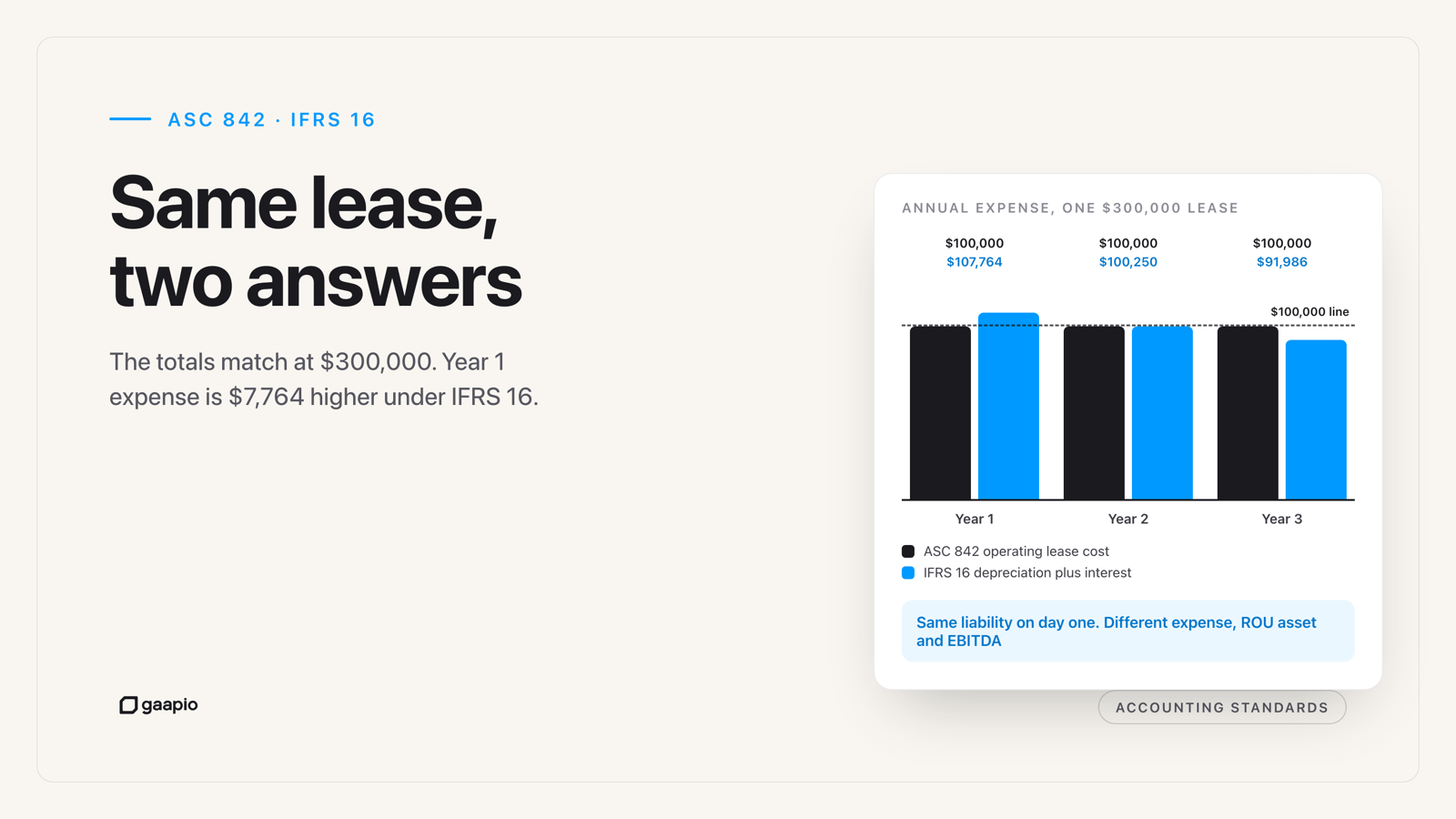
The main difference between ASC 842 and IFRS 16 is the lessee model. IFRS 16 has a single model in which every recognized lease is accounted for much like a US GAAP finance lease, with depreciation of the right-of-use (ROU) asset plus interest on the liability. ASC 842 keeps two lessee models, and an operating lease produces a single, generally straight-line lease cost. For the same contract with the same payments and discount rate, the opening liability matches. If the lease is an operating lease under ASC 842, the expense pattern, the ROU asset each period, EBITDA and the cash flow statement do not.
IFRS 16 and ASC 842 both put your leases on the balance sheet. The numbers still come out differently.
If you report under both frameworks, convert a subsidiary's reporting package, or assess one lease for a parent's IFRS statements and a lender's US GAAP covenant, the differences land in your expense, your right-of-use (ROU) asset, your cash flow statement and your EBITDA.
This guide to IFRS 16 vs ASC 842 (and ASC 842 vs IFRS 16, the way the question gets asked from the other side) works one lease through both standards for three years, then covers a CPI reset, the exemptions, discount rates, scope, term reductions, sale and leaseback, subleases, what changes in your metrics, and what the IASB and IFRS 18 mean for 2026 and 2027. It ends with what a dual-framework lease memo needs to contain. Leases are also one of the clearest places to see IFRS vs US GAAP differences show up in a real set of numbers.
Key takeaway: Both standards require a lessee to recognize an ROU asset and a lease liability at commencement. IFRS 16 has one lessee model: generally depreciation of the ROU asset plus interest on the liability for every lease the lessee recognizes (short-term and low-value leases can be exempted). ASC 842 splits lessee leases into finance and operating, and an operating lease produces a single, generally straight-line lease cost. For the same contract with the same payments and discount rate, the opening liability matches. If the lease is an operating lease under ASC 842, the expense pattern, the ROU asset each period, EBITDA and the cash flow statement do not. Past the model, the standards differ on index or rate resets, short-term and low-value exemptions, the definition of the incremental borrowing rate, scope, term reductions, sale and leaseback, sublease classification and lessor requirements. In July 2026 the IASB decided it had done enough work to conclude its post-implementation review of IFRS 16 and said the standard is overall working as intended. IFRS 18 standardizes where most IFRS reporters show interest paid in the cash flow statement from 2027.
What is the difference between ASC 842 and IFRS 16?
The main difference is the lessee model. IFRS 16 has a single model in which every recognized lease is accounted for much like a US GAAP finance lease, with depreciation plus interest. ASC 842 keeps two lessee models, finance and operating, and the operating model produces one lease cost, generally straight-line.
Day one looks similar when the payments and the discount rate are the same. Both standards measure the lease liability at the present value of the lease payments and start the ROU asset at the liability plus initial direct costs and prepaid rent, less lease incentives received. IFRS 16 also adds estimated dismantling and restoration costs to the ROU asset (IFRS 16.24(d)), which US GAAP handles under ASC 410. The differences show up in day-two accounting, which is why they matter most to anyone running both.
| ASC 842 (lessee) | IFRS 16 (lessee) | |
|---|---|---|
| Standard setter and source | FASB, Accounting Standards Codification Topic 842 | IASB, IFRS Accounting Standards |
| Lessee model | Two: finance and operating | One |
| Balance sheet | ROU asset and lease liability for both types. Finance and operating lease amounts are presented separately or their line items disclosed, and never combined in the same line item | ROU asset and lease liability for leases in scope; no split by type |
| Income statement | Finance lease: amortization plus interest. Operating lease: one lease cost, generally straight-line | Generally depreciation plus interest on every recognized lease, with interest presented separately from depreciation (ROU assets that are investment property at fair value are not depreciated, IFRS 16.34) |
| Cash flow statement | Operating lease payments generally in operating activities (payments that bring another asset to working condition go in investing). Finance lease principal in financing, interest in operating | Principal in financing. Interest follows IAS 7: today a policy choice; in financing once IFRS 18 applies, for entities without specified main business activities |
| Effective | Fiscal years beginning after December 15, 2018 for public business entities, and after December 15, 2021 for most other entities | Annual periods beginning on or after January 1, 2019 |
| Lessors | Classify as sales-type, direct financing or operating | Classify as finance or operating |
The tests for whether a contract contains a lease are nearly identical: the right to control the use of an identified asset for a period of time in exchange for consideration. ASC 842 limits that asset to property, plant or equipment (ASC 842-10-15-3 and 15-4; IFRS 16.9 and B9 to B31). The differences begin once you decide a lease exists.
Do both IFRS 16 and ASC 842 put leases on the balance sheet?
Yes. A lessee recognizes an ROU asset and a lease liability under both standards, including for ASC 842 operating leases. The claim that IFRS puts leases on the balance sheet and US GAAP does not is wrong. Before ASC 842 and IFRS 16 took effect, operating leases stayed off the lessee's balance sheet under both IAS 17 and ASC 840, and both frameworks now bring them on.
What differs is how the two types of lease behave after recognition. Under ASC 842, an operating lease sits on the balance sheet but its expense is a single lease cost within income from continuing operations, usually in operating expenses or cost of sales. Under IFRS 16, the same lease is split into depreciation and interest, which changes operating profit, EBITDA and the cash flow statement. See our guide to operating vs finance lease classification under ASC 842 for the five criteria that put a US GAAP lease in each bucket.
Who has to apply both IFRS 16 and ASC 842?
Six different groups, and "dual reporting" describes only some of them. KPMG identifies dual reporters, companies switching frameworks and companies converting an acquiree's accounting as the groups most affected by the day-two differences. The table splits dual reporters into two groups and adds foreign private issuers and one-off transactions.
| Group | The situation | What gets measured twice |
|---|---|---|
| US subsidiary of a foreign parent | Statutory or lender reporting in US GAAP, plus an IFRS reporting package for the parent | Every lease, under both standards |
| Foreign private issuer filing Form 20-F | The SEC accepts IFRS as issued by the IASB without a US GAAP reconciliation. Lenders, US subsidiaries or the board may still ask for US GAAP views | Leases a stakeholder wants on a US GAAP basis |
| Entity switching frameworks | A move from IFRS to US GAAP, for example ahead of a US listing, or the reverse | Opening balances, comparatives and the policy changes |
| Acquirer converting a target's accounting | The target reports under one framework and the acquirer under the other | The target's lease portfolio at the acquisition date and after |
| Group preparing statements under both | Full sets under both frameworks | The whole lease population, every period |
| One transaction assessed under both | A sale and leaseback or a modification evaluated for two audiences | That one transaction |
Domestic SEC registrants cannot use IFRS, and "IFRS" here means IFRS Accounting Standards as issued by the IASB. Locally endorsed versions can differ, so confirm what your jurisdiction has endorsed, including IFRS 18.
Why does the same operating lease cost different amounts under ASC 842 and IFRS 16?
Because ASC 842 generally spreads the total payments evenly, while IFRS 16 adds depreciation, which is level under the usual straight-line method, to interest, which is highest when the liability is highest. The totals match over the lease term. The timing, the ROU asset each year and the line items do not.
The example is illustrative. The amounts are invented to show the mechanics.
Facts. A company leases equipment for three years and pays $100,000 at the end of each year. The discount rate is 10 percent under both standards. There are no initial direct costs, incentives, prepaid rent, variable payments, residual value guarantees or purchase options, and neither short-term nor low-value exemptions apply. Under ASC 842 the lease meets none of the five finance lease criteria, so it is an operating lease. Assume, for example, a 10-year economic life, a fair value well above $248,685, no transfer of ownership and no specialized asset.
Opening position (identical). The present value of three payments of $100,000 at 10 percent is $248,685. That is the opening lease liability and, with no other items, the opening ROU asset under both standards.
Step 1: the expense each year. Under ASC 842 the single lease cost is the total payments of $300,000 divided by three, or $100,000 a year. Under IFRS 16, interest is the opening liability times 10 percent, and depreciation is the $248,685 ROU asset divided by three, or $82,895 a year (IFRS 16.31 and .32 apply IAS 16 depreciation; this example assumes straight-line over the three-year lease term, the usual method).
| Year | ASC 842: operating lease cost | IFRS 16: interest | IFRS 16: depreciation | IFRS 16: total expense | IFRS 16 minus ASC 842 |
|---|---|---|---|---|---|
| 1 | $100,000 | $24,869 | $82,895 | $107,764 | +$7,764 |
| 2 | $100,000 | $17,355 | $82,895 | $100,250 | +$250 |
| 3 | $100,000 | $9,091 | $82,895 | $91,986 | ($8,014) |
| Total | $300,000 | $51,315 | $248,685 | $300,000 | $0 |
Step 2: the balance sheet at the end of each year. The liability schedule is the same under both standards. The ROU asset is where they part.
| Year-end | Lease liability (both) | ROU asset: ASC 842 | ROU asset: IFRS 16 |
|---|---|---|---|
| Opening | $248,685 | $248,685 | $248,685 |
| 1 | $173,554 | $173,554 | $165,790 |
| 2 | $90,909 | $90,909 | $82,895 |
| 3 | $0 | $0 | $0 |
Three things stand out:
- Expense is higher under IFRS 16 early and lower late. Year 1 is $7,764 (7.8 percent) higher, and the cumulative difference reverses by the end of year 3.
- The ASC 842 ROU asset equals the lease liability each year. Payments are level, and there is no prepaid rent, accrued rent, incentive or initial direct cost to separate them. In real portfolios those items open a gap.
- The IFRS 16 ROU asset is lower each year. It depreciates straight-line while the liability declines more slowly in the early years.
Entries for year 1. Under ASC 842: Dr Operating lease cost $100,000; Dr Lease liability $75,131; Cr Cash $100,000; Cr ROU asset $75,131. The $75,131 is the $100,000 payment less $24,869 of interest accretion. Under IFRS 16: Dr Interest expense $24,869; Dr Lease liability $75,131; Cr Cash $100,000; and separately Dr Depreciation expense $82,895; Cr ROU asset $82,895.
What happens to the lease liability when a CPI or index reset hits?
Under IFRS 16 the lessee remeasures the lease liability when the new payments take effect and adjusts the ROU asset. Under ASC 842 an index or rate change alone is not a reassessment event, so the liability stays where it was and the extra rent is expensed as it is incurred.
IFRS 16 generally uses the original discount rate for this remeasurement. A revised rate applies when the payment change comes from a change in floating interest rates (IFRS 16.39, .42(b) and .43). Under ASC 842, the lessee measures index-based payments using the index at commencement, and picks up the current index only if another event, such as a modification or a change in the lease term, requires remeasurement (ASC 842-10-30-5(b), 842-10-35-4 and 35-5, and 842-20-35-4). Payments above the commencement-index amount are variable lease cost in the period incurred.
The example is illustrative, with one simplification: the rent resets once.
Facts. A five-year lease pays $100,000 at the end of each year, discounted at 6 percent under both standards. The rent is tied to CPI. At the start of year 3, the CPI adjustment takes the annual rent to $106,000 for years 3 through 5. Under ASC 842 the lease is an operating lease. There are no other changes. Interest and depreciation are rounded to the dollar, with a $1 adjustment in the last year so each schedule closes at zero.
Years 1 and 2 are identical in the liability. At commencement, both standards measure index-based payments using the index at that date and do not forecast future changes (IFRS 16.27(b) and .28; ASC 842-10-30-5(b)). The opening liability is $421,236. It falls to $346,510 at the end of year 1 and $267,301 at the end of year 2, under both standards.
At the start of year 3 the schedules split. Under IFRS 16 the liability is remeasured to the present value of three payments of $106,000 at 6 percent, or $283,339, an increase of $16,038. That amount is added to the ROU asset, which goes from $252,742 ($421,236 less two years of $84,247 depreciation) to $268,780 and is depreciated over the three remaining years. Under ASC 842 nothing is remeasured. The liability stays at $267,301 and keeps running down on the original $100,000 payments, and the $6,000 a year of extra rent is variable lease cost.
IFRS 16 schedule after the reset:
| Year | Opening liability | Interest at 6% | Payment | Closing liability | Depreciation | Total expense | ROU asset, end |
|---|---|---|---|---|---|---|---|
| 3 | $283,339 | $17,000 | $106,000 | $194,339 | $89,593 | $106,593 | $179,187 |
| 4 | $194,339 | $11,660 | $106,000 | $99,999 | $89,593 | $101,253 | $89,594 |
| 5 | $99,999 | $6,001 | $106,000 | $0 | $89,594 | $95,595 | $0 |
ASC 842 operating lease, no remeasurement:
| Year | Opening liability | Interest accretion | Fixed payment applied | Closing liability | Lease cost (fixed) | Variable cost (extra rent) | Total cost | ROU asset, end |
|---|---|---|---|---|---|---|---|---|
| 3 | $267,301 | $16,038 | $100,000 | $183,339 | $100,000 | $6,000 | $106,000 | $183,339 |
| 4 | $183,339 | $11,000 | $100,000 | $94,339 | $100,000 | $6,000 | $106,000 | $94,339 |
| 5 | $94,339 | $5,661 | $100,000 | $0 | $100,000 | $6,000 | $106,000 | $0 |
Under ASC 842 the accretion is folded into the single lease cost rather than reported as interest expense, and ROU asset amortization is the balancing amount.
The two liability schedules stay apart until the lease ends: $16,038 apart right after the reset, $11,000 at the end of year 3, $5,660 at the end of year 4, and zero at the end of year 5. Over years 3 to 5, IFRS 16 recognizes $303,441 of expense and ASC 842 recognizes $318,000. Over the whole lease both recognize $518,000, which equals the cash paid.
Two practical points. First, the dual reporter needs a process that captures every index change and remeasures the IFRS 16 schedule only, leaving the ASC 842 schedule on the commencement index. Second, if a modification or term change later forces an ASC 842 remeasurement, the ASC 842 liability is updated to the then-current index at that date, which narrows the gap, though the ROU assets still differ.
How do the two standards differ on everything else?
The table below covers the differences lease teams hit most. Each row says what each standard does and what to track. The sections after it explain the rows that need more than a sentence.
| Topic | ASC 842 | IFRS 16 | What to track |
|---|---|---|---|
| Index or rate reset | Not a reassessment event. Extra payments are expensed as incurred | Remeasure the liability when revised payments take effect, adjusting the ROU asset | A change log per lease that triggers the IFRS schedule only |
| Short-term lease | Policy election by class of underlying asset for leases of 12 months or less. A purchase option disqualifies the lease only if exercise is reasonably certain (ASC 842-20-25-2; Master Glossary, short-term lease) | Policy election by class of underlying asset for leases of 12 months or less (IFRS 16.8). A lease containing a purchase option is not short-term | A different exempt population under each standard |
| Low-value exemption | None. Many lessees apply a materiality or capitalization policy | Available lease by lease, assessed on the asset when new (order of US$5,000 or less when new, per the Basis for Conclusions) | Laptops, phones and small office furniture can sit on the US GAAP balance sheet and off the IFRS one, unless a US policy excludes them |
| Discount rate | Rate implicit in the lease if readily determinable, otherwise the incremental borrowing rate (IBR). A lessee that is not a public business entity may elect a risk-free rate by asset class | Same order of rates. No risk-free election | One stored rate may be right for only one framework |
| IBR definition | Rate to borrow on a collateralized basis, over a similar term, an amount equal to the lease payments in a similar economic environment (Master Glossary) | Rate to borrow, over a similar term and with similar security, the funds needed to obtain an asset of similar value to the ROU asset (IFRS 16 Appendix A) | Document the amount and the security assumed |
| Scope | Excludes leases of all intangible assets, inventory and assets under construction (ASC 842-10-15-1) | A lessee may apply it to intangibles other than certain licensing rights (IFRS 16.3 and .4). A lessor applies it to leases of intangibles other than intellectual property licenses within IFRS 15 | Contracts that are leases under IFRS only |
| Term reduction | A modification that only shortens the term is generally accounted for as a remeasurement: the ROU asset absorbs the change. PwC notes that only an excess over the ROU asset carrying amount goes to income | Treated as a decrease in scope: reduce the ROU asset for the partial or full termination, recognize a gain or loss, then remeasure the remaining liability at a revised discount rate (IFRS 16.45 and .46(a)) | The same amendment, two outcomes |
| Sale and leaseback | If it is a sale, the seller-lessee generally recognizes a gain or loss equal to proceeds less carrying amount, adjusted for off-market terms. A finance-type leaseback precludes sale | Sale test under IFRS 15 (IFRS 16.99). Gain or loss only on the rights transferred, after adjusting for off-market terms (IFRS 16.100 and .101). The ROU asset reflects the right retained | Different gain, different ROU asset, sometimes a different yes or no on sale |
| Sublease | An intermediate lessor classifies by reference to the underlying asset | Classifies by reference to the head lease ROU asset | For the same facts, a sublease is more often operating under US GAAP and more often finance under IFRS 16 |
| Lessor collectibility | Part of the direct financing test, and it affects derecognition for a sales-type lease | No collectibility test in classification | Lessor-side classification of the same lease |
| Cash flow | Operating lease payments generally in operating activities | Principal in financing, interest per IAS 7 | Do not infer one statement from the other |
How do the short-term and low-value exemptions differ?
The short-term exemption exists in both standards with different edges, and the low-value exemption exists only in IFRS 16. A lease of 12 months or less qualifies as short-term under both, but IFRS 16 disqualifies any lease that contains a purchase option, while ASC 842 disqualifies only a lease with a purchase option the lessee is reasonably certain to exercise.
The low-value exemption in IFRS 16.5(b) and B3 to B8 is lease by lease, and it is assessed on what the asset is worth when new, whatever the size of the company. The Basis for Conclusions (BC100) says the IASB had in mind assets worth in the order of US$5,000 or less when new; the figure is not a threshold in the standard. The lessee must be able to benefit from the asset on its own or together with other readily available resources, the asset must not be highly dependent on or highly interrelated with other assets, and a head lease does not qualify if the lessee subleases or expects to sublease the asset (IFRS 16.B5 and B7). ASC 842 has no equivalent. Many US GAAP lessees set a materiality or capitalization policy for small leases. That policy should be documented and tested in aggregate.
The result for a dual reporter is two different populations. A $3,000 laptop lease can be off the IFRS balance sheet and on the US GAAP one, unless the US policy excludes it. Track exemption status per lease and per framework.
How does the discount rate differ?
Both standards start with the rate implicit in the lease when it is readily determinable and otherwise use the lessee's incremental borrowing rate (ASC 842-20-30-3; IFRS 16.26). Three differences follow, and PwC's comparison guide describes the first.
- The IBR is defined differently. PwC describes the ASC 842 rate as a collateralized rate for an amount equal to the lease payments, and the IFRS 16 rate as a rate, with similar security, on the funds needed to obtain an asset of similar value to the ROU asset. PwC concludes the IFRS definition is more considerate of a company's typical borrowing practices, such as loan-to-value. Two valid IBRs can therefore come out different for the same lease.
- A risk-free election exists only under US GAAP. A lessee that is not a public business entity may elect a risk-free rate by class of underlying asset (ASU 2021-09), and it must still use the implicit rate when that rate is readily determinable. IFRS 16 has no such election. KPMG's tip for private dual reporters is to avoid the election, for consistency.
- A single stored rate may not serve both. A rate built for the US GAAP liability may not fit the IFRS definition, so document the amount borrowed and the security assumed for each.
Our guide to the ASC 842 discount rate and incremental borrowing rate covers how to build the rate itself.
What is in scope under each standard?
Scope differs on intangibles, inventory and assets under construction. ASC 842-10-15-1 excludes leases of all intangible assets, leases of inventory and leases of assets under construction, along with mineral, oil and gas rights and biological assets. IFRS 16.3 excludes leases to explore for or use minerals and similar resources, IAS 41 biological assets held by a lessee, service concession arrangements, licenses of intellectual property granted by a lessor, and a lessee's rights under licensing agreements within IAS 38 (such as films, patents and copyrights). IFRS 16.4 lets a lessee apply the standard to other intangible leases but does not require it.
Two practical consequences follow. First, because a US GAAP lease is by definition a contract for identified property, plant or equipment, intangibles sit outside ASC 842 even before the exclusions apply, while IFRS 16.4 lets a lessee apply IFRS 16 to intangible leases other than the excluded IAS 38 licensing rights. A lessee that elects not to do so removes that difference. Second, ASC 842 explicitly excludes leases of inventory and assets under construction, so check those contracts separately under each standard.
What happens when a modification reduces the term?
Under IFRS 16 a reduction in scope generally produces a gain or loss, and under ASC 842 a modification that only shortens the term generally does not. IFRS 16.46(a) has the lessee reduce the ROU asset for the partial or full termination and recognize the difference in profit or loss. Under ASC 842, a shorter term is a change in term (ASC 842-10-25-11 and 25-12). The lessee reassesses classification, remeasures the liability using a discount rate as of the effective date, and adjusts the ROU asset by the same amount, so generally no gain or loss results. PwC notes that if the reduction in the liability exceeds the ROU asset's carrying amount, the excess goes to income as a gain.
Both standards recognize a gain or loss on a partial termination in which the lessee gives up part of the asset. The difference is the term-only change. A dual reporter holding the same amendment can book a gain or loss under IFRS and none under US GAAP. Our guide to ASC 842 lease modifications walks through the US GAAP side.
How does sale and leaseback accounting differ?
Two questions come up, whether a sale occurred and how much gain to recognize, and the standards answer both differently.
- Did a sale occur? Both use the revenue standard's control test (ASC 606; IFRS 15). ASC 842 adds that a leaseback the seller-lessee would classify as a finance lease (a sales-type lease for the buyer-lessor) precludes sale accounting, and a seller-lessee repurchase option precludes it unless the exercise price is the asset's fair value at exercise and alternative assets substantially the same as the transferred asset are readily available in the market, a test real estate generally cannot meet (a seller-lessee obligation to repurchase, such as a forward, also generally precludes sale). If no sale occurs, the seller-lessee keeps the asset and records the proceeds as a financial liability. IFRS 16 has no leaseback classification test, and under IFRS 15 a repurchase option held by the seller generally means control has not passed, so there is no sale, with no exception like the ASC 842 one for non-real-estate assets (IFRS 16.99; IFRS 15.B64 to B66). KPMG says that in its experience sale accounting for a finance-type leaseback under IFRS would apply only in rare cases.
- How much gain? Under IFRS 16 the seller-lessee measures the new ROU asset at the proportion of the old carrying amount that relates to the right it keeps, and recognizes gain or loss only on the rights it transfers (IFRS 16.100). Under ASC 842, once the transfer is a sale, the ROU asset follows ordinary lease guidance and the seller-lessee generally recognizes the full difference between proceeds and carrying amount, adjusted for off-market terms. Both standards adjust for off-market terms: below-market terms are a prepayment of lease payments and above-market terms are additional financing (IFRS 16.101; ASC 842-40-30-2).
IFRS 16 also has a 2022 amendment, effective for annual periods beginning on or after January 1, 2024, that governs how the seller-lessee measures the leaseback liability after commencement. The seller-lessee sets the lease payments so that it recognizes no gain or loss on the right of use it kept, which matters most when the leaseback payments are variable and do not depend on an index or rate. A gain or loss on a later partial or full termination of the leaseback is still recognized (IFRS 16.102A).
How are subleases and lessor accounting different?
An intermediate lessor classifies a sublease by reference to the underlying asset under US GAAP and by reference to the head lease ROU asset under IFRS 16 (IFRS 16.B58). If the head lease is a short-term lease the lessee has exempted, IFRS 16.B58 classifies the sublease as an operating lease. PwC's example is a five-year lease of an office building with a sublease for the full five years. Under ASC 842 the lessor compares the sublease term with the building's remaining economic life, and under IFRS 16 with the five-year ROU asset. On that term comparison alone, the sublease points to operating under ASC 842 and finance under IFRS 16, subject to the other classification criteria.
Lessor classification criteria are similar, but under ASC 842 each criterion is determinative at commencement, while IFRS 16 uses examples and indicators, assessed at inception, that are not always conclusive. ASC 842 also adds requirements. Collectibility is part of the ASC 842 direct financing test, and when collection of a sales-type lease's payments is not probable at commencement, the lessor does not derecognize the underlying asset and records amounts received as a deposit until collection becomes probable or, if earlier, the contract is terminated or the asset is repossessed with no further obligation, and the payments received are nonrefundable. A lease that would otherwise be sales-type or direct financing, has variable payments that do not depend on an index or rate, and would produce a loss at commencement is classified as operating (ASU 2021-05). IFRS 16 has no collectibility test in classification (IFRS 16.61 to 66); credit risk on a finance lease receivable is dealt with through IFRS 9 impairment. Under US GAAP a lessor recognizes selling profit at commencement only on a sales-type lease, and a direct financing lease defers it. Under IFRS 16, a manufacturer or dealer lessor recognizes selling profit at commencement of a finance lease, with no separate control test (IFRS 16.71).
How do EBITDA, operating cash flow and other metrics change?
The effect depends on how the entity presents the lease and how it defines the measure. Using the first example, the same operating lease reports differently:
| ASC 842 operating lease | IFRS 16 | |
|---|---|---|
| Year 1 lease expense | $100,000 inside operating expenses | $82,895 depreciation and $24,869 interest, $107,764 in total |
| EBITDA effect | Reduced by $100,000 | Not reduced: depreciation and interest sit below EBITDA |
| Operating profit effect | Reduced by $100,000 | Reduced by $82,895. Interest sits below operating profit under IFRS 18 for most entities, and under current IAS 1 where the entity presents an operating profit subtotal |
| Profit before tax | Reduced by $100,000 | Reduced by $107,764 |
| Operating cash flow | ($100,000) | ($24,869) if interest is classified as operating, or $0 if classified as financing |
| Financing cash flow | none | ($75,131) principal, plus ($24,869) interest if classified as financing |
| Total cash paid | $100,000 | $100,000 |
Year-one EBITDA is $100,000 higher under IFRS 16 and year-one operating profit is $17,105 higher, while profit before tax is $7,764 lower. Total cash is $100,000 in both columns. Where the cash lands on the statement is what moves, so a team that infers the IFRS cash flow classification from the US GAAP statement, or reverses it, will get it wrong.
Four caveats apply.
- Definitions decide the answer. Some US GAAP reporters use EBITDAR, which adds operating lease cost back, and some IFRS reporters report a measure after lease payments. The $100,000 gap assumes the measure adds back depreciation, amortization and interest but does not add back ASC 842 operating lease cost, which is the common definition among US GAAP reporters. Check how your credit agreements and public measures define it.
- Operating profit is an IFRS 18 subtotal from 2027. Today, IAS 1 does not define operating profit, so where interest lands depends on the entity's presentation. Under IFRS 18, an entity without specified main business activities classifies interest expense on lease liabilities in the financing category, below operating profit.
- IFRS 16 cash flow follows IAS 7. Principal goes to financing. Interest follows IAS 7, and payments on short-term leases, low-value leases and variable payments left out of the liability go to operating activities (IFRS 16.50). Under IAS 7 as amended by IFRS 18, an entity without specified main business activities classifies interest paid in financing. Entities whose main business activity is providing financing to customers or investing in particular types of assets have specified main business activities and follow other rules.
- ASC 842 finance leases look like IFRS 16. A US GAAP finance lease also puts amortization and interest below EBITDA and principal in financing. The metric gap in the example exists because the lease is an operating lease under ASC 842.
What is changing in 2026 and 2027?
Four items matter. None of them changes the recognition and measurement differences above, but IFRS 18 changes where IFRS reporters show lease interest in the cash flow statement.
- IASB review of IFRS 16, July 2026. The IASB decided it had done enough work to conclude its post-implementation review and said the requirements are overall working as intended. It added to its project pipeline a research project on reducing lessees' ongoing costs from remeasuring lease liabilities and setting discount rates, with no start date announced, and a narrow-scope project on rent concessions where the only change is the lessor forgiving payments. The IASB plans to run the two as a single project. It also decided to explore, within its cash flow statement project, requiring lessees to disclose the components of total lease cash outflow. The IASB Update says a project summary and feedback statement is expected in the fourth quarter of 2026, subject to approval by the IFRS Foundation's Due Process Oversight Committee. These are research and pipeline decisions. The standard has not changed. If the IASB later simplifies index remeasurement, one of the largest practical differences in this guide would narrow.
- IFRS 18, effective 2027. IFRS 18 applies to annual periods beginning on or after January 1, 2027, with earlier application permitted, and the amendments it makes to IAS 7 apply with it. An entity without specified main business activities classifies interest paid in financing activities and interest received in investing activities, which removes today's policy choices. IFRS 18 applies retrospectively, so a calendar-year reporter's 2027 statements also restate the 2026 comparatives. A US GAAP reporter generally keeps interest paid in operating activities under ASC 230, so the same lease's interest can sit in different cash flow categories in the two sets of statements. Where IFRS is adopted locally, confirm that IFRS 18 has been endorsed and from what date.
- IFRS 16 sale and leaseback amendment. Effective since January 1, 2024, as described above.
- FASB. The most recent ASUs focused on Topic 842 are ASU 2021-05 (lessors with certain variable payments), ASU 2021-09 (private company discount rates) and ASU 2023-01 (common control arrangements). BDO's summary of ASU 2025-12 (Codification Improvements) lists a clarification on disclosures for lease receivables from sales-type and direct financing leases, which does not change the lessee differences in this guide. As of November 5, 2026, fasb.org lists no lease project on its current projects page.
What goes in a dual-framework lease memo?
A dual-framework lease memo answers one reporting question and shows the same facts through both standards. The structure below is a suggested workflow, not a required format. Adapt it to your policies and your auditor's expectations.
| Section | What it holds |
|---|---|
| 1. The reporting question | Which entity, which statements, which framework or frameworks, and whether this is a dual set, a subsidiary package, a conversion or a one-off transaction |
| 2. Contract facts | The identified asset, control of use, commencement date, term and options, fixed and variable payments, incentives, guarantees, lease and nonlease components, and any modifications, with contract excerpts |
| 3. Conclusions, separately for each framework | Whether a lease exists, scope under each standard, exemptions and elections used, and finance or operating classification under ASC 842 |
| 4. Two calculation schedules | Liability and ROU asset roll-forwards under each standard, with the discount rate and the reasoning for each, and the remeasurement triggers that apply to each |
| 5. Reconciliation | Balance sheet, profit or loss, cash flow classification and disclosures, with each reconciling difference explained and tied to a paragraph |
| 6. Evidence and judgment | Contract references, assumptions, alternatives considered, authoritative references for each conclusion, and preparer and reviewer sign-off with a date |
Section 3 needs the most care. A single conclusion that says "this is a lease" without separate scope support under each standard is likely to draw a reviewer's comment. Section 5 is where the work pays off later: when the lease is modified, the memo tells you which of the differences in this guide will move.
Where does Gaapio fit in lease accounting?
Gaapio is an AI-powered technical accounting platform built by CPAs. For leases, it is lease accounting software for the judgment layer of ASC 842: Gaapio helps your team work through classification and write the analysis into a reviewer-ready memo, with version history and sign-off, grounded in the FASB Accounting Standards Codification through our direct licensing relationship with the FASB. The memo structure above is a general method. The schedules and reconciliations in it come from your lease system and your team.
Gaapio does not replace your lease subledger. Systems built for schedules, journal entries and roll-forwards produce the amortization tables once classification and the rate are set. See Gaapio for lease accounting for how the two fit together, and the ASC 842 glossary entry for the definitions.
Want to see how Gaapio supports the ASC 842 analysis on one of your leases? Request a demo.
Frequently asked questions
What is the main difference between IFRS 16 and ASC 842?
IFRS 16 has one lessee model, and ASC 842 has two. Under IFRS 16 every lease the lessee recognizes generally produces depreciation plus interest. Under ASC 842 a finance lease produces amortization plus interest and an operating lease produces a single, generally straight-line lease cost. Both put an ROU asset and lease liability on the balance sheet.
Does IFRS 16 put leases on the balance sheet and ASC 842 does not?
No. Both standards require a lessee to recognize an ROU asset and a lease liability for leases in scope, including ASC 842 operating leases. Before ASC 842 and IFRS 16 took effect, operating leases stayed off the lessee's balance sheet under both IAS 17 and ASC 840, so the statement was not accurate under the older standards either.
Does ASC 842 have a low-value asset exemption like IFRS 16?
No. ASC 842 has a short-term lease exemption and no low-value exemption. IFRS 16 has both. Some US GAAP lessees apply a materiality or capitalization policy to small leases, which should be documented and tested in aggregate.
Is the discount rate the same under IFRS 16 and ASC 842?
Both standards use the rate implicit in the lease if it is readily determinable and otherwise the lessee's incremental borrowing rate, but they define the borrowing rate differently. PwC describes ASC 842 as a collateralized rate for an amount equal to the lease payments and IFRS 16 as a rate, with similar security, on the funds needed to obtain an asset of similar value to the ROU asset. ASC 842 also lets a lessee that is not a public business entity elect a risk-free rate by asset class. IFRS 16 has no such election.
How does a CPI increase affect the lease liability under each standard?
Under IFRS 16 the lessee remeasures the liability when the CPI-based payment takes effect and adjusts the ROU asset. Under ASC 842 the change alone is not a reassessment event, so the liability is not remeasured and the extra payment is expensed as it is incurred. The worked example above shows the two liability schedules diverging by $16,038 after a $6,000-a-year reset.
Does a lease that qualifies as short-term under ASC 842 also qualify under IFRS 16?
Not always. Both standards exempt leases of 12 months or less, but IFRS 16 excludes any lease that contains a purchase option. ASC 842 excludes only a lease with a purchase option the lessee is reasonably certain to exercise. A lease with a purchase option the lessee does not expect to use can be short-term under US GAAP and not under IFRS.
How does sale and leaseback accounting differ under the two standards?
Under IFRS 16 the seller-lessee recognizes gain or loss only on the rights it transfers and measures the ROU asset on the right it retains. Under ASC 842, once the transfer is a sale, the seller-lessee generally recognizes the full difference between proceeds and carrying amount. The tests for whether a sale occurred also differ, including how repurchase options and finance-type leasebacks are treated.
Does IFRS 16 or ASC 842 give higher EBITDA?
For a lease that is an operating lease under ASC 842, EBITDA is higher under IFRS 16, because depreciation and interest sit below EBITDA while the US GAAP operating lease cost sits inside operating expenses. The effect depends on how the entity presents the lease and defines EBITDA. A US GAAP finance lease and an IFRS 16 lease both put amortization or depreciation and interest below EBITDA.
What does IFRS 18 change for lease cash flows?
IFRS 18 amends IAS 7 for annual periods beginning on or after January 1, 2027, with earlier application permitted and comparatives restated. For an entity without specified main business activities, interest paid is classified in financing activities, which ends today's choice between operating and financing. Principal payments on lease liabilities are already in financing under IFRS 16. A US GAAP reporter generally keeps interest paid in operating activities.
What are the main IFRS vs US GAAP differences beyond leases?
Leases are one of many areas where the frameworks diverge. Other well-known differences include inventory costing, where US GAAP permits LIFO and IAS 2 does not; impairment, where IAS 36 requires an impairment loss on an asset other than goodwill to be reversed when the estimates used to measure the recoverable amount change, and US GAAP prohibits reversal for assets held and used; and development costs, which IAS 38 requires an entity to capitalize once criteria are met while US GAAP generally expenses research and development. Compare each standard pair separately, because the answer for leases does not carry over.
Do foreign private issuers that file on Form 20-F need to reconcile to US GAAP?
No, if the financial statements state explicitly and without reservation that they comply with IFRS as issued by the IASB and the auditor's report is unqualified and opines on that compliance. The SEC accepts those statements without a US GAAP reconciliation. Statements that follow only a locally adapted version of IFRS do not get that relief. A US finance team supporting such a filer may still need US GAAP views for lenders, US subsidiaries or other stakeholders, and that is where an ASC 842 view of a lease comes in.
Related reading
- Operating vs finance lease under ASC 842: classification guide
- ASC 842 discount rate: incremental borrowing rate and risk-free election
- ASC 842 lease modifications: separate contracts and remeasurement
- What is ASC 842?
- Gaapio for lease accounting
About the author: Zack Larsen, CPA, is a cofounder of Gaapio. He started in audit at Deloitte and PwC and has worked on lease accounting software since 2019, during the ASC 842 and IFRS 16 adoption.
This article is general information for accounting professionals, not accounting or legal advice. Your facts, your auditor and the standards themselves govern.
Sources: FASB ASC 842-10-15-1, 15-3 and 15-4, 842-10-25-11 to 25-13, 842-10-30-5, 842-20-25-2, 25-5 and 25-6, 30-2 and 30-3, 842-10-35-4 and 35-5, 842-20-35-4, 842-20-45-1 to 45-3 and 45-5, 842-40 (sale and leaseback), ASC 230, ASC 606, FASB ASU 2021-05, ASU 2021-09, ASU 2023-01, and the Master Glossary definitions of incremental borrowing rate and short-term lease; IFRS 16 paragraphs 3 to 5, 8, 9, 22, 24, 26 to 28, 31, 32, 34, 36, 39, 42, 43, 45 to 47, 49, 50, 61 to 66, 71, 98 to 102A, B3 to B8, B9 to B31, B58, BC100 and Appendix A; IFRS 15 B64 to B66; IFRS 18 and IAS 7 as amended by IFRS 18; IASB Update, July 2026, and the IFRS Foundation project page for the Post-implementation Review of IFRS 16 Leases; KPMG, Lease accounting: IFRS Accounting Standards vs US GAAP (December 2025); KPMG, IFRS 18 changes the statement of cash flows; PwC Viewpoint, IFRS and US GAAP: similarities and differences, chapter 14 Leases; SEC Release No. 33-8879.