

ASC 326-20 (CECL) requires an entity to record an allowance for expected credit losses over the contractual life of financial assets measured at amortized cost (trade receivables, contract assets, held-to-maturity debt securities and loans), a lessor's net investment in sales-type and direct financing leases, and certain off-balance-sheet credit exposures. Available-for-sale debt securities sit in ASC 326-30, which uses a different model: the allowance is limited to the amount by which fair value is below amortized cost.
Picture a December close at a manufacturer with no bank in sight. The receivables aging is final, the auditor asks what the forecast adjustment in the allowance rests on, and someone realizes the note receivable from a former distributor and the net investment in a sales-type lease to a customer cannot simply ride the trade receivables aging matrix, even though all three sit in ASC 326-20. This guide is for the controller or technical accounting lead in that chair. It walks ASC 326 for a company that is not a bank: scope, the expected-loss objective, pooling, methods, forecasts and reversion, write-offs, purchased assets, presentation and disclosure, and a worked aging-matrix example. As of November 2026, every entity has adopted CECL, and ASU 2025-05 and ASU 2025-08 are the two recent changes to know.
Key takeaway: ASC 326-20 measures lifetime expected credit losses at amortized cost from day one, with no "probable" threshold, so even a current receivable from a good customer usually carries an allowance. You estimate it from historical loss experience, adjusted for current conditions and for reasonable and supportable forecasts, and you revert to history for the periods you cannot forecast. Pool assets with similar risk characteristics, choose a method you can support (loss rate, aging schedule, roll rate, probability of default and loss given default, or discounted cash flow), and document the judgment. ASC 326-30 covers available-for-sale debt securities with a separate, fair-value-limited model. ASU 2025-05 lets any entity skip the forecast for current receivables and contract assets, and ASU 2025-08 extends gross-up accounting to purchased seasoned loans for annual periods beginning after December 15, 2026.
What is ASC 326, and what does CECL stand for?
CECL stands for current expected credit losses. It is the model in ASC 326-20, created by ASU 2016-13, that replaced the incurred-loss approach, which waited until a loss was probable. Under CECL you record an allowance at inception for the credit losses you expect over the life of the asset, based on past events, current conditions and reasonable and supportable forecasts.
ASC 326 has three Subtopics that matter here. ASC 326-10 is the overall guidance and transition. ASC 326-20 covers financial assets measured at amortized cost and off-balance-sheet credit exposures. ASC 326-30 covers available-for-sale (AFS) debt securities. Public business entities that are SEC filers (other than smaller reporting companies) adopted for fiscal years beginning after December 15, 2019, which is 2020 for calendar-year companies. Everyone else, including smaller reporting companies and private companies, adopted for fiscal years beginning after December 15, 2022. By 2026 the question is no longer whether CECL applies. It is whether your model still reflects the portfolio you hold.
Which assets are in scope of ASC 326-20 for a non-bank company?
ASC 326-20 applies to financial assets measured at amortized cost, to a lessor's net investment in leases, and to credit exposures on off-balance-sheet loan commitments, standby letters of credit, financial guarantees not accounted for as insurance, and similar instruments (ASC 326-20-15-2). The scope also includes receivables and contract assets that result from revenue transactions under ASC 606.
For a non-bank, most of the work sits in the first three rows below. The table lists where the common items land.
| Item | In ASC 326-20? | What to know |
|---|---|---|
| Trade receivables | Yes | The most common CECL balance for a non-bank. Our ASC 606 variable consideration guide covers how the transaction price, and so the receivable, is set |
| Contract assets | Yes | A right to consideration conditioned on something other than the passage of time (ASC 606-10-45-3 and 45-4). Measured under 326-20 as a contract asset and, once unconditional, as a receivable |
| Loans and notes receivable | Yes | Including notes from customers, distributors, employees and affiliates that are not under common control |
| Held-to-maturity debt securities | Yes | Debt you have the intent and ability to hold to maturity, carried at amortized cost |
| Lessor's net investment in sales-type and direct financing leases | Yes | Measured under 326-20. See our ASC 842 lease classification guide for how a lease lands in these categories |
| Off-balance-sheet credit exposures (loan commitments, standby letters of credit, financial guarantees, similar) | Yes, except instruments in ASC 815 | A liability is recorded for expected losses, separate from the allowance. A guarantee of someone else's operating lease payments can be in scope even though the lessor's operating lease receivable is not. No liability is recorded for commitments you can unconditionally cancel (ASC 326-20-30-11) |
| Operating lease receivables | No | Excluded by ASC 326-20-15-3. Collectibility is assessed under ASC 842 |
| Other exclusions | No | Financial assets measured at fair value through net income, AFS debt securities, loans made to participants by defined contribution plans, policy loans of insurers, promises to give of not-for-profits, and loans and receivables between entities under common control |
Equity securities are outside ASC 326 altogether. They are measured under ASC 321 (fair value or the measurement alternative), and an equity investment has no CECL allowance.
How is ASC 326-30 different from ASC 326-20?
ASC 326-30 does not use the CECL model. It applies to AFS debt securities, which are carried at fair value, and it measures credit losses only when fair value falls below amortized cost, through an allowance that cannot exceed that shortfall. Decreases in fair value that are not credit losses go to other comprehensive income.
The practical difference is the starting point. Under ASC 326-20 you estimate losses on every asset from day one. Under ASC 326-30 there is nothing to measure until fair value is below amortized cost, and then you split the decline into the credit part and the rest.
| ASC 326-20 (CECL) | ASC 326-30 (AFS debt securities) | |
|---|---|---|
| Assets | Amortized cost assets, leases, off-balance-sheet exposures | AFS debt securities |
| Trigger | None. An allowance exists from initial recognition | Fair value is below amortized cost |
| What is measured | Lifetime expected credit losses | The credit-related part of the decline in fair value |
| Ceiling | None | The allowance cannot exceed the amount fair value is below amortized cost |
| Non-credit declines | Not applicable (not measured at fair value) | Other comprehensive income |
| Intent to sell | Not a factor | If you intend to sell, or more likely than not will be required to sell, before recovery of amortized cost, write off any allowance and write amortized cost down to fair value through earnings (ASC 326-30-35-10) |
| Later improvement | Allowance can be reduced through credit loss expense; it can be negative only for expected recoveries | Allowance can be reduced, but not below zero |
| Pooling | Required where risk characteristics are similar | Individual security level; no pooling (ASC 326-30-35-4) |
If you hold investment-grade corporate bonds as AFS, your credit loss work starts with the securities below amortized cost: assess whether each decline reflects credit factors, and only where it does, compare the present value of expected cash flows with amortized cost. If you hold the same bond to maturity, the full CECL model applies. Our ASC 820 guide covers the fair value side of that comparison.
What does the expected-loss objective require?
The objective is a measurement of expected credit losses over the contractual term that reflects the risk of loss even when that risk is remote (ASC 326-20-30-1 and 30-10). You consider past events, current conditions and reasonable and supportable forecasts. The estimate is not a worst case. You can build it from a single economic scenario or from several weighted scenarios.
Three consequences follow:
- Lifetime, not 12 months. The estimate runs over the contractual term, adjusted for expected prepayments (ASC 326-20-30-6). You do not extend the term for expected extensions, renewals or modifications, unless the contract at the reporting date contains an extension or renewal option that you cannot unconditionally cancel.
- Zero is hard to support. ASC 326-20-30-10 allows a zero allowance only when historical loss information, adjusted for current conditions and forecasts, supports an expectation that nonpayment is zero. U.S. Treasury securities are the standard example. A receivable from a creditworthy customer rarely meets that bar.
- No probable threshold. A loss does not need to be probable. A low-probability loss still enters the estimate.
How do you pool receivables by similar risk characteristics?
You measure expected credit losses on a collective (pool) basis when assets share risk characteristics, and individually when they do not (ASC 326-20-30-2). ASC 326-20-55-5 gives examples of characteristics to consider: internal or external credit ratings, asset type, collateral, size, effective interest rate, term, geographic location, industry, vintage, and historical or expected loss patterns.
For a typical non-bank the useful cuts are customer segment, payment terms, region, product line and days past due. Two guardrails keep a pool defensible:
- Enough history in each pool. A pool of 15 customers with two years of data produces unstable rates. Where a pool's own history is thin, supplement it with peer or external loss data, or combine it only with pools that share similar risk characteristics.
- Individual evaluation when a customer stops looking like the pool. A customer in bankruptcy, or in a dispute that will not settle at invoice value, comes out of the pool and gets its own reserve. Do not count it twice.
Which CECL methods are acceptable?
ASC 326-20 does not prescribe a method. It lets you use any approach that faithfully estimates expected credit losses and is applied consistently, and it names several (ASC 326-20-30-3 and 55-6 through 55-7). The table shows the ones a non-bank sees most often.
| Method | How it works | Best fit for a non-bank |
|---|---|---|
| Loss rate | Historical net write-offs over the life of a pool divided by the pool's balance at the start | Trade receivables and short-term notes with stable history |
| Aging schedule (provision matrix) | A loss rate per days-past-due bucket, applied to the current aging | Trade receivables. ASC 326-20-55 includes an example |
| Roll rate | The share of balances that move from one delinquency bucket to the next, carried to write-off | Portfolios with enough volume to see the migration |
| Probability of default and loss given default | Expected default frequency times severity, by risk rating | Notes, leases and guarantees where you have ratings |
| Discounted cash flow | Expected cash flows discounted at the effective interest rate (for a lease, the rate implicit in the lease), compared with amortized cost | Longer-term notes and net investments in leases |
| Vintage or cohort | Loss curves by origination year | Portfolios with seasoning patterns |
You can use different methods for different pools. Whatever you choose, keep the data lineage clean. The aging report must agree to the general ledger before any rate is applied, and the loss history must come from the same population you are measuring.
How do reasonable and supportable forecasts and reversion work?
You use historical loss experience as the base, adjust it for current conditions, and adjust again for reasonable and supportable forecasts over the period you can forecast. For the remaining contractual term beyond that forecast period you revert to historical loss information (ASC 326-20-30-9). You may revert immediately, on a straight-line basis or on another rational and systematic basis, and you may apply reversion to each input or to the entire estimate.
For a non-bank with 30 to 60 day receivables, the forecast period usually covers most or all of the remaining life, so reversion matters little. For a five-year note it matters a great deal, because most of the term falls after the point where a forecast is supportable. The forecast should be one you can explain with data: a customer-industry indicator, a macro series you have tested against your own write-offs, or specific information about the borrowers in the pool. A qualitative overlay is acceptable if you document the reasoning and its size.
Build the estimate in this order:
- Define the pools from the risk characteristics above and agree each pool's balance to the ledger.
- Measure historical loss by pool and aging bucket over a look-back period that, as a matter of practice, includes a credit downturn where your data has one.
- Adjust for current conditions, such as concentration, dispute levels, collection staffing, credit policy changes and the condition of key customers.
- Adjust for reasonable and supportable forecasts over the period you can forecast, and revert to history afterward.
- Evaluate individually the assets that no longer share pool risk, and remove them from the pool.
- Record, document and back-test. Post the entry, write the memo, and compare each period's prior allowance with actual write-offs and recoveries.
For notes receivable, three more items apply: the collateral-dependent practical expedient (measure at collateral fair value when repayment is expected substantially through the collateral and the borrower is in financial difficulty), the accounting policy elections for accrued interest receivable, and the disclosures for modifications made to borrowers experiencing financial difficulty, which ASU 2022-02 added when it eliminated troubled debt restructuring accounting for entities that have adopted CECL.
Does CECL apply to accounts receivable, and what did ASU 2025-05 change?
Yes. Trade receivables and contract assets from ASC 606 transactions are within ASC 326-20 and need an allowance. ASU 2025-05, issued July 30, 2025, added two options for current accounts receivable and current contract assets. Any entity may elect a practical expedient for current accounts receivable and current contract assets arising from ASC 606 transactions that assumes current conditions at the balance sheet date do not change for the remaining life of the asset. That removes the forecast, but you must still adjust historical loss information for current conditions (ASC 326-20-30-10C and 30-10D). An entity that is not a public business entity and elects the expedient may also elect a policy of considering collections received after the balance sheet date.
The ASU applies to annual reporting periods beginning after December 15, 2025, and interim periods within them, prospectively, with early adoption permitted. For a calendar-year company, December 31, 2026 is the first year-end it applies. We cover who can elect what, the transition and three worked scenarios in ASU 2025-05 and CECL for receivables. The rest of this guide assumes you are on the full model, and the worked example below shows what the expedient would skip.
How do write-offs and recoveries work under ASC 326-20?
You write off a financial asset, in full or in part, in the period you deem it uncollectible (ASC 326-20-35-8). The write-off reduces the gross balance and the allowance. Recoveries are recorded in the allowance when received (ASC 326-20-35-8). Your estimate also includes expected recoveries of amounts previously written off and expected to be written off. In limited cases that can produce a negative (debit) allowance, which cannot exceed those amounts (ASC 326-20-30-1).
Write-off timing is a policy. Document the trigger (for example, a stated number of days past due, a bankruptcy filing or a settlement) and apply it the same way each period. A write-off policy that varies from quarter to quarter distorts your loss history, which is the input to the next estimate.
How do purchased financial assets with credit deterioration and ASU 2025-08 work?
A purchased financial asset with credit deterioration (PCD) is one that has experienced a more-than-insignificant deterioration in credit quality since origination, as you assess it at acquisition. You record the allowance for expected losses as an addition to the purchase price (the gross-up approach), so there is no day-one credit loss expense. An asset acquired without that deterioration has historically been measured like an originated asset, with the day-one allowance recorded through credit loss expense, which investors and preparers described as double counting.
ASU 2025-08, issued November 2025, extends the gross-up approach to a new category called purchased seasoned loans (PSLs). A loan is a PSL if it is not PCD, is not excluded, and meets either of these tests (ASC 326-20-30-16):
- Business combination. The loan was obtained in a business combination accounted for under ASC 805-20.
- Other transfer. The loan was obtained in a transfer that is not a business combination (or initially recognized through consolidating a variable interest entity that is not a business), more than 90 days after origination, and you were not involved in originating it. You were involved if, within 90 days after origination, you had direct or indirect exposure to the economic risks and rewards of ownership, or if you had substantive influence on the originator's offering, arranging, underwriting or other nonadministrative lending activity related to the initial extension of credit (ASC 326-20-30-17). Involvement is more likely when the transfer runs through an existing contract, financing arrangement or purchase commitment with the originator. A group of loans is assessed loan by loan (ASC 326-20-30-18).
PSLs exclude credit cards, debt securities and trade receivables arising from ASC 606 transactions (ASC 326-20-30-19). That last exclusion is why most non-banks will not feel the ASU through receivables. The places it can reach a non-bank are purchased notes or loans, and notes receivable that arrive in an acquisition.
ASU 2025-08 is effective for all entities for annual reporting periods beginning after December 15, 2026, and interim periods within them. It is applied prospectively to loans acquired on or after the initial application date, and early adoption is permitted. For a calendar-year company, loans acquired from January 1, 2027 are the first affected.
What do you present and disclose under ASC 326-20?
You present the allowance separately from the amortized cost of the asset (ASC 326-20-45-1), the liability for off-balance-sheet credit exposures separately from the allowance (ASC 326-20-45-2), and credit loss expense or its reversal in net income (ASC 326-20-35-1). Disclosures sit in ASC 326-20-50 and cover your policies and methodology, the factors that influenced your judgment, the allowance roll-forward, and write-offs and recoveries.
Two scoping points save work for a non-bank:
- Credit quality indicators. The credit quality indicator disclosures do not apply to trade receivables due in one year or less that result from ASC 606 transactions (ASC 326-20-50-9). The carve-out does not cover contract assets. KPMG's view is that you still provide credit quality information for them, though not by year of origination.
- Vintage-year information. Public business entities present the amortized cost basis within each credit quality indicator by year of origination and, since ASU 2022-02, current-period gross write-offs by year of origination. Other entities do not (ASC 326-20-50-6). This applies to financing receivables and net investments in leases, not to trade receivables due in one year or less.
For loans and net investments in leases, expect the fuller package: credit quality indicators, past-due status and nonaccrual information. ASU 2025-11 (Interim Reporting, Topic 270) adds explicit interim-period language to several of these disclosures. It is effective for public business entities for interim periods in fiscal years beginning after December 15, 2027, and for other entities for interim periods in fiscal years beginning after December 15, 2028.
Worked example: an aging matrix with a forecast adjustment
This example is illustrative. Harbor Point Industrial is invented, and so are all of its figures.
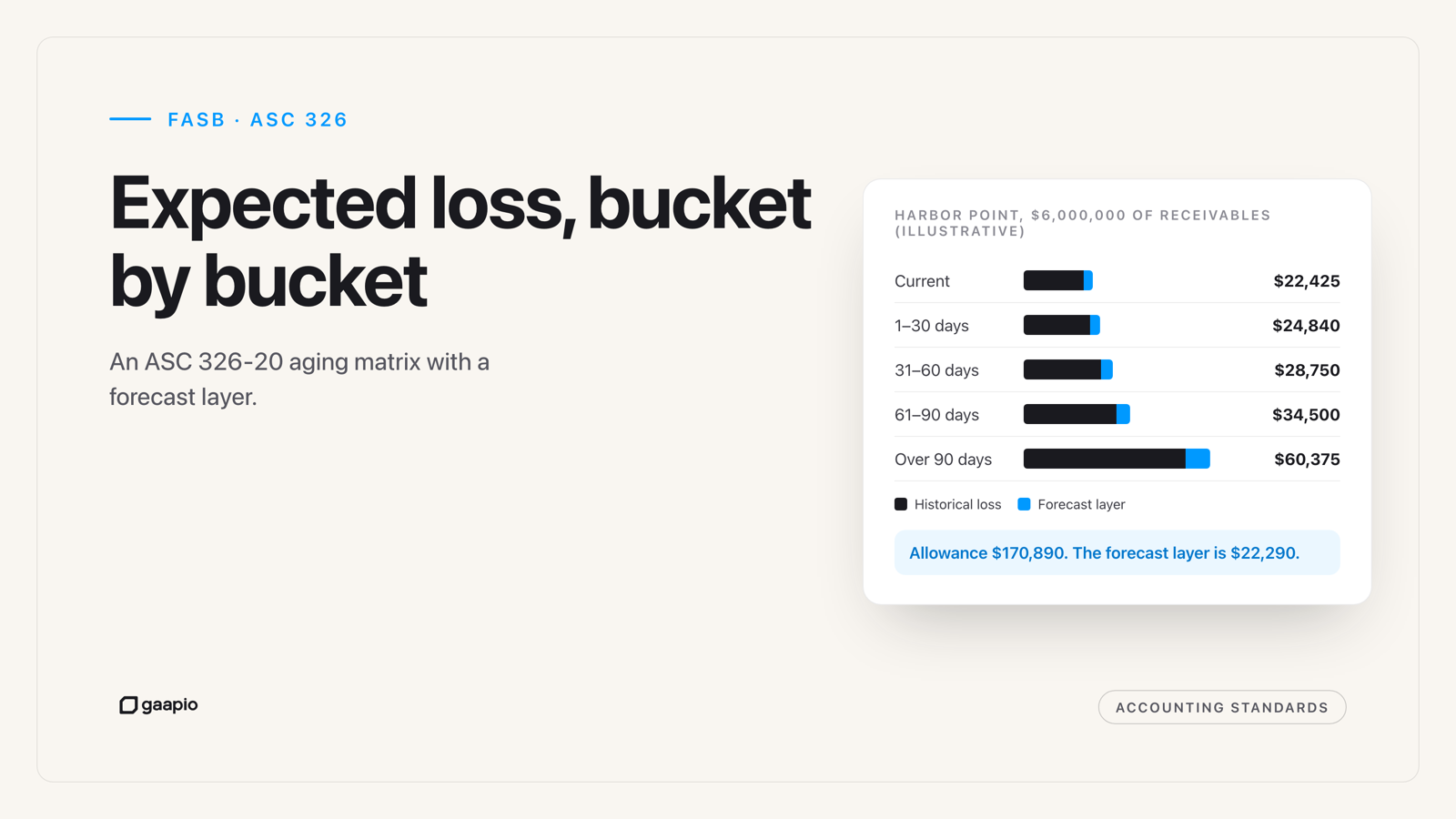
Harbor Point is a calendar-year manufacturer that sells to builders on net-30 terms. At December 31, 2026 its trade receivables total $6,000,000 and share risk characteristics, so management measures them in one pool with an aging schedule. Historical loss rates come from three years of write-off data measured against the bucket balances at each period end, and the look-back includes a soft housing year. Management concludes that current conditions match the look-back on average, so no current-conditions adjustment is needed. Its reasonable and supportable forecast covers six months of builder activity, longer than the remaining life of these balances, nearly all of which management expects to collect or write off within six months, and points to losses 15% above the historical rates. No reversion is needed because the forecast covers the whole life.
| Aging bucket | Balance | Historical rate | Historical loss | With forecast (×1.15) |
|---|---|---|---|---|
| Current | $3,900,000 | 0.50% | $19,500 | $22,425 |
| 1 to 30 days past due | $1,200,000 | 1.80% | $21,600 | $24,840 |
| 31 to 60 days | $500,000 | 5.00% | $25,000 | $28,750 |
| 61 to 90 days | $250,000 | 12.00% | $30,000 | $34,500 |
| Over 90 days | $150,000 | 35.00% | $52,500 | $60,375 |
| Total | $6,000,000 | $148,600 | $170,890 |
The allowance is $170,890, or 2.85% of the gross balance. The forecast adjustment adds $22,290 to the historical-rate result of $148,600. It is the number the auditor will ask about first, because it is the judgment line. Management's file for it should show the indicator used, the test of that indicator against Harbor Point's own write-offs, and why a 15% uplift rather than 10% or 20%.
Applying one uplift to every bucket is a simplification. Many companies apply the forecast mainly to current and early buckets and evaluate the oldest balances customer by customer. If the deterioration behind the forecast is already visible at year-end, part of it is a current-conditions adjustment rather than a forecast.
Harbor Point's allowance roll-forward for the year:
| Roll-forward | Amount |
|---|---|
| Allowance, January 1, 2026 | $155,000 |
| Write-offs | ($48,000) |
| Recoveries | $6,000 |
| Credit loss expense (the balancing entry) | $57,890 |
| Allowance, December 31, 2026 | $170,890 |
The year-end entry, after write-offs and recoveries have been posted through the allowance during the year:
Dr  Credit loss expense                  57,890
    Cr  Allowance for credit losses               57,890
On the balance sheet, trade receivables are shown at $6,000,000 less an allowance of $170,890, or $5,829,110 net.
ASU 2025-05 is effective for Harbor Point's 2026 year. Had it elected the practical expedient for these current receivables, it would drop the forecast column. Because management made no current-conditions adjustment, its allowance would be the historical-rate result of $148,600 (2.48%), $22,290 lower, and it would not need to evidence a forecast each period. Any current-conditions adjustment would still be required under the expedient. The lower number is not automatically better if conditions are in fact deteriorating.
What belongs in a CECL memo?
A CECL memo is the document the auditor reads before touching the spreadsheet. Copy this outline and fill it in for each pool:
- Scope. The assets in ASC 326-20, with the exclusions you applied (operating lease receivables, common-control balances, AFS securities).
- Pools. The risk characteristics and the reasons you grouped or separated assets.
- Method. The method for each pool and why it fits.
- Data. Source, period, reconciliation to the ledger, and how write-offs and recoveries are defined.
- Current conditions. The adjustments and their support.
- Forecast and reversion. The forecast period, the indicator, the test against history, and the reversion approach, or the ASU 2025-05 election if you made it.
- Individually evaluated assets. Each one, its reserve and why it left the pool.
- Conclusion and back-test. The allowance, the prior-period comparison and the variances explained.
Our guide to writing a technical accounting memo shows how to structure the analysis, and the ICFR guide covers the controls auditors expect around a judgmental estimate like this one.
How does Gaapio help with ASC 326?
Gaapio is an AI-powered technical accounting platform built by CPAs. For a CECL memo, such as the scope analysis, the pooling and method rationale or the forecast and reversion documentation, you give Gaapio your facts and it asks follow-up questions before drafting. It is grounded in the licensed FASB Codification (through a direct licensing relationship with the FASB), Big 4 guidance, and SEC filings and comment letters. It drafts the memo and the supporting research with clickable citations. See Gaapio accounting memos.
For the footnote, Gaapio reviews your disclosures against the Codification. See AI footnote disclosures. Gaapio does not run your loss-rate model or pull your aging report. Your team owns the data, the forecast and the accounting calls.
Want to see it on your own CECL memo? Request a demo.
This article is general information, not accounting or legal advice. Confirm the requirements for your facts against the Codification and with your auditor.
Written by Zack Larsen, CPA, a Big 4 alum (Deloitte, PwC) and cofounder and CEO of Gaapio.
Frequently asked questions
When did CECL take effect?
It took effect for SEC filers other than smaller reporting companies for fiscal years beginning after December 15, 2019. Smaller reporting companies, private companies and not-for-profits followed for fiscal years beginning after December 15, 2022. As of November 2026, all entities apply it.
Do private companies have to apply CECL?
Yes. Private companies apply the same measurement model. Their relief is the ASU 2025-05 collections election, which is available only to entities that are not public business entities and that elect the practical expedient, plus the exemption from vintage-year disclosure. The ASU 2025-05 practical expedient itself is open to every entity.
Can the allowance ever be zero?
Only when your historical loss information, adjusted for current conditions and forecasts, supports an expectation that nonpayment is zero (ASC 326-20-30-10). U.S. Treasury securities are the usual example. For trade receivables, document why a zero is supportable or record a small allowance.
Does CECL apply to intercompany receivables?
Not for loans and receivables between entities under common control, which ASC 326-20-15-3 excludes. In consolidated financial statements those balances eliminate anyway. If a subsidiary issues standalone statements, the exclusion matters there.
How is CECL different from the old incurred-loss model?
The incurred-loss model recognized a loss when it was probable that a loss had been incurred. CECL records lifetime expected losses at inception, with no probable threshold, and includes reasonable and supportable forecasts. The practical result for most companies is an earlier and larger allowance on receivables that look healthy.
Does CECL apply to available-for-sale securities?
No. AFS debt securities are measured under ASC 326-30, which records an allowance only when fair value is below amortized cost and limits it to that shortfall. Held-to-maturity debt securities are under ASC 326-20.
Can a company reverse part of the allowance?
Yes. At each reporting date you compare your current estimate with the allowance on the books and record the difference as credit loss expense or a reversal of it (ASC 326-20-35-1). A reversal reflects a lower expected loss, not a write-back of an actual write-off.
Related reading
- ASU 2025-05 and CECL for receivables
- ASC 606 variable consideration and the constraint
- Operating vs finance lease classification under ASC 842
- ASC 820 fair value measurement and disclosures
- FASB Codification guidance by topic
- Accounting memos: format, example and template
Sources: FASB, ASU 2016-13, Financial Instruments-Credit Losses (Topic 326); FASB, ASU 2025-05, Measurement of Credit Losses for Accounts Receivable and Contract Assets; FASB, ASU 2025-08, Purchased Loans; KPMG, Credit impairment handbook (July 2026); Deloitte, Roadmap: Current Expected Credit Losses; PwC, Loans and investments guide, instruments subject to the CECL model; RSM, FASB issues ASU on purchased loans.