

Under ASC 205-40, financial statements are prepared on the going concern basis, which presumes the company will keep operating, unless liquidation is imminent. At each annual and interim reporting period, management must evaluate whether it is probable that the company will be unable to meet its obligations as they become due within one year after the date the financial statements are issued (or available to be issued, for entities that are neither SEC filers nor conduit bond obligors), and that probable outcome is what the Codification calls substantial doubt (ASC 205-40-50-1 and the Glossary).
Picture the week before your 10-K or year-end audit closes. The revolver matures in nine months, a covenant test sits three quarters out, and the cash forecast has one line you would rather not read twice. This guide walks through how management evaluates that situation under ASC 205-40, what plans count, what to disclose in each outcome, how the auditor's evaluation differs, and how debt covenants, subsequent events and SEC reporting fit in. It ends with a worked example (illustrative) and a memo outline you can copy.
Key takeaway: Management looks forward one year from the date the financial statements are issued (or available to be issued, for entities that are not SEC filers). Step 1 asks whether, before counting plans that are not yet fully implemented, it is probable the company cannot pay its obligations as they come due. If so, Step 2 asks whether management's plans alleviate that doubt, and a plan counts only if it is probable it will be effectively implemented and probable it will mitigate the conditions (ASC 205-40-50-7). Then disclose: the conditions, management's evaluation and the plans if doubt is alleviated, plus an explicit substantial doubt statement if it is not (ASC 205-40-50-12 and 50-13).
What is going concern in accounting?
Going concern is the presumption that an entity will continue operating, so its assets are carried at the amounts used in ongoing operations and its obligations are paid in the normal course. ASC 205-40-05-1 says continuation as a going concern is presumed unless and until liquidation becomes imminent. When liquidation becomes imminent, the entity moves to the liquidation basis of accounting under ASC 205-30.
When liquidation is not imminent but conditions and events, considered in the aggregate, raise substantial doubt, the statements stay on the going concern basis, and ASC 205-40 sets the disclosures (ASC 205-40-05-2).
People also search for "going concern value," which is a valuation idea: what a business is worth as a continuing operation versus its pieces sold off. That concept sits in valuation, not in ASC 205-40.
What is ASC 205-40 and who has to apply it?
ASC 205-40 is the FASB Codification Subtopic, "Presentation of Financial Statements, Going Concern," that makes management responsible for evaluating going concern and sets the related footnote disclosures. It applies to all entities (ASC 205-40-15-1). That includes private companies, public companies, and not-for-profits.
FASB issued it as ASU 2014-15 in August 2014. Before then, US GAAP left the evaluation to auditing standards. The ASU is effective for annual periods ending after December 15, 2016, and interim periods within annual periods beginning after December 15, 2016 (ASC 205-40-65-1). Read the primary source on FASB's ASU 2014-15 PDF.
Management does the evaluation in connection with preparing financial statements for each annual and interim reporting period (ASC 205-40-50-1). The interim requirement applies to every entity that prepares interim financial statements. For SEC registrants, that means every Form 10-Q, not only the 10-K.
What does "substantial doubt" mean, and what is the probable threshold?
Substantial doubt exists when conditions and events, considered in the aggregate, indicate that it is probable that the entity will be unable to meet its obligations as they become due within one year after the date the financial statements are issued (or available to be issued). The Glossary adds that "probable" is used consistently with Topic 450 on contingencies.
In Topic 450 terms, probable means the future events are likely to occur. FASB did not set a numerical threshold for probable, and the Codification gives none. If your policy uses a number for ASC 450, apply the same number here. Our ASC 450 guide covers how reviewers read "probable."
The substantial doubt definition has two features that are often misread. It looks at the ability to meet obligations, so a net loss alone does not answer the question. And it is aggregate: one adverse condition rarely decides it, and ASC 205-40-55-2 says the presence or absence of any single listed condition does not determine the answer.
How far ahead does management have to look?
One year after the date the financial statements are issued, or one year after the date they are available to be issued when that is the applicable date (ASC 205-40-50-1). SEC filers (and conduit bond obligors) use the issued date. Other entities use the available-to-be-issued date, which is when the statements are complete in a form and format that complies with GAAP and all approvals needed for issuance have been obtained (Master Glossary; ASC 855-10-25-1A and 25-2 set which date applies).
The window runs from the issuance date and not from the balance sheet date. A calendar-year company that issues its statements on March 15, 2027 looks through March 15, 2028. A late issuance extends the window, so a slipped audit can pull a maturity date inside it.
Management's evaluation is based on conditions and events that are known and reasonably knowable at the issuance date (ASC 205-40-50-3). Events after the balance sheet date that you learn before issuance count. For SEC registrants, ASC 855-10-S99-2 gives the SEC staff's view of when statements are issued.
How do you evaluate going concern, step by step?
The evaluation has two steps, in this order. Step 1 ignores plans that are not yet fully implemented. Step 2 considers them only if they pass a probability test. Here is the procedure an auditor will expect to see.
- Set the window. Issuance date (or available-to-be-issued date) plus one year.
- Collect conditions and events that are known and reasonably knowable: liquidity sources, obligations due or anticipated (recognized or not), funds needed to run the business, and other adverse conditions (ASC 205-40-50-5).
- Build the forecast of obligations and liquidity across the window. Include debt maturities, interest, lease payments, purchase commitments, covenant tests and contingent obligations.
- Step 1: apply the probable threshold without unimplemented plans. Plans approved but not fully implemented are left out (ASC 205-40-50-4). Actions already completed, such as a signed waiver or a closed financing, are facts and stay in.
- If doubt is not raised, stop and document. No substantial doubt disclosure is required under ASC 205-40.
- Step 2: test each plan. It counts only to the extent it is probable of being effectively implemented within the window and probable of mitigating the conditions (ASC 205-40-50-7).
- Conclude and disclose under ASC 205-40-50-12 (alleviated) or 50-13 (not alleviated).
- Update through issuance. Re-run the evaluation for events that arrive before the statements are issued, and repeat it at the next interim period.
The evaluation rests on a forecast, so the forecast needs support. Reviewers ask where each assumption came from, how it compares to actual results, and whether the downside case was run.
What conditions and events raise substantial doubt?
ASC 205-40-55-2 lists four categories of adverse conditions and events, and says the list is not all-inclusive. None of them decides the question alone.
| Category (ASC 205-40-55-2) | Examples in the Codification | What a reviewer asks for |
|---|---|---|
| Negative financial trends | Recurring operating losses, working capital deficiencies, negative operating cash flows, adverse key ratios | Trend by quarter and the forecast for the window |
| Other indications of financial difficulty | Loan defaults, dividend arrearages, denied trade credit, need to restructure debt, noncompliance with statutory capital requirements, need to dispose of substantial assets | Lender correspondence and covenant calculations |
| Internal matters | Labor difficulties, dependence on one project, uneconomic long-term commitments, need to significantly revise operations | Contract terms and operating plans |
| External matters | Legal proceedings or legislation that might jeopardize operations, loss of a key franchise, license or patent, loss of a principal customer or supplier, uninsured or underinsured catastrophe | Legal letters, customer concentration data |
Quantitative and qualitative information both count. A company with $4.0 million of cash and a $6.0 million note due within the window has a quantitative issue even if the business is profitable.
What counts as management's plans, and when do they alleviate substantial doubt?
Management's plans alleviate substantial doubt only to the extent two things are both probable on the information available at the issuance date: the plans will be effectively implemented within one year after issuance, and, once implemented, they will mitigate the conditions that raise doubt (ASC 205-40-50-7). A plan that fails either test does not count toward alleviating substantial doubt (ASC 205-40-50-7, 50-9 and 50-10).
Implementation is judged on feasibility in light of the entity's facts and circumstances. Generally, management or others with the appropriate authority must have approved the plan before the issuance date (ASC 205-40-50-8). Mitigation is judged on the expected magnitude and timing of the plan's effect compared with the magnitude and timing of the problem (ASC 205-40-50-10).
ASC 205-40-55-3 gives four kinds of plans and the questions to ask for each.
| Plan | Questions that decide feasibility (ASC 205-40-55-3) | Common weak spot |
|---|---|---|
| Dispose of an asset or business | Covenants or encumbrances that restrict the sale, marketability, direct and indirect effects of selling | No buyer and no signed agreement |
| Borrow or restructure debt | Availability and terms of new financing or refinancing, committed arrangements to restructure, existing borrowing restrictions, sufficiency of collateral | A term sheet with open conditions |
| Reduce or delay expenditures | Feasibility of cutting overhead or deferring projects, direct and indirect effects on cash flows | Savings that hurt revenue, so net cash does not improve |
| Increase equity | Existing or committed arrangements to raise capital, to reduce dividends, or to accelerate investor cash infusions | Hoped-for investors with no commitment |
A plan to pay obligations through liquidation never counts as part of management's plans, even if liquidation is probable (ASC 205-40-50-11).
What do you disclose when substantial doubt is alleviated, and when it is not?
If management's plans alleviate substantial doubt, disclose the principal conditions or events that raised it (before the plans), management's evaluation of their significance, and the plans that alleviated it (ASC 205-40-50-12). If the plans do not alleviate it, include a statement that there is substantial doubt about the ability to continue as a going concern within one year after the issuance date, plus those same three items, with the plans described as intended to mitigate the conditions (ASC 205-40-50-13).
| Outcome | Footnote must say | Paragraph |
|---|---|---|
| No substantial doubt raised in Step 1 | Nothing required under ASC 205-40. Other Topics (for example ASC 275 and ASC 470) and MD&A may still require liquidity disclosures | 205-40-50-1 to 50-4 |
| Doubt raised, alleviated by plans | Principal conditions, management's evaluation of significance, plans that alleviated the doubt | 205-40-50-12 |
| Doubt raised, not alleviated | Explicit substantial doubt statement, principal conditions, management's evaluation, plans intended to mitigate | 205-40-50-13 |
| Doubt continues in later periods | Repeat the disclosures, with more detail and context on what changed | 205-40-50-14 |
| Doubt resolved in a later period | Disclose how the conditions were resolved | 205-40-50-14 |
ASC 205-40-50-14 also says disclosures should become more extensive as more information about the conditions and plans becomes available. Do not roll the same paragraph forward unchanged.
How does the auditor's evaluation differ from management's?
Management evaluates first under ASC 205-40, and the auditor then evaluates whether there is substantial doubt and whether the disclosures are adequate. The two evaluations use different standards and, for PCAOB audits, different look-forward periods.
| Management | AICPA auditors (nonissuers) | PCAOB auditors (issuers) | |
|---|---|---|---|
| Standard | ASC 205-40 | AU-C 570 | AS 2415 |
| Look-forward period | One year after the issuance (or available-to-be-issued) date | One year after the date the financial statements are issued or available to be issued, matching ASC 205-40 | A reasonable period of time, not to exceed one year beyond the date of the financial statements being audited |
| Threshold | Probable, per Topic 450 | Substantial doubt, with consideration of management's plans | Substantial doubt about ability to continue, with consideration of management's plans |
| Who owns the conclusion | Management | Auditor, on management's evaluation | Auditor, based on audit evidence, with management's ASC 205-40 disclosures evaluated for adequacy |
The PCAOB period starts at the balance sheet date, so management's window (from issuance) can reach past what the auditor's standard calls for. Expect the auditor to ask about events in that gap anyway, because a covenant test or maturity just beyond the auditor's period is still known at the issuance date. As of November 2026, AS 2415 is unchanged. Targeted amendments to it are on the PCAOB's standard-setting agenda (updated September 30, 2026), but we found no proposal. The AICPA Auditing Standards Board has also been considering converging AU-C 570 with ISA 570 (Revised 2024) since August 2025. Check pcaobus.org and aicpa-cima.com before relying on this table.
Ask your auditor early which forecast they plan to test and how they will look at your plans. They will usually want the approval evidence, the lender communications and the downside case. If substantial doubt remains after considering plans, the auditor's report includes going concern language (a separate section titled "Substantial Doubt About the Entity's Ability to Continue as a Going Concern" under AU-C 570, or an explanatory paragraph under AS 2415).
How do subsequent events and debt covenants affect the going concern evaluation?
Subsequent events extend the evaluation to the issuance date, and covenant terms can create the very obligation that fails the test. Events after the balance sheet date and before issuance feed the evaluation as conditions that are known and reasonably knowable, and as plans that may now be approved or completed. ASC 855 then decides whether the event is recognized or only disclosed.
Under ASC 855-10-25-1, you recognize events that provide additional evidence about conditions that existed at the balance sheet date. Under ASC 855-10-25-3, you do not recognize events that arose after it, but you disclose them if omitting them would make the statements misleading, giving the nature of the event and an estimate of its effect (ASC 855-10-50-2). SEC filers evaluate subsequent events through the issuance date. Other entities evaluate through the available-to-be-issued date and disclose that date (ASC 855-10-50-1).
Debt covenants affect a going concern evaluation in two ways. A breach can make debt callable, which is an obligation that could come due inside the window. And classification under ASC 470-10 is a separate question from going concern, with its own tests. Our ASC 470 debt guide walks through those classification rules.
| Situation at issuance | ASC 470-10 classification | Going concern effect |
|---|---|---|
| Compliant at the balance sheet date, a test later in the window is projected to fail | Generally noncurrent. If the agreement has a subjective acceleration clause, circumstances such as recurring losses or liquidity problems may require current classification, and disclosure is required unless acceleration is remote (ASC 470-10-45-2). Consider disclosing the expected breach | A projected breach is a condition for Step 1. An amendment or waiver not yet signed is a Step 2 plan |
| Violated at the balance sheet date, no waiver by issuance | Current, because the debt is callable, unless a grace period applies and a cure within it is probable (ASC 470-10-45-11) | Debt callable now is a strong Step 1 indicator |
| Violated at the balance sheet date, lender grants a waiver before issuance | Noncurrent if, before issuance, the lender waived or lost the right to demand repayment for more than one year from the balance sheet date (ASC 470-10-45-11). But if it is probable the company will fail the same covenant at a later compliance date within 12 months of the balance sheet date, classify as current (ASC 470-10-45-1) | The signed waiver is a completed action and counts in Step 1 |
| Covenant tied to the audit opinion | Check the agreement. A default triggered by the audit report arises after the balance sheet date, so evaluate it as a subsequent event under ASC 855 and discuss classification with your auditor | A new default risk to model before the report is issued |
In practice, a lender waiver signed before issuance is a completed action, while a waiver still being negotiated is generally hard to support as probable, because the lender's approval is outside management's control (see KPMG's going concern handbook). A commitment letter with open conditions stays a plan until the amendment closes.
A commitment letter with open conditions also usually does not qualify as a post-balance-sheet refinancing agreement under ASC 470-10-45-14, so the debt can be current even while the going concern conclusion rests on the same letter. Check that paragraph against your facts with your auditor.
At its May 27, 2026 meeting, the FASB added a project on subjective acceleration clauses and debt default disclosures, and tentatively decided that such a clause would affect classification only when triggered. As of November 2026 we found no exposure draft or final ASU, so ASC 470-10-45-2 still applies.
This article is general information, not legal advice. Credit agreement terms need review by counsel.
What does the SEC add for going concern in a 10-K or 10-Q?
For SEC registrants, the going concern conclusion has to line up with Item 303 of Regulation S-K (MD&A), Item 105 (risk factors) and the auditor's report. Item 303(b)(1) asks for liquidity and capital resources: known trends, demands, commitments, events and uncertainties reasonably likely to affect liquidity, covering both the short term (the next 12 months from the most recent fiscal period end) and the long term.
That 12-month period runs from the balance sheet date, not the issuance date, so MD&A and ASC 205-40 use different clocks. Reconcile the forecasts. If MD&A says liquidity is adequate for 12 months and the footnote says there is substantial doubt, a reader and a comment letter reviewer will notice.
SEC registrants should keep three points consistent across the footnote, MD&A and risk factors. Describe the same plans in the footnote and in MD&A, with the same amounts and dates. Carry the risk into Item 105 when the conditions are known. And remember that SEC filers evaluate subsequent events through the date the financial statements are issued (ASC 855-10-25-1A). Our MD&A Item 303 guide covers the liquidity discussion in detail.
What does a going concern evaluation look like with real numbers? (illustrative)
Everything in this example is illustrative. Harlow Components is invented, as are all dollar figures, dates and covenant terms. Harlow is a calendar-year SEC filer that will issue its 2026 financial statements on March 15, 2027, so the evaluation window runs to March 15, 2028.
Facts. Cash at March 15, 2027 is $4.0 million. Harlow's credit agreement has a $6.0 million revolver, fully drawn, that matures September 30, 2027, and a $10.0 million term loan at December 31, 2026 that amortizes $0.5 million a quarter. One financial covenant, total debt to trailing twelve-month EBITDA, must be no more than 4.00x at each quarter end. Amounts are in millions.
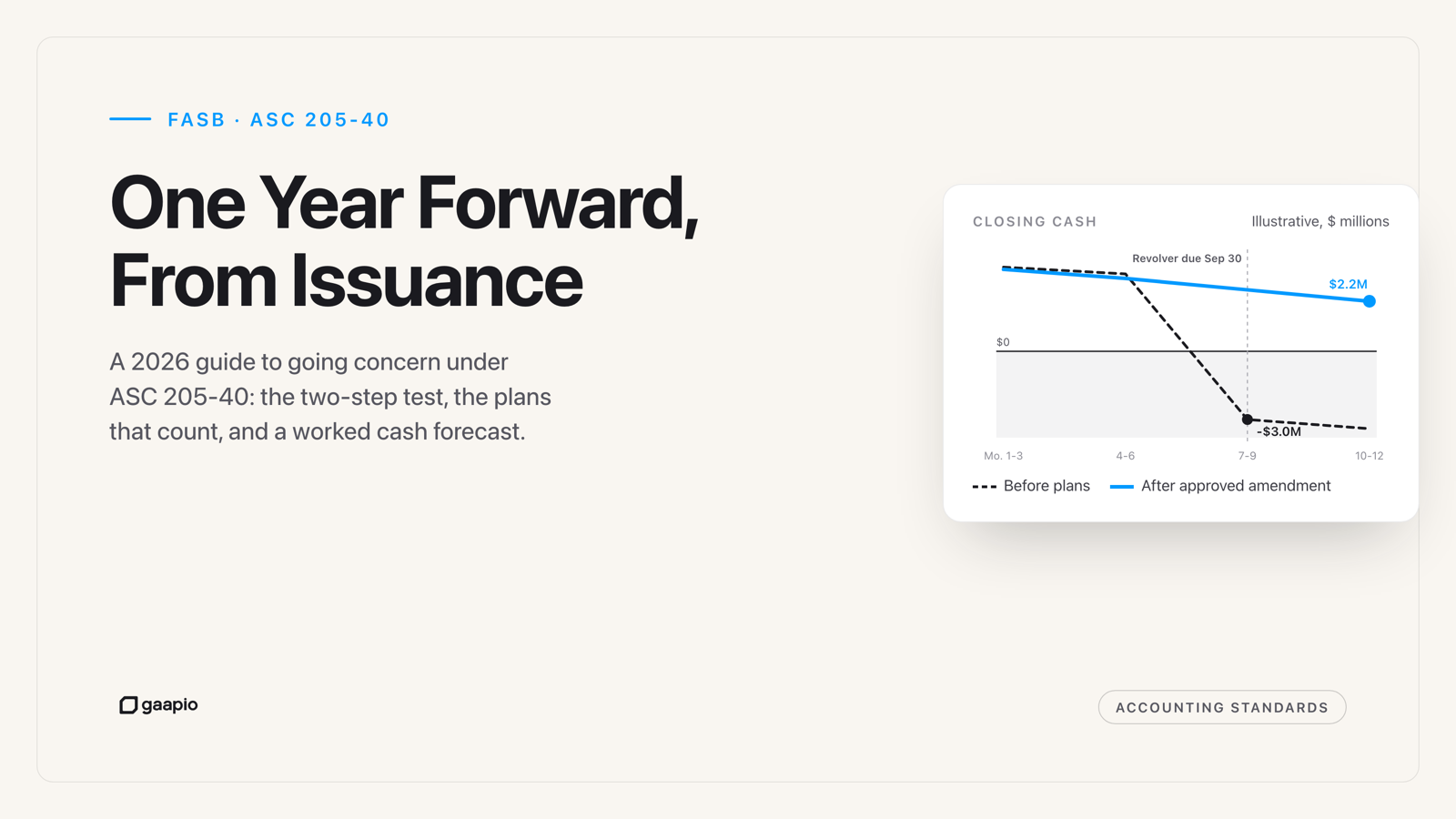
Step 1: cash forecast without plans not yet implemented.
| Months after issuance | Operating cash flow | Capex | Debt service | Revolver maturity | Closing cash |
|---|---|---|---|---|---|
| 1 to 3 | 0.9 | (0.4) | (0.8) | 0.0 | 3.7 |
| 4 to 6 | 0.9 | (0.4) | (0.8) | 0.0 | 3.4 |
| 7 to 9 | 0.8 | (0.4) | (0.8) | (6.0) | (3.0) |
| 10 to 12 | 0.8 | (0.4) | (0.8) | 0.0 | (3.4) |
Harlow cannot repay the revolver. The forecast shows a shortfall of $3.0 million in the quarter the revolver matures, and there are no unused borrowing commitments. If Harlow cannot repay the revolver at maturity, that is a payment default, and with the $6.0 million still outstanding the 4.00x covenant also fails at September 30, 2027. Either would let the lender accelerate the remaining $8.5 million term loan. Before counting any plan that is not fully implemented, it is probable Harlow will be unable to meet its obligations, so substantial doubt is raised.
The covenant test, under the existing 4.00x maximum and a proposed 5.00x maximum.
| Test date | Total debt | TTM EBITDA | Debt to EBITDA | Pass at 4.00x? | Pass at 5.00x? |
|---|---|---|---|---|---|
| Dec. 31, 2026 (actual) | 16.0 | 4.2 | 3.81x | Yes | Yes |
| Mar. 31, 2027 | 15.5 | 4.1 | 3.78x | Yes | Yes |
| Jun. 30, 2027 | 15.0 | 3.9 | 3.85x | Yes | Yes |
| Sep. 30, 2027 | 14.5 | 3.5 | 4.14x | No | Yes |
| Dec. 31, 2027 | 14.0 | 3.3 | 4.24x | No | Yes |
Debt balances assume the revolver remains outstanding after September 30, 2027, as under the amendment.
The existing covenant fails at September 30 and December 31, 2027, and a failure lets the lender call the debt. Harlow was compliant at the December 31, 2026 balance sheet date (3.81x), so ASC 470-10-45-11 does not move the term loan to current for a breach. At December 31, 2026, the $6.0 million revolver is current because it matures within 12 months, and the March 5 commitment letter generally would not qualify as a financing agreement under ASC 470-10-45-14, because its material-adverse-change condition lets the lender decline to close on a basis that is not objectively determinable. The $2.0 million of term loan amortization due in 2027 is current. The remaining $8.0 million is noncurrent, because Harlow was compliant at the balance sheet date.
Step 2: management's plans. Three plans exist.
- Amend and extend. The lender signed a commitment letter on March 5, 2027 to extend the revolver to 2030 and reset the maximum to 5.00x through March 31, 2028. The covenant steps back down after that date, which is outside the window, so management flags the step-down in MD&A as a known long-term liquidity uncertainty. The board approved it on March 10. Closing is expected May 31, 2027, subject to customary conditions, with a $0.1 million fee and about $0.1 million more debt service per quarter after closing.
- Hiring freeze. Approved, but savings are small and not needed for the conclusion, so Harlow treats it as cushion.
- Sale of a non-core unit. No buyer and no board approval. Excluded under ASC 205-40-50-9.
| Months after issuance | Operating cash flow | Capex | Debt service and fees | Revolver maturity | Closing cash |
|---|---|---|---|---|---|
| 1 to 3 | 0.9 | (0.4) | (0.9) | 0.0 | 3.6 |
| 4 to 6 | 0.9 | (0.4) | (0.9) | 0.0 | 3.2 |
| 7 to 9 | 0.8 | (0.4) | (0.9) | extended | 2.7 |
| 10 to 12 | 0.8 | (0.4) | (0.9) | extended | 2.2 |
Months 1 to 3 include the $0.1 million closing fee. Months 4 to 12 include about $0.1 million of added debt service per quarter.
The two probable tests. Is the amendment probable of being effectively implemented? It is approved and the lender has committed. Management reviewed the closing conditions (no material adverse change, accurate representations, no default at closing), expects to meet them, and found no condition that the forecast itself puts at risk, so it concludes implementation is probable. Does it mitigate? Closing lands four months before the maturity, cash stays positive at a $2.2 million low, and the reset covenant clears every projected test with a peak of 4.24x against 5.00x. Management also asks how far EBITDA can fall: at $14.0 million of debt, EBITDA of $2.8 million is the break-even for 5.00x, which is about 15 percent below the $3.3 million forecast. Management concludes substantial doubt is alleviated and documents the downside case.
Disclosure for this outcome (illustrative wording).
Note 2, Liquidity. The Company's revolving credit facility of $6.0 million matures on September 30, 2027, and the Company projected that its debt to EBITDA ratio would exceed the maximum of 4.00x permitted by its credit agreement at September 30 and December 31, 2027. These conditions raised substantial doubt about the Company's ability to continue as a going concern within one year after the date the financial statements are issued, before consideration of management's plans. Without an extension, the Company's forecast showed cash of approximately $3.4 million before the $6.0 million maturity, leaving a shortfall of approximately $3.0 million by the end of that quarter, and a failure to repay the facility at maturity, together with the projected covenant breaches, would have permitted the lender to accelerate the term loan. On March 5, 2027, the Company received a commitment letter from its lender to extend the revolving facility to 2030 and to increase the maximum debt to EBITDA ratio to 5.00x through March 31, 2028. The board approved the amendment on March 10, 2027. Closing is subject to customary conditions, and the Company expects it to close by May 31, 2027. Under the amended terms, the Company forecasts that it will remain in compliance with its covenants and meet its obligations through March 15, 2028. Management concluded that the amendment alleviates the substantial doubt.
What changes the answer. If the lender had only discussed an extension and no commitment existed, the plan would generally fail the implementation test, because nothing committed by the lender would exist at issuance to support feasibility (ASC 205-40-50-8 and 55-3(b)). Substantial doubt would not be alleviated, and the footnote would carry the explicit statement under ASC 205-40-50-13 along with the intended plans. The auditor's report would then carry going concern language, and any covenant that treats that language as a default would need a look too.
What should a going concern memo include? (copyable outline)
A going concern memo documents the window, the forecast, the Step 1 conclusion, each plan tested in Step 2, and the disclosure decision. Reviewers read it for evidence behind each probable judgment. Copy the outline below and fill it in with your facts. For the general memo structure, see our guide to how to write a technical accounting memo.
- Header. Entity, reporting period, issuance (or available-to-be-issued) date, preparer, reviewer, date.
- Question. Are there conditions and events that raise substantial doubt about the ability to continue as a going concern within one year after the issuance date?
- Basis of accounting. Confirm liquidation is not imminent, so ASC 205-30 does not apply.
- Evaluation window. Start date, end date, and why that date applies (SEC filer or not).
- Sources of liquidity. Cash, available credit, committed lines, and conditions on drawing them.
- Obligations in the window. Debt maturities, interest, leases, purchase commitments, contingent and unrecognized obligations (ASC 205-40-50-5(b)).
- Forecast and assumptions. Cash flow by quarter, source of each assumption, comparison with prior forecasts to actuals, downside case.
- Covenant and default analysis. Each test date, calculation, headroom, cross-default and audit-opinion triggers. Cite ASC 470-10 for classification.
- Adverse conditions considered. Tick through ASC 205-40-55-2 categories with the facts.
- Step 1 conclusion. Probable or not, without plans not yet implemented, with the reasoning.
- Step 2 plan analysis. For each plan: approval evidence, feasibility (ASC 205-40-55-3 questions), probable of implementation, probable of mitigation (magnitude and timing), conclusion. List plans excluded and why.
- Subsequent events. Events through issuance that changed the analysis (ASC 855).
- Conclusion and disclosure. Alleviated, not alleviated, or no doubt. Draft footnote under ASC 205-40-50-12 or 50-13, and the MD&A and risk factor cross-check for SEC filers. Other disclosures: ASC 275, ASC 470-10 covenant and subjective acceleration clause matters, and ASC 855.
- Auditor and governance. Evidence shared with the auditor, audit committee review, representation letter items, next re-evaluation date. Note the auditor's look-forward period (AS 2415: up to one year from the balance sheet date) and any events between that date and the end of the ASC 205-40 window.
How does Gaapio help with going concern evaluations?
Gaapio is an AI-powered technical accounting platform built by CPAs. For a going concern memo, you give Gaapio your facts and it asks follow-up questions before drafting. It is grounded in the licensed FASB Codification (through a direct licensing relationship with the FASB), Big 4 guidance, and SEC filings and comment letters. Where the analysis forks, it shows the alternatives so a reviewer can see the close calls, and conclusions come with clickable citations. It drafts in a memo template with reviewer comments, approvals and version history. See Gaapio accounting memos.
For the footnote, Gaapio reviews your disclosures against the Codification and compares them with peer filers. See AI footnote disclosures. Gaapio does not build your cash forecast, test your covenants or conclude on substantial doubt. You and your auditor make those calls.
Want to see it on your own going concern memo? Request a demo.
This article is general information, not accounting or legal advice. Confirm the requirements for your facts against the Codification and with your auditor.
Written by Jace Chambers, CPA. Jace started his career in audit at EY and has worked in hedge accounting at Chatham Financial, revenue recognition at RevenueHub, lease accounting at Netgain, and SEC comment letters at Connor Group, and teaches as an adjunct at BYU. Last reviewed November 2026.
Frequently asked questions
Does a net loss mean substantial doubt about going concern?
No. Substantial doubt turns on whether it is probable the company cannot meet its obligations as they come due within one year after issuance. A company with recurring losses and enough liquidity, including undrawn capacity under existing committed facilities, can pass Step 1. New financing that has not closed is tested in Step 2. ASC 205-40-55-2 lists recurring losses as an example condition, and says the presence of one does not determine the answer.
Do you have to evaluate going concern every quarter?
Yes. ASC 205-40-50-1 requires management to evaluate in connection with preparing financial statements for each annual and interim reporting period. Interim evaluations use the new issuance date, so the window moves forward each time.
Can management count a plan that the board has not approved?
Generally no. ASC 205-40-50-8 says that to be probable of effective implementation, management or others with the appropriate authority must generally have approved the plan before the issuance date. Plans that are not probable of implementation are ignored in the alleviation test (ASC 205-40-50-9).
Is a going concern paragraph in the auditor's report the same as a footnote disclosure?
They are related but separate. The footnote is management's disclosure under ASC 205-40. The auditor's report paragraph reflects the auditor's own conclusion under AU-C 570 or AS 2415 that substantial doubt remains, after considering management's plans. Check your credit agreements, because some treat a going concern paragraph as a default.
What is the difference between going concern and the liquidation basis of accounting?
Going concern basis presumes continued operations. Liquidation basis applies when liquidation is imminent, and it is governed by ASC 205-30. Substantial doubt about going concern is a disclosure matter under ASC 205-40 and does not by itself change the basis of accounting (ASC 205-40-05-2).
What happens when substantial doubt is resolved in a later period?
Disclose how the conditions or events that raised the doubt were resolved (ASC 205-40-50-14). That applies whether the doubt went away before or after considering management's plans. The note gives readers continuity between periods.
Does ASC 205-40 apply to private companies and not-for-profits?
Yes. ASC 205-40-15-1 says the guidance applies to all entities. The window differs slightly: entities that are neither SEC filers nor conduit bond obligors measure from the date the financial statements are available to be issued.
Does going concern value have anything to do with ASC 205-40?
No. Going concern value is a valuation concept, the worth of a business as a continuing operation. ASC 205-40 covers whether to disclose doubt about the entity's ability to keep operating and meet its obligations.
Related reading
- ASC 470 debt modification and extinguishment guide
- How to write MD&A (Item 303): the 2026 guide
- How to write a technical accounting memo
- ASC 450 contingencies guide
- Why technical accounting memos matter
- FASB Codification topics on Gaapio
Sources
- FASB, ASU 2014-15, Going Concern (Subtopic 205-40) (Aug. 2014)
- SEC, Regulation S-K Item 303 and Item 105
- KPMG, Handbook: Going Concern (US GAAP) (Dec. 2025)
- BDO, Going Concern Assessments (Apr. 2020)
- Journal of Accountancy, Going concern: What CPAs in audit and finance should know (Oct. 1, 2026)
- PCAOB, AS 2415, Consideration of an Entity's Ability to Continue as a Going Concern
- AICPA, AU-C Section 570, The Auditor's Consideration of an Entity's Ability to Continue as a Going Concern