

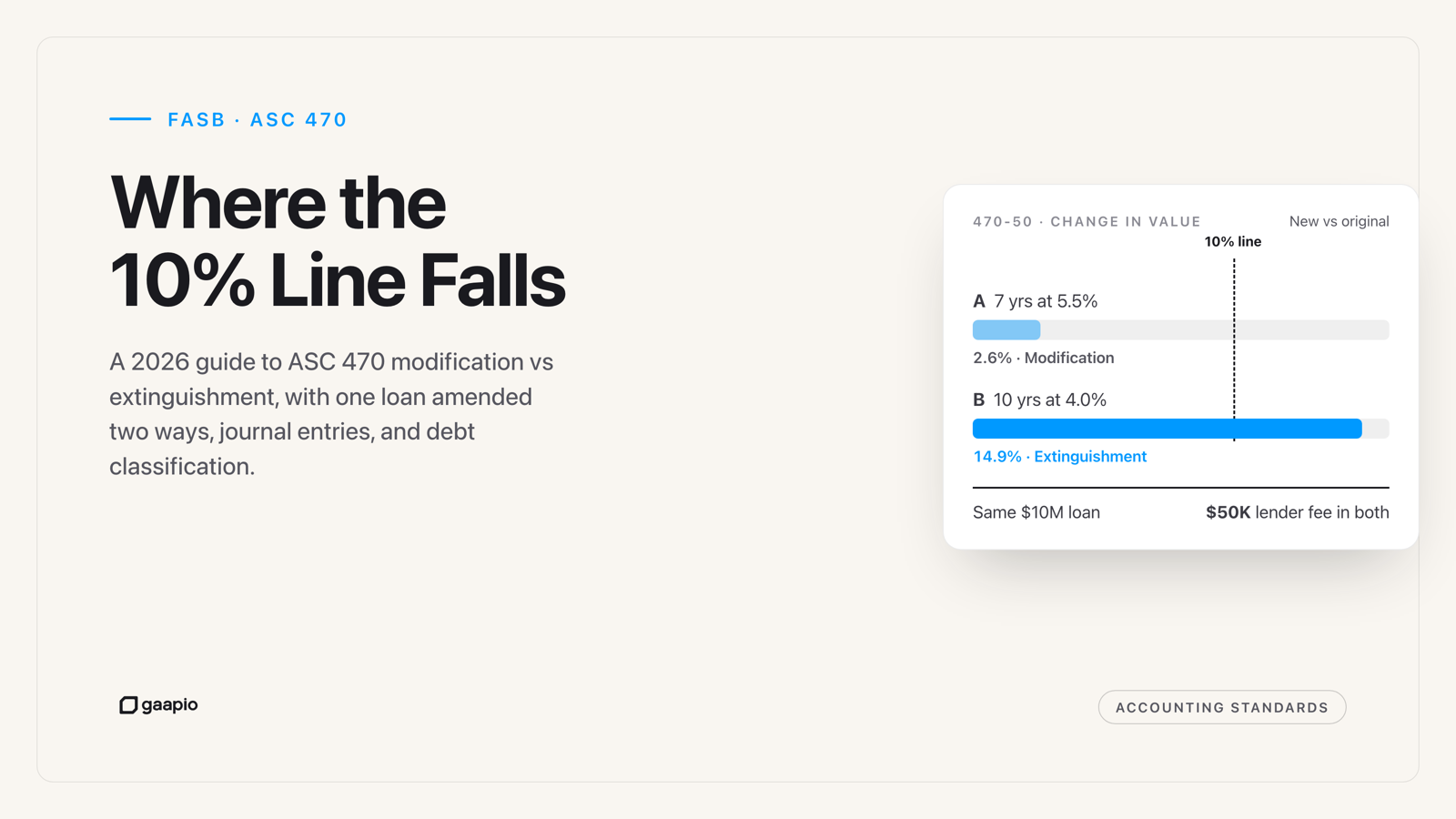
When a borrower and the same lender amend a term loan, ASC 470-50 asks whether the new terms are substantially different. If the present value of the new cash flows differs from the present value of the remaining original cash flows by at least 10 percent, a substantive conversion option is added or eliminated, or the change in the fair value of an embedded conversion option is at least 10 percent of the original debt's carrying amount immediately before the change, you account for an extinguishment of the old debt and the issuance of new debt. Otherwise it is a modification. Revolving and line-of-credit arrangements use a borrowing-capacity test instead (470-50-40-21). If the borrower is experiencing financial difficulty and the lender grants a concession, apply ASC 470-60 first.
Your lender just amended the credit agreement, and now someone wants to know whether you have a modified loan or a new one. The answer decides whether you carry fees forward, write off issuance costs, or book a gain or loss, and it turns on a calculation most teams run once a year at best.
This guide covers ASC 470 for the controller or reporting manager who owns the debt footnote: the structure of the topic, the debt modification vs extinguishment test in ASC 470-50 (including the 10 percent cash flow test), how fees and third-party costs are treated, the gain or loss on extinguishment, troubled debt restructurings in ASC 470-60, and current versus noncurrent classification in ASC 470-10. It also covers what FASB has proposed and decided so far on debt classification and debt modifications, with the status as of November 5, 2026. It ends with a worked example of one amendment tested two ways, with the journal entries.
Key takeaway: When a borrower and lender amend a loan, ASC 470-50 asks whether the new terms are substantially different. If the present value of the new cash flows differs from the present value of the remaining original cash flows by at least 10 percent, a substantive conversion option is added or removed, or the fair value of an embedded conversion option changes by at least 10 percent of the debt's carrying amount, you account for an extinguishment of the old debt and the issuance of new debt. Otherwise it is a modification. Fees paid to the lender are capitalized in a modification and become part of the gain or loss in an extinguishment, and third-party costs are expensed in a modification and capitalized in an extinguishment. If the borrower is in financial difficulty and the lender grants a concession, run ASC 470-60 first. For the balance sheet, debt due within a year is current, a covenant violation makes callable debt current unless it is waived or cured in time, and short-term debt you refinance can stay noncurrent only if you meet the tests in ASC 470-10-45-14. FASB has tentative decisions that would change several of these rules, but none is final.
What does ASC 470 cover?
ASC 470 (Debt) sets the accounting for a borrower's debt, organized into subtopics, the most used of which cover classification, convertible debt, modifications and extinguishments, and troubled debt restructurings. The table maps the subtopics to the questions a reporting team asks.
| Subtopic | What it answers | Typical question from your team |
|---|---|---|
| 470-10 Overall | Current versus noncurrent classification, covenant violations, refinancing, callable debt, subjective acceleration clauses, revolving credit with lockbox arrangements | "Does the loan stay long-term after we missed a covenant?" |
| 470-20 Debt with Conversion and Other Options | Convertible debt, debt with warrants, induced conversions | "How do we account for the note after the conversion terms changed?" |
| 470-50 Modifications and Extinguishments | When an amendment or exchange is a modification or an extinguishment, and how fees and costs are treated | "Do we write off the unamortized costs on the old loan?" |
| 470-60 Troubled Debt Restructurings by Debtors | Borrowers in financial difficulty that receive a concession from the lender | "Our lender gave us a payment holiday. Is that a TDR?" |
Three nearby topics matter in nearly every debt question. ASC 835-30 covers debt issuance costs, discounts and the effective interest method, and presents unamortized debt issuance costs as a direct deduction from the carrying amount of the debt. ASC 405-20 covers when a liability is extinguished. ASC 815-15 covers embedded derivatives, such as a conversion or prepayment feature that must be separated from the debt. Our ASC 815 guide covers derivatives and hedges, including the interest rate swaps companies often pair with a floating-rate loan, and our ASC 480 guide covers warrants and other instruments that sit between debt and equity.
How do you decide whether a debt amendment is a modification or an extinguishment?
You decide by working through a short sequence of questions, in order, and the order matters because a troubled debt restructuring changes the answer entirely. First ask whether the borrower is in financial difficulty and the lender has granted a concession. If so, ASC 470-60 applies instead of ASC 470-50. If not, ask whether the old and new debt instruments are substantially different under ASC 470-50. If they are, you account for an extinguishment of the old debt and the issuance of new debt. If they are not, you account for a modification of the existing debt.
| Question | If yes | If no |
|---|---|---|
| 1. Is the borrower experiencing financial difficulty and has the lender granted a concession? | Apply ASC 470-60 (troubled debt restructuring). Stop here | Go to question 2 |
| 2. Does the present value of the new cash flows differ from the present value of the remaining original cash flows by 10 percent or more? | Extinguishment | Go to question 3 |
| 3. Is a substantive conversion option added or removed, or does the fair value of an existing conversion option change by 10 percent or more of the carrying amount of the original debt immediately before the amendment? | Extinguishment | Modification |
Two scoping points save time. The test applies to changes in the terms of an existing debt instrument and to exchanges of debt instruments between the same borrower and lender. A replacement loan from a different lender that pays off the old loan is generally a repayment of the old debt, and the gain or loss follows the extinguishment guidance. If an arranger or other intermediary is involved, first decide whether it is acting as a principal or as the borrower's agent, because an agent's role is ignored and the test looks through to the actual lenders. For a syndicated loan, the guidance is applied lender by lender. One lender's piece can be a modification while another's is an extinguishment, a lender that leaves the syndicate is an extinguishment of its share, and a new lender is new debt. In a loan participation, only the lead lender is the creditor. Revolving credit facilities skip questions 2 and 3 and use the borrowing capacity test described below. Document the first question even when the answer is an obvious no, because it is where auditors tend to start.
How does the 10 percent cash flow test work?
The 10 percent cash flow test compares two present values, both discounted at the effective interest rate of the original debt. The first is the present value of the remaining cash flows under the original terms. The second is the present value of the cash flows under the new terms, including any fees paid to or received from the lender as part of the amendment. If the new present value is at least 10 percent lower or higher than the original, the debt instruments are substantially different. The test is in ASC 470-50-40-10, with the cash flow rules in 470-50-40-12.
The inputs are where teams make mistakes. The table summarizes the usual ones.
| Input | How it is treated in the test |
|---|---|
| Discount rate | The effective interest rate for accounting purposes of the original debt, not the coupon and not the current market rate. It reflects discounts and premiums. KPMG views including or excluding third-party issuance cost amortization as a policy election to apply consistently, so document your policy |
| Cash flows | All contractual cash flows under each set of terms: interest and principal. Document how contingent payments are estimated |
| Fees paid to the lender | Included in the new cash flows at the date paid. Fees paid to the lender count even though they are not interest |
| Third-party costs (legal, valuation, arrangement fees paid to non-lenders) | Excluded from the test. Costs of the lender that you pay directly, such as the lender's counsel, are generally treated as fees paid to the lender |
| Warrants held by the lender | If a freestanding equity-classified written call option held by the lender is modified as part of the amendment, include the change in its fair value in the test (ASC 470-50-40-12A) |
| Variable-rate debt | Use the rate in effect at the amendment date for both sets of cash flows, and do not forecast rate changes |
| Prepayment, call and put options | Run the test twice, once assuming the option is exercised and once assuming it is not, and use the result that produces the smaller change in present value |
| Accrued but unpaid interest | Treat it consistently in both sets of cash flows, and document the approach |
| Earlier amendments | If the debt was modified or exchanged within the prior 12 months and that change was not treated as an extinguishment, compare the new terms with the terms that existed one year ago, not with the terms immediately before this amendment |
The 10 percent threshold is a bright line. A change of 9.9 percent is a modification, and 10.0 percent is an extinguishment. In practice that means the test is worth running on every amendment that touches rate, maturity, principal, amortization schedule or fees, because small changes in each can combine to cross the line. A maturity extension alone rarely does. An extension paired with a large rate change can, as Scenario B shows, unless the debt is prepayable, because the prepayment analysis usually produces the smaller change.
What else can make an amendment an extinguishment?
A change to an embedded conversion option can make an amendment an extinguishment even when the cash flows pass the 10 percent test. Under ASC 470-50-40-10, the instruments are also substantially different if the change in the fair value of an embedded conversion option is at least 10 percent of the carrying amount of the original debt immediately before the change, or if a substantive conversion option is added or eliminated. The fair value change is measured as the difference in the option's fair value immediately before and after the modification. If the amendment is still a modification, an increase in the conversion option's fair value reduces the carrying amount of the debt, with the offset in additional paid-in capital (ASC 470-50-40-15). A decrease is not recognized. These conversion option rules do not address an option bifurcated as a derivative before or after the change (ASC 470-50-40-11). Valuing the option usually needs a valuation provider, and the result feeds the conclusion directly.
Two related points. First, ASU 2020-06 simplified convertible debt by removing the cash conversion and beneficial conversion feature models, so most convertible notes now carry the conversion option inside a single liability unless it is a bifurcated derivative. Second, ASU 2024-04 clarified when a settlement of convertible debt is an induced conversion under ASC 470-20. It is effective for all entities for annual reporting periods beginning after December 15, 2025, and interim periods within those years. Early adoption is permitted for entities that have adopted ASU 2020-06. If your amendment adds an incentive for holders to convert, check ASC 470-20 before applying ASC 470-50.
How are fees and third-party costs treated in a modification or an extinguishment?
The treatment depends on who received the fee and on which way the test came out. In a modification, fees paid to the lender are capitalized as a discount on the debt and amortized as a yield adjustment over the remaining term, while third-party costs are expensed as incurred. In an extinguishment, fees paid to the lender are part of the reacquisition price and flow into the gain or loss, while third-party costs are capitalized and amortized over the term of the new debt. The rules are in ASC 470-50-40-17 and 40-18.
| Cost | Modification (not substantially different) | Extinguishment (substantially different) |
|---|---|---|
| Fees paid to the lender | Capitalized as a debt discount. Amortized over the remaining term of the modified debt using the effective interest method | Included in the reacquisition price, so they increase the loss or reduce the gain |
| Third-party costs (legal, valuation, broker) | Expensed as incurred | Capitalized as debt issuance costs on the new debt and amortized over its term |
| Unamortized costs and discount on the original debt | Stay on the balance sheet and keep amortizing, with a new effective rate | Written off as part of the net carrying amount in the gain or loss calculation |
The asymmetry is the reason the classification of the amendment matters to earnings. The same $50,000 lender fee is a balance sheet item that amortizes into interest expense in one case and a same-period charge in the other. The same $20,000 legal bill goes to expense in one case and to the balance sheet in the other.
Revolving credit facilities have their own rule. For a line of credit or revolving arrangement, ASC 470-50-40-21 compares borrowing capacity, defined as the remaining term multiplied by the maximum available credit, of the old and new arrangements instead of running the 10 percent test. If the new borrowing capacity is equal to or greater than the old, the unamortized costs of the old arrangement, new fees paid to the lender and third-party costs are deferred and amortized over the term of the new arrangement. If it is lower, new fees and third-party costs are deferred and amortized over the new term, and the old unamortized costs are written off in proportion to the decrease in capacity, with the rest amortized over the new term. A revolver exchanged for a term loan with the same lender generally stays under this test. A term loan exchanged for a revolver goes through the 10 percent test. SEC staff has also said it would not object to presenting debt issuance costs for a line of credit as an asset and amortizing them ratably over the term of the arrangement, whether or not there are outstanding borrowings (ASC 835-30-S45-1).
How do you calculate the gain or loss on extinguishment?
The gain or loss on extinguishment is the reacquisition price of the old debt minus its net carrying amount. The reacquisition price is the amount paid to settle the debt, including any call premium and, in a cash payoff, miscellaneous costs of reacquisition. In an exchange or an amendment treated as an extinguishment, the new debt is initially recorded at fair value, and that fair value is part of the reacquisition price. The net carrying amount is the principal outstanding plus or minus any unamortized premium or discount, minus unamortized issuance costs. The rules are in ASC 470-50-40-2 and ASC 405-20-40-1.
Two exceptions. If the debt is extinguished with a related party, such as a shareholder lender, the transaction may in substance be a capital transaction, with the difference recorded in equity rather than as a gain or loss (ASC 470-50-40-2). Evaluate the facts. And in an exchange or amendment with the same lender, third-party costs follow the fee rules above rather than the miscellaneous costs of reacquisition.
Three presentation points. The gain or loss is reported in income from continuing operations, and the label "extraordinary" is no longer used. In the cash flow statement, payments for debt prepayment or extinguishment costs, including fees paid to the lender, are financing outflows under ASC 230-10-45-15, and a non-cash exchange is a disclosure item. And if the fair value of the new debt is far from its face amount, ask why. A gain on an amendment is unusual for a healthy borrower, and a gain that comes from a below-market rate is a signal that the lender made a concession and ASC 470-60 may apply.
What is a troubled debt restructuring, and does it still apply to borrowers?
A troubled debt restructuring (TDR) for a borrower exists when the borrower is experiencing financial difficulty and the creditor grants a concession it would not otherwise consider. The guidance for debtors is in ASC 470-60 and still applies today. ASU 2022-02 eliminated the TDR model for creditors, who now follow the Codification's loan refinancing and restructuring guidance, but it did not change the borrower side.
Both conditions have to be met. Indicators of financial difficulty include default or probable default, bankruptcy, doubt about the ability to continue as a going concern, a forecast that cash flows will not cover debt service, and an inability to obtain financing at market rates for a non-troubled borrower. For a borrower, the test for a concession is specific. The lender has granted a concession if the effective borrowing rate on the restructured debt, including fees and all revised cash flows, is lower than the effective borrowing rate on the old debt immediately before the restructuring (ASC 470-60-55-10). Solve for the new rate against the current carrying amount of the old debt, which includes unamortized premium, discount, issuance costs and accrued interest, and excludes hedge adjustments (ASC 470-60-55-11). Typical sources are a lower rate, a maturity extension without a matching rate increase, forgiven principal or accrued interest, and settlement with assets or equity worth less than the debt.
The accounting depends on how the restructuring settles.
| Form of the restructuring | Borrower accounting under ASC 470-60 |
|---|---|
| Settlement by transferring assets | Gain equals the carrying amount of the debt minus the fair value of the assets transferred. Gain or loss on the asset transfer is recognized separately |
| Settlement by issuing equity | Gain equals the carrying amount of the debt minus the fair value of the equity issued |
| Modification where total future cash payments are at least the carrying amount | No gain. The carrying amount stays the same, and a new effective interest rate is computed so that interest expense continues over the new term |
| Modification where total future cash payments are less than the carrying amount | The carrying amount is reduced to total future cash payments and a gain is recognized. No interest expense is recorded afterward, because every payment reduces the carrying amount |
Direct costs reduce any gain, and any excess is expensed. With no gain, third-party costs are expensed, and KPMG believes lender fees are capitalized and amortized (ASC 470-60-35-12).
The comparison in the modification case uses undiscounted future cash payments, including principal, interest and the maximum amount of any contingent payments, and is a different calculation from the 10 percent test. The two tests can point in different directions, which is why the order matters. An amendment that would be a modification under ASC 470-50 can produce a TDR gain under ASC 470-60, and an amendment that would cross 10 percent can be a TDR with no gain. Teams that apply ASC 470-50 to a distressed amendment and skip the first question are the ones auditors ask to redo the memo.
What does a worked example look like? One amendment, tested two ways
The example below is illustrative. Cedar Ridge Logistics is invented, as are all figures. Cedar Ridge has a $10,000,000 term loan with a bank. It pays 6.0 percent interest annually, has five years remaining, and repays principal at maturity. Neither the original loan nor the amended loan can be prepaid. That assumption matters. If both could be prepaid at par, the test would assume immediate prepayment of both, the only change would be the $50,000 fee, and both scenarios would be modifications. Unamortized debt issuance costs on the loan are $100,000, so the net carrying amount is $9,900,000, which makes the effective interest rate for accounting purposes 6.24 percent. Cedar Ridge is not experiencing financial difficulty: it is current on all payments, in covenant compliance, not in going concern doubt, and able to borrow at market rates. So the first question is answered no and ASC 470-60 does not apply. The new effective borrowing rate is below the old 6.24 percent in both scenarios, so that answer rests on the absence of financial difficulty.
Starting point: discount rate and original cash flows. Discounting the remaining original cash flows (five annual payments of $600,000 plus $10,000,000 at maturity) at the original effective rate of about 6.24 percent (6.239 percent unrounded) gives $9,900,000, the net carrying amount. The figures below use the unrounded rate. This example includes issuance costs in the rate. A company whose policy excludes them would discount at 6.0 percent, compare with $10,000,000, and get changes of 2.3 percent and 14.2 percent, with the same conclusions.
Consider two alternative scenarios, each tested on its own facts. They are separate cases, not offers made on the same day, which is why the market rate differs. In both, Cedar Ridge pays the bank a $50,000 amendment fee and pays its lawyers $20,000.
| Scenario A | Scenario B | |
|---|---|---|
| New maturity | 7 years | 10 years |
| New fixed rate | 5.5% | 4.0% |
| Market rate for Cedar Ridge's credit in this scenario | 5.5% | 4.0% |
| Present value of new cash flows at the original effective rate | $9,590,975 | $8,370,615 |
| Plus lender fee paid | $50,000 | $50,000 |
| Total new present value | $9,640,975 | $8,420,615 |
| Compared with original ($9,900,000) | down $259,025, or 2.6% | down $1,479,385, or 14.9% |
| Result | Modification | Extinguishment |
Scenario A: modification. The 2.6 percent change is below 10 percent and no conversion option is involved, so Cedar Ridge accounts for a modification. The $50,000 lender fee is capitalized as a discount, the $20,000 legal bill is expensed, and the $100,000 of unamortized issuance costs stays and keeps amortizing. The net carrying amount after the amendment is $9,850,000, and the new effective rate that discounts the new cash flows to that amount is about 5.77 percent.
| Account | Debit | Credit |
|---|---|---|
| Unamortized debt discount (contra-liability), lender fee | $50,000 | |
| Legal fees expense | $20,000 | |
| Cash | $70,000 |
In year 1, interest expense is $9,850,000 × about 5.7665 percent, or about $567,998. Cash interest is $550,000 at the 5.5 percent coupon, and the $17,998 difference accretes the discount and costs, so the net carrying amount rises to $9,867,998.
Scenario B: extinguishment. The 14.9 percent change is above 10 percent, so Cedar Ridge accounts for an extinguishment of the old loan and the issuance of a new one. Because 4.0 percent is the market rate for Cedar Ridge's credit, the fair value of the new loan equals its $10,000,000 face amount. The reacquisition price is the $10,000,000 fair value of the new loan plus the $50,000 fee paid to the bank, or $10,050,000. The net carrying amount of the old loan is $9,900,000. The loss is $150,000, which is the $100,000 of unamortized issuance costs written off plus the $50,000 fee.
| Account | Debit | Credit |
|---|---|---|
| Term loan payable (old) | $10,000,000 | |
| Loss on extinguishment of debt | $150,000 | |
| Unamortized debt issuance costs (old) | $100,000 | |
| Term loan payable (new, at fair value) | $10,000,000 | |
| Cash (lender fee) | $50,000 |
| Account | Debit | Credit |
|---|---|---|
| Unamortized debt issuance costs (new, contra-liability) | $20,000 | |
| Cash (legal fees) | $20,000 |
The $20,000 legal bill is capitalized and amortizes over the ten-year term of the new loan with the effective interest method. The loss goes in income from continuing operations, and the $50,000 fee is a financing outflow in the cash flow statement.
Notice what drives the outcome. In Scenario A the same bank, same borrower and a seven-year loan produce a modification and a $20,000 expense. In Scenario B a rate cut that matches the market and a ten-year term produce a $150,000 loss. The cash flow test did the work, and the fee was a small part of the answer. If the market rate for Cedar Ridge's credit had stayed at 6.0 percent while the bank cut the coupon to 4.0 percent, the new loan would have a fair value well below face, the extinguishment would show a gain, and that gain would be the signal to test ASC 470-60 first.
How do you classify debt as current or noncurrent under ASC 470-10?
Debt is current if it is due within one year of the balance sheet date, or within the operating cycle if that is longer, and noncurrent otherwise. ASC 470-10 then adds rules for debt that is callable, debt in covenant violation, debt with subjective acceleration clauses and short-term debt the company expects to refinance. These are the questions that decide most classification disputes.
| Situation at the balance sheet date | Classification | What has to be true |
|---|---|---|
| Debt matures within 12 months | Current | Unless refinanced under the rules below |
| Long-term debt callable by the lender because of a covenant violation at the balance sheet date | Current | Unless the lender has waived or lost the right to demand repayment for more than one year from the balance sheet date, or the debt has a grace period and it is probable the violation will be cured within it (ASC 470-10-45-11) |
| No violation at the balance sheet date, but a covenant test falls within the next 12 months | Noncurrent | Classification does not change for a possible future breach. Consider disclosing expected noncompliance. SEC registrants discuss a breach that is reasonably likely in MD&A (Release 33-8350). Consider the going concern evaluation in ASC 205-40. Check for covenants tied to the period just ended, such as a going concern opinion, because a breach of those can make the debt current |
| Long-term debt with a subjective acceleration clause (for example, a material adverse change clause) | Noncurrent if acceleration is remote. Current if circumstances (such as recurring losses or liquidity problems) make acceleration probable. In between, judge classification and disclosure on the facts | ASC 470-10-45-2 does not use the word probable. The probable and reasonably possible framing is how KPMG applies it |
| Short-term debt you intend to refinance on a long-term basis | Noncurrent up to the amount refinanced | Before the financial statements are issued (or available to be issued), you issued long-term debt or equity to refinance it, or signed a financing agreement that meets the criteria in ASC 470-10-45-14 |
| Revolver with a required lockbox | Current | Customer receipts repay the debt without another event occurring, so it is short-term (ASC 470-10-45-5A). Noncurrent only if the ASC 470-10-45-14 criteria are met, and a subjective acceleration clause means that takes a separate agreement, not the revolver (ASC 470-10-45-5). A springing lockbox stays long-term, with any subjective acceleration clause assessed under ASC 470-10-45-2 (ASC 470-10-45-6) |
Whether a violation exists, whether a waiver is unconditional and when the lender can call the debt all depend on the credit agreement's language, so have counsel confirm your reading of the agreement and any waiver. Waivers deserve a second look. A waiver that expires in nine months does not remove the current classification, because the lender has not given up the right to call the debt for more than one year. A waiver that covers more than a year but is conditional on meeting the covenant at a later date still requires you to assess the later test dates. If a violation existed at the balance sheet date (or would have without the waiver or amendment) and it is probable you will fail the covenant at a measurement date within the next 12 months, the debt stays current (ASC 470-10-45-1). And a waiver received after the balance sheet date but before the financial statements are issued can support noncurrent classification, but only if it meets the one-year test.
The refinancing criteria are specific. The financing agreement must not expire within one year, must not be cancelable by the lender during that period, and borrowings under it must not be callable except for objectively determinable violations. There must be no violation at the balance sheet date, and none afterward unless waived. The lender must be expected to be able to honor it. The amount excluded from current liabilities is limited to the amount available under the agreement and the amount you actually intend to refinance. Non-binding commitment letters and an intention to refinance do not qualify. If you repay the short-term debt before the long-term proceeds arrive, it stays current.
Is FASB changing debt classification and debt modifications? Where the projects stand
FASB has two active debt projects and one paused project, and none has produced a final standard as of November 5, 2026. None of these projects has changed current GAAP in ASC 470. If you searched for ASC 470 and found a FASB proposed ASU on simplifying the classification of debt, that document is from January 2017. It proposed replacing the fact-specific classification rules with a single principle. FASB re-exposed the proposal in September 2019, and neither version became an ASU. The probability assessment for subjective acceleration clauses in ASC 470-10-45-2 remains current GAAP. The new project would remove it, but only through a future ASU.
The classification project is new. FASB's project page shows that the Board added a project on subjective acceleration clauses and debt default disclosures to its technical agenda on May 27, 2026, after considering recommendations from the Private Company Council. The Board's tentative decisions are summarized below.
| Topic | Tentative Board decision |
|---|---|
| Subjective acceleration clauses | Remove the probability assessment in ASC 470-10-45-2. Classify the debt as current only when the clause is triggered, meaning the lender demands repayment under it |
| Grace periods | Not addressed in the context of a trigger |
| Subsequent events | Add an illustrative example of how to apply the subsequent events guidance when a trigger occurs |
| Refinancing and revolvers | Make conforming changes to the intent-and-ability-to-refinance guidance and to the classification of revolving credit agreements with subjective acceleration clauses |
| Disclosures | Require disclosures about events of default for all entities, similar to the SEC's Regulation S-X Rule 4-08(c) |
| Scope and transition | Apply to all entities. Prospective transition with early adoption permitted |
| Next step | Staff to draft a proposed ASU, with a 60-day comment period |
As of FASB's current project and open-comment pages, no exposure draft has been issued for this project. These are tentative decisions, and FASB's page says they do not change current accounting. Treat a classification conclusion that depends on them as a conclusion under today's rules.
The second project is Accounting for Changes in Debt. The Board added a project on debt modifications and exchanges on August 26, 2026. Its tentative decisions to date are summarized below.
| Topic | Tentative Board decision |
|---|---|
| Modifications and extinguishments | Require extinguishment accounting for all modifications and exchanges within ASC 470-50 that affect the timing or amount of cash flows, or the fair value of an embedded conversion option. RSM reads this as replacing the quantitative 10 percent test |
| Considering all changes | All changes to cash flows, written call options and conversion options considered in the determination |
| Simplification | Entities other than public business entities may elect, as an entity-wide policy, to initially measure new or modified debt at its principal amount when extinguishment accounting applies. Not available when the effective rate differs from the stated rate because of multiple units of account |
| TDRs for borrowers | Eliminate the ASC 470-60 guidance for borrowers |
| Disclosures | Describe the principal changes in terms, the reasons for the modification or exchange and the gain or loss recognized. Extend the Regulation S-X debt disclosures (other than Rule 4-08(c)) to all entities |
| Next step | Initial deliberations continue. No exposure draft, effective date or transition method yet |
A third project, Accounting for Debt Exchanges, started from an EITF recommendation in October 2024 about exchanges involving multiple creditors and led to a proposed ASU amending ASC 470-50 and ASC 405-20. On March 18, 2026, the Board paused it while it weighs broader feedback. FASB also has a separate proposed ASU on indexation in ASC 815-40, with comments due January 4, 2027, that affects some convertible debt and warrants. Our ASC 480 guide covers that project.
What to do now: document today's conclusions under today's rules, keep a file of the amendments you tested, and note which ones would come out differently under the Board's tentative direction. If the August tentative decisions are finalized as written, most amendments that change cash flows and are modifications today would become extinguishments, so that file is also a preview of the transition.
What do auditors push on in debt accounting?
Auditors usually ask for the same five things, and a team that has them ready shortens the debt review considerably.
- The amendment memo. A written conclusion for every amendment, with the 10 percent calculation, the discount rate and its source, the treatment of fees and the TDR assessment, signed off by someone other than the preparer.
- The effective rate. Support for the original debt's effective interest rate, because it is the discount rate in the test and often the most thinly documented input.
- Fee tracing. A schedule of every amendment-related payment by recipient, since the lender versus third-party split drives the accounting.
- The classification analysis. Covenant compliance calculations at the balance sheet date, any waiver letters with their terms, and the refinancing agreements and their conditions, all dated against the issuance date of the financial statements.
- The disclosures. Maturities for each of the next five years, the terms of significant debt, covenants and any default, and the gain or loss on extinguishment. Public companies follow Regulation S-X, including Rule 4-08(c) for defaults.
How does Gaapio help with ASC 470 debt accounting?
Gaapio is an AI-powered technical accounting platform built by CPAs. For a debt amendment memo, you give Gaapio your facts and it asks follow-up questions about them before drafting. On an amendment, the facts that matter include whether the lender is the same, whether the borrower is in financial difficulty, and who received each fee. It is grounded in the licensed FASB Codification, Big 4 guidance, and SEC filings and comment letters. Where the analysis forks, for example on whether a concession exists, it shows the alternatives so a reviewer can see the close calls, and conclusions come with clickable citations. It drafts in your team's memo template, with reviewer comments, approvals and version history. See Gaapio accounting memos.
For the debt footnote, Gaapio reviews your disclosures against the Codification, compares them with peer filers in your industry, and drafts footnote language for your review. See AI footnote disclosures and SEC reporting. Gaapio does not run your present value calculation, value your conversion option or give you a legal reading of the credit agreement. Those come from your finance team, your valuation provider and your counsel. You make the accounting calls.
Want to see it on your own amendment memo? Request a demo.
This article is general information, not accounting or legal advice. Confirm the requirements for your facts against the Codification, your credit agreement and your auditor.
Written by Jace Chambers, CPA, who started his career in audit at EY.
Frequently asked questions
What is ASC 470?
ASC 470 is the FASB Codification topic on debt. It covers classification of debt as current or noncurrent (470-10), convertible debt and debt with other options (470-20), modifications and extinguishments (470-50) and troubled debt restructurings by debtors (470-60).
What is the 10 percent test for debt modification?
It compares the present value of the cash flows under the new terms, including fees paid to the lender, with the present value of the remaining cash flows under the original terms, both discounted at the original debt's effective interest rate. If the difference is 10 percent or more, the debt instruments are substantially different and you account for an extinguishment.
How do you account for debt modification versus extinguishment?
In a modification, you keep the existing debt, capitalize fees paid to the lender as a discount, expense third-party costs and keep amortizing the unamortized costs under a new effective rate. In an extinguishment, you remove the old debt, record the new debt at fair value, recognize a gain or loss that includes the old unamortized costs and any lender fees, and capitalize third-party costs on the new debt.
How are lender fees treated in a debt modification?
Fees paid to the lender in a modification are capitalized as a debt discount and amortized over the remaining term as a yield adjustment. They are also included in the cash flows used in the 10 percent test. Third-party costs such as legal fees are expensed as incurred and are not part of the test.
What is a troubled debt restructuring for a borrower?
It is a restructuring in which the borrower is experiencing financial difficulty and the lender grants a concession. ASC 470-60 then governs the borrower's accounting and, depending on the form, can produce a gain with no further interest expense. ASU 2022-02 removed the TDR model for creditors but not for borrowers.
When is long-term debt reclassified as current?
Debt becomes current when it is due within 12 months, or when a covenant violation at the balance sheet date makes it callable, unless the lender has waived its right to demand repayment for more than one year from the balance sheet date, or a grace period applies and it is probable you will cure the violation within it. Short-term debt can stay noncurrent if you meet the refinancing criteria in ASC 470-10-45-14.
Is FASB changing the debt modification and debt classification rules?
FASB has tentative decisions on both topics but no final standard. The classification project would classify debt with a subjective acceleration clause as current only when the clause is triggered, and the debt modification project would require extinguishment accounting for modifications that change cash flows or an embedded conversion option. As of November 5, 2026, no exposure draft has been issued on either project, and current GAAP is unchanged.
What happens to unamortized debt issuance costs when debt is extinguished?
They are written off and included in the gain or loss on extinguishment, because they are part of the net carrying amount of the old debt. In a modification they stay on the balance sheet and continue to amortize.
Related reading
- ASC 480 liability versus equity classification
- ASC 815 hedge accounting
- ASC 820 fair value measurement and disclosures
- Accounting memos: format, example and template
Sources: FASB ASC 470-10, 470-20, 470-50 and 470-60, ASC 405-20, ASC 835-30, ASU 2020-06, ASU 2022-02 and ASU 2024-04; FASB project pages for Subjective Acceleration Clauses and Debt Default Disclosures, Accounting for Changes in Debt and Accounting for Debt Exchanges, and the FASB list of documents open for comment; FASB, Proposed ASU on simplifying the classification of debt (January 2017); Deloitte, FASB revises proposal on simplifying the balance sheet classification of debt (September 2019); RSM, FASB adds project on accounting for changes in debt. KPMG, Debt and equity financing (April 2025); RSM, Debt classification.