

The equity method under ASC 323 is how an investor accounts for an investment in the common stock or in-substance common stock of an investee when it has significant influence over the investee but does not control it (ASC 323-10-15-3 and 15-6). The investor records the investment at cost, then each period adjusts the carrying amount for its share of the investee's earnings and other comprehensive income, less dividends received, basis difference amortization and eliminated intra-entity profit (ASC 323-10-35-4 through 35-18).
Say your company just bought 30% of a supplier and your auditor has asked for the memo. The percentage looks like the whole answer, and it is only the start. The real work is the schedule behind the one-line balance on the balance sheet: the basis difference you have to amortize, the profit on inventory you sold the investee, and the day your carrying amount hits zero.
This guide walks through ASC 323 for a controller or technical accounting lead. It covers when the equity method applies, initial measurement, the annual adjustments, losses below zero, impairment, changes in ownership, the fair value option, the FASB's October 2026 proposal, and presentation and disclosure, including SEC Regulation S-X Rules 3-09 and 4-08(g). It ends with an illustrative worked example that carries a basis difference on a building and an inventory sale through two years. Information is as of November 2026.
Key takeaway: Apply the equity method when you have significant influence (presumed at 20% or more of a corporation's voting stock) but not control. Start at cost and keep a basis difference schedule from day one. Each period, record your share of the investee's earnings and OCI, then subtract dividends, amortization of basis differences in depreciable or amortizable assets, and your share of unrealized intra-entity profit. Stop recording losses at zero unless you have other investments in the investee or have committed to fund it. Test the whole investment for an other-than-temporary decline in value. In October 2026 the FASB proposed changing the scope tests and moving the partnership allocation guidance into Topic 323. It is still a proposal and does not change today's accounting.
What is the equity method of accounting?
The equity method is a one-line consolidation. Instead of combining the investee's assets and liabilities, the investor carries its interest as a single investment and recognizes its proportionate share of the investee's results as income. ASC 323-10-35-4 requires the investor to record that share in net income as the investee earns it, so the investment grows with profits and shrinks with dividends.
It applies to investments in common stock and in-substance common stock, so a preferred stock investment that is not in-substance common stock stays in ASC 321, or in ASC 320 if it is a debt security such as mandatorily redeemable preferred stock, even if you have a board seat. It does not apply when you control the investee, which sends you to ASC 810 and the VIE guidance. It also does not apply to investments held by an investment company under ASC 946 or to investments carried at fair value under the fair value option.
When do you use the equity method of accounting?
You use it when the investor has the ability to exercise significant influence over the operating and financial policies of an investee that it does not control (ASC 323-10-15-6). Ownership of 20% or more of the voting stock of a corporation creates a presumption of significant influence, and ownership below 20% creates a presumption of no significant influence (ASC 323-10-15-8). Either presumption can be overcome with evidence.
ASC 323-10-15-6 lists the indicators of significant influence:
- Representation on the board of directors
- Participation in policy-making processes
- Material intra-entity transactions
- Interchange of managerial personnel
- Technological dependency
- The extent of the investor's ownership relative to the other owners
How do you rebut the 20% presumption?
You rebut it with evidence that the investor cannot exercise influence, or that it can at less than 20%. ASC 323-10-15-10 lists evidence that the investor may not have significant influence even at 20% or more: opposition by the investee (such as litigation or complaints to regulators), an agreement under which the investor surrenders significant rights, majority ownership concentrated among a small group that operates the investee without regard to the investor, failure to obtain the financial information the investor needs to apply the equity method, and an inability to obtain representation on the board.
The rebuttal needs documentation. An auditor will look for the facts behind each indicator, which is why a short memo that works through the six indicators for each investee is worth writing. A 15% investor with a board seat, a long-term supply agreement and a seconded executive has a stronger case for significant influence than its percentage suggests.
How do partnerships and LLCs differ from corporations?
For a limited partnership interest, or an interest in an LLC that keeps specific ownership accounts for each investor, the equity method applies at a much lower level, because these entities behave like partnerships. ASC 970-323-25-6, applied through ASC 323-30-35-3, requires the equity method unless the interest is so minor that the investor has virtually no influence, and the SEC staff position in ASC 323-30-S99-1 treats more than 3% to 5% as more than minor. General partnership and unincorporated joint venture interests are generally accounted for under the equity method by analogy to ASC 323-10 (ASC 323-30-25-1).
| Investee type | Threshold to apply the equity method | Source |
|---|---|---|
| Corporation, LLC without specific ownership accounts | Significant influence, presumed at 20% or more of voting stock | ASC 323-10-15-8 |
| Corporate joint venture | Joint control; equity method regardless of percentage | ASC 323-10-20, 323-10-25-1 |
| Limited partnership interest, LLC with specific ownership accounts | More than minor, commonly more than 3% to 5% | ASC 323-30-35-3, ASC 970-323-25-6, ASC 323-30-S99-1 |
Under the October 2026 proposal, a noncontrolling general partner or managing member would be deemed to have significant influence. That is not yet GAAP.
Do not apply the 3% to 5% threshold to a corporation. The October 2026 proposal would replace both thresholds with significance of influence and would treat a noncontrolling general partner or managing member as having it. That is not yet GAAP.
How do you measure an equity method investment at initial recognition?
You record it at cost, which includes the cash paid, the fair value of other assets transferred and liabilities incurred, and transaction costs directly attributable to the purchase. The investment is measured at cost under the asset acquisition guidance, not as a business combination, even when the investee holds a business (ASC 323-10-30-2 and ASC 805-50-30-1). Two exceptions start at fair value instead: a retained noncontrolling interest after you deconsolidate a subsidiary (ASC 810-10-40-3A to 40-5), and an equity method interest received in exchange for nonfinancial assets under ASC 610-20.
Immediately after recognition, compare the cost with your share of the investee's book equity. The difference is the basis difference, and you identify it at that date because it drives the later adjustments. Work through it asset by asset, in a schedule similar to the one in a purchase price allocation, except that you allocate only your proportionate share.
Contingent consideration, an obligation to fund the investee or an option on more shares can each change the cost, so keep the purchase agreement in the file.
How do you record the investor's share of earnings and OCI?
You record your share of the investee's net income as equity in earnings and your share of its other comprehensive income in your own OCI, both adjusted for basis differences and intra-entity profit. Dividends you receive reduce the carrying amount and are not income (ASC 323-10-35-4, 35-17 and 35-18).
Here is the annual procedure an auditor will recognize:
- Obtain the investee's financial statements for the period, adjusted to U.S. GAAP if needed. U.S. GAAP does not require you to conform the investee's policies to yours where both are acceptable. If you are a public business entity, remove any private company alternatives, such as goodwill amortization, from the investee's results. If the statements are not available in time, ASC 323-10-35-6 lets you record your share from the most recent available statements, with the same lag every period. The Codification sets no maximum, but practice, by analogy to ASC 810-10-45-12, keeps the lag at three months or less. Changing the lag is a change in accounting principle under ASC 250, and you recognize or disclose significant events in the lag period.
- Multiply the investee's net income or loss by your ownership percentage. Where preferred stock or other senior interests exist, allocate first for those claims.
- Adjust for amortization or accretion of basis differences on depreciable or amortizable assets and on liabilities, such as debt with a fair value different from book.
- Eliminate your share of unrealized intra-entity profit and bring in the realized profit from prior periods.
- Record equity in earnings in net income as one line, and record your share of the investee's OCI in your OCI.
- Reduce the carrying amount for dividends declared or received, and tax-effect the equity in earnings under ASC 740 where it applies.
- Roll the investment forward and compare it to the investee's equity times your percentage plus unamortized basis difference, less deferred intra-entity profit. A roll-forward that does not reconcile points to a missed step.
Investee capital transactions also matter. If the investee issues shares to others, you account for it as if you had sold a proportionate share of your investment and recognize the gain or loss in earnings (ASC 323-10-40-1), including a proportionate share of the basis difference and of accumulated OCI. Other investee capital transactions that change your share of its equity, such as treasury stock purchases, are accounted for as if the investee were a consolidated subsidiary (ASC 323-10-35-15).
What is a basis difference and how do you amortize it?
A basis difference is the gap between the amount you paid and your share of the investee's book value, and you account for it as if the investee were a consolidated subsidiary (ASC 323-10-35-13). That means you assign the gap to the investee's assets and liabilities that have fair values different from their book values, and you amortize each piece over the life of the underlying item.
| Where the gap sits | Treatment | Example effect on equity in earnings |
|---|---|---|
| Depreciable property, plant and equipment | Amortize over the remaining useful life | Lower equity in earnings each year |
| Finite-lived intangible assets | Amortize over the remaining useful life | Lower equity in earnings each year |
| Inventory | Expense as the inventory is sold | Lowers equity in earnings in the period of sale |
| Land, indefinite-lived intangibles | No amortization; reflected in impairment and disposal | No annual effect |
| Equity method goodwill (the unallocated residual) | Not amortized (unless a private company investor elected the ASC 350-20 goodwill amortization alternative); not tested separately | None until the investment as a whole is impaired or sold |
Note the last row. Equity method goodwill does not get its own impairment test under the goodwill guide rules. It is included in the single other-than-temporary decline test on the investment (ASC 350-20-35-58 and 35-59).
A negative basis difference, where you paid less than your share of book value, usually means some investee assets have fair values below book. You attribute it to those assets, and the amortization increases equity in earnings. If an unallocated excess remains after you recheck the fair values, ASC 323 does not say what to do with it, and the Big 4 firms describe more than one acceptable approach. Document your policy and agree it with your auditor before you close the quarter.
If the investee records an impairment on an underlying asset, recognize your share and then check whether your basis difference on that asset still stands (ASC 323-10-35-32A).
How are intra-entity profits eliminated?
You eliminate your share of profit on a transaction between you and the investee that is still unrealized, which means the asset sits in the buyer's inventory or fixed assets rather than being sold to a third party. The elimination is your ownership percentage of the profit, not 100%, because you do not consolidate the investee (ASC 323-10-35-7 and 35-8). Full elimination applies when the investor controls the investee, or a group of investors jointly controls it, and the transaction is not at arm's length (ASC 323-10-35-10).
The direction matters for mechanics. In a downstream sale, you sell to the investee, so you defer your share of your own profit with an entry against equity in earnings. In an upstream sale, the investee sells to you, so you reduce equity in earnings and the inventory or asset you carry still shows the full price you paid. In both cases, the deferred profit comes back into income when the asset is sold outside the group or, for depreciable assets, as it is depreciated.
Taxes follow the profit. Where the elimination creates a temporary difference, you consider deferred taxes at the investor level.
How do dividends affect the carrying amount?
Dividends reduce the carrying amount of the investment, not income, because you have already recorded your share of the earnings that funded them (ASC 323-10-35-17). Distributions that consistently exceed your equity in earnings can be an impairment indicator. If you receive a distribution after the investment is at zero and you have no obligation to fund the investee, practice recognizes it in income.
Cash flow classification is a separate question under ASC 230. You classify distributions as operating inflows up to your cumulative equity in earnings and as investing inflows beyond that, if you use the cumulative earnings approach, or you apply the nature of the distribution approach if you have the information (ASC 230-10-45-21D, added by ASU 2016-15).
What happens when equity method losses exceed the investment?
You stop recording losses when the investment, including net advances, reaches zero, unless you have guaranteed the investee's obligations or are otherwise committed to provide further financial support, or the investee's imminent return to profitability appears assured (ASC 323-10-35-19 to 35-22). After that, track the unrecognized losses outside the books and resume only after your share of the investee's net income equals them (ASC 323-10-35-21).
The sequence in practice:
- Reduce the common stock investment to zero.
- If you hold other investments in the investee, such as preferred stock, loans or advances, first measure them under their own guidance, then apply further losses to them in reverse order of seniority (ASC 323-10-35-23 to 35-26).
- Stop when every investment in the investee is at zero, unless you must fund more.
- If you are committed to fund the investee or have guaranteed its debt, continue to record losses up to that exposure, as a liability.
- When the investee turns profitable, resume only after your share of earnings equals the losses you did not record.
Zero does not end the analysis. Keep reading the investee's statements, because the loans or preferred stock you still hold are exposed to credit losses and may require their own measurement under ASC 326 or other guidance.
How do you test an equity method investment for impairment?
You recognize a loss when the decline in value of the investment is other than temporary, and you test the investment as a whole, not asset by asset (ASC 323-10-35-31 and 35-32). Evidence includes a fair value below the carrying amount for an extended period, a sustained loss record, loss of significant customers, going-concern doubt at the investee, and a transaction in the investee's shares at a price below your carrying amount.
The "other than temporary" wording survives in ASC 323 even though the FASB retired it for debt securities under ASC 326. You do not need to prove that fair value will never recover. You need a judgment about whether the decline is temporary, supported by evidence about severity and duration, and your intent and ability to hold the investment until a forecasted recovery. In practice, many investors allocate the impairment to the basis difference components, which changes later amortization. Document the method you use.
If you do record an impairment, it establishes a new cost basis. You do not reverse it later if fair value improves. Fair value measurement follows ASC 820, and the loss goes through equity in earnings or a separate line, depending on your policy and disclosure.
What happens when your ownership changes?
A change in ownership level changes the model, so you determine which Topic applies after each event and then apply it going forward. The rules differ for step acquisitions, for lost influence and for transfers between ASC 321 and ASC 323.
| Event | What happens | Reference |
|---|---|---|
| Increase from ASC 321 to significant influence | Add the cost of the new shares to the carrying amount of the old; no retroactive restatement; identify the basis difference as of the date you obtain significant influence; if the old interest used the measurement alternative and the purchase is an observable price change, remeasure first (ASU 2020-01) | ASC 323-10-35-33 |
| Increase to control (step acquisition) | Remeasure the previously held equity interest to fair value, recognize gain or loss in earnings, reclassify related OCI, then apply ASC 805 | ASC 805-10-25-10 |
| Decrease below significant influence | Stop the equity method and apply ASC 321 to the retained interest: at fair value through net income if it has a readily determinable fair value, otherwise the measurement alternative starting from the carrying amount, remeasured if the transaction is an observable price change (ASU 2020-01); no retroactive adjustment | ASC 323-10-35-36 |
| Sale of part with significant influence retained | Gain or loss equal to the selling price less the carrying amount of the shares sold; reclassify a proportionate share of AOCI; keep the equity method | ASC 323-10-35-35 and 35-37 |
| Investee issues shares to others | Your percentage falls; gain or loss on dilution in income | ASC 323-10-40-1 |
When you lose significant influence, your share of the investee's accumulated OCI is offset against the carrying amount. If the result would take the carrying amount below zero, you reduce it to zero and record the remainder in income (ASC 323-10-35-39). The ASC 321 guide walks through the ASU 2020-01 transfer in both directions with entries.
When you gain control, the investment moves to purchase accounting under ASC 805, and the VIE analysis may apply if the investee is a variable interest entity (ASC 810 guide).
Can you elect the fair value option for an equity method investment?
Yes. ASC 825-10-15-4 allows you to elect the fair value option for an investment that would otherwise be accounted for under the equity method. The exceptions in ASC 825-10-15-5 include an investee you must consolidate. You elect it at the dates in ASC 825-10-25-4, including when the investment first becomes subject to the equity method. The election is irrevocable, and if you make it, you must apply it to all of your eligible financial interests in that investee, including debt and guarantees (ASC 825-10-25-7).
Under the option, you stop using the equity method. You carry the investment at fair value, record changes in fair value in earnings, and recognize dividends in income. You also drop the basis difference schedule, since you no longer track an underlying book value. The tradeoff is fair value measurement each reporting period (Level 1 if the investee is listed, otherwise Level 2 or Level 3) against the earnings volatility that comes with it. The ASC 825 disclosures apply, along with most of the ASC 323-10-50-3 disclosures, and Rules 3-09 and 4-08(g) still apply.
How does the equity method compare with ASC 321 and consolidation?
The three models answer the same question, how much of the investee is yours, with different measurement and presentation. The trigger is the main fork.
| ASC 321 equity securities | ASC 323 equity method | ASC 810 consolidation | |
|---|---|---|---|
| Trigger | No control, no significant influence | Significant influence, no control | Controlling financial interest (voting or VIE) |
| Measurement | Fair value; or measurement alternative (cost, adjusted for impairment and observable price changes) | Cost, adjusted for share of earnings, OCI and distributions | Investee's assets and liabilities combined at 100% |
| Investee earnings in investor income | Only dividends (and fair value changes) | Investor's share, adjusted for basis differences | 100%, with the noncontrolling interest's share split out |
| Dividends | Income | Reduce the investment | Eliminated in consolidation |
| Impairment | Qualitative test under the alternative | Other than temporary decline | Goodwill and long-lived asset tests |
| Intra-entity profit | Not eliminated | Investor's share eliminated | Eliminated in full |
For a deeper treatment of the first and last columns, see the ASC 321 guide and the VIE and ASC 810 guide.
What is the FASB proposing for the equity method in 2026?
As of November 2026, the FASB has a proposal and no new standard. On October 28, 2026, the Board issued a proposed Update, Investments, Equity Method and Joint Ventures (Topic 323): Equity Method of Accounting, Targeted Improvements, with comments due January 11, 2027. The Board's project page says it will begin redeliberations after it receives comments, and the Board has not set an effective date.
The Board added the project to its technical agenda on November 12, 2025. The proposal has two parts.
| What the proposal would do | What it would not change | |
|---|---|---|
| Issue A, scope | One threshold, significant influence, regardless of legal form; remove the presumption of no significant influence below 20%; extend the board indicator to equivalent governing bodies in partnerships; specify that a noncontrolling general partner or managing member has significant influence; keep proportionate consolidation and the proportional amortization method (ASC 323-740) available where they apply today | It does not change the basis difference, intra-entity profit, loss or impairment mechanics |
| Issue B, complex allocation | Move the guidance on complex allocation structures from Subtopic 970-323 into Topic 323 and add illustrative examples of one possible method; apply it when allocating income to noncontrolling interests under ASC 810; remove ASC 970-810-25-1 to 25-3 | It does not prescribe a single allocation method |
| Transition, Issue A | For investments that no longer qualify for the equity method: modified prospective if you apply the ASC 321 measurement alternative (the carrying amount becomes the new cost basis); modified retrospective with a cumulative-effect adjustment to retained earnings if you do not. The Board asked respondents whether any investment would newly enter the equity method | |
| Transition, Issue B | Prospective for new and existing investments | |
| Effective date | To be set after comments; early adoption would be permitted |
Apart from the allocation guidance in Issue B, the proposal does not change the basis difference, intra-entity profit elimination, loss-limit or impairment mechanics described above. Because it would apply to existing investments, some investors could stop using the equity method for investments they hold now, and others could start. If you hold small stakes in partnerships or LLCs, list them now. If you hold corporate stakes below 20% with indicators of influence, list those too.
Two related items sit near this project. ASU 2023-05 changed how a joint venture accounts for its own formation, and ASU 2023-02 allows investors in certain tax credit structures to elect the proportional amortization method. Neither changes the equity method model described here for ordinary investees.
This section is general information. The Board can change the proposal in redeliberations, and nothing in it is authoritative until the Board issues a final Update.
What presentation and disclosures does ASC 323 require?
You present the investment as a single amount on the balance sheet and your share of earnings as a single amount in the income statement (ASC 323-10-45-1). Where the line goes depends on who you are. Rule 5-03 of Regulation S-X places it after income tax expense for SEC registrants. Some registrants present it within operating income when the investee's operations are integral to theirs, and that presentation draws SEC staff questions, so support it in your memo. Private companies have more latitude. Your share of the investee's OCI goes in your OCI, and cash flows follow ASC 230.
ASC 323-10-50-3 requires you to disclose:
- The name of each investee and your percentage of ownership
- The accounting policies for the investments, including the reasons for applying the equity method where you own less than 20%, or for not applying it where you own 20% or more
- The difference between the carrying amount and the underlying equity in the investee's net assets, and the treatment of that difference
- Quoted market value for publicly traded investees
- The possible material effects of conversions of the investee's convertible securities, exercises of its warrants or other contingent issuances on your share of its reported earnings
- Summarized information about the assets, liabilities and results of operations of material investees, individually or in groups
For an SEC registrant, two Regulation S-X rules add to this. Both use the significance tests in Rule 1-02(w).
| Rule | What it requires | Trigger |
|---|---|---|
| Rule 4-08(g) | Summarized financial information of the investee (balance sheet and income statement) in the registrant's financial statement notes | Equity method investees that, individually or in aggregate, exceed 10% on any significance test; present summarized information for all of them, in aggregate or in groups |
| Rule 3-09 | Separate financial statements of the investee, filed with the registrant's Form 10-K, usually by amendment if not available in time | An investee that exceeds 20% on the investment or income test |
The SEC's 2020 amendments to financial disclosures about acquired and disposed businesses (effective January 1, 2021) changed the investment and income tests, so make sure your significance model uses the current Rule 1-02(w). Rule 3-09 applies even if you elected the fair value option for the investee. Ask for the investee's financial statements early, since the registrant often cannot get audited statements in time.
What does a worked example look like?
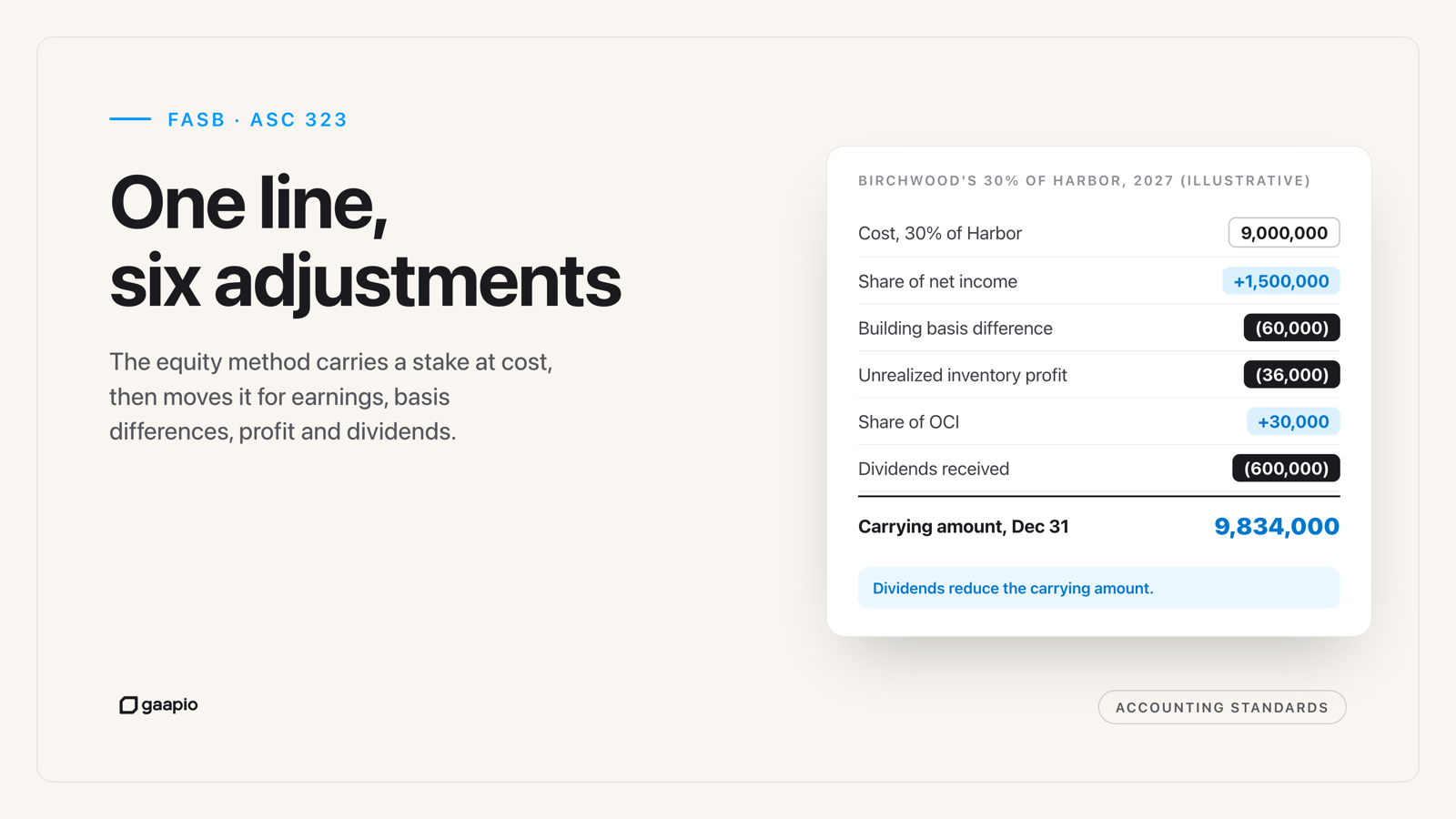
This example is illustrative. The companies and figures are invented. Birchwood Industries buys 30% of Harbor Components, Inc., a private manufacturer, on January 1, 2027 for $9,000,000 in cash. Birchwood has significant influence through a board seat and applies the equity method. Taxes are ignored to keep the arithmetic visible.
Step 1: Basis difference. Harbor's net assets have a book value of $20,000,000. Birchwood's 30% share is $6,000,000, so the basis difference is $3,000,000. A valuation shows Harbor's building has a fair value $4,000,000 above its book value, with 20 years of remaining life.
| Basis difference | Amount | Treatment |
|---|---|---|
| Birchwood's cost | $9,000,000 | |
| 30% of Harbor's book equity ($20,000,000) | $6,000,000 | |
| Total basis difference | $3,000,000 | |
| Building: 30% of $4,000,000 | $1,200,000 | Amortize over 20 years: $60,000 per year |
| Equity method goodwill (residual) | $1,800,000 | Not amortized; part of the investment as a whole |
Step 2: Upstream intra-entity sale. During 2027 Harbor sells inventory to Birchwood for $1,000,000. It cost Harbor $700,000, so Harbor's profit is $300,000. At December 31, 2027, Birchwood still holds 40% of that inventory, and it sells the rest to customers in 2028. The unrealized profit is 40% of $300,000, or $120,000. Birchwood eliminates its 30% share: $36,000.
Step 3: 2027 earnings, OCI and dividends. Harbor reports net income of $5,000,000 and OCI of $100,000, and declares and pays dividends of $2,000,000. All of Harbor's other assets and liabilities have fair values equal to book.
| Roll-forward | 2027 | 2028 |
|---|---|---|
| Opening carrying amount | $9,000,000 | $9,834,000 |
| Share of net income (30%) | 1,500,000 | 1,200,000 |
| Building basis difference amortization | (60,000) | (60,000) |
| Intra-entity profit: eliminated at year-end, realized when inventory sold | (36,000) | 36,000 |
| Share of OCI (30% of $100,000) | 30,000 | 0 |
| Dividends (30% of $2,000,000) | (600,000) | (600,000) |
| Closing carrying amount | $9,834,000 | $10,410,000 |
| Equity in earnings reported in net income | $1,404,000 | $1,176,000 |
For 2028, assume Harbor reports net income of $4,000,000, no OCI, and declares the same $2,000,000 dividend. Equity in earnings is $1,200,000 less $60,000 plus the $36,000 now realized, or $1,176,000.
The 2027 entries are:
| Entry | Debit | Credit |
|---|---|---|
| Investment in Harbor | 1,404,000 | |
| Equity in earnings of Harbor | 1,404,000 | |
| Investment in Harbor | 30,000 | |
| Other comprehensive income | 30,000 | |
| Cash | 600,000 | |
| Investment in Harbor | 600,000 |
Two checks make this a reviewable schedule. First, the closing carrying amount reconciles: 30% of Harbor's $23,100,000 year-end equity is $6,930,000, plus unamortized basis difference of $2,940,000 ($1,140,000 building plus $1,800,000 goodwill), less $36,000 deferred profit, equals $9,834,000. Second, under the cumulative earnings approach the $600,000 dividend is below Birchwood's cumulative equity in earnings of $1,404,000, so it is an operating cash inflow under ASC 230.
If Harbor's performance falls apart, the next question is whether the decline in value is other than temporary, covered above.
How does Gaapio help with ASC 323?
Gaapio, an AI-powered technical accounting platform built by CPAs, helps you document the equity method conclusion. For a significant influence memo, a basis difference schedule or a change in ownership, you give Gaapio your facts and it asks follow-up questions before drafting. It is grounded in the licensed FASB Codification (through a direct licensing relationship with the FASB), Big 4 guidance, and SEC filings and comment letters, and it drafts the memo and the supporting research with clickable citations. See Gaapio accounting memos.
For the investment footnote, Gaapio reviews your disclosures against the Codification. See AI footnote disclosures. Gaapio does not obtain your investee's financial statements or value your investments. Your team owns the data and the accounting calls.
Want to see it on your own equity method memo? Request a demo.
This article is general information, not accounting or legal advice. Confirm the requirements for your facts against the Codification and with your auditor.
Written by Zack Larsen, CPA, a Big 4 alum (Deloitte, PwC) and cofounder and CEO of Gaapio.
Frequently asked questions
Is 20% ownership enough to require the equity method?
It creates a presumption, and the presumption can be overcome. ASC 323-10-15-8 presumes significant influence at 20% or more of the voting stock of a corporation, and the investor can rebut it with evidence such as opposition by the investee or a surrender of rights. Document the indicators in ASC 323-10-15-6 either way.
Do you amortize equity method goodwill?
No. The unallocated part of the basis difference is not amortized and is not tested for impairment on its own. It is part of the investment, which you test as a whole for an other-than-temporary decline. The exception is a private company investor that has elected the goodwill amortization alternative in ASC 350-20, which also amortizes equity method goodwill.
What replaced the cost method?
ASC 321 replaced the cost method for equity securities that are not consolidated or accounted for under the equity method. You carry them at fair value through net income, or elect the measurement alternative for securities without readily determinable fair values.
Where do you report equity in earnings on the income statement?
Present it as a single amount (ASC 323-10-45-1). Registrants following Regulation S-X Rule 5-03 show it after income tax expense. Presenting it within operating income, for investees integral to your operations, needs support. Present your share of the investee's OCI in your own OCI.
Does the equity method apply to preferred stock or loans?
It applies to common stock and in-substance common stock. Preferred stock that is not in-substance common stock, and loans to the investee, follow other Topics, though once the common stock reaches zero you must continue to apply equity method losses to them, in reverse order of seniority, after first applying their own measurement guidance (ASC 323-10-35-23 to 35-26).
Can you reverse an impairment of an equity method investment?
No. A loss from an other-than-temporary decline creates a new cost basis for the investment, and later increases in fair value do not reverse it. Recoveries come through your share of the investee's future earnings.
When must a registrant file separate financial statements for an investee?
Rule 3-09 of Regulation S-X requires separate financial statements of an investee that exceeds 20% on the investment or income test in Rule 1-02(w). Rule 4-08(g) requires summarized information when investees exceed 10% individually or in aggregate. Compute significance each year, since the tests use current amounts.
Related reading
- ASC 321 equity securities guide
- Variable interest entities and ASC 810 consolidation
- ASC 805 purchase price allocation guide
- Goodwill impairment test under ASC 350-20
- Purchase price allocation glossary entry
Sources: FASB ASC 323-10, 323-30, 805-10, 805-50, 810-10, 825-10, 970-323 and 350-20; FASB, Equity Method of Accounting: Targeted Improvements project page; FASB, Proposed ASU, Equity Method of Accounting, Targeted Improvements (October 28, 2026); ASU 2020-01; SEC Regulation S-X Rules 3-09 and 4-08(g), 17 CFR 210; Deloitte DART, Roadmap: Equity Method Investments and Joint Ventures; Deloitte DART, FASB proposes targeted improvements to equity method of accounting; RSM, FASB proposes targeted improvements to equity method accounting; Journal of Accountancy, FASB proposes changes to the accounting for equity method investments.