

Every segment note now discloses the title of your chief operating decision maker, and how that person uses the profit number.
That is one of the changes ASU 2023-07 made to ASC 280. It also added significant segment expense disclosure, an "other segment items" line, and interim requirements. The SEC staff began sending comments on those pieces in 2025. This guide covers how ASC 280 works end to end: identifying operating segments, the CODM, aggregation, the quantitative thresholds, significant segment expenses, single-segment entities, and what the staff and first-year filers did with the new rules. It includes a worked example for one invented company, with numbers that tie.
This is general information about accounting and SEC reporting. It is not accounting or legal advice. Management owns the conclusion for your filings, with input from your auditor and counsel. It reflects guidance and SEC staff views available as of November 2026.
Key takeaway: ASC 280 requires public entities to report segments the way the chief operating decision maker (CODM) manages the business. ASU 2023-07 did not change how you identify operating segments, aggregate them or apply the 10% thresholds. It added disclosure on top: the significant expenses the CODM regularly receives for each reportable segment, an "other segment items" amount and description, the CODM's title and how that person uses each reported profit measure, interim disclosure of the annual segment profit or loss and asset information, and the same requirements for entities with a single reportable segment. The staff's comments since 2025 have focused on missing elements (reconciliations, CODM title and use, interim disclosure), single-segment conclusions, significant expense disclosures and non-GAAP issues.
What is ASC 280, and who has to apply it?
ASC 280 is the Codification topic on segment reporting. It requires a public entity to report financial information about its operating segments, on the basis the CODM uses internally to allocate resources and assess performance. The FASB calls this the management approach.
It applies to public entities: entities that have issued debt or equity securities traded in a public market or are conduit bond obligors for conduit debt securities traded in a public market, that are required to file financial statements with the SEC, or that provide financial statements to issue securities in a public market. Not-for-profit entities and nonpublic entities are not required to apply it, though some provide segment information voluntarily. Segment information sits in the notes, so it falls under the audit and the SEC's disclosure rules, and it feeds the segment discussion in MD&A.
What did ASU 2023-07 change, and when did it take effect?
ASU 2023-07, Segment Reporting (Topic 280): Improvements to Reportable Segment Disclosures, was issued in November 2023. It requires six things, all in the notes:
| Requirement | What it says | ASC reference |
|---|---|---|
| Significant segment expenses | Disclose significant expense categories and amounts that are regularly provided to the CODM and included in reported segment profit or loss | 280-10-50-26A |
| Other segment items | Disclose the amount, and describe the composition, of the difference between segment revenue less significant expenses and reported segment profit or loss | 280-10-50-26B and 26C |
| Interim disclosure | Provide in interim periods all annual disclosures about segment profit or loss and assets | 280-10-50-32 |
| More than one profit measure | If the CODM uses more than one measure, you may report more than one, but at least one must be the measure most consistent with GAAP measurement | 280-10-50-28A |
| CODM title and use | Disclose the title and position of the CODM, and how the CODM uses each reported measure to assess performance and allocate resources | 280-10-50-21(c) and 50-29(f) |
| Single reportable segment | An entity with one reportable segment provides all of the new disclosures and all existing Topic 280 disclosures | 280-10-50-20; 55-15D through 55-15F |
The standard is effective for public entities for fiscal years beginning after December 15, 2023, and interim periods within fiscal years beginning after December 15, 2024. A calendar-year company applied it first in its 2024 Form 10-K and then in its Q1 2025 Form 10-Q. A company with a June 30 year-end adopted it in its fiscal 2025 10-K, which covers the year that began July 1, 2024, and gave its first interim disclosures in the quarter ended September 30, 2025. Early adoption was permitted.
Transition is retrospective to all prior periods presented unless it is impracticable, in which case you disclose that fact and why. The significant expense categories you identify in the period of adoption set the categories for the comparative periods. The FASB's own ASU document is the primary source for all of this: ASU 2023-07 (FASB).
The ASU left three things alone. It did not change how a public entity identifies operating segments, aggregates them or applies the quantitative thresholds. Everything in the next three sections is existing ASC 280. We found no FASB project to amend Topic 280 as of this writing.
How do you identify operating segments?
An operating segment is a component of the entity that meets three characteristics under ASC 280-10-50-1. It engages in business activities from which it may earn revenue and incur expenses. Its operating results are regularly reviewed by the CODM to make resource allocation decisions and assess performance. And discrete financial information is available for it.
Not every part of the entity is an operating segment. Corporate headquarters and some functional departments, such as a central tax or legal function, usually are not, because they do not earn revenue or only earn it incidentally.
A practical starting point is what the CODM actually gets. If the CODM receives monthly results for four business units and decides on capital and headcount based on them, that points to four operating segments, whatever the legal entity structure says. If the CODM only sees one consolidated package, that points toward one, subject to the other evidence. In 2014, Dan Murdock of the SEC's Office of the Chief Accountant said the org chart is only one data point, and so is the CODM report. He pointed to other evidence such as the management structure, the basis for budgets and forecasts, and the basis for executive compensation (SEC remarks).
Who is the CODM?
The CODM is a function, not a title. ASC 280 describes it as the function of allocating resources to the operating segments and assessing their performance. In many companies that is the CEO or COO. In others it is a group, such as an executive committee.
ASU 2023-07 now requires you to disclose the CODM's title and position, or the name of the group or committee if a group fills the role (280-10-50-21(c)). Deloitte's review of Fortune 500 filers after adoption, as reported on its segment reporting roadmap, found that about 86% named the CEO (Deloitte, On the Radar, August 2025).
Naming the CODM is the easy part. The harder disclosure is how that person uses the profit measure. The staff has said that simply stating the CODM uses the measure to allocate resources and assess performance does not satisfy 280-10-50-29(f) by itself (RSM's summary of the December 2025 AICPA & CIMA conference, linked below). Explain the actual use: comparing budget to actual, deciding where to invest, setting compensation, forecasting.
When can you aggregate operating segments?
You may combine two or more operating segments into one reportable segment if aggregation is consistent with the objective and basic principles of ASC 280, the segments have similar economic characteristics, and they are similar in each of five areas (ASC 280-10-50-11). Aggregation is optional. You can report segments separately even when you could combine them.
| Aggregation test | What to check |
|---|---|
| Consistent with the objective of ASC 280 | Would combining them still let a reader understand the business and its prospects? |
| Similar economic characteristics | Similar long-term average gross margins and other measures of performance, and similar trends over time |
| Nature of products and services | Similar utility to customers, judged against how broad the entity's offerings are |
| Nature of production processes | Manufacturing or service delivery methods |
| Type or class of customer | Same buyers, such as retailers or government agencies |
| Distribution methods | Direct sales, distributors, online |
| Regulatory environment, if applicable | Same regulators and rules |
Economic similarity is where most aggregation arguments get tested. Margins that run close for a few years and then diverge are a warning sign. At the 2014 AICPA conference, Dan Murdock, then Deputy Chief Accountant in the SEC's Office of the Chief Accountant, said the aggregation criteria are intended to be "a high hurdle" (SEC remarks). A panelist at the December 2025 conference said aggregated segments typically need very similar long-term average gross margins (RSM's summary). Keep the analysis in a memo that shows margins for several years and the reasons you expect them to converge.
How do the quantitative thresholds work?
After you have identified and aggregated operating segments, ASC 280-10-50-12 tells you which ones must be reported separately. An operating segment is reportable if it meets any one of three tests:
| Test | Threshold |
|---|---|
| Revenue | Reported revenue, including intersegment sales, is at least 10% of the combined revenue of all operating segments |
| Profit or loss | The absolute amount of reported profit or loss is at least 10% of the greater of (a) the combined profit of all segments that did not report a loss, or (b) the combined loss of all segments that reported a loss |
| Assets | Its assets are at least 10% of the combined assets of all operating segments |
Then the 75% test (50-14): the external revenue of your reportable segments must be at least 75% of consolidated revenue. If it is not, identify additional operating segments as reportable until you reach 75%. There is no cap on the number of reportable segments, but as the number rises above ten, consider whether a practical limit has been reached (50-18). Operating segments that are not reportable are combined and disclosed in an "all other" category, with the sources of their revenue described (50-15).
Two traps come up often. First, a segment reportable last year that management still judges of continuing significance stays reported even if it falls below the thresholds (50-16). Second, a segment that was below the thresholds can cross them as the business model changes, so rerun the tests every year. A panelist at the December 2025 conference made the same point.
What are significant segment expenses?
Significant segment expenses are the expense categories and amounts that are regularly provided to the CODM and included in the reported measure of segment profit or loss. The requirement is in ASC 280-10-50-26A. It works in two steps: identify the expenses in the segment-level information the CODM regularly receives, then disclose those that are significant.
The ASU does not define "significant" and sets no percentage. Paragraph 50-26A says to consider qualitative and quantitative factors. In its Basis for Conclusions the Board observed that segment information is significant if leaving it out would change a user's understanding of the segment enough to change capital allocation decisions about the whole entity, even if an item of similar size would not be significant at the consolidated level (BC59). At the June 2025 CAQ SEC Regulations Committee joint meeting, the SEC staff said it expects the most judgment to be applied in deciding which expenses are significant, and that it will respect reasonable, well-grounded judgments (CAQ meeting highlights, which are informal and not authoritative, and BDO).
Four rules of thumb follow from the text:
- The CODM's package sets the starting list. If the CODM gets cost of materials, direct labor and freight by segment, those are your candidates. You do not invent categories, and you do not need categories the CODM does not receive. The staff has said to look at the substance of what is regularly provided, not its form, so check everything the CODM receives, beyond the main report.
- "Regularly provided" includes what is easily computed. The Codification says to evaluate expenses easily computable from information regularly provided. If the CODM gets revenue and gross margin, cost of sales is easily computed (280-10-55-15A and 55-15B).
- Allocated overhead counts. If the CODM's report shows an allocated corporate overhead category and it is in segment profit or loss, assess it like any other expense (55-15C).
- Grouping before testing has no FASB support. The FASB considered, and declined to add, a step letting entities combine expenses by nature or function before applying the significance test (BC60 and BC61). BDO's view is that an entity may combine expenses for disclosure when they are similar in nature, not individually significant to users, tend to move together, and are not shown separately elsewhere in the filing. That is BDO's interpretation, not the FASB's.
Function or nature? ASC 280 does not prescribe either. Present the categories the way the CODM receives them.
What are "other segment items"?
Other segment items are the plug between segment revenue and reported segment profit or loss, after you subtract the significant expenses you disclose. ASC 280-10-50-26B requires the amount and a qualitative description of what is in it. It typically contains expenses the CODM does not receive by segment, expenses that are not significant, gains and losses in the measure, and items such as income tax expense when the measure is segment net income.
Paragraph 50-26C requires the other segment items amount and description for each reportable segment, even if you report no significant expenses for it. For any reportable segment with no significant expenses disclosed, it also requires you to explain the nature of the expense information the CODM uses for it. If the CODM only sees budgeted or forecasted expenses, or only consolidated expenses, say so (280-10-55-15G).
The formula is simple, so write it down in your workpapers:
Segment revenue − significant expenses disclosed − other segment items = reported segment profit or loss
Worked example: a three-segment manufacturer (illustrative)
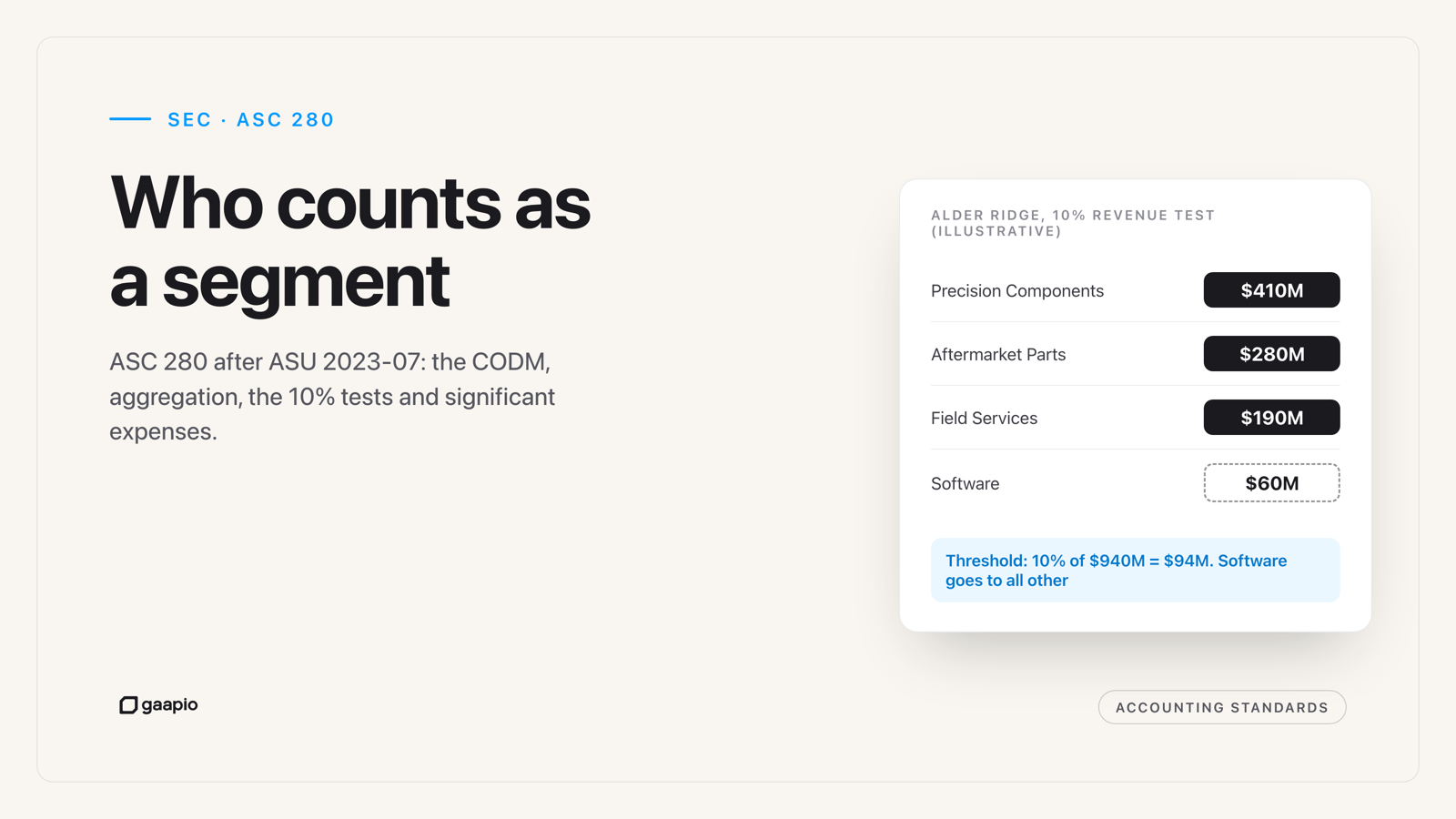
Alder Ridge Industrial is an invented calendar-year public company. All figures are illustrative, in millions of dollars. The CEO is the CODM and gets monthly reports for four operating segments, with segment operating income as the profit measure.
Step 1: the 10% tests.
| Operating segment | Revenue (incl. intersegment) | Profit (loss) | Assets |
|---|---|---|---|
| Precision Components | 410 | 62 | 520 |
| Aftermarket Parts | 280 | 41 | 300 |
| Field Services | 190 | 12 | 140 |
| Software | 60 | (9) | 45 |
| Combined | 940 | 115 profit, (9) loss | 1,005 |
| 10% threshold | 94 | 11.5 (10% of the greater, 115) | 100.5 |
Software misses all three tests (60 against 94, 9 against 11.5, 45 against 100.5), so it goes into "all other." Field Services passes all three tests, though profit only narrowly (12 against 11.5). The profit test is the one that surprises people: it uses the greater of combined profit and combined loss, not total profit net of losses.
Step 2: the 75% test. Precision Components sold 20 to Aftermarket Parts, so consolidated external revenue is 920 (390 + 280 + 190 + 60). The three reportable segments have external revenue of 860, or 93.5% of consolidated revenue. The test is met. Assume Aftermarket Parts resold all 20 of the purchased parts before year-end, so no intersegment profit remains to eliminate.
Step 3: the ASU 2023-07 note. The CODM's monthly package shows materials and components, direct labor, and freight and warehousing by segment. Management evaluated each category the CODM receives by segment and concluded, considering qualitative and quantitative factors, that all three are significant. Plant overhead and selling expenses are not provided by segment and fall into other segment items.
| Year ended Dec. 31, 2026 | Precision Components | Aftermarket Parts | Field Services | Total reportable segments |
|---|---|---|---|---|
| External revenue | 390 | 280 | 190 | 860 |
| Intersegment revenue | 20 | 0 | 0 | 20 |
| Segment revenue | 410 | 280 | 190 | 880 |
| Materials and components | 205 | 130 | 38 | |
| Direct labor | 88 | 62 | 97 | |
| Freight and warehousing | 18 | 22 | 6 | |
| Other segment items (a) | 37 | 25 | 37 | |
| Segment operating income | 62 | 41 | 12 | 115 |
(a) Other segment items include plant overhead and selling expenses, which are not provided to the CODM by segment. Totals are shown only for revenue and segment operating income, which are reconciled to consolidated amounts. Totaling expense categories across segments is not required and can create a non-GAAP subtotal.
Check Precision Components: 410 − 205 − 88 − 18 − 37 = 62. The columns foot across to 115.
Step 4: the reconciliation. The segment note reconciles the total of the reportable segments' profit to income before income taxes, starting from the total of the reportable segments (the staff has warned against building a subtotal that adds non-reportable segments first).
| Reconciliation, 2026 | Amount |
|---|---|
| Total segment operating income, reportable segments | 115 |
| All other (Software) operating loss | (9) |
| Unallocated corporate expenses | (28) |
| Interest expense | (17) |
| Income before income taxes | 61 |
Segment revenue reconciles the same way: 880 for the reportable segments, plus 60 for all other, less 20 of intersegment eliminations, equals 920 of consolidated revenue.
Step 5: the narrative. A sample CODM paragraph for the note:
The Company's chief operating decision maker (CODM) is its Chief Executive Officer. The CODM uses segment operating income to assess the performance of each segment and to decide how to allocate capital and personnel, primarily by comparing actual segment operating income with budget and with prior-year results during monthly operating reviews and the annual planning process.
The table shows only the ASU 2023-07 pieces. A complete note also needs the factors used to identify the segments and the products and services of each (50-21), the 50-22 items included in segment operating income, such as depreciation and amortization, total assets by segment with a reconciliation to consolidated assets, capital expenditures if the CODM receives them, the measurement explanations in 50-29, a description of the sources of revenue in "all other" (50-15), and the entity-wide disclosures. Present comparative periods on the same expense categories. If the CODM's package changes in a way that changes which expenses are significant, recast prior periods unless impracticable (280-10-55-17 and 55-17A).
Can you report more than one measure of segment profit or loss?
Yes, if the CODM uses more than one. ASC 280-10-50-28A permits additional measures, but at least one reported measure must be the one management believes is most consistent with the measurement principles used for the consolidated financial statements. Any additional measure you report in the current period must also be reported for prior periods in which it was provided to the CODM (50-28B). The disclosures in 50-22 through 50-24, 50-26A through 50-26C and 50-29 apply to each reported measure (50-28C).
The staff has explained how it reads "most consistent with GAAP." At the December 2025 conference, as summarized by RSM:
- With two GAAP measures, such as gross profit and operating income, the one with more GAAP revenue and expense line items (here, operating income).
- With one GAAP and one non-GAAP measure, such as operating income and EBITDA, the GAAP one.
- With only non-GAAP measures, it is a judgment. The staff named two non-exclusive factors: the number and nature of adjustments, and how many revenue and expense line items the measure includes.
Additional measures that are not calculated in accordance with GAAP are a separate issue. The SEC staff views them as non-GAAP measures, because ASC 280 does not require or specify them. Item 10(e) of Regulation S-K normally bars non-GAAP measures from the notes, but the staff has said it will not object to an additional segment measure in the notes if the CODM uses it, it is not misleading, and the company complies with ASC 280, Regulation G and the rest of Item 10(e). The incremental non-GAAP disclosures may go in MD&A, with no cross-reference from the notes, or in the notes labeled unaudited. The measure itself cannot be labeled unaudited (CAQ highlights, October 2024; KPMG; BDO). BDO describes these measures as rare in practice. At the December 2025 conference, the staff added that a reconciliation that adds non-reportable segments and corporate amounts to reach a consolidated segment measure can create a prohibited non-GAAP measure (RSM).
What if you have only one reportable segment?
You still provide all the disclosures. ASC 280-10-50-20 and the examples in 55-15D through 55-15F say that public entities with a single reportable segment are subject to Topic 280 in its entirety. That was a clarification, and it changed practice. Many single-segment companies had said little.
For a single-segment company, the staff has said, at the 2023 and 2024 conferences and in other interactions, that it expects an entity managed on a consolidated basis to report consolidated net income as the segment measure. It has also said it is unaware of a case where such an entity's CODM does not regularly review a consolidated GAAP measure (BDO; KPMG). Excluding corporate headquarters from the measure does not by itself show that the entity is managed on some other basis. If the CODM also reviews EBITDA, the note can include it as an additional measure alongside consolidated net income, and it then falls under the non-GAAP requirements described above. BDO's view is that a company with several operating segments aggregated into one reportable segment is not managed on a consolidated basis, so the measure there is a judgment.
A cross-reference to the income statement does not do everything. At the December 2025 conference the staff said a cross-reference is unlikely to satisfy every requirement, even for an entity managed on a consolidated basis, because it cannot cover the factors used to identify the segment, who the CODM is, or how the CODM uses the measure. The staff also said the significant expenses the CODM receives may differ from the income statement captions. When they do, a cross-reference is not enough and the note needs the additional expense categories. If every significant expense the CODM receives is on the face of the income statement, the note should say the CODM gets no additional expense information.
A short illustrative note for an invented single-segment company, Quillmere Software (not a complete segment note):
The Company has one operating and reportable segment, which develops and sells subscription software to mid-sized businesses in North America. The CODM manages the business on a consolidated basis, and the Company's products are delivered on a single platform. The Company's CODM is its Chief Executive Officer, who uses consolidated net income to monitor budget-to-actual results and to decide how to allocate resources, including headcount and capital spending. The significant segment expenses regularly provided to the CODM are cost of revenue, research and development, sales and marketing, and general and administrative, as presented on the consolidated statements of operations; the CODM receives no additional segment expense information. Other segment items consist of interest expense, other income, net, and income tax expense, each as presented on the consolidated statements of operations. Depreciation and amortization are included within the expense categories above and are disclosed on the consolidated statements of cash flows. The measure of segment assets is total assets on the consolidated balance sheets.
What do SEC comment letters ask about after ASU 2023-07?
The staff began issuing comments on ASU 2023-07 compliance in 2025. According to a summary from law firm Maynard Nexsen, dated August 2025 (Insights from Recent SEC Comments on Segment Reporting), with related commentary on TheCorporateCounsel.net, the themes were:
| Theme | What the staff asked |
|---|---|
| Missing reconciliation | Reconcile from a single amount for the subtotal of the reportable segments' profit or loss |
| CODM title and use | Disclose the CODM's title and how the CODM uses the measure |
| Single-segment and aggregation conclusions | Support the single operating segment conclusion or the aggregation, and sometimes provide the CODM reports |
| Significant expenses and other segment items | Add the disclosure, or explain that the CODM receives consolidated expense information only |
| Interim disclosure | Add interim disclosure |
| Non-GAAP | Treat additional profit measures and any segment total shown outside the note as non-GAAP measures subject to the non-GAAP rules. Some companies responded by removing them |
Most of the companies discussed in that summary agreed to add or change disclosure in future filings. A few instead provided analysis that appears to have satisfied the staff. Read the original correspondence on EDGAR before you rely on a specific company's response in your own filing or memo.
The December 2025 staff remarks add two points on significant expenses. The staff has commented where a measure is unclear, such as an "adjusted SG&A" line with no description of the adjustments. And where segment measurement differs from GAAP but the label looks like an income statement caption, use a distinguishing name and disclose the composition.
What did first-year filings look like?
Practice varied. Deloitte examined Fortune 500 companies with fiscal years beginning on or after December 15, 2023, that had filed financial statements as of March 3, 2025, about 70% of the Fortune 500. It reported that these disclosures "vary widely among registrants," even in similar industries, with differences in both the number and the nature of significant expenses. About 86% of those filers named the CEO as CODM. The most frequently cited use of the segment measure was budget-to-actual variance analysis. Disclosures also mentioned forecasting, the annual plan, and management compensation and incentives. About 7% disclosed a voluntary additional measure consistent with GAAP, and 1% disclosed a voluntary additional non-GAAP measure (Deloitte, On the Radar, August 2025).
For your next filing, the first-year pattern points to a short checklist:
- Compare the segment note with the CODM's actual package, line by line, each year.
- Check that the CODM paragraph explains how the measure is used, not just that it is used.
- Check that every label matches its content, especially "adjusted" lines.
- Rerun the 10% and 75% tests and write down the result.
- Compare the note with MD&A, earnings materials and investor presentations. They should describe the same segments and the same measure.
- Confirm that 10-Qs include the interim segment disclosures in 50-32, including significant expenses, other segment items and the reconciliation for each reported measure.
- If segment composition changed (50-34), or the CODM's package changed in a way that changes which expenses are significant (55-17 and 55-17A), recast prior periods, including interim periods, unless impracticable, and if impracticable give the disclosures in 50-35.
Who owns the segment note?
Technical accounting owns the segment determination memo: operating segments, CODM, aggregation and thresholds. Financial reporting owns the note and the reconciliation. FP&A owns the CODM package, and the note is only as good as that package, so FP&A should tell reporting when the package changes. The disclosure committee reads the note against MD&A and the earnings script. The audit committee should see the segment determination at least once a year, and again whenever the organization changes.
How does Gaapio help with segment reporting?
Gaapio is an AI-powered technical accounting platform built by CPAs. For ASC 280 work, you give Gaapio your facts, such as the reports your CODM receives and how your business units differ, and it asks follow-up questions before drafting. It is grounded in the FASB Codification, which Gaapio licenses through a direct licensing relationship with the FASB, along with Big 4 guidance and SEC filings and comment letters. Conclusions come with clickable citations, so a reviewer can trace each one. That is useful for the segment determination memo, the aggregation analysis and drafting the note. See Gaapio accounting memos and the Guidance Updates page for new FASB and SEC guidance.
Your team decides who the CODM is, which segments you report and what is significant. Those are judgments, and they belong to you and your auditor.
Want to see it on your own segment analysis? Request a demo.
Frequently asked questions
What is ASC 280?
ASC 280 is the Codification topic on segment reporting. It requires public entities to disclose financial information about their operating segments on the basis the chief operating decision maker uses to allocate resources and assess performance. It covers how to identify operating segments, which ones to report separately, and what to disclose about each.
What did ASU 2023-07 change?
ASU 2023-07 added disclosures. It requires significant segment expenses regularly provided to the CODM, an other segment items amount and description, the CODM's title and how the CODM uses each reported profit measure, interim disclosure of the annual segment profit and asset information, and full Topic 280 disclosure for single-segment entities. It did not change how operating segments are identified, aggregated or tested against the 10% thresholds.
When did ASU 2023-07 take effect?
For public entities, it took effect for fiscal years beginning after December 15, 2023, and interim periods within fiscal years beginning after December 15, 2024. For a calendar-year company, that was the 2024 10-K and the first quarter of 2025 10-Q. Transition is retrospective to all periods presented, unless impracticable.
Who is the chief operating decision maker?
The CODM is the function that allocates resources to the operating segments and assesses their performance. It may be one person, such as the CEO, or a group, such as an executive committee. You now disclose the CODM's title and position, or the name of the group, and how the CODM uses the reported profit measure.
What counts as a significant segment expense?
An expense category is disclosed if it is regularly provided to the CODM (or easily computed from what is), is included in reported segment profit or loss, and is significant based on qualitative and quantitative factors. The ASU sets no percentage threshold. The FASB said an expense can be significant at the segment level even if an item that size would not be significant at the consolidated level.
Do single-segment companies have to provide the ASU 2023-07 disclosures?
Yes. A public entity with a single reportable segment must provide all of the new disclosures and all existing Topic 280 disclosures. The SEC staff has said it expects a company managed on a consolidated basis to report consolidated net income as its segment measure, and that a cross-reference to the primary financial statements will not cover everything.
What are the quantitative thresholds for a reportable segment?
An operating segment is reportable if its revenue is at least 10% of combined revenue of all operating segments, its profit or loss is at least 10% of the greater of combined profit or combined loss, or its assets are at least 10% of combined assets. Reportable segments must also cover at least 75% of consolidated external revenue.
Can we aggregate operating segments?
Yes, if aggregation is consistent with ASC 280's objective, the segments have similar economic characteristics, and they are similar in the nature of products and services, production processes, type or class of customer, distribution methods and regulatory environment, where applicable. Aggregation is optional, and the SEC staff has described the criteria as a high hurdle.
Related reading
- ASU 2024-03 expense disaggregation (DISE): the 2026 guide
- SAB 74 disclosures: the 2026 guide
- ASU 2023-09 income tax disclosures: the 2026 guide
- Guidance Updates
Sources: ASU 2023-07 (FASB); Deloitte, A Roadmap to Segment Reporting; KPMG, Hot Topic: Segment reporting, Important SEC clarifications (August 2024); SEC, Remarks by Dan Murdock (2014); CAQ SEC Regulations Committee highlights, October 2024; CAQ SEC Regulations Committee highlights, June 2025; BDO Blueprint, Segment Reporting Under ASC 280 (October 2026); RSM, Insights from the 2025 AICPA & CIMA Conference on Current SEC and PCAOB Developments.