

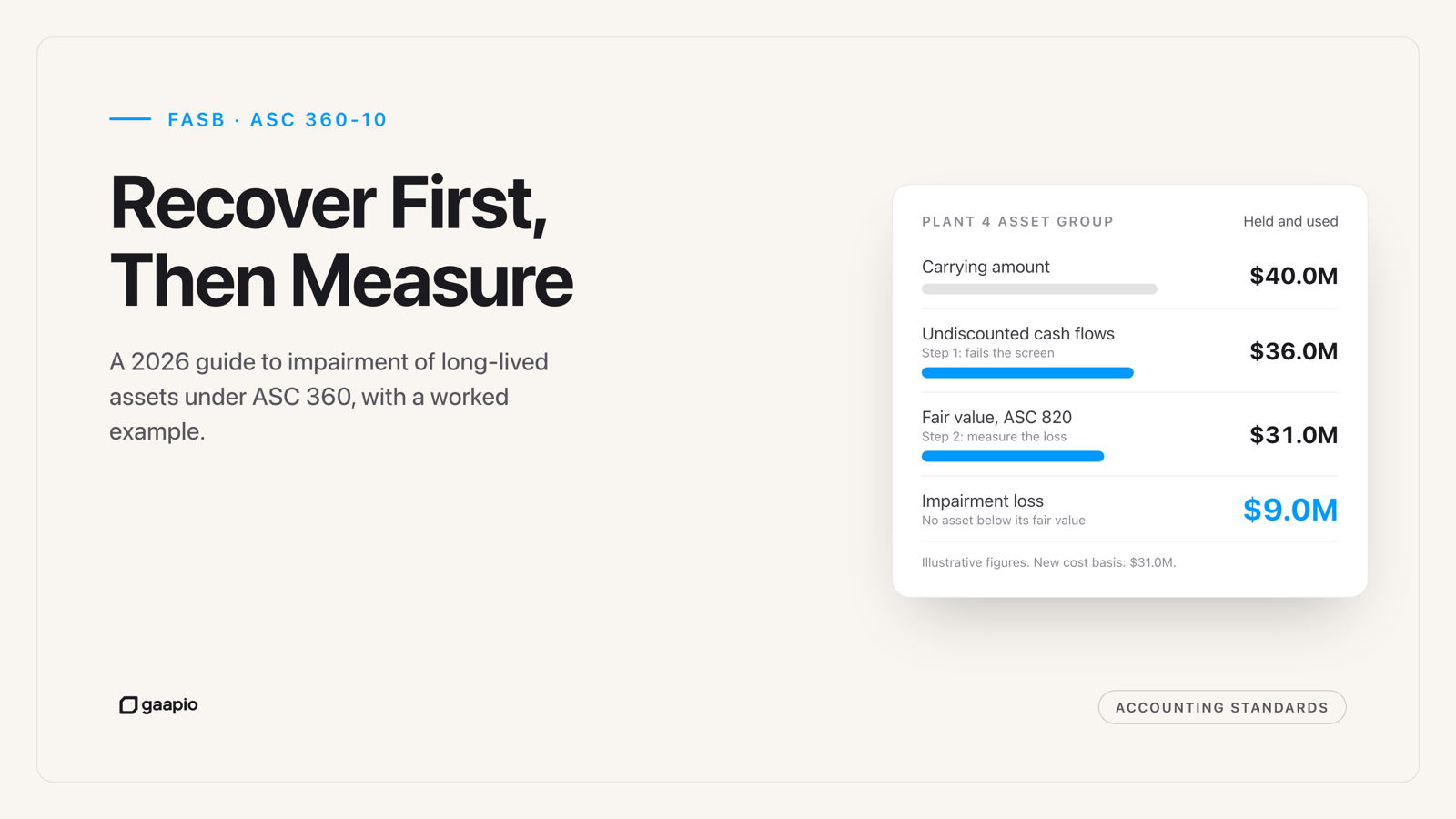
ASC 360 impairment is the US GAAP write-down of a long-lived asset group held and used, such as property, plant and equipment, finite-lived intangibles and right-of-use assets, when its carrying amount is not recoverable and exceeds its fair value. You test only when events or changes in circumstances indicate the carrying amount may not be recoverable: the group fails if its carrying amount exceeds the undiscounted cash flows from its use and eventual disposition (ASC 360-10-35-17), and the loss is then measured as carrying amount minus fair value under ASC 820.
Picture a December close (a hypothetical): a customer that supplied 40% of a plant's volume gave notice in October, the plant has run at a loss for three years, and your auditor asks for the ASC 360 analysis by Friday. Two different cash flow views are about to produce two different numbers, and the loss still has to be spread across land, buildings, equipment and intangibles in a way the auditor can recompute.
This guide covers impairment and disposal of long-lived assets under ASC 360-10 in 2026: scope, asset groups, triggers, the two-step test, the ban on reversals, held for sale, the order of testing with goodwill and inventory, and disclosures. It includes a worked example where an asset group fails recoverability, with the fair value measurement and the allocation of the loss. It's written by Jace Chambers, CPA, Gaapio's cofounder and CPO, with the Gaapio team of CPAs.
Key takeaway: Under ASC 360-10, you test a held-and-used asset group when a trigger appears, not on a schedule. Step one compares the group's carrying amount with the sum of undiscounted cash flows from its use and eventual disposition, using your own assumptions. If the carrying amount is higher, step two measures the loss as carrying amount minus fair value, using market participant assumptions under ASC 820. The loss reduces only the long-lived assets in the group, pro rata by carrying amount, and no asset goes below its own fair value when that fair value is determinable without undue cost and effort. The new carrying amount is the new cost basis, and reversals are prohibited.
This guide is general information about US GAAP, not accounting or legal advice. The FASB Accounting Standards Codification is the authoritative text, so check it and your auditor against your own facts. Facts are as of November 2026.
What is ASC 360 impairment of long-lived assets?
ASC 360-10 is the US GAAP guidance for recognizing and measuring impairment of long-lived assets that you hold and use, and for assets you plan to sell or otherwise dispose of. The two-step recoverability model dates to SFAS 121 in 1995 and was carried into SFAS 144 in 2001, which also set the held for sale and disposal rules. The recoverability and measurement model has not changed since, although ASU 2014-08 narrowed discontinued operations and added disclosures for disposals of individually significant components. What changed around it are the ASC 842 lease standard, which brought right-of-use assets into scope, and ASC 820, which now defines the fair value in step two.
Scope is the first decision. The guidance covers assets you depreciate or amortize, plus a few related items:
| Asset | In ASC 360-10? | Note |
|---|---|---|
| Property, plant and equipment, including construction in progress | Yes | The core population |
| Finite-lived intangibles (customer relationships, technology, trade names) | Yes | Tested here, not under the indefinite-lived rules in ASC 350-30 |
| Lessee right-of-use assets | Yes | ASC 842-20-35-9 sends the impairment question to ASC 360-10 |
| Underlying asset of a lessor's operating lease | Yes | A net investment in a sales-type or direct financing lease is under ASC 326, not ASC 360 |
| Software to be sold, financial instruments, equity method investments | No | ASC 985-20 for software to be sold; ASC 320, ASC 321 and ASC 326 for financial instruments; ASC 323 for equity method investments |
| Internal-use software | Yes | ASC 350-40 refers impairment to ASC 360-10 |
| Goodwill | No | ASC 350-20 |
| Indefinite-lived intangibles | No | ASC 350-30, a fair value comparison |
| Inventory, receivables, deferred taxes | No | ASC 330, ASC 326 and ASC 740 |
For what gets capitalized in the first place, see our guide to ASC 350-40 internal-use software. That sets the carrying amount you test later.
What is an asset group, and how do you define one?
An asset group is the lowest level at which identifiable cash flows are largely independent of the cash flows of other assets and liabilities (ASC 360-10-35-23). That is the unit of account for the recoverability test, and it is often bigger than a single asset. A production line, a store, a plant or a customer contract portfolio is a typical asset group.
Define it by cash flows, not by your org chart or your fixed asset register. Four points come up in most audits:
- Largely independent cash flows. If shutting down one asset would stop the cash flows of another, they belong together. A building and the equipment inside it that make one product usually form one group.
- Primary asset. The group's remaining useful life for the test is set by its primary asset, the most significant asset from which the group derives its cash-flow-generating capacity (ASC 360-10-35-29 to 35-31).
- Corporate and enterprise-level assets. If an asset such as a headquarters building has no identifiable cash flows that are largely independent of other assets, its asset group includes all assets and liabilities of the entity (ASC 360-10-35-24). So it is generally tested at the entity level rather than allocated to lower-level groups.
- Goodwill. An asset group includes goodwill only when the group is or includes a reporting unit, and the loss still reduces only the long-lived assets, never goodwill (ASC 360-10-35-26 and 35-28).
What triggers an ASC 360 impairment test?
You test when events or changes in circumstances indicate the carrying amount of an asset group may not be recoverable (ASC 360-10-35-21). There is no annual requirement for held-and-used assets. In practice, you assess for indicators each reporting period, and the test follows only if one shows up.
ASC 360-10-35-21 lists the indicators, and the list is not exhaustive:
- A significant decrease in the market price of the asset.
- A significant adverse change in how the asset is used or in its physical condition.
- A significant adverse change in legal factors or the business climate, including a regulator's action.
- Costs to acquire or build the asset significantly above what you expected.
- A current-period operating or cash flow loss combined with a history of such losses or a projection of continuing losses.
- A current expectation that, more likely than not, you will sell or dispose of the asset significantly before the end of its estimated useful life.
Indicator six matters for planning. A board decision to close a facility early is itself a trigger, even before any sale criteria are met. Document the indicators you considered each quarter, including the ones you ruled out, because the auditor's first question is whether you looked.
How does the two-step impairment test work?
Step one is a recoverability test using undiscounted cash flows. Step two, which you reach only if step one fails, measures the loss against fair value. The two steps use different assumptions, and that is the part that surprises people.
- Identify the asset group and confirm its carrying amount, adjusted first for any impairment under other GAAP such as inventory or receivables (ASC 360-10-35-27).
- Estimate undiscounted cash flows from the use and eventual disposition of the group, over the remaining useful life of the primary asset, using your own reasonable and supportable assumptions. Consider a probability-weighted approach if you are weighing alternative courses of action, such as sell versus hold. Include only the existing service potential: maintenance and component replacement yes, enhancements that would raise capacity no, except costs to complete an asset still under development. Exclude interest that is expensed as incurred.
- Compare to carrying amount. If the sum of undiscounted cash flows is at or above carrying amount, the group is recoverable. Stop. No loss, even if fair value is below carrying amount.
- Measure fair value of the asset group under ASC 820, using market participant assumptions, and compare it with carrying amount.
- Record the loss, equal to carrying amount minus fair value, and allocate it to the long-lived assets in the group.
- Reset the basis and reassess depreciation for the remaining useful life of each asset.
Step one runs on entity-specific cash flows, undiscounted. Step two runs on market participant assumptions, usually through a discounted cash flow or a market approach. A group can pass step one with a fair value far below carrying amount, because the screen asks whether you will recover your cost through use, not what a buyer would pay. Our guide to ASC 820 fair value measurement covers the hierarchy and the valuation techniques behind step two.
What does an ASC 360 impairment look like with real numbers?
An asset group fails recoverability, the fair value measurement sets the loss, and the loss is spread across the assets with a floor at each asset's fair value. The numbers below are for a fictional company, Alder Ridge Manufacturing, Inc., with a December 31 year end and a Plant 4 asset group. All figures are illustrative.
Facts. For simplicity, the asset group consists only of the four long-lived assets in the table below. Any inventory or receivables in a real group would be adjusted first under their own GAAP and would not absorb any of the loss. In October 2026, a customer representing 40% of Plant 4's volume gave notice. Plant 4 has operated at a loss for three years and management projects continued losses. That combines indicator five, the history of losses, with indicator three, an adverse change in the business climate (ASC 360-10-35-21), so Alder Ridge tests the asset group at December 31, 2026.
Step 1: recoverability. The carrying amount of the Plant 4 asset group is $40.0M. Management's probability-weighted, undiscounted cash flows over the 8-year remaining life of the primary asset, the production equipment, total $36.0M, including the expected sale value of the land and building at the end of that life.
$36.0M is below $40.0M, so the group is not recoverable. Had the undiscounted cash flows been $41.0M, the group would have passed, and no loss would be recorded even though fair value is $31.0M.
Step 2: fair value. Alder Ridge measures the fair value of the asset group at $31.0M under ASC 820, using an income approach with market participant assumptions and a market participant discount rate. Market participant cash flows differ from management's, for example because a buyer would run the plant differently, so the $31.0M is not simply the $36.0M discounted. The inputs are unobservable, so it is a Level 3 measurement. The loss is $40.0M minus $31.0M, or $9.0M.
Allocation. ASC 360-10-35-28 allocates the loss to the long-lived assets of the group pro rata, based on relative carrying amounts, except that the loss allocated to an individual asset does not reduce it below its fair value when that fair value is determinable without undue cost and effort.
| Asset | Carrying amount | Fair value | Loss allocated | Carrying amount after |
|---|---|---|---|---|
| Land | $8.0M | $7.0M | $1.0M | $7.0M |
| Building | $12.0M | $8.5M | $3.0M | $9.0M |
| Production equipment | $16.0M | $11.0M | $4.0M | $12.0M |
| Customer relationships (finite-lived) | $4.0M | $2.5M | $1.0M | $3.0M |
| Total | $40.0M | $9.0M | $31.0M |
A straight pro rata split of $9.0M on carrying amounts would put $1.8M on land ($8.0M of $40.0M). That would take land to $6.2M, below its $7.0M fair value, so land is held at a $1.0M loss. The remaining $8.0M is then spread over the other three assets by their relative carrying amounts of $12.0M, $16.0M and $4.0M, giving $3.0M, $4.0M and $1.0M. Every asset ends at or above its own fair value, and the total ties to the $31.0M group fair value. The individual fair values need not add up to the group's fair value, so they are not summed here.
Entry.
Dr  Impairment loss (operating expense)      9.0M
    Cr  Land                                         1.0M
    Cr  Building                                     3.0M
    Cr  Production equipment                         4.0M
    Cr  Customer relationships                       1.0M
The adjusted carrying amount becomes each asset's new cost basis (ASC 360-10-35-20), so in practice many entities eliminate the accumulated depreciation or amortization against gross cost.
Can you reverse an ASC 360 impairment loss?
No. Once you recognize an impairment loss on a held-and-used asset, the adjusted carrying amount becomes the new cost basis, and restoring the loss in a later period is prohibited (ASC 360-10-35-20). If Plant 4's cash flows recover next year, the equipment stays at its depreciated new basis.
Goodwill follows the same no-reversal rule under ASC 350-20. Assets held for sale are the one exception: a later increase in fair value less cost to sell is recognized as a gain, but only up to the cumulative losses previously recognized for write-downs to fair value less cost to sell (ASC 360-10-35-40). Impairments recorded while the asset was held and used are not restored.
How do you depreciate an asset after an impairment test?
You depreciate the new cost basis over the remaining useful life, and the test is a prompt to reassess that life and the salvage value. Changes are accounted for prospectively as changes in estimate (ASC 360-10-35-22, with ASC 250-10-45-17). That applies even when the asset group passes recoverability and no loss is recorded.
In the example, the production equipment's new basis is $12.0M. With an 8-year remaining life and no salvage value, annual depreciation is $1.5M. If, one year later, management concludes the plant will run only six more years from that date, depreciation is recalculated prospectively on the carrying amount at that date over the shorter life: $12.0M less one year of $1.5M is $10.5M, so $1.75M a year for six years. Any revised life identified during the test itself must also be used in the recoverability cash flows (ASC 360-10-35-22). Land is not depreciated, and the customer relationship intangible continues to amortize over its remaining life.
How do right-of-use assets under ASC 842 get tested for impairment?
A lessee tests its right-of-use asset for impairment under ASC 360-10 and recognizes any loss (ASC 842-20-35-9). The ROU asset usually sits inside the asset group of the store, plant or office it supports. After an impairment of an operating lease ROU asset, the lessee amortizes the remaining ROU asset on a straight-line basis, unless another systematic basis is more representative, and adds accretion of the liability (ASC 842-20-35-10). Lease cost is no longer a single straight-line amount and becomes front-loaded.
Three practical points apply to leases:
- The liability is untouched. The impairment reduces the ROU asset only. The lease liability keeps its measurement.
- Match the cash flows to the carrying amount. If the lease liability is excluded from the asset group, generally exclude the lease payments that settle it from the cash flow estimate as well, and apply the policy consistently. Document it.
- Classification still matters. Whether the lease is operating or finance changes how the post-impairment expense is presented. See our guide to operating vs finance lease classification, and our ASC 842 glossary page for the basics.
What are the held for sale criteria under ASC 360?
A long-lived asset (or disposal group) is classified as held for sale when all six criteria in ASC 360-10-45-9 are met. Management with the authority to approve the action commits to a plan to sell the asset. The asset is available for immediate sale in its present condition, subject only to terms usual and customary for such sales. An active program to locate a buyer has been initiated. The sale is probable, and transfer is expected to qualify as a completed sale within one year, subject to limited exceptions. The asset is actively marketed at a price reasonable relative to its current fair value. And it is unlikely that significant changes to the plan will be made or that it will be withdrawn.
If any criterion is missed at the balance sheet date, the asset stays held and used. A sale agreed after the balance sheet date but before the statements are issued does not change the classification at the balance sheet date.
Once classified as held for sale, measurement and presentation change:
| Held and used | Held for sale | To be abandoned | |
|---|---|---|---|
| Measurement | Test for recoverability, then fair value | Lower of carrying amount or fair value less cost to sell (ASC 360-10-35-43) | Held and used until it is disposed of |
| Recoverability screen | Yes | No | Yes, while in use |
| Depreciation | Continues | Stops | Continues, over a shortened life |
| Later recovery | No reversal | Gains recognized up to cumulative held for sale write-downs | Not applicable |
| Balance sheet | Within PP&E | Separate lines for assets and liabilities held for sale, not offset | Within PP&E |
A held-for-sale loss has no undiscounted cash flow screen. If fair value less cost to sell is below the carrying amount, you record the loss. Cost to sell includes direct selling costs such as broker commissions and legal fees. If the disposal is a strategic shift with a major effect on operations and results, ASC 205-20 may also require discontinued operations presentation.
Before measuring a disposal group at fair value less cost to sell, adjust the carrying amounts of any assets outside ASC 360 under their own GAAP, and allocate goodwill to the group if it is a business (ASC 350-20-40). Interest and other expenses on liabilities in the group continue to be accrued.
Assets you will abandon remain held and used until they are actually disposed of, and you revise depreciation to reflect the shortened life. An asset that is temporarily idled is not treated as abandoned.
In what order do you test ASC 360 assets, ASC 350 goodwill and ASC 330 inventory?
Adjust the other assets under their own guidance first, then test long-lived assets under ASC 360-10, then test goodwill under ASC 350-20. ASC 350-20-35-31 says that when goodwill and another asset or asset group of a reporting unit are tested at the same time, the other asset is tested first, and a long-lived asset group is tested under ASC 360-10 before goodwill.
The sequence at a close with several triggers is:
- Inventory, receivables and other assets under their own GAAP. Inventory is measured under ASC 330-10-35, at the lower of cost and net realizable value for most methods, and receivables under ASC 326. Their adjusted amounts feed the carrying amount of the asset group.
- Indefinite-lived intangibles under ASC 350-30, with a fair value comparison.
- Long-lived asset groups under ASC 360-10, as in the example above.
- Goodwill under ASC 350-20, now using carrying amounts that already reflect the earlier losses. Our goodwill impairment test guide covers the reporting unit test.
- Income taxes under ASC 740, because each loss changes book-tax differences.
The reason is that every later test compares against a carrying amount, and a loss recorded earlier lowers it. Run goodwill first and the same shortfall can show up in both tests.
How does ASC 360 differ from the ASC 350-20 goodwill test?
The ASC 360 test is event-driven, runs on an asset group, and adds an undiscounted cash flow screen before fair value. The ASC 350-20 goodwill test runs at least annually on a reporting unit and compares fair value with carrying amount directly. Both prohibit reversal.
| ASC 360-10 long-lived assets | ASC 350-20 goodwill | |
|---|---|---|
| Unit tested | Asset group, the lowest level with largely independent cash flows | Reporting unit, an operating segment or one level below |
| Timing | When an indicator appears | At least annually, and when a trigger appears (trigger-only under the private company alternative) |
| Optional qualitative step | No, but you assess indicators each period | Yes, the qualitative assessment |
| Recoverability screen | Yes, undiscounted cash flows | No, it never had one. ASU 2017-04 removed the implied fair value calculation (old Step 2) |
| Measurement | Carrying amount minus fair value of the asset group | Carrying amount minus fair value of the reporting unit |
| Cap on the loss | No asset below its own fair value | Goodwill allocated to the reporting unit |
| Where the loss lands | Long-lived assets, pro rata | Goodwill only |
| Reversal | Prohibited | Prohibited |
The screen is the structural difference. The goodwill test has never had an undiscounted cash flow screen. It compares the reporting unit's fair value with its carrying amount, and since ASU 2017-04 the loss is that excess, limited to the goodwill allocated to the reporting unit. So a goodwill loss can happen while the underlying long-lived assets pass their own test. The reverse happens too, which is why the order of testing matters.
What does ASC 360 require you to disclose?
For a held-and-used impairment, ASC 360-10-50-2 requires a description of the impaired asset and the facts and circumstances that led to it, the amount of the loss and its income statement caption if not presented separately on the face, the method used to determine fair value, and the segment if you report segments under ASC 280. For assets held for sale, ASC 360-10-50-3 adds the facts and circumstances of the disposal, its expected manner and timing, any gain or loss and its caption, the segment, and the major classes of assets and liabilities held for sale if not shown on the balance sheet. ASC 360-10-50-3A adds the pretax profit or loss of an individually significant component that is not a discontinued operation.
Fair value measured on a nonrecurring basis also triggers ASC 820 disclosures, including the level in the hierarchy, the valuation technique and, for Level 3, the quantitative unobservable inputs. ASC 360-10-50-1 requires the usual depreciation and PP&E balance disclosures.
SEC registrants have more to consider. Impairment assumptions can be a critical accounting estimate under Item 303(b)(3) of Regulation S-K. ASC 360 itself has no early-warning requirement, but ASC 275-10-50 requires disclosure when it is reasonably possible that an estimate, such as the recoverability of a long-lived asset group, will change by a material amount in the near term. SEC staff also frequently asks registrants for early-warning disclosure in MD&A when an asset group is at risk of impairment. ASU 2024-03, as amended by ASU 2025-01, requires public business entities to disaggregate depreciation and intangible asset amortization in the notes for annual periods beginning after December 15, 2026, and interim periods beginning after December 15, 2027, with early adoption permitted. Our DISE guide covers what changes.
How does Gaapio help with long-lived asset impairment?
Gaapio, an AI-powered technical accounting platform built by CPAs, drafts the analysis behind an ASC 360 conclusion: an accounting memo, the related disclosure, and research with citations. When a team brings a long-lived asset question, Gaapio asks follow-up questions about the facts before drafting. For ASC 360, the facts that matter are how the asset group is defined, which indicators you assessed, and what assumptions sit behind the cash flows.
The draft is grounded in the licensed FASB Codification, through Gaapio's direct licensing relationship with the FASB, with citations you can click. Your reviewer approves it in Gaapio's review workflow, and the output is an accounting memo and footnote disclosures with citations to the Codification. Your team still owns the judgment. For the habits behind a memo that holds up, see why technical accounting memos matter.
What should you do before your next impairment assessment?
- List your asset groups and write down why each is the lowest level with largely independent cash flows.
- Record the indicators you considered this quarter, including the ones you ruled out.
- For any group with a trigger, build the undiscounted cash flows on your own assumptions and the fair value on market participant assumptions, and keep the two bridges separate.
- Run the allocation with fair value floors for every asset in the group, and tie the total to the group loss.
- Reassess remaining useful lives and salvage values, whether or not a loss was recorded.
- Draft the disclosure before the auditor asks for it.
Want to see how Gaapio drafts an ASC 360 memo? Request a demo and bring a real asset group.
Frequently asked questions
Do you test long-lived assets for impairment every year?
No. ASC 360-10 has no annual test for held-and-used assets. You assess for impairment indicators each reporting period and run the two-step test only when one appears. Goodwill and indefinite-lived intangibles are the assets with an annual requirement, unless a private company or not-for-profit has elected the goodwill accounting alternative, which tests goodwill only when a triggering event occurs.
Can an impairment loss take an asset below its fair value?
No, not through the allocation. ASC 360-10-35-28 limits the loss allocated to an individual asset so that it does not reduce the asset below its fair value, when that fair value can be determined without undue cost and effort. The excess goes to the other long-lived assets in the group by relative carrying amount.
Which assets in an asset group take the loss?
Only the long-lived assets within ASC 360-10's scope take the loss. Working capital items, such as inventory and receivables, and goodwill do not. That is why those assets are adjusted first and why a goodwill loss, if any, comes later.
Is there a private company alternative for ASC 360?
No. The impairment model in ASC 360-10 applies to public and private companies and not-for-profits alike. The private company alternatives sit in ASC 350-20, for goodwill amortization and the trigger assessment, not in ASC 360.
What happens to depreciation when an asset is classified as held for sale?
It stops. A long-lived asset classified as held for sale is not depreciated or amortized while it is classified that way. It is carried at the lower of its carrying amount and fair value less cost to sell, and the loss, if any, is recognized on classification, with fair value less cost to sell remeasured each reporting period.
Is the lease liability part of the asset group?
Usually not. The ROU asset is tested as part of the asset group, and the impairment reduces the ROU asset only. The lease liability is not remeasured by the impairment, and you should treat lease payments in the cash flow estimate consistently with how the liability is treated in the carrying amount.
What is the difference between fair value and the undiscounted cash flows?
Undiscounted cash flows reflect your own assumptions about the group's use and eventual disposition and are not discounted. Fair value is a market participant's price under ASC 820, usually from a discounted cash flow with market participant inputs. A group can pass recoverability even though fair value is below carrying amount.
About the author
Jace Chambers, CPA, is a cofounder and CPO of Gaapio. He started in audit at EY, then worked in hedge accounting at Chatham Financial, revenue recognition at RevenueHub, leases at Netgain and SEC comment letters at Connor Group. He is an adjunct professor at BYU.
Sources
- Deloitte, Impairments and Disposals of Long-Lived Assets and Discontinued Operations Roadmap, 2.4 Testing Long-Lived Assets for Recoverability
- Deloitte, Roadmap, 2.5 Measurement of an Impairment Loss
- PwC, Viewpoint, Property, plant, equipment and other assets, 5.2 Impairment of long-lived assets to be held and used
- KPMG, Handbook: Impairment of nonfinancial assets
- FASB, ASC 360-10, Property, Plant, and Equipment: Overall; ASC 842-20-35-9; ASC 350-20-35-31 (Accounting Standards Codification)
- FASB, ASU 2024-03, Disaggregation of Income Statement Expenses
- SEC, Regulation S-K Item 303(b)(3), Critical accounting estimates (17 CFR 229.303)