

Your company bought a minority stake in a private company, and now someone wants to know how to carry it. The answer depends on a short sequence of questions: do you control it, do you have significant influence over it, and does it have a price you can read on a screen. Next time you lose an afternoon to the Master Glossary trying to decide whether a warrant is an equity security, start with that sequence, because ASC 321 only applies after the other Topics have said no.
This guide covers ASC 321 (Investments: Equity Securities) for a controller or technical accounting lead: what is and is not in scope, fair value through net income, the measurement alternative for equity securities without readily determinable fair values, impairment, dividends, transfers between ASC 321 and ASC 323 after ASU 2020-01, presentation and disclosure, and what the FASB has issued or proposed in 2026. It ends with a worked example of the measurement alternative: an observable price change, then an impairment, then another observable price change.
Key takeaway: ASC 321 requires equity securities within its scope to be measured at fair value with changes in net income. If the security has no readily determinable fair value and you cannot use net asset value as a practical expedient, you may elect, investment by investment, the measurement alternative: cost, less impairment, plus or minus changes from observable price changes in orderly transactions for the identical or a similar investment of the same issuer. Under the alternative you do not remeasure to fair value each period. You test for impairment qualitatively each reporting period and adjust only when an observable transaction or an impairment indicator gives you a reason to. Consolidated subsidiaries, equity method investments and most derivatives are outside ASC 321. In October 2026 the FASB proposed changes to the equity method that would move some investments out of ASC 323 and into ASC 321.
What does ASC 321 cover?
ASC 321 covers the accounting for investments in equity securities that are not consolidated, not accounted for under the equity method and not otherwise carved out. It was created by ASU 2016-01 and has applied since 2018 (2019 for most private companies). It replaced the old available-for-sale and cost-method models for equity securities, so unrealized gains and losses on these securities no longer go through other comprehensive income.
The Master Glossary defines an equity security as any security that represents an ownership interest in an entity (common, preferred or other capital stock) or the right to acquire (for example, warrants, rights, forward purchase contracts and call options) or dispose of (for example, put options and forward sale contracts) an ownership interest at fixed or determinable prices. Written equity options, cash-settled options on equity securities or indexes, and convertible debt or preferred stock that must be redeemed or is redeemable at the investor's option are not equity securities. The scope decision is sequential, and ASC 321 sits at the bottom.
One more filter applies to preferred stock. The equity method applies to common stock and in-substance common stock (ASC 323-10-15-13), so a preferred stock investment that is not in-substance common stock stays in ASC 321 even when you have significant influence.
| Your interest | Topic that governs | Measurement |
|---|---|---|
| A controlling financial interest, by voting interest or as the primary beneficiary of a variable interest entity | ASC 810 | Consolidate the investee |
| Significant influence over an investee (presumed at 20% of voting stock for corporations; a more-than-minor interest in many partnerships and LLCs), or you elected the fair value option under ASC 825 for an equity method investment | ASC 323, or ASC 825 | Equity method, or fair value through earnings |
| Common or preferred stock, or fund shares, with a quoted price or published net asset value | ASC 321 | Fair value through net income |
| Common or preferred stock in a private company, no readily determinable fair value | ASC 321 | Fair value through net income, or the measurement alternative |
| A fund interest that qualifies for the net asset value practical expedient | ASC 321 | Fair value (or NAV under the expedient) through net income; the measurement alternative is not available |
| Warrants, purchased options, forwards on equity | ASC 815 if the instrument meets the derivative definition, otherwise ASC 321 | ASC 815: fair value through earnings. ASC 321: fair value through net income, or the measurement alternative if there is no readily determinable fair value |
| Convertible debt, or preferred stock the issuer must redeem or the holder can put | ASC 320 (debt securities) | Not an equity security |
| An investment held by an investment company, broker-dealer or employee benefit plan | The industry Topic (ASC 946, ASC 940, or ASC 960, 962 and 965) | Industry fair value model |
Three scope points come up in practice.
Variable interest entities come first. A small equity stake in a VIE can still require consolidation if you hold the power to direct its most significant activities and the right to its losses or benefits. Run the ASC 810 analysis before you settle on ASC 321. Our VIE guide walks through it.
Warrants and options need an ASC 815 look. A warrant on an investee's stock that is net settleable, or whose shares are readily convertible to cash, usually meets the derivative definition and sits in ASC 815. If the warrant is a derivative, fair value changes go to earnings under ASC 815. If it is not, it is an ASC 321 equity security, and a warrant without a readily determinable fair value can use the measurement alternative. The disclosures and the unit of account also differ. Our hedge accounting guide covers the derivative side. A security carried at fair value through net income generally cannot be a hedged item, because its changes already hit earnings.
Not every instrument you hold in a startup is an equity security. A convertible note is debt: ASC 320 if it meets the definition of a security, otherwise ASC 310, with an ASC 815 look at the conversion feature. A simple agreement for future equity (SAFE) needs its own analysis. Depending on its terms, a SAFE may be a derivative, a receivable, or an equity security under ASC 321 (a right to acquire an ownership interest). Document the contractual analysis and confirm with your auditor.
How do you measure equity securities at fair value under ASC 321?
Equity securities with readily determinable fair values are measured at fair value at each reporting date, with changes recognized in net income (ASC 321-10-35-1). There is no available-for-sale category and no other comprehensive income component for these securities.
Under the Master Glossary, an equity security has a readily determinable fair value if (a) sales prices or bid-and-ask quotations are currently available on an SEC-registered exchange, or in the over-the-counter market when those prices are publicly reported by NASDAQ systems or OTC Markets Group Inc.; (b) it trades only in a foreign market of breadth and scope comparable to those U.S. markets; or (c) it is an investment in a mutual fund or similar structure (such as a limited partnership or venture capital entity) whose fair value per share is determined, published and the basis for current transactions. Restricted stock meets the definition only if the restriction ends within one year. Exchange prices are usually Level 1 inputs under ASC 820, but thinly traded over-the-counter prices may not be. Our ASC 820 guide covers the hierarchy and the disclosures that follow.
Two details matter for securities at fair value:
- Restricted stock. Since ASU 2022-03, a contractual sale restriction is not part of the unit of account and is not reflected in fair value (ASC 820-10-35-36B). A lock-up on shares of a public company is generally ignored in the measurement. A public-company share under a lock-up of more than one year can technically lack a readily determinable fair value, so confirm the treatment with your auditor before applying the measurement alternative to it. You disclose the fair value of restricted equity securities, the nature and remaining duration of each restriction, and the circumstances that could lift it (ASC 820-10-50-6B). ASU 2026-03 changes the measurement for investment companies only (see below).
- Deferred taxes. Unrealized gains and losses in net income create temporary differences. Book the deferred tax under ASC 740 when the tax basis differs from the carrying amount.
What is the measurement alternative for equity securities without a readily determinable fair value?
The measurement alternative lets an entity measure an equity security that has no readily determinable fair value, and does not qualify for the net asset value practical expedient, at cost minus impairment, adjusted up or down for observable price changes in orderly transactions for the identical or a similar investment of the same issuer (ASC 321-10-35-2). It is an election. The alternative is not available for an investment for which you elected the fair value option under ASC 825.
The alternative is not a fair value measurement each period. Between observable transactions, the carrying amount stays at cost (as adjusted for earlier observable price changes), and the only other event that moves it is an impairment. When you do identify an observable transaction, you measure the investment at fair value as of the date the observable transaction occurred (ASC 321-10-35-2). Treat the transaction price as the starting point and adjust it for differences in rights between the security you hold and the one that traded.
| Fair value through net income | Measurement alternative | |
|---|---|---|
| Who can use it | Any equity security within ASC 321 | Only securities without a readily determinable fair value that do not qualify for the NAV practical expedient |
| Election | None. It is the default | Elected investment by investment, and applied consistently to the investment |
| Subsequent measurement | Fair value at every reporting date | Cost, less impairment, adjusted at the date of an observable price change |
| Where gains and losses go | Net income | Net income (upward and downward adjustments and impairments) |
| Work each period | Obtain the quoted price or estimate fair value | Search for observable transactions you know of or can reasonably know of, and assess impairment indicators |
| Reversals | Not applicable, since you remeasure each period | An impairment sets a new carrying amount. Later increases come only from observable price changes |
| Disclosure | ASC 820 fair value disclosures plus ASC 321 gain and loss disclosures | ASC 321-10-50-3 disclosures (carrying amount, adjustments, narrative) |
What counts as an observable price change?
An observable price change is a transaction in the identical or a similar investment of the same issuer that is orderly and that you know about or can reasonably know about. You are expected to make a reasonable effort to identify them. You are not expected to run an exhaustive search of every conceivable transaction.
| Question | What to ask | Why it matters |
|---|---|---|
| Same issuer? | Is the traded security issued by the investee you hold? | A price for a competitor or an industry comparable does not count |
| Identical or similar? | Compare voting rights, distribution rights, liquidation preferences, conversion terms and seniority | A Series B round priced above your Series A usually requires an adjustment, not a one-for-one mark to the Series B price |
| Orderly? | Was there exposure to the market, with willing and unrelated parties, and no forced sale or distress? | A rescue financing led by insiders to avoid insolvency may not be an orderly transaction |
| Do we know about it? | Does the investee share its cap table and financing terms with you, or can you reasonably obtain them? | Your information rights drive how many transactions you can see |
| Right date | Use the transaction date, not the quarter end | The adjustment lands in the period the transaction occurred |
The same-issuer test is where practice varies most. A new funding round is the common trigger, but so are secondary sales of the investee's shares between third parties and a tender offer, if they are orderly and the securities are similar enough to adjust for.
How do you assess impairment under the measurement alternative?
At each reporting period, including interim periods, you make a qualitative assessment of whether the investment is impaired (ASC 321-10-35-3). If the assessment points to impairment, you estimate fair value under ASC 820. If fair value is below the carrying amount, you recognize an impairment loss in net income equal to the difference. The investment's carrying amount is then reduced to fair value.
The qualitative indicators in ASC 321-10-35-3 include:
| Indicator | Examples |
|---|---|
| Deterioration in the investee | A significant decline in earnings performance, credit rating, asset quality or business prospects |
| Adverse environment | A significant adverse change in the regulatory, economic or technological environment of the investee |
| Adverse market conditions | A significant adverse change in general market conditions of the investee's geographic area or industry |
| Price evidence | A bona fide offer to purchase, an offer by the investee to sell, or a completed auction process for the same or a similar investment at an amount less than your carrying amount |
| Going concern | Negative cash flows from operations, working capital deficiencies, or noncompliance with statutory capital requirements or debt covenants |
There is no other-than-temporary test and no requirement to consider whether the decline is expected to reverse. If you decide that no indicator exists, document how you reached that conclusion for the period. The documentation is what an auditor will ask for first.
A written-down investment does not bounce back by itself. A later increase in the carrying amount requires its own observable price change, and the adjustment is measured from the written-down basis.
How do you elect the measurement alternative, and when can't you use it?
The election is made for each investment, and you apply it consistently to that investment. Document the election in your accounting policy and the investment file. Best practice is to do it when you acquire the security; the Codification does not prescribe a form.
You cannot use the measurement alternative when any of these is true:
- The security has a readily determinable fair value (a quoted price, or a published NAV for a mutual fund).
- The investment qualifies for the net asset value practical expedient in ASC 820-10-35-59, whether or not you use it.
- You elected the fair value option under ASC 825 for the investment.
- The investment is outside ASC 321 altogether (consolidated or equity method), or you are an investment company (ASC 946), a broker-dealer (ASC 940) or an employee benefit plan (ASC 960, 962, 965), which measure most investments at fair value under their own Topics.
You must stop using the alternative when the investment acquires a readily determinable fair value, such as when the investee completes an IPO, and from then you measure at fair value. You may also elect to change to fair value under ASC 321-10-35-1. That change is irrevocable and applies to that security and to identical or similar investments of the same issuer, including future purchases (ASC 321-10-35-2, as amended by ASU 2018-03). Reassess each reporting period whether the investment still qualifies for the alternative.
ASC 321 does not address initial measurement, so cost is determined under other GAAP. Under the measurement alternative, cost generally includes directly attributable transaction costs. For securities at fair value, capitalized costs reverse through net income at the first remeasurement. If you acquired the security together with a commercial agreement or for noncash consideration, allocate or measure the consideration at fair value.
How do you account for dividends on equity securities?
Dividend income on an equity security is recognized in net income. For a public security, recognize it on the ex-dividend date. For a private security, recognize it generally on the declaration date. ASC 321 has little dividend-specific text, so practice fills the gap, and the points below come from Big 4 guidance rather than a Codification paragraph.
- Securities at fair value. The dividend goes to income and the price decline on the ex-dividend date flows through the fair value change. You do not reduce cost for a normal dividend.
- Measurement alternative. A dividend out of earnings is income. A liquidating distribution or other return of capital reduces the carrying amount, and a large distribution can be an impairment indicator in itself. Some practitioners carry over the old cost-method view (former ASC 325-20) that distributions in excess of earnings since acquisition are a return of investment that reduces the carrying amount. Practice varies, so set and document a policy.
- Stock dividends and splits. No income. You adjust the per-share basis and keep the aggregate carrying amount.
How do transfers between ASC 321 and ASC 323 work after ASU 2020-01?
ASU 2020-01, issued in January 2020, clarified that an entity applying the measurement alternative must consider observable transactions that start or stop the equity method. In practice, if the transaction that causes you to start or stop applying the equity method is an observable price change (an orderly transaction in an identical or similar security of the same issuer), you remeasure the investment at fair value immediately before you apply the equity method, or immediately after you discontinue it.
| Event | What it triggers | Measurement point |
|---|---|---|
| You apply the measurement alternative, then buy more shares and cross into significant influence | The purchase is an observable price change if it is orderly and for an identical or similar security | If so, remeasure the existing interest at fair value immediately before you apply the equity method. The remeasured amount plus the cost of the new shares is the starting point under ASC 323-10-35-33, and you identify basis differences at that date |
| You own a security measured at fair value through net income, then cross into significant influence | Fair value is already current | Fair value on the date of the change, plus the cost of any additional interest acquired, becomes the starting point for the equity method |
| You apply the equity method, then sell shares (or the investee issues shares to others) and you lose significant influence | ASC 323-10-35-36: remeasure the retained interest under ASC 321 | If the retained interest is measured at fair value, remeasure it to fair value through net income. If you elect the measurement alternative, the carrying amount becomes its cost basis, unless an orderly transaction in an identical or similar security of the investee caused the change. In that case you remeasure the retained interest to fair value immediately after discontinuing the equity method |
| You lose control of a subsidiary and retain an interest | ASC 810-10-40-5 | The retained interest is measured at fair value, which becomes its new cost basis under ASC 321 or ASC 323. This applies when the deconsolidation is within ASC 810-10-40-3A; for a subsidiary that holds nonfinancial or in-substance nonfinancial assets, look to ASC 610-20 first |
Three cautions. First, ASU 2020-01 tells you what to consider and leaves the valuation to you. You still need an ASC 820 fair value for the similar security, adjusted for rights, as in the worked example. Second, your proportionate share of the investee's accumulated other comprehensive income is offset against the carrying amount of the investment when you lose significant influence. If that would take the carrying amount below zero, reduce it to zero and record the rest in income (ASC 323-10-35-39). Third, ASU 2020-01 also addressed forward contracts and purchased options on securities, telling you not to consider whether the underlying shares would later fall under the equity method or the fair value option when you assess whether the contract is a derivative under ASC 815-10-15-141A.
How do you present and disclose equity securities?
Balance sheet and income statement presentation is simple. Net income carries every gain, loss, impairment and upward adjustment, along with dividends. Entities present financial assets separately by measurement category and form (fair value, measurement alternative), on the balance sheet or in the notes (ASC 825-10-45-1A). The statement of cash flows follows ASC 230, which classifies purchases and sales of equity securities by the purpose of the holding and generally puts dividends received in operating activities.
The disclosure requirements split by measurement approach.
| Measurement approach | What you disclose | Source |
|---|---|---|
| Fair value, all entities | Fair value hierarchy level and the ASC 820 disclosures for securities carried at fair value. Entities also disclose the portion of unrealized gains and losses for the period that relates to equity securities still held at the reporting date (ASC 321-10-50-4) | ASC 820-10-50 and ASC 321-10-50 |
| Measurement alternative, all entities | The carrying amount of investments without readily determinable fair values. The amount of impairments and downward adjustments, for the period and cumulatively. The amount of upward adjustments, for the period and cumulatively. Narrative that explains the quantitative disclosures and what you considered in reaching carrying amounts and adjustments. The portion of unrealized gains and losses for the period on equity securities still held at the reporting date (ASC 321-10-50-4) also applies. Adjustments for observable price changes and impairments are nonrecurring fair value measurements, so the ASC 820-10-50 nonrecurring disclosures (level and, for Level 3, the valuation technique and inputs) also apply in the period of the adjustment | ASC 321-10-50-3 and ASC 820-10-50 |
The narrative piece is where reviewers push. "No observable transactions were identified" is a conclusion, and your file should show the search that supports it.
What is new for equity securities in 2026?
The FASB has not proposed a change to the ASC 321 measurement alternative or the impairment model itself. Two 2026 items still matter for anyone holding equity securities.
Proposed ASU on the equity method (October 28, 2026). The FASB's proposed Update, Investments, Equity Method and Joint Ventures (Topic 323): Equity Method of Accounting, Targeted Improvements, is open for comment until January 11, 2027. It came out of the 2025 Invitation to Comment on the FASB's agenda. It is a proposal, not authoritative guidance, and the effective date is not set. It affects ASC 321 because it changes which investments land in ASC 323:
- It would require a single threshold, significant influence, for applying the equity method regardless of the investee's legal form. Today, investments in partnerships and LLCs that keep specific ownership accounts for each investor are on the equity method at a more-than-minor interest, commonly viewed as more than 3 to 5 percent.
- It would remove the presumption that you do not have significant influence below 20 percent, expand the board of directors indicator to cover functionally equivalent governing bodies in partnerships, and specify that a noncontrolling general partner (or a managing member of an LLC) has significant influence.
- Some partnership interests that use the equity method today would move into ASC 321. Some Board members observed that the changes, such as removing the below-20 percent presumption, could move some investments in corporations from ASC 321 into ASC 323, and the proposal asks for feedback on transition for those investments.
- Transition depends on the measurement alternative. For an investment that moves to ASC 321 and uses the measurement alternative, the carrying amount of the equity method investment at adoption becomes the new cost basis, with a modified prospective approach. For an investment that moves to ASC 321 at fair value, the proposal uses a modified retrospective approach, with a cumulative-effect adjustment to opening retained earnings equal to the difference between the equity method carrying amount and fair value at adoption.
- The proposal would also supersede paragraph 321-10-55-5, which deals with noncontrolling shareholders in real estate ventures.
If you hold limited partnership or LLC interests at a small percentage, list them now and note which ones depend on the more-than-minor threshold. Also list corporate stakes below 20 percent where you have a board seat or other indicators of influence, since removing the presumption could bring them into the equity method.
ASU 2026-03 (September 2026): contractual sale restrictions, investment companies only. The Update amends ASC 820 so that investment companies within ASC 946 consider a contractual restriction on the sale of an equity security when they measure its fair value, and disclose the amount of the discount. It is effective for annual periods beginning after December 15, 2027, and interim periods within them. Early adoption is permitted on any date on or after issuance, and the Update applies prospectively, with adoption adjustments recognized in earnings. It does not change ASC 321 for other entities. Current GAAP still ignores a contractual sale restriction in the fair value of an equity security for an operating company.
Possible follow-on for other entities. In the basis for conclusions to ASU 2026-03, some Board members said they would have preferred to address contractual sale restrictions for all entities, but the Board limited the Update to investment companies. If you hold lock-up shares at fair value, watch the FASB's technical agenda for any follow-on project.
As of November 2026, we found no open FASB project on the ASC 321 measurement alternative. Confirm against the FASB's agenda before you finalize a policy memo.
Worked example: the measurement alternative with an observable price change and an impairment
Illustrative only. Cedar Ridge Industries and Northfield Labs are invented, and every number is made up for this example.
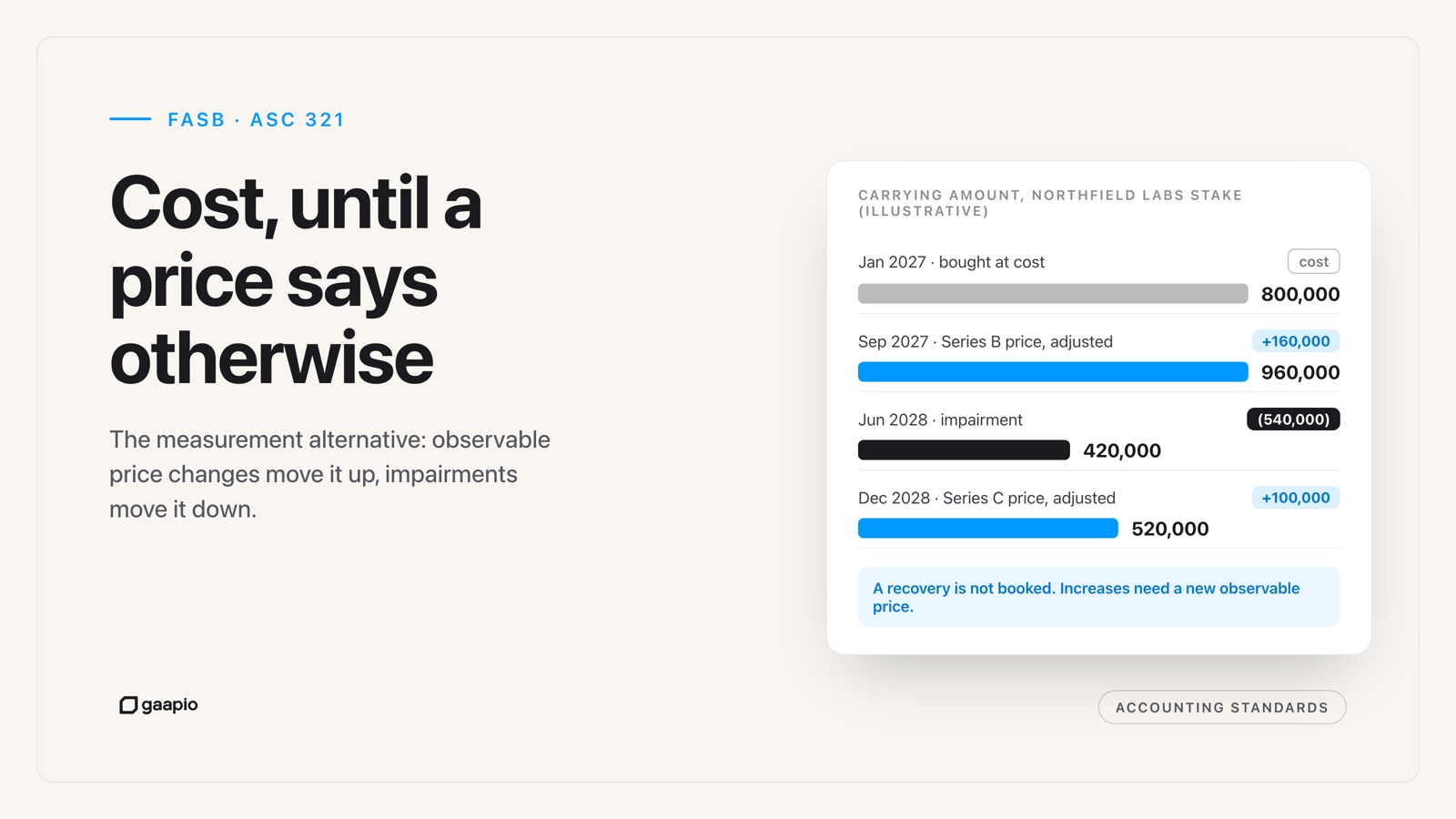
Facts. On January 15, 2027, Cedar Ridge Industries, a private company with a December 31 year end, buys 200,000 shares of Series A preferred stock in Northfield Labs, Inc., a private company, for $4.00 per share, or $800,000. The stake is about 4% of Northfield's voting power, and Cedar Ridge has no board seat or other sign of significant influence. Northfield is not a VIE in which Cedar Ridge is the primary beneficiary. The Series A shares are not in-substance common stock, are not mandatorily redeemable and cannot be put by the holder, so they are equity securities under ASC 321. They have no readily determinable fair value and do not qualify for NAV. Cedar Ridge prepares quarterly financial statements for its lenders, so each quarter end is a reporting period for the impairment assessment. Cedar Ridge elects the measurement alternative on the purchase date and documents it. Ignore taxes and transaction costs.
Step 1. Purchase, January 15, 2027.
| Account | Dr | Cr |
|---|---|---|
| Investment in Northfield Labs (equity security, measurement alternative) | 800,000 | |
| Cash | 800,000 |
Step 2. Observable price change, September 30, 2027. Northfield closes a Series B round with unrelated investors at $5.20 per share, an orderly transaction. Series B is senior to Series A in liquidation, and its anti-dilution terms differ. Cedar Ridge cannot use $5.20 directly. With a valuation specialist, it concludes that the fair value of one Series A share at September 30, 2027 is $4.80, after an adjustment of $0.40 for the seniority and terms differences. The adjustment is a judgment, and it is documented.
Upward adjustment: 200,000 × ($4.80 − $4.00) = $160,000.
| Account | Dr | Cr |
|---|---|---|
| Investment in Northfield Labs | 160,000 | |
| Gain on equity securities (net income) | 160,000 |
Carrying amount: $960,000. At December 31, 2027 there are no other transactions and no impairment indicators, and Cedar Ridge documents that conclusion. The carrying amount does not change.
Step 3. Impairment, June 30, 2028. Northfield loses its largest customer, breaches a debt covenant and discloses to its investors that its cash runway is about four months. Those are indicators in the ASC 321-10-35-3 list (deterioration in earnings and business prospects, and going concern factors). Cedar Ridge estimates the fair value of a Series A share at $2.10 under ASC 820, so the fair value of the investment is 200,000 × $2.10 = $420,000.
Impairment loss: $960,000 − $420,000 = $540,000.
| Account | Dr | Cr |
|---|---|---|
| Impairment loss on equity securities (net income) | 540,000 | |
| Investment in Northfield Labs | 540,000 |
Carrying amount: $420,000. At September 30, 2028, the going concern indicators are still present, and in September Northfield's directors funded a rescue note on distressed terms. Cedar Ridge therefore estimates fair value again under ASC 820. It concludes that fair value is not below the $420,000 carrying amount, so no further impairment is recorded, and it documents the estimate. The impairment is not written back in a later period just because conditions improve.
Step 4. A second observable price change, December 15, 2028. Northfield closes a Series C round at $3.00 per share, led by an unrelated investor after a marketed process. Cedar Ridge assesses it as orderly, and after adjusting for rights it concludes the fair value of one Series A share on that date is $2.60. A rescue note that Northfield's directors funded in September 2028 is not used. It is a debt instrument rather than an identical or similar equity security, and it was priced under distress.
Upward adjustment: 200,000 × ($2.60 − $2.10) = $100,000.
| Account | Dr | Cr |
|---|---|---|
| Investment in Northfield Labs | 100,000 | |
| Gain on equity securities (net income) | 100,000 |
At December 31, 2028, Cedar Ridge assesses impairment, notes that the Series C round extended Northfield's runway, finds no indicator requiring a write-down, and documents that conclusion.
Roll-forward and disclosure at December 31, 2028.
| 2027 | 2028 | Cumulative | |
|---|---|---|---|
| Opening carrying amount | 0 | 960,000 | |
| Purchase | 800,000 | 0 | 800,000 |
| Upward adjustments (observable price changes) | 160,000 | 100,000 | 260,000 |
| Impairments and downward adjustments | 0 | (540,000) | (540,000) |
| Closing carrying amount | 960,000 | 520,000 | 520,000 |
The ASC 321-10-50-3 note for 2028 reports the carrying amount of $520,000, impairments and downward adjustments of $540,000 for the year and cumulatively, and upward adjustments of $100,000 for the year and $260,000 cumulatively. The narrative explains the Series B and Series C transactions, the adjustment for rights, the covenant breach and the estimate of fair value used for the impairment.
Two points from the example. The impairment in Step 3 uses fair value under ASC 820, not the Series B price, so the earlier observable transaction does not hold up the carrying amount once indicators appear. And the $100,000 in Step 4 is an observable price change measured from the written-down basis. The carrying amount after Step 4 is $520,000, well below the $960,000 it carried before the impairment.
What do auditors push on?
Reviewers tend to go after four things on equity securities.
- The scope conclusion. Where is the memo showing why this is not an equity method investment or a consolidated VIE? A 4% stake with a board observer seat, or a 15% stake with significant commercial agreements, gets questions.
- The search for observable transactions. What information rights do you have, and did you read each financing round the investee closed? Silence is not evidence of no transaction.
- The adjustment for rights. Auditors look for support for the difference between the traded security and the one you hold, usually from a valuation specialist.
- The impairment file. An each-period qualitative assessment, documented, with the indicators considered and why none applied (or which did).
How does Gaapio help with ASC 321?
Gaapio is an AI-powered technical accounting platform built by CPAs. For an equity securities memo, such as the scope analysis, the measurement alternative election or an impairment assessment, you give Gaapio your facts and it asks follow-up questions before drafting. It is grounded in the licensed FASB Codification (through a direct licensing relationship with the FASB), Big 4 guidance, and SEC filings and comment letters. Where the analysis forks, it shows the alternatives so a reviewer can see the close calls, and conclusions come with clickable citations. It drafts in a memo template with reviewer comments, approvals and version history. See Gaapio accounting memos.
For the investment footnote, Gaapio reviews your disclosures against the Codification and compares them with peer filers. See AI footnote disclosures. Gaapio does not value your investments or find observable transactions for you; those come from your valuation specialist and your investee's financing information. You make the accounting calls.
Want to see it on your own equity investment memo? Request a demo.
This article is general information, not accounting or legal advice. Confirm the requirements for your facts against the Codification and with your auditor.
Written by Jace Chambers, CPA, who worked in audit at EY and in hedge accounting at Chatham Financial.
Frequently asked questions
What is ASC 321?
ASC 321 (Investments: Equity Securities) is the FASB Codification Topic that governs how an entity measures an equity security it holds and that is not consolidated, not accounted for under the equity method and not otherwise excluded. It requires fair value with changes in net income, with a measurement alternative for securities that have no readily determinable fair value.
What is the measurement alternative in ASC 321?
It is an election to measure an equity security without a readily determinable fair value at cost, minus impairment, adjusted up or down for observable price changes in orderly transactions for the identical or a similar investment of the same issuer. You elect it investment by investment, and it is not available for securities that use the net asset value practical expedient or the fair value option.
What is an observable price change?
It is an orderly transaction in the identical or a similar security of the same issuer that you know about or can reasonably know about. A new funding round at a different price is the common example. You measure the investment at fair value as of the date of the transaction, adjusting for differences in rights between the security that traded and the one you hold.
How do you test equity securities for impairment under ASC 321?
Under the measurement alternative, you make a qualitative assessment each reporting period, including interim periods, using the indicators in ASC 321-10-35-3. If an indicator suggests impairment, you estimate fair value and record an impairment loss in net income for any amount by which the carrying amount exceeds it. Securities at fair value need no separate impairment test.
Can you reverse an impairment under the measurement alternative?
No. The impairment sets a new carrying amount, and recoveries in fair value are not recognized unless you identify an observable price change in an orderly transaction for an identical or similar investment of the same issuer (see Deloitte, reversal of impairment losses under the measurement alternative).
What did ASU 2020-01 change for ASC 321 and ASC 323?
It clarified that an entity applying the measurement alternative must consider observable transactions that start or stop the equity method. If an observable transaction in an identical or similar security causes you to start or stop applying the equity method, you remeasure the investment at fair value immediately before applying the equity method, or immediately after discontinuing it. It also told entities not to consider whether underlying shares would be accounted for under the equity method when they assess certain forward contracts and purchased options under ASC 815.
Where do unrealized gains on equity securities go?
To net income. Since ASU 2016-01, equity securities within ASC 321 do not have an available-for-sale category, so unrealized gains and losses do not go through other comprehensive income. Under the measurement alternative, upward and downward adjustments and impairments also go through net income.
Related reading
- Variable interest entities and ASC 810 consolidation
- ASC 815 hedge accounting
- ASC 820 fair value measurement and disclosures
- Accounting memos: format, example and template
- AI footnote disclosures
Sources: FASB ASC 321-10, 323-10, 810-10, 815-10 and 820-10, ASU 2016-01, ASU 2018-03, ASU 2019-04, ASU 2022-03 and ASU 2020-01; FASB, Proposed ASU, Equity Method of Accounting, Targeted Improvements (October 28, 2026); FASB, ASU 2026-03, Investment Companies with Equity Securities Subject to Contractual Sale Restrictions; PwC, Loans and investments guide, accounting for equity securities; Deloitte, Roadmap: Equity Method Investments and Joint Ventures, change in level of ownership; Deloitte DART, reversal of impairment losses under the measurement alternative; KPMG, FASB clarifies accounting for equity method investments.