

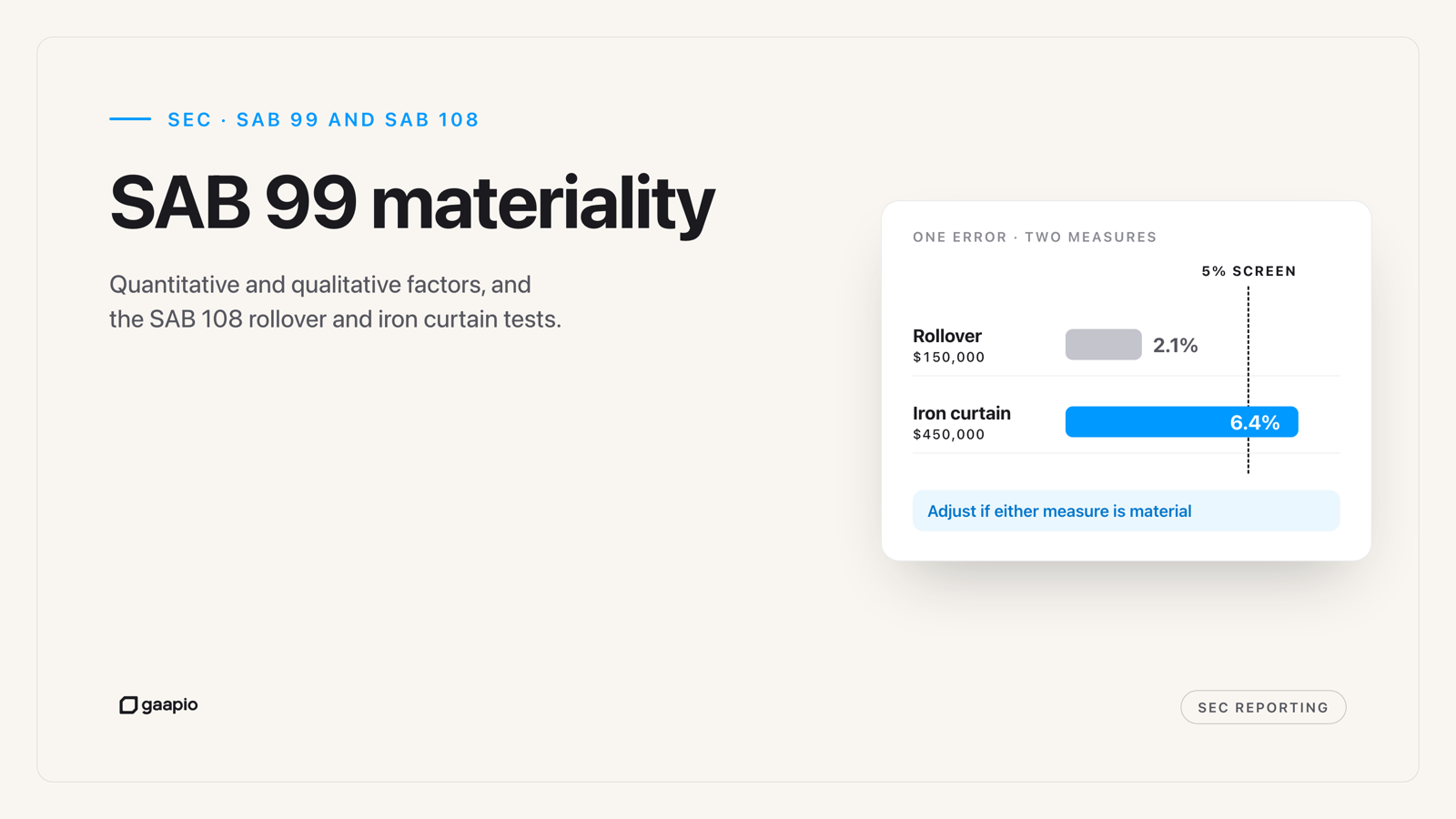
SAB 99 says a misstatement is material if there is a substantial likelihood that a reasonable person would consider it important, and that materiality cannot be decided by a percentage alone. A 5% rule of thumb is a fair first screen and never a conclusion, so every assessment needs quantitative and qualitative factors. SAB 108 adds a second step for errors that have built up across years: measure the error twice, once by its effect on the current-year income statement (rollover) and once by its effect on the year-end balance sheet (iron curtain), and adjust if either measure is material.
An error under 5% of net income can be material. The SEC staff put that in writing in 1999, and plenty of materiality memos still read as if it had not.
This guide covers how to assess materiality for errors in your financial statements under SAB 99 (SAB Topic 1.M), the quantitative and qualitative factors, how to document the assessment so an auditor and an audit committee can follow it, and how SAB 108 (SAB Topic 1.N) calls for both the rollover and iron curtain methods when an error has built up over several years. It ends with a worked error evaluation for one invented company. Sustainability reporting uses "materiality" to mean something different, and this guide does not cover it.
This is general information about accounting and SEC reporting. It is not accounting or legal advice. Management owns the conclusion for your filings, with input from your auditor and counsel.
Key takeaway: SAB 99 says a misstatement is material if there is a substantial likelihood that a reasonable person would consider it important, and that materiality cannot be decided by a percentage alone. A 5% rule of thumb is a fair first screen and never a conclusion. Every assessment needs quantitative and qualitative factors. SAB 108 adds a second step for errors that have built up across years: measure the error twice, once by its effect on the current-year income statement (rollover) and once by its effect on the year-end balance sheet (iron curtain), and adjust if either measure is material. In 2022 the SEC's Office of the Chief Accountant added that the analysis has to be objective, that offsetting errors and missing intent do not make an error immaterial, and that the larger the error, the harder it is for qualitative factors to support a conclusion that it is immaterial.
What is SAB 99?
SAB 99 is Staff Accounting Bulletin No. 99, "Materiality," issued by the SEC staff on August 12, 1999. It tells registrants and their auditors how to judge whether a misstatement in the financial statements is material. It is codified as SAB Topic 1.M and appears in the FASB Codification at ASC 250-10-S99-1.
The bulletin has three jobs. It says that a numerical threshold, including the familiar 5%, cannot be the whole analysis. It lists qualitative factors that can make a small misstatement material. And it says that a registrant may not intentionally book immaterial misstatements, because the books and records provisions of the Exchange Act do not depend on materiality. You will also see it written SAB99 or "SAB No. 99."
It was written for the evaluation of misstatements found while preparing or auditing financial statements. Footnote 1 of the bulletin says it addresses the evaluation of misstatements, not the planning and scoping of an audit, and that it is not meant as definitive guidance on materiality in other contexts. Materiality questions in other contexts, such as auditor independence (the footnote's own example), a Form 8-K Item 1.05 cybersecurity determination or a Regulation FD analysis, start from the same reasonable-investor standard but are not what SAB 99 was written for.
SAB 99 is staff guidance, not a rule. The Commission has not approved it. Auditors and the SEC staff use it as the reference point for evaluating misstatements, and courts, including the Second Circuit in Ganino v. Citizens Utilities, have treated it as persuasive guidance.
What does "material" mean for financial statements?
A misstatement is material if there is a substantial likelihood that a reasonable person would consider it important. SAB 99 draws this from two sources that it says are in substance identical. FASB Concepts Statement No. 2 says an omission or misstatement is material if, in light of surrounding circumstances, it is probable that the judgment of a reasonable person relying on the report would have been changed or influenced by including or correcting it. Concepts Statement No. 2 was later superseded, but in August 2018 the FASB restored its definition in Concepts Statement No. 8, Chapter 3, after dropping a proposal to call materiality a legal concept. The Supreme Court in TSC Industries v. Northway asks whether there is a substantial likelihood that the fact would have been viewed by a reasonable investor as significantly altering the "total mix" of information.
Two parts of that definition do the work:
- The reasonable investor is the test. The question is not whether management, the auditor or the audit committee finds the error important. The 2022 OCA statement puts it plainly: the determination is an objective assessment focused on whether there is a substantial likelihood the error is important to the reasonable investor.
- The total mix includes more than the number. The "total mix" is the size of the misstatement plus the factual context in which a user would read the line item. That is why the accounting and auditing literature talks about quantitative and qualitative factors together.
SAB 99 applies to SEC registrants and their auditors. A private company is not bound by it until it files with the SEC, for example in an IPO registration statement. ASC 250's error-correction requirements still apply to private companies, and their auditors evaluate uncorrected misstatements quantitatively and qualitatively under AU-C 450. The SEC's reasoning is a sensible reference point for any company with lenders, investors or an exit in view.
Is there a materiality threshold or materiality formula?
There is no SEC threshold and no formula. SAB 99 says exclusive reliance on any percentage "has no basis in the accounting literature or the law." The FASB reached the same view in Concepts Statement No. 2, where it concluded that no general standard of materiality could take account of every consideration in an experienced judgment.
SAB 99 does accept a screen. A 5% threshold may provide the basis for a preliminary assumption that a deviation below it is unlikely to be material, and the staff has no objection to using that as an initial step. Quantifying the error in percentage terms, the bulletin says, "is only the beginning of an analysis of materiality."
What the percentage is measured against matters. SAB 99 notes that quantitative assessments are often made against revenues, gross profit, pretax income, net income, total assets, stockholders' equity or individual line items, and that the right base depends on the adjustment and on factors such as covenants.
| Benchmark | What an error here tells a reader | When it deserves extra weight |
|---|---|---|
| Pretax or net income | Effect on reported earnings and earnings per share | Earnings are the main measure users watch |
| Revenue | Effect on the top line and growth rate | Growth drives the valuation story |
| Gross profit or operating income | Effect on margins | Margins are a stated focus |
| Total assets, liabilities or equity | Effect on the balance sheet and on ratios | An error crosses a working capital or leverage covenant |
| The individual line item | Effect on the line as a percentage of itself | A line is small overall but closely followed |
| Segment results | Effect on a segment | The segment is one management calls important |
SAB 99 gives one example. An adjustment to inventory can be immaterial to pretax income and still be material to the financial statements, because it might change a working capital ratio or put the company in default under a loan covenant.
What qualitative factors can make a small error material?
SAB 99 lists nine circumstances that "may well render material a quantitatively small misstatement." Each is a question to answer in writing. The list is not exhaustive, and the bulletin says so.
| SAB 99 factor | The question to answer | What to document |
|---|---|---|
| Precision of the item | Does the error come from an item capable of precise measurement, or from an estimate with built-in imprecision? | The source of the number and the range a reasonable estimate could fall in |
| Masks a change in earnings or other trends | Does the error hide a break in the trend investors watch? | Reported and corrected trends for the periods presented |
| Hides a failure to meet analysts' consensus | Does correcting the error move results from meeting to missing expectations? | Consensus, reported and corrected results |
| Changes a loss into income, or the reverse | Does the sign of the result change? | Reported and corrected results |
| Concerns an important segment | Does the error sit in a segment that management has said drives the business? | Segment disclosures and public statements about the segment |
| Affects regulatory compliance | Does a regulatory requirement turn on the amount? | The requirement and the corrected result |
| Affects loan covenants or other contracts | Does the error change covenant compliance? | The covenant calculation, reported and corrected |
| Increases management compensation | Does the error satisfy a bonus or incentive target? | Plan targets, reported and corrected results |
| Conceals an unlawful transaction | Is the error part of an unlawful transaction? | Facts from legal and the audit committee |
SAB 99 adds two more points. First, the demonstrated volatility of the stock's price in response to certain disclosures may help show whether investors treat small misstatements as important. Market reaction alone is "too blunt an instrument," but a reaction the registrant expects, based on a pattern of market performance, should be taken into account. Second, the materiality of a segment error depends on how important the segment is, so a misstatement in a small segment that management has called important to future profitability is more likely to be material than one in a segment management has not highlighted.
Can qualitative factors make a large error immaterial?
It gets harder as the error grows. The SEC staff has said it is often involved in discussions where that argument is made, and it has set a high bar. In a March 9, 2022 statement, then Acting Chief Accountant Paul Munter described discussions in which the reverse of SAB 99 is argued: that a quantitatively significant error is immaterial because of qualitative considerations. The staff's view is that as the quantitative size of an error grows, it becomes increasingly difficult for qualitative factors to overcome it. The statement reflects staff views. It is not a Commission rule and has no legal force or effect.
The statement also says it might be inappropriate to simply assess the SAB 99 factors in reverse. The qualitative factors that matter for a large error are not necessarily the nine listed for a small one, so a memo that checks the same boxes and concludes "none applies" misses the point.
The same statement pushes back on these arguments:
- The line item does not matter to investors. Financial statements prepared under GAAP or IFRS are the starting point for any objective analysis. Key non-GAAP measures can be added to the analysis but cannot replace it.
- Other registrants made the same error. The staff did not accept that a widely held view, rather than an intention to misstate, shows an error is immaterial.
- There was no intent to misstate. SAB 99 says intent may be significant evidence that an error is material. The staff does not accept the reverse, that lack of intent is evidence the error is immaterial.
- Other errors offset it. Each error is considered on its own first, and the aggregate analysis is not a basis for concluding that individual errors are immaterial.
- Restating would hurt. The statement lists clawbacks of executive compensation, reputational harm, share price declines and litigation as impacts that must not bias the analysis.
How do you aggregate and net misstatements?
Consider each misstatement on its own, then all of them together. SAB 99 says that if a single misstatement makes the statements as a whole materially misstated, other misstatements that reduce its effect on other line items cannot erase that. Its example: if revenues are a material item and are materially overstated, the statements are materially misleading even if the effect on earnings is completely offset by an equivalent overstatement of expenses.
The second step is the cumulative view. A misstatement that is immaterial alone can still make the statements as a whole materially misleading through its effect on a subtotal or total when added to others. The auditor aggregates all misstatements that affect each subtotal or total. The bulletin asks for particular care in offsetting a misstatement of an estimate against one of an item capable of precise measurement, because the imprecision in the estimate carries into the sum.
The bulletin also warns about misstatements that recur. Immaterial misstatements that recur in several years can have a cumulative effect that becomes material in the current year. SAB 108 later addressed how to quantify that buildup.
Can you intentionally misstate, or knowingly leave, an immaterial error?
No. SAB 99 says a registrant may not make intentional immaterial misstatements, and in some circumstances they are unlawful. Sections 13(b)(2) through 13(b)(7) of the Exchange Act require registrants to keep books and records that accurately and fairly reflect transactions in reasonable detail and to maintain internal accounting controls that give reasonable assurance. SAB 99 says "reasonable detail" and "reasonable assurance" turn on what would satisfy prudent officials in the conduct of their own affairs, not on materiality.
For small known errors, SAB 99 gives four factors on whether leaving one uncorrected is reasonable: how significant it is, how it arose, what it costs to correct, and how clear the authoritative guidance is. A clerical error from a recurring process in the normal close is treated differently from a misstatement that is part of an effort known to senior management to manage earnings. If the cost of correcting is small and little room exists for reasonable disagreement about the accounting, leaving a known error alone is hard to defend. SAB 99 also says it does not require every insignificant clerical error from the normal close, such as a missed accounts payable invoice, to be corrected. Those four factors, together with the materiality analysis, help decide where that line falls.
Management's intent does not make a misstatement material, but the bulletin says it can provide significant evidence of materiality. Investors would generally regard an earnings-management practice of staying just under a percentage threshold as significant.
What is SAB 108, and what are the rollover and iron curtain methods?
SAB 108 is Staff Accounting Bulletin No. 108, issued September 13, 2006 and codified as SAB Topic 1.N (ASC 250-10-S99-2). It covers how to quantify a misstatement in the current year when part of it came from prior years. Before it, registrants used one of two methods and often ignored the other, which, for companies using the rollover method, let wrong balances sit on the balance sheet year after year.
| Rollover | Iron curtain | |
|---|---|---|
| What it measures | The amount of the error that originated in the current-year income statement | The error in the year-end balance sheet, whichever year it arose in |
| Treatment of prior-year carryover | Ignores it | Counts all of it |
| Main weakness (per SAB 108) | Can let a large wrong balance build up because each year's piece looks small | Does not treat the reversal of prior-year errors as a current-year error, so a current-year income statement misstatement may never be evaluated |
| SAB 108's $100 example (a liability overstated by $20 a year for five years) | $20 | $100 |
The staff's answer is to use both. A registrant should quantify the error under both the rollover and the iron curtain approaches and evaluate the result of each. The financial statements require adjustment when either approach quantifies a misstatement that is material, after considering all relevant quantitative and qualitative factors.
Two consequences follow. First, quantification under SAB 108 is only the first step of the SAB 99 analysis. Second, if booking the whole correction in the current year would leave the current-year income statement materially misstated by the prior-year portion (in SAB 108's example, the $80 that originated in years 1 through 4), the prior-year financial statements should be corrected, even though the error was and remains immaterial to those years. Correcting prior-year financial statements for immaterial errors does not require amending previously filed reports. The correction can be made the next time the prior-year financial statements are filed.
SAB 108 also notes that a change from an accounting principle that is not generally accepted to one that is generally accepted is the correction of an error. Confirm first that you have an error and not a change in estimate, because the analysis in this guide applies to errors.
Worked example: evaluating a three-year error under SAB 99 and SAB 108
The company, facts and figures below are invented for illustration. Income taxes are ignored to keep the arithmetic readable. A real analysis looks at pretax income, net income, earnings per share and the balance sheet, and applies each period's actual facts.
The facts. Harbor Components, Inc. is a calendar-year SEC registrant. In January 2027, while closing fiscal 2026, a new controller finds that the volume-rebate accrual has been overstated since the first quarter of 2024. A formula in the rebate model counts one volume tier twice for a group of customers. The overstated accrual reduced net revenue and pretax income by $150,000 in each of 2024, 2025 and 2026, so the accrued rebate liability is overstated by $450,000 at December 31, 2026. Rebates are paid from a separate settlement report, so the excess accrual was never released when customers were paid and has carried forward on the balance sheet. Harbor met analysts' consensus in 2024, 2025 and 2026 on both reported and corrected results, and no covenant or bonus target in those years falls between the reported and corrected amounts. The company has no other known errors except one small unrecorded accrual in 2026, described in Step 6.
| Harbor Components (illustrative) | 2024 | 2025 | 2026 |
|---|---|---|---|
| Pretax income as reported | $6,000,000 | $6,600,000 | $7,000,000 |
| Understatement of pretax income from the error | $150,000 | $150,000 | $150,000 |
| Accrued rebates overstated at year-end (cumulative) | $150,000 | $300,000 | $450,000 |
| Pretax income if the error is corrected | $6,150,000 | $6,750,000 | $7,150,000 |
Other 2026 facts: net revenue is $180.0 million, total current liabilities are $37.5 million, and stockholders' equity is $60.0 million. The annual bonus plan pays out when pretax income reaches $7.3 million. The error did not come from a change in an estimate. A formula was applied incorrectly. The 2026 figures are preliminary, because the 2026 statements have not been issued.
Step 1: Quantify the 2026 error under both methods.
| Measure | Rollover | Iron curtain |
|---|---|---|
| Amount | $150,000 (the 2026 piece) | $450,000 (the year-end balance, all years) |
| % of 2026 reported pretax income ($7.0 million) | 2.1% | 6.4% |
| % of 2026 net revenue ($180.0 million) | 0.08% | 0.25% |
| % of total current liabilities ($37.5 million) | n/a | 1.2% |
| % of stockholders' equity ($60.0 million) | n/a | 0.75% |
Step 2: Apply the quantitative screen. The rollover measure is 2.1% of pretax income, under a 5% screen. The iron curtain measure is 6.4%, over it. An error over the screen cannot be waved through, and an error under it is not cleared either. The team goes on to the qualitative factors for the amount that failed the screen, and checks them for the rollover amount too.
Step 3: Work the qualitative factors.
| Factor | Finding |
|---|---|
| Precision | The accrual is an estimate, but the error is not: a tier counted twice is a mechanical mistake that can be measured exactly. It sits outside any reasonable estimation range |
| Masks a change in trend | Reported 2026 pretax growth is 6.1% ($7.0 million over $6.6 million). Corrected growth is 5.9% ($7.15 million over $6.75 million). Booking the full $450,000 in 2026 would show $7.45 million, which is 12.9% growth, more than double the corrected trend of 5.9% |
| Analyst consensus | Reported and corrected 2026 results both meet consensus, so correcting the error does not hide a miss |
| Management compensation | The bonus target is $7.3 million. Reported results ($7.0 million) and corrected results ($7.15 million) are both below it. Booking the full $450,000 in 2026 gives $7.45 million and crosses the target on income that belongs to 2024 and 2025 |
| Covenants, regulatory requirements, segment, loss-to-income, concealment | None affected. Each is documented as considered, with the reason |
| Intent | No evidence of intent. Under the 2022 OCA statement, that does not support a conclusion that the error is immaterial |
Step 4: Conclude on 2026. Two questions, two measures. First, can the error stay uncorrected? No. Under SAB 108 the 2026 statements need adjustment if either measure is material. The iron curtain measure is 6.4% of pretax income, over the screen, no qualitative factor points the other way, and Harbor concludes it is material to 2026: the error is precisely measurable and is not an estimate. Even apart from materiality, SAB 99's books-and-records factors (clear guidance, little cost to correct) would make leaving a known error of this kind hard to defend. Second, can the whole $450,000 go through 2026 as an out-of-period entry? That entry would overstate 2026 pretax income by the $300,000 that belongs to 2024 and 2025, which is 4.2% of corrected 2026 pretax income ($7.15 million, the figure the entry would misstate; against reported income it is 4.3%) and under the 5% screen. The qualitative factors decide it: the entry would lift 2026 pretax income to $7.45 million, cross the $7.3 million bonus target and more than double the apparent growth rate. Harbor concludes the out-of-period entry would be material to 2026. Under SAB 108, the prior-year financial statements are corrected instead, even though the error was not material to them.
Step 5: Evaluate the prior years on their own. The team measures the error in the financial statements as they were issued, using both methods and the same factors.
| Year | Rollover | Iron curtain | Trend check | Conclusion |
|---|---|---|---|---|
| 2024 | $150,000 = 2.5% of $6.0 million | Same (first year) | n/a | Not material |
| 2025 | $150,000 = 2.3% of $6.6 million | $300,000 = 4.5% | Reported 2024 to 2025 growth is 10.0%. Corrected growth ($6.75 million over $6.15 million) is 9.8% | Not material. Both measures are under 5%, and the iron curtain measure at 4.5% is close enough to the screen that the qualitative factors carry the conclusion. The trend is essentially unchanged (10.0% reported, 9.8% corrected). The error understated income, so it did not raise 2025 bonuses. Corrected results do not move 2025 from missing to meeting consensus, and no covenant, regulatory or segment measure turns on the amount. The error was precise rather than an estimate, which weighs toward materiality, and the memo says so and explains why the other factors outweigh it |
Harbor concludes the 2024 and 2025 annual financial statements were not materially misstated. Subject to the quarterly evaluation in Step 7, there is no "Big R" restatement, no amended filing and no Item 4.02 Form 8-K. It will revise the 2025 and 2024 comparatives in the 2026 Form 10-K and label them "as revised." If Harbor's securities are registered under Section 12(b), it also marks the Form 10-K cover box for an error correction and works with counsel on the recovery analysis box. Because the error understated income, it would not have inflated incentive pay. The 2024 and 2025 comparatives are revised to pretax income of $6,150,000 and $6,750,000, and 2026 is reported at $7,150,000. The accrued rebate liability is reduced by $300,000 at December 31, 2025, with the matching revision to retained earnings in the statement of stockholders' equity, and 2026 closes with the liability $450,000 lower than the uncorrected balance.
Step 6: Aggregate with other known errors. The audit team's summary of unadjusted differences for 2026 holds one other item, a $60,000 legal fee accrual for December work, not recorded, which overstates 2026 income. That is 0.8% of corrected pretax income. It is evaluated on its own and in aggregate with any other uncorrected items. Because the rebate error is being corrected, it does not offset the $60,000 in the aggregation, and the $60,000 is recorded or passed on its own merits.
Step 7: Assess interim periods, disclosure and control. SAB 99 says materiality should be assessed at each quarterly and interim period, not only at year-end. Harbor runs the same analysis for each quarter from 2024 through 2026. If income and the error fall evenly across quarters, the rollover measure stays near the annual percentage, about 2.1% to 2.5%. The iron curtain measure does not. It runs from about 11% to 16% of quarterly pretax income in the 2025 Forms 10-Q and about 19% to 24% in the 2026 Forms 10-Q. ASC 250-10-45-27, which addresses error corrections in interim periods, looks to estimated full-year income and the trend of earnings, and calls for separate disclosure of an item material only to the interim period. The conclusion still has to be reached quarter by quarter. If any previously issued Form 10-Q is materially misstated, that quarter needs its own Big R analysis and Item 4.02 consideration, whatever the answer for the annual statements. In this illustration Harbor concludes the quarters were not materially misstated, measuring each against estimated full-year income and the earnings trend. The 2026 quarters are the closest call, at up to 5.9% of full-year income, and the memo says so. It revises the 2026 quarterly comparatives in its 2027 Forms 10-Q and considers whether Regulation S-K Item 302(a) requires disclosure of the revised 2025 and 2026 quarters in the 2026 Form 10-K. The 10-K note describes the nature of the error, the periods affected and the effect on each line item. Last, the failure of the rebate review control for three years goes through the deficiency evaluation described in our ICFR guide. Under the 2022 statement, the actual error is only the starting point. The severity depends on what could have gone wrong, so one control failing across 12 quarters gets a hard look at the other rebate programs and at the review control itself.
When do you restate: "Big R" versus "little r"?
If an error is material to previously issued financial statements, the company restates them. This is a reissuance restatement, or "Big R." If an error is not material to those statements, but either correcting it or leaving it uncorrected would be material to the current period, the company must still correct it. It may do so by revising the prior-period information in the current comparative statements and disclosing the error. This is a revision restatement, or "little r." The OCA's 2022 statement says both are restatements to correct errors, and both need transparent disclosure.
| Reissuance restatement ("Big R") | Revision restatement ("little r") | |
|---|---|---|
| Trigger | Error is material to previously issued financial statements | Error is not material to previously issued statements, but correcting it or leaving it would be material to the current period |
| How it is corrected | Restate the prior-period financial statements (typically by amending the prior filing) | Revise the comparative prior-period information in the current filing, labeled "as revised" |
| Form 8-K | Item 4.02 applies once the board, committee or authorized officers conclude the prior statements should no longer be relied on, with the filing due within four business days | Item 4.02 does not apply, because the prior statements remain reliable |
| Clawback and Form 10-K cover | Rule 10D-1 recovery policy applies. For Section 12(b) registrants, cover check boxes apply | The same. A little r can also trigger recovery analysis and the cover check boxes |
| ICFR | A material error is an indicator of a material weakness | Still evaluate the control deficiency. A material weakness can exist even when the error itself is not material |
The staff said in its 2022 statement, citing Audit Analytics, that "little r" restatements rose from approximately 35% of all restatements in 2005 to nearly 76% in 2020. It noted that some attribute the trend to better ICFR and audit quality, said it continues to monitor it, and said it had seen materiality analyses that appeared biased toward the "little r" answer. A memo that reaches "little r" needs to show the analysis was objective.
How do you document a materiality assessment?
SAB 99 does not prescribe a memo. In practice teams write one, often called a SAB 99 memo or materiality memo, because the auditor will ask for it, the audit committee will want to read it, and management's own ICFR evaluation needs support. A reviewer should be able to follow the analysis from the facts to the conclusion without asking you anything.
| Section | What it holds | The usual gap |
|---|---|---|
| 1. Facts and discovery | What the error is, how and when it was found, who found it | The discovery date and the date of any non-reliance conclusion are missing. The Form 8-K clock runs from the conclusion, and the gap between the two dates will be read |
| 2. Error or estimate | Why this is an error and not a change in estimate | Assumed, never stated |
| 3. Periods affected | Every annual and interim period, balance sheet and income statement | Only the current year |
| 4. Quantification | The error in each period, each financial statement line item, by rollover and iron curtain | One method only |
| 5. Quantitative evaluation | Percentages against each relevant benchmark, with the benchmark choice explained | A single percentage against one benchmark |
| 6. Qualitative factors | Each SAB 99 factor, with the finding and the evidence, including the ones that do not apply | A list of factors followed by "none applies" |
| 7. Aggregation | All known uncorrected misstatements, each alone and together, without netting away an individual one | The error is evaluated in isolation |
| 8. Conclusion by period | Material or not, for each period, and whether Big R or little r applies | One conclusion for all periods |
| 9. Disclosure and filings | What will be disclosed, where, and whether Item 4.02 is triggered | Left to a separate workstream |
| 10. Internal control | Cross-reference to the deficiency evaluation | Missing |
| 11. Approvals | Who reviewed it, when the auditor and audit committee were informed | No dates |
Three habits keep the memo credible. Write the memo before the answer is known, so the facts are not shaped to a conclusion. Keep the analysis free of the impacts of restating, since the 2022 statement treats an analysis influenced by clawbacks, share price or litigation concerns as not objective. And state your benchmark choices before the numbers come in. Our post on how to write a technical accounting memo covers the general memo structure, and the SAB 74 guide covers a different staff bulletin that shows up in the same filings.
What mistakes do materiality memos make most often?
Weak memos tend to fail in one of six ways:
- Using 5% as a safe harbor. SAB 99 treats it as a starting point.
- Evaluating one method. SAB 108 says the staff expects both rollover and iron curtain.
- Looking at one year. Errors that recur build up, and the prior years need their own analysis.
- Netting. A large error is not immaterial because another error offsets it.
- Checking factors without findings. "Covenants: not applicable" carries no support unless the memo shows the covenant calculation.
- Working backward from a restatement concern. The objective test is the reasonable investor, and the cost of a Big R is not part of it.
How does Gaapio help with materiality assessments?
Gaapio is an AI-powered technical accounting platform built by CPAs. For an assessment like this one, it searches the Codification, firm accounting guides and SEC filings together, and cites them together. You can then export the research as a starter for your memo. Your team still supplies the facts, the rollover and iron curtain numbers and the qualitative findings, and management owns the conclusion. See how Gaapio supports SEC reporting teams, or read about accounting memos.
Want to see how that looks on an error you are working on right now? Request a demo.
Frequently asked questions
What is SAB 99?
SAB 99 is SEC Staff Accounting Bulletin No. 99, "Materiality," issued August 12, 1999. It says a misstatement is material if there is a substantial likelihood a reasonable person would consider it important, and that materiality has to be judged using quantitative and qualitative factors, not a percentage alone. It is codified as SAB Topic 1.M and ASC 250-10-S99-1.
Is the 5% rule a safe harbor?
No. SAB 99 says a 5% threshold may provide the basis for a preliminary assumption that a deviation below it is unlikely to be material, and the staff does not object to using it as an initial step. It adds that misstatements below 5% could well be material and that exclusive reliance on any percentage has no basis in the accounting literature or the law.
What is the difference between SAB 99 and SAB 108?
SAB 99 tells you how to decide whether a misstatement is material. SAB 108 tells you how to measure the misstatement in the current year when part of it came from prior years. You use SAB 108 to quantify, then SAB 99 to evaluate what you quantified.
What is the difference between the rollover and iron curtain methods?
The rollover method measures the error by the amount that originated in the current-year income statement and ignores the carryover from prior years. The iron curtain method measures the error by the amount sitting in the year-end balance sheet, whichever year it arose in. The SEC staff's view in SAB 108 is that a registrant should quantify under both and adjust when either measure is material.
What are the qualitative factors in SAB 99?
SAB 99 lists nine: whether the item is an estimate or precisely measurable, whether the error masks a change in earnings or other trends, whether it hides a missed analyst consensus, whether it turns a loss into income or the reverse, whether it involves an important segment, whether it affects regulatory compliance, whether it affects loan covenants or other contracts, whether it raises management compensation, and whether it conceals an unlawful transaction. The list is not exhaustive.
Can offsetting errors make a misstatement immaterial?
Not on their own. SAB 99 says to consider each misstatement separately and then all of them in aggregate, and that a material misstatement of one item is not erased by errors that reduce its effect elsewhere. The SEC staff repeated in 2022 that offsetting effects should not be the basis for concluding that individual errors are immaterial.
Does SAB 99 apply to private companies?
SAB 99 is SEC staff guidance for SEC registrants and their auditors. A private company is not bound by it until it files with the SEC, for example in an IPO registration statement. ASC 250 error-correction requirements still apply, and the auditor evaluates uncorrected misstatements quantitatively and qualitatively under AU-C 450.
Do I have to write a SAB 99 memo?
SAB 99 does not require a memo. Management does have to evaluate the materiality of misstatements it identifies, and the evaluation supports the auditor's review, the audit committee's oversight and management's ICFR assessment. A written memo is how teams show that work.
Who decides whether an error is material?
Management evaluates the error and decides how to correct it, the audit committee oversees the process, and the auditor evaluates whether uncorrected misstatements are material to the financial statements. The 2022 OCA statement addresses registrants, auditors and audit committees together and asks each to apply an objective, reasonable-investor analysis.
When is Form 8-K Item 4.02 required?
Item 4.02(a) applies when the board, a board committee or authorized officers conclude that previously issued financial statements should no longer be relied on because of an error. The filing is due within four business days of that conclusion. A "little r" revision, where the prior statements remain reliable, does not trigger it. Item 4.02(b) applies separately when the independent auditor tells the company that disclosure is needed to prevent future reliance on a previously issued audit report or completed interim review.
Related reading
- ICFR: the 2026 guide to internal control over financial reporting
- SAB 74: disclosing the effects of new accounting standards
- How to write a technical accounting memo
- Quarter-end close checklist
Sources
- SEC Staff Accounting Bulletin No. 99, Materiality (August 12, 1999)
- SEC Staff Accounting Bulletin No. 108, Considering the Effects of Prior Year Misstatements when Quantifying Misstatements in Current Year Financial Statements (September 13, 2006)
- SEC Office of the Chief Accountant, Paul Munter, Assessing Materiality: Focusing on the Reasonable Investor When Evaluating Errors (March 9, 2022)
- Deloitte DART, Roadmap: SEC Comment Letter Considerations, 2.15 Materiality of Errors
- PwC Viewpoint, SEC staff accounting bulletins, Topic 1 financial statements
- FASB Concepts Statement No. 2, Qualitative Characteristics of Accounting Information; TSC Industries, Inc. v. Northway, Inc., 426 U.S. 438 (1976)
- Exchange Act Sections 13(b)(2)-(7); Form 8-K Item 4.02