

Your auditor will ask who owns the control, how precisely it operates, and what evidence shows it ran, whether or not the control uses AI.
I started my career in audit at EY, and the questions at a control walkthrough have not changed because a model is involved. What changed is where the answers live. This guide covers whether AI is prohibited in audits and in SOX and ICFR controls, which controls AI can support and which it cannot own, the evidence an auditor will ask for, what the PCAOB and SEC have said (with primary sources), how 404(a) and 404(b) differ when AI is in the picture, and a worked example of an AI-assisted review control with its documentation.
Key takeaway: We have found no PCAOB standard, SEC rule or COSO publication that prohibits AI in audits or in SOX 404 and ICFR controls. The test for any control is the same: a named owner with the authority and competence to perform it, enough precision to prevent or detect a misstatement that could be material, reliable inputs, and evidence that someone else can reperform. AI adds three questions an auditor will ask: what did the AI do versus what did a person do, how do you know its output is complete and accurate, and who approved changes to the tool. A control that lets a person agree AI output to source documents is easier to defend than one that trusts the output. Management still owns the 404(a) assessment, and the auditor still owns the evidence behind its 404(b) opinion, whichever tools either side uses.
Is AI prohibited in audits or in SOX 404 and ICFR controls?
No. As of November 2026, we have found no PCAOB standard, SEC rule or COSO publication that bans AI in an audit or lists AI uses that are off limits for ICFR controls. What exists is a set of existing requirements that apply to AI the same way they apply to any other tool, and active conversations at both regulators about whether more is needed.
For management, Section 404(a) still requires an annual assessment of ICFR against a suitable framework, and a control that uses AI has to meet the same standard as any other: designed to address the risk, operating as designed, performed by someone competent. For the auditor, AS 2201 still requires testing of design and operating effectiveness, and AS 1105 still requires evidence that is sufficient and appropriate. The PCAOB's own staff reported in July 2024, based on limited outreach, that the audit firms they spoke with did not view the auditing standards as impediments to using generative AI. That is staff reporting what firms told them, and it is not a Board rule or an approval of any particular use.
What AI cannot do is lower the bar. If the tool's output feeds a control and nobody can show the output was complete and accurate, the control has a problem, with or without AI.
What do SOX 404 and AS 2201 require when a control uses AI?
The same things they require of any control: a risk it addresses, a person with the authority and competence to perform it, a precision that would prevent or detect a misstatement that could be material, and evidence of operation. AS 2201.42 says the auditor tests design by asking whether the controls, if operated as prescribed by persons possessing the necessary authority and competence, would satisfy the control objectives. AS 2201.44 adds that the auditor tests operating effectiveness by determining whether the control operates as designed and whether the person performing it has that authority and competence.
Where AI sits in the control changes what the auditor looks at. Three patterns cover most of what finance teams do today:
| Where the AI sits | Example | What the auditor focuses on |
|---|---|---|
| AI produces information the control relies on | AI extracts contract terms, or builds a report a reviewer uses | Completeness and accuracy of that information (AS 1105.10), and controls over changes to the tool |
| AI drafts, a person reviews | AI writes a variance explanation, and the controller reviews it | Whether the review is a real comparison to source, at a defined precision, with evidence |
| AI performs the control activity | AI flags unusual journal entries or auto-matches reconciling items | Whether the control can be treated as automated at all, given that model output can vary between runs; ITGCs; change management; and what happens when it fails without an alert |
In our experience, most teams start in the second pattern. In that pattern the review is the control, and the AI is a drafting aid inside it. That matters because benchmarking under AS 2201.B28 and B29 is available only for entirely automated application controls, which can carry forward without full retesting each year when IT general controls are effective and the control has not changed since the baseline was established. A review a person performs does not qualify, so the auditor will test a sample of review occurrences every year. Even for the AI step itself, an auditor may not treat a model whose output can vary from run to run like a traditional automated control.
Which controls can AI support, and which can it not own?
AI can support the mechanical, high-volume parts of a control. It cannot own the judgment, the sign-off or the conclusion, because those belong to management and, in the end, to the officers who certify the filing.
| Control area | AI can support | AI cannot own |
|---|---|---|
| Account reconciliations | Matching items, proposing reconciling items, drafting the reconciliation narrative | The preparer and reviewer sign-off, and the decision that a reconciling item is valid |
| Journal entry review | Screening 100% of entries for unusual patterns, ranking entries for human review | The decision that an entry is appropriate, and management override risk assessment |
| Flux and variance analysis | Drafting explanations, pulling subledger detail for large movements | The reviewer's conclusion that the explanation is supported and complete |
| Revenue and lease contract set-up | Extracting terms from contracts, flagging missing fields | The accounting judgments under ASC 606 or ASC 842, and the comparison to the signed contract |
| Estimates and valuation | Running a model you have validated, running sensitivities, drafting support | Management's key assumptions and the decision on the recorded amount |
| Disclosure and footnote drafting | First drafts, tick-and-tie support, consistency checks | The disclosure decision, and the representations in the filing |
| ICFR program work | Drafting process narratives, building risk and control matrices, collecting evidence | The risk assessment, the deficiency evaluation and the 404(a) conclusion |
A useful test is to ask who the auditor would call if the output were wrong. If the answer is "the tool," the control has no owner. The named person must be able to challenge what the AI produced, which is the competence point in AS 2201.42 and .44.
The same logic applies to an auditor's own use of AI. No PCAOB standard addresses AI specifically. The closest recent change, the amendments on technology-assisted analysis (AS 1105 and AS 2301), applies to audits of fiscal years beginning on or after December 15, 2025, which makes calendar year 2026 the first year for calendar-year companies. The Board said in the adopting release that those amendments address technology-assisted analysis, not other technology such as artificial intelligence. The auditor is responsible for the evidence either way, and professional skepticism applies to AI output as it does to anything else. See our guide to PCAOB AS 1000 and auditor responsibilities.
What evidence will an auditor ask for on an AI-assisted control?
Expect five areas: precision of the review, completeness and accuracy of the inputs, IT general controls over the AI tool, change management, and the competence of the person performing the control. The rest of the evidence set follows from those.
Precision of the review control
Precision is how small a misstatement the control would catch. AS 2201.68 uses the idea for compensating controls, which must operate at a level of precision that would prevent or detect a misstatement that could be material, and AS 2201.23 applies it to entity-level controls. For a review control, precision shows up as a threshold, a comparison basis and a stated investigation standard.
An AI-assisted review control needs three precision facts in writing:
- What gets reviewed. The population and the rule that selects items for investigation. Keep that rule deterministic and outside the AI, so the AI cannot decide what gets looked at.
- The threshold and why it is set there. Tie it to materiality and to the risk. A threshold that leaves room for several unflagged errors to add up to a material amount is not precise enough.
- What the reviewer does with a flagged item. "Agrees explanation to source" is a control. "Reviews AI summary" is not.
A control can also fail on precision from the other direction. If the AI flags so many items that reviewers stop investigating, the control exists on paper only. Track flagged volume and investigation rate as part of the control.
Completeness and accuracy of inputs
When a control relies on a report, a population or AI output, the auditor asks how completeness and accuracy were established. AS 1105.10 requires the auditor, when using information produced by the company, to test its accuracy and completeness (or the controls over them) and to evaluate whether it is sufficiently precise and detailed for the purpose. Management's own assessment depends on the same logic.
For AI-assisted controls, this has two layers:
- The data going in. Does the trial balance, subledger or contract set agree to the books? Is anything missing because of a failed extract or a changed field mapping?
- The output coming out. Does the control compare AI output to source, or does it rely on the output? A control that agrees every extracted or explained item to the underlying document does not depend on the AI being right. A control that accepts the AI output does, and then the AI's accuracy becomes the control's accuracy.
IT general controls over the AI tool
If the AI tool is part of how the control operates, the auditor asks about the general controls around it: who can access it and the data it reads, how changes to it are approved and tested, and how it is operated and monitored. Staff of the SEC's Office of the Chief Accountant (OCA), speaking for themselves and not the Commission, said at the December 2025 AICPA and CIMA conference that auditors need to adjust how they assess IT general controls for AI models, because model drift and changes from third-party vendors call for more proactive and frequent monitoring by both the registrant and the auditor (as summarized by EY).
| ITGC area | Traditional question | What to add for an AI tool |
|---|---|---|
| Access | Who can access the application and its data? | Who can edit prompts, templates, thresholds or connected data sources? Who can see the output before review? |
| Change management | Who approves and tests program changes? | Model version, prompt or template changes, vendor-side model updates, and who assessed their effect on the control |
| Operations | Are jobs run, monitored and failures resolved? | What happens when the tool returns nothing, times out or returns partial output? Is a silent failure visible to the reviewer? |
| Service organization | Does the vendor host or process data the control relies on? | Does the vendor's SOC 1 report cover the AI feature, and what complementary user entity controls does it expect from you (AS 2201 Appendix B addresses service organizations)? |
Change management
A model update, a prompt change or a new data source can change what the tool produces without anyone touching your accounting system. Keep a log of each change to the tool, who approved it and what was done to check the effect. For vendor-hosted tools, ask what notice the vendor gives of model updates, and decide what you do when there is none.
The log is the evidence. After a material change, run a prior period through the tool and compare the output to what the reviewer previously accepted. If the control has a person comparing output to source, a change mostly affects how often the reviewer finds differences. It can still affect whether the control works: a change can drop detail the reviewer relies on, return partial output without an error, or shift what the draft emphasizes. That is why the log and the re-run matter even when a person reviews every item.
Competence of the person performing the control
AS 2201.44 puts the reviewer's authority and competence in the operating test. An accountant who cannot evaluate what the AI produced, or who signs off on output they did not compare to anything, is an operating deficiency we expect auditors to look for first. The fix is training and a review step that requires the reviewer to point to a source.
The evidence set to keep
| Evidence | What it shows | Where the auditor uses it |
|---|---|---|
| Control description with the AI and human steps separated | Who does what | Understanding the control, design test |
| Population rule, threshold and rationale | Precision | Design test, evaluating deficiencies |
| Input reconciliation (trial balance to ledger, extract counts) | Completeness and accuracy of inputs | AS 1105.10 testing |
| Reviewer checklist or sign-off with source references, per occurrence | The review happened and compared to source | Operating effectiveness test |
| Exception log with disposition | Items found, who resolved them, outcome | Deficiency evaluation |
| Tool change log with approvals and re-test results | Change management | ITGC test, reliance on the control |
| Access list for the tool and its data | Who could change what | ITGC test |
| Vendor SOC 1 report and complementary user entity controls, if applicable | Service organization coverage | Service organization evaluation |
| Reviewer training or competence record | Competence | Operating effectiveness test |
How accurate is AI for financial data analysis, and how do you test it?
Accuracy is a measured property of a specific tool on your data, and a vendor's headline percentage tells the auditor very little. For an AI platform used in financial data analysis, the accuracy question has two parts: how often is the output right, and what happens to the control when it is wrong.
To answer the first part, test the tool against a labeled sample from your own population. Take a set of prior-period items where you already know the right answer, such as reconciling items you resolved, journal entries you know were unusual, or flux explanations you accepted, and compare the tool's output. Track two things: how often it misses a real exception (false negatives) and how often it flags items that turn out to be fine (false positives). Misses matter for precision. False positives matter because they bury reviewers.
To answer the second part, design the control so that an AI error is caught by a person comparing to source. Then most of the control's precision comes from the review step, and the accuracy test tells you how much work that review will generate. It still matters for the control: any detail the AI pulls that the reviewer relies on is information produced by the entity, and a draft that sounds right can anchor a reviewer. Keep the review standard tied to source documents, not to the draft.
Re-run the labeled sample after any model or template change and at least once a year. If you rely on the tool to select what gets reviewed, rather than to draft what the reviewer examines, accuracy testing becomes central to the control's design, and you should discuss the approach with your auditor before year-end.
What have the PCAOB and SEC said about AI so far?
Neither has banned it, neither has issued an AI-specific rule for controls, and both have pointed to existing frameworks. Here is what is on the record, with sources:
| Source | What it says | Weight |
|---|---|---|
| PCAOB staff Spotlight (July 2024) | Based on limited outreach. Firms interviewed did not view PCAOB auditing standards as impediments to using generative AI, and described current use as mostly administrative and research tasks. Some preparers used it for less complex, repetitive processes such as reconciliations. Firms and preparers both said human review of output remains essential. | Staff observations, not a rule |
| PCAOB Release No. 2024-007, technology-assisted analysis amendments | Amends AS 1105 and AS 2301, effective for audits of fiscal years beginning on or after December 15, 2025. The Board said the amendments address technology-assisted analysis, not other technologies such as AI. | Adopted standard, not AI-specific |
| PCAOB AS 2201 | The ICFR audit standard. Technology-neutral. Tests design and operating effectiveness, including the competence of the person performing the control. | Standard |
| SEC OCA staff (Senior Associate Chief Accountant Anita Doutt), AICPA and CIMA conference, December 2025 (EY summary) | Auditors evaluating AI in ICFR need to understand and document how the models perform their tasks, including data and assumptions, and keep human oversight. AI model ITGCs call for more frequent monitoring because of model drift and vendor changes. | Staff remarks, not Commission views |
| SEC OCA staff, June 4, 2026 (Thomson Reuters report) | Deputy Chief Accountant Michal Dusza, speaking at the USC SEC and Financial Reporting Conference, said it would be hard to be prescriptive given the pace of change and that staff may share reminders and questions. The article notes that existing frameworks, including COSO and the SEC's ICFR guidance, are useful resources. Areas raised: third-party service providers, data quality, and whether management's risk assessment keeps pace with AI use. | Staff remarks, not Commission views |
| COSO, Achieving Effective Internal Control Over Generative AI (February 2026) | Applies the 2013 Internal Control-Integrated Framework to generative AI. Does not create a new framework. | Framework guidance |
| SEC Release 33-8810 | Management's interpretive guidance for evaluating ICFR: risk-based, scalable, evidence-supported. Technology-neutral. | Interpretive release |
On the PCAOB side, in June 2026 the Board requested public comment on its standard-setting priorities, and comments closed August 7, 2026. AI was one of the subjects commenters addressed. In the comment letters we read that addressed AI, more asked for guidance than for new rules, though that is our reading of a subset of letters, not a PCAOB summary. As of this writing, the PCAOB has issued no AI-specific auditing standard. Check pcaobus.org before you rely on that in a planning meeting.
The practical read from the staff remarks is to use the frameworks you already apply, document what the AI does and the data it uses, and keep a person responsible. EY's commentary on those remarks adds a point we agree with: talk to your auditor early and often. Our post on COSO's generative AI guidance covers the COSO side in more depth.
How do 404(a) and 404(b) differ for AI-assisted controls?
404(a) is management's assessment, and every public company filing an annual report owes it after its first. 404(b) is the registered auditor's attestation on ICFR, and it applies to accelerated and large accelerated filers that are not emerging growth companies. Both requirements stay as they are, and the evidence each side has to assemble grows.
| 404(a), management's assessment | 404(b), auditor's attestation | |
|---|---|---|
| Who it applies to | Public companies filing annual reports, after the first annual report | Accelerated and large accelerated filers that are not EGCs |
| Who is responsible | Management, with CEO and CFO certifications under Section 302 | The registered public accounting firm, under PCAOB AS 2201 |
| Standard of evidence | SEC interpretive guidance in Release 33-8810: risk-based, scaled to risk, documented. Following it satisfies the evaluation requirement, though it is not the only acceptable approach | AS 2201: design and operating effectiveness, sufficient appropriate evidence |
| What AI changes | Management must identify controls that use AI, assess risks from them and keep evidence that someone competent reviewed the output | The auditor tests the AI-assisted control like any other, plus ITGCs and service organization considerations for the tool |
| What the auditor sees | The company's documentation | The auditor's own testing of the company's documentation and controls |
| If a material weakness exists | Management cannot conclude ICFR is effective and must disclose it | The ICFR opinion is adverse |
| If you are exempt from 404(b) | You still owe 404(a), and the controls still need to work | Not required, but the financial statement auditor must still understand your controls and evaluate the design and implementation of those relevant to the audit, and will communicate significant deficiencies and material weaknesses it finds |
Filer status matters for how much of this reaches your auditor. The SEC proposed on May 19, 2026 in Release 33-11419 to simplify the filer categories, including raising the large accelerated filer threshold from $700 million to $2 billion of public float and eliminating the separate accelerated filer category. If adopted, that would change which companies need a 404(b) attestation. As of November 2026 the proposal has not been adopted, so the current thresholds apply. For the full table of who needs what, see our ICFR guide.
One practical point for emerging growth companies and other non-attestation filers: the 404(b) exemption does not defer the work. Controls you build around AI during the exemption period get their first auditor test of operating effectiveness when the exemption ends, so document them to the standard an auditor will apply.
Worked example: an AI-assisted flux review control
The example below is illustrative. Alder Point Systems is an invented calendar-year accelerated filer (under current rules). The thresholds, roles and numbers are examples, not benchmarks, and a real control should reflect your own risk assessment. It is deliberately a different pattern from contract extraction: here the AI drafts and a person reviews.
The situation. Each quarter, the corporate controller's team compares the trial balance to the prior quarter and to the same quarter last year, and a reviewer must explain and support large movements before each 10-Q and the 10-K are filed. The team uses an AI tool to draft the explanations and pull related journal entry and subledger detail. The risk is that an error or unusual entry sits inside an account movement and nobody investigates it.
The control, documented
| Attribute | Documentation |
|---|---|
| Risk and assertions | A misstatement in a balance sheet or income statement account goes undetected because a large movement is not investigated (accuracy, completeness, cutoff, classification) |
| Control description | After the quarter-end trial balance is final, the assistant controller reviews every account whose movement meets the threshold. For each, the reviewer reads the AI-drafted explanation, agrees it to source support, and records the support reference, or investigates. The AI drafts; the reviewer's comparison to support and the sign-off are the control. |
| Owner and backup | Assistant controller. The corporate controller is the named backup. |
| Frequency | Quarterly, before each 10-Q and the 10-K are filed. The year-end occurrence carries the most weight for 404(a) and 404(b). |
| Population rule | A locked report in the reporting system lists every account where the change in balance (balance sheet accounts) or in quarterly activity (income statement accounts), versus the prior quarter or versus the same quarter last year, is $150,000 or more, regardless of percentage. The AI does not choose the population. The report's logic and parameters were validated when it was built and are covered by change management, so the auditor can test it as information produced by the company. |
| Precision | Management's materiality for its ICFR evaluation is $1.2 million (illustrative). The $150,000 threshold is 12.5% of that amount. The controller documented, using the expected movement for each account type, why a misstatement large enough to matter would be expected to push an account's movement over $150,000, and why several smaller misstatements across the accounts most exposed to the risk would be unlikely to add up to a material amount. The challenge sample below tests that reasoning each quarter. The threshold is re-assessed each year and after an acquisition or system migration. |
| Investigation standard | The reviewer agrees each explanation to a source document (invoice, contract, payroll register, journal entry with approval). An explanation the AI drafted without source support is treated as unexplained. |
| Completeness and accuracy of inputs | Before the review, someone other than the reviewer agrees that (a) trial balance debits equal credits, (b) the trial balance total agrees to the general ledger close report, (c) the account count agrees to the chart of accounts, and (d) the prior-period comparatives, summarized by financial statement line, agree to the filed 10-Q or 10-K. |
| Challenge sample | Each quarter the reviewer independently explains the five largest unflagged movements and compares the result to what the AI drafted, as a check that the threshold is not hiding something. |
| Evidence per occurrence | A signed review log listing each flagged account, the AI draft, the support reference, the reviewer's conclusion, and any entry proposed. Kept with the input reconciliation. |
| Change management | A log of changes to the AI tool, including model version, prompt template, connected data sources and access, with the approver and date. After a change, the prior quarter is re-run in a test environment and compared to the explanations the reviewer accepted last quarter. For vendor-hosted models, the vendor's change notices are filed in the log. |
| Access | Only named finance and IT staff can edit the prompt template, the threshold report or the data connections. The list is reviewed quarterly. |
| Exceptions | Differences found are logged with a disposition. A pattern of incomplete AI explanations is reported to the controller and considered in the deficiency evaluation. |
What the review looks like in one quarter
For Q3 2026, the population rule flags 19 accounts. Three of them show how the control works.
| Account | Q2 | Q3 | Movement | AI draft explanation | What the reviewer found |
|---|---|---|---|---|---|
| Deferred revenue | $14.80M | $17.10M | +$2.30M (+15.5%) | "Driven by annual prepaid renewals billed in Q3" | Billing register shows $6.45M of Q3 billings, mostly annual prepaid renewals, including $0.25M from one customer billed up front for a multi-year term, supported by the signed contract. The revenue schedule shows $4.15M recognized from deferred revenue in Q3. Billings less revenue recognized agree to the $2.30M increase. The reviewer confirmed the billing created an unconditional right to payment and that the portion beyond 12 months was classified as noncurrent. No exception. |
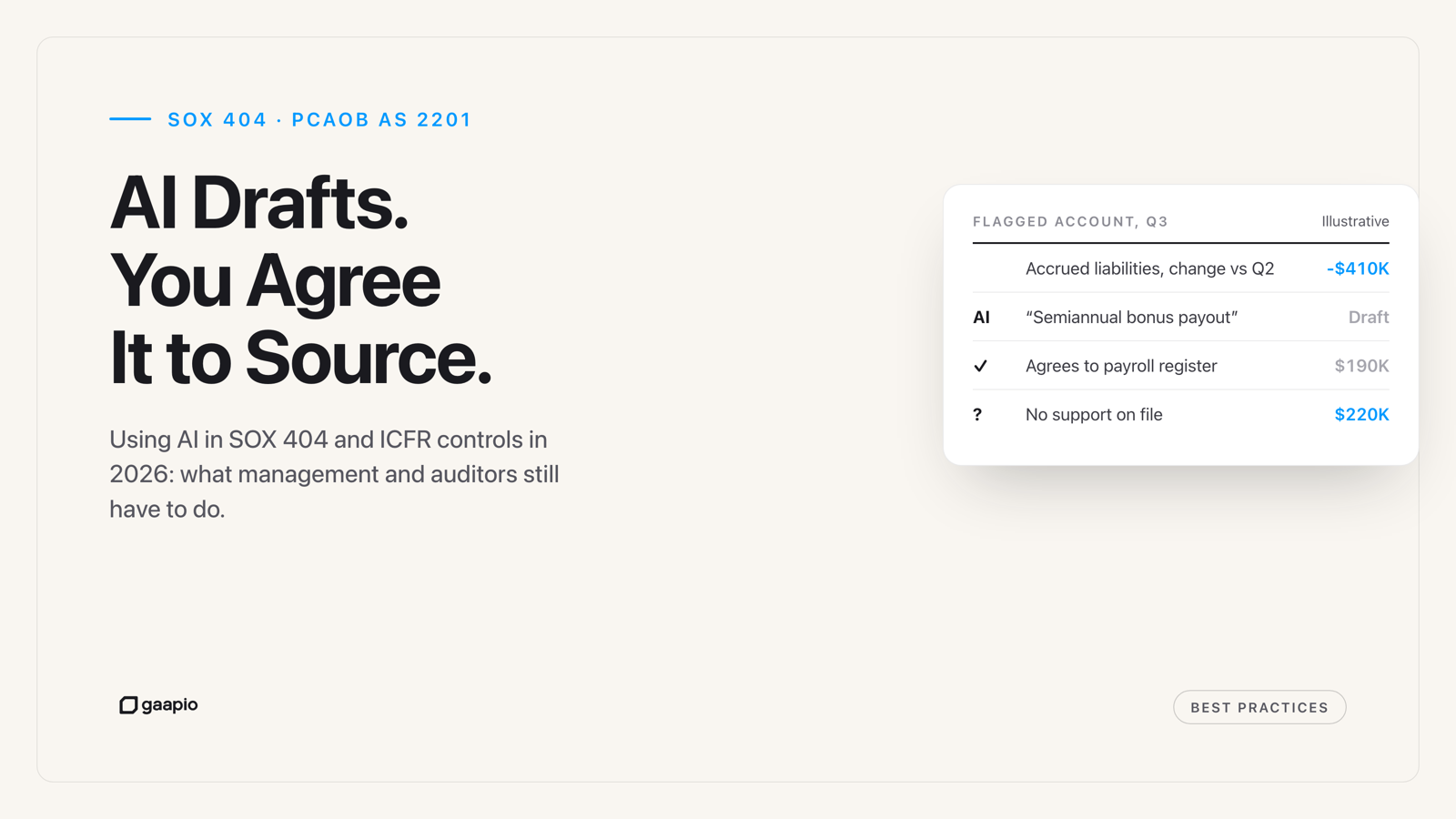
| Accrued liabilities | $2.25M | $1.84M | −$0.41M (−18.2%) | "Reflects payout of the semiannual bonus" | Payroll register supports a $190,000 bonus payout, and no new Q3 accruals were booked. The other $220,000 is a reversal of an accrual for a vendor dispute with no support on file. Escalated to the controller. |
| Prepaid expenses | $1.10M | $1.28M | +$0.18M (+16.4%) | "Annual cyber insurance renewal" | The renewal invoice, less Q3 amortization on the prepaid schedule, accounts for the $180,000 increase. No exception. |
On the accrued liabilities line, the AI explanation was plausible and covered less than half the movement. A reviewer who read the draft and signed off would have passed a $220,000 reversal that nobody had supported. This reviewer agreed the draft to the payroll register, saw the gap and escalated. The controller's team then evaluated the dispute and determined the reversal lacked support. The entry was reversed before the 10-Q was filed and logged as an exception the control detected. Management also evaluated why the unsupported reversal was posted in the first place, because a detective control catching an error points to a possible deficiency in the upstream journal entry or accrual control. The account was flagged because its total movement of $410,000 crossed the threshold, and the reviewer found the $220,000 only because the investigation standard required every dollar of the movement to be agreed to support. That is the kind of item the control exists to catch. A flux review does not find an error that is offset by another movement in the same account, which is one reason it sits alongside other controls rather than replacing them.
What the auditor does with it
The auditor would typically select quarters from the year, reperform the review for a sample of flagged accounts (agree the explanation to source), inspect the signed log and the input reconciliation, and read the change log and access list. If the evidence showed that the reviewer only read the AI summary and never opened the payroll register, the control as performed would not address the risk. That is a deficiency in operation, even though the control description reads well. Because a person performs the review, the auditor cannot benchmark it as an entirely automated control, so expect the auditor to test a sample of quarters every year, including the year-end occurrence.
If the controller had instead let the AI choose which accounts to review, the auditor would add procedures over the AI's selection logic, its false-negative rate and its change history. Keeping the population rule deterministic keeps that scope out of the control.
What should management do before year-end?
Start with an inventory, then decide for each AI use whether it is a control, an input to a control, or a drafting aid outside ICFR. Then close the evidence gaps.
- Inventory every AI use in financial reporting, including AI built into your ERP, close and reconciliation tools, not only standalone products. The SEC staff remarks in June 2026 raised a related point, asking whether management's risk assessment keeps pace with where AI is being used across the organization.
- Classify each use using the three patterns above, and put anything that is a control or an input to a control in your risk and control matrix.
- Separate the AI step from the human step in each control description, and name the owner and backup.
- Fix the population. Make sure no AI decides what gets reviewed unless you have tested its misses.
- Document completeness and accuracy of inputs and outputs.
- Stand up change management and access controls for the tool, and decide what you do when a vendor updates a model.
- Ask your vendors about SOC 1 coverage if the tool hosts or processes data a control relies on.
- Talk to your auditor now. Tell them which controls use AI and what evidence you will keep. EY's own commentary on the December 2025 OCA remarks makes the same point about communicating early and often.
- Brief the audit committee on which controls use AI and what could go wrong.
For the quarterly evidence side of this, see our quarter-end close checklist and building an audit-ready documentation process.
How does Gaapio help with AI in controls?
Gaapio is an AI-powered technical accounting platform built by CPAs. The technical accounting judgments that feed your controls, such as the memo behind an estimate or a contract conclusion, are where it fits today. You give Gaapio your facts and it asks follow-up questions before drafting. It is grounded in the licensed FASB Codification through a direct licensing relationship with the FASB, plus Big 4 guidance and SEC filings and comment letters. Drafts come with clickable citations so a reviewer can trace each point to its source. Customer data is never used to train third-party AI models, and Gaapio has completed a SOC 2 Type 2 examination. See Gaapio accounting memos and our security page.
Gaapio's SOX Controls product is coming soon and is being designed to help teams document controls, organize testing workpapers and prepare documentation for auditor review. See the SOX controls page for what it is designed to do. Your team makes the control, testing and classification calls. Gaapio does not test your controls, conclude on your ICFR or file your 10-K.
Ready to see how it works on your next technical accounting memo? Request a demo.
Frequently asked questions
Is AI prohibited in SOX 404 and ICFR controls?
No. We have found no PCAOB standard, SEC rule or COSO publication that bans AI in ICFR controls or lists prohibited uses. A control that uses AI is held to the same tests as any other control: a named owner with the authority and competence to perform it, enough precision to prevent or detect a misstatement that could be material, reliable inputs and evidence of operation. The risk comes from how AI is deployed, such as no owner, no review against source or untracked tool changes.
Is AI prohibited in an audit?
No. We have found no PCAOB standard that prohibits it, and PCAOB staff reported in July 2024 that the audit firms they interviewed did not view the auditing standards as impediments to using generative AI. The auditor still has to obtain sufficient appropriate evidence, apply professional skepticism, and remain responsible for the work, including any procedures performed with AI. The PCAOB's technology-assisted analysis amendments to AS 1105 and AS 2301 apply to audits of fiscal years beginning on or after December 15, 2025, but the Board said they do not address other technologies such as AI.
What does an auditor ask for when a SOX control uses AI?
Expect questions on five areas: who owns the control and whether they are competent to challenge the AI, what precision the control operates at, how the completeness and accuracy of the inputs and the AI output are established, what IT general controls cover the tool, and what changed in the tool during the period and who approved it. Keep a control description that separates the AI step from the human step, a per-occurrence review record with source references, a change log and an access list.
What is the difference between SOX 404(a) and 404(b)?
404(a) is management's annual assessment of ICFR, required of public companies after their first annual report. 404(b) is the independent auditor's attestation on ICFR, required of accelerated and large accelerated filers that are not emerging growth companies. A company exempt from 404(b) still owes 404(a). AI does not change who owes which. It changes the evidence each side needs for any control that uses AI.
Is a review control that uses AI-drafted output still a management review control?
Yes, if a person with the authority and competence performs a real review at a defined precision and keeps evidence. The review is the control, and the AI is a drafting aid inside it. A reviewer who reads the AI draft without comparing it to source does not address the risk that the draft is wrong, and an auditor can find that a deficiency in operation.
Can AI be an ICFR control by itself?
Not entirely. AI can perform a control activity, such as flagging exceptions, if management documents what it does, controls changes to it and has a way to know when it fails, but an auditor may not treat a model whose output can vary between runs like a traditional automated control. Management's responsibility, the judgment calls and the sign-off stay with people. The more a control depends on the AI being right with no human comparing to source, the more the auditor will test the tool's controls and the harder the evidence is to assemble.
Does a vendor's AI tool create a service organization issue?
It can. If the vendor hosts or processes data that a control relies on, the auditor may evaluate it as a service organization under AS 2201 Appendix B, ask for a SOC 1 report and look for the complementary user entity controls you perform. Whether a particular tool qualifies depends on what it hosts and processes, so confirm the approach with your auditor. Management's responsibility for ICFR does not move to the vendor.
How should I test the accuracy of an AI tool used in financial analysis?
Test it against a labeled sample from your own data where you already know the right answer, and track both missed exceptions and false alarms. Re-run the sample after any model or template change and at least annually. Then design the control so that a person compares the output to source, which makes the control's precision depend mainly on the review. Changes to the tool still need to be logged and tested, because a change can alter what the reviewer sees.
Related reading
- Internal control over financial reporting (ICFR): the 2026 guide
- SOX controls (coming soon)
- COSO's generative AI internal control guidance and what it means for accountants who use AI
- PCAOB AS 1000: auditor responsibilities and the 14-day documentation rule
- The accountant's guide to evaluating AI-generated memos
- Quarter-end close checklist
Sources: PCAOB, AS 2201; PCAOB, AS 1105, Audit Evidence; PCAOB Release No. 2024-007; PCAOB staff Spotlight on generative AI in audits and financial reporting (July 2024); SEC Release 33-8810; SEC Release 33-11419 (proposed May 19, 2026); COSO, Achieving Effective Internal Control Over Generative AI; EY, 2025 AICPA and CIMA Conference on Current SEC and PCAOB Developments; Thomson Reuters Checkpoint News, SEC Staff Eye AI Reminders (June 15, 2026).
This post is general information, not accounting, audit or legal advice for a specific situation. Written by Jace Chambers, CPA, with the Gaapio team of CPAs. Last reviewed November 2026.