

You can trust AI for technical accounting research only as far as you can check it: every citation has to resolve to the actual passage of the FASB Accounting Standards Codification, and every fact the analysis relies on has to match your own records. General-purpose chatbots do invent paragraph citations, so they are safe for drafting and orientation and unsafe as the source of what the guidance says; a tool that retrieves licensed Codification text at query time and links each citation makes invented citations far easier to catch, but does not remove the need for your review.
The question is not new. Next time a reviewer asks you where a sentence in a memo came from, the honest answer has to be a paragraph you or someone you trust opened. This guide covers where AI breaks, what grounding fixes and does not fix, a review checklist for an AI-drafted memo with a worked example, the data questions to ask any vendor, what the PCAOB and SEC have said as of November 2026, and how your team keeps the judgment.
Key takeaway: Trust in AI research comes from verification, not from the vendor. General chatbots generate citations from patterns, so they can cite paragraphs that do not exist or that say something adjacent. A tool grounded in licensed Codification text with clickable citations makes the check fast, and it still can misread the text or apply it to the wrong facts. Review every AI-drafted memo in four passes (trace every cite, check the facts used, check the alternatives considered, sign off by name), ask every vendor about retention, training use and independent attestation, and keep the conclusion with a named person. As of November 2026, we have found no PCAOB or SEC rule that prohibits using AI for this work. Firms told PCAOB staff that human review of AI output remains essential, and SEC staff have stressed human oversight of AI used in internal control.
Can I trust ChatGPT for technical accounting research?
Trust it for drafting, restructuring and explaining a concept you already half know, and do not trust it as the source of what the Codification says. A general chatbot answers from training data and, when web search is on, from whatever public pages it finds (which may include an ASU, but not the current codified text), not from the licensed Codification, so a paragraph number in its answer is a plausible-looking reference that has to be checked by hand.
I covered where the boundary sits in ChatGPT for accounting: what it's good for, and where it breaks. This post starts after that one ends: you have decided to use AI for research, and you need a way to decide how much to rely on a given answer. I use these tools every week, and the question underneath is usually the same. If I let an assistant do the first pass, am I still doing the work, or am I the person who signed a memo I did not write?
You are still doing the work, as long as your review is real. The same goes for a junior preparer's draft, and the reviewer who signs it owns it. A contact at a state CPA society put a second failure plainly, after noting that most models tell him what they think he wants to hear:
It's almost playing a yes man a little bit. And for a situation like this, I need AI to tell me when I'm wrong sometimes. — Association, June 2026
That is a different failure from an invented citation, and it matters just as much. A tool that tells you what you want to hear will not tell you when your reading of the guidance is wrong.
Does AI hallucinate accounting guidance?
Yes. A general language model generates text that looks like a correct answer, including a pin cite such as ASC 842-10-25-2, whether or not that paragraph says what it claims. PCAOB staff recorded the same risk in July 2024: some firms told them that generative AI output may not always be reliable because it can sometimes produce content that is false or misleading, the so-called hallucinations.
For accounting the damage is specific. The output looks identical when the citation is right, adjacent or invented, so scanning for format catches nothing. I have had ChatGPT cite ASC 815 guidance that does not exist while I was checking a hedge effectiveness question, with a paragraph number and everything. Here are the five ways a bad citation hides, and the check that catches each one.
| How the citation fails | What it looks like | How to catch it |
|---|---|---|
| The paragraph does not exist | A subparagraph letter or number the section never reaches | Open the Codification at the cited paragraph and confirm it is there |
| The paragraph exists and says something adjacent | A real cite that addresses a nearby issue | Read the paragraph and compare its words to the sentence it supports |
| The paragraph is overstated | "Requires" where the text says "one reasonable approach" | Look for the verb: shall, should, may, one approach |
| The guidance is superseded | A paragraph amended or replaced by a later ASU | Confirm the effective date and the current text, not a prior version |
| The right paragraph is missing | Nothing cited from the paragraph that controls the answer | Search the topic yourself and see what the memo left out |
A useful habit is to test any tool before you rely on it. Pick ten citations from a question where you already know the answer and open every one. The result tells you more than any vendor's accuracy claim, and I have not seen a reliable public error rate for citation accuracy across tools.
What does grounded retrieval on licensed authoritative text change, and what does it not?
It changes where the text comes from. A grounded tool retrieves the actual Codification passage at query time, reasons over that passage and returns a citation you can click to the same text, so the check "does this paragraph exist and say this" takes seconds instead of a search.
What it changes:
- Citations point to retrieved text, so an invented paragraph number has far fewer places to come from, and an invented one is easier to spot.
- The text is as current as the vendor's licensed copy of the Codification, so ask how often it is updated and how pending content is shown. A model alone knows only what it absorbed before its training cutoff.
- The reviewer can read the source passage beside the sentence it supports.
- A well-built grounded tool can say it does not have support for a conclusion, which a chatbot rarely does.
What it does not change:
- The model can still misread a paragraph or give weight to the wrong sentence.
- Retrieval can return a paragraph near the right one and miss the paragraph that controls.
- It does not know your facts. If the facts you gave it are wrong or incomplete, a well-cited memo is still wrong.
- It cannot make the judgment call where the guidance leaves room for two reasonable views. That belongs to you.
The Codification is licensed content. Gaapio accesses it through a direct licensing relationship with the FASB, which is the reason retrieval can return the passage itself instead of a summary of it. Your own test is the same for any vendor: ask for a citation resolving to actual text, on a question you choose.
How do I check whether an AI-generated accounting memo is correct?
Review it in four passes, in this order: trace every cite to its source text, check the facts the analysis used against your records, check the alternatives the memo considered and rejected, and record a named reviewer's sign-off. Do them in order, because a wrong citation or fact makes the later passes pointless.
- Trace every cite. Open each paragraph. Confirm it exists, says what the sentence says, uses the verb the memo claims (shall, should, may) and is current. Flag, do not quietly fix, any cite that fails. A wrong cite is a signal about the rest of the draft.
- Check the facts used. Compare every number, date and term in the memo to the contract, the fixed asset register or the system of record. Memos built from a vendor's specification sheet or a prior-year file are where the facts drift.
- Check the alternatives considered. A memo that reaches one answer without showing why the others fail is incomplete. List the other plausible conclusions and confirm each is addressed with reasons. Ask what an auditor would ask first and look for the answer on the page.
- Sign off by name. The preparer and the reviewer each put their name and date on it, and the reviewer notes what they traced. The memo you file is yours.
Our guide to evaluating AI-generated memos goes deeper on the fix-versus-flag decision, and how to write a technical accounting memo shows the structure a reviewer expects to see.
What does that look like on a real draft? (illustrative)
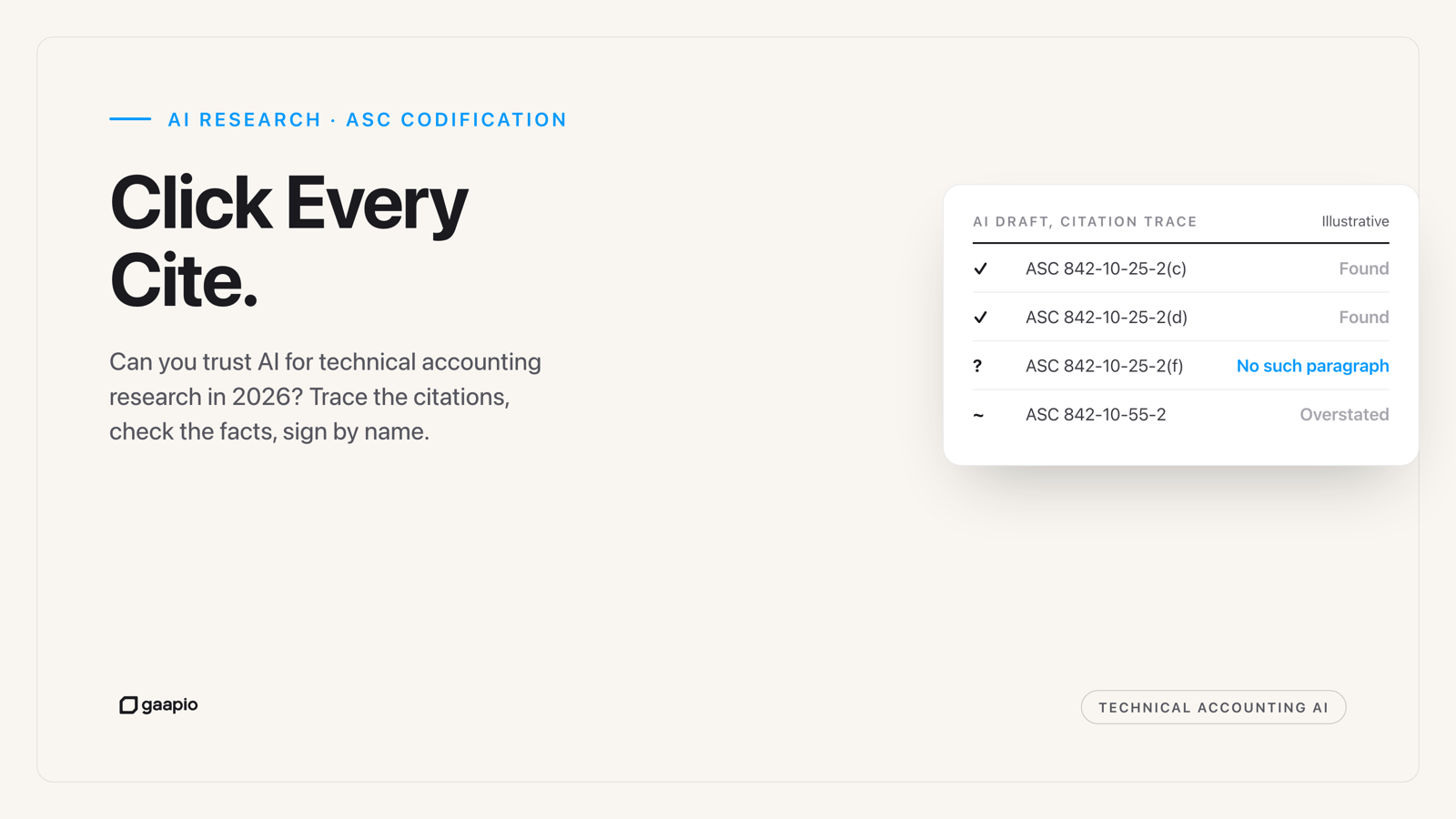
Here is an invented example. A company, Harbor Ridge Manufacturing, leases a new packaging line for a noncancellable 8-year term with no renewal or purchase options, no transfer of ownership and no residual value guarantee, and the line is a standard model with alternative uses to the lessor. The present value of the lease payments is $1,840,000 and the fair value of the line is $2,100,000. An AI draft concludes the lease is an operating lease under ASC 842. The reviewer's trace of its four citations looks like this.
| Citation in the AI draft | Exists? | Says what the memo says? | Reviewer note |
|---|---|---|---|
| ASC 842-10-25-2(c) | Yes | Yes | Cited correctly. The economic life input is checked in pass two |
| ASC 842-10-25-2(d) | Yes | Yes | Cited correctly, but the memo asserts (d) is not met without showing the calculation (see pass three) |
| ASC 842-10-25-2(f), "economic compulsion criterion" | No | No | The classification criteria in 842-10-25-2 run (a) through (e). Flag it. The preparer removes it and rechecks the sentence it supported |
| ASC 842-10-55-2 | Yes | Overstated | The memo says 90% is required. The paragraph describes 75% and 90% as reasonable approaches, not rules |
Pass two finds the more serious problem. The draft used 12 years as the economic life of the line, taken from the vendor's brochure for a different model. The engineering assessment the company obtained before signing, and its experience with identical lines it owns, support a remaining economic life of 10 years, and the line is new. Economic life is the period over which the asset is expected to be economically usable by one or more users, not the company's useful life or depreciation life, so the memo should document which evidence it relied on. An 8-year term is 67% of 12 years but 80% of 10 years, so the term is a major part of the remaining economic life under the 75% approach in 842-10-55-2, criterion (c) is met, and the lease is a finance lease. The conclusion flips on one fact.
Pass three adds a gap. The memo never ran the numbers for criterion (d): $1,840,000 divided by $2,100,000 is 87.6%, just under the 90% approach in 842-10-55-2, so the memo should say whether it treats that as substantially all, confirm the discount rate, and explain why (c) carries the conclusion either way. Pass four records who traced what. A reader who skipped pass two would have signed a memo with an accurate-looking cite list and the wrong answer.
Is it safe to use AI for accounting research?
It is safe when you know where your data goes, what the vendor and its model providers keep, whether those commitments are contractual, and when every answer is checked against the source before you rely on it. The data risk sits in what you paste in. Inputs often include pre-release financial information, and a vendor with a good privacy policy can still pass that content to a model provider that retains it.
Ask any vendor the questions in this table, and ask for the answer in writing. Compare the answers with the vendor's own security page, not with the sales deck.
| Question to ask | What a good answer looks like |
|---|---|
| Do you retain my content, and do your model providers? | The vendor states its own retention. Each model provider is under a written zero-data-retention agreement, not default API terms |
| Is my content used to train any model? | A written no, covering the vendor and every model provider in the chain |
| Is that a contract or a setting? | A contract. A setting can be changed by someone on your team or theirs |
| Do you have an independent attestation? | A current SOC 2 Type 2 report, available under NDA. Ask which criteria it covers, what period it examined, whether any exceptions were noted and which complementary user entity controls it expects you to run |
| Who are your subprocessors, and is the list public? | A published list with notice of changes |
| Where is my data stored, and who can see it? | Per-company separation and role-based access, in writing |
| If the tool's output feeds a financial reporting control, what assurance can you provide? | An honest answer. SOC 2 is not SOC 1. A SOC 1 matters when the vendor's system is part of your ICFR information system, and for a research tool your auditor will more likely test your review of its output |
A SOC 2 Type 2 report is an attestation examination of the vendor's controls over a period, not a certification, and it does not tell you the tool's answers are accurate. Accuracy is a separate question, and the first half of this guide is about how to test it. For the controls side of AI use, see our guide to AI in SOX 404 and ICFR controls.
Is there an AI accounting tool with zero data retention?
Yes, at the model layer. Gaapio has a contractual zero-data-retention agreement with every model provider it routes to, currently Anthropic, OpenAI and Google, so under those agreements what you upload is not retained by them or used to train their models. Gaapio has also completed a SOC 2 Type 2 examination.
Read that sentence the way you would read any vendor's: it describes the model layer. Zero data retention at the model provider is half of the question, and the other half is what the tool stores for your workspace and for how long. Ask both, ask the same question about the vendor itself in writing, and look at Gaapio's security page and the trust center linked from it for the attestations, controls and subprocessors. The zero-data-retention terms are contractual, so nobody has to remember to switch a setting on.
What have the PCAOB and SEC said about using AI?
We have found no PCAOB standard or SEC rule, as of November 2026, that prohibits using AI in audits or financial reporting. The statements that exist are staff publications and staff remarks. They point the same way: firms told PCAOB staff that human review of GenAI output remains essential, and SEC staff have stressed human oversight of AI in internal control.
| Source | What it says | Weight |
|---|---|---|
| PCAOB staff Spotlight on generative AI in audits and financial reporting (July 2024) | Based on limited outreach. Firms said the auditing standards were not currently viewed as impediments to GenAI. Firms said human involvement remains essential to review GenAI output, preparers said human supervision and review continue to be important, and firms said an engagement team member who uses a GenAI tool is still responsible for the results and documentation. Some firms noted hallucinations, and others do not allow GenAI for audit procedures because of data privacy and reliability concerns | Staff observations, not a rule |
| PCAOB AS 1105, Audit Evidence | When the auditor uses information produced by the company as audit evidence, the auditor evaluates whether it is sufficient and appropriate, including by testing its accuracy and completeness or the controls over them (AS 1105.10). The PCAOB's 2024 amendments on technology-assisted analysis, effective for fiscal years beginning on or after December 15, 2025, address technology tools more broadly but do not single out AI. Our reading is that AI-assisted analysis you hand an auditor will be evaluated the same way | Auditing standard (our application to AI is interpretation) |
| PCAOB request for public comment on its standard-setting agenda (June 2026; comments closed August 7, 2026) | Among other agenda items, the Board asked whether auditors' growing use of technology, including AI, warrants guidance or changes to standards. We found no resulting standard or staff guidance as of November 2026 | Pending |
| SEC Office of the Chief Accountant staff remarks (December 2025, EY summary) | OCA staff said auditors evaluating a company's use of AI in ICFR need to understand and document how the models are designed to perform their tasks, and stressed human oversight in AI-driven internal controls | Staff remarks, not Commission views |
| SEC Office of the Chief Accountant staff remarks (June 4, 2026, Thomson Reuters report) | Deputy Chief Accountant Michal Dusza said it is hard to be prescriptive given how fast AI is changing, and that staff may issue reminders. The report noted that principles-based frameworks such as COSO are helpful resources | Staff remarks, not Commission views |
| PCAOB QC 1000, A Firm's System of Quality Control | Requires audit firms to address the technological resources they use, which includes AI tools. Effective December 15, 2026 | Quality control standard (applies to audit firms) |
| COSO, Achieving Effective Internal Control Over Generative AI | Applies the COSO internal control framework to generative AI | Framework guidance |
The Spotlight dates from July 2024 and reflects limited outreach, mainly with larger firms. It remains the most direct PCAOB staff statement on GenAI we found as of November 2026. The two SEC rows are secondary reports of staff remarks, not SEC transcripts. Deloitte's summary of the PCAOB Spotlight and our guide to COSO's AI governance framework cover the same ground from the firm and framework sides.
The practical reading is consistent across all of them. The standards that apply to your memo and your controls are the ones that already existed, and an auditor will ask who reviewed the AI's output and how you know it was complete and accurate.
How does a team keep ownership of the judgment?
By deciding in advance which parts of the work the tool may draft and which parts a named person must conclude, and by keeping evidence of both. The AI can draft the research, the structure and the first pass at the analysis. It cannot own the conclusion, the choice between two reasonable readings or the sign-off.
Four habits keep that line visible:
- Write the policy once. State which tasks AI may draft (research summaries, first-draft memos, disclosure comparisons) and which it may not decide (the conclusion, estimates, the final disclosure).
- Make the reviewer different from the prompter where you can. The person who asked the tool the question tends to read the answer generously.
- Keep the trail. Keep the question asked, the passages retrieved and the review notes with the memo. If an auditor asks what the AI said, you can show them.
- Train reviewers on the failure modes. The table earlier in this guide is a one-page training aid. A new preparer who has never seen an invented cite will not look for one.
The identity question under all of this deserves a plain answer. Using AI for the first draft does not make you a lesser accountant, and it is not cheating. Technical accounting is challenging because of the judgment, and the judgment is the part you keep. If you are weighing the bigger worry, our guide on whether AI will replace accountants takes it on directly.
Is there a purpose-built tool for technical accounting research?
Yes. Gaapio is an AI-powered technical accounting platform built by CPAs for research with clickable citations, accounting memos and disclosure work, and other vendors sell tools aimed at the same work. Whichever you evaluate, compare it on the criteria below, and run the test on your own fact pattern.
| What a controller cares about | General-purpose chatbot | Purpose-built technical accounting tool |
|---|---|---|
| Source of the answer | Training data and, with web search on, public pages of mixed quality and age | Should be licensed authoritative guidance, retrieved at query time |
| Citations | Generated to look plausible, and need checking by hand | Should be retrieved and clickable to the passage |
| Currency | As of the training cutoff, plus whatever a web search finds | As current as the vendor's licensed copy. Ask the update cadence |
| Saying "the guidance is unclear" | Tends toward a confident answer, and may reverse when pushed | Should surface ambiguity and competing readings |
| Your facts | Whatever you paste in, with no memo structure | Fact pattern, follow-up questions and a memo format built for review |
| Data handling | Depends on the plan and settings, which can change | Should be contractual: zero data retention at the model layer, an independent attestation |
| Audit trail | A chat history | Reviewer, approval and version history on the work |
| Who owns the conclusion | You | You |
The last row is the same in both columns on purpose. Our guide to what to look for in an AI tool for technical accounting goes through the buying questions in more detail.
How does Gaapio help?
Gaapio, an AI-powered technical accounting platform built by CPAs, answers research questions with citations that resolve to licensed Codification text, drafts accounting memos and checks disclosures, so the review passes in this guide start from sources you can open. Codification access comes through a direct licensing relationship with the FASB.
The data side is on the security page: a contractual zero-data-retention agreement with each model provider Gaapio routes to, a completed SOC 2 Type 2 examination, and a trust center with the attestations and subprocessors. Gaapio does not replace the preparer or the reviewer. A customer who drafts in a general assistant and has Gaapio check the work told us his auditor asked what Gaapio said, and we wrote that up in "What did Gaapio say on that?".
If you want to see the test in this guide run on your own question, request a demo and bring a fact pattern you would normally take to a chatbot.
Frequently asked questions
Can I use ChatGPT or Claude at all for accounting work?
Yes, for the work where you are the source of authority: getting past a blank page, tightening writing you already trust, summarizing a long document for orientation and arguing the opposite side of your own analysis. Stop when you need the tool to tell you what the guidance says. At that point the answer needs a retrieved source or a manual check against the Codification.
Will my auditor accept support drafted with AI?
An auditor evaluates the support, and may ask about the tool if its output feeds a control or is used as audit evidence. No PCAOB standard we found prohibits AI-assisted drafting. Expect questions about who reviewed it, how citations were verified and how you know the facts are complete and accurate. A memo with a dated, named review and traced citations answers all three.
Does a SOC 2 report mean the tool's answers are accurate?
No. A SOC 2 Type 2 report is an examination of the vendor's controls over a period against the trust services criteria: always security, and sometimes availability, processing integrity, confidentiality or privacy. Even processing integrity speaks to system processing, not to whether an accounting conclusion is right, which is why the memo review passes still apply.
Is it safe to paste pre-release financial information into a chatbot?
Only if the plan's data terms are a written commitment you can rely on, and many consumer plans offer settings that can change. For pre-release financial information, ask for contractual retention and training terms from the vendor and from every model provider in the chain, and follow your company's AI policy.
How often do AI tools get accounting citations wrong?
There is no reliable public rate we can point to, and it varies by tool, topic and prompt. Test your own: take a question you already know the answer to, collect ten citations and open each one. The result is more useful to your team than a vendor claim or a headline number.
Does grounded retrieval eliminate hallucinations?
It reduces them and makes the rest easier to find, but it does not eliminate every error. A grounded tool can still misread a paragraph, retrieve a nearby one or work from incomplete facts. That is why every cite gets traced and the reviewer signs the memo.
Who is responsible if an AI-drafted memo is wrong?
The people who prepared, reviewed and approved it, and ultimately management. PCAOB staff recorded in July 2024 that firms expect an engagement team member who uses a GenAI tool to remain responsible for the results and documentation. The same principle applies to a preparer's work in a finance department.
Does using AI for research mean I do less technical accounting?
You do less searching and more judging. The searching was never the part of the job that made the conclusion defensible, and the time it saves is best spent on the facts, the alternatives and the questions an auditor will ask.
Related reading
- ChatGPT for accounting: what it's good for, and where it breaks
- The accountant's guide to evaluating AI-generated memos
- How to write a technical accounting memo
- Using AI in SOX 404 and ICFR controls in 2026
- Accounting memos: format, example and template
- Security and trust
Sources: PCAOB staff Spotlight on generative AI (July 2024); PCAOB, AS 1105; COSO, Achieving Effective Internal Control Over Generative AI; Deloitte DART on the PCAOB Spotlight; EY, 2025 AICPA and CIMA Conference on Current SEC and PCAOB Developments; Thomson Reuters, SEC staff eye AI reminders; FASB Accounting Standards Codification, Topic 842 (licensed content).
This post is general information, not accounting, audit or legal advice for a specific situation. The Harbor Ridge example is invented and for illustration only. Written by Jace Chambers, CPA, with the Gaapio team of CPAs. Gaapio security details reflect gaapio.com/security as of November 2026. Last reviewed November 2026.