

"We use AI throughout our platform."
If that sentence is in your earnings deck, your website and your 10-K, the SEC staff may ask you to explain it. If it is not true, the Division of Enforcement may ask you something harder.
Public companies are making more AI statements than ever, and the SEC has no AI-specific disclosure rule to tell them what to say. What exists is Regulation S-K, the antifraud provisions, a growing set of enforcement actions and a steady stream of staff comments. This guide covers what the SEC expects in a 10-K, 10-Q or registration statement about AI as of November 2026: what "AI washing" actions turned on, where AI belongs under Items 101, 105 and 303, what the SEC has said about rulemaking, what the comment letters ask, how to describe board oversight, and a checklist with a sample risk factor you can adapt.
Key takeaway: As of November 2026, the SEC has no rule that requires public companies to disclose AI as such. The existing rules apply anyway. Item 101 covers how AI fits your business, Item 105 covers the material risks, Item 303 covers known trends and costs that are reasonably likely to affect results, and the antifraud provisions cover every AI claim you make anywhere. Most of the enforcement record turns on one question: could the company show a basis for what it said about its AI?
Does the SEC require public companies to disclose AI in 2026?
No. As of November 2026, there is no SEC rule, proposed rule or formal Corporation Finance staff guidance that requires a public company to disclose its use of AI. The Commission's 2023 proposal on predictive data analytics, which covered broker-dealers and investment advisers and never applied to operating companies, was withdrawn in June 2025.
That does not mean AI is outside the disclosure rules. Regulation S-K asks for material information, and the antifraud provisions apply to anything you say about AI, in a filing or out of one. Chair Paul Atkins has said the SEC's approach is anchored in materiality, and in January 2026 launched a review of Regulation S-K on that theme. Most AI-related exposure for a registrant comes from two places: what the company says about its AI, and what it leaves out about the risks and costs of using it.
This guide is general information, not legal advice. Whether an AI matter is material to your company is a judgment for management, the audit committee and securities counsel.
What has the SEC said and done about AI disclosure? (as of November 2026)
The table lists the items that matter for a registrant, with their status as of November 2026. Items marked "reported" are from law firm summaries, not from the SEC's own text. We note where we did not find an SEC primary source.
| Date | Item | Status as of November 2026 |
|---|---|---|
| Feb. 13, 2024 | Then-Chair Gary Gensler's Yale Law School remarks on AI and finance | Said AI washing by issuers may violate the securities laws and that disclosure should be particularized to the company, not boilerplate. Historical. |
| Jun. 12, 2025 (effective Jun. 17) | Withdrawal of 14 proposals, including the 2023 predictive data analytics proposal (Release 33-11377) | Withdrawn. It applied to broker-dealers and advisers, not operating companies. The SEC said it did not intend to issue final rules. |
| Nov. 17, 2025 | Division of Examinations FY2026 priorities | Applies to registered firms such as advisers and broker-dealers. Says examiners will review the accuracy of representations about AI capabilities. |
| Dec. 4, 2025 | Investor Advisory Committee recommendation on AI disclosure | Advisory only. Asks the Commission to have issuers define "AI," disclose board oversight of AI if any, and, if material, report separately on AI's effect on internal operations and on consumer-facing matters. We found no Commission action on it. |
| Dec. 4, 2025 | Chair Atkins' remarks at that meeting (reported) | Reported to say existing principles-based rules already reach material AI matters and to resist AI-specific line items. |
| Jan. 13, 2026 | Chair Atkins' statement on reforming Regulation S-K | Launches a review of Regulation S-K anchored in materiality. Contains no AI disclosure item. |
| May 5 and May 19, 2026 | Proposals on optional semiannual reporting (new Form 10-S) and on filer-status simplification (Release 33-11419, May 19) | Proposed, not final as of our latest check. Neither contains AI content. The filer-status proposal would change Items 101, 105 and 303 for non-accelerated filers. |
| Oct. 23, 2026 | Division of Examinations FY2027 priorities | Applies to registered firms. Keeps firms' use and governance of AI, and AI-enabled cyber threats, in focus. Supersedes the FY2026 priorities. |
| Oct. 30, 2026 | Enforcement Director David Woodcock's remarks to Law360 (reported) | Reported to say the Division will scrutinize public companies that overstate AI capabilities or omit AI use or risk in a core business area. A law firm describes this as paraphrase, not a new rule. |
SEC enforcement is only part of the exposure. Law firm trackers report that private securities class actions over AI statements have increased since 2024.
The practical read: the SEC is applying old rules to a new subject. No AI-specific form, item or checklist has been proposed that you can wait for. Expect staff comments and enforcement to keep drawing the lines, and watch the Regulation S-K review, because any change to Items 101, 105 or 303 will reach your AI disclosure as well.
What is "AI washing," and what did the SEC enforcement actions turn on?
AI washing is a company overstating, or misdescribing, what its AI does or whether it uses AI at all. The SEC has no separate AI-washing statute. It uses the same provisions it uses for any misleading statement: Section 17(a) of the Securities Act, Section 10(b) and Rule 10b-5 of the Exchange Act, and, for reporting companies, the reporting and disclosure controls provisions. Section 17(a)(2) and (3) apply to the offer or sale of securities and require only negligence. Rule 10b-5 requires intent or recklessness. The reporting and disclosure controls provisions require no showing of intent at all, Separately, in private litigation over a registration statement, Section 11 makes the issuer liable for a material misstatement without proof of fault.
The actions below are from SEC releases. Where we could only find law firm summaries, we say so.
| Action | Date | What the SEC said was misleading | Outcome |
|---|---|---|---|
| Delphia (USA) Inc. (release) | Mar. 18, 2024 | An investment adviser's filings, press release and website said it used AI and machine learning on client data to improve its predictions. The SEC found it did not have those capabilities. | Settled. $225,000 penalty. |
| Global Predictions Inc. (same release) | Mar. 18, 2024 | Website and social posts called it the "first regulated AI financial advisor" and advertised AI-driven forecasts. | Settled. $175,000 penalty. |
| Joonko / Ilit Raz (release) | Jun. 11, 2024 | A founder of an AI recruiting startup allegedly fabricated customers, revenue and testimonials. | SEC civil complaint with a parallel criminal case. |
| Rimar Capital (release) | Oct. 10, 2024 | Purported AI-driven automated trading, with false assets under management and returns. | Settled. $310,000 in civil penalties against the CEO and a board member, disgorgement from the CEO, and an industry bar against the CEO. |
| Destiny Robotics (litigation release) | Oct. 15, 2024 | Claimed to be developing a humanoid AI home companion robot for delivery by 2023, while the product was far less capable than described. | Settled, subject to court approval. The CEO agreed to a $50,000 penalty and about $14,400 in disgorgement and interest on roughly $141,000 raised. |
| Presto Automation (order) | Jan. 14, 2025 | A public company's filings described third-party speech recognition as its own technology, and said its product removed human order-taking while offshore workers handled most orders. | Settled under Securities Act 17(a)(2), Exchange Act 13(a) and Rules 13a-11 and 13a-15(a). Cease-and-desist, no penalty. The Commission cited cooperation, remediation and the company's financial condition. |
| Nate Inc. / Albert Saniger (litigation release) | Apr. 2025 | A founder allegedly marketed an app as completing purchases with AI when contract workers entered the orders by hand. | SEC civil complaint (S.D.N.Y.) with a parallel criminal case. Both were pending when we checked. |
Presto is the one to read if you file 10-Ks. Law firms describe it as the first SEC action against a public company over AI claims. We found no later SEC action against a public company over AI statements through November 2026. The 2026 AI-related cases we found involved small private fundraisings and trading-bot schemes, and they read as ordinary fraud with an AI label.
What patterns show up across the actions?
Five patterns repeat:
- The AI did not exist. Delphia and Global Predictions described capabilities the firms did not have.
- Third-party technology was presented as proprietary. In Presto, the order found that from November 2021 to September 2022 every deployed unit ran a supplier's speech recognition, while filings called it "our" and "Presto's" technology.
- People were hiding behind "automated." Presto and Nate both turned on human work behind a claim of automation.
- A metric did not mean what a reader would assume. Presto reported "automated order completion" and "non-intervention" rates that counted only restaurant-staff intervention and left out the off-site workers who handled orders.
- Old-fashioned fraud with an AI story. Joonko and Rimar involved fabricated customers, revenue or returns.
For a public company, patterns 2 to 4 are the live risk. They arise from the gap between how marketing, sales and investor relations describe a product and what engineering can document. The common question is whether the company could support the claim, judged against what a reasonable investor would consider important. The Supreme Court's long-standing formulation asks whether there is a substantial likelihood that a reasonable investor would have viewed the omitted fact as having "significantly altered the 'total mix' of information made available" (TSC Industries v. Northway, 1976). For contingent events, Basic v. Levinson (1988) weighs probability against magnitude. Our guide to SAB 99 materiality assessments covers how to document that judgment.
Where does AI belong in a 10-K? Items 101, 105, 303 and the rest
AI can touch five places in an annual report, plus the proxy statement. The table maps each to what it asks and the AI question it raises.
| Where | What it requires | The AI question |
|---|---|---|
| Item 101 (Description of Business) | General development of the business and, to the extent material, the business itself: products and services and any dependence on key products or customers, the status of development efforts for new or enhanced products, material resources including patents and licenses, competitive conditions, the material effects of government regulation, and human capital resources. | Is AI a material part of what you sell, how you compete or how you operate? If so, describe it specifically: what it does, whether it is built in-house or licensed, and what stage it is at. |
| Item 105 (Risk Factors) | A discussion of the material factors that make an investment in the company speculative or risky, organized under headings, each explained as it applies to the company. Generic risks go at the end under "General Risk Factors." | Which AI risks are material to you, and have any already happened? |
| Item 303 (MD&A) | Reasons for material changes, known trends or uncertainties reasonably likely to have a material effect, material cash requirements, and critical accounting estimates. | Is AI changing your revenue, margins, pricing, headcount, capital spending or cloud and compute commitments in a way readers need explained? |
| Regulation S-K Item 106 (Form 10-K Item 1C) and Form 8-K Item 1.05 | Cybersecurity risk management, governance and material incident disclosure. | AI-enabled threats belong in the Item 106 description of cyber risk management, and an AI-related event falls under Item 1.05 if it is a material cybersecurity incident. |
| Financial statements | Capitalized software costs, impairment, commitments, contingencies. | Do AI development costs, purchase commitments or AI-related claims need accounting consideration? See ASC 350-40. |
| Proxy statement, Item 407(h) | The board's role in risk oversight. | How does the board oversee AI risk, if AI is a significant risk? |
Two general rules sit over all of it. Rule 12b-20 requires additional material information needed to make the required statements not misleading, and Rule 408 does the same for registration statements. And Rule 13a-15 requires disclosure controls and procedures. Presto was charged under Rule 13a-15(a) because the SEC found that, from September 2022 through December 2024, the company had no established process for drafting, reviewing or approving its periodic and current reports, so no one at Presto was formally responsible for the accuracy of what it filed, including its AI statements.
What should the business description say about AI under Item 101?
Say what the AI does, where it is used and what is not yet built. Item 101 asks about products, development status and competitive conditions, so a company that sells AI features should separate what is in production from what is in development. A phrase like "AI-powered" tells a reader nothing. "A machine learning model, licensed from a third party and fine-tuned on our data, suggests account codes for invoices; customers review and can correct each suggestion" tells a reader what the product is.
Three disclosures are worth a deliberate decision:
- In-house or third party. The staff has asked companies to identify third-party models and data. If a supplier's model does the core work and a change by that supplier would hurt you, a reader needs to know.
- Human involvement. If people review, correct or perform the work that your materials describe as automated, say so where the claim is made.
- Current or aspirational. Describe what works today separately from the roadmap.
How should risk factors address AI under Item 105?
Write the risk that is true for your company, and say so if it has already happened. Item 105 asks for risks specific to the registrant, explained as they apply to it, and it discourages risks that could apply to any company. A risk factor that reads the same as a competitor's, or the same as last year's, is the one the staff is likely to question.
The hypothetical-risk problem is the most useful lesson here. In August 2021, the SEC settled with Pearson plc, with a $1 million penalty, for a risk factor that described a data breach as a hypothetical event after one had occurred. That was a cybersecurity case, not an AI case, and we found no AI-specific Item 105 enforcement action. The logic carries over to AI: if a model failure, a biased output or a vendor outage has already hurt you, the risk factor should say it happened.
Survey data shows how quickly AI risk factors became standard. Conference Board and ESGAUGE found 72% of S&P 500 companies disclosed at least one material AI risk in their 2025 Form 10-K risk factors, up from 12% in 2023. EY's Center for Board Matters found 36% of Fortune 100 companies carried a separate AI risk factor in 2025, up from 14% in 2024. When nearly three in four S&P 500 companies say "AI is a risk," generic language tells a reader little. The specific facts do.
Under current rules, smaller reporting companies are not required to include risk factors in a Form 10-K, though many do, and the antifraud rules apply to whatever they say.
Risks that tend to be material, depending on the company:
- Errors, bias or hallucinated output in your own products
- Reliance on a third-party model provider or data source
- Intellectual property and data rights in training data
- Regulation, including the EU AI Act and state laws, to the extent they apply to you
- Cybersecurity and AI-enabled attacks
- Competition from companies that adopt AI faster
- Cost of AI infrastructure and talent
- Your own use of AI in financial reporting and internal controls
What does AI change in MD&A under Item 303?
Item 303 asks about known trends, events and uncertainties reasonably likely to have a material effect on results, liquidity or capital resources. AI belongs there when it changes the numbers: compute and cloud costs growing faster than revenue, pricing pressure from AI-enabled competitors, a restructuring tied to automation, or large take-or-pay commitments with a model or cloud provider.
It also reaches estimates. If you capitalize AI development costs, test an AI-related intangible for impairment or accrue for an AI-related claim, the underlying estimate may be a critical accounting estimate. Our MD&A guide covers the requirements and the staff's most common comment themes. The rule of thumb carries over: explain why a number moved; saying that it moved is not enough.
What about forward-looking AI statements?
Statements about plans are forward-looking. In private securities litigation, the statutory safe harbor can protect them if they are identified as forward-looking and accompanied by meaningful cautionary language. The safe harbor does not apply to SEC enforcement actions, and it is unavailable in some settings, such as initial public offerings. Statements about what the product does today are statements of present fact, and the safe harbor does not reach them. That distinction is where "our AI does X" and "our AI will do X" lead to different legal exposure. Statements to analysts and investors in earnings calls and decks also raise Regulation FD and consistency questions with the filing.
What do SEC comment letters ask about AI?
The staff asks the same few questions in different words. The best public analysis we found is Orrick's review of staff comments on AI since 2021, republished by the Harvard Law School Forum in January 2025. It counted at least 92 AI-related comments to 56 companies from 2021 through late 2024, and its categories overlap, so the shares total more than 100%.
| Theme | Share of comments | Typical staff request |
|---|---|---|
| Specific, balanced business and risk disclosure | About 61% | Explain how you actually use AI, discuss limitations, and tailor risk factors rather than using boilerplate. |
| Other issues | About 34% | Intellectual property and open-source use, data sources, third-party models, model development and validation, inconsistencies. |
| Reasonable basis, or AI washing | About 30% | Support the claim, and separate current capabilities from aspirations. |
| Defining AI and related terms | About 17% | Provide your definition of "artificial intelligence." |
| Materiality | About 10% | Explain how AI affects financial performance, or whether the discussion is properly characterized. |
Practitioner reports on the 2025 filing season describe the same themes with more emphasis on how AI is developed and validated, dependence on third parties and the real operational role of AI. Gibson Dunn's 10-K guidance for 2025 says the staff looks for a definition of AI, tailored disclosure of material risks, current and proposed uses and a reasonable basis. Deloitte's roadmap on SEC comment letters also identifies AI as a recurring topic.
We have not pulled each individual letter, and the staff has not published an AI-specific comment-letter summary or guidance topic that we could find. The comments and responses are public on EDGAR, and you can search SEC comment letters in Gaapio's comment letter library to see how the staff has phrased its questions.
The practical approach is to run your draft through the questions in the table before the staff does: Is "AI" defined? Is it built or licensed? What does it do today? What is the basis for each claim? What is the financial effect?
How should a public company disclose board oversight of AI?
Describe how the board actually oversees AI, if AI is a significant risk, in the proxy statement under Item 407(h) and, where relevant, in the 10-K. Item 407(h) asks for the board's role in risk oversight, and a company with a material AI risk has a reason to say who owns it.
Practice is moving fast. EY's Center for Board Matters found 48% of Fortune 100 companies disclosed AI in the board's risk oversight in 2025, up from 16% in 2024. Glass Lewis reported that 54% of S&P 100 companies disclosed board-level AI oversight in 2025 proxies, with the majority of those assigning it to a specific committee, most often audit or technology. The Investor Advisory Committee's December 2025 recommendation asks the SEC to issue guidance under which issuers would disclose board oversight of AI, if any. The Commission has not acted on it.
Disclose only what is true. If AI is not on the board's agenda, do not imply that it is. A short, accurate description of who receives AI reports, how often and what is escalated is better than a framework description that no one follows. The COSO guidance on AI governance and our ICFR guide cover the control side.
What does AI compliance look like for regulated industries in 2026?
For SEC-regulated firms, it depends on your registration. An operating company that files 10-Ks follows Regulation S-K and the antifraud rules described above. A registered investment adviser or broker-dealer also faces the exam program: the Division of Examinations' FY2026 priorities said examiners would review the accuracy of representations about AI capabilities and whether firms have policies to monitor AI use, and the FY2027 priorities, released October 23, 2026, keep AI use and governance in focus. Delphia and Global Predictions were adviser cases under the Marketing Rule, which bars untrue statements in advertising.
Banks, insurers, health care companies and other regulated filers answer to their own regulators on AI in addition to the SEC, and the EU AI Act and several state laws can apply depending on what the AI does and where it is used. Those regimes sit outside this guide. The SEC disclosure question remains the same for all of them: whether the AI risk, use or cost is material to the company, and whether what you said about it was true when you said it.
What is the AI disclosure checklist for a 10-K or 10-Q?
Use this list before each filing. Our SEC disclosure checklist covers the broader filing.
| # | Check | Evidence to keep |
|---|---|---|
| 1 | Every AI claim in the filing has a source: a product owner, a test result or a customer count. | A claim-to-evidence table signed off by the product or engineering owner. |
| 2 | The filing says what is in production, what is in development and what is only planned. | Product roadmap with dates and status. |
| 3 | "AI" is defined the way you use it. Machine learning, rules-based automation and a licensed model are not the same thing. | Short definition used consistently in the filing. |
| 4 | Third-party models and data are identified where the business depends on them. | Vendor list and contract terms on changes and termination. |
| 5 | Any human review or manual work behind an "automated" claim is disclosed where the claim is made. | Process description from operations. |
| 6 | Metrics such as "automation rate" or "accuracy" are defined and reproducible. | Metric definition and calculation file. |
| 7 | The filing matches the earnings script, deck, website, sustainability report and press releases. | Side-by-side comparison from investor relations. |
| 8 | Item 105 risk factors are specific to your use of AI, and any risk that has already occurred is stated as having occurred. | Incident log reviewed by legal. |
| 9 | Item 303 covers AI effects on revenue, margins, capital spending, commitments and headcount that are reasonably likely to matter. | Finance's AI cost and revenue analysis. |
| 10 | Accounting follows the facts: capitalization, impairment, commitments, contingencies. | Technical accounting memo. |
| 11 | Board and committee oversight is described accurately. | Board and committee agendas and minutes. |
| 12 | Disclosure controls cover public AI statements, and the CEO and CFO certifications are supportable. | Sub-certification or review step for AI statements. |
| 13 | Counsel has reviewed the filing for AI-related regulatory and litigation disclosure. | Counsel's sign-off. |
Worked example: how to write the AI risk factor and substantiate the claims
The example below uses an invented company. Everything in it, including the names, amounts and events, is illustrative and is not drawn from any real filer.
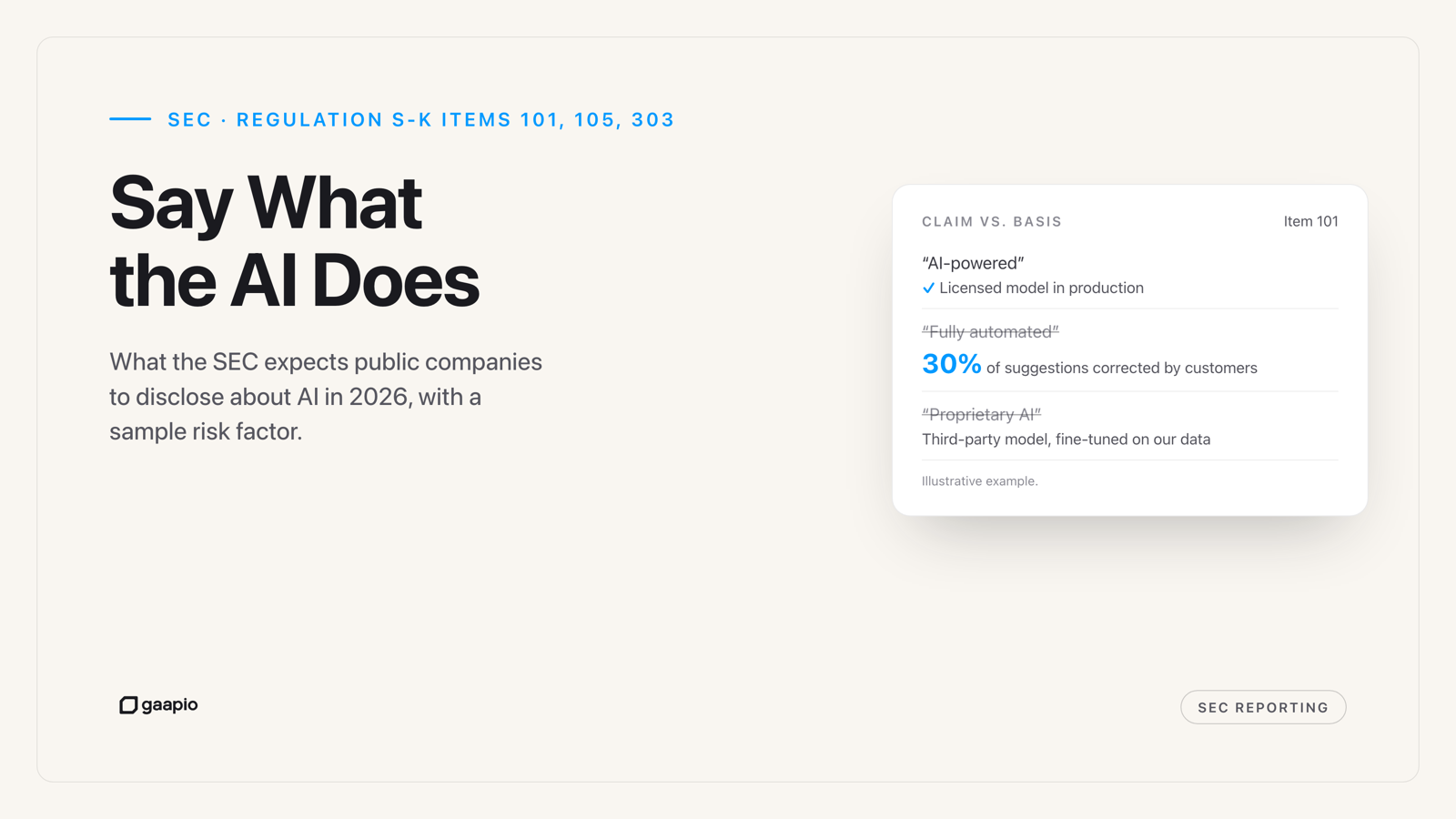
ExampleCo, Inc., an invented company, sells accounts payable automation. Its product suggests general ledger codes for invoices using a machine learning model licensed from a third party. Its investor deck says "proprietary AI" and "AI-powered, fully automated invoice processing." Assume ExampleCo is preparing its Form 10-Q for the quarter ended September 30, 2026, which must disclose material changes to its risk factors. In the third quarter of 2026, a model update from the provider misclassified a portion of invoices for customers on one release. ExampleCo issued service credits and lost one enterprise customer.
Step 1: Test each claim against the evidence
| Claim in the deck | Evidence on file | Conclusion | Filing wording |
|---|---|---|---|
| "AI-powered" | A licensed model, fine-tuned by ExampleCo on customer data under license, suggests codes in production. | Supported, if the filing says the model is licensed and fine-tuned. | "Our invoice coding feature uses a machine learning model that we license from a third party and fine-tune on customer data under license." |
| "Fully automated" | Customers must approve suggestions above a dollar threshold they set, and about 30% of suggestions are corrected by customers. | Not supported. Humans are in the loop and the correction rate is a material fact for a reader judging the product. | "Customers must approve suggestions above a dollar threshold they set and can review and correct any suggestion. Customers corrected approximately 30% of suggestions in the nine months ended September 30, 2026." |
| "Proprietary AI" | The model belongs to the provider, with ExampleCo fine-tuning on customer data under license. | Overstated. | "The model is owned by a third-party provider. We fine-tune it on customer data under license; we do not own the underlying model." |
The "fully automated" row is the Presto pattern: a claim of automation that the evidence does not support. The fix is to change the claim to match the evidence, in the filing and in the deck.
Step 2: Write the risk factor from the facts
A weak version reads:
We may use artificial intelligence, which could have errors. This could harm our business.
A tailored version, for the facts above, reads:
We rely on a third-party machine learning model in our invoice coding product, and errors or changes in that model have harmed, and may again harm, our customers and our results. Our invoice coding feature uses a model that we license from a third party. We do not control how the provider trains, updates or retires its models, and our agreement permits the provider to change or discontinue a model on 60 days' notice. In the third quarter of 2026, a model update by the provider caused the feature to misclassify invoices for customers on one product release. We issued service credits of approximately $0.4 million and one enterprise customer, which represented approximately 2% of our annual recurring revenue, terminated its contract. We have since added a validation step before provider updates reach customers, but we may not detect all errors before they affect customers. Customers must approve suggestions above a dollar threshold they set and can correct any suggestion, and customers corrected approximately 30% of suggestions in the nine months ended September 30, 2026. If customers lose confidence in the accuracy of our feature, if the provider raises its prices or if applicable regulation of AI systems imposes obligations on us or the provider, our revenue, gross margin and reputation could be adversely affected.
It states the event as an event, the dependency as a dependency and the numbers as numbers. Once the deck is corrected, the risk factor, the MD&A and the deck tell the same story. A reader can tell which facts belong to ExampleCo.
Step 3: Carry the facts into MD&A and the accounting
If the service credits and the lost customer are material, Item 303 asks for them in the discussion of revenue, including the expected effect of the lost contract on future revenue, and, if material, the cost of the new validation step belongs in the discussion of cost of revenue. Revenue reduced by service credits is a question of variable consideration under ASC 606, and if the company capitalizes the development costs of the invoice coding feature, the accounting follows ASC 350-40 for a hosted product (or ASC 985-20 if the software is sold or licensed to customers), and the fee for the licensed model needs its own analysis. Each of those is a decision for the accounting team, with the auditor.
How does Gaapio help with AI disclosure?
Gaapio is an AI-powered technical accounting platform built by CPAs. It searches the Codification and firm accounting guides together and cites the sources behind its answers. For the accounting decisions behind an AI disclosure, such as capitalization, impairment or revenue effects, it lets your team check the guidance, with sources cited, before the memo goes to review. See how Gaapio supports SEC reporting teams.
Your team and counsel still decide what is material and what to say. Gaapio does not write your risk factors. The judgment on disclosure stays with management, the audit committee and securities counsel.
If you want to see how it handles the accounting questions behind your filings, request a demo.
This guide is general information, not legal advice. Disclosure decisions depend on your facts. Consult your securities counsel on questions of law. Status of rules and proposals is as of November 2026.
Frequently asked questions
What is the latest SEC AI disclosure news?
As of November 2026, the SEC has no AI-specific disclosure rule for public companies. The Investor Advisory Committee recommended AI disclosure guidance in December 2025, and the Commission has not acted. Chair Atkins has said materiality-based rules already apply, and a Regulation S-K review is under way. Enforcement continues against misleading AI claims, and the Enforcement Director was reported on October 30, 2026 to be focusing on public companies that overstate AI capabilities.
Does the SEC require companies to disclose their use of AI?
No rule requires it by name. Companies must disclose AI where it is material to the business description, the risks or MD&A, and any statement a company makes about AI must be accurate and have a basis. The test is materiality, whatever the AI is called.
What is AI washing?
AI washing is overstating or misdescribing a company's AI capabilities or its use of AI. The SEC treats it as a misleading statement under existing law. The settled actions to date involved claims that AI was not used, that third-party technology was the company's own, or that humans were not involved when they were.
Which SEC enforcement action involved a public company and AI?
Presto Automation, settled on January 14, 2025. The SEC found that the company's filings described a supplier's speech recognition as its own technology and said its product removed human order-taking while offshore workers handled most orders. The company settled without a penalty. The Commission considered its cooperation, its remediation and its financial condition.
Where does AI disclosure go in a 10-K?
It can appear in Item 101 (business), Item 105 (risk factors), Item 303 (MD&A), Item 106 (Form 10-K Item 1C) if the issue is cybersecurity, the financial statement notes, and the proxy statement for board oversight. Most companies need only some of these, based on how material AI is to them.
Should a risk factor describe an AI incident that has already happened?
Yes, if the incident is material. Describing a risk as hypothetical after it has occurred has drawn SEC action in a cybersecurity setting (Pearson, 2021). We found no AI-specific case, but the same reasoning would likely apply to an AI incident. State what happened and what you did about it.
What do SEC comment letters ask about AI?
The most common requests are to explain how the company actually uses AI, tailor the risk factors, support capability claims, define AI and explain the effect on financial results. Orrick's review of at least 92 staff comments to 56 companies found specificity and balance in business and risk disclosure was the largest category, at about 61% of comments.
Does AI compliance differ for regulated industries?
Yes. Registered advisers and broker-dealers also face SEC examinations that review the accuracy of AI claims, and banks, insurers and health care companies answer to other regulators and to state and international AI laws. The securities-law question for any SEC registrant is whether the AI statement was true and the risk was disclosed if material.
Do I need board oversight language for AI in my 10-K or proxy?
Item 407(h) asks for the board's role in risk oversight, so a company with a significant AI risk should describe how the board oversees it. The Investor Advisory Committee has recommended making this specific, but the Commission has not adopted it. Describe only the oversight that actually exists.
Related reading
- How to write MD&A (Item 303): the 2026 guide
- SAB 99 materiality assessment guide
- Regulation FD and Form 8-K guide
- Internal control over financial reporting guide
- SEC comment letters on Gaapio
Sources
- SEC, Press release 2024-36 (Delphia and Global Predictions), 2024-70 (Joonko), 2024-167 (Rimar)
- SEC, Presto Automation order, Release 33-11352 (Jan. 14, 2025)
- SEC, Destiny Robotics, LR-26157; Nate / Saniger, LR-26282
- SEC, Withdrawal of proposed rules, Release 33-11377 (June 2025)
- SEC Investor Advisory Committee, Recommendation on AI disclosure (Dec. 4, 2025)
- SEC Division of Examinations, FY2026 examination priorities (Nov. 17, 2025) and FY2027 priorities (Oct. 23, 2026)
- Gary Gensler, AI, Finance, Movies, and the Law (Feb. 13, 2024); Paul Atkins, Statement on Reforming Regulation S-K (Jan. 13, 2026)
- Regulation S-K, Items 101, 105, 303 and 407
- Orrick, SEC comment letter trend: AI-related disclosures (Harvard Law School Forum, Jan. 16, 2025)
- Gibson Dunn, Considerations for preparing your 2025 Form 10-K
- Conference Board and ESGAUGE, AI risk disclosures in the S&P 500 (Oct. 2025)
- EY Center for Board Matters, Cyber and AI oversight disclosures: what companies shared in 2025 (Oct. 2025)
- Glass Lewis, US AI oversight through three lenses (Mar. 2026)
- Davis Polk, SEC sanctions company for hypothetical cyber risk factor (Pearson, Aug. 2021)
- Debevoise, SEC enforcement director signals continued scrutiny of AI disclosures (Nov. 2026)