

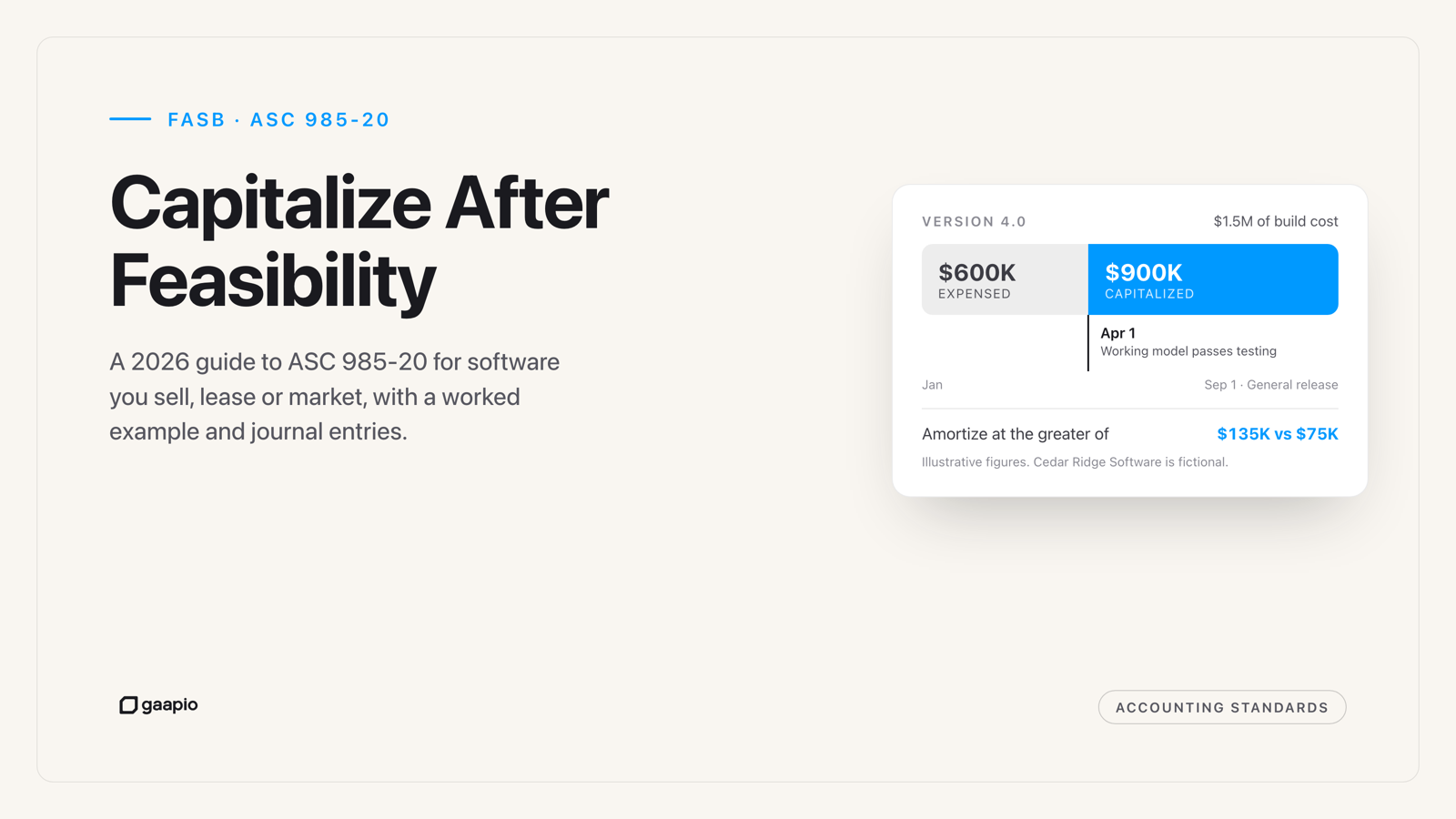
ASC 985-20 requires you to expense the costs of creating software to be sold, leased or marketed until technological feasibility is established, which at a minimum requires either a completed detail program design or, without one, a completed and tested working model. After that, you capitalize production costs until the product is available for general release. You then amortize at the greater of a revenue-based ratio or straight-line over the remaining economic life, and at each balance sheet date you cap the unamortized cost at net realizable value. ASU 2025-06 amends ASC 350-40 for internal-use software and leaves ASC 985-20 unchanged.
You can spend months building a product and still have nothing to put on the balance sheet. Under ASC 985-20, what you spent before technological feasibility is an expense, no matter how sure the roadmap felt.
That is the rule most software vendors run into when they sell, lease or license what they build. FASB ASC 985-20, Software: Costs of Software to Be Sold, Leased, or Marketed, starts capitalizing late and then keeps checking whether the asset is still worth what you carry it at.
This guide covers the recognition rules, the amortization test, net realizable value, and how to tell ASC 985-20 from ASC 350-40 for internal-use software and hosting arrangements. It answers whether ASU 2025-06 touches this guidance, and it ends with a worked example with journal entries. It's written by Jace Chambers, CPA, cofounder and CPO of Gaapio, who started his career in audit at EY, with the Gaapio team of CPAs.
Key takeaway: ASC 985-20 requires you to expense the costs of creating software to be sold, leased or marketed until technological feasibility is established, which at a minimum requires either a completed detail program design or, without one, a completed and tested working model. After that, you capitalize production costs until the product is available for general release. You then amortize at the greater of a revenue-based ratio or straight-line over the remaining economic life, and each balance sheet date you cap the unamortized cost at net realizable value. ASU 2025-06 amends ASC 350-40 for internal-use software and leaves ASC 985-20 unchanged.
This guide is general information about US GAAP, not accounting or legal advice. The FASB Accounting Standards Codification is the authoritative text, so check it and your auditor against your own facts.
What is ASC 985-20?
ASC 985-20 is the Codification subtopic for the costs of software that a company sells, leases or otherwise markets as a separate product, or as part of a product or process, whether it developed or purchased the software (BDO). It lives in Topic 985, Software, and it is the software-vendor counterpart to ASC 350-40.
The guidance answers four questions in order. When do development costs start to qualify for capitalization? Which costs qualify? How do you amortize them once the product ships? And how do you test the unamortized balance for recoverability?
It reads a lot like R&D accounting, because that is where it starts. Costs before technological feasibility are research and development costs and are expensed as incurred.
Does ASU 2025-06 change ASC 985-20?
No. ASU 2025-06, Targeted Improvements to the Accounting for Internal-Use Software, amends ASC 350-40 and leaves ASC 985-20 as it was. BDO's September 2025 Bulletin says "No changes were made to the external use software guidance in ASC 985-20," and that the ASU adds no new disclosures for costs of developing software to be sold or licensed. The ASU itself says its amendments do not affect software costs subject to Subtopic 985-20.
The update does reach toward 985-20 in one way. It adds the "significant development uncertainty" concept to ASC 350-40, which resembles the high-risk development issues in the 985-20 detail program design criteria, so outcomes may move closer. BDO says the ASU results in more alignment, though the thresholds can still differ. The standards remain separate, and a project can still clear one test and fail the other.
The ASU is effective for all entities for annual reporting periods beginning after December 15, 2027, including interim periods within those years, and early adoption is permitted. That date matters to you here only if some of your software falls under ASC 350-40, including hosted software customers cannot take, since 985-20 has no new effective date. Our ASC 350-40 guide covers the ASU in full.
ASC 985-20 or ASC 350-40: which one applies?
Intent decides. ASC 985-20 applies to software you develop to sell, lease or market externally. ASC 350-40 applies to software you develop or buy solely to meet your own internal needs. Under ASC 350-40, software is internal-use only if no substantive plan exists, or is being developed, to market it externally. If such a plan exists during development, the costs fall under ASC 985-20.
| Question | ASC 985-20 | ASC 350-40 |
|---|---|---|
| Whose use is it for? | Customers: sold, licensed, leased or marketed | Your own operations |
| When does capitalization start? | After technological feasibility | Today: after the preliminary project stage, once management authorizes and commits funding and completion is probable. After adopting ASU 2025-06: project stages no longer apply, and significant development uncertainty must also be resolved |
| What do you expense first? | Everything before feasibility, as R&D | Costs before that threshold is met, including costs incurred while significant development uncertainty exists |
| When does capitalization stop? | Product available for general release | Software ready for its intended use |
| How do you amortize? | Greater of revenue ratio or straight-line over remaining economic life | Straight-line, unless another systematic pattern better fits |
| How do you test the balance? | Unamortized cost vs. net realizable value, every balance sheet date | ASC 360-10 impairment |
| Changed by ASU 2025-06? | No | Yes |
How do hosting arrangements and SaaS fit?
A vendor's hosted software falls under ASC 985-20 only when the customer can take the software and run it elsewhere. ASC 985-20-15-5 sets out two conditions, and both must be met. The customer has the contractual right to take possession of the software at any time during the hosting period without significant penalty. And it is feasible for the customer to either run the software on its own hardware or contract with another party, unrelated to the vendor, to host it. Without significant penalty means the customer can take delivery without significant cost and can use the software separately without a significant loss of utility or value (ASC 985-20-15-6).
When either condition fails, the customer is buying a service and the software is outside ASC 985-20, so the vendor accounts for its development costs under ASC 350-40 (ASC 985-20-15-7). That changes if the vendor develops a substantive plan to sell, lease or market the software while building it (ASC 985-20-55-2). The customer-side mirror of the test is ASC 350-40-15-4A, and our 350-40 guide walks through the SaaS side.
A common middle case is a product sold both as an on-premise license and as a hosted service. If you license the same software on-premise, or hosted customers can take possession without significant penalty and run it elsewhere, the development costs generally fall under ASC 985-20. Base the call on the rights your contracts give customers, not on how the product is labeled. Revenue for these contracts follows ASC 606, which is separate from the cost question here. See our revenue recognition page for that side.
What is technological feasibility under ASC 985-20?
Technological feasibility is the point where you have finished the planning, designing, coding and testing needed to show the product can be built to its design specifications, including functions, features and technical performance requirements (ASC 985-20-25-2). At a minimum, you need either a completed detail program design or, if you have no detail program design, a working model. A working model is a running version built in the final product's language. It has to perform all the major functions planned for the product and be ready for first customer testing, usually beta. A prototype does not qualify.
PwC notes this is not a policy election. A company that reaches feasibility through a detail program design cannot choose to wait for a working model. The detail program design route also requires that the product design and detail program design are complete, that you have confirmed the skills, hardware and software technology needed are available, that the detail program design has been traced to the product specifications, and that high-risk development issues were identified and resolved through coding and testing. The working model route requires that the product design and a working model are complete and that the model has been tested to confirm it matches the design.
With agile development common, many software companies do not prepare a detail program design, so a working model becomes the milestone. PwC notes that this is often late in the development cycle. Capitalizing during that window is not a policy election either. KPMG notes that many vendors capitalize little or nothing, because their facts leave a short window between feasibility and general release and the costs in it are clearly inconsequential. Document the date, the evidence (a build, a test report, a design review) and who signed off, because the whole capitalized balance rests on it. If the software is part of a larger product or process, capitalization also waits until R&D on the other components is complete (ASC 985-20-25-4).
Which software costs do you capitalize, and which do you expense?
You expense everything before technological feasibility and capitalize qualifying production costs after it. A few activities stay expensed in both periods.
| Cost | Treatment under ASC 985-20 |
|---|---|
| Planning, design, coding and testing before technological feasibility | Expense as R&D |
| Coding and testing after feasibility, through general release | Capitalize |
| Production of product masters after feasibility | Capitalize |
| Purchased software or components to be included in the product | With no alternative future use, account for it like internal development: capitalize only if technological feasibility is established, otherwise expense as R&D. With an alternative future use, capitalize when acquired and account for it based on that use |
| Duplicating the software, documentation and training materials from product masters, and physically packaging the product | Inventory on a unit-specific basis under ASC 985-330, then cost of sales when revenue for those units is recognized |
| Maintenance and customer support | Expense as incurred or when related revenue is recognized, whichever comes first |
| Sales, marketing, and general and administrative overhead | Expense as incurred |
The one that surprises people is the first row. Management can approve the budget, hire the team and sign the plan, and the costs still go through the income statement until feasibility.
When does capitalization end?
Capitalization ends when the product is available for general release to customers. After that date, costs of maintenance and customer support are expensed. Costs of a product enhancement, meaning one that extends the product's life or significantly improves its marketability, are evaluated on their own: they are expensed until the enhancement reaches technological feasibility and capitalized after that, until its general release. Routine maintenance and bug fixes stay expensed.
How do you amortize capitalized software costs?
Amortization starts when the product is available for general release. The annual amortization is the greater of two amounts (ASC 985-20-35-1):
- The revenue ratio: the ratio of the product's current gross revenues to the total of current and anticipated future gross revenues, applied to the product's unamortized capitalized cost at the start of the period.
- Straight-line: that unamortized cost spread over the product's remaining estimated economic life.
You compute amortization product by product. The "greater of" rule means the straight-line amount works as a floor. If revenue arrives slowly, straight-line sets the minimum expense, and if revenue is front-loaded, the ratio catches up faster. You update your revenue estimates and the remaining life each period, and the revised percentage applies to the unamortized balance. For interim reports, KPMG says to estimate the full-year amortization, including which method will apply, and not to restate earlier quarters when that estimate changes.
Your revenue estimates need support. A forecast that has gone unchanged while the product misses plan will draw questions from your auditor, so keep the forecast, the pricing assumptions and the remaining life in your file.
What is net realizable value, and how does the test work?
At each balance sheet date, the unamortized capitalized cost of a product cannot exceed its net realizable value (ASC 985-20-35-4). Net realizable value is the product's estimated future gross revenues, reduced by the estimated future costs of completing and disposing of it, including the cost of maintenance and customer support you are obliged to provide.
If the unamortized cost is higher, you write the balance down to net realizable value and record the loss. A write-down recorded at the close of an annual fiscal period becomes the new cost basis, and you do not restore it later if estimates improve (ASC 985-20-35-4). KPMG's view is that a write-down recorded at an interim date may be reversed within the same fiscal year if conditions improve, because the bar on restoring a write-down attaches to the close of an annual fiscal period. That is an interpretation, so confirm it with your auditor. This NRV test is also different from the ASC 360-10 recoverability test used for internal-use software, so similar facts can lead to different results under the two models.
What does a worked example of ASC 985-20 look like?
Cedar Ridge Software, a fictional vendor, builds Version 4.0 of an on-premise product that it licenses to customers. All the figures are illustrative. Cedar Ridge's teams work in agile sprints and do not prepare a detail program design, so technological feasibility is established when a working model is completed and tested. We assume the April 1 build meets that standard. Many agile teams do not reach it until much later, which would move most of the $900,000 below into R&D expense.
The timeline:
- January through March: Planning, product design, and coding and testing of the core engine. No detail program design is prepared. Cost: $600,000.
- April 1: A working model that performs all the major planned functions and is ready for beta testing passes testing. Technological feasibility is established.
- April through August: Coding, testing and product master production. Payroll and payroll-related costs of $620,000, contractor fees of $230,000, and embedded third-party components of $50,000. Total: $900,000.
- September 1: The product is available for general release.
- September through December: Maintenance and customer support of $50,000.
- Estimates at release: Total gross revenues of $6,000,000 over a four-year economic life. Actual gross revenues in September through December are $900,000.
What are the journal entries?
Each entry credits cash, accrued payroll or accounts payable. We combine them in one line to keep the entries short.
Pre-feasibility work, January through March, expensed:
Dr  Research and development expense      600,000
    Cr  Cash / accrued payroll / A/P                600,000
Post-feasibility work, April through August, capitalized:
Dr  Capitalized software costs            900,000
    Cr  Cash / accrued payroll / A/P                900,000
Maintenance and support, September through December, expensed:
Dr  Maintenance and support expense        50,000
    Cr  Cash / accrued payroll / A/P                 50,000
How much do you amortize in year one?
Amortization starts September 1. Cedar Ridge computes both tests for September through December and books the greater.
| Test | Calculation | Amount |
|---|---|---|
| Revenue ratio | $900,000 current revenue / $6,000,000 total revenue = 15%, times $900,000 | $135,000 |
| Straight-line | $900,000 / 48 months, times 4 months | $75,000 |
| Greater of the two | $135,000 |
Dr  Amortization of software costs        135,000
    Cr  Accumulated amortization                    135,000
Unamortized cost at December 31 is $765,000. Year-one expense is $785,000: $600,000 of R&D, $50,000 of maintenance and $135,000 of amortization. Amortization goes in cost of sales or a similar expense line, not R&D (ASC 985-20-45-1).
Does the product pass the net realizable value test?
It passes in the base case. At December 31, remaining estimated gross revenues are $5,100,000 ($6,000,000 less the $900,000 already earned). Estimated future costs of disposing of the product, including maintenance and support, are $1,100,000. Net realizable value is $4,000,000, well above the $765,000 unamortized cost, so no write-down is needed.
Now change one fact. A competitor ships in the fourth quarter, and at December 31 Cedar Ridge cuts its estimate of remaining gross revenues to $600,000. Amortization uses the estimates at the reporting date, so the revenue ratio becomes $900,000 / $1,500,000 = 60%. Year-one amortization is $540,000 instead of $135,000, and unamortized cost falls to $360,000. Estimated future maintenance and support costs are $300,000, so net realizable value is $300,000 ($600,000 less $300,000), below the $360,000 carrying amount. Cedar Ridge records amortization of $540,000 and then writes the balance down by $60,000 at its December 31 year-end:
Dr  Amortization of software costs        540,000
    Cr  Accumulated amortization                    540,000

Dr  Write-down of capitalized software     60,000
    Cr  Capitalized software costs                   60,000
The $300,000 is the new cost basis. Year-one expense in this case is $1,250,000: $600,000 of R&D, $50,000 of maintenance, $540,000 of amortization and the $60,000 write-down. If the revenue outlook recovers next year, Cedar Ridge cannot reverse the write-down, and amortization continues from $300,000 using the revised ratio and the remaining life.
What would change if this were internal-use software?
The same $1.5 million of spending would be tested under ASC 350-40 instead. Under ASC 350-40 as amended by ASU 2025-06, capitalization can begin once management has authorized and committed to funding, completion is probable and no significant development uncertainty remains. Before adoption, it begins after the preliminary project stage. Either way, more of the early work could qualify. Even then, only qualifying costs, such as external direct costs and payroll for employees directly working on the project, would be capitalized. The amortization is straight-line unless another pattern fits, and the balance is tested for impairment under ASC 360-10. That is why the scoping call comes first, and why it needs a written conclusion.
What do you disclose under ASC 985-20?
ASC 985-20-50-1 requires you to disclose the unamortized software costs included in each balance sheet presented and, for each income statement presented, the total charged to expense for amortization and for write-downs to net realizable value. You can disclose those two amounts separately or as one total. ASC 985-20-50-2 also applies the intangible asset disclosures in ASC 350-30-50-1 through 50-3 and points to ASC 730-10-50-1 for total R&D expense, which includes costs of software to be sold, leased or marketed. Registrants usually add a note on the feasibility milestone and the amortization policy, and many discuss the revenue estimates behind amortization and the net realizable value test in critical accounting estimates.
If you want the broader disclosure picture, see our footnote disclosures page.
How does Gaapio handle ASC 985-20 questions?
Gaapio is an AI-powered technical accounting platform built by CPAs. When a team brings a software cost question to Gaapio, it asks follow-up questions about the facts before drafting. Those can include whether customers can take possession of the software, what the feasibility milestone is, and how the team sells the product.
Gaapio drafts from the FASB Codification, through its direct licensing relationship with the FASB, with citations you can click. Your reviewer approves it in Gaapio's review workflow, and it ends up as an accounting memo your auditor can follow. Your team still owns the judgment, and Gaapio does not forecast your revenues or set your feasibility date.
For the memo habits behind this, see why technical accounting memos matter.
What should you do next?
- List each software product and mark whether you sell, lease or market it, or use it internally.
- For hosted products, test both ASC 985-20-15-5 conditions against your contract terms.
- Write down the feasibility milestone, the date and the evidence for each product in development.
- Save the revenue forecast and remaining-life assumptions behind each amortization calculation.
- Run the net realizable value test every balance sheet date and keep the result.
Want a second set of eyes on the memo? Request a demo and bring a real product.
Frequently asked questions
What is ASC 985-20?
ASC 985-20 is the FASB Codification subtopic for the costs of software to be sold, leased or otherwise marketed. You expense development costs until technological feasibility is established, capitalize production costs after that until general release, amortize at the greater of a revenue ratio or straight-line, and limit the unamortized balance to net realizable value. Software used only internally falls under ASC 350-40.
What is technological feasibility?
Technological feasibility is the point at which you have completed the planning, designing, coding and testing needed to show the product can be built to its design specifications. At a minimum you need a completed detail program design or, without one, a working model (ASC 985-20-25-2). Costs before that point are expensed as research and development.
Does ASU 2025-06 change ASC 985-20?
No. ASU 2025-06 amends ASC 350-40 for internal-use software and leaves ASC 985-20 unchanged, as the ASU itself states. The ASU adds a significant development uncertainty concept to ASC 350-40, which may narrow the outcome gap for software delivered through the cloud, though they remain separate tests.
How do you amortize software under ASC 985-20?
Amortization starts when the product is available for general release. Each year you record the greater of two amounts: the ratio of current gross revenues to total current and anticipated future gross revenues, applied to the unamortized capitalized cost, or straight-line over the remaining estimated economic life (ASC 985-20-35-1). You update the estimates as new information arrives.
What is the net realizable value test?
At each balance sheet date, unamortized capitalized software cost cannot exceed net realizable value, which is estimated future gross revenues less the estimated costs of completing and disposing of the product, including maintenance and support. If it does, you write the balance down to net realizable value, and a write-down recorded at the close of an annual fiscal period can't be reversed later (ASC 985-20-35-4).
Is SaaS accounted for under ASC 985-20 or ASC 350-40?
Usually ASC 350-40, because the customer accesses the service and does not take the software. ASC 985-20 applies to hosted software only when both conditions in ASC 985-20-15-5 are met: the customer can take possession without significant penalty, and it is feasible for the customer to run the software itself or have an unrelated party host it.
Can you capitalize costs before technological feasibility?
Not for software you develop. ASC 985-20 treats those costs as research and development and requires you to expense them as incurred, even after management approves the project and commits funding. The exception is purchased software with an alternative future use, which is capitalized when acquired and accounted for based on that use. Only qualifying production costs incurred after feasibility are capitalized.
How is ASC 985-20 different from ASC 350-40?
ASC 985-20 covers software you sell, lease or market, and starts capitalizing at technological feasibility. ASC 350-40 covers internal-use software and starts capitalizing once management commits funding and completion is probable (after the preliminary project stage until a company adopts ASU 2025-06). The amortization and balance tests also differ: 985-20 uses the greater-of test and net realizable value, and 350-40 uses straight-line and ASC 360-10 impairment.
Where can I read the guidance?
The authoritative source is the FASB Accounting Standards Codification at ASC 985-20. Our citations to PwC, KPMG and BDO are in the sources below. Big 4 and mid-tier summaries are not authoritative guidance.
Related reading
- ASC 350-40 internal-use software capitalization
- Why technical accounting memos matter
- FASB guidance library
Sources
- PwC Viewpoint, Software, chapter 2: Costs of software to be sold, leased or marketed, including Establishing technological feasibility
- BDO, New ASU on Internal-Use Software Costs Guidance (Bulletin, September 23, 2025)
- BDO, Accounting for Software Costs (Blueprint)
- FASB, ASU 2025-06, Targeted Improvements to the Accounting for Internal-Use Software
- KPMG, Software and website costs Handbook (February 2026)